




Abstract
Wireless sensor grids form a special class of sensor networks that find more applicability than their randomly deployed counterparts in many commercial applications due to innate regularity in their design and operation. In contemporary wireless sensor grids, primarily single gateway sensor grids, each node senses the information and follows a relay relationship with gateway forming a multisource single receiver paradigm and pursues an added energy consumption pattern that serves as a premier bottleneck in wireless sensor grid environment. This research focuses on statistically modeling the energy consumption of single gateway sensor grids in terms of network availability by analyzing different energy consumption phenomena with communication as a grid-wide routing problem. On the basis of our findings and results in conjunction with Moor's law of semiconductors and batteries, we propose a linear programming heuristic for multiple gateway deployment to reduce network survivability costs and optimize communication for wireless sensor grids. We then present a case study using the proposed heuristic that is augmented through a node scheduler for nearest gateway connectivity, collision avoidance, and fairness, to show the performance gain that presents an ultimate cut-through energy paradigm.
1. Introduction
In recent times wireless sensor networks have evolved in order to fit into application-specific requirements and service classes. One such classification is based upon the adopted strategy to deploy sensors in the region of interest (ROI). For example, nodes are deployed in an ad hoc manner in military applications where mission criticality takes priority over cost. Likewise, commercial applications such as factory and home automation require minimization of cost and thus a high profitability. In either of these deployments, sensor networks face a common challenge of optimizing serviceability by minimizing usage of a limited battery. Wireless sensor grid (WSG) is a derivative concept of sensor networks that assumes an embedded topological uniformity in the arrangement of sensor nodes. It has been considered as a viable business proposition due to the following advantages:
(a) Before and during Deployment
Grids render an ease of deployment due to the exhibited regularity in the physical infrastructure of buildings, streets, and other locations. Grids make the simplification and tailoring of node and network operations possible. For example, routing mechanism due to in hand knowledge of nodes' locations, identification of sources and sink(s), reduces down to mere grid lattice traversal. Similarly, the assignment of sleep mode duty cycles, to implement the energy conservation, becomes a node location problem [1, 2].
(b) After Deployment This research presents a comprehensive analysis of energy consumption through different constituent phenomena in contemporary sensor grids. It further identifies the phenomenon that consumes the major portion of this energy expenditure and proposes a cut-through energy paradigm to minimize energy consumption for this particular sensor grid phenomena to reduce the overall energy expenditure of the sensor grid. We start with analysis of the energy consumption of the most common and widely known sensor grid deployment architecture, the single gateway sensor grid (SGSG). In such an arrangement, all the nodes in the ROI sense and relay information towards the gateway, making it a multiple source, single sink architecture. Our findings lead us to the next and a natural step of modeling, optimization of energy resources of a sensor grid as we propose a multiple gateways deployment heuristic for a sensor grid. We show through a specific scenario of multiple sources multiple sinks that such heuristic is very useful in minimizing the initial and recurrent costs of a WSG. In this paper, we focus on the energy consumption of such sensor grids.
We analyze most, if not all, aspects of WSGs that contribute towards and affect the energy consumption. Specifically, our contributions are as follows:
The analysis of network availability in terms of energy consumption of a relay customizable in a single gateway WSG (SGWSG). An analysis of various performance metrics under numerous node and network parameters. A linear programming- (LP-) based heuristic to reduce network survivability costs. It is based on the Moore's law of semiconductors and batteries. A node scheduler for nearest gateway connectivity, collision avoidance, and fairness.
The paper is organized as follows. Section 2 summarizes contemporary research activities and related work. Section 3 deals with the rationale to demonstrate a typical wireless sensor grid model, formulate conditions, and make necessary assumptions to make it as much as practicable. Section 4 puts forward the derivation of a stochastic expression for determining the availability of sensor grids. In Section 5 we present a simulation-based analysis of the availability expression and reveal our findings in Section 6. A deployment heuristic is proposed as a linear programming model to deploy multiple gateways around the sensor grid in Section 7 which simultaneously contains a node scheduler. We present some numerical results from a case study in Section 8. Finally Section 9 concludes the paper along with the identification of prospective future directions.
2. Related Work
In this section, we present the contemporary research work related to energy consumption analyses of wireless sensor networks with trio dimensional approach. Primarily, the aspects in the analysis of energy consumption of wireless sensor networks in general are presented. The efforts to model and optimize various energy consumption phenomena are particularly summarized (in sensor grids) as secondary discussion phase of this section. Lastly, the energy optimization strategies through the smart deployment of sensor nodes and sinks are summed up for both random and grid deployments of sensors. We have taken into broader account the fact that the usability of individual sensor nodes is gauged by their continued operation in the form of alive and connected sensor network. This is an issue of network availability or equivalently network longevity. A number of interpretations of network availability have been identified in [4], where each has the potential to emerge into a distinct research direction in its own right. This research effort is a good rudimentary, albeit theoretical cue for proposing energy efficiency measures in WSNs. Tilak et al. [5] identify various architectural, functional, and application-oriented aspects of WSNs that may all be considered to extend the longevity of networks they form, while meeting performance objectives amicably. However, it only serves as a generalized guideline.
Zhu and Papavassiliou propose bit-level energy consumption models for sensor nodes as lifetime measure that can be shown to iteratively yield entire WSN lifetime [6]. They consider a simplifying assumption that all the nodes have the same initial energy, which is true at the network initialization time but does not manifest real network dynamics. For example, with spatio-procedural heterogeneity, the energy states soon turn temporally exponential in distribution. Rai and Mahapatra through [7] present a mathematical model for WSN lifetime by assuming multihop communication over linear and ring topologies of sensor nodes. They propose Continuous Time Markov Chain (CTMC) analysis to model WSN lifetime as an optimal routing-over-topology phenomenon. It emphasizes on multihop communication through neighboring nodes, where the transmission cost to reach each adjacent neighbor is the same. It is a rigid model because in practical topologies, radio adjacency does also incorporate transmission power and reception power variability. Another work in Markov Chain modeling of WSN lifetime has been demonstrated by Saito and Minami [8]. They define and derive network availability expression as a measure of network lifetime. It is the most practicable expression in the sense that it subsumes topological connectivity in addition to establishing a relationship among sensor nodes' states (active or inactive), sensor network parameters, and the network availability. This research endeavor is however constrained in various ways. For example, their expression is for a linear arrangement of sensor nodes only. Consequently, there is no consideration given to the communication phenomena arising in planar topologies including routing, variable transmission, and reception models, intermediate node failures in planar topologies, and consequent retransmissions.
Duarte-Melo and Liu [9] present a lifetime estimate for cluster-based heterogeneous ad hoc sensor networks with an avid focus on the energy consumption imbalance between normal sensor nodes and cluster heads. Since their primal focus is on network heterogeneity, their lifetime expression is tightly coupled with rounds. Their lifetime expression, however, does not incorporate the effect of the placement of such cluster heads within the topology. In the domain of WSN energy optimization and balancing strategies, Schurgers et al. [10] suggest a scheme to adjust the sleep-awake periods of sensor nodes for energy optimization using two radios, one for waking up a sleeping node and another for data transmission. Together, they extend the operational lifetime of WSNs. The mathematical expression for inferring the operational lifetime of a sensor node and hence WSN is the energy consumption model. Their expression embodies the radio aspects including on-off scheduling for waking up a node and data transmission. However, the expression does not include the practical considerations where either (a) dual radio interfaces are not available in sensor node hardware or (b) wakeup failures occur and consequently retransmissions take place, all adding to the energy consumption of sensor nodes.
Liu and Li [11] establish a relationship between node transmission power control and network-wide connectivity by suggesting topology control algorithms and protocols. They assert that network-wide connectivity is an indirect, yet a good measure of network life time. Nonetheless, there is no mathematical substantiation to this effect. Assuming most of the ad hoc deployments, the studies of randomly deployed sensor nodes and networks seldom, or even never, consider exploiting prior knowledge (e.g., node IDs, location information of sensor nodes, and location of sinks) in order to maximize objective functions, such as to improve communication performance and optimize energy and reduce delays. It is unarguably true that sensor networks, when placed as a lattice, such as in a rectangular grid make network planning significantly simpler than pure random placement. For example, in smart homes telematics applications and for military applications (surveillance, etc.), it would allow flexibility and simplification in design and deployment due to a fair amount of in hand knowledge about the environment [12]. Exceedingly complex and computationally expensive schemes for sensor networks may therefore be reduced into their light-weight equivalents by utilizing such a knowledge base.
Zhang and Hou show in [3] that deterministic deployment of sensor nodes such as grid deployment yields better coverage and connectivity than their random counterparts. This work is merely a geometric analysis of geographical coverage favoring grid deployment over random deployment. Issues related to communicating over grids are not addressed here. Biagioni and Sasaki have computed the number of nodes in grids and other topologies deterministically in [13]. Their considerations include the transmission range, coverage of sensed region, and the degree of a node, which is the number of nodes within its transmission range. Their work however falls short of presenting sink node placement strategies for these regular topologies. Shakkottai et al. [14] compute the upper bounds on the number of hops that broadcast messages traverse during route discovery in sensor grids. Their work focuses on the numerical modeling on drawing the conditions for necessity and sufficiency. They do not propose or advance any algorithmic aspects of sensor grids.
Yu et al. [1] and Xu et al. [2] determine that nodes that know their geographical locations which can actually use this information to conserve energy. They put forward the concept of a virtual grid such that sensors are divided into subrectangular regions under a constraint that the maximum distance between any communicating nodes in adjacent grids is less than their effective transmission range. Their energy conservation strategy is based on the notion of a leader, which is the only awake node in a subrectangular region. Their concept is significantly different from a physical sensor grid which adopts lattice traversal for routing and a sleeping node can actually be an isolate part or whole of the network. In [15], Huang et al. highlight the role of adjusting transmission power dynamically to make a sensor grid resilient to node failures and the resulting routing holes problem. Their work provides basis for dynamic power control only in large deployments of sensor grids wherein redundant routes towards the sink are also possible. Finally in [16], Haenggi presents a range of strategies to adjust the sensing, routing, and compression evenly across the grid such that the nodes wither out at the same rate, ensuring connectivity as far as possible. Their proposals are rudimentary and lack performance evaluation through numerical results. Figure 1 shows some of the example sensor grids with neighbor degrees as four, six, and eight, respectively.

Some examples of grid topologies.
In gateway deployment strategies, Hu et al. [17] and Li and Cao [18] propose Integer Linear Programming (ILP) based heuristics to deploy sensor networks as nonregular topologies that include resource-rich devices (called microservers) and resource-impoverished devices in capacitated networks. The heterogeneity has been exploited to attain longevity, yet cost effectiveness is ensured by insisting on reducing the number of microsensors. Likewise, [12, 19] present the same problem formulation to form a sensor grid with a limited number of class A nodes (cluster head or nodes with more transmission power) to ensure sufficiency (in terms of coverage and connectivity) for a given number of class B nodes. While the former presents a deployment heuristic that later figures out deterministic worst-case bounds. However, in practical deployment scenarios, though sensor nodes might be deployed in regular topologies within the region of interest (ROI), the deployment of sinks in ROI is impractical. It is due to the fact that the data processing units with command and control centers are usually farther away from the ROI and that the sinks are too costly to be deployed at such unsafe and unmanned areas. In [20] single sink placement strategies are suggested for single and multihop networks. Separate schemes are proposed for life prolonging and least energy consumption requirements. The idea is to place sink at the center for least energy consumption and also to place sink in highly dense area for prolonging life of network. These solutions are very trivial. Ant routing mechanism is used but it does not provide collision avoidance. Moreover, the proposed schemes are applicable for single sink networks.
This research effort simultaneously embodies analysis of lifetime modeling of sensor grids, proposes practical deployment strategies for their longevity, and provides scheduling framework for their effective operations and usage.
3. Network Model
As given in Figure 2, consider a reference topological model with a total of Every node in the sensor grid senses an event and sends it towards the gateway. Intermediate nodes relay it downstream towards the gateway. The last node in the relaying activity is the collector that finally collects all of the sensed and relayed information before relaying to the gateway. Whenever a sensing node transmits data, it is overheard by all its neighboring nodes that are one hop away according to disk model. Here the range of a successful transmission (the hop distance) may be restricted to a transmission range of either d or Either of the two relay models may be obtained by (b): in the first model, a node In Delannoy number walk there are nodes at the left and bottom edges of a sensor grid that do not have diagonal neighbors. Such nodes do not need to transmit at A sensing node relays data to a neighboring node for onwards delivery to the collector node, only if the neighbor is closer to the collector as compared to the sending node; that is, it is a downstream neighbor. The grid nodes and network may be vulnerable to failures and transmission losses. These transmission losses are represented as the probability of error, The energy cost for overhearing neighbor's transmissions is kept negligible by assuming cut-through processing [22]. The sensing process is a random memory less process that takes place whenever an event occurs. We have assumed the occurrence of an event to be Poisson distributed with mean Sensing and relaying activities where sensing includes detection of an event and sending it while relaying consists of both reception and forwarding of an event are assumed to take place after an event occurs; that is, energy consumption of node Interference model: in this paper, we have assumed a disc model as a path loss model in free space. Nonetheless, collocated nodes experience co- and cross channel interference which is not reflected in our model. Incorporating this expression in the network availability expression is more natural and practicable extension to our work. Phenomena such as local node contention and network congestion can be modeled on top of an interference model. Packet delivery delay: for a typical sensor grid, a packet experiences the following delays when delivered from source node towards the collector:
where (i)


A contemporary wireless sensor grid.
In our analysis of network availability, we assume all the delays to be alike for both staircase walk and Delannoy number walk traversal with certain level of approximation. For example, our assumption is plausible for
The energy efficiency-versus-delay remains a conundrum from the view point of the network availability. At the first sight it may seem that allowing packets to stay in the network for lesser time periods (shorter end-to-end delays) results into network-wide energy conservation. However, a second look at this approach might signify the strain experienced by sensor nodes that render least delay paths and eventually leads towards making them dead and letting network availability void. In [24], the authors have considered energy-delay tradeoff as a cross-layer design problem. They conclude that at times elongated routing paths may be optimal to deliver certain bits with delay constraints between transceivers when rate adaptation is permissible. At all the other times, shorter routing paths may yield smaller delays and smaller energy consumptions.
4. Numerical Modeling of Energy Consumption for Single Gateway Sensor Grid (SGSG)
We denote Since Energy consumptions due to sensing and relaying activities are considered to be exponentially distributed with mean When sensor node Now, we combine all the factors discussed in where

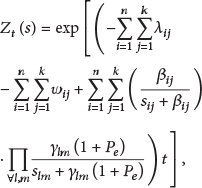

The network availability of a linear-only sensor network,


5. Communications Models: A Combinatorial Theoretic Perspective
In this section, we define various lattice traversal models that affect As mentioned in statement (a) of Section 3, communication in sensor grids is gateway-oriented. Communication may be either unicast or multicast. It means that each sensor node may relay data from its one-hop upstream neighbor or all the one-hop upstream neighbors. The traffic load at such a node is dependent upon the relay model as specified in statement (b) and (c) of Section 3. Usually depending upon the hardware and deployment, the ratio of transmission and reception energy consumptions may vary from 1 : 1 to a more diverging ratio say 2 : 1. Therefore, relay load per node may be considered as either one or unity energy consumption per node or a more fine grained description of relay load may be considered, such as taking a linear summation of reception energy consumption and transmission energy consumption. In the former case, we measure relay load in terms of hop count to transmit traffic between a sensor node and sink. In the latter case, we consider reception and transmission energy consumptions as two distinct activities while transmitting traffic between a sensor node and sink.
Therefore, communication models for a sensor grid are defined as shown in Table 1 which shall be used for analysis in the rest of the paper.
Communication models for sensor grid.

Depending upon the communication models for sensor grid, relay energy varies as number of nodes that are actually traversed to relay transmission towards the gateway changes. By modifying network availability formula according to the communication models for sensor grid, we find following results.
6. Numerical Analysis
In the following, we compare availability expression for different communication models against each other and against node and network parameters. Unless otherwise stated, the abscissa is time (approx. 4 months [9]). Figures 3(a) and 3(b) compare the network availabilities for two lattice path traversal schemes, namely, staircase walk and Delannoy number walk under unequal

Network availability under two energy consumption models.
However, when the topology size increases, the network availabilities in Delannoy number walk equalize its counterpart, mainly due to the lesser hops. It is interesting to note in Figures 3(a) and 3(b) that an increase in topology size from 25 to 100 affects the network availability more than the equal energy consumption. It is due to the fact that more transmission power reduces network availability considerably. Due to efficiency of staircase walk, we analyze the network availability for staircase walk in Figures 4, 5(a), and 5(b).

Fixed transmission power.

(a) Effect of broadcast versus unicast. (b) Effect of retransmission.
Figure 4 shows the network availability if the edge effect gives rise to fixed and variable transmission powers. While all the nodes transmit at the same transmission power in the former case, a total of
In this subsection, we consider the effects of other node and network parameters that contribute to the network availability. The first parameter that affects it is dependent upon the sensing radius of each node as shown in Figure 6(a). We assume it to be the same as the transmission range to provide maximum coverage along with connectivity [28].

(a) Effect of sensing energy. (b) Effect of data rate. (c) Effect of battery size.
The effect of data rate, shown in Figure 6(b), is more pronounced in larger topologies due to heavier relaying load for the longer of the sensor-to-gateway chains. As shown in Figure 6(c), the effect of all the factors on network availability whether directly or indirectly may be strongly neutralized when the battery size and its cost are considered no more a constraint.
Considering the 8~10% growth per year in battery energy within limited form factors computing power, the idea of battery energy following Moore's law is farfetched idea, if not impossible [29, 30]. Therefore any strategy for extending network availability has to reduce the network traffic as much as possible.
Summarizing the factors that were analyzed in Figure 6(a) through Figure 6(c), it is significantly obvious that it is the communication (in different variants) that undermines network availability the most. Some of these parameters are hardware specific while others are specific to deployment scenarios. In either case, relaying is the most significant activity and any performance optimizing measure must address it in particular. In the next section, we suggest a mechanism that deploys multiple gateways to optimize communication at an added capital cost. The “added” capital cost is considered viable by considering a cut down in recurring battery replacement cost for sensor nodes, a gain in unattended and unmanned sensor grid lifetime.
7. A Heuristic for Multiple Gateway Deployment: A Special Case of P-Median Problem
In this section, first we present the justification of deploying multiple gateways around the ROI. Then we present a heuristic for their deployment. Finally, we present a numerical result that shows the gain in network availability for a 4 × 4 sensor grid. The plausibility of deploying multiple gateways across the ROI is derived from the following.
Fact 1.
Homogeneous sensor nodes once deployed in an unattended sensor grid are difficult or sometimes impossible to reenergize. Therefore, additional nodes with unconstrained batteries may be deployed only at the outskirts of sensor grids.
Fact 2.
The cost of the gateway depends upon the design, complexity, and operation of target user applications. These tasks may vary between tasks as simple as communication between dissimilar networks to user specified data operations such as filtering, aggregation, and beam forming. For the heuristic that we propose, a more restricted role of gateways is assumed.
Lemma 1.
The cost disparity between gateways and groups of sensors becomes asymptotic as the sensor grid size increases.
Fact 3.
In a single gateway topology, transmission paths for all the sensor nodes are all wireless up to the penultimate hop. In a multiple gateway topology, there exist wireless-cum-wired paths for every sensor node, which reduce the drainage of battery per unit of energy per bit (or equivalently per packet). These facts motivate us in various ways. For example, Fact 1 motivates us to deploy gateways to reduce relay load. Fact 2 ensures the cost viability of these gateways. Lastly, Fact 3 motivates us to exploit out of sensor grid perimeter rout-ability.
7.1. A Heuristic for Multiple Gateway Deployment
The deployment of multiple gateways around the ROI is aimed at achieving maximum network availability. This activity involves each of the N, k are sensor grid size in terms of rows and columns, respectively.





The objective function in (9a) consists of two parts. The first part minimizes the relay hops (implicitly maximizing the total network availability of sensor grids). The second part minimizes the cost of the gateways. Overall, it optimizes the coverage of gateways to as many nodes as possible and connectivity of sensor nodes through as minimum hops as possible. The constraint (9b) ensures that at most one gateway is occupied by each sensor node. The constraint (9c) ensures that exactly
The number of gateways that can be deployed around the grid is a combinatorial problem. If a total of gateways are to be deployed among the available 

7.2. Column Generation Problem
Let U be the union of all possible paths for all the number of gateways. We observe that such all-paths union contains optimal, suboptimal, and nonoptimal paths. Since we are only interested in optimal paths, we assume that a subset 
Problem (11h) finds the shortest path routing as the total number of hops needed to connect a node
7.3. G Wave
G Wave is a node scheduler for nearest gateway connectivity, collision avoidance, and fairness. In this subsection, we first present numerous multisource multidestination routing schemes that schedule communication within the network and towards the gateway in order to prevent collisions and ensure fairness and optimality. We then identify the most appropriate scheme for wireless sensor grids.
Zhang and Shi have discussed various energy efficient protocols in [25]; however they do not consider the multiple sink scenario. Their routing protocols are tightly coupled with their definition of network availability, time till the first node breaks down. Hence it does not exploit the multiple gateway model as considered in this research effort. A routing scheme has been proposed in [33] which maps the multisink multisource routing problem to the well-established multicommodity network design problem. This scheme focuses on minimizing the number of paths and links being used. It does so by maximizing the extent of overlap between new paths to be created and the paths already being used by the network. Using the same path that is already being used by the network, the extra overhead is avoided (which would be necessary if routing is to be done on a new path). Using the scheme per se into the wireless sensor grid might save collisions in path discovery and data transmissions. However, it would result into reduced network longevity, because aggregating neighboring traffic along a singular path would wear out the batteries too much and too quick. Utilizing the information about remaining battery life as part of the cost metric may provide a route scheduling solution that is well-suited for energy starved wireless sensor grids.
A novel routing framework called P Wave routing has been proposed in [34] which proposes and then establishes an isomorphism between a communication network and an electrical network, in order to handle multisource multisink routing in wireless sensor networks. Herein, Liu et al. consider the network as a graph
A zero potential is assigned to a gateway node so that it behaves as a sink node under normal conditions and that all the data within the network eventually flows towards the gateway. When a gateway wishes to broadcast or anycast, the potential of the gateway is raised to an arbitrarily agreed upon maximum value and it starts to behave like a source node. Interestingly, raising the potential of a gateway to a maximum value would automatically cause the incoming traffic to divert to a different gateway, naturally offering a mechanism to avoid collisions. P Wave being a good candidate for multiple source-multiple sink sensor grids is constrained in fulfilling the following requirements. (R1.1) the gateway deployment heuristic (Section 7.1) necessitates that each sensor node must relay the data in the least number of hops. P Wave uses a localized rule to route intermediate data flows between the neighboring nodes, across the whole topology. Consequently, it does not ensure that each sensor node forward data towards the nearest gateway. Figure 8 shows two nodes transmitting at the same time. Due to the potential raise by node 1, node 2 diverts its transmissions towards a farther gateway.
(R1.2) Sensor nodes wishing to transmit must have simultaneous paths to their respective gateways if their destinations are disjoint and (R2) sensor nodes wishing to transmit over overlapping paths must avoid collisions. Since P Wave uses equilibrium potential fields in routing using the localized rule to ensure loop freedom only, collisions have not been addressed, for both disjoint and overlapping paths.
Consider Figure 9, where hidden terminal problem occurs due to simultaneous potential raise from 1, 3, and 4 towards 2, preventing nodes 1, 3, and 4 from successful transmission.
In the remainder of this section, we present the operation of G Wave while laying a specific emphasis on addressing R1.1, R1.2, and R2.
Nearest gateway connectivity: in order to address R1.1 and R1.2, we propose the idea of visualizing wireless sensor grid that uses multiple gateways as a number of subnetworks. Each of such subnetworks would have a gateway at its root handling all the traffic of the child nodes. This would turn our network into disjoint graphs, where each subnetwork along with its gateway and child nodes maintains its singularity. Each gateway now advertises its ID in addition to the zero potential to attract traffic from respective sensor nodes. This mechanism not only satisfies R1.1 but also provides traffic isolation among the disjoint subnetworks (R1.2). Now, G Wave algorithm executes separately on these isolated subnetworks with each transmission tagged with its subnetwork number.
In Figure 9, the dotted line shows the isolation achieved through the incorporation of gateway IDs. To initially tag the nodes with their closest gateways, the hop count field is set as a threshold, beyond which the node cannot transmit to a certain gateway and hence is required to join a different gateway. Again, if we assume a uniform density of our sensor grids, the hop count metric would naturally translate into the physical distance between a gateway (root node) and its child nodes. Please note that now the transmissions from node 1 and node 2 both bound to Gateway 1 collide in the wake of simultaneous transmissions. In the following, we present collision avoidance mechanism that also ensures fairness. Collision avoidance and fairness: the contention among competing nodes belonging to the same subnetwork can be resolved using timers. The design of timers follows the discipline as follows:
The value of the timer at every node is dependent upon its location such that the node closest to the gateway has the longest Wait Time. Conversely, as the hop count from the gateway increases, the Wait Time decreases. For instance, node 2 (internal node) would have a shorter Wait Time as compared to node 1 (collector node). This results into the network becoming capable of aggregating traffic towards the sink. For those nodes with the same hop count, Distributed Inter Frame Spacing (DIFS) [20] parameter is preassigned for left, right, and bottom/up neighbors such that their transmissions are isolated in distinct epochs, avoiding collisions (as shown in Figure 10).
7.4. Performance of the Heuristic
The results for the minimized objective function from Figure 7 are obtained for a 4 × 4 sensor grid by considering the LP as shown in Table 1.

Suboptimal path selection.

Hidden terminal problem.

Inclusion of gateway IDs to isolate traffic.
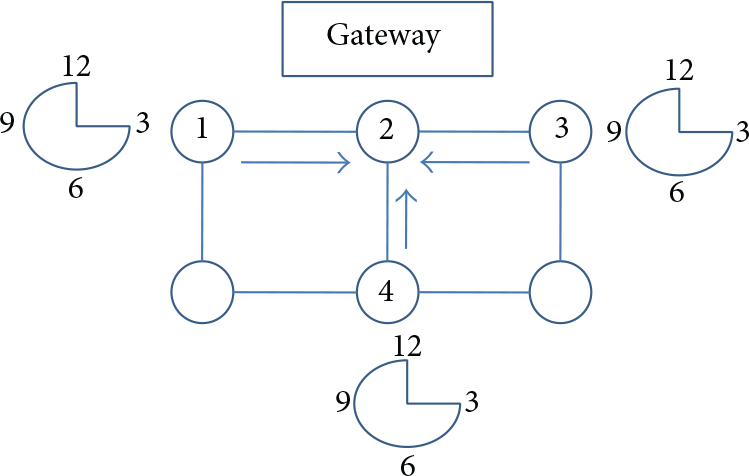
Satisfaction of R2 through the inclusion of timers.
Different values of
Figure 11(a) shows only some of the possible gateway deployment scenarios for a 4 × 4 grid. Figure 11(b) shows the difference in network availabilities under various gateway deployments. The difference is highlighted for two time epochs: first epoch is at the start of network lifetime and second epoch is when the network availabilities become asymptotic. The deployment of 3 gateways gives a consistent gain of 20% at the first observation epoch and 3% at the second epoch observation.

Multiple gateway deployments and their respective availabilities plotted as a difference.
8. Case Study
We present the network availability of a practical scenario to show how much is the performance gain that we actually get by deploying gateways according to the heuristic that we have presented. We consider the deployment of an optimal number of gateways around a 4 × 4 sensor grid that comprises sensor devices of a specific type (Table 3). These devices conform to IEEE802.15.4 standard [20]. The specifications used in obtaining the network availability are summarized along with plot in Table 2 and Figure 12.
Minimized objective functions for a 4 × 4 sensor grid.

Sensor devices specifications.


Network availability under optimal gateway deployment versus single gateway deployment along with parameter list.
According to Figure 12, the deployment of three gateways according to the heuristic (Section 7) around the sensor grid results in a performance gain due to reduction in the number of hops for transmissions from sensor nodes to the gateways. The average gain across all the time scale is 0.128; it means that approx. 13% of the resources (coverage and connectivity) are available additionally to the optimal deployment under all the times.
9. Conclusion
In this paper, we study and analyze the energy consumption pattern followed by single gateway sensor grids. Further to this, we analyze the network availability of sensor nodes deployed across a two-dimensional space. We conclude that the energy consumption in sensor network grids can be optimized through the deployment of multiple gateways. It is also concluded that the effective network availability of a two-dimensional sensor network is dependent on the number of sensor nodes, their topological distribution, the transmission model adopted, and the node parameters. We present a linear programming heuristic for multiple gateway deployment to optimize communication through optimized relaying activity across the sensor grid. Our work shows practical utility for the design and implementation of wireless sensor grids as cut-through energy paradigms.
Footnotes
Competing Interests
The authors declare that they have no competing interests.
Acknowledgments
The authors wish to thank Saif Shams, Irfan Qadir, Professor Shaokai Yu, and Professor Won-Sik Yoon for their valuable comments and support.