




Abstract
WirelessHART is considered to be one of the most promising wireless network protocols for its high robustness comparing to other similar wireless networks. Convergecast is an efficient approach for industrial control. But in WirelessHART specifications, no scheduling algorithms are defined for convergecast. In this paper, an efficient link arrangement strategy for packet delivering named WBLSS (Weight-Based Link Scheduling Strategy) is proposed. In order to improve the communication reliability and assign time slots to nodes in the network evenly, WBLSS considers network topology for time slot assignment. Nodes with more children in the communication tree have more time slots for communication, which improves the global throughput dramatically. As compared to the existing link arrangement strategy in WirelessHART, both the throughput of the network and the real-time performance are improved in WBLSS.
1. Introduction
Industrial wireless sensor networks are efficient means of industrial control, but considering the special demands of industry, the wireless network transport protocol must have high real-time capability. The traditional protocols like ZigBee, UWB, ISA, and Bluetooth promote the application of wireless technologies in industrial automation control. However, there are many challenges when they are used in practical application because of lack of real-time characteristics [1, 2]. To address the real-time of wireless networks, WirelessHART, extended from HART protocol, becomes the first publicly available standard.
WirelessHART employs IEEE 802.15.4-2006 as its physical layer and uses 16 frequency channels. In MAC layer, it defines some unique features, including 10 ms time slot of TDMA technology, global network time synchronous, frequency hopping, and channel blacklist. Communication between the devices is arranged in one time slot composed of superframe. When one superframe is an end and it will come back to ASN0 (Absolute Slot Number) till this superframe is abandoned, the time synchronization can be finished in one slot. Devices will record the time when the packet arrives, compare with the anticipant arrival time, and get the time deviation delta-T (
In the network layer, WirelessHART supports the self-organized mesh network topology; each device in the network acts as a router [3, 4]. Being a centralized network, WirelessHART has exactly one active network manager to be responsible for everything like constituting network, allocating resource, and configuring routers. The network manager collects the field information to get the topology of the network and schedule the communication according to the need of actual transmission. By our scheduling algorithm, network manager creates the superframe which consists of time slots and links between the devices and sends it to each device. The device will establish communication time based on the superframe. Although WirelessHART protocol specifies the structure of the superframe, the scheduling algorithm is not presented.
Several universities and research institutes began to study the scheduling algorithm for WirelessHART after the agreement was announced and have achieved some research results [5, 6]. In this paper, we put forward a scheduling strategy based on the network weights—WBLSS which combines the periodical sensor data with the actual load of the network link. WBLSS can realize the convergecast in a short period of time and improve the network throughput.
2. Related Work
The current study for the wireless network scheduling algorithm has achieved fruitful results, but those algorithms cannot be applied to WirelessHART directly. By now, the researches about the scheduling algorithm of WirelessHART are so few.
Zhang et al. and Soldati et al. started to research this topic, and in literature [7, 8] they analyzed the convergecast of WirelessHART network with line routing topology, multiple line routing topology, and general tree routing topology. Their algorithm takes at least
In [9], Saifullah et al. presented an algorithm named C-LLF which set a critical time for each data flow. The flow cannot arrive at the destination address when the flow is not sent before critical time. The difference between the critical time and the current time makes up the laxity of the flow. Setting the flow which has the least laxity in the active flows to the current slot, until the active data stream is scheduled or the available channel is assigned, the algorithm takes the next time slot. C-LLF realizes the effective arrangement for real-time data flow and reduces the delay of data flow. However the complicated calculations make it difficult to implement in production.
In [10], Fang et al. delaminated the node in network and allocated time slots for the communication link between layers. Link in different layer uses distinct channel. This approach avoids conflict, but the actual communication is not considered; therefore it leads to high latency and low throughput.
Based on graph routing in WirelessHART protocol, Dang et al. put forward a scheduling algorithm in [11]. The algorithm arranges slot for each link in subgraph, and the superframe can send packets from the source node to the destination node. To increase the robustness of the network, every link is assigned twice. Reference [12] improves the retransmission mechanism of the above algorithm. The new algorithm finds an optimal path according to the reliability of the link between the source and destination, and only the link in the optimal path is assigned twice. Both of them are based on graph routing and need to schedule time slot for every graph, which leads to more transmission latency and resource consumption.
In general, the researches regarding the scheduling strategy for WirelessHART despite having yielded the certain results cannot solve the convergecast problem in mesh network perfectly. In this paper, owing to the actual traffic of network link, taking the load balancing of each link into full account and weighting value for links, WBLSS assigns slot according to its weighted value. The algorithm can converge the traffic rapidly in mesh network of WirelessHART.
3. Scheduling Strategy
This chapter describes the scheduling strategy of WBLSS including building network model, the method of the link weight, and the slot management method.
3.1. Network Model
WirelessHART network is a mesh network consisting of the field devices, the gateway server, and the network manager as shown in Figure 1. The field device can sense and control process equipment, moreover acting as a router, which can forward flow for neighbor device. Gateway is the bridge linking the wireless network and the network manager. As a cache for the WirelessHART data and the source point of time synchronization, only one active gateway can be used in WirelessHART network, but there could be more than one virtual gateway to improve the robustness of the network. The responsibility of the network manager is to configure the network and schedule communication. Network manager supervises the whole network's flow and controls the communication between the devices by broadcasting superframe.

A WirelessHART network.
Gateway is the sink node of the WirelessHART, so all the data will converge to the gateway. We layer the device and use “depth” to define the hops between source device and the gateway. The smaller the depth value the device has is, the less hops there are to reach the gateway. Therefore we assume that the devices with the same depth do not send packets to each other, and the packet will only be sent to lower ground when the data flows to the gateway and diametrically when the network manager broadcasts superframe.
Based on the assumptions, the WirelessHART networks could be modeled as a directed graph

An example of network topology.
3.2. Link Weight
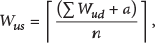
The nodes in the network can receive, send, and store packet. When the number of receiving packets is greater than the number of sending, the packets will be accumulated in the nodes which will result in packet loss. To avoid packet loss, the weight of the sending link (the link between the node and its father node) should be larger than the receiving link (the link between the node and its child node). We use the weight of the receiving link and the packets' number of the node to calculate the value of the sending link. When the node has more than one sending link, the result will be given to each sending link on average to load balancing. A layer-to-layer method is used from bottom to top of the topology to compute the weight of the sending links for every node and stipulate that the weight of the receiving link of leaf node is 0. The proposed weight is calculated as

Weighted network.
3.3. Scheduling Algorithm
In order to improve performance of data convergecast, there are some restrictions that need to be considered.
Collision Avoidance. The TDMA isolates the communication in time and the frequency hopping isolates the communication in channel which reduce the likelihood of conflict greatly. However, they cannot completely become free from conflicts. There are two kinds of conflicts. Due to the half duplex of the device, conflicts are introduced when the node is both the sending node and the receiving node in one slot, as shown in Figure 4(a). Each node can only listen to one channel in one slot; therefore the node which two nodes send packets to in one slot will lose packets, as shown in Figure 4(b). The communication is conflict-free, if the scheduling algorithm avoids both cases.

Two kinds of conflicts.
The Order of Communication. In order to reduce the need of the storage of the node and decrease the delay of the packet, the node should send the packet as soon as possible. Therefore the sending link should be arranged after the receiving link. This condition is unsatisfactory for the packet from the node itself, so the link for sending this packet can be arranged more front than its receiving links.
The Rules of Assigning Link. In WirelessHART, nodes can communicate with each other in one slot using different channels. If all the receiving nodes on the equal layer are arranged in the same slot, packets will not be flowed to lower layer because of the half duplex of the node, which could increase the network delays. To solve this problem, we stipulate that the number of the destination node on the equal layer must not exceed half of the total number of nodes on the layer. The communication is conflict-free if there is only one node on the layer.
Algorithm Description. Algorithm 1 is our scheduling algorithm to allocate time slots for the link according to the weighted network and the constraint condition.
Output: Weighted Graph G ( ( ( ( ( ( ( ( ( ( ( ( ( ( ( ( ( ( ( ( ( ( ( ( ( ( (
The input in the algorithm is weighted graph G, the depth of the graph is D, and the network's weighted sum is W. The output of the algorithm is the superframe which can be recognized by the nodes. The algorithm is running until the value of W is equal to zero and allocates a suitable slot to the nodes in every layer, starting at the lowest available level of the topology and moving upward. In the layer d, for example, traversing the set of sending link

The schedule of superframe calculated by WBLSS.
From the superframe, we can get that every node appears only once in the same slot, and every link in the same slot is arranged in different channels, so the communication is conflict-free. The weight of the link determines the link's assigned slots. Taking the link
4. Analysis and Evaluation
In this section, we compare our method with Z. Haibo's convergecast schedule in [8] and the graph route-based link scheduling scheme, GRBLSS, in [12] to evaluate the performance of our algorithm in three aspects: the total slots to finish convergecast, the network throughput, and the maximum delay of the packet.
Z. Haibo's strategy cannot be applied in mesh network, so we get a tree topology from Figure 2 by BFS, as shown in Figure 6. The comparison of performances between Z. Haibo's strategy and our method is in the tree topology. Figure 7 shows the result of comparison, and it shows that WBLSS has the same performance as Z. Haibo's. This is because the node has only one parent node and there is no redundant link in tree topology; in the process of scheduling, each link has fully played the role. Compared to tree topology, WBLSS has better performance in mesh topology. As can be seen from Figure 7, there is a big difference of performance between MBLSS and GRBLSS, because GRBLSS builds a separate superframe for each node and these superframes are linked end to end to realize convergecast, which increases the period of convergecast.

Tree topology generated by BFS.

The simulation result of slot number to finish convergecast.
The network throughput can be expressed by the ratio between the total number of the packets in the network and the total slots required to finish the convergecast as follows:

Table 1 is the computation result of the throughput of two other algorithms and our strategy in two topologies. As shown in the table we notice that our algorithm has the same throughput as Z. Haibo's in the tree topology and has a 46 percent increase over graph route-based link scheduling scheme.
Throughput comparison result of algorithms.

The redundant path in the mesh network will increase the maximum delay of the packet. In a D depth network, for example, the result of maximum transmission delay is displayed in Table 2. GRBLSS imports the retransmission mechanism for the optimal path between the source node and the gateway, so it needs
Delay comparison result for different algorithms.

5. Conclusion
In this paper, we present an effective convergecast scheduling algorithm, WBLSS, for WirelessHART network with low delay and high throughput. Compared with other link scheduling algorithms, our method has a higher performance and wider range of application. The following work is to add the link reliability when computing the link weight and evaluate our schemes on real WirelessHART environments.
Footnotes
Competing Interests
The authors declare that they have no competing interests.