




Abstract
As participants of intelligent networks, secondary users should first act as sensors to detect wireless environment to get available spectrum. However, to get more accurate sensing data and access idle spectrum with higher probability in cognitive radio networks, secondary users have to share positions with other entities such as fusion centers, which may raise serious privacy concerns if these positions are not protected adequately. In this paper, to make full use of idle spectrum with low probability of location leakage, we propose a Location Privacy-Preserving Channel Allocation (LP-p CA) scheme. The scheme can conceal identities of secondary users and cut off the relationship between secondary users' location and register data in database (DB) while using random sequence and self-coexistence mechanism of agents. Simulations show that the proposed scheme can satisfy users' personal location privacy concerns and maximize spectrum utility synchronously.
1. Introduction
With the rapid growing demand of multimedia in wireless communication, users need reliable resources to download or upload content such as video streams, images, and other sensor data. However, the limited spectrum resource is becoming an obstacle to support the increasing number of these advanced wireless applications. On the one hand, people are eager to find out a new technique to meet the requirement of increasing services. Cognitive radio networks (CRNs) have been introduced to allow cognitive radios to act as SUs of the spectrum left unused by licensed services (primary users) [1]. SUs are required to sense the channels' states and assign the idle channels without interference, such that limited spectrum can be utilized more efficiently [2–5]. On the other hand, more and more users are paying close attention to their privacy recently [6–9]. The entities, such as location-based services, friend finder services, for example, Loopt, or social networks as Facebook [10], contain sensitive location privacy data about users. Adversaries can collect these information to infer users' home location, life styles, work place, and health conditions. Obviously, in CRNs, to obtain accurate information and assign available channels, SUs have to exchange or upload necessary data which is always related to personal sensitive data such as personal habits and working places. During spectrum allocation, the allocation information which can be intercepted easily by malicious users has close relation to SUs' location. For example, the regional distribution feature of available channels would reveal the fact that there exists an inalienable relationship between SUs' locations and the available channels they can access. Attackers can infer SUs' locations through their used channels. Even all SUs want to access idle channels, they are unwilling to access at the cost of leaking private information. The most important purpose of CRNs is to maximize the total throughput [11] in CRNs; therefore, how to balance the opportunities to access and the privacy leakage is important.
To protect location information in CRNs, Li et al. proposed a Privacy-Preserving Collaborative Spectrum Sensing (PPSS) scheme, which can significantly improve SUs' location privacy with a reasonable security overhead in collaborative sensing [12]. However, the aggregation requires strict channel condition. Gao et al. proposed a novel prediction based Private Channel Utilization (PCU) protocol to mitigate the possibilities of location privacy leakage by choosing the most stable channel [13]. However, the scheme mostly depends on the stability of channels. Qin et al. proposed a novel privacy-preserving mechanism for cognitive radio transactions through commitment scheme and zero-knowledge proof [14]. The result shows that the proposed scheme can guarantee that the payment is correctly calculated with minimal SU's usage information, but the scenario is limited. To defend against location inference attack, [15] proposed an agent-based algorithm which selects base stations to work as agents to protect SUs' location during spectrum allocation. It is a feasible method to defend against location inference attack in data base driven CRNs. Based on the structure proposed in [15], in this paper, we propose a Location Privacy-Preserving Channel Allocation (LP-p CA) scheme which can protect users' location information efficiently. Firstly, all legitimate SUs can pass the authentication without leaking identities. Secondly, considering the increasing number of SUs and the limited available spectrum, the proposed scheme achieves a noninterference allocation and is k-anonymous with self-coexistence mechanism. Lastly, to increase adversaries' complexity to infer SUs' location from channel usage information, LP-p CA scheme takes base stations as agents to cut off the relation between SUs' location and register data. Result shows that the proposed scheme can protect SUs' location privacy more effectively.
The rest of this paper is organized as follows. Section 2 introduces the location privacy leakage in CRNs. Section 3 presents the proposed LP-p CA scheme based on self-coexistence. Section 4 discusses and analyzes the proposed scheme. Section 5 concludes this paper.
2. Location Privacy Leakage in CRNs
Besides primary users' activities, spectrum availability information is related to secondary users' physical position. For instance, in spectrum sensing, all sensing reports are location-dependent on users' physical position. Even for the same channel, the sensing data in different areas may be different. To get more accurate sensing data and deal with the data more efficiently, users normally send sensing data with their own physical positions. Therefore, malicious entities could geolocate a SU from the correlation between the SU's sensing data and its physical location.
During spectrum allocation, users in different areas or cells are allocated different channels to avoid interference. All the allocation information is related to users' physical location information. Generally, the more the location information is leaked, the more efficient the spectrum allocation becomes. However, most users are unwilling to get convenience at the cost of location privacy leakage. How to balance location privacy leakage and resource utility is a serious challenge in CRNs.
Whatever in spectrum sensing or spectrum allocation, an efficient method to preserve SUs' location privacy is to cut off the correlation between data transmitted and SUs' locations. In the following, we will introduce the proposed Location Privacy-Preserving Channel Allocation scheme in detail.
3. Location Privacy-Preserving Channel Allocation Scheme
3.1. Self-Coexistence with Coloring Model
Coloring model [16] can assign different colors to all cells or areas to reach that no two adjacent cells or areas share the same color. It is a natural model for channel assignment in wireless communication networks. In CRNs, we can assign several different colors to each cell to guarantee that there are no two adjacent cells or areas which share the same color. In this paper, we divide the whole areas C into several cells denoted by
3.2. Location Privacy-Preserving Channel Allocation Scheme
To prevent SUs' location leakage from channel usage information, in this subsection, we propose a LP-p CA scheme. The target is to obtain a noninterference channel allocation with small probability of location privacy leakage of SUs. To make full use of spectrum, power control is a mature technology in wireless network, with which users can coexist and reuse spectrum in different areas. In order to distinguish the coexistence between PUs and SUs, we define the coexistence among SUs as self-coexistence in CRNs and propose a new channel allocation scheme based on self-coexistence, which can protect SUs' location information in CRNs.
We consider the system architecture as shown in Figure 1. The whole area covered by CRNs is defined as C. There are N base stations deployed in the network.


Main structure of CRNs.
The proposed LP-p CA scheme includes two parts, pseudonym generation and identification and channel allocation.
In LP-p CA scheme, DB can verify SUs' identities according to the transformational random numbers instead of their own identities. Each BS acts as an agent to register channels to protect SUs' location. The self-coexistence and the unified register with dummy injection can increase the spectrum utilization and decrease the location leakage probability simultaneously. There exists a secure control channel for cognitive radio system to transmit control message. The steps of LP-p CA scheme are described as follows.
Pseudonym Generation.

Then,
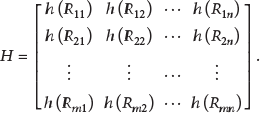

Identification and Channel Allocation. Five steps are included, and they are channel request, information collection, identity verification and feedback, channel allocation, and register, respectively.
(i) Channel Request.
(ii) Information Collection. After
(iii) Identity Verification and Feedback. After the DB receives the request packet, it decrypts the packet and performs hash computing. If the random number can be verified in the hash matching phase, the corresponding tag will pass the verification, or the verification process will be failed. After hash matching, DB will send the passed tags and the encrypted message of the list of available channels of the area
After that, DB will delete the random numbers
(iv) Channel Allocation.
(v) Register. After allocation,
Hash Matrix Update. The hash matrix will be updated by element deletion and addition regularly. Deletion can be done after each round of hash matching in the step of identity verification and feedback. DB will delete the hash values which have been matched with the random numbers included in the channel request information. If there is a SU who uses up its random numbers or there is a new SU who wants to join the network, addition will be launched by the SU. The SU must connect to
Take

Interaction process for channel allocation.
Pseudonym Generation.

The details of spectrum allocation are as follows.
Step 1 (channel request).
Step 2 (information collection).
After receiving channel request,
Step 3 (identity verification and feedback).
Upon receiving message
Step 4 (channel allocation and register).
When
In the LP-p CA scheme proposed in this paper, DB does not store SUs' used channel information, which can prevent privacy leakage by inferring the location from used channel. Besides, we adopt hash matching, which can not only verify SUs' identities, but also increase the difficulty for attackers to infer location information. Even if knowing someone's location, attackers have no knowledge about the identity of the user.
4. Analysis of LP-p CA Scheme
4.1. System Setup
In order to analyze the efficiency of LP-p CA scheme, we set 10 channels to be available in each hour, which means that after one hour, the system will randomly select 10 channels from the total channels to allocate to SUs. In this paper, the knowledge of each entity at time t is the following: CA: DB:
4.2. Comparison of Location Privacy Leakage and Spectrum Utility
If attackers obtain the registered data in DB, they can only get the used channel information of each BS but have no knowledge of the used channel information of each SU. Therefore, by only knowing the registered data, attackers cannot infer SU's location. If attackers obtain all contents of DB, they can only get the self-coexistence allocation matrix
If an attacker captures a base station
We adopt color model as the self-coexistence mechanism for illustration in this simulation. The same channel can be reused among different base stations without interference under the condition of allocation matrix. For our study here, there are randomly 10 channels available for SUs to access each time. We compare the efficiency in Figure 3. Results show that the average probability of SUs to be located is increasing to
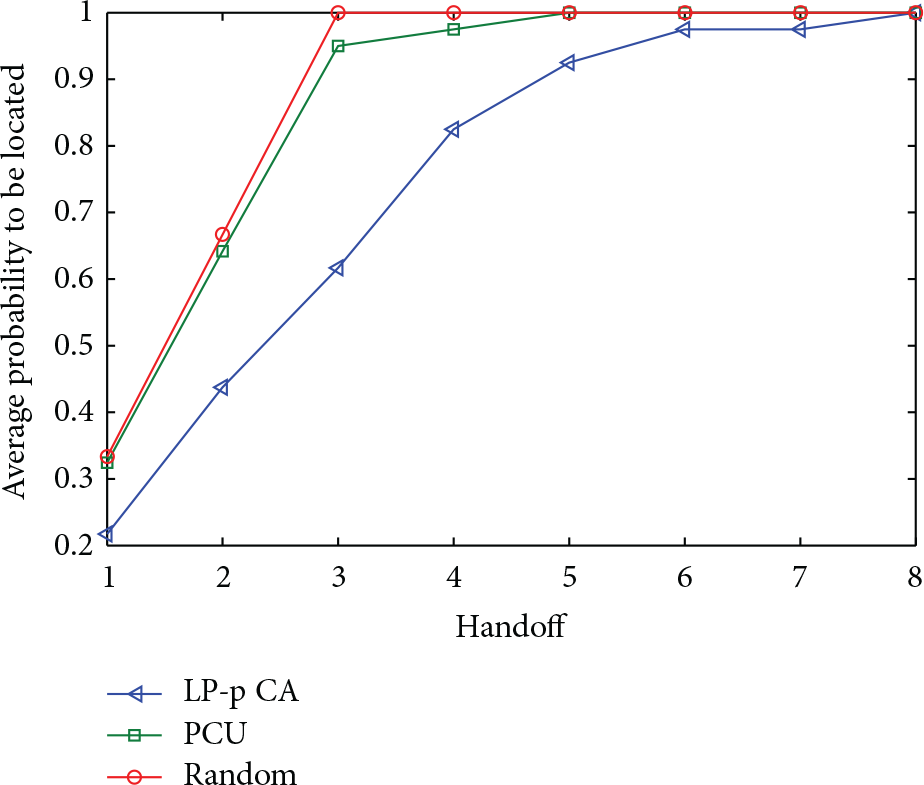
Comparison of the average probability to be located.
Spectrum utility is related to the number of available channels, users' distribution, and channel allocation algorithm. We consider
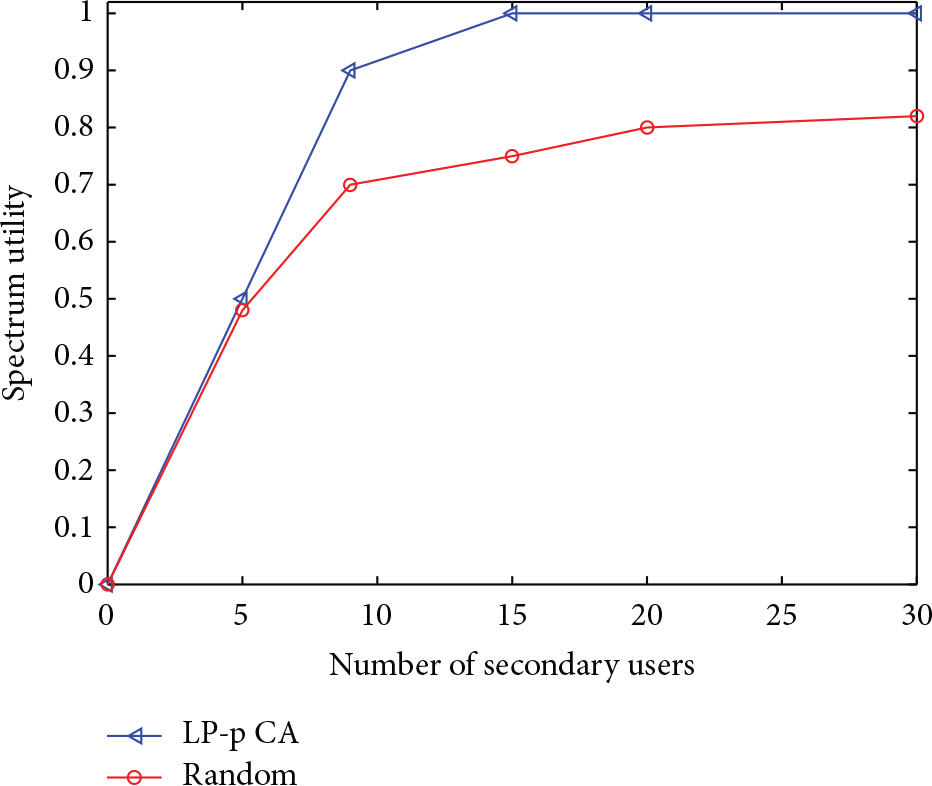
Spectrum utility varies with the number of SUs (10 available channels).
4.3. Privacy Leakage with Different Parameters
The probability of a special channel or a SU to be located is related to the total number of available channels, the allocation model (coloring model in this paper), and the number of base stations. We give the variation curves of the factors above as follows.
In the LP-p CA scheme, the possibility of a specific channel to be allocated to each area covered by different BSs is shown in Figures 5, 6, and 7, respectively, where

The average probability of a special channel to be allocated to each area with different number of channels allocated to each BS.

The average probability of a special channel to be allocated to each area with different number of available channels.
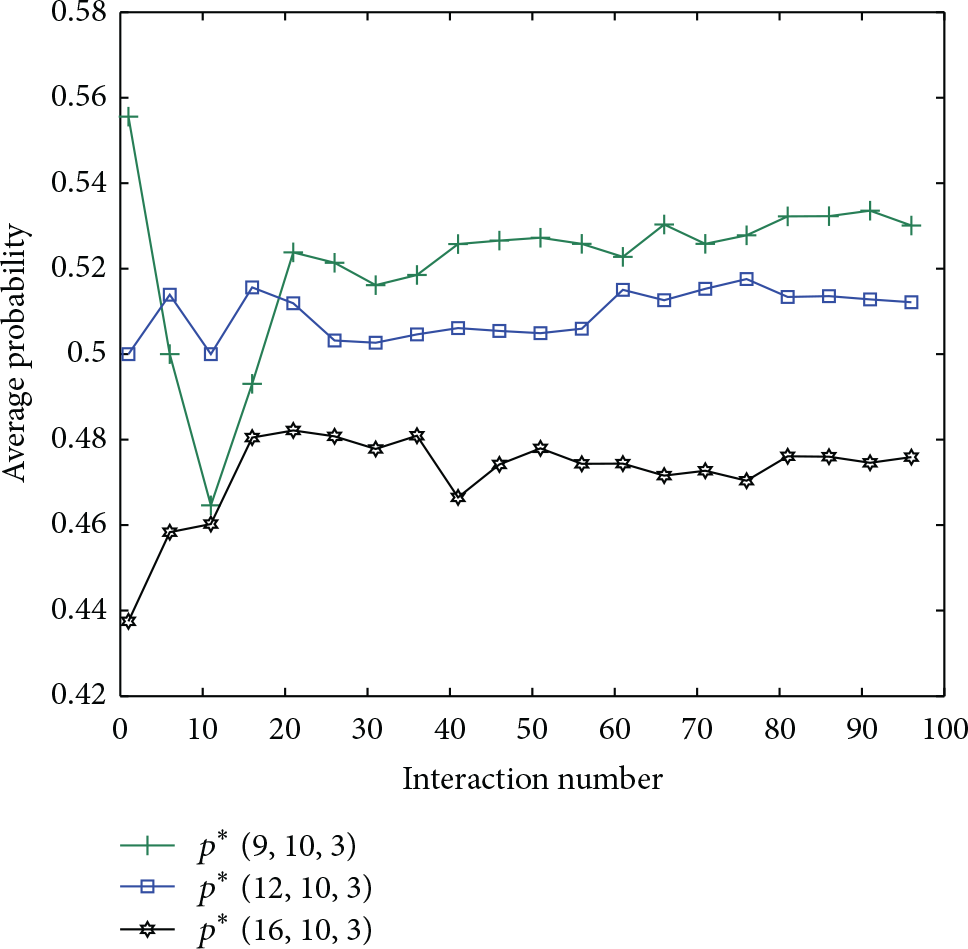
The average probability of a special channel to be allocated to each area with different number of BSs.
Besides the states of channels, the location leakage probability is also related to other factors, such as the total number of base stations, the total available channels, and the allocation mechanism. We can see the effects in Figures 8, 9, and 10, respectively. p is the average probability of a SU located to a certain base station. Figures 8, 9, and 10 give us the changing curves with different parameters. From these figures, we can summarize the influence level of each factor and optimize one or more parameters when others are given or fixed to decrease the probability to be located in a real system. With this conclusion, we can use the idle spectrum freely without considering sensitive data leakage such as location privacy.

p with different k in

p with different j in

p with different i in
In the self-coexistence mechanism, one channel can be reused in different cells. Besides, we also add dummy information during spectrum allocation. Therefore, in the registration data of DB, the same channel may exist in much more cells. Thus, the proposed scheme can reach k-anonymity. Even if attackers can get all the information in DB and detect which channel the target user is transmitting on, they cannot locate the user. k-anonymity relies on the reused times of a channel and the number of secondary users who transmit on this channel. The more times a channel is reused, the more secondary users in the network, and the easier it is to reach k-anonymity. In CRNs, the number of SUs is always assumed to be much more larger than available channels, and this assumption relies on the increasing service of wireless communication demand.
Compared to the scheme proposed in [13], the LP-p CA scheme proposed in this paper has the following advantages. Firstly, random sequence matching ensures that the legitimate SUs can successfully pass authentication process without identity privacy leakage; thus, SUs can access available channels with temporary tags. Secondly, self-coexistence mechanism is used in the scheme to allocate spectrum resource among different base stations with dummy information. It guarantees SUs to communicate without interference simultaneously and makes full use of idle spectrum. Finally, the dummy information injection and anonymous authentication can also reach k-anonymity.
5. Conclusion
We proposed an LP-p CA scheme based on self-coexistence in this paper. Our scheme can protect SUs' location privacy against untrusted DB by decreasing location inferring probability of attackers. By hashing matching, self-coexistence mechanism, and unified register, the proposed LP-p CA scheme can make full use of idle spectrum and achieve the noninterference goal of the channel allocation with low probability of location privacy leakage. In CRNs, because of the unpredictable return of primary users, the available channels are changing with time. Considering this, how to make full use of spectrum and support more SUs in the system without leaking privacy is the most important purpose of CRNs. In the future research, we will focus on the optimal design of the system to preserve SUs' location privacy in actual scenarios.
Footnotes
Notations of LP-p CA
Competing Interests
The authors declare that they have no competing interests.
Acknowledgments
This work was supported by the National Natural Science Foundation of China (nos. 61373170, U1401251, and U1536202), China Postdoctoral Science Foundation (no. 2015M572528), Fundamental Research Funds for the Central Universities (no. JB150114), and the Natural Science Basic Research Plan in Shaanxi Province, China (no. 2014JQ8308).