




Abstract
As a technology of monitoring and recording human body health signals, wireless body area networks (WBANs) play an increasingly important role in the field of healthcare. Inspired by the semigroup property of Chebyshev maps, we designed a novel chaotic maps-based authentication scheme for wireless body area networks. The study aims to avoid modular exponential computation or scalar multiplication on an elliptic curve and reduce the need for time-consuming. Compared with the previous schemes, our scheme not only enjoys more security features but also has reduced computational cost of client and application provider. Moreover, we present the security model for our scheme, demonstrate the validity of the protocol by the BAN (Burrows, Abadi, and Needham) logic in detail, and analyze the software implementation method of Chebyshev polynomial.
1. Introduction
In wireless body area networks (WBANs) [1, 2], with the human body as the communication center, some intelligent low-power sensor nodes are integrated in/on or around a human body. Low-power sensor nodes can collect important physiological parameters of human body and surrounding environment data, then send the collected data to the intelligent mobile terminal or the base station near the body in the wireless way, and finally transfer the data to the server for analysis and processing through Internet. Through the network, medical personnel can monitor the physiological information and surrounding environmental information of users by computer and users may ask for emergency first aid. Moreover, the server can also realize real-time recording of the user data. WBANs are not only applied in medical and health care but also applied to privacy protection. Security and privacy are key aspects of the applications in WBANs [3], so access control and authentication are the major security services needed. A typical wireless body area network is shown in Figure 1.

A typical scenario of WBANs.
Authentication is to confirm the legitimacy of the two communication entities in an open network environment; it allows two entities to establish the trust relationship and is an important component of network security technologies. Authentication can be realized via 3W (What You Know, What You Have, or What You Are). Physiological information and health privacy data have strict security requirements. As the first barrier, the authentication information protection system also becomes one of the key problems of WBANs. The authentication enables a node to verify the legitimacy of the other sensor nodes involved in the communication, and only messages sent by authorized nodes can be detected and accepted. However, the authentication schemes costing more time of computation and communication are not suitable for WBANs because of the limitations of computation capability, energy, storage space, and the battery's lifetime. Therefore, WBANs system requires more secure and practical authentication mechanism.
In 1981, Lamport [4] presented a solution to solve the problem of password-based remote authentication using cryptographic hash functions. However, high hash overhead and the necessary consumption of password resetting lowered its practical applicability. Since then, several improved password-based authentication schemes had been proposed [5–7]. However, most of these password-based remote user authentication schemes can only prevent certain kinds of attacks [8, 9]. The authentication scheme based on symmetric key encryption was vulnerable to smart card attack [10]. The scheme based on public key password encryption involving modular exponentiation computation or elliptic curve algorithm [11–13] produced large computational overhead for terminal equipment. In 2009, Tseng et al. [14] proposed the first authentication scheme based on chaotic maps. However, Niu and Wang [15] pointed out that the scheme of [14] could not ensure user anonymity and scheme security when there was a malicious user. In order to overcome these disadvantages, Niu and Wang also presented an improved scheme. Unfortunately, Xue and Hong [16] found that the scheme of [15] was vulnerable to the man-in-the-middle attack. In 2013, Guo and Chang [17] pointed out that these schemes [14–16] did not meet the requirements of key agreement, put forward a new authentication scheme based on chaotic maps, and asserted that the scheme could realize user anonymity and resist a variety of attacks. In the same year, Hao et al. [18] pointed out that Guo and Chang's scheme cannot ensure user untraceability and requires the use of double secret keys. To enhance the efficiency and privacy, they presented their modified version. Unfortunately, Lee [19] found that Hao et al.'s scheme violates the contributory property of key agreements and it can predetermine the session key alone by a malicious participant. To handle this, Lee presents effective improvements with higher security. In addition, Jiang et al. [20] identified that the security flaw of Hao et al.'s scheme is not to resist the stolen smart card attack, and they also proposed a new chaotic map-based authentication scheme. Regrettably, Li et al. [21] found that both Lee's and Jiang et al.'s authentication have a serious security problem which can cause the service misuse attack, so they modified it slightly to prevent the shortcomings. In [22] the authors proposed a key exchange scheme which worked like Diffie-Hellman algorithm by utilizing the semigroup property of Chebyshev polynomials. The improved protocol overcomes many drawbacks of the previous chaotic key agreement protocols. Both analysis and experimental results demonstrate that it was secure and practical.
Theoretically, the authentication schemes in WBANs could be realized by traditional public key cryptosystem such an RSA algorithm [23] and ElGamal algorithm [24]. But in these algorithms, a complicated operation called modular exponentiation is needed. Rather, the computation capability of medical sensors and control nodes in WBANs is very limited. Hence those algorithms are not suitable for WBANs. In recent years, Liu et al. [25, 26] proposed a certificateless signature (CLS) scheme and designed two certificateless remote anonymous authentication schemes for WBANs. The two schemes involved the bilinear paring operation, and the computation complexity of a pairing operation is several times of that of elliptic curve point multiplication. Moreover, the first scheme did not realize user anonymity because a constant value related to client's identity should be transferred via the network, and the second security enhanced authentication scheme was vulnerable to the stolen-verifier attack. Therefore, the scheme of Liu et al. was not suitable for WBANs. In 2014, Zhao [27] presented an identity- (ID-) based efficient anonymous authentication scheme for WBANs with elliptic curve cryptosystem (ECC); the proposed scheme avoided the complicated bilinear pairing operation and saved the additional computation to verify the legality of certificate. However, the proposed scheme requires the elliptic curve point multiplication, thus increasing the computation cost.
In the paper, we studied the intrinsic characteristics of WBANs, compared existing remote authentication schemes, and proposed a chaotic maps-based authentication scheme for WBANs. Our scheme took full advantage of the semigroup property of Chebyshev chaotic map. In the new scheme, two entities in communication did not need to establish a public key encryption system in advance and the modular exponential calculation and elliptic curve scalar multiplication were avoided in the authentication phase. Besides we analyze validity, security, and computational cost of the scheme and also demonstrate the security model for the scheme and software implementation of Chebyshev polynomial. We think that the proposed scheme was more suitable for WBANs.
The rest of the paper is arranged as follows. Section 2 briefly introduces the preliminaries of Chebyshev chaotic maps. Section 3 elaborates scheme's design, including design architecture, three phases of the authentication scheme, and password change phase. Section 4 is performance analysis, it gives the scheme's security model, the validity proof of our scheme by BAN logic in detail, security analysis of defense variety attacks, software implementation of Chebyshev polynomial, and computational cost comparison with recently published schemes. Section 5 presents the conclusion.
2. Chebyshev Chaotic Maps
In this section, we firstly described Chebyshev polynomials. The definitions of Chebyshev polynomials [28] are provided as follows.
Definition 1.
Let n be an integer and

Then, the recurrence relationship of Chebyshev polynomial is defined as

Here are some examples of Chebyshev polynomials:

Chebyshev polynomials satisfy the following important characteristics [29–31], the semigroup property, and the chaotic property.
(1) Semigroup Property. One of the most important properties of Chebyshev polynomials is called the semigroup property:

According to the semigroup property, Chebyshev polynomial meets the following conditions:

In 2008, Zhang [32] proved that the semigroup property could be defined within the interval

Here
Therefore,
(2) Chaotic Property. When
Chebyshev polynomials are often to be used to solve the following two kinds of problems [20, 33–35], which are intractable to be solved within polynomial time.
Definition 2 (chaotic maps-based discrete logarithm problem (CMDLP)).
Given two elements x and y, it is computationally infeasible to find the integer n such that
Definition 3 (chaotic maps-based Diffe-Hellman Problem (CMDHP)).
Given three elements x,
3. Design Scheme
3.1. Design Architecture
As show in Figure 2, three kinds of participation objects are involved in the authentication protocol for WBANs: the WBANs client, the network manager (NM), and the application provider (AP). WBANs client refers to the users who can obtain certain service from AP through WBANs terminals or applications such as PDA, smartphone, biosensor, or medical equipment. AP may be a hospital, a clinic, or a physician, which can provide medical service through WBANs. NM is responsible for creating the private key between the client and the application service provider. It is not necessarily the strong trusted third party (TTP) because it only issues one part of the private key of a legitimate user. However, this part of the private key is not adequate to pretend to be a legitimate client. TTP is a trusted third party in the network, and it may be a trusted server or a key distribution center. TTP shares different secret key with each participant and all of these keys will be in place before protocol begins. In our scheme, we have not employed TTP, because (1) TTP needs to know user's identity to search the session key which is contrary to the anonymity of the user; (2) more steps will lead communication burden and computational load, which neglects the resource constraints of WBANs; (3) even though the server is pretended by malicious user, it could not obtain user's random number b because user sends

Working flow in the authentication scheme for WBANs.
3.2. Authentication Scheme
In this section, we will elaborate our remote authentication scheme for WBANs. The proposed scheme has three phases: the initialization phase, the registration phase, and the authentication phase. The notations used in this scheme are provided in Notations.
3.2.1. Initialization Phase
This phase is also called parameter generation phase. In this phase, S firstly creates the system parameters, including the secret key
3.2.2. Registration Phase
If the user U wants to be a legal user, the following steps must be executed between U and S through a secure channel, as shown in Box 1.
Select Generate a random number b Compute Compute Replace Y with Store b into
 Generate a random number p

Step 1.
U chooses
Step 2.
Upon receiving
Step 3.
U computes
3.2.3. Authentication Phase
A legal user U with valid smart card can establish the secure and authorized session with the server. When the users want to request some services, they firstly carry out the mutual authentication and then consult the session key that will be used in the future for the secure transmission of data. As shown in Box 2, the authentication between the user and the server consists of the following steps.
Input Generate a random number u Compute Compute Check if true Generate a random number r Compute Check if true Compute Check if true Check Compute
Step 1.
User U inserts the smart card
Step 2.
Upon receiving the request message, S checks whether
Step 3.
After receiving the response message
Step 4.
Upon receiving the message
3.3. Password Change Phase
In addition to the above three phases, the system also provides the function of changing the password. A legal user U with smart card can change the password of the smart card in the following steps.
Step 1.
User U inserts his/her smart card
Step 2.
In order to verify the correctness of the input, the smart card
Step 3.
Smart card
4. Performance Analysis
In this section, we will analyze the validity, security, and efficiency of our protocol. First, we demonstrate the security model and then use Burrows-Abadi-Needham (BAN) logic to confirm the correctness of the proposed protocol. Second, we will explain that our protocol can withstand various attacks. The third is the discussion of the efficiency about our proposed protocol.
4.1. Security Model
In order to make our scheme resist the known attacks in the authentication protocol, so the method of provable security is used. The proof of security is in the random oracle model and is based on the model proposed by Abdalla and Pointcheval [36]. The model [34, 35] which we use is as follows.
4.1.1. Participants
Each participant of an authentication protocol is either a client
4.1.2. Adversary Model
The communication network is assumed to be potentially controlled by an adversary
4.1.3. Security Proof
Here we show that the proposed scheme can provide the secure authentication and key agreement under the assumption of CMDHP.
Theorem 4.
Suppose that
Proof.
Firstly, we assume the type of attack which forges the user to communicate with server. Then we can construct algorithm
For instance, CMDLP is
If
Reveal
If
Send
When the adversary
When the adversary
If
Through analyzing, we can conclude that it is almost impossible for
4.2. Authentication Proof Based on BAN Logic
BAN logic [37–39] is a formal logic analysis method based on the belief; it achieves from the initial belief to the final purpose of the operation through sending and receiving of the message during the running of authentication protocol. It is a well-known formal model used to analyze the security of authentication and key agreement schemes. In this section, we first present the notations, rules, goals, and assumptions. Then we verify the validity of our protocol. The details are shown as follows.
4.2.1. Notations and Rules
First of all, let us define P, Q as participators and X as a formula. In order to use the BAN logic, some notations and rules used in BAN logic analysis are given below.
Rule 1.
The message meaning rule (for shared secret keys) is as follows:

When P sees a message which is encrypted with the shared key k of P and Q, then P believes that Q has said to be X.
Rule 2.
The nonce verification rule is as follows:
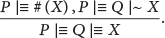
If P believes that X is a recent message and Q has once said to be X, then P believes that Q believes X.
Rule 3.
The jurisdiction rule is as follows:

If P believes that Q has jurisdiction over X and P believes that Q believes X, then P believes X.
Rule 4.
The freshness rule is as follows:

If one part of a formula X is known to be fresh, then the entire formula must also be fresh.
Rule 5.
The message of elimination of multipart rules is as follows:

These rules show how principal handles multipart message.
The idealized forms for our protocol, as illustrated in Box 2, expressed by the BAN logic are as follows: Message 1: Message 2: Message 3:
4.2.2. Goals
According to the analytic procedures of BAN logic, the proposed protocol has the following four goals; the goals of our protocol are shown as formulas
4.2.3. Assumptions
The following assumptions about the initial state are made to analyze our protocol by using the BAN logic:
4.2.4. Verification
We use the rules and assumptions based on the BAN logic to analyze the idealized form of the proposed protocol; the main steps of the proof are described as follows.
Message 1 (
According to assumption (
S computes the session key
Message 2 (
According to assumption (
According to assumption (
According to (S5) and Rule 5, we obtain
According to assumption (
Message 3 (
According to assumption (
According to assumption (
According to (S9), (S10), and Rule 2, we obtain
Therefore, we are sure that our proposed protocol is capable of achieving the goals from (
4.3. Security Analysis
4.3.1. Anonymity
User anonymity refers to the condition that an attacker
4.3.2. Mutual Authentication
Mutual authentication means that the server and the user can verify each other and establish mutual trust before visiting the patient privacy information. In our scenario, only the legitimate user who possesses the right password and authenticated information can send the request to the server, and only the authorized server who owns the correct secret key can verify the user's request. Therefore, this scheme can provide mutual authentication between the user and the server. That is to say, our proposed scheme achieves mutual authentication between the legal user and the server.
4.3.3. Replay Attack
Replay attack means that the attacker captures the message before running the protocol or being run to attack the current agreement. In the process of authentication, both the user's request
4.3.4. Perfect Forward Secrecy
Perfect forward secrecy means that the previously claimed session key remains safe even if the long-term private keys of the server and the user are disclosed. In our scenario, it is assumed that even the current session key is compromised and then the previously established session key
4.3.5. Man-in-the-Middle Attack
Man-in-the-middle attack refers to the condition that the attacker disguises herself as a legitimate participant, thus making the other communication terminal think that they are performing a direct dialogue through the secret connection. In our scheme, the attacker
4.3.6. Smart Card Stolen Attack
An attacker
4.3.7. Efficient Password Change Phase
A user can make denial of service attack if he/she did a little mistake which may be due to incorrect password input in the password change phase. The invalid detection of incorrect input can lead to denial of service scenario, so we should give efficient password change phases. In our scheme, the smart card first verifies the correctness of identity and password with the server by establishing an authorized session. Then owing to entering correct identity and password, the authorized session can be successfully established. As long as the session has been established, the smart card requests a new password and initiates the password change phase. This process shows that our proposed scheme has efficiency to detect incorrect input.
4.3.8. Privileged Insider Attack
A malicious privileged insider in server's system may try to obtain a legitimate user's password. In the registration phase of our proposed protocol, the user U sends
4.3.9. Session Key Verification
In Steps 3 and 4 of the authentication phase, the user sends message
4.4. Software Implementation Analysis and Comparison
4.4.1. Software Implementation
The main problem of our scheme in software implementation is computation time of the Chebyshev polynomials
Let the Chebyshev polynomial order be
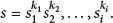
Then

Therefore, the computation of
With the existing high-precision libraries, the correctness of numerical algorithms in finite precision arithmetic may be solved. In the practical application, the security of this agreement does not completely rely on the difficulty of high-order polynomial number problem anymore. Therefore, we may not take the most maximum values of u and r, thus further enhancing the security of the protocol.
4.4.2. Comparison
In this section, we will compare the security and the computational cost of the proposed scheme with the recently published scheme.
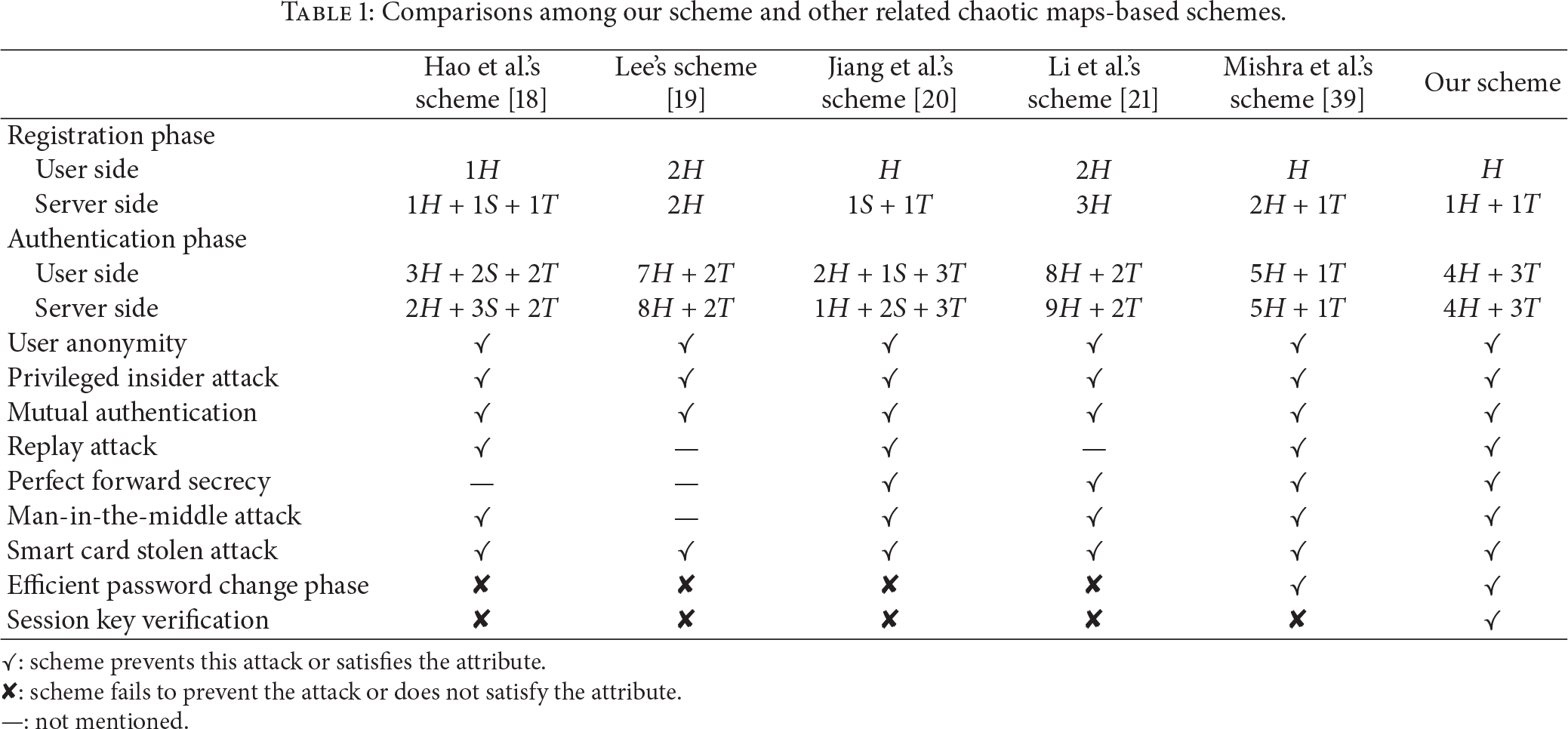
In the WBANs applications, resource constraint in low cost devices must be given priority to consider in addition to security and privacy. The used sensors for medical service are limited with storage space, computation power, and the lifetime of a battery. Firstly, we defined some computational parameters as follows. H denotes the time for the hash operation; S denotes the time for the encryption/decryption operation; T denotes the time for the Chebyshev polynomial computing.
As show in Table 1, comparing with the chaotic maps-based authentication, the proposed scheme can satisfy the desirable security attributes of authentication and overcome the weaknesses of the existing schemes. The number of Chebyshev chaotic maps operations used in our scheme equals that in [20], but our scheme does not need symmetric en/decryption operations. Moreover, the proposed scheme needs one more Chebyshev polynomial operation than that in [21], but it can better guarantee the authentication on both communication sides. In addition, the proposed scheme supports the function of session key verification and efficient password changing; however, the schemes [18–21] do not provide efficient password changing phase and the schemes [18–21, 39] lack the verification of session key.
Comparisons among our scheme and other related chaotic maps-based schemes.
✓: scheme prevents this attack or satisfies the attribute.
✘: scheme fails to prevent the attack or does not satisfy the attribute.
—: not mentioned.
Table 2 shows the comparison of computational cost among our proposed scheme and the other two schemes in WBANs. Here, we established the simulation hardware environment and evaluated the computation overhead of this scheme. The simulation environment of AP is Windows 7 OS (a Pentium(R) E5300 2.6 GHz processor and 2 GB RAM). The simulated WBANs client is run in Android OS 5.0 (64-bit processor and 32 GB memory). Otherwise, Table 2 shows the computational cost comparison at the client and application provider in the authentication phase among three related schemes in WBANs. In our proposed scheme, it is obvious that the computational overhead is superior to the other two schemes both at the WBANs client and the application provider. In our authentication protocol based on Chebyshev polynomials, the semigroup property of Chebyshev polynomials is utilized to achieve the mutual authentication and acquire the common session key. At the beginning of the authentication, we do not need to establish the public key cryptographic system. In the authentication phase, we save the time for modular exponential computing and scalar multiplication on elliptic curves which are involved in previous agreements. Therefore, in our scheme, the calculation load is decreased.
A comparison of computational cost of different schemes in WBANs.

It is obviously seen from Table 3 that the proposed scheme does not only satisfy the existing security attribute of [26, 27] but also satisfy the efficient password change. So it can achieve the desirable safety demands of WBANs. Moreover, the proposed scheme has less computational cost than previous results [26, 27]. In conclusion, our proposed scheme takes into account not only the security properties but also the computation overhead of APs and WBANs client.
Security attributes comparison with some recently proposed schemes in WBANs.

✓: scheme prevents this attack or satisfies the attribute.
✘: scheme fails to prevent the attack or does not satisfy the attribute.
—: not mentioned.
5. Conclusion
In this paper, we proposed a chaotic maps-based authentication scheme for WBANs. This scheme can not only realize user anonymity but also resist a variety of attacks. Moreover, the scheme makes full use of Chebyshev polynomial's semigroup feature to create the session key. In the authentication phase, it reduces the computation time by eliminating the modular exponential and the scalar multiplication on elliptic curve. In addition, it is not required to create a public cryptographic system in advance.
We presented the security model for our scheme, verified the validity of the protocol, demonstrated its security property, analyzed the key implementation point of Chebyshev polynomial, and compared computation overhead of the related schemes. Through the above analysis, we think that the proposed scheme is more suitable for WBANs.
Footnotes
Notations
Competing Interests
The authors declare that there are no competing interests regarding the publication of this paper.