




Abstract
The world population is aging and loneliness has become one of the major issues affecting the quality of life of our senior citizens. Additionally, we have observed that social computing increases social contexts through the use of Information Communication Technology (ICT). Smartphone and tablet proliferation also empower people to interact and create and share contents, strengthening new forms of communication independent of time and space. Therefore, the senior population would have a lot to gain by using social networks to overcome their solitude. Nevertheless, the elderly are still digitally excluded due to their lack of technological skills, as well as age-related impairments. This work presents a social network tailored for the senior population where the feelings of belonging, companionship and connectivity, well-being and interaction, meaningfulness, and emotional comfort are empowered. Our contribution aims to digitally include all seniors—independent of their educational level, literacy, or technological skills—by promoting a social network that allows them to share their life experiences, strengthen communication, improve their awareness of still playing an active and useful role in society, encourage emotional comfort, improve their health condition, and provide new forms of joyful entertainment in their lives. The final evaluation indicates that all seniors were very enthusiastic about the experience.
1. Introduction
The world population pyramid projects an increasing population of those aged 65 years or over [1, 2]. This global phenomenon is leading to socioeconomic and political implications.
As they retire, the elderly change from an active role in society to a more passive role. They no longer have a schedule or professional activity and interaction with their coworkers and instead stay at home. Most do not have their children living with them anymore, and some are widowers/widows. Therefore, they usually find themselves lacking in purpose and lonely, which may lead to manifest depressions due to social isolation. Exacerbating this state of mind is the physical health impairment that results from aging [3–5].
For family members who assume a caregiver role, their own modern lifestyle with demanding jobs, child care, household activities, social involvement, and digital lives leads to time issues that constrain the support they could otherwise provide to their elderly relatives. Moreover, we can observe an increasing trend in migration where many families leave their area seeking better life opportunities. During these migrations, senior members often remain in their familiar surroundings while their children go abroad, leaving their parents unattended [6]. Therefore, family members often develop feelings of guilt from their inability to provide proper care and attention to their elderly parents, including anxiety due to the absence of distress alerts whenever their elderly parents or family members are in dangerous situations.
As a result of the diminishing number of young active workers and the increasing number of retired seniors, governments are struggling to maintain a sustainable social security system [7].
All of these stakeholders—seniors, family members, caregivers, and governments—would benefit from a solution where seniors, while keeping their own independency, could be monitored both physically and emotionally. Emerging technologies and devices can contribute towards this task. The past few years have seen body area network solutions becoming more mature and providing features to monitor vital signs [8]. We also have observed the exponential development of social networks to connect people all over the world [9]. Additionally, devices such as mobiles or tablets are available at an affordable price and are now an intrinsic part of our daily lives, with more and more accessible interaction. Consequently, the combination of several technologies can improve the quality of life for seniors.
In this paper we will focus the loneliness issue as seniors and medical staff, when interviewed, were unanimous in pointing out that solitude is the major issue that must be addressed when considering the elderly population [10]. During these interviews, it was clear that seniors prefer to maintain their independence and live in their own homes as long as possible, yet they are still eager to communicate. Another inference is that solitude and social exclusion is a transversal problem in rural and urban areas. While in rural areas isolation is often due to geographical locations, in urban areas isolation among the elderly can be attributed to a fear of walking in the bustling cities. Moreover, for those with reduced mobility who live in older buildings with no elevator, stairs are often an obstacle to leaving their homes.
To overcome solitude and increase the use of virtual societies by the senior population, social networks and social media can play a crucial role when adequately applied for older adults [11]. Social networks are leverage to maintain active relationships with other family members or friends and continuous medical support, regardless of time or place [12]. In a social media context, the creation of a user-generated content and exchange based on life experiences and wisdom in seniors is a vital feature, particularly since life experiences are one of the greatest sources of wealth accumulated during our lifetime and must be disclosed to future generations.
Despite the development of many software applications where people interact socially, such as Facebook, Twitter, LinkedIn, Pinterest, Google+, and Instagram, the needs and specifications of the senior population are often disregarded.
The absence of a social network platform that meets the usability needs for seniors is identified as the major reason for their lack of involvement in Web 2.0 social networks, despite the many potential benefits [13]. The senior population still struggles with digital exclusion and technological barriers [14].
Given the intense benefit that social networks can provide to increase the quality of life for seniors and the fact that there are still many seniors who are unable to take advantage of these benefits, we have explored social networks features and propose a fundamental set of mandatory characteristics so that all older people, despite their education level and technological skills, can fully enjoy social networks. Moreover, a solution using the proposed characteristics was developed and further tested.
The remainder of the paper proceeds as follows: related works are presented in Section 2, followed by the characteristics and architecture of social networks in Section 3. Section 4 contains the prototype and evaluation. Conclusions are shown in Section 5.
2. Related Work
The loneliness manifested by older adults has been a transversal motivation in several studies. The appearance of social networks and the proliferation of low cost devices—such as tablets and smartphones—and existing internet communications have expanded the horizons in research seeking to apply new technologies to overcome social exclusion in the senior population [15].
One of these examples is AMCOSOP (Ambient Communication for Sense of Presence). This platform uses a touch screen device (home terminal and mobile client) and web services to encourage communications by the elderly with their families, friends, and professional caregivers [16].
Another example is the Mazadoo platform [17]. Mazadoo solution has a TV interface allowing the senior population to interact with Facebook, a wide social network already used by the family members of many seniors. The Mazadoo developers adapted the display of Facebook newsfeeds and content consultation on the home TV screen of the elderly user.
TV-Kiosk is another TV-based user interface designed for the elderly with the same goal of stimulating social interaction and avoiding isolation [18].
The 2014 call challenge for the joint active and assisted living and ICT for living well programme, especially call 2—ICT based solutions for Advancement of Social Interaction of Elderly People—presents several projects within this scope [19].
Some, including TV-Kiosk, are TV-based projects. For example, FoSIBLE (Fostering Social Interactions for a Better Life of the Elderly) aims to improve the quality of life for seniors by fostering social interaction of elderly people by means of innovative ICT. They have designed TV-based services dedicated to the elderly [20]. The HOMEdotOLD project has the same goal, as it aims to provide a TV-based platform with cost-effective services to advance the social interaction of elderly people [21].
Another example of projects that resulted from the 2014 call challenge for the joint active and assisted living and ICT for living well programme is Nostalgia Bits (NoBits). This project explores the digital archiving and sharing of memories encapsulated in letters, newspaper clippings, postcards, photos, and other artifacts. They mention a double effect in digitally archiving artifacts in the senior population: a means for connecting the elderly with members of their own generation and a significant resource for use by future generations [22]. Another example is Going online: my social life platform [23]. This platform is tailor-made for older people and can be used on a computer, smartphone, or tablet PC.
SSP (Senior Social Platform) presents itself as a social network with a user-friendly interface focused on senior citizens, using Google OpenSocial APIs [13]. They also refer many senior social networks that aim to exchange photos, chat, play brain games, provide online dating, and so forth.
While these are valid initiatives, there remain nonetheless some issues yet to address. For example, TV-based solutions, while using a familiar device which is already present in the homes of most seniors, can be limited when inputs are taken into account. In fact, the increasing expansion of low cost devices such as tablets and smartphones, which are intuitive for the senior population because of the touch and voice recognition base instead of the traditional and more complicated inputs, extends the interaction potential with social networks. Another issue to address is the fact that older adults still recognize that technology has also the capability of disempowerment [14]. What we want to do is expand the use of social networks to every elderly person, even the illiterate. The solutions found to date also assume that seniors are able to read, which is still not a reality [24], namely, in our country—Portugal [25].
To suppress the above-identified issues, we propose a senior social network (SSN). Our contribution aims to digitally include all seniors—independent of their educational level, literacy, or technological skills—by promoting a social network that allows them to share their life experiences, strengthen communication, improve their awareness of still playing an active and useful role in society, encourage emotional comfort, improve their health condition, and provide new forms of joyful entertainment in their lives.
We propose some fundamental characteristics that must be present in social networks tailored for the senior population, in conjunction with a solution that meets those characteristics. Our proposal is explained in detail in the next section.
3. SSN: Senior Social Network for Improving Quality of Life
As previously mentioned, social networks and social media are now an intrinsic part of our lives. People are always connected, sharing information, exchanging experiences and emotional feedback as we live in a digital era. Many discussions are being held over the benefits and other issues concerning this new digital life. In fact, these kinds of solutions may play an extremely important role in combating the loneliness and emptiness manifested by the majority of the senior population. In order to do so, some characteristics linked to social networks and social media [26] must be taken into account. We further address some characteristics that we consider fundamental, especially due to the target population. Afterwards, we will present the architecture of the proposed solution, which followed the proposed characteristics.
3.1. Characteristics
In order to develop a social network for improving the quality of life for seniors, we need to attend certain specifications. We need to keep in mind that seniors wish to foster relationships with distant family members and friends. They also want to keep an active role in society and cherish entertainment activities. Furthermore, they usually manifest some difficulties in dealing with new technologies, and some of them are even illiterate. Age-related physical and cognitive decline is also a factor to bear in mind, as we want to promote healthy aging.
For that purpose we propose the following characteristics: Simple interface: common minimalistic and intuitive social user interfaces must be developed. This feature is even more relevant when the senior population is the target and natural physical and cognitive age-related changes must be taken into account. The main drive is to “keep it simple.” Therefore, we have done some previous work regarding the existing barriers between the elderly and their use of ICT in order to underscore all the benefits provided from mobile sensing and social computing. A survey on guidelines, standards, and advice regarding usability and accessibility issues when developing solutions for elderly people was carried out in [27]. Extended interface: smartphones, tablets, and wearable technologies are contributing towards a more dynamic and ingrained interaction in our daily routines. Social networks are not constrained to traditional inputs, where some technological skills were previously needed. These new components appear as a natural extension of ourselves, spreading our ability to relate with the world and others. Collecting and sharing information are becoming more inherent to anyone, even those with little to no technological skills and digital expertise, anytime, anywhere. Consequently, the interaction of the senior population with social networks is growing into easier-to-use and more enriching forms. Ease of feeding and finding: data must be easy to upload, share, and find. Most of our contents are unstructured and not just based on text, but also images, videos, and emotional reactions. So, this social participation needs to be simple to provide. Also due to this miscellaneous ecosystem, the contents must be easy to search and access. Again this characteristic is fundamental concerning the elderly, who are usually technologically illiterate and are less agile within digital barriers. Being user-based: users fill the social network with conversations and content, in a collaborative and interactive way. Again, in a social network tailored for the elderly, this kind of interaction is very important as feedback stimulates the continuity of discussions and shares. User-generated content creation and exchange: social media enriches social networks. This characteristic is vital whenever the elderly are considered, as they have so many life experiences and so much wisdom to share [28]. These may include (i) life testimonies, such as the experience of going through and overcoming an illness, which can help others who are going through the same situation, especially giving hope and motivation; (ii) storytelling to their grandchildren, consolidating the ties that sometimes geographical distance keeps apart; (iii) passing down traditional know-how and craft to future generations, such as recipes, proverbs, or folklore, preventing the loss of information; (iv) professional tacit knowledge shared with former but still active coworkers, ensuring organizational proficiency. Being interactive and entertaining: modern social networks have an increasing number of applications for games and other entertainment. The elderly can significantly benefit from this characteristic as they are likely to have more time to spend with serious games applications that can, for instance, stimulate their memory and cognitive functions. Additionally, games with multiple players lead them to interact with other people. Emotion over content: sharing life experiences not only with friends but also with other persons who are passing through the same experience can provide extreme emotional comfort. Moreover, having a network of people to contact at any time provides a reassurance that we are never alone. Relationships: in the course of our lives we cross paths with many people with whom it is nearly impossible to keep in touch. The appearance of social networks has brought the opportunity to easily find old acquaintances and even some “lost” family members. Seniors, above other people, enjoy hearing from friends and family with whom they once interacted and resuming some relationships. Being community-driven: the fact that several people share the same interests, hobbies, and tastes contributes towards the increasingly numerous groups of people forming subnetworks. It is profitable to follow and interact with people who have similar background with regard to interpersonal growth. In-person event promoter: many social networks facilitate the creation of events, including hiking or other outdoor activities such as visiting tourist sites. Whenever the elderly are home alone, they may have tendency to settle and be isolated. Social networks can provide groups to promote activities involving physical exercise and tours, which is very important in developing healthy routines.
Our aim is for these proposed characteristics to develop positive feelings in the elderly. The communication underlying a social network should enhance the (i) feeling of belonging, the social aspect of communication, and contact with remaining family members and friends face to face. Although not replacing face-to-face interactions, it will help fight the loneliness that may occur when physical presence is not possible. Thereby existing relationships will be fortified and new ones will emerge, increasing the (ii) feeling of companionship and connectivity. Additionally, we want to increase mental health and memory stimulation among senior citizens by holding the concept of network-based gaming applications, such as card games available for multiple players, and other more serious games, thus developing the (iii) feeling of well-being and interaction. As for the construction and interchange of media content, we want to improve the (iv) feeling of meaningfulness, being valuable to society by sharing knowledge, and leaving a mark. The experience exchange and support will also intensify the (v) feeling of emotional comfort.
3.2. Architecture
Using the stated characteristics in social networks and the positive feelings we intend to encourage in seniors to improve their quality of life, we have built a solution to allow the senior population to become easily integrated in a social network and to create and share their own generated content.
Figure 1 represents the high level architecture of the proposed solution, which follows the characteristics that we have highlighted in the previous section.

High level architecture.
The concept is to allow the senior population to use an easy and adapted interface in order to interact, produce, and share artifact over social networks. This participation over social networks by the senior population increases some important feelings that can contribute to the process of overcoming solitude. Family members and other caregivers are able to use familiar social networks to interact with the elderly, like Facebook, YouTube, Google+, Twitter, and other social networks that have Application Programming Interfaces (APIs).
4. Prototype and Evaluation
For evaluation purposes we have built a prototype of the proposed architecture. Regarding social network servers, we have installed two servers: one IP multimedia subsystem (IMS) application server, where the web application and databases are hosted, and one speech recognition server, where audio is translated to the correct command and transmitted back to the web application. As for social network API, we have used YouTube Data API, which allows users to see videos in our web application, and YouTube Upload Widget to allow users to send and share their videos.
Figure 2 represents the prototype workflow now described. From the initial tests conducted, we have concluded that the registration process is too complex to be performed by seniors. Therefore, the registration and configuration of channels must be done by the caregiver (1). After the registration process, both caregiver and senior can interact with the social network application (1, 2). These stakeholders can use the platform to make video phone calls or to create, watch (using YouTube Data API underneath), and upload videos using the embedded YouTube Upload Widget (3). Given the target population, support is available anytime to help seniors whenever they experience any difficulty, thus assuaging their anxiety and fear of using new technologies (4).

Prototype workflow.
The prototype was built to incorporate the characteristics we found essential to include in a social network whose aim is to improve the quality of life for seniors. (i) Simple interface characteristic: we designed the web application interface as simply as possible, according to a previous survey made over usability and accessibility guidelines [27]. (ii) Extended interface: we also included Responsive Web Design (RWD), allowing the application to adapt to different equipment. Additionally, we enlarged the input methods allowing voice command interaction through the existence of the speech recognition server. (iii) Ease of feeding and finding: we adopted YouTube API to build our prototype, as YouTube channels help us fulfil this characteristic. (iv) Being user-based, (v) user-generated content creation and exchange, (vi) being interactive and entertaining, (vii) emotion over content, (viii) relationships, and (ix) being community-driven are intrinsically connected and are achieved in the prototype as seniors are able to create and share their own videos and make video phone calls. Finally, (x) in-person event promoter: users can use the provided social network to arrange events.
In order to evaluate the prototype, which included the proposed characteristics and reflected the architecture, we adopted a qualitative research methodology by conducting semistructured interviews [29] with 23 individuals in their own environment. In our population sample, we included some younger adults who could contribute their personal experience in other social networks.
Although the elderly participants were in their own environment, bringing in unfamiliar devices and our mere presence created a certain detachment and distrust among them. Semistructured interviews were a very valuable methodology that served to build rapport prior to using the questionnaires. We focused our evaluation within the social context. We want to evaluate user's acceptability, opinions, and feelings towards the proposed model of social engagement [30].
We began by explaining the functionality and goal of our platform and performing a demonstration. Afterwards we asked them to explain in their own words what they understood and then clarified any doubts. Next, we asked them to perform some usability tests, as shown in Figure 3, to experience some of the social network functionalities. For this purpose we asked them to perform the following tasks: (i) access the application, (ii) create and share content, and (iii) visualize already available content. We repeated this process over a period of 5 days to allow users to become more aware of the solution and evaluate its benefits. Then we conducted the semistructured interviews following a framework of questions.

Usability tests.
Regarding the framework of our questions, we intended to gather information about basic sociodemographic information and evaluate the participants' feelings towards our solution and its characteristics. As for sociodemographic variables, we obtained data on age, gender, literacy, and technological literacy. We considered a person with no computer skills or interaction, or one who had never had used a mobile phone, to be technologically illiterate.
Table 1 represents the sociodemographic dataset of our sample.
Sociodemographic dataset of our study population.
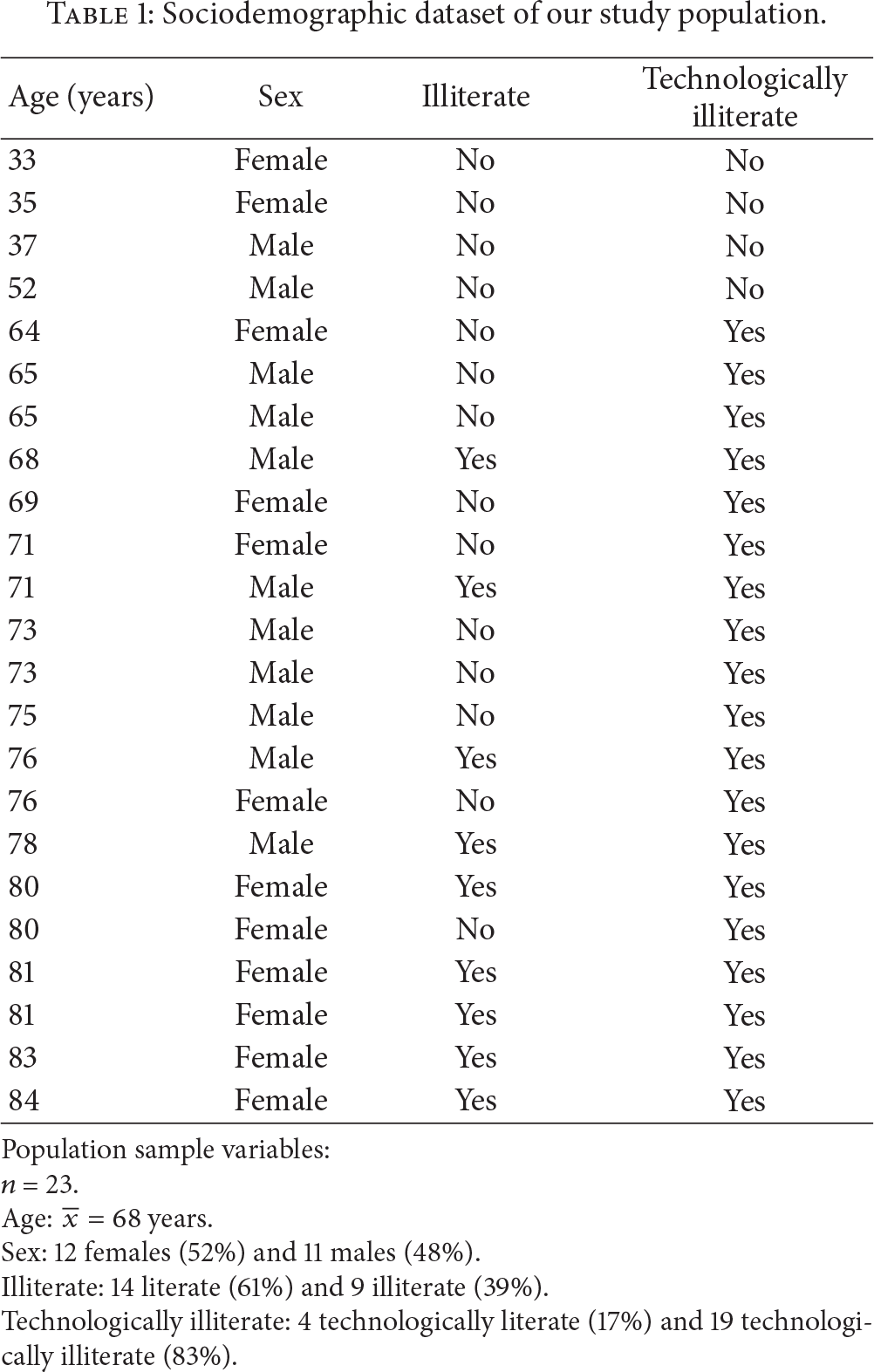
Population sample variables:
n = 23.
Age:
Sex: 12 females (52%) and 11 males (48%).
Illiterate: 14 literate (61%) and 9 illiterate (39%).
Technologically illiterate: 4 technologically literate (17%) and 19 technologically illiterate (83%).
In order to evaluate the emotions and feedback to our proposal, the following questions were posed. (Q1) What did you most enjoyed? (Q2) What were the major difficulties that you felt? (Q3) Do you think that using our solution would reduce some loneliness that you may feel? (Q4) Is it important for you to be able to share previous life experiences? (Q5) Would you be willing to use our solution on a daily basis, as with your television, radio or telephone? (Q6) In what way would your life most benefit from using this solution?
We then analyzed the responses, coded them, and obtained the following results. some were embarrassed at first. But the novelty of using something different generated some excitement in most of the elderly participants. Many of them reported it was funny to see themselves after recording the videos. despite the previous explanation and demonstration, many of them still felt lost when presented with a touch device. They still manifested some resistance and fear in handling new devices. they were unanimous in affirming that such a solution would become a source of entertainment that could help them in lonely days. they were also unanimous in stating the extreme importance of leaving knowledge to further generations. One user shared that her mother had never taught her how to make a typical recipe and that knowledge was forever lost when her mother passed away. they manifested some initial fear of ruining the equipment as they were not familiar with tablets or touch computer screens like with other equipment, including, for instance, television or radio. For that reason, they feel the need to have someone supporting them until they are secure and autonomous in dealing with the equipment. But afterward, they acknowledge our solution's benefits and are excited and willing to use it on a daily basis. the main item was the fact that they were able to see their family members in video phone calls. They also found it very amusing to create and share content among themselves.
Result discussion and conclusions will be drawn in the next section.
5. Conclusions
Social networks can deeply increase quality of life for the elderly, especially their ability to overcome solitude, a condition usually manifested by this population. Nevertheless, many seniors are still unable to take advantage of these benefits due to age-related issues and technological illiteracy, among other factors. Our major goal is to overcome these issues and use social networks and social media to promote some of the positive feelings identified by the seniors in our study during the interviewing phase: (i) feeling of belonging, (ii) feeling of companionship and connectivity, (iii) feeling of well-being and interaction, (iv) feeling of meaningfulness, and (v) feeling of emotional comfort. Moreover, our purpose is to reach every elderly person, regardless of their education level, literacy, or technological skills.
To this end, we explored social networks features in order to propose a fundamental set of mandatory characteristics to enhance their use among the senior population: (i) simple interface, (ii) extended interface, (iii) ease of feeding and finding, (iv) being user-based, (v) user-generated content creation and exchange, (vi) being interactive and entertain, (vii) emotion over content, (viii) relationships, (ix) being community-driven, and (x) in-person event promoter. Moreover, we have proposed an architecture where seniors can view, create, and share artifacts, such as life testimonies, over social networks that meets the mentioned fundamental characteristics. This way we can extend the benefits of some existing social networks, creating a layer in order to adapt them to our target population and to add new features in order to potentiate their use. To make a proof of concept, we developed a solution using the proposed characteristics and performed an evaluation. For the presented solution we based our work on user-content creation and share build upon YouTube API. Concerning the tests, we have asked 23 individuals to experiment the visualization, creation, and share of contents over the prototype during a 5-day period. We have included illiterate individuals to reach as many profiles as possible, since it is very important that the solution found could be usable by any senior, despite his/her literacy level. The tests were important to check if users were able to fulfil the proposed tasks and to obtain their feedback regarding the added value of the solution to improve their quality of life.
We verified that, in an initial phase, senior participants manifest some lack of confidence to interact with new technologies, being afraid of destroying the equipment. They need support presence until they feel comfortable in handling the equipment. After this adaptation to new hardware they were able to take full advantage of the proposed solution due to its simplicity. They even expressed their admiration in being able to fulfil all the tasks by themselves. Their feedback was extremely positive as they were amazed by new experiences and value communication, entertainment, and user-content creation and sharing. After the test phase, they all manifested the will to continue to use the solution. Future studies could involve more family members who serve as caregivers, which would provide the seniors with a familiar face during the tests. Moreover, their support could serve to integrate social networks into the daily routines of their senior family member, for instance, by replacing phone calls with video calls.
Footnotes
Competing Interests
The authors declare that there are no competing interests regarding the publication of this paper.
Acknowledgments
Special thanks are due to the Memoria nursing home for their collaboration and to all the elderly residents who collaborated in the authors' tests and gave their opinion, thus making the authors' work possible.