




Abstract
In this article, we propose a novel wireless powered communication network, which is composed of two multiple antennas hybrid access points and a series of distributed wireless devices. The two hybrid access points transmit downlink wireless energy to the wireless devices and receive uplink wireless messages from the wireless devices; meanwhile, the information of wireless devices nearer to their corresponding hybrid access point should be transmitted to the faraway hybrid access point. To improve the throughput performance of some wireless devices away from their corresponding hybrid access point, we propose a clustering-collaboration interactive communication protocol with multiple antennas by Time Division Multiple Access, where two of the distributed wireless devices are selected as cluster heads to help relay information of other cluster members, which can efficiently improve some faraway wireless devices’ throughput performance. However, its performance is also constrained by cluster heads’ high-energy consumption. To solve this energy imbalance problem, multi-antenna energy beamforming technology is exploited for the hybrid access points, which distributes more transmission power to the cluster heads to balance all the wireless devices’ energy consumption. In particular, we obtain the proposed system’s throughput performance through the multi-antenna cluster-based collaboration, and verify through simulations that this scheme can effectively enhance user unfairness and improve the throughput performance.
Keywords
Introduction
The finite battery life cycle of wireless devices (WDs) powered by battery is the bottleneck of modern wireless communication network (WCN) performance. 1 When its energy is exhausted, a WD requires to replace/recharge the battery manually, which can lead to interruption of normal operation of WDs and serious degradation of communication performance. Moreover, the state-of-the-art development of wireless energy transmission/wireless power transmission (WET/WPT) technology makes a new network paradigm possible, called wireless powered communication network (WPCN),2–4 in which WDs’ information transfer, such as sensors, is powered by dedicated WET to supply sustainable and continuous microwave energy through the air. The utility of WET can effectively lower the cost of batteries replaced or recharged, reduce power interruption, and improve the quality of communication. Because WET has the potential to address the key energy confinement, WET is expected to be a significant component of the future WCNs.
WPCN has drawn much attention from domestic and foreign scholars,5–7 and has been widely applied in various fields to prolong network life cycle effectively or enhance network’s data rate, especially in the application of lower power consumption, for instance, radio frequency identification (RFID) networks, 8 unmanned aerial vehicle (UAV), 9 Mobile Edge Computing (MEC), 10 Big Data, 11 5G Communication, 12 , 13 Blockchain, 14 and wireless sensor networks (WSNs).15–17 At present, there are a large number of literatures regarding WPCN. For example, Ju and Zhang 18 studied a WPCN’s throughput performance with multi-user and one single-antenna hybrid access point (HAP), which first put forward a classical harvest-then-transmit (HTT) protocol, where in the downlink (DL) the HAP broadcasts radio frequency (RF) energy to all users, and in the uplink (UL) all users use the energy harvested DL to transfer their respective information to the HAP via Time Division Multiple Access (TDMA). However, there is a phenomenon that these users far away from their associated HAP harvest less energy but require more energy to transmit their information, and vice versa, which is so-called “doubly-near-far” unfairness problem in WPCN due to the distance-dependent power loss. This will result in lower throughput of users far away from the associated HAP, which makes user unfairness exist in the networks, and thus affects the performance of the whole networks. Therefore, Che et al. 19 also revealed that this design would lead to great unfairness in the throughput among users, especially that the data rate of these users was two orders of magnitude smaller than that of other users, and this unfairness problem was more obvious, which directly reduced the sensing accuracy of WPCN.
Subsequently, many researchers proposed different methods of user cooperation to improve user fairness of WPCN, that is, users close to the associated HAP forwarded the information of users far away from the associated HAP.20–28 For example, Zhong et al. 20 presented those two users interact with each other’s information to form a distributed system of antennas that jointly transfer their messages Chen et al. 21 thought of a simple reference module for three nodes in a WPCN, where a harvest-then-cooperate (HTC) protocol was first put forward, and then extended it to common multi-user collaboration scenarios. Ju and Zhang 22 proposed a two-user collaboration method, in which the closer user acted as a relay to assist in transmitting the farther user’s message to HAP. Zhong et al. 23 further considered a general multi-user scenario: multiple users are used to assist users far from the associated HAP to transmit their formation. Besides, Yuan et al.29–31 proposed a multi-antenna cluster-based cooperation protocol, in which a WD acted as a cluster head (CH) and relayed the other cluster members’ (CMs) messages to the HAP. While considering interactive transmission between multi-HAP and multi-user, the clustering collaboration’s throughput performance is unknown.
This article focuses on a novel WPCN system consisting of two HAPs (HAP1 and HAP2) and N WDs, as shown in Figure 1, where HAP1 and HAP2 first broadcast wireless energy to the N WDs, and the N WDs then use the collected energy from HAP1 and HAP2 to transmit their independent messages to the corresponding HAP. The distance between each WD and the two HAPs is compared, and the one nearer to

A novel WPCN system.

WIT UL: (a) WIT UL of HAP1 and (b) WIT UL of HAP2.
The main contributions of this article are shown as follows:
A novel WPCN system model is proposed for interactive information between two HAPs and a clustering-collaboration interactive communication with multiple antennas by TDMA to improve its data rate.
To deal with the issue of the two CHs’ high-energy consumption, multi-antenna EB technique at the HAPs is exploited, where more transmission power is concentrated into the two CHs to achieve a balance of energy consumption for all WDs. The application of multi-antenna EB technique at HAPs not only improves the efficiency of WET DL but also enhances the spectral efficiency of wireless information transmission (WIT) UL.
We develop the issue of maximizing the minimum power received among the WDs and demonstrate through simulations that this scheme can efficiently enhance the proposed system’s throughput unfairness performance.
Modeling system
Channel model
As shown in Figure 1, a novel WPCN system model is proposed constituting two HAPs (i.e. HAP1 and HAP2) and N WDs, where HAP1 and HAP2 include (N – k – 1) and (k + 1) WDs, respectively. Specially, the two HAPs perform WET DL and receive WIT UL. The two HAPs have steady power requirement to coordinate WET and WIT from the N WDs. Each WD is furnished with an internal battery for reserving wireless energy collected from its closer HAP. All the WDs and the two HAPs run on the same frequency band, and apply a time-division-duplexing circuit 25 for separating energy and message transmissions. In particular, both the two HAPs and each WD are fitted with M > 1 antennas and single antenna, respectively. Our purpose is to make their respective messages transmit to each other’s HAP. In other words, the messages of (k + 1) WDs within HAP1 should be transmitted to HAP2, while the messages of (N – k – 1) WDs within HAP2 should be transmitted to HAP1.
In this article, two of the WDs are selected to act as the CHs that assist in relaying the other CMs’ WIT UL. The means of choosing the CHs will be covered in the “Numerical results” section. In general, the two CHs are labeled as
At the start of a transport block, there is over a fixed time period of
Clustering-cooperation Interactive communication protocol
As seen in Figure 3 after the CE phase, the multi-antenna clustering-cooperation interactive WPCN runs in three stages in each duration block

The clustering-cooperation interactive communication protocol.
During the second phase with

where
Analyzing throughput performance
Stage I: design energy transfer
Note that CH1 and CH2 need to, respectively, transmit (k + 1) and (N – k – 1) messages in total, whose consumed energy would be considerably more than that of the other CMs. Therefore, the energy received by the two CHs is a bottleneck in network performance. In order to balance energy consumption and reception, this article considers the technology of EB32,33to concentrate the transferred energy into the two CHs.
Within time

where

where

In particular, all WDs can harvest the energy broadcast by HAP1 and HAP2 within
Ignoring noise power, we can represent the amount of energy collected by the WDs as 28

Here,
This article designs the EB matrix

The objective is to maximize the minimum received power among the N WDs. More specifically,
Stage II: intra-cluster transfer
Let

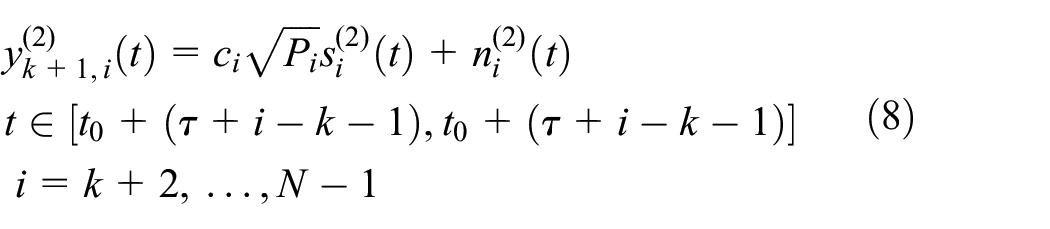
where
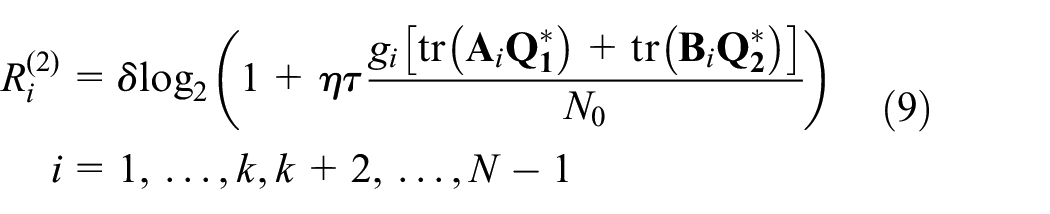
Meanwhile, the CMs’ transmission can also be overheard by HAP1 and HAP2, such that HAP1 and HAP2 can, respectively, receive

and

where
Stage III: cluster-to-HAP transfer
After decoding their corresponding CMs’ information, the two CHs successively send their corresponding CMs’ information along with their own information to their relevant HAP, where each information takes

and
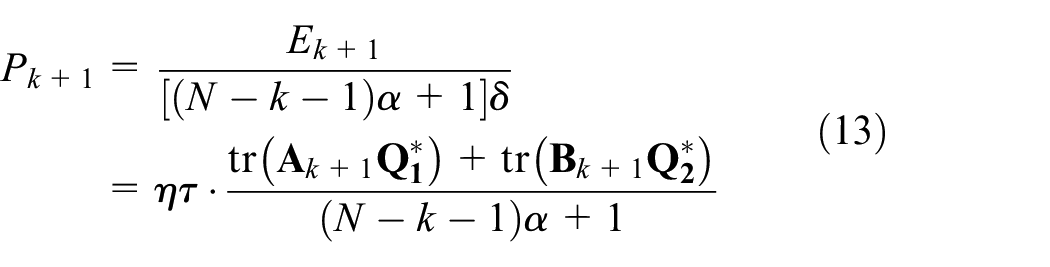
Let

and

More specifically, Figure 3 shows the CHs first take
To maximize the received signal to noise power ratio (SNR), HAP2 and HAP1 adopt the method of maximal ratio combining (MRC), in which their combined output SNR are

and

Then, the data rates of CH1 at HAP2 and CH2 at HAP1, respectively, are

and

However, HAP2 and HAP1 receive each CM’s information in both the second and third stages, in which of the situation, the message for each CM can be co-decoded by HAP2 and HAP1 across two stages at a rate, respectively, given by

and

where

and
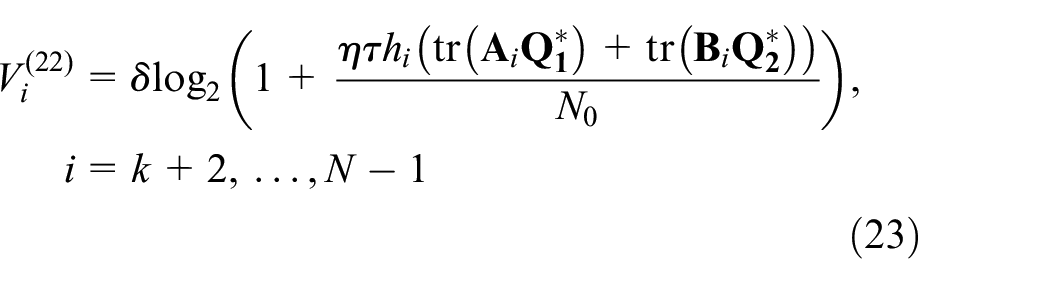
According to the data rates of WDs given in equations (20), (21), (22), and (23), both the spectral efficiency and fairness of our proposed protocol can be evaluated. More specifically, sum throughput performance can reflect spectral efficiency, that is

Furthermore, considering the minimum data rate among the WDs can reflect the fairness of our proposed protocol, 8 that is

It can be seen that the time allocation parameters
Benchmark method
The classical benchmark method Independent Transmission (IT)—with two multi-antenna HAPs adopting EB (IT with two HAPs)—has been compared in this article. For a relatively fair comparison, all the WDs are assumed to use up their energy collected during the WIT stage and transfer at a fixed power, and the two HAPs use MRC scheme to maximize the received SNR.
For this approach, the first duration

Let

Then the WDs transfer their information to their corresponding HAP one by one, where the transmission of each WD spends

In consequence, the WDs’ data rates at the two HAPs are

Numerical results
This section evaluates our proposed novel system model’s throughput performance for WPCN by simulation software MATLAB to simulate. All figures below show various approaches of the performance for the minimum data rate or optimal sum throughput. The Power cast TX91501-3W transmitter and P2110 Power harvester are, respectively, adopted as energy transmitter at HAP1 and HAP2 with transmitting power
Subsequently, we consider two schemes of selecting CHs by cluster-based cooperation, that is, the WD nearest HAP in the same cell as the CH (CCHAP), or the WD nearest to the center of the cell in the same cell as the CH (CCCH), where the former and the latter are, respectively, called CCHAP with two CHs and CCCH with two CHs for short. Besides, the WDs closest to their corresponding centers are selected as the CHs.29–31,34
In Figure 4, we compare user fairness (the maximum–minimum throughput or average minimum data rate) among all the WDs achieved by our proposed model for the system and multi-antenna clustering-collaboration interactive communication with the benchmark scheme IT with two HAPs in Section Benchmark method by fixing the cell radius r = 6 m when the distance d varies. Specifically, sum throughput (spectral efficiency) is also compared.

Performance comparison of the various transmission methods when r = 3 m and the cluster-to-HAP1d changes: (a) maximum–minimum throughput and (b) sum throughput.
Unsurprisingly, the data rates for all three schemes go down as d goes up. However, as shown in Figure 4(a) and (b), our proposed scheme (CCCH with two CHs) for the maximum–minimum and sum throughput performance is the best of the three schemes. For instance, in Figure 4(a), when d = 5 m, CCCH with two CHs and CCHAP with two CHs are, respectively, over 2 and 1 times more than the benchmark scheme, when d adds up to 12 m, the throughput for the IT with two HAPs is approximated to 0, while the proposed method CCCH with two CHs can still keep a fairly high optimal throughput. This indicates that our proposed system model and clustering-collaboration interactive communication have obvious performance advantages when the distance from the cluster to HAP1 is reversely far away. This is in part due to the doubly-near-far problem, which reduces some far-off WDs’ data rate severely; however, our proposed scheme can efficiently help to relay the information of those far-off WDs.
Figure 5 demonstrates the influence of intra-cluster communication links on the throughput performance by setting d = 9 m and changing the cell radius r. As seen from Figure 5, with the increase of r, the proposed scheme’s performance is performed the best among the other two schemes; for example, in Figure 5(a) and (b), when r = 3 m, our proposed scheme’s maximum–minimum and sum throughput performance are, respectively, over 3 and 2 times larger than those of the benchmark method. Moreover, as r increases, the other two methods’ throughput has a little change, but ours can remain reversely a high throughput. This means adopting EB technology at multi-antenna HAPs and clustering-collaboration interactive communication are necessary and helpful to enhance the system’s minimum throughput when r is relatively big.

Performance comparison of the various transmission methods when d = 9 m and the radius of the cluster r changes: (a) maximum–minimum throughput and (b) sum throughput.
Finally, Figure 6 demonstrates the stability of throughput performance as the number of N WDs ranges from 50 to 100 with an increase. In general, we fix d = 9 m and r = 6 m. As can be observed from Figure 6(a) that all schemes’ maximum and minimum throughput decreases with the increase of N. The reason is that the average transmission time assigned per WD is shorter, and thus the worst-performing WD’s data rate decreases. More specifically, as the number of N WDs increases from 50 to 100, the decrease in maximum–minimum throughput is steady, whereas the maximum–minimum throughput decreases significantly when N increases further. However, Figure 6(b) shows the sum throughput rises as N goes up in spite of the probable decrease of the data rate per individual. This suggests that there exists a trade-off for the throughput of between each individual WD and aggregate network. In practice, even so, it can be still observed that our proposed method has a fairly high-performance gain compared to the benchmark method, in which in the case of relatively large networks (such as N = 100), the worst-performing WD can still keep an extremely high data rate.

Performance comparison of the various transmission methods when the number of N WDs changes: (a) maximum–minimum throughput and (b) sum throughput.
Conclusion
In this article, a novel WPCN system model consisting of two HAPs with multiple antennas and a single antenna with N WDs is studied. A new interactive communication protocol for clustering collaboration with multiple antennas is used to improve throughput fairness. EB technology at the multi-antenna two HAPs is adopted for achieving directional energy transfer to equilibrate the WDs’ diversified energy consumption levels, especially the high-power consumption of both CHs. Through the joint optimization of EB design, the allocation of transfer time between HAPs and WDs, the transmitting power of two CHs, and the problem of optimal maximum–minimum throughput among WDs are formulated. Extensive simulation results demonstrate that the proposed system model and multi-antenna clustering-collaboration interactive communication with TDMA can significantly improve user fairness and spectrum efficiency in various scenarios compared with representative benchmark methods.
Footnotes
Handling Editor: Yanjiao Chen
Declaration of conflicting interests
The author(s) declared no potential conflicts of interest with respect to the research, authorship, and/or publication of this article.
Funding
The author(s) disclosed receipt of the following financial support for the research, authorship, and/or publication of this article: This work was financially supported by Doctoral research project of Tongren University (trxyDH2003), Doctoral talent project of Tongren Science and Technology Bureau (No.[2020]124), and Basic Research Program of Guizhou Province-ZK[2021] General 299.
