




Abstract
In order to meet the demand for efficient computing services in big data scenarios, a cloud edge collaborative computing allocation strategy based on deep reinforcement learning by combining the powerful computing capabilities of cloud is proposed. First, based on the comprehensive consideration of computing resources, bandwidth, and migration decisions, an optimization problem is constructed that minimizes the sum of all user task execution delays and energy consumption weights. Second, a dynamic offloading scheduling algorithm based on Q-learning is proposed based on the optimization problem. This algorithm makes full use of the computing power for cloud and edge, which effectively meets the demand for efficient computing services in Internet of Things’ scenarios. Finally, facing the environment dynamic changes of edge nodes in edge cloud, the algorithm can adaptively adjust the migration strategy. Experiments show that when the number of Internet of Things’ devices is 30, the total energy consumption of Internet of Things’ devices of proposed algorithm is reduced by 24.67% and 19.44%, respectively, compared with other algorithms. The experimental results show that proposed algorithm can effectively improve the success rate of task offloading and execution, which can reduce the local energy consumption.
Keywords
Introduction
Mobile cloud computing migrates the complex computing tasks of mobile devices by mobile networks, and offloads tasks to cloud data centers with powerful computing and storage capabilities for processing to meet the needs of complex emerging mobile applications. 1 However, the mobile cloud computing architecture has limitations; the cloud data center is far away from mobile terminal devices. The task to be processed needs to pass through access network and backhaul link can reach the cloud.2–4 This will lead to excessively long application services in mobile cloud computing, and will not be able to achieve the design goal of 5G providing users with millisecond end-to-end latency. 5 In addition, the centralized mobile cloud computing architecture affects network risk and attack resistance. For example, mobile cloud computing cannot meet the low-latency and high-reliability requirements of emerging applications such as Internet of Things (IoT), Industry 4.0, and telemedicine.6–9 Therefore, it is necessary to design a new computing service architecture in mobile network to support the landing and development of new mobile applications. 10
By sinking the computing and storage resources of cloud to the edge of network, services are provided for mobile devices near the edge network.11–14 Mobile Edge Computing (MEC) can improve network data processing throughput, achieve low-latency and high-reliability data processing services, and solve the dilemma faced by mobile cloud computing.15–18
In the MEC environment, in order to better satisfy users’ Quality of Service (QoS) requests and improve the quality of user experience, how to efficiently perform the computing and allocation of IoT resources is one of the hot issues that has been widely studied.19,20 The literature 21 proposed to optimize the energy consumption of edge computing networks under delay constraints. It summarized the problem as a mixed-integer programming problem, and further transformed it into an integer programming problem and solved it with a dynamic programming algorithm, which verified its superiority 2 compared with the branch and bound method. The literature 22 designed a delay-sensitive microservice deployment system, which involves communication delay, calculation delay, and data migration delay. The shortest path algorithm and Q-learning algorithm are proposed to reduce the delay under offline and online conditions, respectively. However, the prior information required by offline algorithms is generally difficult to obtain, and Q-learning may also suffer performance degradation when the system state is complex. In the literature, 23 in response to mobile users’ demand for low energy consumption and low latency, a problem of minimizing energy consumption in MEC was proposed in order to study the energy consumption problem with performance guarantee in MEC, and Karush Kuhn Tucker (KKT) condition was used to solve and optimize this problem. Numerical simulation results show that this method is superior to local calculation and complete offloading methods in terms of energy consumption and delay performance. The literature 24 proposed a unified Mobile Service Provider (MSP) performance trade-off framework, and used Lyapunov technology to optimize the framework, designed the VariedLen algorithm to solve the optimization problem. The simulation results show that the algorithm can make the average profit of MSP reach the optimal level under the premise of ensuring system stability and low congestion. In order to save system energy consumption, the literature 25 proposed an energy-saving resource allocation algorithm for multi-user MEC systems while considering system communication and computing resources at the same time. Similarly, in order to improve the energy efficiency of system, under the constraints of a given task completion time, the literature 26 proposed the problem of Cloud-Radio Access Network (CRAN) and MEC joint energy minimization and resource allocation. The problem was transformed into a non-convex optimization problem, an iterative algorithm was used to solve the optimization problem, so that the weighted sum of two energy sources was minimized. Simulation results show that this method can improve system performance and save energy. The literature 27 used a Performance Aware Resource Allocation (PARA) scheme based on Depth Deterministic Policy Gradient (DDPG) to derive the optimal resource allocation strategy. This algorithm can solve the problem that when a large number of mobile users offloading computing tasks to edge server at the same time, due to the limited computing and communication resources of edge server, inefficient resource allocation will not be able to make full use of limited resources, resulting in waste of resources and low system performance problem. The literature 28 used mobile devices and edge servers to collaboratively allocate computing resources to reduce execution costs. The mixed-integer non-linear optimization problem of computing resource allocation and offloading strategies is segmented, and an iterative optimization algorithm is proposed to find the approximate best excellent solution. The literature 29 considered an MEC scenario with multiple mobile users and multiple heterogeneous edge servers. Under the limited battery of mobile devices and strict task completion time constraints, MEC system with completion time-aware energy consumption minimization problem is proposed, and two approximate algorithms are used to solve the optimization problem. However, these research schemes are basically based on precise algorithms or approximate algorithms based on mathematical programming to solve the corresponding computational migration optimization problems. It is difficult for them to make adaptive migration decisions based on dynamically changing loads in actual edge computing scenarios.
When faced with scenarios with a huge number of tasks, due to the limitations of edge node resources and the lack of cloud edge collaboration considerations, it is often difficult to meet the high-efficiency data processing requirements of big data scenarios, so this article proposes a cloud edge collaborative computing allocation strategy based on deep reinforcement learning. The proposed algorithm fully considers the resource requirements of mobile terminal applications and the remaining amount of resources of MEC server when making migration decisions. It always migrates tasks to the most suitable computing resources for execution as much as possible, so as to balance the resource utilization of MEC server and deploy more virtual machines to perform tasks.
System modeling
Network model
The edge computing load balancing problem first considers the computing load balancing problem in the data analysis application scenario of IoT devices in the large-scale cloud edge collaborative network. The large-scale cloud edge collaborative network architecture scenario is shown in Figure 1. The main research content is that the huge amount of data generated by underlying IoT devices is transmitted and processed by wireless and wired networks, and finally converged to the cloud data center for big data analysis and processing. Large-scale intelligent networks, such as smart homes and smart cities, need to analyze the data collected by IoT device nodes to complete corresponding intelligent processing. The centralized processing solution of traditional cloud data center cannot meet the existing big data processing needs. The massive amount of data generated by the huge amount of IoT devices poses a huge challenge to the transmission capacity of backhaul link and the processing capacity of core network. Thus, on one hand, it is necessary to take advantage of the nearby services of edge nodes to meet the low-latency requirements of IoT applications. On the other hand, collaboration between edge nodes and cloud data centers is needed to cope with the arrival of intensive data, disperse the pressure of data processing, which can ensure the normal operation of network.

Large-scale edge cloud collaborative network architecture.
Figure 1 shows the system model of problem being studied. The system can be a three-tier architecture (i.e. including three types of nodes), from the bottom to top: IoT devices, edge nodes, and cloud data centers. The underlying IoT devices will generate a large number of tasks that require big data analysis and processing, which are transmitted to the corresponding edge server nodes via wireless links, and then converge upward to the uppermost cloud data center node for centralized big data analysis and processing. The edge server nodes in the middle—such as base stations, WI-FI access points, switches, routers, and gateways—are connected by wires to form an edge cloud. Edge noders have abundant computing resources. When transmitting the data generated by underlying IoT devices, it can use its own computing resources to preprocess the data, and transmit the preprocessing results to the cloud data center. In the process of data processing and transmission, multiple edge nodes can process and transmit data in a collaborative manner.
The set of cloud data centers and edge nodes in the network is
Calculation model
Based on the definition of network model in the previous section, suppose

where
The edge node updates and maintains the above-mentioned task table synchronously under edge cloud. This synchronization only needs to update the table information after each edge node makes a task migration decision, and broadcast it to all edge nodes under the same edge cloud. Therefore, the total task set

The total task set
Local execution
When the local calculation time is less than the maximum allowable delay of user

where

where
Combined with the local calculation delay formula and corresponding energy consumption formula, the total cost of local calculation can be expressed as

where
Migration execution
When the local calculation time of user task
Because each user migrates to a different edge node with different uplink and downlink rates, suppose the uplink rate of task

where
Assuming that the downlink and uplink have the same channel environment and noise, the downlink rate can be expressed as

According to the above steps, the transmission delay of user

According to the transmission delay, the corresponding transmission energy consumption can be obtained

where
When the data are transmitted to edge node, CPU resources allocated to the task by edge node are used for calculation, and the calculation time of tasks for user

where
When edge node

where
Based on the transmission delay of edge node

where
Combining equations (8), (10), and (11), we can get the total delay of execution process of user task

Therefore, it can be obtained that in the process of user task

where
Combining equations (9), (12), and (14), it can be obtained that the total energy consumption of user side in the process of migrating task

Finally, combined with the total delay and total energy consumption during the execution of task migration for user

where
Optimization problem description
Latency and energy consumption are the two core indicators for measuring network performance. The optimization objectives of this article are mainly focused on the completion time and energy consumption of all tasks at user level. The specific optimization goal is to minimize the weighted sum of task execution delay and energy consumption of all users, that is, the total cost

s.t.




In the above optimization problem, the objective function (17) is to minimize the sum of weights for completion time of all tasks and the energy consumption of user side, expressed by the total cost C. Constraint (17a) indicates that neither the delay caused by local computing nor the delay caused by migration computing can be greater than the maximum delay that the user can tolerate for task execution. Constraint (17b) indicates that the sum of bandwidth proportions allocated by node
Dynamic offloading method of edge computing based on reinforcement learning
Reinforcement learning
Reinforcement learning is an important branch of machine learning. In this branch, the agent learns how to get the maximum reward through interaction with environment. Unlike supervised learning, reinforcement learning cannot learn from samples provided by experienced external supervisors. On the contrary, it must learn from its own experience, even though it faces greater uncertainty in environment. The definition of reinforcement learning is not to describe learning methods, but to describe learning problems. Besides, method suitable for solving this problem can be considered as a reinforcement learning method. A reinforcement learning problem generally includes the following elements:
State: it describes the current environmental situation, such as a Go program, the state is the position of chess piece on the chessboard. The state space refers to all possible environmental conditions.
Action: it represents the actions that the agent may perform in each state. The action space refers to all possible operations of agents.
Reward: in a certain state, after performing a certain action, the reward is obtained. The reward may be positive or negative (i.e. punishment).
State transition probability: it indicates the probability value of the system transitioning to the next state after performing a certain action in a certain state.
Strategy: it indicates the mapping relationship between states and actions, that is, which action to execute in a certain state, usually expressed as
Value function: reinforcement learning focuses on the maximization of long-term rewards, not the maximization of instant rewards. If you only maximize the instant reward, it will only choose the action with the largest instant reward each time, which becomes a simple greedy strategy. In order to well represent the long-term reward accumulated from the current moment until state reaches the goal, a value function is used to describe this variable.
Reinforcement learning problem can usually be described as the optimal control of Markov Decision Process (MDP), but it is not necessary to know the state space, transition probability, and reward function. Thus, reinforcement learning is very effective in dealing with complex problems in the real world. An MDP consists of a finite number of states, actions, and rewards, which can be expressed as

where
Reinforcement learning has two outstanding features: trial and error search and delayed reward. Trial and error search means a trade-off between exploration and exploitation. Agents prefer to use effective actions they have tried in the past to generate rewards. But it must also explore new and better actions that may generate higher returns in the future. The agent must try a variety of actions, and gradually favor those that get the most rewards. Another feature of reinforcement learning is that the agent must not only consider the immediate reward, but also the long-term accumulated reward, that is, the value function.
Generally speaking, depending on whether the environmental elements (i.e. state transition probability and reward function) are known, reinforcement learning can be divided into model-free reinforcement learning and model-based reinforcement learning. Model-free reinforcement learning has recently been successfully applied to deep neural networks. It can directly input the original state into the deep neural network to learn more difficult task strategies. In contrast, model-based reinforcement learning learns the system model with the help of supervised learning, and optimizes the strategy under this model. In recent years, model-based reinforcement learning elements have been incorporated into model-free deep reinforcement learning to increase the learning speed without losing advantages of model-free learning. Q-learning algorithm is one of the widely used model-free reinforcement learning algorithms. The Q-function is defined as the state-action value function, usually expressed as
Dynamic offloading scheduling algorithm based on Q-learning
Under normal circumstances, due to the dynamic changes of network environment, conventional dynamic programming algorithms or model-based algorithms cannot effectively solve such optimization problems without prior knowledge of environment. Because the agent cannot predict the next state of environment before acting. Thus, this article uses this model-free reinforcement learning method to study the problem of offloading optimization.
Q-learning algorithm is a very classic model-free, offline strategy reinforcement learning algorithm. The core of Q-learning algorithm lies in Q-table. The rows and columns of Q-table are composed of states and actions, namely, the state set

where
In the process of learning and training of Q-learning algorithm, in order to prevent falling into the local optimal solution, ε-greedy strategy is used to learnQ-table. The ε-greedy strategy is a balance between exploration and utilization. Exploration is to randomly select actions, that is, randomly select an offloading strategy for task
Since offloading optimization is considered in a dynamic network environment, it is necessary to determine which one or more tasks can be executed at the same time in the time slot

Task scheduling process in dynamic scenario.
Based on Figure 2, this article gives the specific steps of task scheduling in a dynamic environment:
Step 1: after the IoT service is started by remotely issuing instructions, the preparation time and completion time of each task are initialized as RT table and FT table, respectively, and scheduling queue
Step 2: when Q-learning algorithm is executed in the time slot T, actions are selected for all tasks in scheduling queue
Step 3: update RT table according to inter-task dependency information
Step 4: search for the task with the smallest value and unscheduled task in RT table. There may be none, one, or more tasks that meet the conditions, and add these tasks to scheduling queue
Step 5: check whether the scheduling queue is empty. If it is not empty, it means that there are still tasks to be calculated. Repeat Steps 2–5 in the next time slot
Simulation results and analysis
In the simulation scenario of this article, it is assumed that there are three edge nodes, and the bandwidth of edge nodes is 100, 150, and 200 MHz, respectively. The computing capabilities of edge nodes are 150, 200, and 250 Mb/s. The computing energy consumption per unit time of edge nodes is 0.001, 0.002, and 0.003 J, respectively. At the same time, assuming that the number of user terminals is 30, it means that there are 30 user terminals that have tasks to be calculated. The task data size of each user terminal is randomly generated between 100 and 500 Mb. The distance between each user terminal and edge node is also randomly generated. Furthermore, it is assumed that the local computing capability
Figure 3 evaluates the impact of different learning rates on the reward value in the deep neural network. From the figure, it can be found that (1) as the learning rate decreases, the convergence of reward value gradually slows down. This is because the learning rate is too small, and the efficiency of each iteration optimization is too low. Thus, the learning rate in deep neural networks cannot be too low. (2) When the learning rate is larger, as the number of iterations increases, the optimal value may be exceeded, causing oscillations near the optimal value. Thus, the learning rate in deep neural network in this article can neither be too low nor too high. Based on the results of multiple simulations, the learning rate selected at the end of this article is 0.001.

Convergence of reward value under different learning rates.
Figure 4 shows the relationship between the total energy consumption of IoT devices and the number of IoT devices participating in the service under different algorithms. In a dynamic scenario, the number of tasks K of IoT devices increases from 5 to 30 with the number of IoT devices. It can be found that as the number of IoT devices increases, the total energy consumption of IoT devices obtained by all algorithms increases. But compared to the other two methods, the performance of proposed algorithm is better than the other two methods in terms of energy consumption. When the number of IoT devices is 30, the total energy consumption of IoT devices of proposed algorithm is reduced by 24.67% and 19.44%, respectively, compared with the algorithms proposed in the literature.27,28 The proposed algorithm adopts ε-greedy strategy to learn Q-table, which prevents falling into the local optimal solution, so it can show efficient energy-saving performance under different numbers of IoT devices. The proposed algorithm makes full use of the computing power of cloud and effectively meets the demand for efficient computing services in IoT scenarios. Moreover, facing the environment dynamic changes of edge nodes in edge cloud, the proposed algorithm can adaptively adjust migration strategy to minimize the system delay and energy consumption.

Relationship between total energy consumption of IoT devices and number of IoT devices.
Figure 5 illustrates the impact of different average data sizes on the total energy consumption of IoT devices. It can be observed that with the increase in average data size, the energy consumption of IoT devices for these three methods is approximately linearly increased. Besides, the energy consumption of the proposed algorithm is the smallest compared with the other two algorithms. It shows that proposed algorithm can adaptively adjust the offloading strategy according to data size, so as to achieve the effect of efficiently optimizing the total energy consumption of IoT devices. However, due to the dependency between tasks, waiting for energy consumption becomes not negligible. The comparison method will show poor energy consumption performance when the average data are large, which will directly increase the energy consumption of other IoT devices. In the case of different average data sizes, the proposed algorithm can get the best energy-saving effect.

Impact of different average data sizes on the total energy consumption of IoT devices.
In order to analyze the performance of IoT resource computing allocation strategy based on edge computing, the other two migration location selection strategies are used as comparison strategies. One is the fastest response time strategies (Best Response, BR for short), that is, the node with the shortest completion time of previous round of task processing is selected as migration destination. The other is random selection strategy (Random), that is, any service node is randomly selected as the migration destination in MEC platform. Figure 6 shows the comparison of average task completion time for these three strategies in MEC environment when different numbers of application tasks participate in migration. The task completion time refers to time interval from when the task is submitted to when the task is completed and result is returned to users.
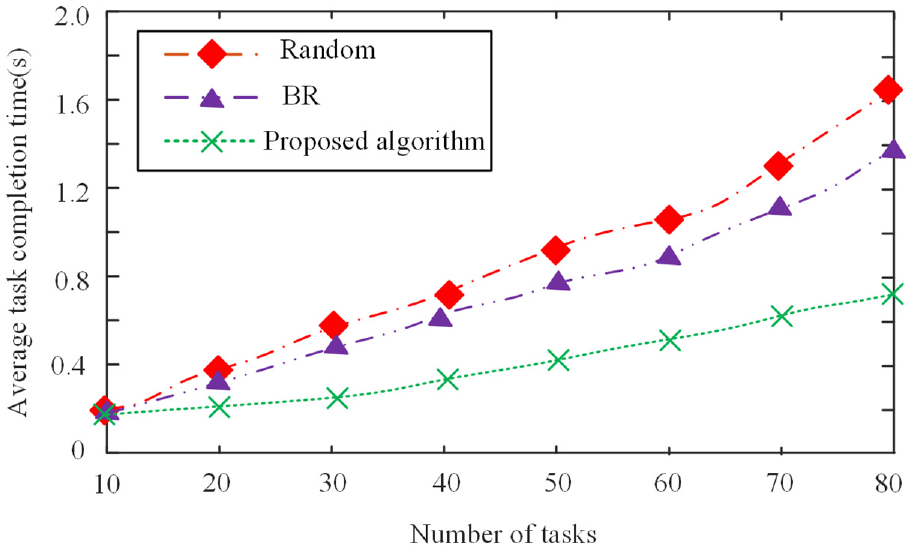
Comparison of task completion time of three strategies.
It can be seen from Figure 6 that IoT resource computing allocation strategy based on edge computing is always better than Random strategy and BR strategy. The average time to complete its tasks is always the smallest. When the number of migration tasks is small, the advantage of proposed algorithm in the average task completion time is not obvious. This is because the available resources are relatively sufficient at the beginning, the resource utilization is relatively balanced, and the corresponding virtual machines can be deployed. As the number of tasks involved in migration increases, the average task completion time of proposed algorithm is much lower than the other two strategies. This is because the total amount of resources for MEC is fixed, and proposed algorithm makes full use of the computing power of both sides and effectively meets the demand for efficient computing services in IoT scenarios. Facing the environment dynamic changes of edge nodes in edge cloud, the proposed algorithm can adaptively adjust migration strategy, which improves the efficiency of resource allocation.
Figure 7 is a comparison chart of task overhead under the three strategies. Figure 7 shows the comparison of average task overhead costs of these three algorithms. Task cost refers to the actual scheduling cost that users pay to complete task migration in MEC environment.

Comparison of task overhead of three strategies.
It can be seen from Figure 7 that as the number of tasks increases, the competition between tasks is fierce, and the task waiting time is longer. Therefore, the average task completion time increases, the resource unit price also increases dynamically, and the average task overhead will increase accordingly. The average task migration overhead of computing allocation strategy based on edge computing for IoT resources is significantly better than Random strategy and BR strategy. This is because the proposed algorithm considers the utilization and price of computing resources when making migration decisions, and it is always more inclined to migrate tasks to computing nodes that match its resource requirements and have relatively low prices. This reduces the migration overhead cost of application tasks to a certain extent.
Conclusion
This article constructs a problem of minimizing the user task execution delay and weighted sum of energy consumption, and then proposes a computing allocation strategy based on edge computing for IoT resources to solve the optimization problem. The proposed algorithm can show efficient energy-saving performance under different number of IoT devices. The comparison method lacks the consideration of cloud edge collaboration, and it is often difficult to make the optimal decision in the dynamic diversity environment with great differences.
In the next step of research work, one is to consider the mobility of mobile terminals, predict its moving direction and trajectory, and calculate the connection time between the mobile terminal and computing resources. After judging whether the task migration can be completed within its connection time, further migration decisions can be made. Besides, the second is to further consider the allocation of other physical layer resources, such as spectrum and power.
Footnotes
Acknowledgements
The author expresses the appreciation to the reviewers for their helpful suggestions which greatly improved the presentation of this article.
Handling Editor: Yanjiao Chen
Declaration of conflicting interests
The author(s) declared no potential conflicts of interest with respect to the research, authorship, and/or publication of this article.
Funding
The author(s) disclosed receipt of the following financial support for the research, authorship, and/or publication of this article: This study was financially supported by the National Education Information Technology Research 2018 project funding, project no. 186130014.
