




Abstract
Ultrasonic computerized tomography is a promising technique for damage detection by enabling ultrasonic waves via multiple measurement paths leading to accurate localization of structural damage. Unlike traditional ultrasonic computerized tomography that requires numerous measurements and costly computation, a compressive sampling advancing both the measuring phase and the imaging phase is proposed in this study to achieve accurate identification with no low-speed traditional ultrasonic computerized tomography technique measurements or costly computation in real-world applications. The proposed rapid ultrasonic computerized tomography approach advances both the measuring phase and the imaging phase. In the measuring phase, far few ultrasonic measurement paths are randomly selected to capture the characteristics of the ultrasonic waves carrying the underlying damaged information. And in the imaging phase, ℓ1-norm minimization optimization algorithm is used to reconstruct the internal damage, rendering the sparest solution related to the physical damages. The functionality of the proposed approach is validated by both numerical simulation and experimental testing. The results indicate that the improved ultrasonic computerized tomography technique in compressive sampling framework has a great potential for rapid damage detection, which is a game-changing technique for accurate and cost-efficient damage detection in real-world applications.
Keywords
Introduction
Structural health monitoring (SHM) is an effective detection method that provides quantitative data of infrastructures for manager, engineers, and researchers in the civil engineering community. SHM plays an essential role in localizing damage, classifying damaged type, ensuring structural safety, and evaluating structural remaining life. Compared to the global sensing approaches which are insensitive to small levels of damages, local measurements based on non-defective testing/evaluation (NDT/E) can provide direct measured data to structural component behavior. While many of the local sensing techniques can be costly and permanently deployed (e.g. strain gauge and thermistor), to overcome these limitations, the use of ultrasonic wave for damage detection attracts more and more attention in the SHM community.
Ultrasonic computerized tomography (UCT) is a digital imaging technique computed by taking multiple ultrasonic scans at given rotations around an object. The transducer–receiver coupled array physically rotates around the structural component providing multiple pathways for ultrasonic propagations.1–3 Ultrasonic wave interacts with the internal flaws and damage of the object being imaged. The characteristics of ultrasonic waves such as time-of-flight (ToF), magnitude, and attenuation carrying the damaged information can be reconstructed for imaging the internal damage in the structure.4,5 Norose et al. 2 applied UCT technique using ToF measured by transmission method for the inspection of high-attenuation billets. Schabowicz 6 presents UCT as a suitable NDT technique for testing concrete members for locating defects and determining their sizes. Jiang et al. 7 applied UCT technique in the concrete-filled steel tube (CFST) of underground structures and got accurate inspected results. Kakuma et al. 8 used UCT method to visualize the defects in billets. Rahiman et al. 9 developed the ultrasonic tomography for imaging liquid and gas flow using a hybrid-binary reconstruction algorithm. Experiments show that performance is acceptable with a real-time image-reconstruction speed. Hay et al. 10 demonstrate a novel UCT technology using Lamb ultrasounds excited by embedded piezoelectric sensors on hidden surfaces. Both reconstruction algorithm for probabilistic inspection of damage (RAPID) and filtered back-projection (FBP) methods are used to detect material loss on real-aircraft component. The results show that using a 16-element circular array embedded piezoelectric sensors, material loss is detectable on the exposed surface by UCT technology. Goncharsky et al. 11 applied UCT technique for characterization of biological tissues. Higher precise is achieved for the soft tissue because of the low attenuation of the low-frequency ultrasounds. Due to the expensive computational cost of the reconstruction algorithm, they use graphic processing units (GPU) clusters to parallelly pursue the inverse problem of ultrasonic tomography. The results show that UCT technique is a promising technique with spatial resolution of about 2–3 mm for the soft tissues.
If the current trend continues to develop with UCT technique with the capability of creating tomographic image via ultrasonic measurement equation inversion approaches that can image the internal damage conditions with a low-cost and effective way, the traditional approach of high rates of measured paths, redundant data, and a big cost of labor and time will become less desirable. Thus, this article is an investigation into the development of a novel means of UCT technique that advances the traditional UCT using randomly selective measurement net for application to compressive sensing (CS) theory and normal piezoelectric probes. The approach advocated can avoid enormous measurements and can limit expensive workload.
In this article, in section “UCT,” the entire UCT technique including both the measurement phase and imaging phase is redesigned in the framework of CS theory to shrink the measurement paths and simplify the reconstruction processing. The traditional UCT technique and basic Radon equation, CS framework, and the proposed CS-based UCT approach are introduced in section “UCT technique in CS framework.” In section “Numerical validation,” multiple numerical simulations are carried out to validate this approach. And, a real-world experimental testing is implemented to interrogate the CFST of a bridge in section “Experiments and results.” Finally, conclusions and future work are highlighted in section “Conclusion.”
UCT
UCT technique used for damage detection in civil engineering is evolved from the concept of ultrasonic/X-ray computerized tomography in medical community aiming at pursuing the internal condition of the human bodies. There are two phases: ultrasonic measurement phase and imaging phase. For measurement phase, after generated by actuator on the surface, ultrasonic wave propagates in the solid media and it will interact with the damage part in the structure resulting in re-emitting wave front according to Huygens–Fresnel principle. While traversing and interacting with the damaged part, the physical parameters of ultrasonic wave (e.g. wave velocities, acoustic pressure, and magnitude) are changed by the damaged part and carry their information. The information can be collected by ultrasonic probes made from piezoelectric materials. To image the internal conditions, probe or transducers are repeated iteratively to measure all the measurement paths in a dense net to pursue the desired resolution. For imagine phase, measurements are interpreted by tomographic algorithms to reconstruct the internal condition of structures. 4 As shown in Figure 1(a), a dense net consisting enormous measurement paths is utilized to capture the ultrasonic information using transducer and receiver. In 1917, Johann Radon provided an integral formula to define a function whose value at a particular line is equal to the line integral of another function defined on the space over that line.12,13 Radon equation has been widely applied to tomography creating images from the projection data associated with cross-sectional scans of an object.

(a) Measurement net for UCT and (b) measuring path and the discrete microstructures.
Ultrasonic ToF in ith measurement path (

where
The whole detected structure is discretized into multiple microstructures based on the desired resolution. Then, a dense net consisting of N measuring paths is arranged as well. Transducer and receiver are attached to each position of the measurement net for generating and receiving the ultrasonic waves. After discretized, Radon equation can be expressed as equation (2). The ToF of ultrasonic wave propagating along ith measurement path is calculated as follows

where
Considering all the ToFs measured by probes,

where matrix
For applications in the real world, two probes, namely, transducer and receiver, are utilized for introduction and observation of ultrasonic wave. The location of structural damage (e.g. holes and flaws) can be identified by applying computational reconstructive algorithm to the ToF of ultrasonic wave obtained from the probes attached on the boundary.
In the reconstruction phase, there are sophisticated inverse techniques used to solve tomographic reconstruction problem, for example, algebraic reconstruction techniques (ART), simultaneous iterative reconstruction techniques (SIRTs), least squares QR-factorization (LSQR), and so on.14–16 However, traditional UCT measurements and reconstructed algorithm have the limitations of redundant measurements and big cost of computational time. Thus, this study explores techniques that do not require too many measurements, thus increasing feasibility of a rapid monitoring scheme. Both the measurement phase and reconstruction phase are redesigned in CS framework that will be introduced in the following section.
UCT technique in CS framework
As mentioned previously, redundant measurement paths are regarded as the major drawback for a heavy workload of measurement and computation. To reduce the number of measurements for speeding up the processing of traditional UCT technique, a novel technique is proposed based on CS theory via randomly selecting measurement paths and reconstructing using

where

where
Moreover, the transfer matrix

where
In summary, if three requirements are satisfied: (1) signal

where
In real-world applications, in general, the distribution of damages (e.g. crack and holes) is naturally sparse in the structure. This natural feature can be taken as a gift to apply the CS theory to improve the traditional UCT technique.
24
We redesign the entire UCT processing according to the sparse-distribution feature. In the measurement phase, we randomly select the measurement paths instead of using the normal equal-space measurement paths. In the imaging phase, the inverse problem is solved by
In the measurement phase, a random Bernoulli matrix

Thus, the linear measurements for the proposed technique can be expressed as equation (9)

where
After measuring m chosen paths, the slowness vector

where
The purpose of the ℓ1-minimization optimization algorithm is to pursue the sparsest form of
A flowchart of the proposed UCT technique is summarized in Figure 2. The determination of the exact number of measurement paths in which probes are located for generation and observation is a function of the desired damage detection resolution. Piezoelectric transducers and receivers are proposed to attach to the boundary for the introduction and observation of ToF of ultrasonic waves within a defined interrogation zone. To reconstruct the internal conditions, the aforementioned randomly selected measurement net is determined by the measurement matrix via MATLAB, and

Flowchart of the proposed UCT approach and traditional UCT.
Numerical validation
Numerical simulation is employed to validate the functionality of the CS-based UCT technique. A model was created based on the interrogated structure in COMSOL Multiphysics® Modeling Software. A steel tube with a diameter of 1200 mm is shown in Figure 3, whose elastic modulus (

Numerical model of the bridge on Weiqi road.
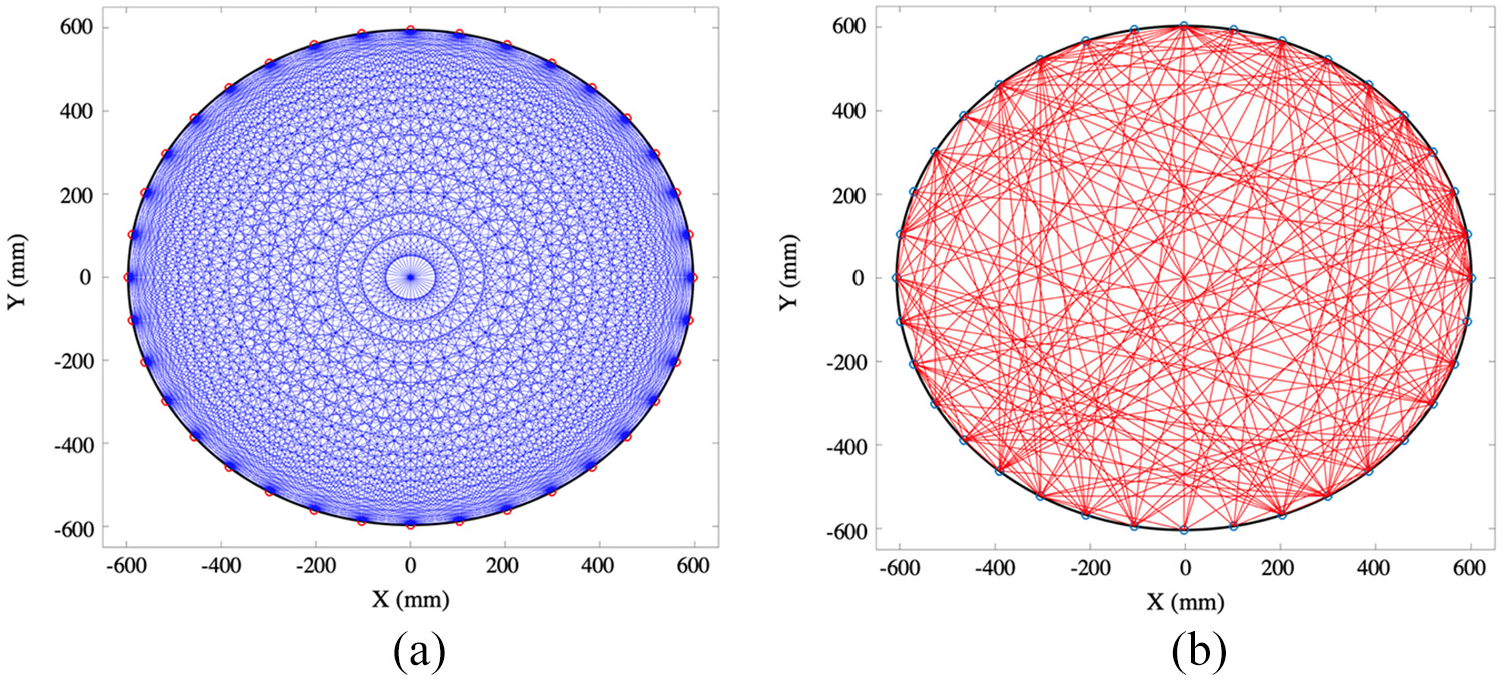
Measurement paths for traditional UCT technique and proposed: (a) even spaced measurement net and (b) randomly selected non-uniform measurement paths based on CS theory.
Comparison of the random selective measurement paths and the even spaced measurement net in Figure 4 indicates that the CS-based UCT approach significantly reduces measuring number. Both the single- and multiple-damage cases are simulated to validate the proposed approach using the same selected paths as demonstrated in Figure 4.
Single damage
For the single-damaged case, a hole with a diameter of 15 mm is cut from the model to mimic damage in the structure. As we can see in Figure 5(a), the center of the damaged location is
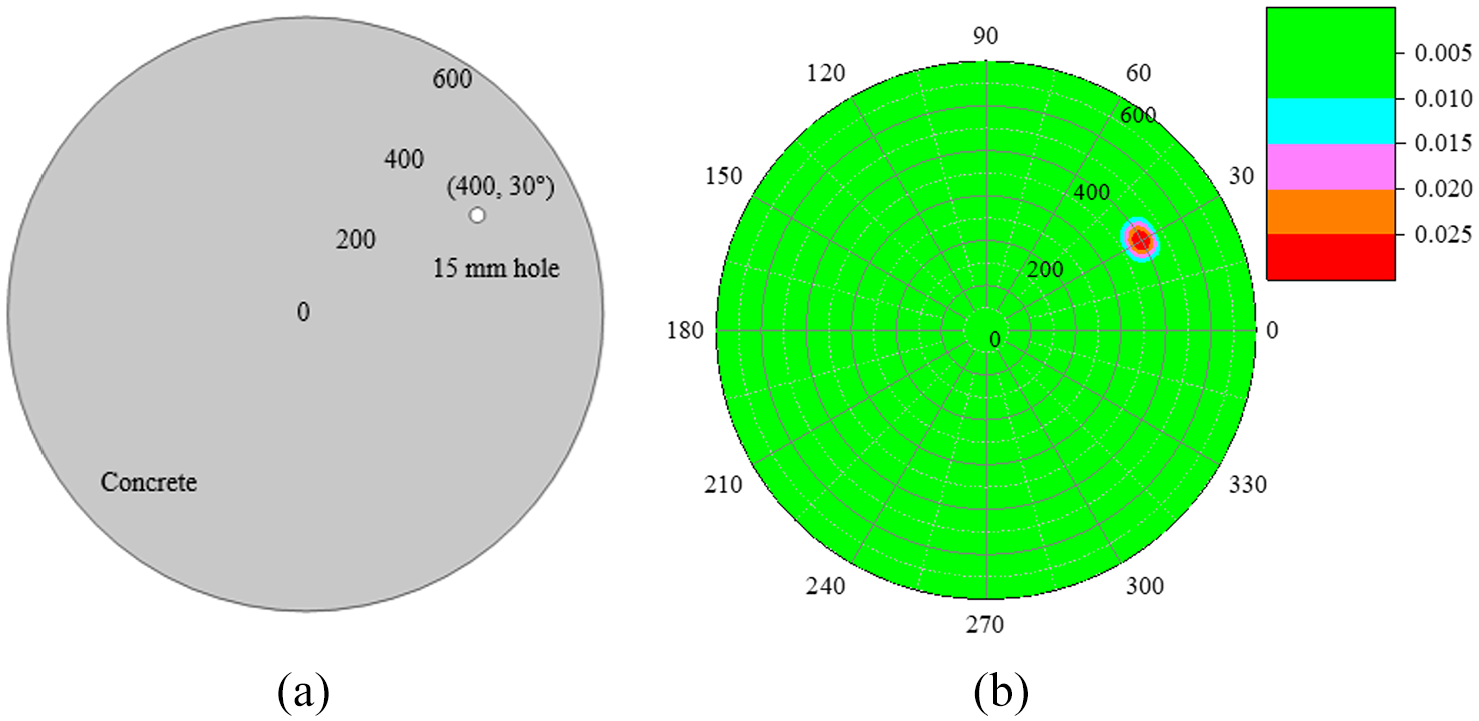
Single-damaged case of the CFST: (a) preset single damage and (b) reconstructed results.
Multiple damages
In addition, three damages located at

Multiple-damaged case of the CFST: (a) preset damages and (b) reconstructed results.
Reconstruction results of both the single-damage and multi-damage cases have great agreements with the original damage setups. Since the preset damages in the numerical validation part are much simpler than the specimen in real world, the results obtained by traditional UCT technique has similar results as that reconstructed by the proposed technique. The authors emphasize that the proposed CS-based UCT approach reduces measuring number from 630 to 150 but keeps the same reconstruction accuracy. Thus, the proposed UCT is capable of significantly shrinking the number of measurements under the same spatial resolution, which should be a game-changing approach to tremendously reduce the measurement workload for applications.
Experiments and results
To evaluate the proposed CS-based UCT technique in the real-world applications, the novel approach is used to interrogate a concrete-filed steel tube in an arch bridge located at Lanzhou city. The bridge is along the east-west direction of Weiqi road in the New Area of Lanzhou city. Weiqi road is one of the important main roads planned by Lanzhou city with a design speed of 60 km/h. It is an east-west road and has a total length of 6548 m. The bridge of Weiqi road is a cross-lake bridge above a lake of New Area of Lanzhou city built in 2014. The total length of the bridge is 120.82 m.
The bridge consists of dual CFST as the arch structure. The CFST arch rib has an outer diameter of 120 cm and the thickness of the steel tube is 22 mm. The connecting steel pipe between the upper and lower arch ribs is made of 16-mm-thickness Q 345 steel plate. The arch span of the bridge is 63.1 m. The arch rib is filled by C55 concrete based on Chinese standard GB50936-2014 of a CFST structure with a single-tube circular section. The sketch of the bridge is shown in Figure 7.

The arch bridge in the New Area of Lanzhou city: (a) sketches and (b) arch ribs of the bridge.
To ensure the loading carrying capacity of the bridge, the CFST in the arch must be inspected to derive the internal situation, as shown in Figure 8(a). The inspections for the arch ribs are sliced into 60 two-dimensional (2D) UCT imaging detection of the cross section with 1 m distance approximately. For each cross-sectional detection, the traditional UCT requires thousands of measurements which is a huge work consisting redundant measurement paths. Thus, the rapid UCT technique is proposed to speed up the inspection project for SHM.

(a) UCT inspection for the CFST structure and (b) launched excitation signal and received waveforms.
Both the proposed method and traditional UCT technique aim at identifying the flaw, crack, and void part within the concrete to protect the bridge from collapse. The threshold is 0.004, representing the defects under the size of 15 mm will be discarded. The spatial resolution is chosen as 120 mm which discretizes the 2D UCT image into 100 pixels. And the total number of measurement paths is 630 according to the traditional UCT technique. In general, the number of damaged microstructures is less than 10% of the total number, which is a reasonable hypothesis proven by the previous inspection results of the structure. For the proposed CS-based UCT, 150 measurement paths are enough to reconstruct the desired image with the same resolution. The measurement paths are randomly selected from the original net of the traditional UCT technique according to the random Bernoulli matrix
A handheld ultrasonic detector, NU62, is employed as the UCT instrument to detect CFST structure in the bridge. The detector consists two probes: one transducer introduces ultrasonic waves and the other is utilized to capture the waveform with the sampling rate of 25 MHz from the other end. The ultrasonic wave is continuous square waves as shown in Figure 8(b) whose central frequency and magnitude is 50 kHz and 500 V, respectively. The aforementioned randomly selected measurement net is implemented by piezoelectric probes in the applications. Piezoelectric transducers and receivers are proposed for the introduction and observation of the ToF of ultrasonic waves within the defined interrogation zone. The transfer matrix
As shown in Figure 8(b), the measured ToFs of the ultrasonic waves for pitch-catch approach are indicated by blue vertical bars of each captured waveform. Based on the measurements from the proposed CS-based UCT approach, the raw reconstructed results obtained by ℓ1-minimization optimization is shown in red solid line in Figure 9(a). As a comparison, the reconstructed result of traditional ART algorithm is demonstrated in gray line as well. Noted the red line is sparse with only nine non-zero values. In addition, the magnitudes of all the non-zero value have good agreements with that obtained by traditional UCT. That means both the location and size of major damage are well approximated.

Reconstruction of No. 12 cross-sectional inspection of the CFST: (a) raw reconstructed results, (b) reconstructed image of the improved UCT, and (c) reconstructed image of the traditional UCT technique with algebraic reconstruction techniques (ART) algorithm.
The differences concentrate on the small-size damages, whose sizes are under 4 mm. The different is attributed to the proposed CS-based UCT approach focus on the major damage by pursuing the sparsest solution in the ℓ1-minimization problem. Using the proposed approach, the reconstructed results precisely reveal the major damages in the cross section of the arch rib at a price of throwing away large number of the low-error coefficients, which represents the minor damage in the rib. The authors emphasize that minor damage is not important as major damage and can be ignored in many studies.
In general, the method proposed in the article can quickly identify significant damage microstructure elements without much loss but much fewer measurements. As we can see, a typical reconstructed image indicates on the No.12 cross-sectional one hole with diameter larger than 15 mm existing, as shown in Figure 9. The reconstruction results have been confirmed by traditional UCT detection, as shown in Figure 9(b) and (c). As we can see, the reconstructed results have a good agreement with the image obtained from the traditional UCT technique and the hole is located at approximately 130°. The results provide structural managers the health evaluation of bridge. Similarly, reconstructed results reveal two flaws in the No. 37 cross-sectional inspection of the CFST of the arch rib (Figure 10).

Reconstruction of No. 37 cross-sectional inspection of the arch rib: (a) reconstructed image of the improved UCT and (b) traditional UCT technique with the ART algorithm.
Compared with the traditional UCT technique requiring 630 measurements, the proposed rapid UCT approach improved by CS dramatically reduce the number of measurements with the same resolution which is an effective alternative for the spatial damage detection approach.
Conclusion
This article has presented a new approach to advance the traditional UCT technique by exploiting CS theory. Both the measurement phase and the imaging phase are improved and redesigned to reduce the workload in applications.
In the measurement phase, much fewer measurement paths instead of the enormous paths are random chosen from the original dense net, since the distribution of the damaged part is naturally sparse in spatial domain. In the imaging phase, the slowness vector is reconstructed from the measured ToFs of the ultrasonic waves using
Various damaged conditions are numerically simulated to validate the proposed approach for SHM. In addition, a CFST structure of the arch bridge is experimentally tested to apply the proposed method in the real-world applications. Both the traditional UCT technique and the CS-improved UCT approach are implemented in the detection. The results indicate that the proposed approach can successfully provide the information of flaws and void of concrete in the detected structure with less measurements. Thus, the proposed rapid UCT approach is a game-changing technique that can provide accurate imaging for asset decision-making with rapid detection, low-cost, and fewer measurements.
Future work will include the optimization of choosing measurement paths from the original net and the exploration of the functionalities of the proposed approach for identifying various damaged types in different host structures. More algorithms will be employed to solve the sparsest problem for pursuing the physical damages in structure.
Footnotes
Handling Editor: Francesc Pozo
Author contributions
B.L., Y.L., B.L., and W.W. conceived and designed the method; B.L., Y.L., T.Y., and B.L. measured and analyzed the data; B.L. wrote the article.
Declaration of conflicting interests
The author(s) declared no potential conflicts of interest with respect to the research, authorship, and/or publication of this article.
Funding
The author(s) disclosed receipt of the following financial support for the research, authorship, and/or publication of this article: This work was supported by the Innovation Capability Support program of Shaanxi under Grant No. 2020PT-038.
