




Abstract
To alleviate the broadcast storm problem in the route discovery process, this article proposes a novel routing protocol considering the boundary effects for ad hoc networks, named NRP. The novelty of NRP lies in the following: first, NRP defines a forwarding area criterion considering the effects of the node transmission area boundary to reduce the broken links due to the mobility of nodes; second, NRP adopts the idea of a piecewise function to estimate the node degree when the nodes are in the center, borderline, and corner areas, respectively, which considers the effects of both network boundaries and node communication boundaries without broadcasting Hello messages periodically; third, NRP applies the static game forwarding strategy to calculate the forwarding probability during the route discovery process. NRP reduces the redundant retransmissions and collision probability among neighboring nodes, thus improving the forwarding efficiency. The extensive simulation results by NS-2 simulator have shown that NRP performs better than AODV + FDG, AODV + Hello, ad hoc on-demand distance vector, ad hoc on-demand multipath distance vector, and energy-efficient ant-based routing in terms of packet delivery ratio, routing overhead, normalized medium access control load, throughput, and network lifetime.
Introduction
Ad hoc networks are temporary networks consisting of a special kind of wireless mobile nodes without any infrastructure or centralized administration, which have a wide application prospect in civil and military fields. As a core supporting technology of ad hoc networks, routing protocols are mainly used to find routes. 1 Highly dynamic network topology, as well as limited bandwidth and energy constraint, presents challenges for implementing high-performance routing protocols. Routing protocols are classified into reactive, on-demand, and hybrid types. 2 On-demand routing protocols are highly concerned by researchers all over the world for their advantages, such as low routing overhead and no need for maintaining the whole network information. In on-demand routing protocols, source nodes initiate routing discovery processes by means of broadcasting routing request (RREQ) packets. Therefore, the efficiency of the routing discovery process seriously affects the overall performance of routing protocols. The simplest broadcasting is flooding, in which nodes rebroadcast the first received packets to all their neighbors. During the route discovery process, flooding the RREQ packets to establish routes causes the broadcast storm problem, which leads to a large number of packet collisions and redundant rebroadcasts, especially in dense networks.
In order to alleviate the broadcast storm problem, many broadcasting protocols have been proposed in the last decade, which are classified into deterministic and probabilistic schemes. 3 In deterministic schemes, only a subset of nodes is allowed to participate in the broadcasting process. However, the nodes that have repeatedly undertaken the rebroadcast task may deplete their energy, which decreases the connectivity of networks. On the other hand, due to highly dynamic topology, it is difficult to select the forwarding nodes in ad hoc networks. In probabilistic schemes, nodes participate in the broadcasting process according to a certain probability value, so all nodes are allowed to broadcast the received packets. Compared with the deterministic scheme, the probabilistic broadcast scheme exhibits better robustness to routing failures, network attacks, and dynamic topology conditions. However, it is an urgent key issue to calculate the forwarding probability in probabilistic broadcast schemes. Node degree, namely, neighbor number, is an efficient factor for calculating forwarding probability as described in the literature.4–9 However, in the aforementioned studies, nodes need to periodically broadcast Hello messages to obtain node degrees, which consumes a large amount of energy and takes up a lot of bandwidth.
To overcome these obstacles, this article presents a novel routing protocol considering the boundary effects for ad hoc networks, named NRP. The major contributions of NRP are as follows:
NRP defines a novel concept of the forwarding area. The nodes in the forwarding area participate in broadcasting, which reduces the probability of the broken links due to mobility of nodes.
NRP considers the border effects of the network area and divides the network area into center, borderline, and corner areas. NRP adopts the idea of a piecewise function to estimate the node degree when the nodes are in the center, borderline, and corner areas, respectively, which avoids unnecessary overhead compared with broadcasting Hello messages periodically to obtain the node degree.
NRP adopts a novel static game forwarding strategy to forward RREQ packets, where node degree is used to estimate the number of nodes participating in the forwarding process. Forwarding and no-forwarding packets are used as strategy sets to design a gain function. The forwarding probability is obtained by Nash equilibrium to improve the broadcasting efficiency in the routing discovery process.
The major innovation of NRP is that, for the first time, NRP considers the effects of both network boundaries and node communication boundaries. The node degree information is calculated by considering the network boundary, which is used to estimate the next hop neighbor’s game participants. Therefore, the number of participants in the game is estimated, instead of the number of actual neighbors.
The rest of this article is organized as follows: section “Related work” introduces the related previous works; section “Node degree estimation and static game forwarding strategy–based ad hoc network routing protocol: NRP” proposes a node degree estimation algorithm considering boundary effects, and the NRP protocol and its implementation process are also described in detail; section “Performance evaluation” verifies the performance of NRP using the NS-2 simulator; section “Conclusion and future work” concludes this article and follows the future work.
Related work
The typical on-demand routing protocols are ad hoc on-demand distance vector (AODV), 10 ad hoc on-demand multipath distance vector (AOMDV), 11 and dynamic source routing (DSR). 12 In the routing discovery process of AODV and AOMDV, the nodes broadcast RREQ packets to all neighbor nodes, which results in excessive redundant retransmissions and high collision probability due to the broadcast storm problem. 9 Although AODV and AOMDV periodically broadcast Hello messages, they do not utilize the information of one-hop neighbor. During the routing discovery process of DSR, RREQ packets contain path information by adding node information into RREQ packets. However, DSR still causes the broadcast storm problem. To overcome the problem, AODV + FDG utilizes one-hop node degree information to calculate the forwarding probability based on game theory. 4 Simulation results verified that AODV + FDG performs better than AODV in terms of routing overhead, packet delivery ratio, and average end-to-end delay. In Camilo et al., 13 the energy-efficient ant-based routing (EEABR) algorithm is proposed. It allows the nodes in the network to obtain the location information and selects one of the neighbor nodes as the next hop node based on ant colony optimization. Simulation results show that EEABR expands the lifetime of a wireless network. The forwarding probability is adjusted according to the node degree in the range between the maximum and the minimum value. 8 Simulation results prove the advantages of the proposed protocol in terms of saved rebroadcast and collision number. In order to improve saved rebroadcast, the forwarding probability is inversely proportional to the one-hop node degree, 7 and similar research work is reported in Lysiuk and Haas 5 and Wegener et al. 6 In order to make full use of node degree information, one- and two-hop node degree information is used to compute the forwarding probability. 14 When the two-hop node degree is relatively large, the forwarding probability is reduced and vice versa. Simulation results show the superiority of the scheme in terms of packet delivery ratio and routing overhead. In order to optimize routing discovery processes, a neighbor knowledge-based rebroadcast (NKR) protocol is proposed which combines neighbor coverage knowledge and probabilistic methods. 15 However, due to periodically broadcasting Hello messages to obtain the node degree information in these schemes, the node’s energy and wireless bandwidth are consumed, thus increasing network congestion and routing overhead.
To overcome the weakness of broadcasting Hello messages to obtain the node degree, scientific researchers proposed node degree acquirement methods without relying on Hello messages.16–18 The link probability and the number of nodes in the networks are used to obtain node degree information. 16 However, the effects of the network boundary are not taken into account. The average number of neighbors is calculated by considering the effect of network boundary,17,18 while the deficiency of such method lies in the following: (1) nodes located in any areas have the same node degree. In fact, the node degree varies with the area range of node location; (2) due to no analytic solution, it is difficult to be applied in routing protocol. A node degree estimation and game forwarding based routing protocol (NGRP) is proposed in Qing-Wen et al., 19 which does not consider the effects of node transmission area boundary.
The difference between our work and the aforementioned works is that NRP considers not only the impact of network boundaries, but also that of node communication boundaries. NRP adopts a static game forwarding strategy to forward RREQ packets, in which the number of participants in the game is estimated, instead of the number of actual neighbors.
Node degree estimation and static game forwarding strategy–based ad hoc network routing protocol: NRP
Forwarding area definition
When a node sends a packet, its mobile neighbor nodes near the border area are likely to leave its transmission area after one-hop delay, thus causing broken links. NRP defines the forwarding area as shown in Figure 1.

where

Forwarding area.
Node degree estimation algorithm considering border effects of network area
The total area of a network is

Geographic division of the network scenario.
When the lower left corner of the network scenario is set to be the origin point, a rectangular area is set up where the left border is the y-axis and the lower border is the x-axis. The center, border, and corner areas are obtained, respectively, by expressions (2)–(4) in the coordinate system as follows


where
When nodes are located in
As shown in circle

The average neighbor number of the nodes is given by

When nodes are located in
When nodes are located in area

Node in the border area.
Therefore, angle

Then, the area of sector

The area of triangle

Then, the invalid forwarding range of

Therefore, the forwarding area range of node
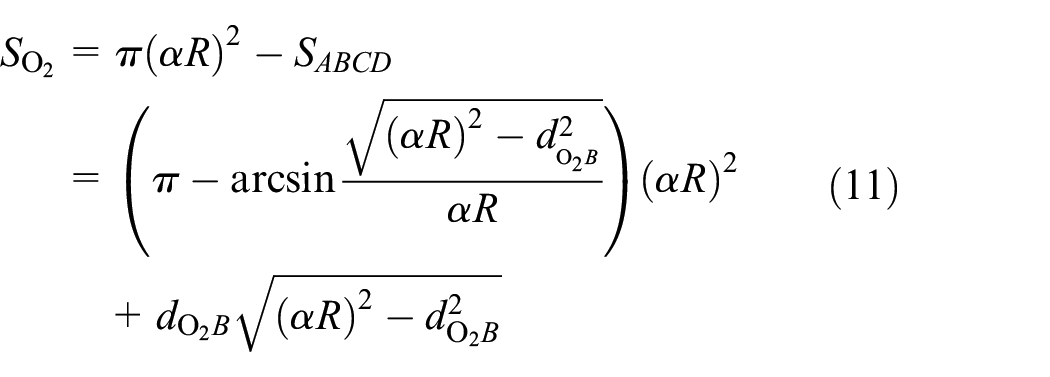
Here, the node degree is estimated by

In the same way, the node degree is obtained in three situations when nodes are close to the upper, lower, and left borders, respectively.
When nodes are located in
When nodes are located in the corner area of the network scenario, four situations are divided when nodes are located in the upper left, lower left, upper right, and lower right corners, respectively. We take the nodes in the upper right corner as an example. The situation is classified into two.
When
When the nodes are located in area

In the same way

Here, the forwarding area range of node


Here, the node degree is given by

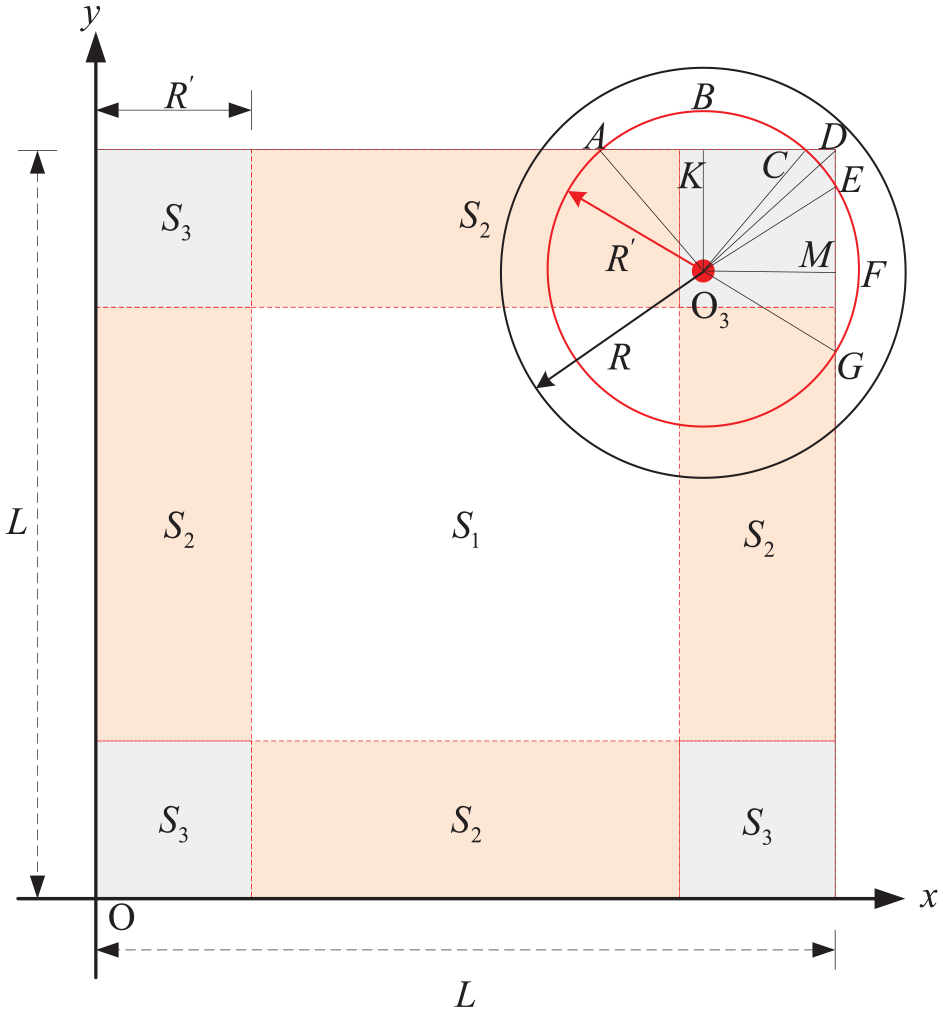
Node in the corner area (a).
When
Here, according to equation (10), the invalid forwarding area range of node

Another part of the area of node

By transformation, we obtain

For the instance in Figure 5, we obtain

Here, the valid forwarding area range of node

Because

we obtain


By further derivation, we obtain

and then
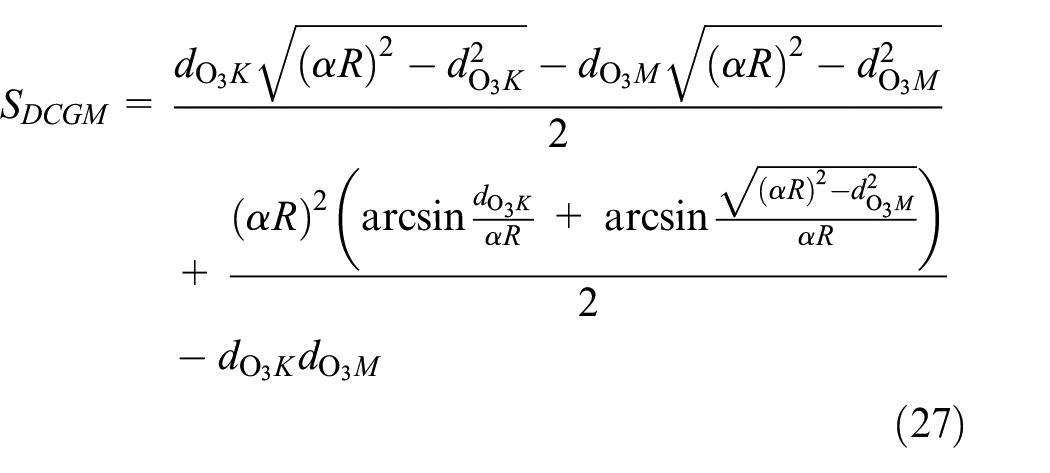
By combining equations (18) and (27), the invalid forwarding area range of node

Then, the forwarding area range of node

By combining equations (28) and (29), we obtain

Here, the node degree is estimated by

In the same way, node degree is estimated when nodes are located in the upper left, lower left, and lower right corners, respectively.

Node in the corner area (b).
Node degree estimation
NRP assumes that nodes in networks carry locating devices, and every node knows its geographic location information. First, the node makes use of its location information to determine its located area in the network scenario based on equations (2)–(4). Then, the node computes its node degree. When the node is located in the center area, the node degree is computed by equation (6). When the node is located in the border area, the node degree is obtained by equation (12). When the node is located in the corner area and

On one hand, by considering the boundary impact of the network scenario, NRP improves the accuracy of node degree; on the other hand, compared with broadcasting Hello messages to obtain node degree information, NRP avoids the unnecessary network overhead.
Static game forwarding strategy
NRP is an on-demand routing protocol substantially. When source nodes have data to forward to destination nodes and no routing to destination nodes, they initiate the routing discovery process by broadcasting RREQ packets. NRP regards the forwarding process as a static game process, that is, nodes participating in forwarding RREQ do not know the strategies of other nodes when they make decisions. There is no the exchange of game information among nodes who participate in forwarding packets. Once nodes make decisions, the development of the game will not be affected. Static game forwarding is defined as follows

where
Forwarding dilemma game.

In Table 1,

The Nash equilibrium point of static game packet forwarding is as follows: the benefit of the current node forwarding the packets equals the benefit when at least one node among

Let

If
Packet structure
The RREQ packet structure is shown in Table 2, where node degree information is added into the RREQ packet. Source node address and broadcast ID identify a unique RREQ packet.
Routing request packet.

RREQ: routing request.
The route table and route reply packets of NRP are the same as those of AODV.
Route discovery process
The procedure of the route discovery process of NRP is as follows:
When a source node attempts to send a data packet to a destination but it does not already know the route, it initiates the routing discovery processes. The source node estimates its node degree
When an intermediate node in the forwarding area receives an RREQ packet for the first time, if it is not the destination or it does not have a route to the destination in its route cache, then it calculates the forwarding probability
We modify the source code of AODV in NS-2 (v2.34) to implement NRP. The procedure of the receive RREQ function is shown in Table 3.
The procedure of the NRP receive RREQ function.

Performance evaluation
Simulation environment
In order to evaluate the performance of the proposed NRP protocol, we compare it with the performance of some other protocols using the NS-2 simulator. The compared protocols include AODV + FDG, AODV + Hello, AOMDV, AODV, and EEABR. NRP-0.95, NRP-0.9, and NRP-0.85 represent NRP with α = 0.95, 0.90, and 0.85, respectively. AODV + Hello and AODV are different modes of the AODV protocol. AODV + Hello allows the nodes to send Hello messages periodically, while AODV does not. AOMDV allows the nodes to send Hello messages periodically. The simulation parameters are as follows: the wireless transmission radius is 250 m; the bandwidth of networks is 2 MBPS; we choose 802.11 as the medium access control (MAC) layer protocol; the number of CBR (constant bit rate) connections is 10 in the experiments. The source nodes send one packet per second. The simulation results are the average of simulation results from 10 rounds. Table 4 shows the global simulation parameters.
Simulation parameters.

Performance metrics
Five important performance metrics are evaluated.
Average end-to-end delay

where
Packet delivery ratio

where
Routing overhead

where
Normalized MAC load

where
Throughput

where
Network lifetime
Network lifetime is defined as the duration between network initialization and energy depletion of all the nodes in the network.
Simulation results
Verifying the effects of the node density on protocol performance
The purpose of the simulations presented in this subsection is to investigate the effects of different network densities on the performance of these protocols. The number of nodes varies from 275 to 450. All nodes are allowed to move using the random waypoint model in a field of 1500 m × 1500 m. The maximum speed of 20 m/s is chosen to study the effects of network density in the network with a high speed. The pause time of nodes is 100 s.
Figure 6 shows the effects of the network density on the average end-to-end delay. It is clear that, with the increase in node density, the end-to-end delays of NRP, AOMDV, and AODV + FDG remain stable, but AODV + Hello and AODV show fluctuation in end-to-end delay. The average end-to-end delays of NRP, AOMDV, and AODV + FDG are obviously better than those of AODV + Hello, AODV, and EEABR. It is due to the fact that, with the increase in node density, NRP, AOMDV, and AODV + FDG are capable of reducing the number of redundant rebroadcasting packets because of the probability forwarding modes, thus suppressing the network congestion, and reducing the competitions and collisions among nodes.

Effects of network density on average end-to-end delay.
Figure 7 depicts the relationship between the packet delivery ratio and the network node density. It is seen that the packet delivery ratio of NRP is obviously better than that of the other protocols. The reason is that NRP adopts the static game strategy and node degree estimation algorithm to obtain node degree information while considering the boundary effects, so that it reduces the number of packet drops caused by collisions. NRP and AODV perform significantly better than AODV + FDG, AODV + Hello, AOMDV, and EEABR. It is due to the fact that the periodical broadcast of Hello messages increases network collisions, thus resulting in the reduction of the packet delivery ratio.

Relationship between packet delivery ratio and network node density.
Figure 8 illustrates the effects of the network density on the routing overhead. It is observed that NRP is the lowest in terms of routing overhead. As the network density increases, the routing overheads of AODV, AOMDV, AODV + FDG, and EEABR increase significantly, but that of the NRP is still stable. This is because NRP adopts the static game strategy and forwarding area criterion, which decreases the number of nodes participating in forwarding routing requests in dense networks. On the other hand, AODV + FDG, AOMDV, AODV + Hello, and EEABR need to broadcast Hello messages periodically, thus increasing routing overhead. Because NRP adopts the static game strategy, the number of nodes participating in forwarding routing requests decreases in dense networks. Therefore, NRP decreases the number of control packets in the routing layer.
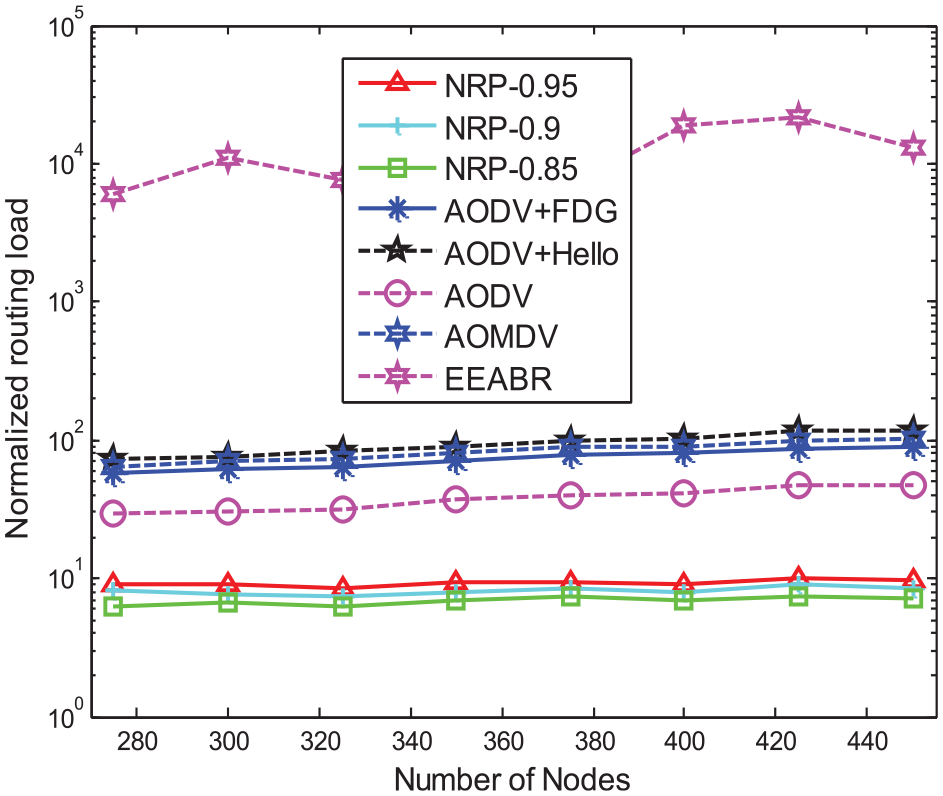
Effects of network density on routing overhead.
Figure 9 depicts the results of the MAC routing overhead versus the network density. Apparently, this figure shows that NRP achieves better performance in comparison with other protocols. As the network node density increases, the metric of NRP remains stable, while those of AODV + FDG, AODV + Hello, AOMDV, AODV, and EEABR increase rapidly. The reason is that AODV + FDG, AOMDV, and AODV + Hello broadcast the Hello message periodically, which increases the number of control packets in the MAC layer. NRP adopts the static game strategy and forwarding area criterion, which reduces the number of nodes forwarding the routing requests, thus decreasing the number of control packets in the MAC layer.

Results of MAC routing overhead versus network density.
Figure 10 presents the effects of the network density on the throughput. It is obvious that NRP exhibits better performance than the other protocols. The reason is that, on one hand, NRP obtains the node degree information without broadcasting Hello messages while considering boundary effects; on the other hand, it adopts the game forwarding strategy. Therefore, the broadcast storm problem is relieved significantly in NRP. NRP achieves high packet delivery ratio and low end-to-end delay, which increases the reception efficiency of data packets.

Effects of network density on throughput.
Figure 11 illustrates the results of the network lifetime versus the network density. It is seen that NRP achieves better performance in comparison with other protocols. As the network node density increases, the metric of NRP remains stable, while those of AODV + FDG, AODV + Hello, AOMDV, and AODV decrease rapidly. This is because NRP is capable of reducing the number of nodes participating in forwarding by means of adopting the static game strategy, thus reducing the energy consumption of nodes in the network. AODV + FDG, AOMDV, AODV + Hello, and EEABR broadcast Hello messages periodically, which wastes a large amount of energy of nodes.

Results of network lifetime versus network density.
Verifying the effects of the nodes’ maximum speed on protocol performance
The purpose of the simulations presented in this subsection is to study the effects of the nodes’ maximum speed on the performance of these protocols. The nodes’ maximum speed changes between 1 and 25 m/s. All nodes are allowed to move using the random waypoint model in a field of 1500 m × 1500 m, in which each node moves to a random selected destination with a random speed from a uniform distribution [0, maximum speed]. The pause time is 0. The number of nodes is 275.
Figure 12 shows the effects of the nodes’ maximum speed on the average end-to-end delay. It is observed that, with the increase in the nodes’ maximum speed, the end-to-end delay of all protocols increases gradually. The average end-to-end delays of NRP, AOMDV, and AODV + FDG are obviously better than those of AODV + Hello, AODV, and EEABR. It is due to the fact that, with the increase in the nodes’ maximum speed, NRP and AODV + FDG adopt the probability forwarding modes, which decrease the number of redundant rebroadcasting packets, thus suppressing the network congestion, and reduce the competitions and collisions among nodes.

Effects of nodes’ maximum speed on average end-to-end delay.
Figure 13 depicts the relationship between the packet delivery ratio and the nodes’ maximum speed. It is seen that the packet delivery ratio of NRP is obviously better than those of the other protocols. The reason is that NRP adopts the static game strategy and node degree estimation algorithm to obtain node degree information while considering the boundary effects, so that it reduces the number of packet drops caused by collisions. As we all know, mobile bordering nodes are likely to get out of the node’s transmission area, thus causing broken links. Whenever a broken link occurs, a new discovery phase should be started which in turn will increase the use of control messages. Therefore, NRP improves the packet delivery ratio using the forwarding area criterion. NRP and AODV perform significantly better than AODV + FDG, AOMDV, AODV + Hello, and EEABR. It is due to the fact that the periodical broadcast of Hello messages increases network collisions, thus resulting in the reduction of the packet delivery ratio.

Relationship between packet delivery ratio and nodes’ maximum speed.
Figure 14 illustrates the effects of the nodes’ maximum speed on the routing overhead. It is observed that NRP produces the lowest amount of routing overhead. As the nodes’ maximum speed increases, the routing overheads of AODV, AOMDV, AODV + Hello, and AODV + FDG increase significantly, but that of the NRP grows slowly. This is because NRP adopts the static game strategy and forwarding area criterion, which decreases the number of nodes participating in forwarding. Therefore, NRP decreases the number of control packets in the routing layer. On the other hand, AODV + FDG, AOMDV, AODV + Hello, and EEABR broadcast Hello messages periodically, thus increasing routing overhead.
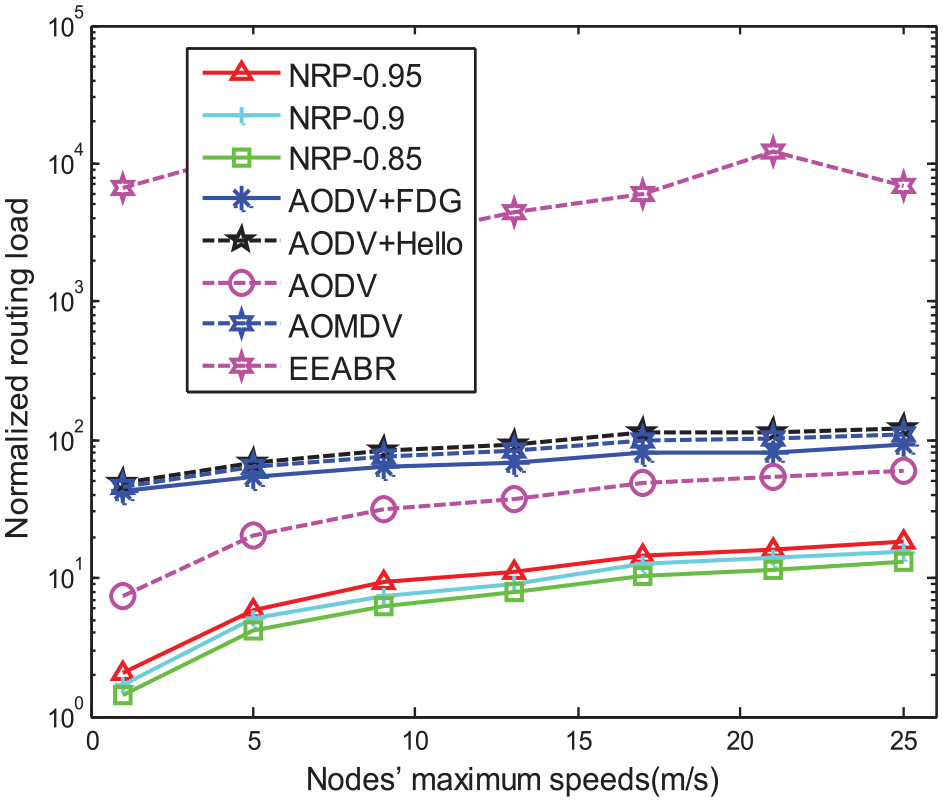
Effects of nodes’ maximum speed on routing overhead.
Figure 15 depicts the results of the MAC routing overhead versus the nodes’ maximum speed. Obviously, this figure shows that NRP achieves better performance in comparison to other protocols. As the nodes’ maximum speed increases, the metric of NRP grows slowly, while those of AODV + FDG, AODV + Hello, AOMDV, and AODV increase rapidly. The reason is that AODV + FDG, AOMDV, AODV + Hello, and EEABR broadcast the Hello message periodically, which results in a large number of control packets in the MAC layer. NRP adopts the static game strategy and forwarding area criterion, which reduces the number of nodes forwarding the routing requests, thus decreasing the number of control packets in the MAC layer.
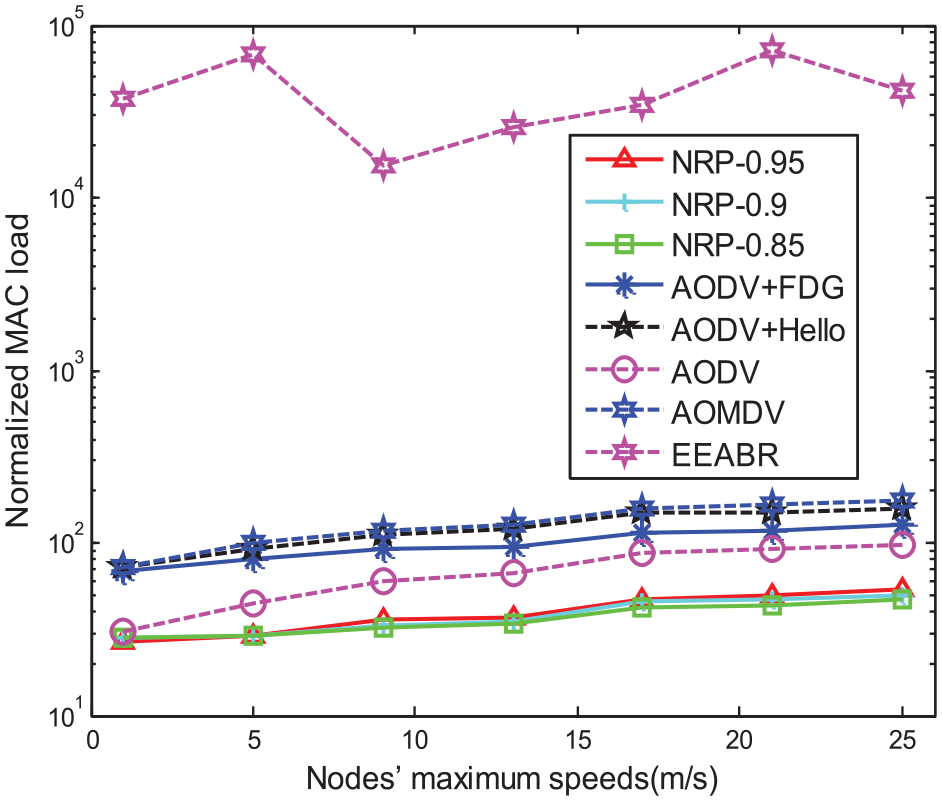
Results of MAC routing overhead versus nodes’ maximum speed.
Figure 16 presents the effects of the nodes’ maximum speed on the throughput. It is obvious that NRP exhibits better performance than the other protocols. The reason is that NRP obtains the node degree information without broadcasting Hello messages and then adopts the game forwarding strategy, which relieves the broadcast storm problem significantly. NRP achieves high packet delivery ratio and low delay, which increases the data packet reception efficiency.

Effects of nodes’ maximum speed on throughput.
Figure 17 illustrates the results of the network lifetime versus the nodes’ maximum speed. It is seen that NRP performs better than the other protocols. As the nodes’ maximum speed increases, the metric of NRP remains stable, while that of AODV decreases rapidly. This is because NRP adopts the static game strategy, which reduces the number of nodes participating in forwarding, thus reducing the energy consumption of nodes in the network. AODV + FDG, AOMDV, AODV + Hello, and EEABR broadcast the Hello message periodically, which results in a large amount of energy of nodes.

Results of network lifetime versus nodes’ maximum speed.
Verifying the effects of the nodes’ speed on protocol performance
The purpose of the simulations presented in this subsection is to study the effects of the nodes’ speed on the performance of these protocols. The nodes’ speed changes between 1 and 25 m/s. All nodes are allowed to move following the uniform speed mobility model in a field of 750 m × 750 m, in which each node moves to a random selected destination with a constant speed. The pause time is 0. The number of nodes is 70.
Figure 18 depicts the results of the average end-to-end delay versus the nodes’ speed. It can be seen that the end-to-end delays of all protocols increase with the increase in the nodes’ speed. NRP and AODV + FDG perform obviously better than AODV + Hello, AOMDV, AODV, and EEABR. It is due to the fact that, with the increase in the nodes’ speed, NRP and AODV + FDG adopt the probability forwarding, which reduces the number of redundant rebroadcasting packets.

Results of average end-to-end delay versus nodes’ speed.
Figure 19 presents the relationship between the packet delivery ratio and the nodes’ speed. It shows that NRP performs better than the other protocols. The reason is that NRP adopts the static game strategy, so that it reduces the number of packet drops caused by collisions. NRP designs the forwarding area by means of considering the impact of node communication boundaries, which reduces the number of new routing discoveries caused by broken links. NRP and AODV perform significantly better than AODV + FDG, AOMDV, AODV + Hello, and EEABR. It is due to the fact that NRP and AODV do not need to broadcast Hello messages periodically, thus increasing the packet delivery ratio.

Relationship between packet delivery ratio and nodes’ speed.
Figure 20 depicts the effects of the nodes’ speed on the routing overhead. It is clear that NRP exhibits the lowest routing overhead. With the increase in the nodes’ speed, the routing overheads of AODV, AOMDV, AODV + Hello, and AODV + FDG grow significantly, but that of the NRP increases slowly. This is because NRP adopts the static game strategy and forwarding area, which decreases the number of nodes participating in forwarding. Therefore, NRP decreases the number of control packets in the routing layer. On the other hand, AODV + FDG, AOMDV, AODV + Hello, and EEABR broadcast Hello messages periodically, thus increasing the routing overhead.

Effects of nodes’ speed on routing overhead.
Figure 21 illustrates the results of the MAC routing overhead versus the nodes’ speed. It is obvious that NRP achieves better performance in comparison with other protocols. With the increase in the nodes’ speed, the metric of NRP grows slowly. However, the metrics of AODV + FDG, AODV + Hello, AOMDV, and AODV increase rapidly. The reason is that AODV + FDG, AOMDV, AODV + Hello, and EEABR broadcast the Hello message periodically, which results in a large number of control packets in the MAC layer. NRP reduces the number of nodes participating in forwarding, thus decreasing the number of control packets in the MAC layer.

Results of MAC routing overhead versus nodes’ speed.
Figure 22 presents the effects of the nodes’ speed on the throughput. It is clear that NRP exhibits better performance than the other protocols. The reason is that NRP obtains the node degree information without broadcasting Hello messages and then adopts the game forwarding strategy, which relieves the broadcast storm problem significantly. NRP achieves high packet delivery ratio and low delay, which increases the data packet reception efficiency.
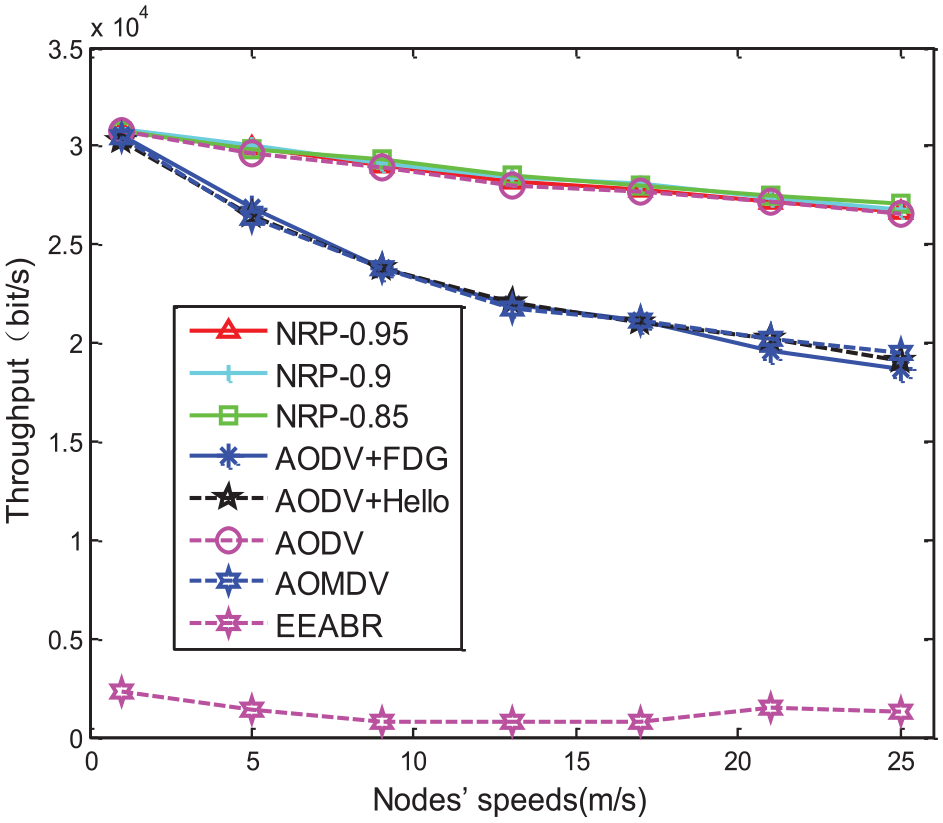
Effects of nodes’ speed on throughput.
Figure 23 depicts the results of the network lifetime versus the nodes’ speed. It is clear that NRP performs better than the other protocols. This is because NRP adopts the static game strategy, which reduces the number of nodes participating in forwarding, thus reducing the energy consumption of nodes in the network. AODV + FDG, AOMDV, AODV + Hello, and EEABR broadcast Hello messages, which results in a large amount of energy consumption.
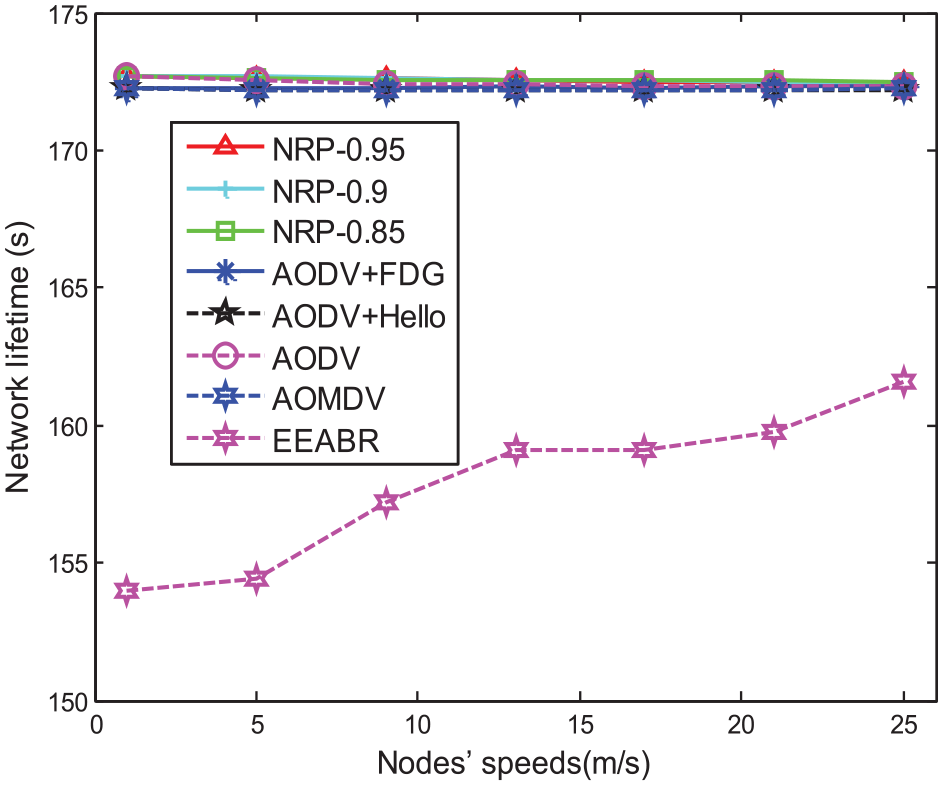
Results of network lifetime versus nodes’ speed.
Conclusion and future work
In this article, we proposed a novel routing protocol considering the boundary effects (NRP) for ad hoc networks. NRP considers boundary effects to obtain the node degree information and does not apply broadcasting of Hello messages. NRP adopts the static game forwarding strategy and forwarding area, which suppresses the broadcast storm problem caused by broadcasting of routing packets in the routing discovery process. Simulation results show that NRP performs better than AODV + FDG, AODV + Hello, AOMDV, AODV, and EEABR in terms of packet delivery ratio, routing overhead, normalized MAC load, throughput, and network lifetime.
The NRP protocol has some drawbacks to be further improved. First, NRP is suitable for high-density scenarios instead of sparse ones. How to improve the NRP protocol so as to make it suitable for sparse scenarios is one future aim. Second, the NRP protocol is suitable for nodes with uniform distribution. How to make NRP suitable for the networks with non-uniform node distribution is one future work. Third, we use rectangular network scenarios to evaluate protocol performance. Although the network scenarios are not rectangular actually, some scenarios can be converted into rectangular ones. Existing network simulators such as NS-2, NS-3, and OPNET also use rectangles as network scenarios. For those network scenarios that cannot easily be converted into rectangular, we will make further research in the future. In addition, our one future aim is to study the effects of
Footnotes
Acknowledgements
The authors would like to thank the editors and the anonymous reviewers for their valuable comments and suggestions.
Handling Editor: Sergio Toral
Declaration of conflicting interests
The author(s) declared no potential conflicts of interest with respect to the research, authorship, and/or publication of this article.
Funding
The author(s) disclosed receipt of the following financial support for the research, authorship, and/or publication of this article: This work was supported by the National Natural Science Foundation of China (Grant No. 61601475), Key Laboratory Fund of the Ministry of Equipment Development (Grant No. 614210401050317), Aeronautical Science Foundation of China (No. 201555U8010), Guangxi Natural Science Foundation (Grant Nos 2018GXNSFAA138209 and 2018GXNSFAA294061), and Foundation of Guilin University of Technology (Grant No. GUTQDJJ2017).
