




Abstract
Pedestrian protection technology has become the most important issue in the field of vehicle safety. The design and simulation method of pedestrian protection system for vehicles is studied based on the Teoriya Resheniya Izobreatatelskih Zadatch theory in this article. The optimal solution of a new type of all-around airbag system mounted to the front of vehicles is presented after performing some Teoriya Resheniya Izobreatatelskih Zadatch analysis tools, such as the component analysis, causal analysis, resource analysis, and contradiction analysis. The digital modeling is carried out on the airbag deployments by SolidWorks, and the simulation analysis is performed on the collision between vehicle and pedestrian head by HyperWorks and LS-DYNA. The results show that the vehicle equipped with the front-end all-around airbag than without can play a better role in pedestrian head protection during the collision, making the maximum value of head injury criterion decrease by 66.7%, effectively reducing the collision damage and verifying the feasibility of the solution.
Keywords
Introduction
Nowadays, the scope of vehicle safety has been stretched from the protection of occupants in the vehicle to the protection of pedestrians outside the vehicle. 1 When the vehicle collides with the pedestrian, the pedestrian is prone to serious injury or even death, so it is essential to design pedestrian protection system for the vehicles. 2 The concept of pedestrian protection for vehicles was put forward in the 1960s. Many scholars have studied the traffic accidents and adopted pedestrian impactor model to carry out collision analysis by means of software modeling and test simulation on pedestrian head, calf, and thigh,3,4 then more effective pedestrian protection measures are put forward.5–7 At present, there are four kinds of pedestrian safety protection devices for vehicles: the optimized and improved bumper, 8 the pop-up engine hood, 9 the pedestrian airbag protection system, and the intelligent vehicle safety system. 10 Nearly all advanced pedestrian protection technologies are developed on the basis of these four technologies.
This article presents a new type of all-around airbag system mounted to the front of vehicles aiming to improve the problem of pedestrian protection based on Teoriya Resheniya Izobreatatelskih Zadatch (TRIZ). 11 This solution considers the materials and installation position of the airbag and designs the control device and elastic device of airbag. Through the digital modeling by SolidWorks, the deployments of the airbag are compared with derive the best one, and the simulation test of the vehicle-to-pedestrian collision is also conducted, which proves that the solution can effectively protect pedestrians.
Establishment of pedestrian protection system for vehicles
Design of a new type of all-around airbag system
An airbag is a type of vehicle safety device, and the airbag mounted to the front of vehicles is called pedestrian airbag designed to reduce injuries especially on head in the event of a vehicle-to-pedestrian collision. The pedestrian airbag can form a buffer in the process of collision between vehicle and pedestrian, so as to reduce secondary collision for people.12,13
In 2008, Toyota introduced a 360° airbag protection system, as shown in Figure 1, but when the pedestrian and the moving vehicle are collided, the collision force, position, and the pedestrian movement state all will affect the collision area, so there is no guarantee that the collision (including secondary collision) position on the vehicle is sure to be covered by the 360° airbag protection system. Consequently, this article optimizes the existing pedestrian airbag system by TRIZ, and extends the technology of 360° airbag protection system introduced by Toyota in order to design a new type of all-around pedestrian airbag which will cover all possible areas of collision between vehicle and pedestrian.
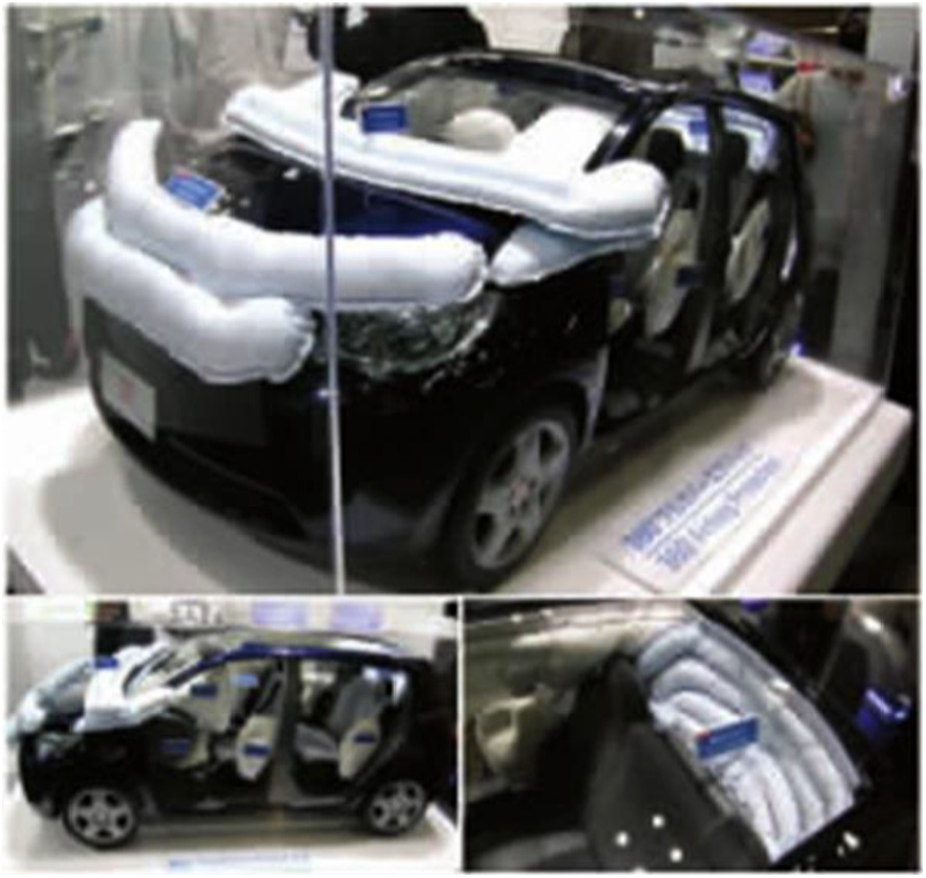
Toyota 360° airbag protection system.
Design of a pedestrian protection system for vehicles by TRIZ
The pedestrian protection system for vehicles aims to protect pedestrians using a series of measures, such as pedestrian airbag, to reduce the intensity of vehicle-to-pedestrian collision when the pedestrian injury is unavoidable.14,15
TRIZ means “theory of inventive problem solving.” As a result of the study of a large number of patents by Genrich Saulovich Altshuller, the TRIZ was developed in 1994 as a systematic and innovative solution that focuses on logic and data-based problem patterns. By the examination of a large number of patents, 39 engineering parameters and 40 inventive principles were determined. 16
TRIZ also includes component analysis and system triaxial analysis. Component analysis is an analysis tool that identifies the functions, features, and costs of engineering system and super-system components. System triaxial analysis is an analysis tool to establish the logical relationship between the initial faults and the underlying faults, and finds more breakthroughs in problem-solving. In the literature, the TRIZ method was applied to solve core categorization, coordination, and procurement (CCP) problems to improve the CCP performances of spare parts in Naval Maintenance and Repair Command Acquisition Management Unit (NMRC-AMU). 17 As an Engineering example, infusion system is analyzed and re-designed by TRIZ. The innovative idea is generated to liberate the caretaker from the infusion bag. 18
TRIZ can provide solutions to the problems and contradictions encountered in the system, 19 and select the best solution through analysis and comparison so as to eliminate the technical barriers in the development of products. The specific new solution of pedestrian protection system for vehicles is analyzed as follows:
1. System definition and component analysis: the system definition process is shown in Table 1.
System definition process.

Through the system definition process and component model analysis, the functional structure diagram of pedestrian protection system for vehicles can be obtained, as shown in Figure 2. The diagram describes the names of the components in the system as well as the relationships between them.

Functional structure diagram of the system.
The driver controls the throttle and brake components, and the throttle and brake components regulate the rotational speed of the moving wheels. The moving wheels are connected with the frame components to jointly dominate the movement state of the vehicle body. The moving vehicle body provides protection to the driver, while the driver indirectly controls the movement state of the vehicle body. Pedestrians act as an obstacle (detrimental) to the driver’s driving state, and the driver can judge whether the outside environment is safe according to the movement state of the pedestrian. When the moving vehicle body collides with the pedestrian, there will be a harmful effect (red arrow mark) between them while the control, protection, judgment, and connection are all useful functions (blue arrow mark).
2. System triaxial analysis: the cause of injury arising from collision between the moving vehicle body and the pedestrian is studied by triaxial analysis, and three causal axes are obtained, as shown in Figure 3. ① The uncontrollable reaction speed of the driver and external environment contribute to insufficient reaction time for driver to control throttle and brake, and the speed of the moving wheels cannot be effectively reduced, thereby leading to the collision injury. ② Because of the diversity of the surrounding environment of a vehicle and the instability of the feedback system in the vehicle, the effectiveness of the vehicle-to-pedestrian distance feedback system is insufficient, which leads to the collision injury. ③ The lack of protection system for reduction of the collision injury to pedestrians makes the strength of the moving vehicle too great and the flexibility effect too small when the collision occurs, which leads to the collision injury.
3. Technical contradiction analysis: through technical contradiction analysis, the system (object) studied is defined, and the aspects of improvement and deterioration are described with appropriate engineering parameters. Then a more perfect solution is obtained by looking up the inventive principles.

Triaxial analysis diagram of the system.
Four groups of technical contradictions are analyzed in this article, and the specific establishment process and analysis are as follows:
Group I. Aiming at the problem that the airbag coverage area is not enough to protect pedestrians completely, the method of all-around airbag is put forward. Such airbag uses its area to increase airbag coverage, but it worsens the driver’s information loss. Inventive principles for solving problems are determined by analysis: 16 partial or excessive action and 30 flexible shells or thin films.
Group II. Aiming at the complexity in realizing the all-around airbag functions, the method that each separate area has its own airbag control device is put forward. The decentralized control device uses its reliability to stabilize the controllability of all-around airbag, but it will worsen the system complexity of the moving vehicle body. Inventive principles for solving problems are determined by analysis: 1 segmentation, 13 do it in reverse, and 35 transform the physical/chemical state.
Group III. Aiming at the problem of installation position of all-around airbag control device, a method of installing an intermediate control device in the engine hood area is put forward. This device makes use of its adaptability and versatility to increase the stability of the all-around airbag, but it causes the shape of the engine hood to deteriorate. Inventive principles for solving problems are determined by analysis: 1 segmentation, 8 anti-weights, 15 dynamicity, and 37 thermal expansions.
Group IV. Aiming at a large difference in the height of center of gravity between the engine hood plane and the front-end windshield plane of the vehicle, the method of mounting a support device in the middle position after the deployment of all-around airbag is put forward. The support device makes use of its adaptability and versatility to reduce the difference in the height of center of gravity between the engine hood and the frontal windshield, but it makes the system complexity of the vehicle body deteriorate. Inventive principles for solving problems are determined by analysis: 15 dynamicity, 28 replacements of a mechanical system; 29 pneumatics and hydraulics, and 37 thermal expansions.
4. Establishment of solutions: section “Modeling of airbag protection system” establishes and analyzes the technical contradictions in the four aspects: the material characteristics of the airbag, the form of the airbag control device, the installation position of the intermediate control device, and the large difference in the height of center of gravity. By referring to 40 inventive principles, the optimal solutions for each problem are obtained as follows:
Group I. According to the principle of thin films, visual materials are used in special areas and common materials are used in the remaining areas, or visual materials are used for the whole of the airbag.
Group II. According to the principle of transform the physical/chemical state, the all-around airbag is designed as a whole and is controlled by a control device.
Group III. According to the principle of dynamicity, the module of intermediate control device is installed in a suitable space under the engine hood instead of being exposed to the upper surface of the engine hood. When the intermediate control device works, the airbag will break through the upper limit of the engine hood to pop up and deploy to play a protective role.
Group IV. According to the principle of dynamicity, an elastic device is introduced into the module of the intermediate control device so that the two are integrated into one module. Before the intermediate control device receives the work instruction, the elastic device works first, and the intermediate control device will be driven by the elastic device to achieve the effect of popping up.
The above four solutions will be integrated to get the final solution established in this article.
Modeling of airbag protection system
Modeling of airbag protection system based on SolidWorks
During driving, the appearing position and time of the pedestrians outside the vehicle are random, and such uncontrolled external environment has a great impact on the safety of vehicles. 20 This article studies the problem of collision injury and protection of the pedestrians in front of the vehicle.
When the pedestrian is in front of the vehicle, the relative position relationship between vehicle and pedestrian can be divided into three types: the center, the left side of the center and the right side of the center. When the collision occurs, the impact force on pedestrians is different in magnitude and direction, and the damage to pedestrians is also different. 21 Considering the setting of resistance to reduce more damage caused by tumbling and falling from a vehicle, the airbag on the engine hood is arranged as a trapezoidal airbag with obvious effect of increasing resistance. At the same time, new damage may also occur in the reflector area on both sides of the vehicle, so the airbag at the windshield is designed to be protruding on both sides.
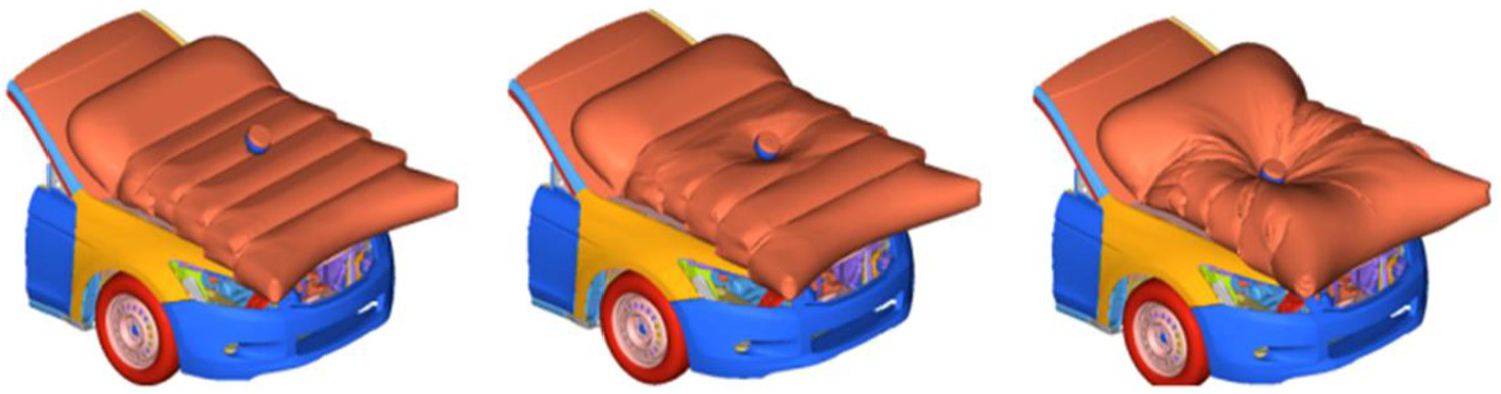
Therefore, according to the above three different position relationships, three different models of airbag deployment are designed based on the SolidWorks software: convex (Figure 4), straight (Figure 5), and concave (Figure 6). The characteristics, advantages, and disadvantages of each form are shown in Table 2.
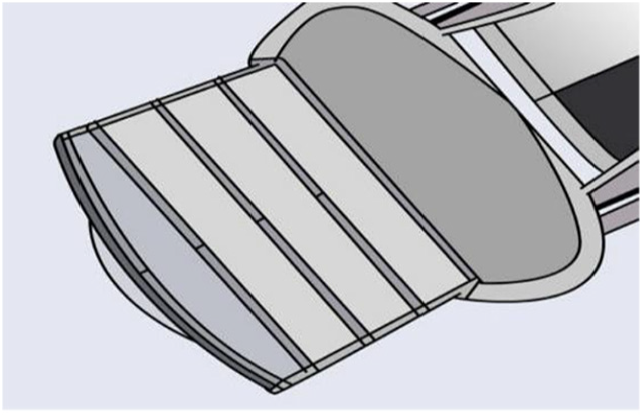
Convex airbag deployment.

Straight airbag deployment.

Concave airbag deployments.
Comparison of different models of front-end deployment.

When a vehicle collides with a pedestrian, the pedestrian will be subjected to a lateral force component. If the collision point is closer to the edge of the airbag, the pedestrian will be subjected to a greater lateral force component. The lateral force component is directed to the inner side by the concave airbag, which makes the pedestrian fall on the airbag of the vehicle body and reduces the probability of pedestrians falling on the hard ground to cause secondary damage. In contrast to convex and straight airbags, concave airbag also has the advantages of material saving. Therefore, from the point of view of safety reliability and material consumption, the concave airbag is selected here.
Considering the practicability of the system, the rectangular groove on the engine hood is first designed. Three groups of elastic devices are placed in the rectangular groove to control the airbag popping up, and the airbag units are also arranged, including a groove for placing the airbag and two sets of folded airbags, one extending toward the engine hood and the other toward the windshield to form a complete pedestrian airbag in front of the vehicle, as shown in Figure 7.

Airbag model in airbag groove.
The form of the airbag deployment changes at a large angle in this position, because it is necessary to deploy the airbag bidirectionally. The rectangular groove should be positioned as close as possible to the vehicle wiper, and its length needs to be as long as possible to meet the requirements of effective action area for airbag deployment. Meanwhile, in order to avoid great impact on the structural stability of the hood, the rectangular groove is designed at the groove connected to the various structures of the vehicle so that the rectangular groove and the frame are connected as a whole. Through the above analysis, the combination effect diagram of the airbag control device is shown in Figure 8, and the whole assembly effect model of the airbag protection system is shown in Figure 9.

Combination effect diagram of the airbag control device.
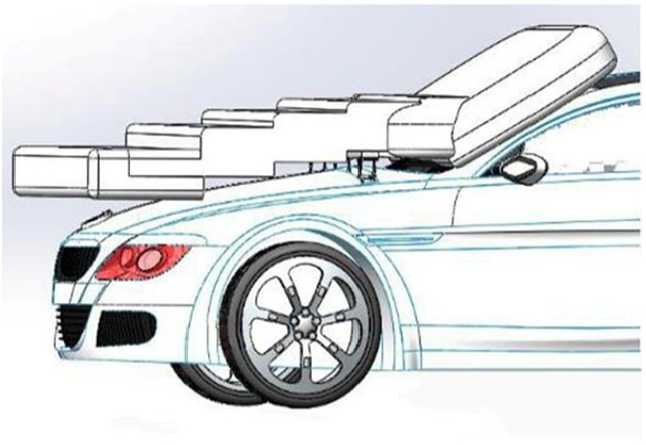
The whole assembly effect model of the airbag protection system.
Introduction to the work of airbag protection system
The pedestrian protection system for vehicles consists of pedestrian collision sensor, controller, elastic device, gas generator, airbag components, and so on. The pedestrian collision sensor includes speed sensor, distance sensor, infrared temperature sensor, and so on. The functional structure of the specific components is shown in Figure 10.
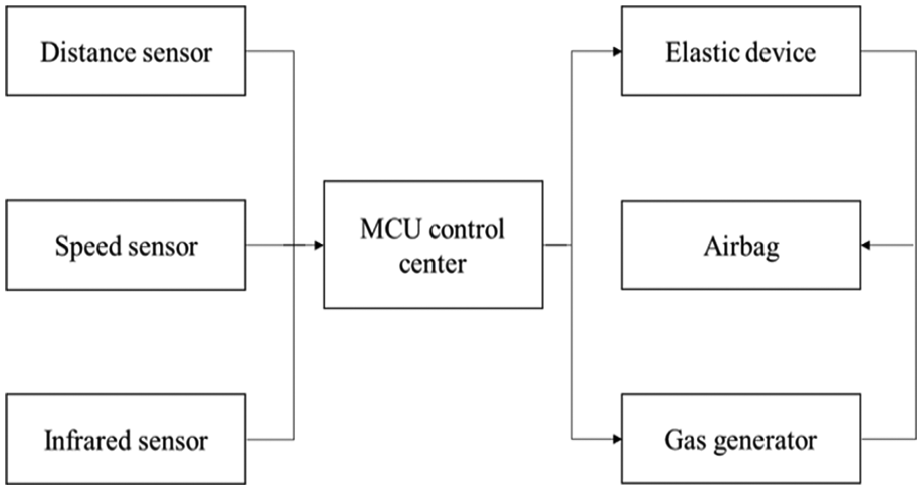
Functional structure of airbag protection system components.
During the driving, the sensor sends the measured data and signal to the Microcontroller Unit (MCU) control center which receives the parameters such as the vehicle speed value and the distance change value. After analysis and calculation, if the parameters reach the pre-set value of the hazard situation, a signal will be sent to make the elastic device work. When the elastic device is deployed to a certain extent, the MCU control center will give the gas generator an ignition signal to generate a large amount of gas instantly, so that the airbag will be fully deployed to protect pedestrians.
Collision simulation analysis
In vehicle-to-pedestrian collision, the pedestrian head injury caused by the collision is the greatest, and the head injury is the main cause of serious pedestrian injuries.22,23 Therefore, based on the standard pedestrian head impactor model (adult), this article carries out the simulation analysis. There is an acceleration sensor unit in the model, which can output the acceleration-related information of pedestrian head injury.
With the common vehicle as the research object and head injury criterion (HIC) as the target, a simulation model of the collision between a normal pedestrian and a 50 km/h vehicle is established. The HIC value of pedestrian head is calculated and compared when collision occurs with or without airbag protection, so the feasibility of the solution can be verified.
In the course of head injury research, the HIC index is mainly used to evaluate the pedestrian head impact risk. According to the international standard GB/T 24550-2009 Protection of Motor Vehicle for Pedestrians in the Event of a Collision, HIC = 1000 is the critical value for head impact damage, and it is calculated in equation (1)

where HIC is the head injury criterion; a is the combined acceleration at the centroid of the head impactor model, the value of which is a multiple of the gravitational acceleration g; and t1 and t2 are any two moments in the process of impact (unit: ms).
When the collision occurs, the pedestrian head begins to contact the rear end of the vehicle hood at about 26 ms, and the angle of the pedestrian head colliding with the engine hood is about 60°. A vehicle-to-pedestrian head impact simulation model with or without airbag protection is established, as shown in Figures 11 and 12.

Vehicle-to-pedestrian head impact simulation model without airbag protection.
Vehicle-to-pedestrian head impact simulation model with airbag protection.
The finite element modeling is completed, and the LS-DYNA solver is used to calculate. The curve is extracted and the data are processed by HyperWorks. When there is no airbag protection in the collision, the maximum value of HIC is calculated to be 1608, which exceeds the safety limit, and it may cause serious injury to the human head. When the pedestrian airbag is added, the maximum value of HIC is decreased to 536, which meets the regulatory requirements for HIC. The injury values with or without airbag protection at the time of impact are compared as shown in Figure 13.

Comparison of HIC with or without airbag protection.
The above simulation analysis and test results show that under the same conditions, the vehicle equipped with the front-end all-around airbag can play a better role in pedestrian protection during the collision, which make the maximum value of HIC decrease by 66.7% and effectively reduce the collision damage.
Conclusion
The application of TRIZ has been involved in many fields and has yielded many significant results; nevertheless, it is seldom designed, applied, and studied in the field of vehicle. It can provide more innovative solutions for researchers.
This article put forward a kind of the optimal solution of airbag protection system for vehicle-to-pedestrian collision and analyzed the technical contradictions in the working process of airbag by TRIZ. A new type of all-around airbag system mounted to the front of vehicle was designed. From the point of view of safety reliability and material consumption, the deployment of the airbag was modeled digitally, and the concave airbag deployment model was selected. Through the simulation analysis of vehicle-to-pedestrian head impact with the finite element software, it was concluded that the HIC value under airbag protection was much smaller than that without airbag protection. All of those verified that the innovative solution can effectively reduce the collision injury and protect the pedestrian safety.
Footnotes
Handling Editor: Wei-Chang Yeh
Declaration of conflicting interests
The author(s) declared no potential conflicts of interest with respect to the research, authorship, and/or publication of this article.
Funding
The author(s) disclosed receipt of the following financial support for the research, authorship, and/or publication of this article: The authors acknowledge the innovation method project of the Ministry of Science and Technology of China (grant no. 2016IM020100), the Key R&D Project of Zhejiang Province (grant no. 2018C01074), and the R&D Project of Zhejiang Province (grant no. 2019C35008).
