




Abstract
A substitution box is a core component of the popular symmetric-key algorithms. However, the major problem of the conventional substitution boxes is the statistic behavior, which is employed as a fixed-size lookup table. To solve the fixed-size lookup table problem, various substitution box construction methods were proposed with key control, but it is hard to enhance all cryptographic properties, for example, linear and differential probabilities. Thus, chaos is applied for key control in designing robust substitution boxes due to unpredictable and random-like behavior. Moreover, the confusion and diffusion properties of cryptography can be achieved by chaos. This article introduces an efficient construction of a key-dependent substitution box based on the mixing property of the chaotic sine map. The substitution box so constructed has very low differential and linear approximation probabilities. The experimental results confirmed that the proposed method to construct substitution box has acceptable cryptographic properties to resist against various cryptanalysis.
Introduction
Cryptography is an art of converting or transforming data into unreadable or scrambled form through an encryption process, which is controlled by the secret key. It can be applied to any data1,2 to provide data protection. Once the data are encrypted, only authorized parties should possess the secret key, to retrieve the original data. According to Lee et al., 3 cryptography and authentication are two intertwined processes, where encryption is used to validate the actual users or sources accurately by offering a reliable authentication system. A symmetric-key cryptosystem can be described in Figure 1. 4

Block diagram of symmetric-key cryptosystem.
Based on algorithm structure and design, these symmetric-key cryptographic techniques further divided into two groups: stream ciphers and block ciphers. Block cipher performs encryption transformation with specified symmetric key, on fixed-length units of bits or bytes of data (known as a block). Encryption transformation is based on block iteration for higher security. Block size plays a significant role in designing new block cipher. Larger block size means improved security, but it increases the overall algorithm complexity. Data Encryption Standards (DES), Triple-DES, International Data Encryption Algorithm (IDEA), and Advanced Encryption Standard (AES) are extensively employed symmetric-key block ciphers; some of them have become standard, for example, DES and AES.
Substitution box (S-box) is an important component in these symmetric-key block ciphers, especially since Biham and Mitsuru had discovered differential and linear cryptanalysis methods, respectively. Both linear and differential cryptanalyses are currently the most powerful cryptanalysis attacks. 5 The application of S-box in the cryptographic algorithm leads to the achievement of Shannon’s recommended confusion and diffusion properties to strengthen against linear and differential cryptanalyses. 6 Confusion intends to ambiguous the key and ciphertext relationship, whereas diffusion goals at reshuffling the bits in the plaintext for redundancy. 7
Furthermore, S-box is a core component of the popular symmetric-key algorithms 6 due to its cryptographic benefits. However, the primary problem of these S-boxes is the statistic behavior without any key control, which is employed as a fixed-size lookup table in the encryption and decryption process. Thus, to produce dynamic S-box with key control, chaotic systems were used to construct S-box instead of being fixed. 8 Moreover, the strength of cryptographic algorithms depends on S-box against various attacks, for example, linear and differential cryptanalyses.2,3 Thus, the construction of efficient and secure S-box is a crucial part of designing symmetric-key algorithms. This can be accomplished by satisfying important analytic measures, for example, nonlinearity (NL), balance criteria (BC), differential uniformity (DU), avalanche effect, confusion coefficient variance (CCV), algebraic degree (AD), and strict avalanche criteria.
This article presents an efficient construction of a key-dependent S-box. The design objective is to achieve higher NL in generated S-boxes and increase resistant level against cryptanalysis. The rest of this article is organized as follows: the “Related work” section discusses the related work, the “Proposed work” section presents the proposed method of constructing key-dependent S-box, the “Experiment analysis” section provides the experiment analysis and results, and the “Conclusion” section presents the conclusion.
Related work
As mentioned earlier, the major problem of the conventional S-boxes is the statistic behavior, which is employed as a fixed-size lookup table. To solve the fixed-size lookup table problem, various S-box construction methods were proposed with key control.9–11 These techniques incorporated key control with several methods such as neural network, and evolutionary and genetic algorithms. 12 However, it is hard to enhance all cryptographic properties, for example, linear and differential probabilities. Thus, chaos is applied for key control in designing robust S-boxes,8,12–15 due to unpredictable and random-like behavior. Moreover, the confusion and diffusion properties of cryptography can be achieved by chaos.16,17 Moreover, the cryptographic properties such as confusion and diffusion can be achieved by chaos.18–20
Generally, chaotic systems are employed to construct proficient cryptosystems.21–,24 ThCChe chaotic maps are practicable for cryptography, for instance, randomness, mingling, and sensitivity;25–27 all of these properties make chaotic maps a suitable option for achieving Shannon’s concept of good practical secrecy systems. In addition to the theoretical study of the chaos, its potential applications in cryptosystem-based S-box have also been widely explored,23,28–31
Toward this end, chaotic dynamics was first employed in the construction of S-box by Jakimoski and Kocarev. 26 The presented method consisted of four steps to generate S-boxes from the logistic map. In Tang et al.’s study, 32 a method based on a two-dimensional (2D) Baker map was presented to produce 8 × 8 S-boxes which had better performance and cryptographic properties compared to the study of Jakimoski and Kocarev. 26 However, its implementation issues were exposed by Chen et al., 33 and then they presented the improved method by applying three-dimensional (3D) Baker map to resolve the implementation issues. Moreover, a better S-box construction method was presented in Özkaynak and Özer 15 based on Lorenz system, which employs particular shifting operation, and demonstrated better performance. Meanwhile, chaotic dynamics was used in the construction of active S-boxes12,34 to achieve higher NL in encryption process for improving confusion and diffusion properties.
Later, Belazi et al. 8 used the Rossler system to construct S-boxes, and Hamdi et al. 13 presented another method using the chaotic logistic map as a source of randomness for better NL and DU. Both methods8,13 presented improved linear and differential resistance level. Recently, Ahmad et al. 14 suggested a new method by chaotic map’s trajectory sampling method to improve the S-box quality.
However, these techniques still postured serious security issues, and their vulnerability can be exposed by analyzing differential approximation probability (DAP) and linear approximation probability (LAP). Experiments were conducted by comparing DAP and LAP, offered by the previous studies8,12–15 to determine their strength against differential and linear cryptanalyses. Tables 1 and 2 show the DAP and LAP results, respectively. Results show that there is not considerable enhancement in the linear and differential probabilities. Comparatively, work in Özkaynak and Özer 15 achieved the highest DAP and LAP that are 10 and 0.1289, respectively.
DAP results of the chaos-based S-box construction methods.

DAP: differential approximation probability.
LAP results of the chaos-based S-box construction methods.

LAP: linear approximation probability.
However, this requires more improvement because an improved S-box (regarding the DAP and LAP) may lead to the decline of other properties, for example, NL, AD, CCV, and DU. 35
Proposed work
Chaotic sine map
The sine map is taking as the primary chaotic map for the construction of the proposed S-box. The chaotic sine map (CSM) is a widely known one-dimensional (1D) chaotic map. It is similar to the Lorenz system from many respects and meets many cryptographic requirements such as complex chaotic behavior, sensitivity to initial values, randomness, and unpredictability.26,27 Equation (1) defines CSM26,27

where

Bifurcation diagram of the CSM.

Lyapunov exponent of the CSM.
The method of constructing key-dependent S-box
The proposed method of constructing a key-dependent S-box is based on the mixing property of CSM. CSM is an iterative map (start from two input parameters,
The flowchart of the method of constructing a key-dependent S-box is shown in Figure 4. It takes

Flowchart of the chaotic S-box construction method.
Inputs and outputs
The chaotic S-box construction method based on CSM requires secret key
Step 1. Select the initial input parameters
Step 2. Include zero to final stored values as it has no inverse.
Step 3. Define the output domain range of the CSM to
Step 4. Divide the domain range into 255 subdomains of equal length and sequentially label them
Step 5. Iterate the CSM with the input initial value
Step 6. Stop iterating the CSM, when stored values approach to 255 of
The S-box generated using the proposed method is provided in Table 3. Finally, an experiment analysis is performed on constructed S-box and compared to recently proposed chaotic S-boxes. The analysis results are provided in the following sections.
The output S-box of the proposed method.
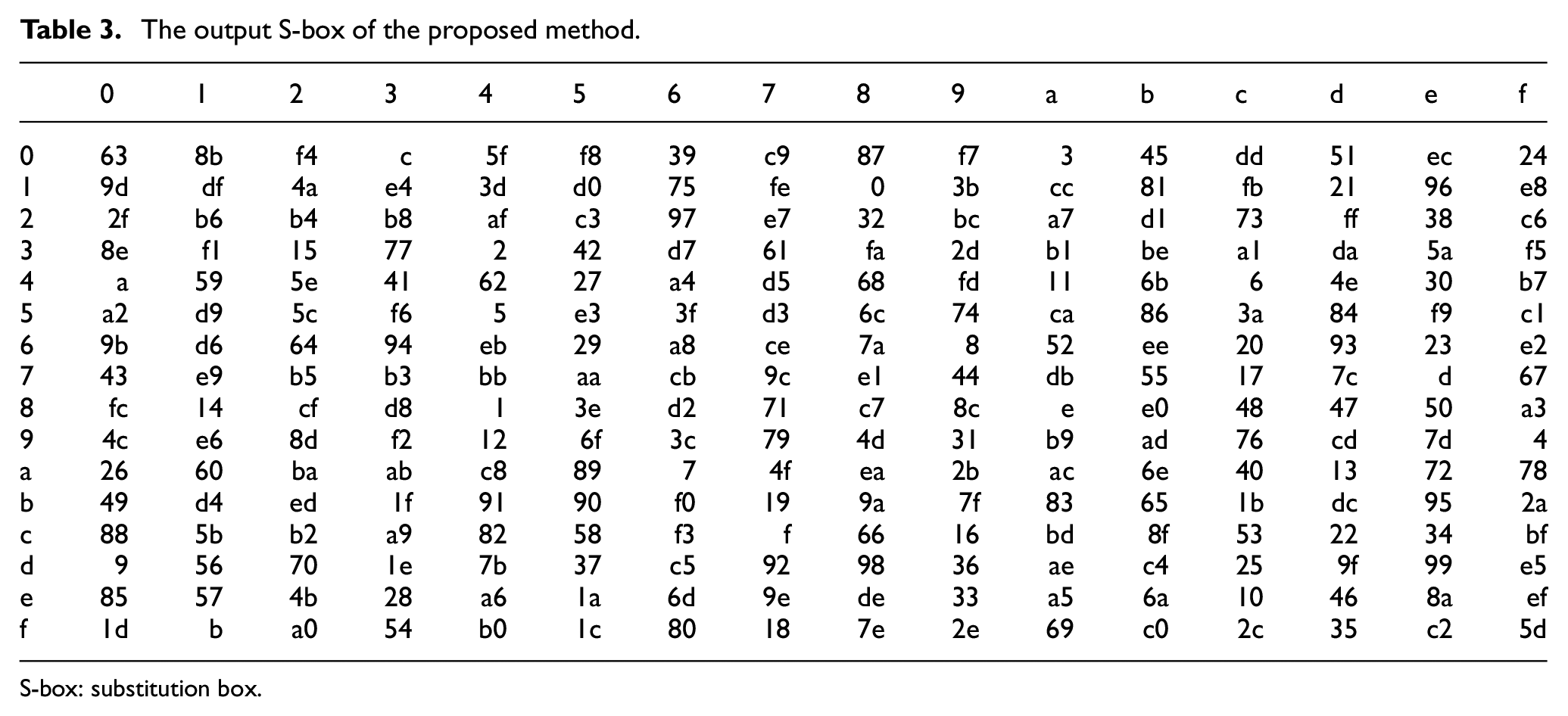
S-box: substitution box.
Experiment analysis
Earlier studies5,26,36 presented some significant cryptographic properties that strong S-boxes should fulfill such input/output XOR distribution and LAP. Consequently, to confirm the robustness of the proposed method, this section presents the comparative analysis of S-box generated using the proposed method and S-boxes presented in prior work. Table 3 shows the output S-box, where the initial value
Keyspace analysis
Based on the control parameter analysis of CSM presented in the “Chaotic sine map” section, the S-box construction method based on CSM presented in “The method of constructing key-dependent S-box” section is therefore limited to
DAP
Biham and Shamir 5 had discovered differential cryptanalysis by identifying imbalance XOR distributions between inputs and outputs. By this means, S-box should possess DU so that the differential inputs and outputs of S-box should map uniquely to ensure uniform mapping probability and thus possess DU. The DAP is defined by equation (2)5,8,14

where
DAP comparison between proposed and existing S-boxes.

DAP: differential approximation probability.
The maximum DAP of the proposed S-box is 8/256, which is a comparatively lowest maximum DAP among all prior S-boxes where maximum DAP reached 10/256 and 12/256. This proves that the proposed method to construct dynamic and key-based S-box is stronger than prior proposed methods against differential attacks. Moreover, histogram analysis is performed to confirm the DU. Figure 5 shows the histogram of differentials of the generated S-box (as given in Table 3), where the x-axis shows input differentials, the y-axis shows output differentials, and z-axis shows the frequency of the input and output differentials. The histogram analysis confirms that proposed method for constructing S-box possesses DU, where very few DAPs are 8 and rest are lesser.

DAP histogram of proposed S-box.
LAP
Matsui
36
presented the linear cryptanalysis method by measuring LAP to investigate the probability that a value of an input bit coincides with a value of an output. The LAP is the measure of the maximum imbalance value of an event; the parity of the input bits selected by the mask

where
LAP comparison between proposed and existing S-boxes.

LAP: linear approximation probability.
S-box analysis using the S-box Evaluation Tool
There are many S-box Evaluation Tools (SETs) available to rigorously analyze the cryptographic properties with different criteria. For example, the Boolfun package 38 and the Boolean Functions module in Sage 39 are known for cryptographic analysis but restricted to figure out difference distribution and linear approximation of an input S-box while another tool known as SET 40 can evaluate a broad set of cryptographic properties of Boolean functions and S-boxes. SET is written in ANSI C and supports arbitrary input and output sizes of the S-boxes.
This study used the SET suite to evaluate the cryptographic properties of the proposed S-box. The following sections define more precisely the cryptographic properties that can be evaluated using SET. These properties include BC, DU, NL, CCV, AD, and signal-to-noise ratio (SNR)/differential power analysis (DPA). Furthermore, this section presents the comparative analysis of S-box generated using the proposed method (as described in “The method of constructing key-dependent S-box” section) and S-boxes presented in prior work. These S-boxes are Akram_S-box, 8 Hamdi_S-box, 13 Musheer_S-box, 14 Wang_S-box, 12 and Ozkaynak_S-box, 15 and the output S-box of the proposed method is shown in Table 6.
SET results for comparison between proposed and existing S-boxes.
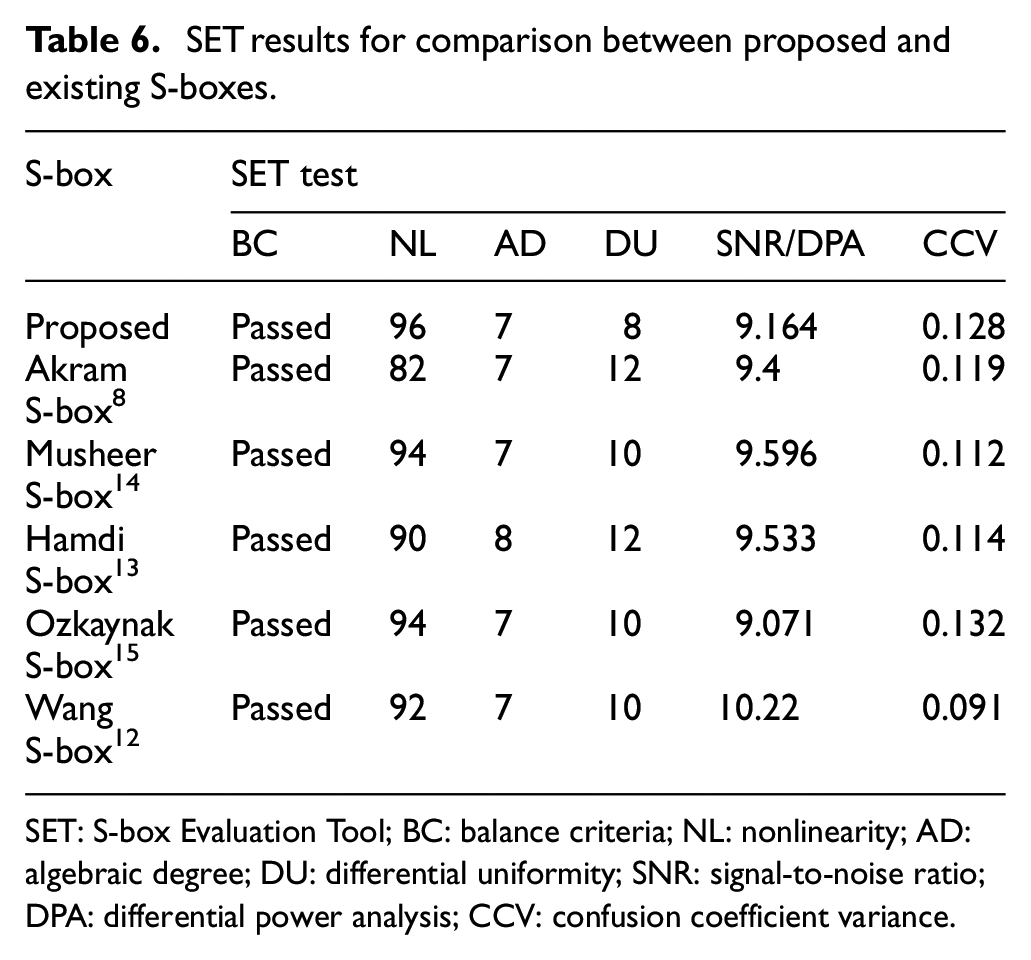
SET: S-box Evaluation Tool; BC: balance criteria; NL: nonlinearity; AD: algebraic degree; DU: differential uniformity; SNR: signal-to-noise ratio; DPA: differential power analysis; CCV: confusion coefficient variance.
BC
The BC is an important measure to confirm the cryptographic properties of the S-box. Any S-box is proved to meet BC if it has an equal number of zeroes and ones. Table 6 shows the BC results of the proposed and prior published S-boxes. Results confirm that proposed and prior S-boxes passed BC since they have equal numbers of zeroes and ones.
SNR(DPA)
DPA is a prominent cryptanalysis method that is used to attack cryptographic algorithms. DPA is of great concern due to its effectiveness to break the secret key. Kocher et al. 41 presented the DPA by statistical processing, for example, differential means 41 and correlation power 42 analyses. Furthermore, Guilley et al. 43 presented the SNR for DPA to quantify the S-box resistance level against the DPA attack. Any S-box that produces lower SNR(DPA) value ensures better resistance power against DPA attack. 43 SET test results for SNR(DPA) are presented in Table 6 of the proposed and prior S-boxes. Results show that the proposed and Özkaynak and Özer 15 S-boxes have the lowest SNR(DPA) values as compared to the prior S-boxes, which are 9.164 and 9.071, respectively. This confirms that proposed method to construct S-box is secure against DPA attack.
CCV
Fei and colleagues44,45 proposed the new property that relates to the DPA resistance of S-boxes which is CCV. They presented a probabilistic model for a side-channel attack that allows the attacker to explore the cipher design.44,45 Moreover, Heuser et al. 46 quantify the CCV value to measure side-channel resistance. They suggested that higher CCV value makes the side-channel attack difficult and confirms a higher resistance level. In this work, SET is employed to compute CCV of the proposed and prior S-boxes. Results are presented in Table 6, which confirms that the proposed and Özkaynak and Özer 15 S-boxes are secure against side-channel attack as they have higher CCV values than the prior S-boxes.
NL
NL is another important measure for the design of S-box since Matsui 36 presented linear cryptanalysis. NL quantifies the measure of the S-box function to resist against linear cryptanalysis. It is defined as the minimum Hamming distance between the S-box function and a set of all affine functions.9,10 NL specifies the distance to cryptographically imperfect affine functions.8,36 Thus, it is crucial that S-box should possess high NL. Table 6 shows the NL results of proposed and prior S-boxes. The NL of the proposed S-box is 96 which is highest as compared to prior S-boxes.8,12–15 This proves that the proposed method to construct dynamic and key-based S-box has the highest capability to resist against linear cryptanalysis.
AD
The AD is another quantitative cryptographic property of the S-box to analyze the strength against the higher order differential and algebraic cryptanalyses. 47 Any S-box is vulnerable to cryptanalysis if it has low AD. 47 Thus, it is crucial to confirm the AD of the S-box that is chosen to be used in a cryptographic algorithm. In this work, the capability to produce AD was evaluated using the SET. Table 6 shows the AD results of the proposed and prior S-boxes. Results show that the maximum AD is 8 of Hamdi et al. 13 and the rest have seven, which is acceptable to resist against higher order differential and algebraic cryptanalyses.
DU
DU analysis plays a significant role in the design of the new S-box. The DU quantifies the measure of the S-box function to resist against differential cryptanalysis. Hence, S-box should possess DU so that the differential inputs and outputs should map uniquely to ensure uniform mapping. Table 6 shows the DU comparison between proposed and prior proposed S-boxes. Results show that the maximum DU is 12 in the case of the studies of Belazi et al. and Hamdi et al.8,13 Furthermore, the input and output differential pairs occur with the maximum DU of 10 in the previous studies.12,14,15 The DU of the proposed S-box is 8 which is comparatively lowest among all prior S-boxes. SET results for DU confirm that the proposed method to construct S-box is stronger than prior proposed methods against differential attacks.
Conclusion
The application of S-box in symmetric-key block cipher leads to confusion and diffusion properties of the cryptography and strengthen against linear and differential cryptanalyses. However, the primary problem of conventional S-boxes was its statistic behavior. Thus, to produce a dynamic S-box with key control, chaotic systems were used to construct the S-box. Toward this end, an efficient method for constructing dynamic S-boxes with key control based on the mixing properties of the chaotic dynamical system was introduced. The generated S-box fulfills the security criteria. The experimental results confirmed that the maximum DAP and LAP of the constructed S-box are found lower than those investigated by the recent researchers. Most of the differentials occur with very low probability. The performance of the generated S-box was proved to be suitable as a strongly nonlinear component in the encryption process. Also, the S-Box testing criteria were conducted by the SET suite to evaluate the cryptographic properties of the proposed S-box. SET results indicated that the proposed S-box has good cryptographic properties to resist cryptanalysis.
Footnotes
Handling Editor: Aneel Rahim
Declaration of conflicting interests
The author(s) declared no potential conflicts of interest with respect to the research, authorship, and/or publication of this article.
Funding
The author(s) received no financial support for the research, authorship, and/or publication of this article.
