




Abstract
Nuclear safeguards evaluation is a complicated issue with many missing values and uncertainties. By invoking Dempster–Shafer theory of evidence, the missing values are assigned to a subset of a set of multiple objects, at the same time, by combining different evaluation values, and the effect of uncertainty will be decreased. In this way, both the missing values and uncertainties are considered in the final evaluations. This method has been used in considering the International Atomic Energy Agency experts’ evaluation for nuclear safeguards. The result shows that (
Introduction
Nowadays, nuclear system safety has attracted much attention from all over the world. Many researches have been done on nuclear power plant,1–8 nuclear wastes, and especially nuclear weapon. Since improper use of nuclear energy may cause mass destruction, it is necessary to evaluate nuclear safeguards and limit the development of nuclear detonations. Nuclear safeguards evaluations9–14 are invoked to test and verify that states meet with the international treaty, which put forward by International Atomic Energy Agency (IAEA) and make sure that those nuclear materials will not be used to manufacture nuclear weapons. In order to make the evaluation of indicators and then make the final assessment of the States’ declarations to the institution concerning any activity which are related to nuclear power, the IAEA experts collect relevant information from some main sources: information provided by the State itself, Internet and newspapers, and non-safeguards IAEA databases. 15
However, there still exists much uncertainty and complexity on the information they collected, and the number of indicators is huge. As a result, it is difficult for IAEA experts to conduct a comprehensive assessment of all indicators. In addition, some indicators in the assessment framework are missing values; 16 it may cause some incomplete evaluation of the security. At the same time, when we want to take those missing values into consideration, uncertainties usually come as which part these missing values should belong to. Therefore, many researchers have focused on these problems, and some methods have been put forward to handle them, such as deletion and imputation.17–19 At the same time, Liu et al. 15 put forward a framework to deal with the information by introducing a newly belief rule. Kabak and Ruan20–22 presented a method for estimating the cumulative belief in nuclear safeguards. Rodríguez et al.16,23 proposed to manage missing values with an imputation process by means of a collaborative filtering model24,25 based on the k-nearest neighbors (K-nn) scheme. Based on the hierarchical analysis and the IAEA model, Pei et al. 26 treat and handle nuclear safeguards evaluations by using a 2-tuple fuzzy linguistic aggregation model 27 and weighted ordered weighted averaging (WOWA) operator. 28
In the present work, a new method for evaluating nuclear safeguards is proposed. The method is based on Dempster–Shafer theory of evidence, which has been widely invoked to handle uncertain information, such as fault diagnosis,29–32 human reliability analysis, 33 pattern recognition,34–37 uncertainty modeling,38–40 evidential reasoning,41,42 decision making, 43 and environmental assessment.44,45 In this article, first, according to the belief degrees of linguistic evaluation values given by IAEA experts and weights of IAEA experts about indicators, we obtain the basic probability assignment (BPA) of each indicator. Then, the BPA of each indicator is combined to get a general evaluation result. At the same time, some adjustments will be made on our results so that the output data can be used for other analysis. Finally, by taking the strengths of indicators into consideration, we aggregate the evaluation results of indicators and compare them with some results from other works.
Preliminaries
The IAEA physical model
In order to have an accurate evaluation of nuclear energy, the IAEA proposes the physical model to consider lots of indicators in hierarchical and multilayer structure, which take all those linguistic evaluation values into account.
The values of this model are shown in Table 1, with totally 914 indicators in it. Different levels are clear and directly address this assessment issue. At the same time, in practice, the strength of each indicator is different. Let us take a strong indicator as an example. When an indicator is connected to nuclear process or nuclear activities, it can be viewed as a strong indicator. Conversely, an indicator is weak if it is for many other reasons or for many other activities. In the process of combining indicators with different strengths during the evaluation, Liu et al. 15 put forward a rule to regulate the difference with the ratio of strong indicators:medium indicators:weak indicators being 9:3:1, which means the importance of strong indicators is nine times the importance of weak indicators.
Stratification of the multilayer evaluation. 26

The evaluation of nuclear safeguards is shown in Table 2. As shown in the table

represents all the IAEA experts

which is the vector of evaluation value for each indicator Ii given by IAEA expert
Nuclear safeguards evaluation by IAEA experts.

IAEA: International Atomic Energy Agency.
The weight of each IAEA expert

or

Here,
Here, we limit
Dempster–Shafer theory of evidence
Uncertainty information has always been a hot topic, and how to deal with uncertainty is still an open issue. 46 Many mathematical methods and models have been invoked, such as fuzzy sets, 47 belief structure,48–50D numbers,51–55Z numbers,56,57 and so on. Dempster–Shafer theory of evidence,58,59 as one of the widely used methods, is often used to solve uncertainty information problems. Compared with other tools, Dempster–Shafer theory can express the missing values and uncertainty by assigning a probability directly to a subset of a set of multiple objects. At the same time, the total belief of the objects will be measured separately. Due to these advantages, it has been widely used in many areas, such as information fusion,60,61 game theory, 62 decision making,54,63,64 and risk and reliability analysis.65,66
To complete the description, we introduce some basic concepts in the following parts.
Let

where
The power set of

The elements of
When it comes to a frame of discernment

which satisfies the following condition

In the theory of Dempster–Shafer, a mass function is usually defined as a BPA of the frame of discernment
Taking two pieces of evidence into consideration, they can be indicated by two BPAs,
With two belief structures

with

where
Dempster’s combination rule can be seen as one of the most important and widely used parts of Dempster–Shafer theory, and it also satisfies the exchange and association properties. Therefore, if there exist multiple belief structures, the calculation of their combination results can be performed in pairs or in any order. When we talk about the Dempster–Shafer theory, how to manage the conflict evidence is of great importance.72–76 In addition, for the purpose of facilitating decision making, many methods have been developed to do the transformation or directly convert belief structures into probability distributions. For example, the pianistic transformation 77 and plausibility transformation 78 are two well-known methods.
Method
A new method is proposed in this section to evaluate the nuclear safeguards, which is based on Dempster–Shafer theory of evidence, and the details about this method will also be provided. Also, the belief degree79,80 to aggregate the values of Table 2 is proposed.
Step 1: Notice that
For each evaluation given by IAEA expert, the corresponding weight will be multiplied.
Then a new evaluation is constructed as follows

Step 2: BPAs are constructed by assigning the missing values and uncertainty to the subsets of the set composed of multiple objects. In our case, the set is constructed as (

Here, 1 – S represents evaluation value of the missing information and the uncertainty.
Step 3: If there are n IAEA experts making their evaluations on each indicator, we would have n BPAs on each indicator.
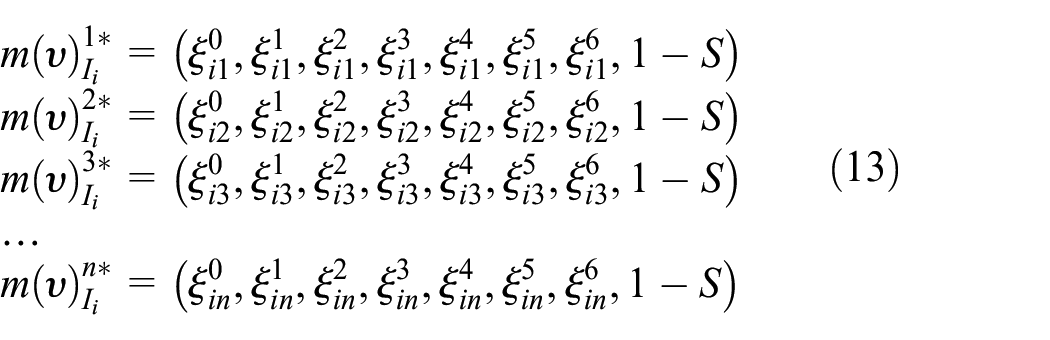
Using the combination rule of Dempster–Shafer theory of evidence to aggregate the evaluation experts made on each indicator, composite evaluation on each indicator can be obtained

Step 4: Based on the strength of an indicator, the indicators are divided into three classes—the strong indicators, the medium indicators, and the weak indicators. They should be considered independently to get the corresponding evaluation results. Then, we combine them, respectively, under the rule of Dempster–Shafer theory of evidence and the results are noted as

where
Step 5: Following step 4, the combination results of strong indicators, medium indicators, and weak indicators will be calculated, and the final results can be achieved on the basis of the three individual classes. We continue to combine them by using the combination rule of Dempster–Shafer theory of evidence whose results needed to be aggregated. Because of the different weights of three kinds of indicators, which is
Finally,
Application
In this section, we illustrate an example to demonstrate how our method works and show the advantages of it by comparing with other works. The example is based on the gaseous diffusion enrichment process, which consists of 22 indicators, shown in Table 3.
21
It is a general assumption that each IAEA expert has the same weight for any indicator, which means in this example, for any
Specific indicators of gaseous diffusion enrichment.
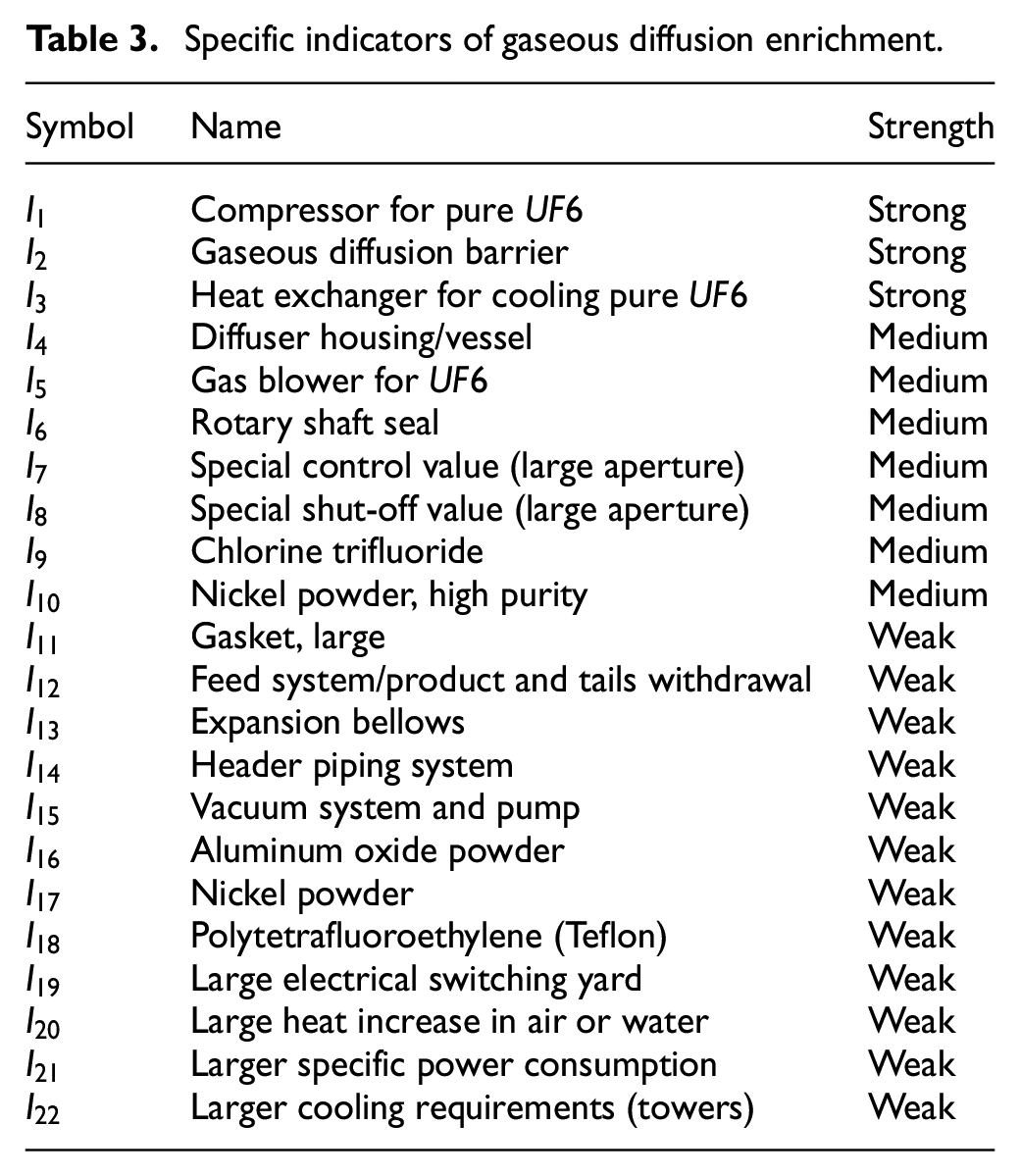
Values of the evaluation for the 22 indicators are shown in Table 4. 21
Evaluations of 22 indicators by four IAEA experts.

IAEA: International Atomic Energy Agency.
For

Calculate the normalized corresponding weights as mentioned in step 1, which is
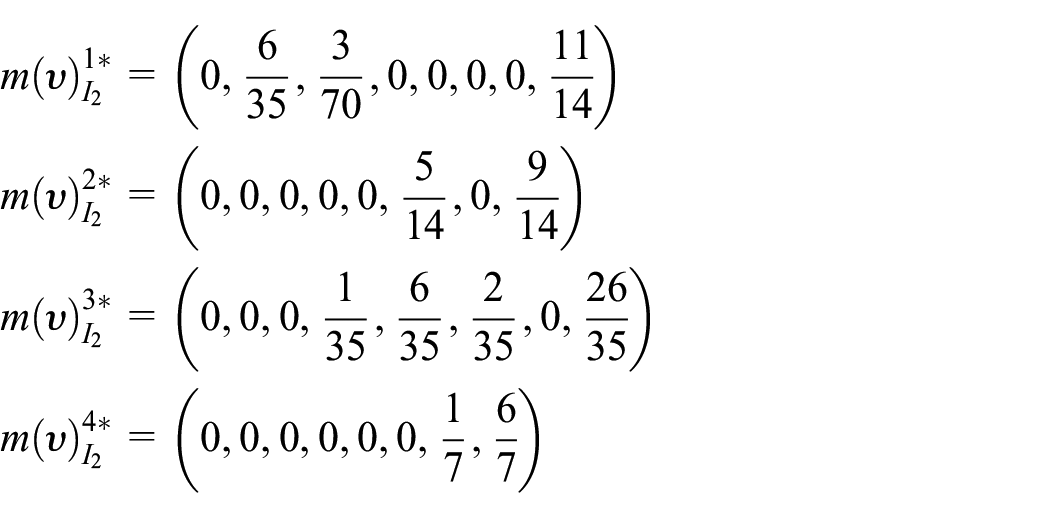
Therefore, the belief degree of indicator

Then, the evaluation of all indicators and the results are shown in Table 5.
Evaluation results of 22 indicators.

The indicators are of the same values, and there are 3 strong indicators, 7 medium indicators, and 12 weak indicators. Hence, the aggregations of three kinds of indicators will be computed, respectively, according to the combination rule of Dempster–Shafer theory of evidence, noted as
Evaluations of three kinds of indicators.

Finally, we multiply

Combining

Therefore, 0.1897, which is (
Comparison of the result of several existing methods.

In Liu et al.’s
15
method, although it takes into account the strengths of indicators, it does not consider the degree of belief in the value of linguistic evaluation, the weight of IAEA experts, and the “missing value in nuclear safeguards evaluation.” In Kabak and Ruan’s
21
method, despite the degree of belief that the indicator k at
Based on the advantages of Dempster–Shafer theory of evidence, our method can handle uncertainty information and missing values more efficiently by assigning the probability to the subsets of the set composed of multiple objects. At the same time, our approach rationally takes into account the information on the indicators and the weighting factors. In the final evaluation part, our result can not only provide the value of
Conclusion
Decreasing the effect of uncertainty and missing values is critical for nuclear evaluation. Because nuclear safeguards information may be incomplete and there are various uncertainties in nuclear safeguards assessment, this article deals with these uncertainties and missing values by assigning probabilities to a subset of a set of multiple objects and in this way the uncertainty and missing information will both be taken into the evaluation process. In the proposed method, Dempster–Shafer evidence theory is invoked to express uncertainty and missing values. At the same time, the weighting factors of the indicators and experts who took part in the evaluation process have been made full use of. As a result, our method can handle the missing values and the uncertainty better than other methods, and the limitations of it are much less than other methods. The results prove that it is of great importance to consider uncertainty and missing information.
Footnotes
Acknowledgements
The authors greatly appreciate the reviewers’ suggestions and the editor’s encouragement.
Handling Editor: Zehong Cao
Data availability
The data used to support the findings of this study are included within the article.
Declaration of conflicting interests
The author(s) declared no potential conflicts of interest with respect to the research, authorship, and/or publication of this article.
Funding
The author(s) disclosed receipt of the following financial support for the research, authorship, and/or publication of this article: The work is partially supported by the National Natural Science Foundation of China (Grant Nos 61573290 and 61973332).
