




Abstract
The recent advances in computation and communication technologies have led to the emergence of Internet-of-Vehicles where vehicles are connected to each other through sensors so that they can exchange information to improve driving safety, efficiency, and comfort. Internet-of-Vehicle has attracted attention from both academia and industry, as it promises huge commercial and research value. This article studies an advertisement dissemination problem in Internet-of-Vehicle with an aim to maximize the profit (number of vehicles to receive advertisements) given a limited budget. In this problem, advertisements will be first sent to a selected set of seed vehicles, then forwarded to neighboring vehicles. To find the influential set of vehicles, we examine the probability of interaction between vehicles by exploiting their mobility. In particular, we present the computation of node marginal gain in four cases by examining vehicle connectivity and topology. Simulation results demonstrate that the proposed algorithm outperforms existing methods for influence maximization by running time and deliver ratio under different traffic scenarios.
Keywords
Introduction
Recent years have witnessed an explosive growth in Internet-of-Things (IoTs) where “Things” such as physical devices and home appliances are embedded with computer-based systems for information collection and exchange. Various applications of IoT require mobility support, geo-distribution, and location awareness. 1 We have to exploit the cloud computing technology to process massive data generated by these applications. This cloud computing paradigm should cause the latency issue of computation and communication between cloud servers and edge nodes. 2
Edge computing, a novel distributed computing paradigm, is an extension for cloud computing.3–5 It can address the requirement of ultra-low latency for communications. Take the exciting application of IoT, Internet-of-Vehicles (IoVs), as an example. It has provided a wide range of services to improve transportation safety, efficiency, and comfort. 6 The existing works on mobile-edge computing for IoV focus on the downloading and off-loading,7,8 efficient resource allocation,9,10 date integrity analysis,11,12 secure data sharing,13,14 and privacy preserving analysis. 15
IoV is composed of cloud servers and a vehicular ad hoc network (VANET), where the VANET consists of vehicles and road side units (RSUs). 16 Vehicles, treated as mobile-edge computing (MEC) nodes, are equipped with onboard units (OBUs) and one or multiple application units, following the dedicated short range communication (DSRC) protocol 17 to communicate with each other, and additional facilities such as RSUs; and RSUs can offer vehicles access to the Internet and enhance the performance of information exchanging due to its large computing capacity.
The ease of data interaction in IoV has opened a myriad of possibilities for intelligent value added services inter-vehicle and intra-vehicle. Messages such as commercials of nearby gas stations, hotels, and restaurants can be disseminated to a large number of road users with a small cost through vehicle collaboration and participation. This is called as cooperative communications 18 or relay networks. 19 Yet, the high mobility of vehicles has been a double-edged sword. While rapidly moving vehicles can send information to more road users as they encounter each other, new challenges have been introduced due to the highly dynamic and intermittent connections between vehicles. The value-added services typically serve a goal of maximizing the impact (the number of receivers) among users with a limited budget. Predecessor studies proposed several solutions to this problem over static wireless networks and (less dynamic) mobile networks,20–22 but little has been contributed to IoV.
In this article, we consider a profit-maximization advertisement (ad) dissemination problem in IoV, where merchants send ads through RSUs to vehicles. Given a limited budget, ads will be first sent to a selected set of vehicles (seeds), and forwarded to other vehicles as seed vehicles moving, with an aim to maximize the total profit (the number of receivers). In order to find the influential set of vehicles, we examine the probability of interaction between vehicles by exploiting the mobility of vehicles, that is, we consider the physical distance, the traveling history, the route at the moment, to find users with a large overall effect on the network. In light of security concerns, information shared is carefully processed to protect user privacy. In addition, the contents of ads are often time sensitive, ads in VANETs are associated with a timer
The problem considered in this article is similar to the influence maximization (IM) problem in social networks, 23 which seeks a subset of influential nodes which can obtain a maximum benefit of propagandizing. We adopt the idea of choosing seed nodes with largest marginal gain from. 24 However, due to the differences in the information diffusion model (detailed in section “Problem definition”), existing methods to calculate node marginal gain cannot be used to solve our problem directly. The contributions of this article are summarized below:
We formulate the ads dissemination problem as a profit maximization problem, and prove it to be NP-hard.
We employ a greedy algorithm to solve the profit maximization ads dissemination problem. In particular, we present the computation of node marginal gain in four cases by examining their connectivity and neighboring nodes.
We exploit the mobility of vehicles when selecting seed nodes. Information to be shared is carefully processed to protect user privacy.
The performance evaluation of the two algorithms are conducted through extensive simulations. Simulation results suggest that our proposed selecting algorithms surpasses state-of-the-art methods for IM by two factors, running time and delivery ratio, that is our selecting algorithms can deliver ads to more vehicles with shorter running time under variable scenarios.
The rest of the article is organized as follows. The related work is reviewed in section “Related work.” We present the network model and problem definitions in section “Problem definition.” In section “Solutions,” we present independent cascade (IC)-based model to cope with the ads dissemination problem. Experimental results and performance evaluation are discussed in section “Performance evaluation.” Finally, concluding remarks and future directions are given in section “Conclusion.”
Related work
Our work is related to selecting influential nodes with knowledge of social network. In this section, we introduce these studies and compare them with our work. Lu et al. 25 utilized the concept of social degree applying to the selection of RSUs, by placing RSUs at high social intersections vertexes. Kim et al. 26 abstracted a metropolitan area map into a rectangular graph with little quadrate blocks in it. The authors proposed an algorithm with a polynomial running time based on the graph to maintain a maximum influence with budget constrained. These two studies performed well in RSU selecting, but the nodes are immobile and cannot apply to our problem. Chuang and Lin 27 and Mezghani et al. 28 focused on the offloading problem in VANETs, which is similar to our seeds selecting problem. In Chuang and Lin, 27 the authors proposed a community-based selecting algorithm to select initial sources to improve the offloading efficiency. The algorithm divided the nodes into communities to segregate the impact range of each initial source. Mezghani et al. 28 designed an interest-aware selection scheme called SIEVE. The SIEVE algorithm take the nodes’ interests into consideration and combined it with the near-future encounter probability conjectured by the vehicular controller, yet the seeds can be determined by a content utility computation using the two indexes. These two algorithms can both improve the content utility when offloading, but cannot apply to our problem because the offloading process requires users’ own accord, which is not practical in advertising.
Notably, our seeds selecting problem is similar to the IM problem which has drawn continuous attention in social networks. Tang et al.
20
proposed a two-phase influence maximization (TIM) algorithm under the IC model. It can achieve
Problem definition
Consider an IoV, displayed in Figure 1, that consists of N vehicles and M RSUs. Each vehicle is equipped with an on-board-unit (OBU) for communications with other vehicles and RSUs.8,16 Let the communication range of the vehicle and the RSU be
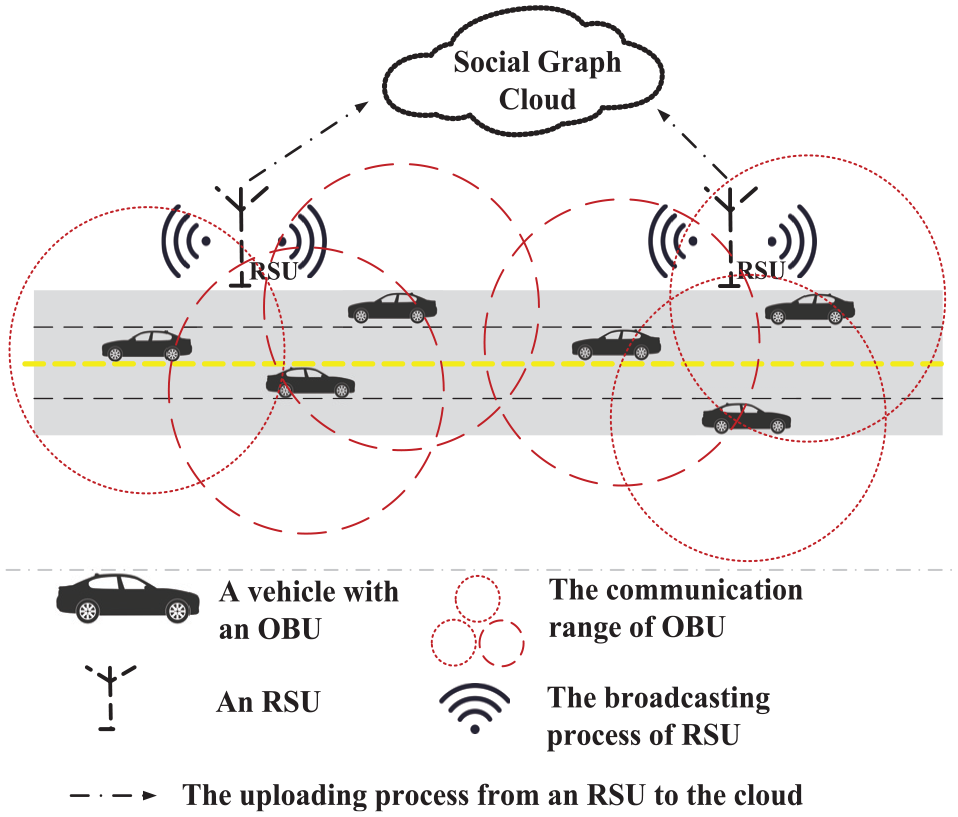
An IoV network model.
Under the above IoV network model, we consider an ads dissemination scenario based on a modified IC model, where some nodes are initially activated as seeds and then these activated nodes continue to activate their neighbors individually. All vehicles update their information to RSUs and merge to a social graph cloud. According to the information stored in the social graph cloud, we select a small set of seed vehicles (initial active nodes). Merchants first send ads to nearby RSUs. Any seed vehicles that enter into the range of
This one-hop ads dissemination scenario are based on the consideration of the analysis complexity and the budget. Since no vehicles are willing to forward ads without being paid, merchants have to pay seed vehicles for helping disseminate ads. As we know, the budget of merchants is limited, which constraints the number of seed vehicles to be selected. However, a large number seed vehicles means that ads can be disseminated more widely and thus, the merchants can get a higher profit. Motivated by the tradeoff between the cost and the profit, we formulate a profit maximization ads dissemination problem under a budget constraint.
To be specific, let

where

For a time period
Let

Given a limited budget

Theorem 1
The problem in equation (4) is NP-hard.
Proof
Let k be the maximum number of seed vehicles that budget
Lemma 1
Proof
See Proof of Lemma 1 in Appendix 1.
Note that equation (4) can be seen as a variation of the IM problem 29 in social networks. However, solutions for the IM problem cannot be used to solve our problem directly due to the following reasons:
Different from social networks with the relatively stable topology, the topology of VANETs changes constantly as vehicles move at high speed and vehicles get disconnected frequently.
We assume that vehicles (except seed vehicles) that receive ads will not forward ads to other vehicles, that is, an active node cannot activate another node unless it is a seed node. While in the IM problem, once a node becomes active, it is able to affect other nodes.
The influence between nodes in the IM problem is based on social relationship, for example, contact frequency, and the number of common friends, while the influence between vehicles in VANETs is impacted mostly by locations and velocities of vehicles.
In next section, we propose an algorithm to solve equation (4), which is similar to solutions of the IM problem based on the classic IC model. 22 Because of the above differences between our problem and the IM problem, we make many necessary modifications. For the sake of clarity, notations used in this article and their descriptions are summarized in the following Table 1.
Table of notations.

Solutions
In this section, we present solutions to the problem defined in equation (4). As described in the above section, the goal is to find a k-element seed set S to maximize the profit
To select k seed nodes, we can employ a classic greedy algorithm that starts with an empty set S then iterates k times and adds the node with the largest marginal gain
IC-based seed selection algorithm.

IC: independent cascade.
To calculate
Case 1. v and S have no common neighbors, and v is not adjacent to S.
Case 2. v and S have no common neighbors, but v is adjacent to S.
Case 3. v and S have neighbors in common, but v is not adjacent to S.
Case 4. v and S have neighbors in common, and v is adjacent to S (there exists at least one node in S that is adjacent to v).
Detailed expressions are shown in the top of the next page and the proof of Theorem 2 is given as follows.
Theorem 2
The marginal gain

Proof
Case 1: In our ads dissemination model, seed nodes activate their neighboring nodes (forward ads to neighboring nodes) independently of each other. Therefore,
Case 2: If v is adjacent to S, as a seed node, v would try to activate its neighbors in S that are also seed nodes. These nodes similarly would try to activate u. As a result, when adding
Case 3: In this case, v and S would both try to activate their common neighbors. When adding
Case 4: This case is a combination of Case 2 and Case 3. Therefore, when adding
Consider an example IoV G displayed in Figure 2. Let


An example of G.
Given

The result is the same as Case 4 in equation (5).
We can also let v be

which is consistent with Case 3 in equation (5).
If v is
Finally, it is obvious that
This completes the proof of Theorem 2.
According to Theorem 2 and the communication probability between nodes
Theorem 3

Proof
According to Theorem 2, if v and S have no common neighbors, and v is not adjacent to S,

We have

Note that node u would be influenced by node v following a binomial distribution where
This completes the proof of Theorem 3.
Theorem 4

Proof
When v and S have no common neighbors, and v is adjacent to S, following Theorem 2, we have

This completes the proof of Theorem 4.
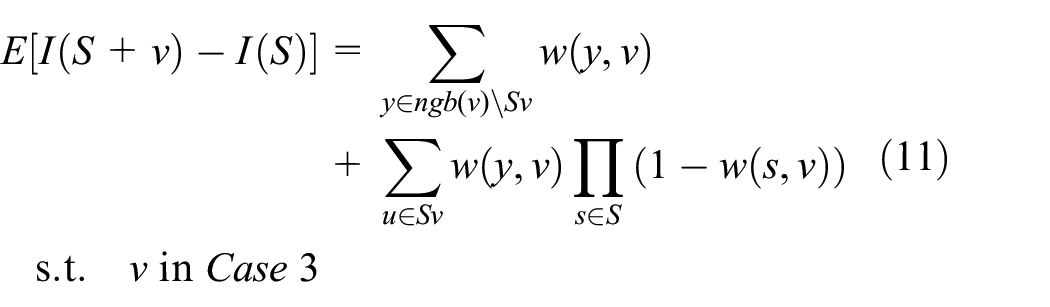
Let
Theorem 5
Proof
In Case 3, if v and S have neighbors in common, but v is not adjacent to S, we have

We know that

Note that S and v would influence nodes in

where
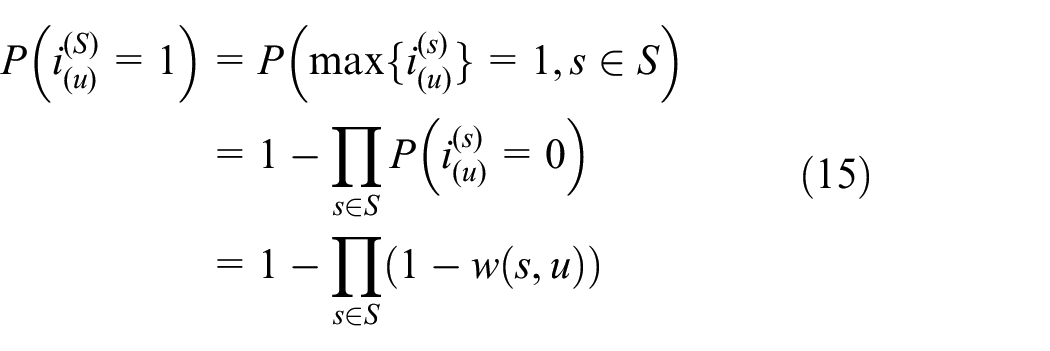
By substituting equations (14) and (15) into equation (13), we have

Therefore, we can get

This completes the proof of Theorem 5.
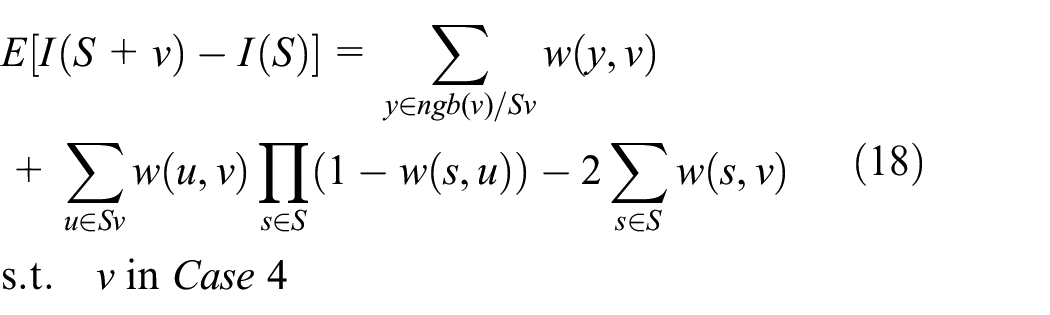
Theorem 6
Proof
It is easy to obtain that when v and S have neighbors in common, and v is adjacent to S,
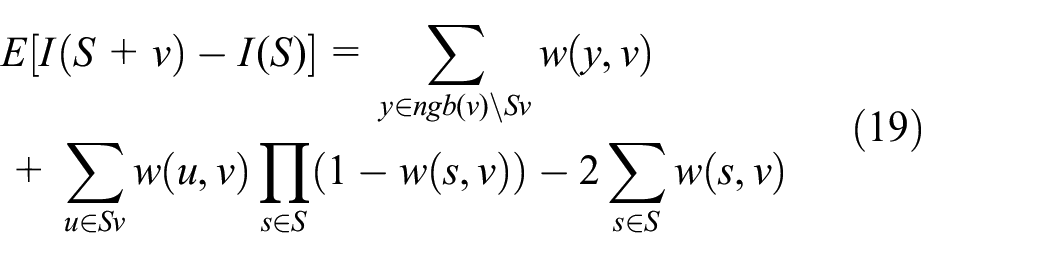
This completes the proof of Theorem 6.
In summary, the computation complexity of the proposed IC-based seed selection algorithm (ISA) in Algorithm 1 can be calculated as
Given above equations, it is easy to select the node that has the largest marginal gain in each iteration of Algorithm 1. However, since vehicles travel at a high speed, the IoV G changes significantly, resulting in dynamic topology and intermittent connections, and we may lose useful traveling information if we only observe what happens in the current network G. Therefore, we examine the influence of vehicles by exploiting their mobility and take mobility related parameters into the computation of the influence spread for each node v. In this article, the mobility based influence spread is defined as

where
Note that these mobility information can be easily collected from vehicles because the information may help increase the probability of being selected as the seed vehicle. Once being selected as the seed, the vehicle can get paid. In light of security concerns, when sharing information, participants can choose to report categorial data, not to report the details such as street name and building/apartment number, in order to protect user privacy. For example, when reporting areas visited, instead of “89 East 42nd Street at Park Avenue, New York, NY 10017,” they can report “Manhattan, New York” or “Midtown, New York.” When reporting the destination at the moment, instead of specifying its detailed address, the distance can be specified as “within 0–10 miles” or “more than 100 miles.”
Thus, the modified mobility-based seed vehicle selection algorithms can be described as Algorithm 2. The computation complexity is same to Algorithm 1 and is also
Mobility-based seed selection algorithm.

Performance evaluation
In this section, we evaluate the performance of the proposed algorithm through extensive simulations.
Experimental settings
In this article, simulations are conducted on a Windows machine with an Intel Core
Traffic scenario settings
We consider an IoV which consists of N vehicles, where N varies from 20 to 200. We let the vehicles traveling at a speed ranging from 40 to 100 km/h around a real world map in Helsinki (Helsinki, 4500 m × 3400 m, as in Figure 3). Each vehicle has a randomly chosen destination and calculates the route by Dijkstra shortest path algorithm. When arriving at the destination, a vehicle will pause for a short random time and choose another destination randomly on the map. This repeats until the end of the simulation. The communication range of vehicles is set to 200 m, and the ads expiration period
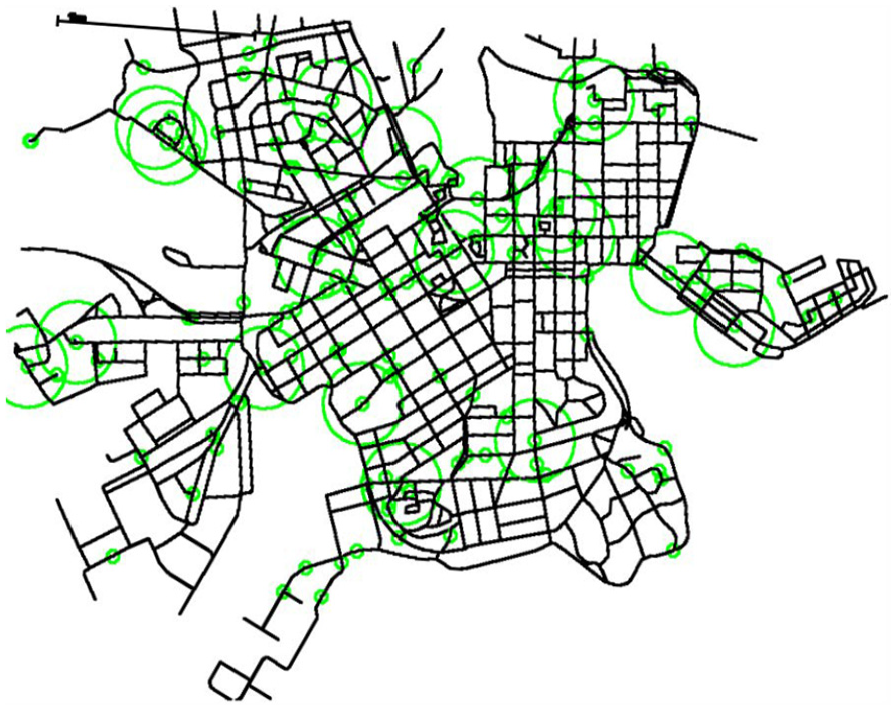
Helsinki region considered for simulation.
Algorithms compared
We implement two state-of-the-art algorithms for performance comparison, a Mente Carlo simulation method, 34 varied from the classical greedy algorithm by Kempe et al.’s, 24 and an algorithm based on reverse influence sampling by Borgs et al. 33 The two compared methods are denoted as CELF++ and RIS, respectively. For CELF++, the number of Monte Carlo steps is set to 10,000, following the standard practice in the literature, while for RIS, the number of hyperedges is set to 5000. For the other parameters, we take the recommended values in the corresponding papers if available.
Experimental results
Comparison of running time
Figure 4 reports the running time versus the number of nodes. The number of seeds is set to a medium size as a quarter of the number of nodes. In Figure 4, the results show that the proposed ISA achieves the lowest run time. When N equals to 300, the proposed algorithm is almost four times faster than CELF++, and twice faster than RIS.

The running time on the IC-based model in different sizes of VANETs.
Comparison of delivery ratio
Figure 5 plots the performance of delivery ratio of algorithms when the network size varies between
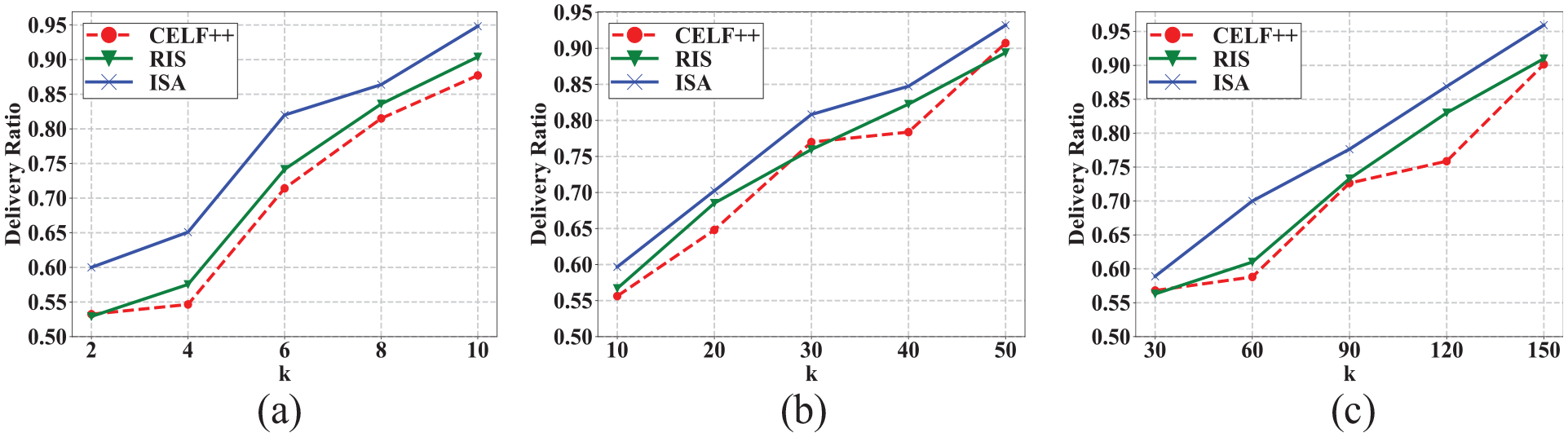
The delivery ratio of three algorithms when N varies: (a) N = 20, (b) N = 100, and (c) N = 300.
Figure 6 displays the delivery ratio when
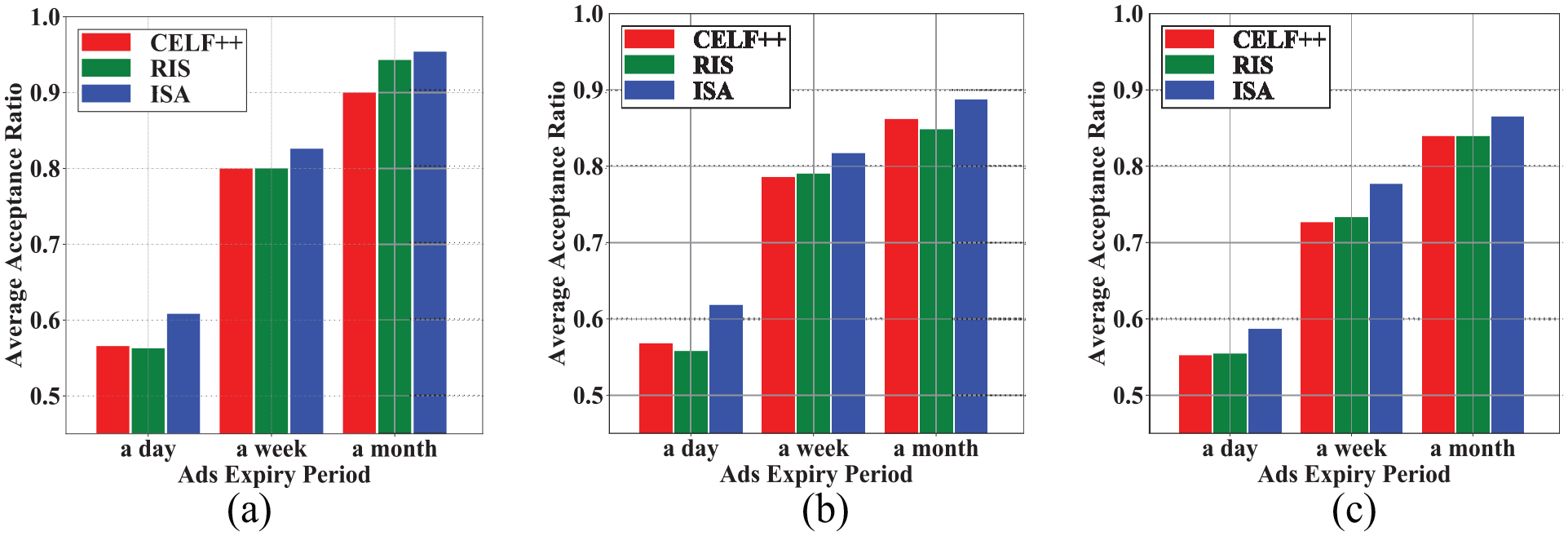
The delivery ratio of three algorithms when ads has different expiry periods: (a) N = 20, (b) N = 100, and (c) N = 300.
Finally, Figure 7 illustrates the impact of mobility on selecting seed vehicles when N varies from 20 to 300, and k ranges from 1/8 to 1/2 N. It can be seen that considering the vehicle mobility enhances the delivery ratio under various network and traffic settings. Thus, we can conclude that introducing mobility improves the delivery performance.

The delivery ratio with and without considering vehicle mobility: (a) N = 20, (b) N = 100, and (c) N = 300.
Conclusion and future work
In this article, we investigated the problem of maximizing the benefit of ads dissemination in an IoV under the budget constraints. This problem is transformed to a seed selecting problem on the IC model. On the basis of constant individual benefit and cost, we put forward an IC-based seed selection algorithm to guarantee the selected vehicles can maximize the influence spread. By taking the mobility of vehicles into consideration, we proposed a mobility-based seed selection algorithm to fit the dynamic topology. Through extensive performance evaluation, we have demonstrated that the proposed algorithm can achieve better efficiency in terms of delivery ratio and running time. And the preponderance does not alter with the variation of network size, proportion of seeds and the expiry period of ads. We also illustrated that the consideration of vehicle mobility can contribute to the delivery ratio.
In this article, we assume that all vehicles are trusted and legal nodes. Yet, a node is likely to pretend to be a normal node in IoV to do various malicious behaviors. 35 These behaviors include wiretapping, 36 intercepting, 37 or even tampering with data contained personal and vehicle information, 38 when a user browse ads. As a result, we will further study a security-mechanism-enabled ads dissemination scheme for the mobile IoT system.
Footnotes
Appendix 1
Acknowledgements
The authors thank all reviewers who have helped in improving the quality of this paper.
Handling Editor: Carlos Calafate
Declaration of conflicting interests
The author(s) declared no potential conflicts of interest with respect to the research, authorship, and/or publication of this article.
Funding
The author(s) disclosed receipt of the following financial support for the research, authorship, and/or publication of this article: This work was supported by the National Natural Science Foundation of China (Grant Nos 61571010 and 61871023), and the Fundamental Research Funds for the Central Universities (Grant No. 2019JBZ001).
