




Abstract
Water inrush occurred in mines, threatens the safety of working miners which triggers severe accidents in China. To make full use of existing distinctive hydro chemical and physical characteristics of different aquifers and different water sources, this article proposes a new water source discrimination method using laser-induced fluorescence technology and generative adversarial nets. The fluorescence spectrum from the water sample is stimulated by 405-nm lasers and improved by recursive mean filtering method to alleviate interference and auto-correlation to enhance the feature difference. Based on generative adversarial nets framework and improved spectra features, the article proposes a novel water source discrimination-generative adversarial nets model in mines to solve the problem of data limitation and improve the discrimination ability. The results show that the proposed method is an effective method to distinguish water inrush types. It provides a new idea to discriminate the sources of water inrush in mines timely and accurately.
Introduction
Water inrush in mines generally occurs when a large volume of water unexpectedly bursts into underground working areas in a short period of time, which jeopardizes the safe production of coal mine, causes casualties, and engenders severe economic losses. Many research works have verified that different aquifers and different water sources have distinctive hydro chemical and physical characteristics.1,2–4 Based on these theories, the available methods to discriminate water source including trace elements, 5 representative ions, 6 water temperature level, 7 and water flow conditions, in mines could be acknowledged in detail, that could be used to accurately forecast mine water inrush disasters.
However, still many unfavorable factors, such as lagging of monitoring responses, sample contamination, and heavy labor consumption, are caused by the method of water sample collection in mines in situ. It is impossible to measure water inrush type accurately in time. Recently, as some online sensors were proposed gradually, especially, the laser-induced fluorescence (LIF) technology is a twinkling innovation to measure the reflected fluorescence of the water sample online. The fluorescence is sensitive to hydro chemical and physical characteristics of different water and protects the tested water from being polluted. 8 Therefore, the LIF severed as an effective online monitoring parameter used to discriminate water type for prediction of water inrush disaster.
However, discriminant model based on data driven is an important approach to solve the problem of discrimination of water type in mines nowadays. Related methods include the support vector machine (SVM), 9 clustering analysis, 10 extreme learning machine (ELM), 3 back propagating neural network, 11 and so on. Gradually, these methods are applied to discriminate the type of water source in mine. Nevertheless, these methods adopt shallow frameworks, where useful features are necessary to be chosen in prior. It has to construct feature vectors in subjective and experiential ways. Randomly, initial weights and non-convex function of network also make the model be more likely to be trapped in local optimal solutions.
Recently, as deep neural network grows deeper and stronger, deep concept has been successfully applied to discriminate the type of water source in mines and predict the disaster of water inrush. 1 Particular, convolutional neural network (CNN) is specific to image data, which automatically learns from fluorescence spectra of LIF technology and avoids feature extraction and feature selection by human interference. Whereas, the large volume of data is vital to train an excellent discriminant model. However, available data are extremely limited in actual industrial production. This thorny phenomenon is the bottleneck problem to construct mine water source type discrimination model using CNN.
The generative adversarial nets (GAN) model was innovatively first proposed by Goodfellow who inspired by the game theory of two-person zero-sum game.12–14 The modeling framework consists of a generated model and a discriminant model. The generated model is responsible for capturing the distribution of sample data and generating new data to the training model. Discriminant model is utilized to estimate the probability of the input form the real data or generated samples. The GAN provides a new idea to solve the shortcomings of validly data for discrimination of mine water inrush sources.
Methods
Recursive mean auto-correlation spectra feature construction
The recursive filer method can be used to reduce high-frequency fluctuation interference of signal. Equation (1) presents recursive average method, where N is utilized to control the flatness of the obtained instantaneous fluorescence spectra. Simple moving average filter could be used for this

where
Discrimination model of mine water inrush source based on GAN
The straightforward GAN framework of mine water inrush source is shown in Figure 1, which includes a generating model labeled by G and a discriminant model labeled by D. It defines a prior random noise variable

GAN model structure diagram.
Based on the given generator G and the optimization discriminator D, the loss function is

where

The GAN model is a semi-supervised learning process. Suppose there are m input train samples
Figure 2 shows training process of water source discrimination-generative adversarial nets (WSD-GAN) model. First, the auto-correlation fluorescence spectra severed as important features that are calculated by recursive mean filtering and auto-correlation method. It is further used to build a deep convolution generation network and initialize parameters of discriminant network. After trained by auto-correlation fluorescence data, the network model, finally, could be saved.

Training process of WSD-GAN.
WSD-GAN model experiment and result analysis
Materials and spectral data acquisition
The water samples were gathered from the No. 2 Xinji mine of Huainan Mining Group from June 2016 to June 2017 at four different hydrogeology environments. These samples were named as Goaf hydrops, Sandstone water, Limestone water, and Ordovician Limestone water. All collected samples in situ have been placed in airtight polypropylene sample bottles, which had been cleaned by 10% HCl and distilled water before. All the water samples were measured in laboratory. The water samples included 46 items from the Goaf hydrops, 59 items from Sandstone water, 42 items from Limestone water, and 14 items from Ordovician Limestone water.
The fluorescence spectrum has been captured in totally dark environment avoiding influence from background and personnel activities. The wavelength of fluorescence spectrum ranges from 340 to 1340 nm with 0.5-nm resolutions. Each spectrum data has 2048 dimensions. The spectrum images of four different water sources are shown in Figure 3. Then, spectrum energy is focused in the range of 420–720 nm. These four curves are mainly composed of two peaks. The first peak emerges at 517 nm. The second peak arises at 560–580 nm.

The spectrum of four different water sources.
Figure 4 presents auto-correlation fluorescence spectrum image. Consider distribution characteristics of the fluorescence spectrum, the last 1024 dimensions of fluorescence are almost overlapping together while the first 1024 dimensions of fluorescence are chosen to construct auto-correlation fluorescence spectrum image. Autocorrelation and normalization of one-dimensional (1D) spectral data after smoothing processing are performed to obtain the two-dimensional (2D) spectral diagram as shown in Figure 4, which has 1024×1024 frame size. Color is applied to distinguish the received energy among four different kinds of water emitted by the fixed laser. The brighter the color is the more spectral energy the band receives, where larger the fluorescence component of the sample is stimulated. Compared with the fluorescence spectra, it can better describe the changes of spectral curves in the whole band.

Auto-correlation fluorescence spectrum: (a) Goaf hydrops, (b) Sandstone water, (c) Limestone water, and (d) Ordovician Limestone water.
These four fluorescence spectra, including Goaf hydrops, Sandstone water, Limestone water and Ordovician limestone water, present obvious differences in Figure 4. Considering, Goaf hydrops gradually coming with increased organic compounds, the auto-correlation fluorescence spectra shows seven levels of energy stages and a tendency to diverge gradually. Sandstone water gradually developing with reduced organic compounds in water, the auto-correlation fluorescence spectra shows six levels of energy stages and a tendency of the lowest three levels to diverge gradually. Limestone water growing with further reduced organic compounds in the water, where the lowest two levels energy of the auto-correlation fluorescence spectra shows a tendency to diverge gradually. Ordovician limestone water accumulating with fewer organic compounds in clear water, the auto-correlation fluorescence spectra shows an obvious tendency toward convergence. These results conclude that the proposed auto-correlation fluorescence spectra achieve a clear discrimination between Sandstone water and Limestone water and displays obvious convergence in the Ordovician Limestone water.
WSD-GAN model result analysis
Figure 5 presents the WSD-GAN model diagram, including the generating network and discriminant network. The generating network consists of three layers of transposed convolution. The first layer uses the convolution kernel 128@5 × 5 and the activation function is ReLU. The second layer uses the convolution kernel 64@4 × 4 and the activation function is ReLU. The third layer uses convolution kernel 1@2 × 2, and the activation function is Tanh. The discriminant network D consists of the convolution layer, the pooling layer, full connection layer, and the output layer. Convolution layers and the pooling layers connect alternately. The convolution layer adopts various specific convolution kernels and an activation function to compute output features. It adopts 5-fold cross-validation; 20% random samples used for the test and the remaining 80% used to train the model.

WSD-GAN model of mine water inrush source.
Among three layers of convolutions, the first layer uses convolution kernels 32@2 × 2 and the activation function is LeakyReLU. The second layer uses convolution kernel 64@2 × 2 and the activation function is LeakyReLU. The third layer uses convolution kernel 96@2 × 2 and the activation function is ReLU. The pooling layer adopts the mean pool to select output features. The classifier is constituted by fully connected layer and the output layer using logistic regression, softmax regression, and SVM. The hyper parameters of the model includes: batch = 16, epoch = 150, learning rate λ = 0.0001, stochastic gradient descent (SGD) optimization algorithm, cross-entropy loss function, the penalty factor of SVM C = 1.5 and radial basis function (RBF).
The experimental results of WSD-GAN model with improved fluctuation feature are shown in Figure 6. By contrast, Figure 7 demonstrates the results of discrimination accuracy using those unprocessed fluorescence data and the WSD-GAN model. It could be observed that whether the improved feature set or the original data set, the proposed WSD-GAN model performs a gradually increasing tendency of correct recognition as iterations increase. These results are further used to verify the proposed WSD-GAN model performance on data robustness. Specially, based on the proposed WSD-GAN model, the improved features achieve more excellent recognition rate at the end of the iteration.

Discrimination accuracy of WSD-GAN model with improved features.
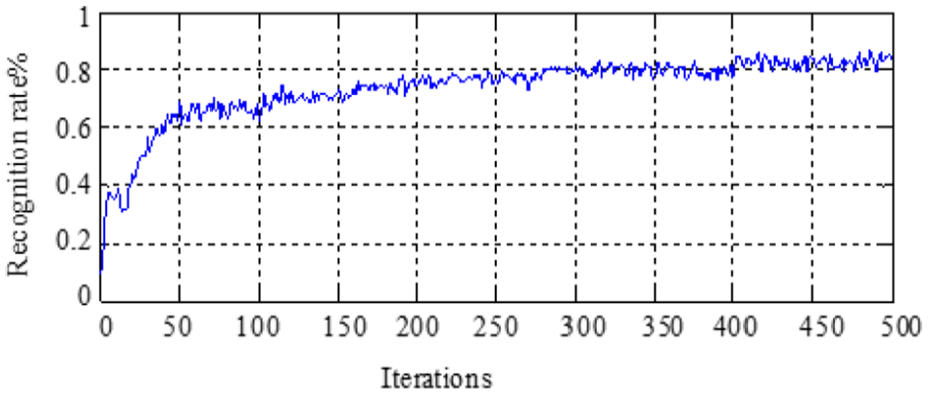
Discrimination accuracy of WSD-GAN model with unprocessed auto-correlation feature.
Finally, as a comparison, we have compared our method with the other four different state-of-the-art classification methods, namely, feedforward chaotic neural network (FCNN),
15
Bp network, light gradient boosting machine (LightGBM),
16
and convolution neural network (CNN). In the experiment, the LightGBM parameters include learning rate
Table 1 reports the discrimination accuracy of different models with an improved feature spectra. It shows that our proposed method could perform optimal ability of water source discrimination than the other four methods. Specifically, our method is 0.62%, 0.91%, 16.33%, and 12.40% over CNN, LightGBM, Bp, and FCNN. More interestingly, based on the proposed improved recursive mean auto-correlation spectra, WSD-GAN algorithm performs similar discrimination accuracy of CNN and LightGBM.
Comparison of different models.
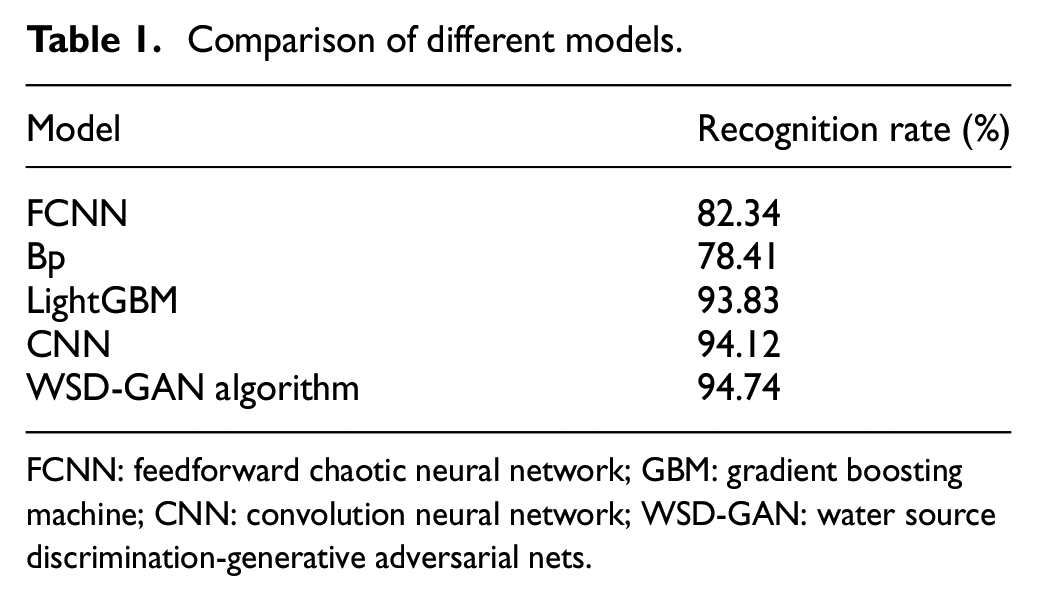
FCNN: feedforward chaotic neural network; GBM: gradient boosting machine; CNN: convolution neural network; WSD-GAN: water source discrimination-generative adversarial nets.
Conclusion
This article developed a new method to discriminate the source type of water inrush based on improved fluorescence and GAN for water inrush forewarning of mines. In the first stage, we proposed a novel method to construct features made by recursive mean filtering method and auto-correlation calculation, so that we can benefit from the alleviated fluctuation of interference and the magnified area around the resonance peaks. Some individual differences among different water sources are obviously presented. The characteristic of organic compounds in water can be effectively distinguished. In the second stage, the proposed WSN-GAN model is used as the classifier to solve the problem of the exciting small-sample set. The theoretical analysis and experimental results show that the proposed method is an effective assessment method to define inrush water source types in a mine. It provides a new method to solve discrimination of inrush water sources in mines.
Footnotes
Acknowledgements
The authors would like to thank anonymous reviewers and the associate editor, whose constructive comments helped to improve the presentation of this work.
Handling Editor: Konstantinos Kalpakis
Declaration of conflicting interests
The author(s) declared no potential conflicts of interest with respect to the research, authorship, and/or publication of this article.
Funding
The author(s) disclosed receipt of the following financial support for the research, authorship, and/or publication of this article: This work is supported by National Natural Science Foundation of China (Nos 51875100, 61673108, and 41674133), University Science Research Project of Jiangsu Province (No. 19KJB470024), Science Application Basic Research Program of Xuzhou City (No. KC18015).
