




Abstract
Coverage and connectivity in wireless sensor network have been studied extensively in existing research works with physical and information coverage. The optimal deployment to achieve both information coverage and connectivity, on arbitrary values of the ratio of rc and rs, has been studied in previous work; meanwhile, the extended strip-based deployment based on information coverage is also studied. Either information coverage or cooperative communication could exploit collaboration of sensor nodes to improve the efficiency of deployment, while how good is strip-based deployment with both information coverage and cooperative communication is worth to be measured when the value of rc/rs is varied. In this article, the relationship between the density of sensors needed to achieve physical or information coverage and connectivity and the variety of rc/rs is derived in closed form for strip-based deployment of wireless sensor networks with cooperative communication. Then, a summary of different combinations of coverage and connectivity is provided, that physical or information coverage with or without cooperative communication could be employed to achieve full coverage and connectivity for strip-based deployment. Finally, some new strategy could be proposed based on the fusion of physical and information coverage to improve strip-based deployment. Some numerical results are provided to show the efficiency of all schemes to help researchers design more effective deployment schemes.
Introduction
Coverage and connectivity are critical issues for research on wireless sensor network (WSN).1–8 The coverage issue normally depends on the sensing model of sensors, which has been studied in existing research works. One commonly used model is physical coverage, in which a sensor would cover a disk region centered on it with a radius as its sensing range.1–3 Furthermore, the other type is that sensing accuracy might be dependent on the distance, 9 whereas each point in the field could be determined by the sensing intensity that could be measured by its nearby sensors. Every point could be deemed to be covered with different levels of sensing intensities based on this sensing model. As a result, a new sensing model based on distributed estimation theory was proposed by Wang and colleagues.9–11 Based on different detection techniques and scenarios, many probabilistic coverage models have also been proposed in past research work.12–17
In a WSN, each sensor usually has limited communication range rc, which might be different from the sensing range rs.
4
For coverage and connectivity in deployment of WSNs, some useful results could be found in existing works. If rc is twice rs at least, full coverage implies the full connectivity for WSNs.
6
When
In recent years, coverage and connectivity in WSNs have been studied extensively in existing research works with physical coverage,1–8 probabilistic coverage,18–24 and coverage with data fusion.25–27 However, rc/rs is usually regarded as a fixed value. Some regular deployments for coverage and connectivity with arbitrary values of rc/rs are studied recently,1,8 while most of these are based on physical coverage model. The strip-based deployment is proposed to achieve coverage and 1-connectivity or 2-connectivity in Bai et al. 8 Moreover, the deterministic deployment and random deployment with information coverage are proposed in Wang et al.9,10 Furthermore, the regular deployments to achieve both information coverage and connectivity, on arbitrary values of rc/rs, are studied in our previous work; 28 meanwhile, the extended strip-based deployment based on information coverage is also studied in Wei et al. 28
Cooperative communication (CC)29,30 has emerged in WSN, and sensors with a single antenna could share the antennas of others that have spatial diversity, such as the MIMO (multiple input, multiple output) system. The source sensor node and helper sensor nodes could transmit independent copies of sensing data simultaneously to the destination sensor node, which can combine partial signals of sensor nodes and decode them.31–33 Any one-hop neighbors within the transmission range of the source sensor node can be regarded as potential helper sensor nodes. There are extensive works on the physical layer of CC,25,34,35 and the research on higher layer is also being studied increasingly, since it could be used in coverage control, 26 broadcasting,31,32 and routing.27,33 Regular deployment with CC model for two-node cooperation to achieve K-connectivity and full coverage in WSNs is studied in Lu et al. 36
Although cooperative coverage, such as information coverage, and cooperative connectivity, such as CC, have been studied for coverage and connectivity in WSN, there are a few results for considering them both so as to improve the performance of deployment. In response to this, we focus on strip-based deployment for information coverage and cooperative connectivity in WSNs, with arbitrary values of rc/rs, and propose some enhanced scheme for strip-based deployment.
Some related works are summarized in Table 1. It can be found that there are many works on coverage and connectivity in WSNs, yet there are still some open issues that need to be addressed. Our work is motivated by these problems:
Either information coverage or CC could exploit collaboration of sensors to improve the efficiency of deployment. However, when both of these are considered, the arbitrary values of rc/rs could affect the strip-based deployment rather than regular deployment, since all the communication range should be identical in the latter. Hence, the question that needs to be answered is, how good is strip-based deployment with both information coverage and CC while the value of rc/rs is varied?
There is a small issue on deployment with information coverage while the value of rc/rs is varied; we will propose a new strategy of deployment based on fusion of physical and information coverage to enhance the sensor deployment in WSN.
Related works on connectivity and coverage for WSNs.

CC: cooperative communication.
The main contributions of this article are the following:
For strip-based deployment of WSNs with CC, the relation between rc/rs and density of sensors to achieve physical or information coverage and connectivity is derived in closed form, compared with that without CC.
A summary of different combinations of coverage and connectivity is provided, that physical or information coverage with or without CC could be employed to achieve full coverage and connectivity for strip-based deployment of WSN.
Strip-based deployment with information coverage is improved so that some results are derived for all strip-based deployment with this improved information coverage and CC.
The organization of this article is as follows: section “Coverage model” gives preliminary information about coverage models. Strip-based deployment is analyzed with both physical and information coverage in section “Strip-based deployment.” In section “Deployment with CC,” the strip-based deployment is extended in connectivity by CC, and different combinations of coverage and connectivity are provided. Section “Extension with information coverage and CC” provides some discussion and improvement on information coverage of strip-based deployment. Then, the performance of the deployment scheme is evaluated by numeric simulations in section “Numerical results.” Finally, conclusions are presented in section “Conclusion.”
Coverage model
Physical coverage
The classical disk sensing model has been widely used in numerous studies of WSNs.1–8,12–14 Any sensor could only sense the event that happens within its sensing range rs. Based on this model, a point in the area is said to be “covered” physically by a sensor when the distance between the sensor’s position and this point is less than the sensing range rs. This disk sensing model is widely accepted due to its simplicity and convenience for modeling and analysis. Thus, the probability that a point p is covered physically by a sensor node si can be modeled as

where
Information coverage
The following illustration is defined in Wang et al.:9,10 Consider K sensors, in which each sensor could obtain its locations by some methods and could acquire the measurements with unknown parameter θ of an target or event at some location. Let

Thus, this could achieve minimum mean squared error (MSE) on

When some event or target that has appeared at a given location could be estimated with a guaranteed estimation error by K distributed sensors, this point could be regarded as “information covered” by these K sensors. It is noteworthy that the estimation error
The following assumptions could be made in this article similar to that in Wang et al.9,10 for simplicity: all noises are Gaussian; thus, the summation of these noises is still Gaussian with zero mean. Furthermore, assuming that all noises have the same variance
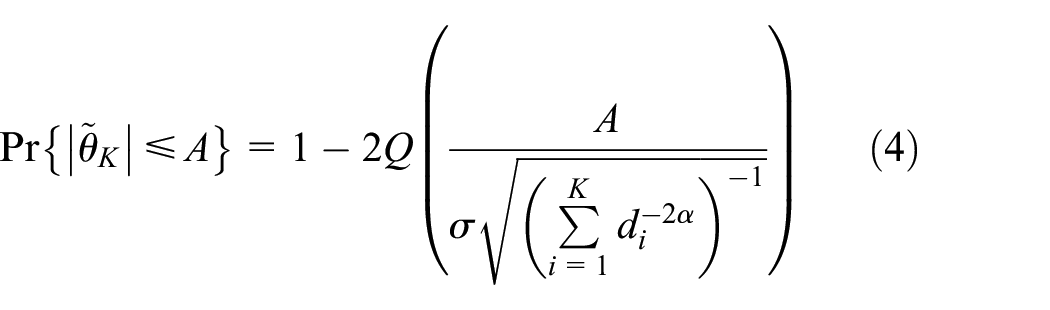
where
Strip-based deployment
The original strip-based deployment is extended in this section, from the physical coverage model to the information coverage model, and some results are presented based on the theoretical analysis.
Strip-based deployment with physical coverage
The original strip-based deployment is proposed to achieve coverage and 1-connectivity or 2-connectivity in Bai et al. 8 (as in Figure 1).

Strip-based deployment with coverage and (a) 1-connectivity and (b) 2-connectivity,
Considering a Euclidean plane as the sensing field, horizontal strips of sensors are shaped by placing sensors with a regular separation of
Denote the distance between sensors of adjoining horizontal strips as δ, then

Some definitions are also provided that are the same as in Bai et al. 8
Definition 1 [Connection Chord, Connection Angles]
Assuming two sensors are connected, that are deployed at x and y, there is a common chord within these two sensing disks

Two sensors located at x and y are connected under the situation that d(x, y) = rc. Thus, chord AB is the connection chord, while
When N(rs, rc) is addressed as the minimum quantity of sensors for full coverage in strip-based deployment, this can be divided into two portions—Nh(rs, rc), which denotes the quantity of sensors required in horizontal strips, and Nv(rs, rc), which denotes the number of sensors required in vertical strips. The latter could be 0 in some situation as in Lemma 1, which is also defined in Wei et al. 28 Overall, N(rs, rc) can be expressed as

Lemma 1
When
Proof
When

Thus,
It could be found that the Euclidean plane in two dimensions can be tiled by non-overlapping Voronoi polygons indicated by the dashed lines in Figure 3. It could be observed that the area of this polygon is area per node (APN) as in Definition 1 in Bai et al. 8

Non-overlapping polygons cover the two-dimensional plane; Voronoi polygons are formed by the dashed line.
Thus, the maximum APN of this sensor deployment is expressed as

where

When SA is the area of the sensing region, without considering the boundary effect, the minimum quantity of sensors in all horizontal strips to obtain coverage and connectivity could be determined by

Strip-based deployment with information coverage
The strip-based deployment with information coverage is defined in Wei et al., 28 such as (2,ε) coverage, that points in the sensing region could be covered by two sensors cooperatively. It can be expressed as

Without loss of generality, there is A = σ, α = 1, and d1 = d2 = d; thus, the maximum distance between the points in the midline of two sensors and the centers of two sensing disks could be figured out, while (2,ε) information coverage can be achieved opportunely for this distance. This normalized distance

In strip-based deployment with the physical coverage model, the maximum distance between two neighboring sensors in horizontal strips is

Definition 2 [Generalized Connection Chord, Generalized Connection Angle]
An extension of connection chord, Generalized Connection Chord, could be defined based on information coverage,
28
that is, a line segment on midline of two sensors. Then, the length of this line segment is equal to
As shown in Figure 4, the position O (0,0) is set as the center point of adjoining four sensors in our coordinate, and the radius r of sensing disk is equal to


The connected sensors located at positions (–x0,0) and (x0,0). Generalized Connection Chord AB is the extended connection chord with
and there is


Therefore, the final deployment can be described as


The distance between two sensors in adjoining horizontal strips with (2,ε) coverage is

While ε = 0.683,
Then, the Generalized Connection Angle can be expressed as
Definition 3 [Generalized APN]
The extended concepts of APN could be defined based on information coverage. 28 Generalized APN indicates the area of a Voronoi polygon, which is similar to that in the definition of APN. It could be used for any sensor node to represent the average contribution on quality of service (QoS) of WSNs, such as coverage or communication, as shown in Figure 5.

Non-overlapping polygons that cover plane in two dimensions; the Voronoi polygon is the hexagon formed by the blue line.
To derive the expression of

Then, the following results could be obtained on sensor density requirement for strip-based deployment to achieve (2,ε) information coverage and connectivity

When

Since the total number


This can be explained in Lemma 2, which was also defined in Wei et al. 28 as the same deployment with the physical coverage model.
Lemma 2
When
Proof
The minimum distance between the two sensors in adjoining horizontal strips to achieve (2,ε) coverage is

Thus, there is

So in this case, sensors in adjoining horizontal strips are connected natively, without sensors needed in vertical strips.
As shown in Figure 4, the position of sensor E is

Then the distance between sensor C and sensor E is

This implies that the distance between sensor C and sensor E is twice of radius r of sensing disk, so there are two tangent sensing disks. In this case, the Generalized Connection Chord could reach its lower bound in terms of length.
Lemma 3
The sensing region is fully information covered with no gap, under the deployment which is defined in Figure 4
Proof
It would be shown that if the union of (2,ε) coverage of sensors C and D and (1,ε) coverage of sensor E could fully cover the region defined by triangle CDE, then the total region, which can be divided by many triangles similar to triangle CDE, could be fully covered by another set of three sensors. Thus, the total sensing region is fully (2,ε)-covered with no gap. First, the curve with identical detection probability is drawn up, which could be used to determine the edge of coverage by two cooperative sensors. Based on
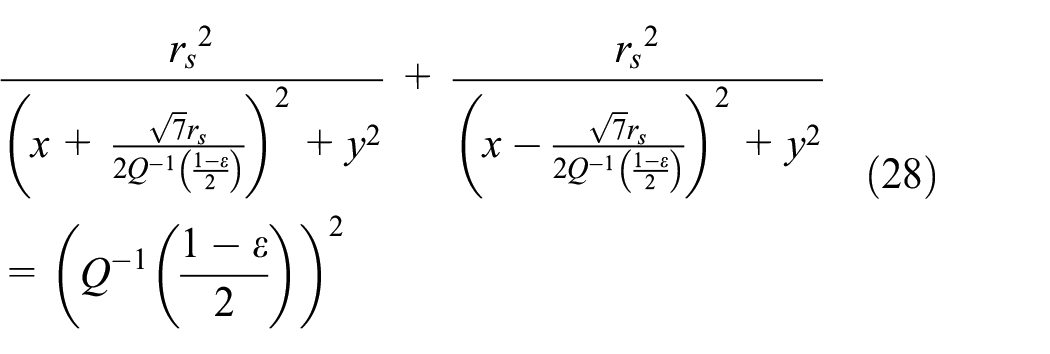
This is the curve with identical detection probability to determine the edge of (2,ε) coverage (sensors C and D), and the curve with identical detection probability to determine the edge of (1,ε) coverage (sensor E) could also be determined by

Without loss of generality, we could carry out normalization

The solutions of the above two equations could be worked out, and since y is always negative in the region defined by triangle CDE, the sensing region is fully (2,ε)-covered with no gap

where

The relation between two curves with range line of tangency points.
We will check the relation between
Deployment with CC
CC model
In Yu et al.,
30
the CC model was described as follows: Traditional connectivity without CC assumes that node A with transmission range R is connected to node B, which is in a disk with radius R and center A. Generally, if the received average signal-to-noise ratio (SNR) of node B from node A is not less than a given threshold

Multiple nodes transmit the same data packet to destination node j simultaneously by CC, while the multipath signals are then received by node j. The total SNR of the output with maximal-ratio combining (MRC) on node j could be expressed as the summation of received average SNRs:
45

As in equation (33), CC could extend transmission coverage. The source node could use CC only after transmitting the request for cooperation and source data to neighbor nodes by direct communication. Without loss of generality, noise N can be normalized as 1 in equations (32) and (33), and channel gain could also be normalized as

In the coverage and connectivity models,

Under the same model, when two neighbor nodes use CC to connect to the other node, there is

When the destination node is deployed on the middle line of two cooperative nodes, that is, exactly strip-based deployment, all nodes use the same transmit power for traditional connectivity without CC, which can guarantee the basic connectivity between the source node and the helper node. Thus, there is
When it takes the lower bound

where path loss factor
Strip-based deployment with CC
There should be information transfer without CC between the source node and the helper node to guarantee the basic connectivity, so the CC could not be employed effectively in triangle, square, and hexagon deployments that distances between all neighboring nodes are equal. However, the distances between neighboring nodes in vertical and horizontal strips are different; it could be employed to extend the range of connectivity by CC.
First, we recall the deployment of physical coverage without CC; there is
In Bai et al.,
8
there is proof that when
Next, it would be shown how deployment could be improved when CC is adopted. Since two adjoining nodes in horizontal strip take advantage of CC, the transmit range in vertical direction could be extended, as shown in equation (37), and we need to examine how this extension would affect the strip-based deployment.
The separation of sensors in a horizontal strip is still
When CC is adapted to the strip-based deployment, then the separation of adjoining horizontal strips meets

Lemma 4
If there is
Proof
If there is

As a result, there is
Strip-based deployment with information coverage and CC
In our previous article,
28
we proved that if
When the full coverage is based on (2,ε) coverage model for strip-based deployment, there is

Finally, we could improve Lemma 2 in subsection “Strip-based deployment with information coverage,” which is also Lemma 3 in Wei et al. 28
Lemma 2a
For the (2,ε) coverage model, if
Next, we consider the threshold when the sensors in adjoining horizontal strips are connected natively with CC for the (2,ε) coverage. In this situation, the deployment parameters are still as
Then, we could derive the threshold as

Lemma 5
For the (2,ε) information coverage model, if
Proof
If there is

Since

Then, there is
On the other hand, when

As a result, because
Summary of different combinations
We summarize the different situations in which sensors in adjoining horizontal strips are connected natively:
1. If all sensors are deployed with physical coverage and without CC, then when
2. If all sensors are deployed with physical coverage and CC, then when
3. If all sensors are deployed with information coverage and without CC, then when
Proof
When
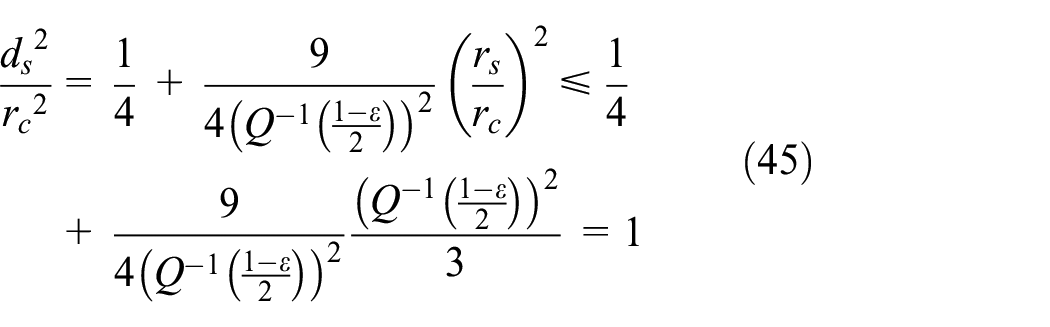
Therefore,
On the other hand, when
4. If all sensors are deployed with information coverage and CC, then what is the threshold of
For this configuration, the deployment parameters are still denoted as
As the threshold could be reduced by the function of CC, while it is still smaller than

Therefore, if
Proof
When
On the other hand, when
Extension with information coverage and CC
Improvement of information coverage
Now we focus on some new issue which could be found in our previous article.
28
When
For the strip-based deployment for physical coverage, the parameter of deployment is
What was previously ignored was that Generalized Connection Chord is not required to calculate


It was shown that there is a threshold which defined two regions, in that the Connection Chord and Generalized Connection Chord are employed to calculate
Deployment with improved information coverage and CC
If all sensors are deployed with this improved information coverage and CC, then what is the threshold of
Since this threshold is smaller than
Proof
When
As this is in the region
On the other hand, when
Finally, when
Overall, we complete the discussion on different cases that
Numerical results
In this section, the aforementioned deployments are compared in terms of the number of sensors needed to achieve full coverage and full connectivity, with different models. The region of sensor deployment is a two-dimensional square region that is 1000 m × 1000 m, and the sensing range rs is set as 30 m for the physical coverage model, while the communication range is defined as 20 m ≤ rc ≤ 120 m for physical connectivity. As the deployment area is large enough relative to the sensing range rs, the boundary effect is not a major factor in deployment performance; therefore, the effect of
Information coverage or CC
The comparison of different strip-based deployments with physical coverage, information coverage, and CC is shown in Figure 7. There are different vertical drops in different strip-based deployments in Figure 7, which indicate the thresholds of

Number of sensors needed in different strip-based deployments for 1-connectivity (strip1: physical coverage, strip1info: information coverage, stripc1: physical coverage with CC) to achieve full coverage and connectivity for various values of rc/rs (ε = 0.683,
Figure 8 shows the comparison of different strip-based deployments with information coverage, CC, and both information coverage and CC. In Figure 8, there are different vertical drops in different strip-based deployments, which indicate the thresholds of

Number of sensors needed in different strip-based deployments for 1-connectivity (stripc1: physical coverage with CC, strip1info: information coverage, strip1infoc: information coverage with CC) to achieve full coverage and connectivity for various values of rc/rs (ε = 0.683,
First, the minimum amount of sensors needed for two deployments with information coverage is very close no matter with or without CC. It could also be found that when

Number of sensors needed in different strip-based deployments for 1-connectivity (strip1infoc: information coverage with CC, strip1infoxz: improved information coverage without CC, strip1infoxzc: improved information coverage with CC) to achieve full coverage and connectivity for various values of rc/rs (ε = 0.683,
Strip deployment with information coverage
Figure 9 shows the comparison of different deployments based on information coverage, including the redefined strip-based deployment with improved information coverage and CC. In Figure 9, there are different vertical drops in different strip-based deployments, which indicate the thresholds of
As in Figure 9, it can be seen that the redefined deployment with information coverage and CC outperforms all other schemes with information coverage overall
When
Deployment under different path loss factors
For applications in real world, the path loss factor

Number of sensors needed in different strip-based deployments for 1-connectivity (strip1: physical coverage, stripc12: physical coverage with CC where

Number of sensors needed in different strip-based deployments for 1-connectivity (strip1: physical coverage, strip1infocxz2: improved information coverage with CC where
Conclusion
In this article, the relation between the ratio of rc and rs and the density of sensors required to achieve physical or information coverage and connectivity is derived in closed form so as to judge how good is strip-based deployment with both information coverage and CC for strip-based deployment of WSNs with CC. Then, a summary of different combinations of coverage and connectivity is presented, that physical or information coverage with or without CC could be employed to achieve full coverage and connectivity for strip-based deployment. Finally, the strip-based deployment is improved based on fusion of physical and information coverage, and its characteristics are derived in closed form. Also, the efficiencies of all schemes are analyzed and compared by some numerical results, and it is worth noting that the following remarks can be deduced:
Information coverage is more attractive than CC for strip-based deployments while rc/rs is in the high level, because if rc/rs is in a high level, the bottleneck of the deployment depends on the sensing range; data fusion could be utilized cooperatively to increase the effectiveness of this situation.
Redefined strip-based deployment with information coverage and CC outperforms all the other strip-based deployments with information coverage overall. With the increase in the path loss factor, the deployments with CC become more closed compared to that without CC. Since communication range is extended by CC as
Footnotes
Handling Editor: Masayoshi Aritsugi
Declaration of conflicting interests
The author(s) declared no potential conflicts of interest with respect to the research, authorship, and/or publication of this article.
Funding
The author(s) disclosed receipt of the following financial support for the research, authorship, and/or publication of this article: This work is supported by the National Natural Science Foundation of China under Grants No. 61401360 and Fundamental Research Funds for the Central Universities (3102017zy026).
