




Abstract
This article first analyzes big data technology. Then, the agricultural Internet of Things system was established, and the acquisition of agricultural data was achieved through the establishment of sensor modules, image acquisition modules, and meteorological acquisition modules. The data are transmitted to the server through GPRS communication technology and 3G network card to realize data transmission. The Web Service technology is used to connect the Internet of Things with the neural network model to achieve data interoperability. By comparing the prediction results and actual data of the model, it is found that the prediction error of the model designed in this article is less than 1%, and the high-precision prediction of agricultural data is realized, which provides an effective guidance for the improvement of agricultural product quality and yield.
Introduction
As the economy develops, people’s demand for food is getting higher and higher. Therefore, the control of agricultural products has become more and more important. The agricultural sector not only needs traditional agricultural production experience and theory but also needs to use modern science and technology and management methods to serve it, and promote the continuous improvement of agricultural productivity, with a view of improving the quality and output of agricultural products.
After entering the 21st century, various data explosions have occured due to the continuous development of Internet technology, cloud computing technology, and sensing technology; and these huge amounts of data can be stored, analyzed, and utilized on the basis of storage technology and cloud computing technology. Based on this context, big data technology has born. Big data are widely used in medical, metallurgy, mining, agriculture, aerospace, and so on, and have an impact on human life. Applying big data to agricultural production can achieve timely monitoring of agricultural products and increase the output of agricultural products.
Wang et al. 1 designed a database server, mobile client application, and data management system to improve the timeliness of data collection and the convenience of uploading for the agricultural workers to conveniently upload the agricultural data in real-time, ensuring the reliability and timeliness of the data, and increasing the output of agricultural products. Hai and Zhang, 2 in order to deal with agricultural big data, adopted a service-oriented architecture, with B/S as the main technical framework, integrating GIS, Web Service, JSON data exchange, and other technical means to realize data services, application services, data exchange services, and so on, and to quickly establish an agricultural industry business application system, thereby shortening the development cycle of management information systems, improving R&D efficiency and the value of agricultural big data utilization. Zeng and Ren 3 built the agricultural big data management platform with Hadoop technology as the core. The platform can automatically collect information on the growth, reproduction, market demand, marketing, and other aspects of agricultural operations in a certain area, and generate detailed management information reports. It provides standardized information on production and sales warning and intelligent decision-making for agricultural management departments and farmers; realizes reliable storage and intelligent management of agricultural big data information; and improves the accuracy and efficiency of agricultural production. Mao and Cheng 4 designed a hybrid big data architecture, including data exchange layer, data storage layer, data processing layer, and centralized resource management layer to integrate a variety of distributed storage technologies to build a data storage and management model, and integrate computational engines such as parallel computing to optimize big data processing performance, real-time monitoring of agricultural products in agricultural production, and reduce the loss of agricultural products. Cheng 5 designed and developed the customer-based key technologies of Zigbee wireless technology, CDMA 3G technology, and embedded technology through the design model, concept system and key technologies of the Internet of Things (IoT), based on the design model of the agricultural IoT. End-server-gateway, integrated agricultural information collection control system and greatly reduced the data transmission time, provided real-time help for agricultural production, and improved the quality of agricultural products. Hirafuji 6 designed the overall architecture of farmland environmental parameter monitoring system supporting transmission control protocol/internet protocol (TCP/IP) network, ZigBee network and 3G network connection for agricultural environment, and the ZigBee network program and the embedded server’s Web server program are realized based on the system hardware platform, and finally the functions of agricultural big data storage, real-time monitoring, dynamic analysis, historical query, and abnormal warning are realized.
Although the above scholars have introduced modern technology, they have not been able to form a complete and convenient integrated system in agricultural production. This article will use neural network model to which agricultural production, and the agricultural data are processed in time and accurately through the design of the sensor. The model is connected with Internet technology to achieve rapid data transfer, so as to guide agricultural production in a timely manner and improve the quality of agricultural products.
The application of big data in agriculture
Big data are data that exceeds the acquisition, storage, management, and analysis capabilities of management analysis software that exceeds traditional databases. 7 Big data are also an information asset. It is also a data set that uses common software tools to capture, manage, and process data in excess of the tolerable time limit. Big data are fundamentally a data set, and the characteristics of big data can be displayed by comparison with previous data management analysis techniques.8–10 Big data are a collection of data that is extremely large and cannot be collected, processed, stored, and calculated within the time required by traditional data processing methods or tools. It has five main characteristics: large amount of data, big data including very large collection, storage and calculation;2,11 a wide variety of types including categories, sources, and structures. The low value density and the large amount of data make some data low in value and must be screened to obtain valid data. The speed is fast and time-efficient, and the data processing speed is fast and the scale is growing fast. 12 Always on the line again, data are always being produced as is shown in Figure 1.

Big data coverage map.
Due to the maturity and intelligence of big data technology, big data technology has been applied to many industries,1,13,14 such as agriculture, metallurgy, mining, medicine, mechanical processing, aerospace, and so on. It conducts processing and analysis of industry big data by effectively dealing with problems in the industry and bringing great benefits to the development of the industry.
At present, agricultural big data are mainly used in agricultural condition monitoring, agricultural product monitoring and early warning, precision agricultural decision-making, and the construction of rural comprehensive information service system.15,16 For the monitoring of agricultural conditions, on the basis of big data, according to the analysis and processing of the data processing platform, the agricultural monitoring system can be improved, bringing new opportunities for agricultural monitoring.17–19 For the detection and early warning through the analysis of the collected meteorological data, combined with meteorological simulation, land analysis, plant root situation analysis and other elements, enhance the prediction accuracy of natural disasters and improve the disaster assessment method to improve the accuracy of prediction; and through agricultural big data, we can provide feedback crop growth data and provide important information and intelligence for crop estimation and growth dynamic monitoring.20,21 In agricultural decision-making, big data processing and analysis technology can integrate crop growth and development and climate and soil in crop growth environment. While taking into account economic, environmental and sustainable development, provide more accurate, real-time and efficient agricultural decision-making for agricultural production decision-makers. In the construction of rural integrated information service system, sufficient and accurate data provides the necessary technical support for the construction of rural integrated information service system.
It can be seen that the amount of data generated by agricultural production is large and the variety of data is different, and the quantitative indicators between different data are not the same, which leads to difficulties in processing agricultural production data. As an intelligent algorithm, neural network can process big data under the premise of large amount of agricultural data, and accurately predict agricultural production according to the big data generated by the production process, and then guide agricultural production.
Agricultural big data acquisition based on IoT technology
IoT technology is mainly reflected in sensors, sensor gateways, radio-frequency identification (RFID), and cloud computing. IoT technology is used in many industry sectors, and different industry sectors often have different industry requirements and technical forms. However, among these different technical systems, the IoT technology is mainly composed of four major systems. The four systems are perception systems, network systems, computing and service systems, and management and support systems. Perception and identification technology are the most basic components of IoT technology, and also the basis of IoT technology.22,23 The network layer ensures the secure and reliable transfer of information. Services and applications are the key ways in which IoT technology can be used to realize the value of information. Management and support technology is the key to ensuring efficient operation of the IoT.
The farmland IoT information collection platform is mainly composed of data acquisition module, data transmission module, and remote monitoring of the upper computer.24–28
The data acquisition module mainly includes a wireless sensor network (WSN) module composed of a plurality of sensors and a ZigBee module, an image acquisition module, and a weather acquisition module. The wireless sensor module is mainly used to obtain the real-time environmental data of the farmland. The image acquisition module is mainly used to capture the real-time environmental conditions of the farmland. The meteorological acquisition module mainly acquires a wide range of meteorological data. The data acquisition module is mainly used to complete the collection of farmland microclimate data, including the environmental data of farmland, the temperature and humidity of the air, the light intensity, the soil water content, and so on. The image data of farmland mainly uses the WSN composed of related agricultural sensors and ZigBee modules to obtain environmental data, and industrial cameras to acquire image data.29–31 In addition to the collection of microclimate environmental data and image data from farmland, there is a wide range of meteorological data collection. Meteorological data and crop growth are also closely related. Timely weather warning can effectively improve the speed of farmers’ response to disasters, reduce disaster losses and increase crop yield.
The GPRS communication technology and the 3G network card in the data transmission module, respectively, transmit the environmental data and pictures to the upper computer,32–36 and finally the upper computer monitoring platform stores and analyzes the received data, and uses the webpage to form tables, statistical charts, query interfaces, and so on. The form is presented on the computer user interface, and the user can view the environmental data and image images and data analysis results returned from the farmland through the webpage in real-time, thereby better providing management services for the farmland. The overall structure of the system is shown in Figure 2. As can be seen from the figure, it is mainly divided into three parts: data receiving module, data transmission module, and data storage module. The three modules work together to complete data collection and processing.

Agricultural IoT system architecture.
WSN module
The WSN has the characteristics of distributed network, mainly through collecting, processing, and transmitting a large amount of data to the demander. The main structure includes sensor terminal nodes, aggregation nodes, and management nodes. WSNs contain a large variety of sensors, including ground motion, temperature, humidity, light, pressure, soil, pH, water soluble oxygen, and other sensors related to the surrounding environment and industrial production. The application field is very wide, and there are applications of WSNs in agriculture, military, aviation, disaster relief, environment, medical care, and so on. At the same time, WSNs are characterized by large-scale, autonomous, dynamic, reliable, and highly integrated.
In this article, ZigBee communication technology and air temperature and humidity sensor, light intensity sensor and soil water content sensor are used to construct WSNs. Then, together with the image acquisition module and the meteorological data acquisition module, the data acquisition module of the agricultural IoT is constructed.
ZigBee technology
ZigBee technology 37 is an emerging short-range wireless communication technology that has been emerging in the past 20 years. Based on the IEEE802.15.4 standard low-power local area network (LAN) protocol, the ZigBee protocol model is not completely the same as the Open System Interconnection (OSI) seven-layer network model. The physical layer, the data link layer, and the network layer merge the last four layers into an application support layer and ZigBee Device Object (ZDO).
The ZigBee network mainly includes a star network, a mesh network, and a tree network as shown in Figure 3. The star network is composed of a coordination node and a plurality of terminal nodes, and the terminal node and the coordination node can perform direct communication. The tree network adds more routing nodes than the star network tree network. The terminal node can communicate directly with the coordination node or through the routing node and the coordination node. In addition, the terminal nodes can also communicate through the routing node. The mesh network is implemented on the basis of the tree node. In addition to the connection of the tree node, the connection between the routing nodes is added to realize the mesh transmission of the message.

ZigBee network topology.
According to the characteristics of ZigBee technology, it has a wide range of applications in home, agriculture, medical care, and education. Among them, in the aspect of smart home appliances, home appliances such as air conditioners, refrigerators, and televisions can be formed into a LAN, and then a remote controller can be used to control various home appliances. In agriculture, traditional agricultural production equipment does not have communication capabilities, and environmental data and crop growth data in farmland can only be collected and monitored by manpower. Through the use of ZigBee technology, control of agricultural machinery and monitoring of crop growth can be achieved.
According to the agricultural production demand and the demand for crop growth, the system mainly selects the air temperature and humidity sensor, the light intensity sensor and the soil water content sensor as the data acquisition equipment of the agricultural IoT to collect the farmland environmental data.
Air temperature and humidity sensor
The software design is mainly based on the Eclipse development environment. 38 By installing the JN5148 software developer kit (SDK) function library and calling the application program interfaces (APIs) function provided in the function library, the data transmission initialization of the SHT-11 digital temperature and humidity sensor is completed. The data acceptance sending program is designed and written. The calculation formula for converting the received 2-byte hexadecimal temperature value (TEM) air humidity value (HUM) into a decimal floating point number is as follows


The air temperature and humidity sensor can collect the air humidity and temperature within the distribution range of the farmland, and determine whether the air temperature and humidity are suitable for the growth of the crop by analyzing and adjusting the environment of the farmland through feedback information.
Light intensity sensor
Light is one of the necessary conditions for plant growth. Green plants can only carry out photosynthesis in the presence of light, and changes in light intensity directly affect the growth of plants. The yield and light intensity of crops are inseparable, and reasonable control of light intensity can greatly increase the yield of crops.
The light intensity sensor used in this system is BH1750. The BH1750 module is a digital light intensity sensor integrated circuit based on I2C serial port protocol. The integrated circuit has high resolution to detect a wide range of illuminance changes.
The light intensity sensor can collect the light intensity obtained by the crops in the area where the farmland is located, and combine the characteristics of the crop growth with the feedback of the light intensity, and then give feedback information to improve the growth environment.
Soil water content sensor
The change of water content in the soil will have a great impact on the root development of the plant, and the development of the root will directly affect the growth of the plant. When the soil moisture content is too high, the root hypoxia will lead to the death of plant roots, and the low water content will affect the plant’s absorption of fertilizer and nutrients in the soil.
The system uses MS-10 soil moisture sensor, which has the characteristics of high precision, high sensitivity, good sealing, and corrosion resistance. The moisture content of the soil is directly reflected by the measurement of the soil dielectric constant. The sensor uses flame retardant epoxy resin and high quality steel needle to measure the moisture of soil in various environments.
The soil water content sensor can obtain the water content of the farmland, combined with the amount of water required for the growth of the agricultural material, giving feedback information to provide a better growing environment for the crop.
Image acquisition module
Image data collection is also an important part of agricultural IoT data. Real-time image acquisition can provide farmland households with timely observation of farmland, and the combination of farmland data and collected data can better provide farmers with decision-making needs. 39 In addition to the overall image observation, the high-definition camera can also observe the condition of the crop leaves, so that it can be more precise to find out whether the growth state of the crop has changed. The system uses a camera to support motion shooting, which can monitor the target moving from the front of the camera. When the light is strong, the light intensity can be suppressed by itself. When the light is weak, the light intensity can be compensated by itself, and it can work under various environmental conditions; and can support a variety of Internet communication methods, such as Wi-Fi wireless, 3G network, and wired form connection. The impacts collected are mainly the growth status of crops, including the color and integrity of crop leaves, the thickness of crop stem diameter, and the height. Through the collected information, the growth status of the crops is judged, and the information is fed back to guide the production of the farmland.
Weather data acquisition module
Due to the influence of monsoon and geographical location, there are many kinds of agrometeorological disasters in China, mainly including floods, droughts, low temperatures, typhoons, and so on, especially the impact of large-scale planting meteorological disasters. Every year, it causes immeasurable damage to national agriculture. The acquisition of real-time meteorological data, the prediction of meteorological data, and the early warning of meteorological disasters are urgent problems to be solved.
The meteorological data of this system comes from the API provided by the China Meteorological Science Data Sharing Service Platform. Relevant meteorological data can be obtained by visiting the URL address provided by the National Meteorological Science Data Sharing Service Platform. Since the data format returned by the shared service platform is JSON, real-time or historical meteorological data of the relevant area can be obtained by parsing the JSON data packet through the Java language. There are many kinds of meteorological data, and the main analytical data are selected for the air pressure, temperature, maximum temperature, minimum temperature, relative humidity, minimum relative humidity, precipitation, and 10-min average wind speed related to agricultural meteorology. After analyzing the data, combined with the growth characteristics of the crops, timely preventive measures are taken to increase the yield of crops.
Data transmission and remote monitoring module
Mainly to complete the communication between the LAN composed of the WSN and the upper computer wide area network. The ZigBee-GPRS gateway is used to communicate through the RS232 serial port, and the data collected by the coordinator to the agricultural environment are transmitted to the GPRS module. Then, by establishing communication between the GPRS module and the host computer, the collected data are sent to the server for remote monitoring through the server. 40
The Web system uses Web Service technology to communicate with middleware, uses XML technology to exchange data and store data with other platforms, and digitizes and graphs data in the form of web pages. It can be deployed in any computer in the cloud, data query interface. The overall architecture of the system is shown in Figure 4. It can be seen from the figure that the data obtained by the sensor and the remote monitoring is transmitted to the Server through the processing of ZigBee, and the final data are expressed in the form of a table or a graph, and the result is more clear.

Data acquisition and delivery system architecture.
Data processing based on back propagation neural network model
Neural networks
Artificial neural networks are a complete neural network constructed by simulating human brain neural processing problems and consisting of a large number of neurons as basic units. The advantage of artificial neural network is that multi-input and multi-output realize parallel processing of data and self-learning ability, and can fully approximate arbitrary complex nonlinear curves. Each neuron has high robustness and fault tolerance. In recent years, artificial neural networks have been used more and more, and the field of application has become wider and wider. In the artificial neural network, the forward feedback network and the Elman neural network are currently two artificial neural networks that are relatively mature and widely used.41–43
Back propagation (BP) neural network is a multi-layer feedforward network, which is usually used in machine learning, such as prediction, classification, data extraction, feature extraction, and so on. In general, the common BP neural network is a three-layer neural network, which includes an input layer, an implicit layer, and an output layer. A weight and an excitation function are included between the input layer and the hidden layer and between the hidden layer and the output layer. Changes in the weight and the excitation function directly affect the output of the output layer. The neurons in the hidden and output layers themselves also contain a threshold that changes when the input exceeds the threshold. The multi-layer perceptron is proposed to solve the classification problem in the case of single linear inseparability,44,45 and its structure is shown in Figure 5.

Neural network architecture diagram.
The structure of the multi-layer perceptron is composed of a plurality of input neural nodes, output neural nodes, and intermediate layer neural nodes. Each small part of the multi-layer perceptron is a single-layer perceptron, the structure is similar to the single-layer perceptron, but the neural nodes in the same layer in the multi-layer perceptron structure are not connected to each other, but are connected only with this layer, that is, the connection between the front layer and the back layer of the neural node; and a stimulus function is added to all neural nodes throughout the network. The function of the stimulus function is to transform all inputs of the neural node into an output through a nonlinear transformation. When the output is a vector, it can represent more categories, and it can also return to a very large number of samples. The main process of BP neural network is shown in Figure 6.

Main process of neural network.
In the IoT agricultural information processing system designed in this article, the data are collected and transmitted to the server through the sensor module, image acquisition module, and meteorological data acquisition module. At this point, the neural network model is loaded into the server, and the data are directly imported into the neural network model through the Web Service technology.
The article uses Web services as a key technology for heterogeneous data integration platforms. 46 Web services are a new type of distributed computing model that uses simple object access protocol (SOAP) for communication, Universal Description, Discovery, and Integration (UDDI) for publishing, and Web Service Definition Language (WSDL) for description. Web services are a new technology that has the greatest advantage of enabling applications that run on different operating systems and use different programming languages on the network without the need for third-party software or hardware. Data integration, data exchange, and other operations can be realized through a standard XML messaging mechanism. Therefore, it is feasible for Muwen to integrate heterogeneous data using key technologies of Web services.
The article uses the intermediary system architecture in the virtualized view method for data integration. The way it works is that the user only needs to access the address of the mediation system, without having to know the access method, mode, and location of each data source. Figure 7 is the data integration framework based on the mediation system in this article. The data collected by the sensor module, the image acquisition module, and the meteorological data acquisition module are processed by the Web service data integration intermediary to unify the data of different modules, and then can be processed by the neural network. The main modules in the whole framework are Web service data integration mediation, Web service application server group and UDDI.

Web service data integration framework.
Data processing result
Considering the wheat yield per mu of a certain wheat field in a group of different soil water content, light intensities, air temperatures, and air humidities as an example, the following data are obtained as shown in Table 1.
Wheat yield per mu in a wheat field.

It can be seen from the above table that the yield of wheat per mu is different under different soil water contents, different light intensities, different temperatures, and different humidities. Because of the large amount of agricultural data, the data are brought into the neural network model, multiple sets of predictions are made, the error between the predicted value and the actual value is observed, and the accuracy of the neural network model is judged. The first group predicts changes in atmospheric humidity and yield over a given soil moisture content. The second group predicts changes in light intensity and yield at a certain atmospheric humidity. The third group predicted changes in soil water content and yield under certain light intensities. The fourth group predicts that the atmospheric temperature will be different, the atmospheric humidity will be different, and the yield will change. The fifth group predicted the change of yield under different soil water contents, different light intensities, different atmospheric humidities, and different atmospheric temperatures. The network iterations of five groups of data are 21, 34, 32, 28, and 40 times, respectively. The prediction results and actual results are shown in Figure 8.

Comparison of production figures: (a) variation of output at a given atmospheric temperature, (b) change of yield at a certain soil moisture content, (c) change of yield at a certain atmospheric humidity, (d) change of yield at a certain illumination intensity, and (e) change of yield when four groups of conditions change.
It can be seen from Figure 8 that in the comparison of the five sets of data, the fluctuation of any two lines is not large, and the error between the actual output and the predicted output predicted by the neural network is small. It can be seen from the error diagram of Figure 9 that the error amplitude is controlled below 31, that is, the error is controlled within 1%; explaining that the prediction accuracy is high and the neural network model is suitable for the prediction of agricultural data. Through the prediction of the neural network, advanced processing of the data can be realized, and the growth trend of the crops can be obtained, thereby predicting in advance the problems that may occur in the production process of the crops. In turn, corresponding measures are taken during the growth of crops to improve the efficiency of agricultural production and the yield of crops.
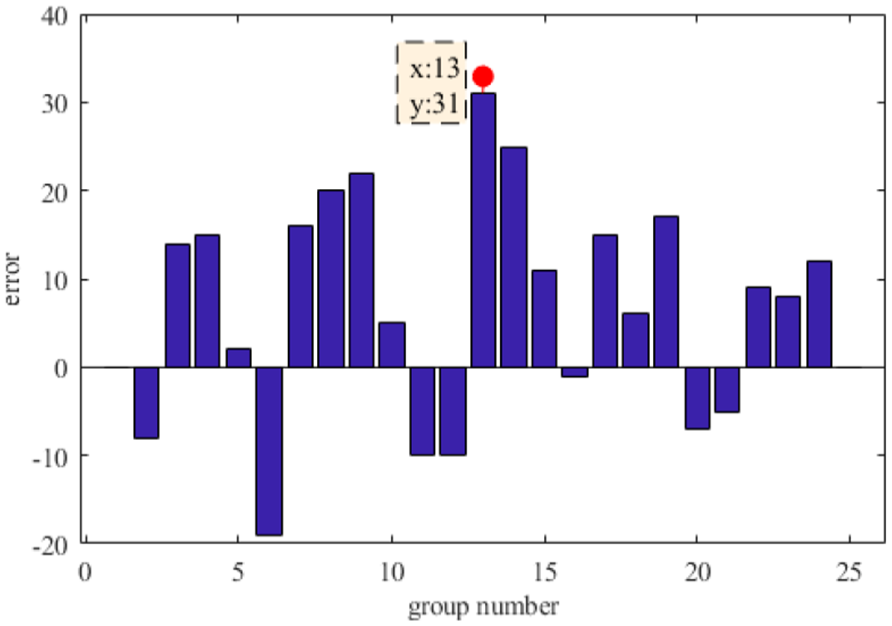
Yield error map.
Conclusion
This article first analyzes big data. Then, an agricultural big data platform based on IoT technology was established. Three modules were designed in the overall architecture: sensor module, image acquisition module, and meteorological data acquisition module. Data such as soil moisture content, temperature and humidity, light intensity, crop growth status, and weather factors were obtained from the farmland. The data are then transmitted to the server through ZigBee and the 3G network card, and the data are directly imported into the neural network model for processing the data through the Web Service. Finally, by comparing the prediction results with the actual data, it is found that the prediction error of the model designed in this article is within 1% and the agricultural data are highly predictable, which helps efficiently in agricultural production.
Footnotes
Handling Editor: Jinsong Wu
Declaration of conflicting interests
The author(s) declared no potential conflicts of interest with respect to the research, authorship, and/or publication of this article.
Funding
The author(s) disclosed receipt of the following financial support for the research, authorship, and/or publication of this article: This work was supported by “The Mechanism of Regional and Industrial Differences of the New Generation Information Technology Innovation and Diffusion Coupling Driving Economic Growth” (Project number: A2017002114) for high-level talents in Hebei Province in 2017 and was also supported by the funding scheme for High-Level Overseas Chinese Students’ Return “Research on deep integration of informationization and industrialization of Hebei Province under the background of Internet+” (Project number: C201882).
