This article introduces the concept of Heronian mean operators, geometric Heronian mean operators, neutrosophic cubic number–improved generalized weighted Heronian mean operators, neutrosophic cubic number–improved generalized weighted geometric Heronian mean operators. These operators actually generalize the operators of fuzzy sets, cubic sets, and neutrosophic sets. We investigate the average weighted operator on neutrosophic cubic sets and weighted geometric operator on neutrosophic cubic sets to aggregate the neutrosophic cubic information. After this, based on average weighted and geometric weighted and cosine similarity function in neutrosophic cubic sets, we developed a multiple attribute group decision-making method. Finally, we give a mathematical example to illustrate the usefulness and application of the proposed method.
The multi-attribute decision-making (MADM) or multi-attribute group decision-making (MAGDM) widely existed in the field of management, military, economy, and engineering techniques1–3 to get an accurate evaluation information in the premises of decision makers (DMs) to make feasible and rational decision. There is a variety of limitations in real-world problems such as uncertainty and complexity of the decision-making environment, too much abundant data and inconsistent and indeterminate with respect to fuzzy information. To process this kind of information, in 1965 Zadeh4 first introduced the fuzzy set (FS) theory. After that Atanassov proposed the intuitionistic fuzzy set (IFS).5,6 In IFS, Atassanav added a non-membership function to decrease the shortcomings in which the FS has only the membership function whereas the IFS is composed of the truth-membership function and falsity-membership function and satisfies the conditions and . Moreover, in 1998 Smarandache7 defined the neutrosophic set (NS). In NS, Samarndache added indeterminacy-membership function, that is, NS is characterized by truth-membership , indeterminacy-membership , and falsity-membership . Moreover, the NS is the generalization of FS and IFSs. For applications point of view we refer the readers.8–10 Further, Jun et al., proposed the concept of neutrosophic cubic set (NCS) by adding truth-membership , indeterminacy-membership , and falsity-membership in the form of interval NS and truth-membership , indeterminacy-membership and falsity-membership in the form of NS.11 Al-Omeri and Smarandache12 introduce the idea of neutrosphic sets via neutrosophic topological spaces (NTs), and some other types of NSs such as neutrosophic open sets, neutrosophic continuity, and their application in geographical information system. NCS is the generalization of FS, cubic set, and NS. Many researchers used NCSs in different directions such as,13–18 to have more applications. So many others discussed different aspects of NCS environment on MADM like, Peng et al.,19 Zhang et al.,20 Ye,21,22 Shi and Ye,23 Lu and Ye,24 Pramanik et al.,25–28 GRA29 and Dalapati and Pramanik,30 Liu and Wang31 proposed the aggregation operator and applied in MAGDM problems. NS theory has various applications in numerous fields such as data record, control theory, problems and decision-making theory. Xu and Yazer32 and Xu33 proposed some arithmetic aggregation operators and geometric aggregation operators for intuitionistic fuzzy information and these operators did not consider the correlations of aggregated arguments. After that, in 2007 Beliakov et al.34 proposed the Heronian mean (HM) operators, which are an important aggregated arguments and possess the characteristic of correlation of aggregation operators. HM operators can deal with the interactions among the attribute values and neutrosophic cubic numbers (NCNs) can easily express the incomplete, indeterminate and inconsistent information. Liu (The research note of HM operators. Shandong University of Finance and Economics, 2012, personal communication) in 2012 extended HM operator to the generalized HM operator.35 Yu and Wu36 studied the interval-valued intuitionistic fuzzy information aggregation operators and their applications in decision-making. Further work to aggregate the interval-valued intuitionistic fuzzy information Liu37 proposed some operators such as generalized interval-valued intuitionistic fuzzy Heronian mean (GIIFHM) operator, generalized interval-valued intuitionistic fuzzy weighted Heronian mean (GIIFWHM) operator, an interval-valued intuitionistic uncertain linguistic weighted geometric average (IVIULWGA) operator, an interval-valued intuitionistic uncertain linguistic ordered weighted geometric (IVIULOWG) operators and also developed the idea of interval-valued intuitionistic uncertain linguistic variables, decision-making problems and their operational laws. Yu38 proposed the idea of decision-making problems under intuitionistic fuzzy environment and introduced some aggregation operators, such as the intuitionistic fuzzy geometric Heronian mean (IFGHM) operators and the intuitionistic fuzzy geometric weighed Heronian mean (IFGWHM) operators and their properties. Liu et al.,39 proposed the aggregation operator and applied in MAGDM problems. We extend the idea of Li et al.,40 provided in Liu et al.39 Therefore, in this article, we will extend neutrosophic numbers (NNs) to NCNs, and propose some HM operators for NCNs, including the improved generalized weighted geometric Heronian mean (IGWGHM) operators which can satisfy some properties, such as reducibility, idempotency, monotonicity and boundedness. At the end, these properties are applied to multi-attribute group decision-making problem (Figure 1).
A flowchart of NCNs based on MAGDM problem.
Preliminaries
In this section, we give some helpful terminologies from the existing literature.
Definition 1 (NS)
Let be a non-empty set.7 A neutrsophic set in is a structure of the form , is characterized by a truth-membership , indeterminacy-membership and falsity-membership , where such that .
Definition 2 (NCS)
Let X be a non-empty set.11 A NCS over is defined in the form of a pair where is an interval NS in and is a NS in U.
Definition 3 (HM operator)
A HM operator of dimension is a mapping such that (The research note of HM operators. Shandong University of Finance and Economics, 2012, personal communication)
where then the function HM is called Heroinan mean (HM) operator.
Definition 4 (geometric Heronian mean operator)
A GHM operator of dimension is a mapping such that (The research note of HM operators. Shandong University of Finance and Economics, 2012, personal communication)
where and . Then the function is called generalized Heroinan mean (GHM) operator.
It is easy to prove that GHM operator has the following properties:
Theorem 1 (idempotency)
Let , then
Theorem 2 (monotonicity)
Suppose and be two collections of non-negative numbers, if , then
Theorem 3 (boundedness)
GHM operator lies between the max and min operators, that is
Since the HM and geometric mean (GM) operator only consider the interrelationship of the input arguments and do not take their own weights into account. In the following, we will introduce another HM operator which is called the weighted generalized Heronian mean (GWHM) operator and shown as follows.
Definition 5
Let and be a collection of non-negative numbers.36 is the weight vector of and satisfies if
then is called a generalized weighted HM (GWHM) operator.
Definition 6.(The GHM operator)
Let and be a collection of non-negative numbers, if37
The is called the generalized geometric Heronian (GGHM) operator.
Definition 7
Let and be a collection of non-negative numbers.38 is the weight vector of and satisfies if
then is called the generalized geometric weighted Heronian mean operator.
Definition 8
Let and be a collection of non-negative numbers (The research note of HM operators. Shandong University of Finance and Economics, 2012, personal communication). is the weight vector of and satisfies if
then is called the improved generalized geometric weighted Heronian mean operator.
The IGGWHM has the properties, such as reducibility, idempotency, monotonicity, and boundedness (The research note of HM operators. Shandong University of Finance and Economics, 2012, personal communication).
Theorem 4 (reducibility)
Let then
Theorem 5 (idempotency)
Let where then
Theorem 6 (monotonicity)
Suppose and be two collections of non-negative numbers, if , then
Theorem 7 (boundedness)
The operator lies between the max and min operators, that is
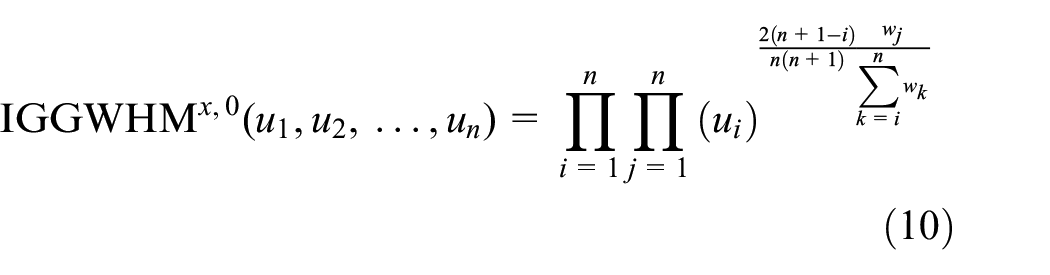
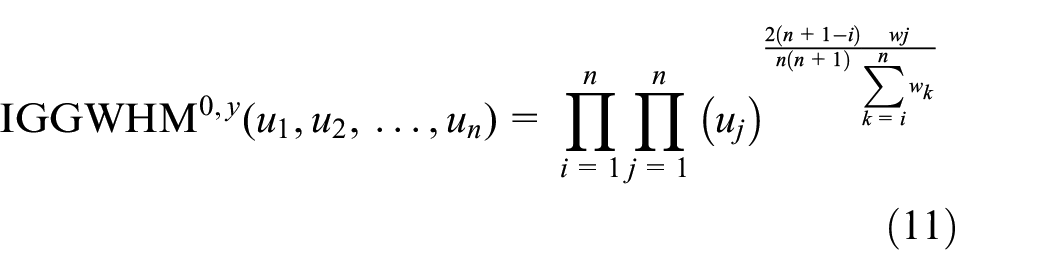
We analyze some special cases of the IGGWHM operator which are defined as follows:
1. When , then
From here we see that does not have any relationship with .
2. When , then
Similarly, does not have any relationship with y.
3. When , then
Definition 9 (cubic Hamy mean)
Suppose where is a collection of non-negative real numbers and parameter 18 Then, the cubic Hamy mean (CHM) is defined as follows
where navigate all k-tuple arrangement of and is the binomial coefficient and .
Definition 10
Let be a finite set and two NCSs be and where and for j = 1, 2, …, n are two collections of NCNs.24 Then cosine measure of is proposed based on the distance as follows
Some HM operator based on the NCN
In this section, we define cNCNIGWHM operator and NCNIGWGHM operator, their properties and different operations.
Definition 11 (the NCNIGWHM operator)
Let and where
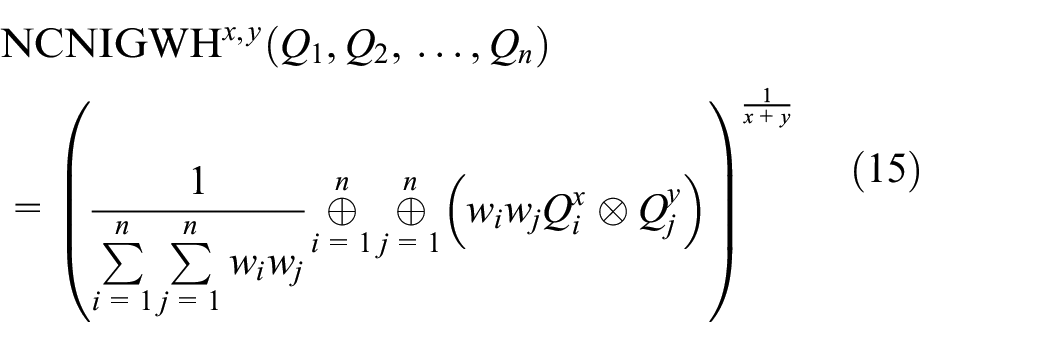
be a collection of NCNs with the weight vector such that and then an NCNIGWH operator of dimension is a mapping and has
where is the set of all NCNs.
Theorem 8
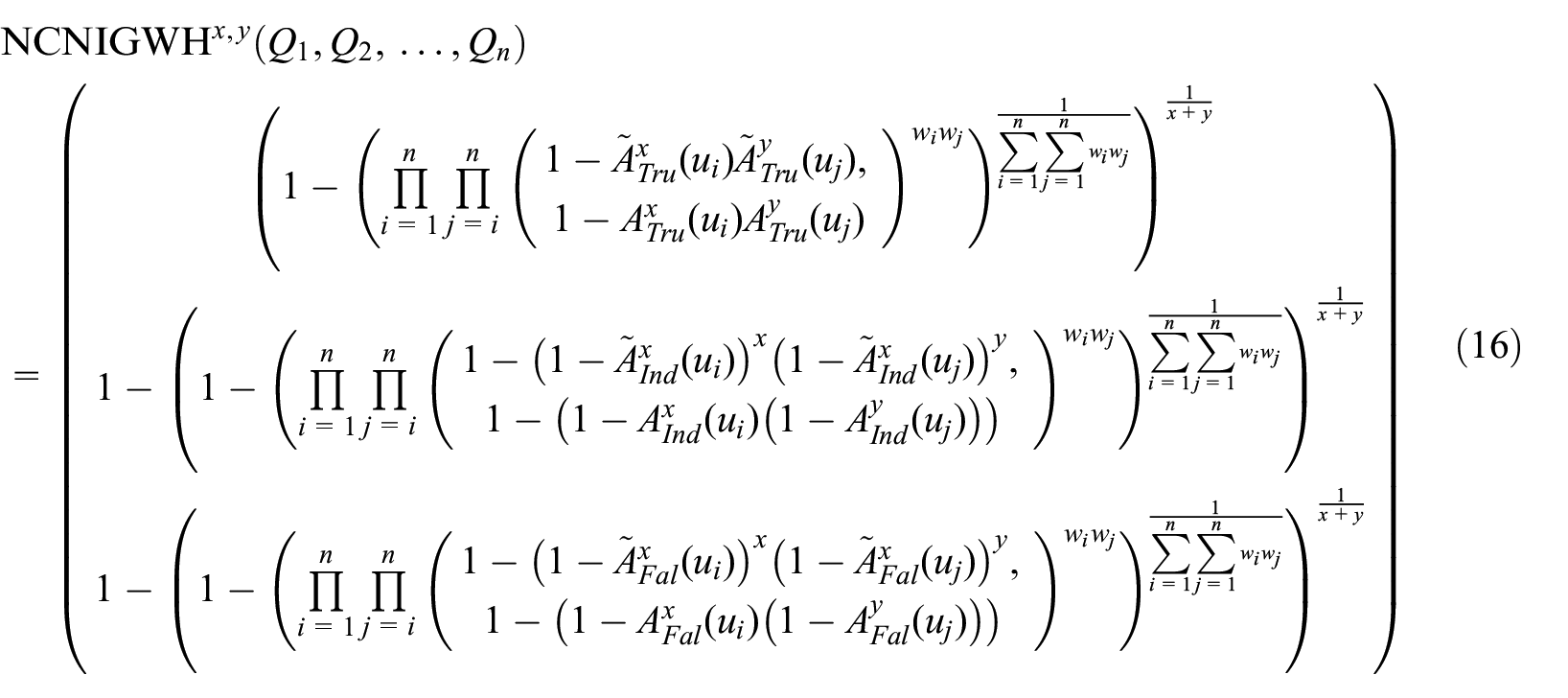
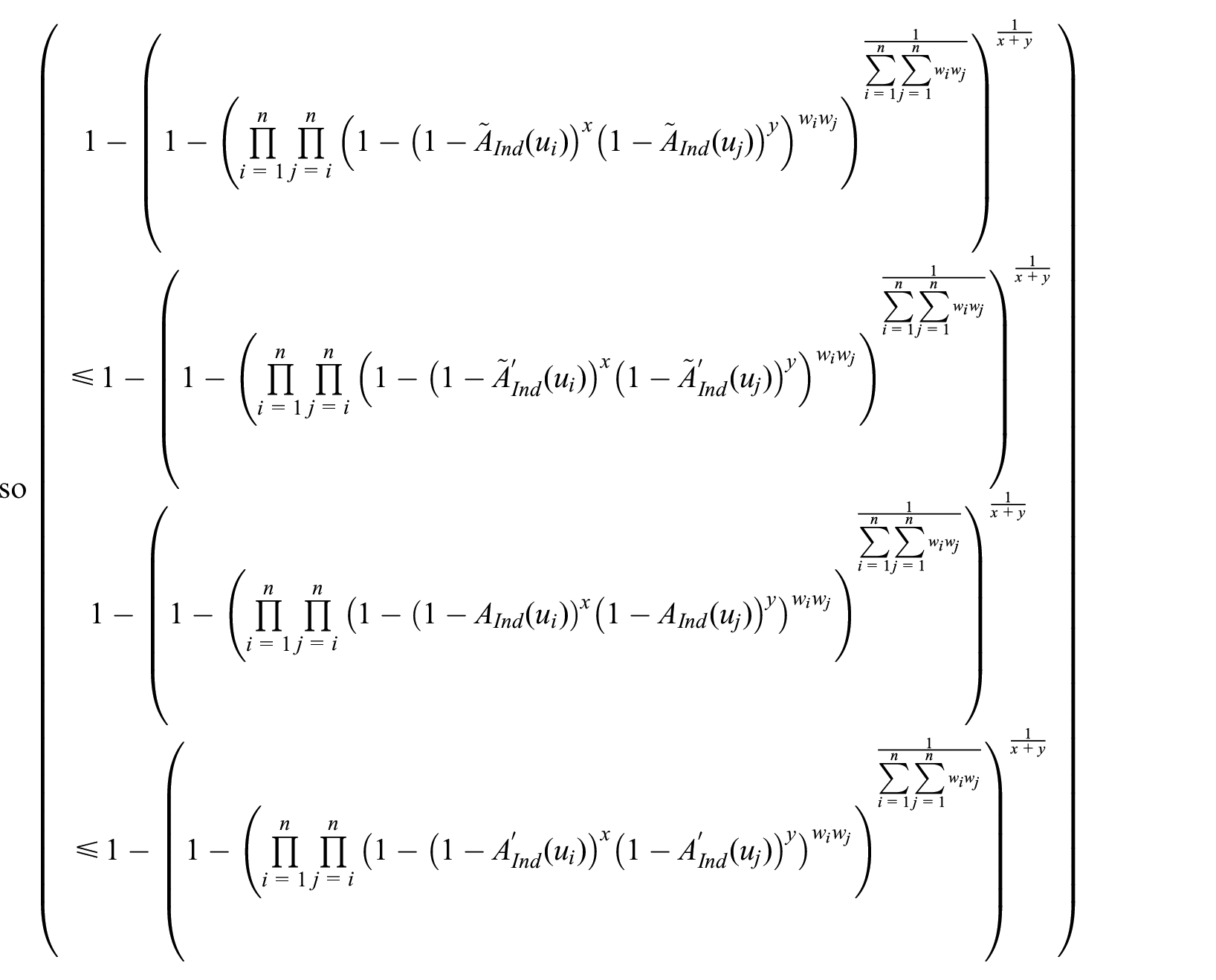
Let and be a collection of NCNs with the weight vector such that and , then the result aggregated from Definition 11 is still an NCN, and even
Proof
Since
and
then
Furthermore
which complete the proof of Theorem 8 □
Moreover, the NCNIGWHM operator also has the following properties.
Theorem 9 (idempotency)
Let , then
Proof
Since , and then according to equation (16), we have
Theorem 10 (monotonicity)
Let and be two collections of NCNs. If , then
Proof
1. Since and then we have
and
so
2. Since and then we have and then
3. Similar to step 2, we can prove
According toTheorems 10–12 and Definition 12, we can get
that is, which completes the proof.□
Theorem 11 (boundedness)
Let be a collection of NCNs, and or
then
Proof
Since then based on Theorems 10 and 11, we have
Like wise, we can get
Then
which completes the proof. □
We will discuss some special cases of the with respect to parameters and , as follows:
1. When , then
2. When , then we have
3. when then we have
NCNIGWGHM operator
Definition 12
Let and where and be a collection of NCNs with the weight vector such that and then an NCNIGWGHM operator of dimension n is a mapping and has
where is the set of all NCNs.
Theorem 12
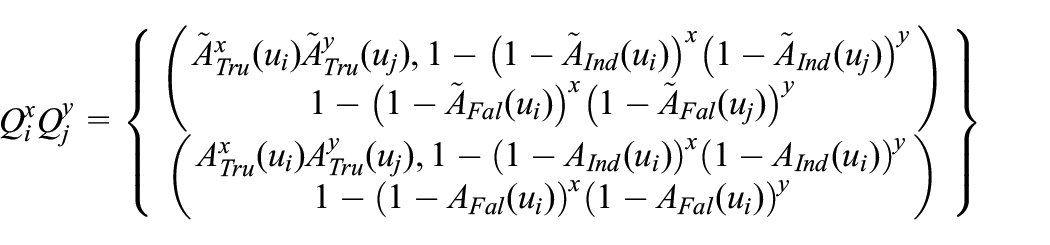
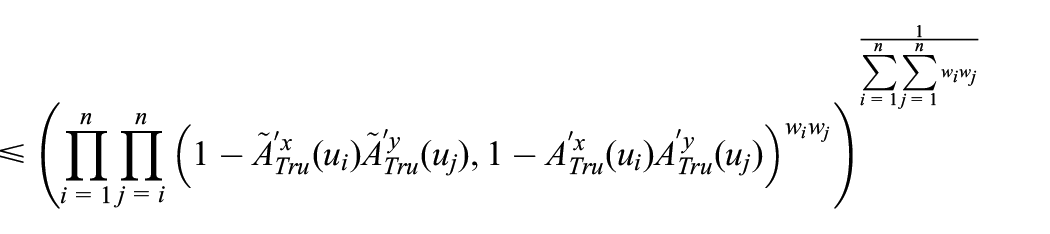
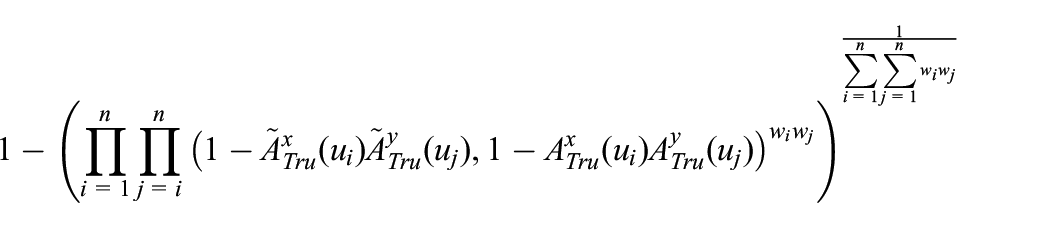
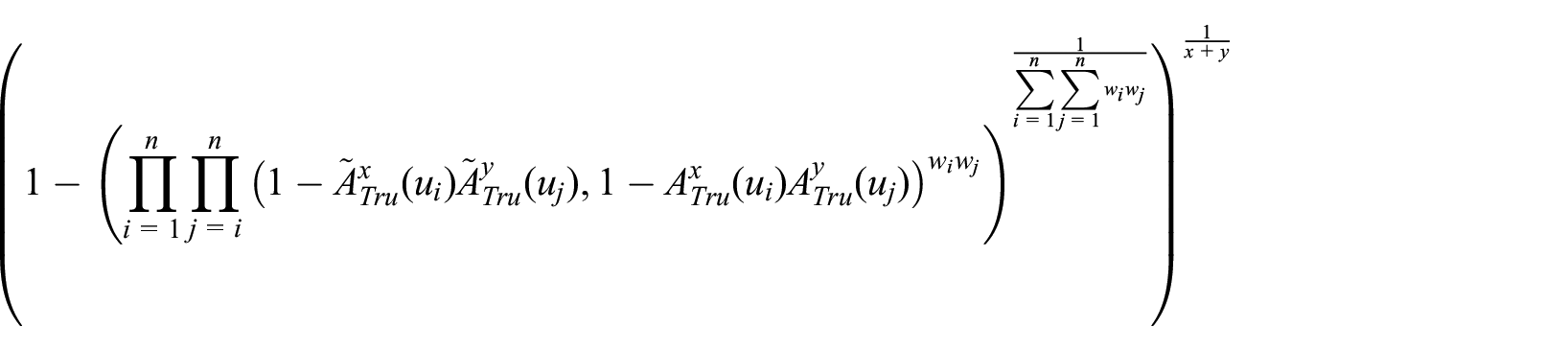
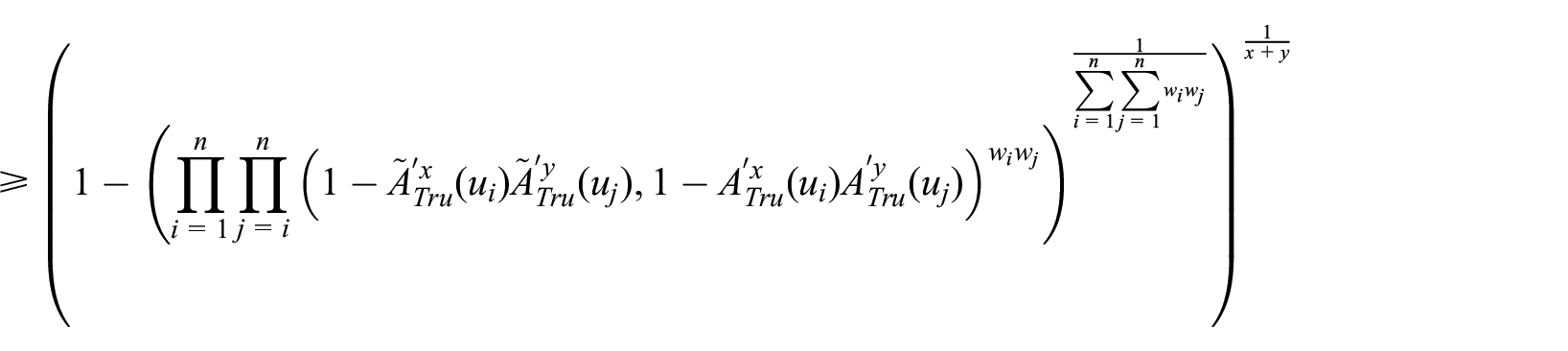
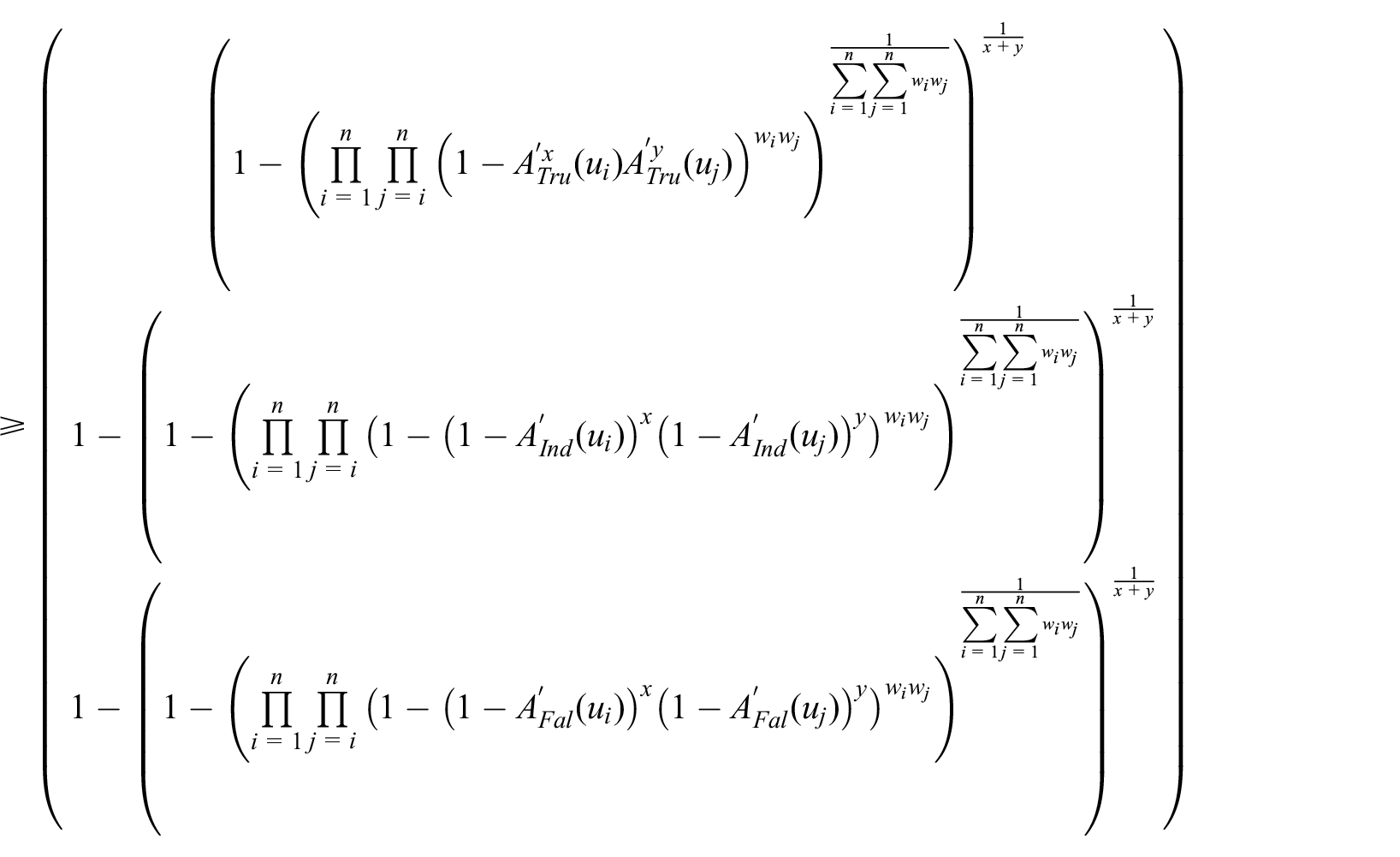
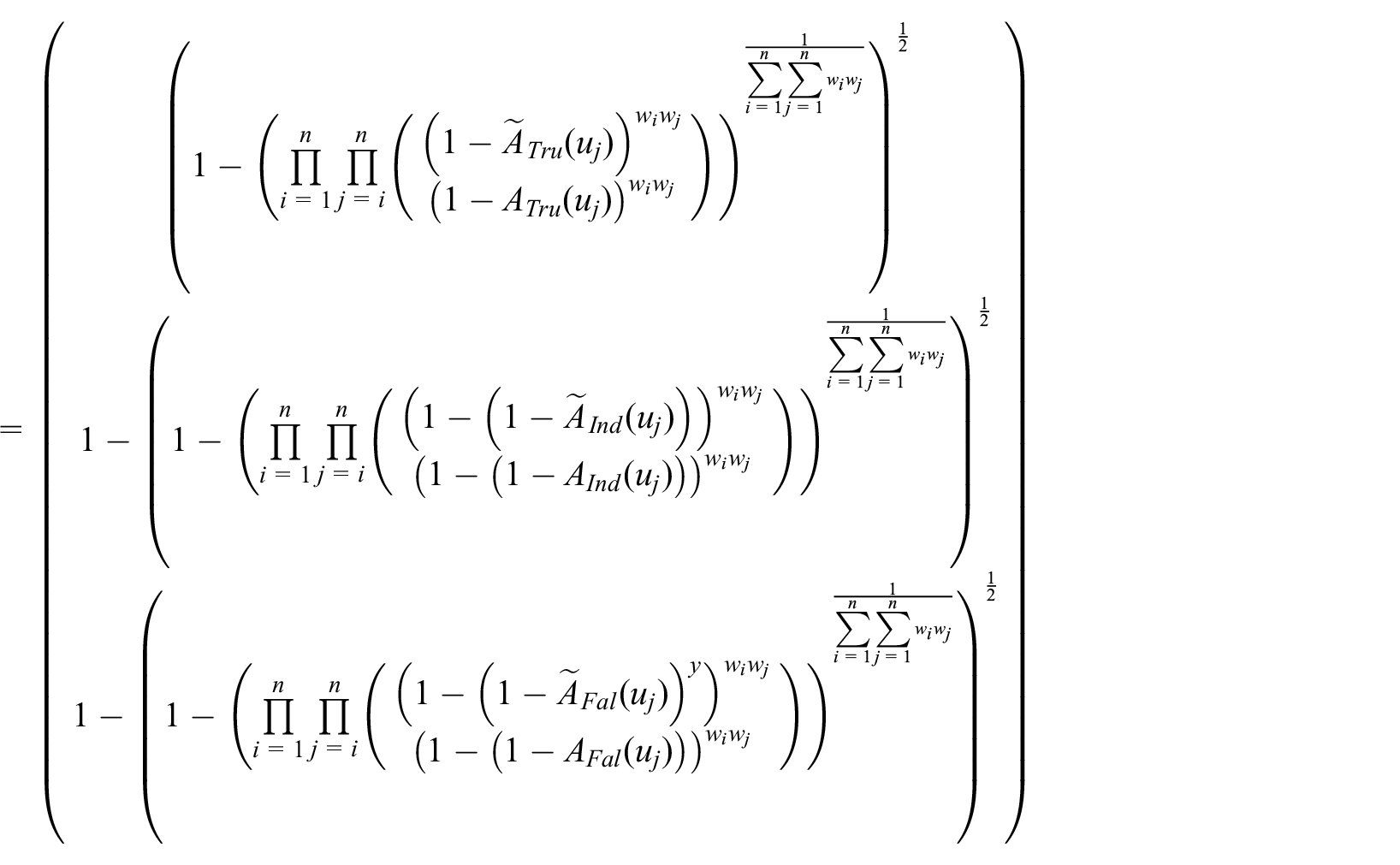
Let and where and be a collection of NCNs with the weight vector such that and then the aggregated value by equation (23) can be expressed as
Similar, the proofs of Theorem 8 and Theorem 12 are omitted.
Moreover, similar to the proofs of Theorems 9–11, it is easy to prove that the NCNIGWGHM operator also has the following properties.
Theorem 13 (reducibility)
Let then
Theorem 14 (idempotency)
Let then
Theorem 15 (monotonicity)
Let and be two collections of NCNs. If , then
Theorem 16 (boundedness)
Let be a collection of NCNs, and
or
then
Some special cases of the with respect to parameters and are discussed as following:
1. When , then
2. When , then
Obviously, , does not have any relationship with . In addition, the parameters x and y do not have the interchangeability.
3. When then
The approach to multiple attribute group decision-making with NCNs
In this section, we shall introduce the approach to multiple attribute group decision-making with the help of the NCNs. We apply NCN-improved generalized weighted Heronian mean operator to deal with the attribute group decision-making problems under the NCNs environment with an illustrated example.
Applications in multiple attribute group decision-making problem
In the problem of multiple attribute group decision-making, the developed procedure can easily be used for the better decision.
Suppose is a set of alternatives, is a set of attributes or criteria, and is the weighted vector of the criteria, where, and Then, the evaluation value of an attribute with respect to alternatives is expressed by an NCN where and . So, the decision matrix is obtained as: The steps of the decision-making based on NCNs are given as follows:
Algorithm
Step 1. The DMs take their analysis of each alternatives based on each criteria. The performance of each alternatives with respect to each crteria .
Step 2. Calculate the NCNIGWHM operator to obtain the collective evaluation value of alternatives with respect to each criteria .
Step 3. Calculate the cosine similarity using Definition 10 in article.24
Step 4. Rank all the alternatives.
Step 5. End.
Numerical example
This section introduces an illustrative example to show the application of the above MAGDM method based on NCN. An investment company intends to choose one product to invest its money from four alternatives Where H1 = medicine company, H2 = textile company, H3 = mobile company, and H4 = car company. The weights of the indicators are . Three criteria have been evaluated and they are shown as follows: G1 = Tax Rate, G2 = Demand/Supply and G3 = Wages. In order to get a most suitable choice we will use the above-mentioned algorithm as follows:
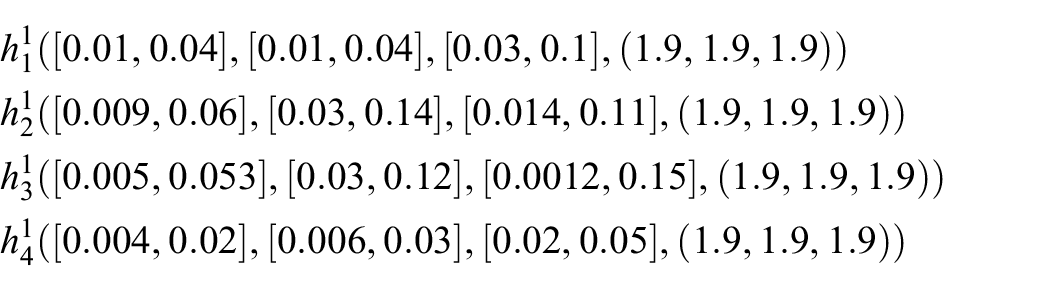
Step 1. Let be a set of alternatives and be the set of criteria. Let be set of decision matrix. The decision matrix evaluates each alternative based on given criteria.
Step 2. Calculate the NCNIGWHM operator by formula (15) to obtain the collective evaluation value of alternatives with respect to each criterion and , we can get
Step 3. To calculate the cosine similarity using Definition 10, we get
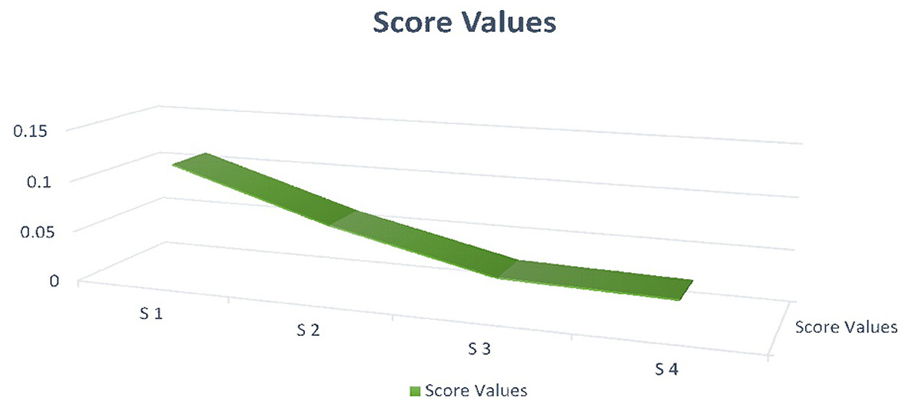
Step 4. Rank all the alternatives, we get the sequence of candidates as follows: shown in Figure 3.
Step 5. End.
Line chart of alternatives versus score values of alternatives.
Graphical representation of the ranking values of alternatives.
Conclusion
In this article, we have discussed the idea of NCNs and different operators such as HM, GHM, weighted Heronian mean, generalized Heronian mean, and generalized weighted geometric mean operators. We applied HM to the NCSs. The NCS can be defined as the three elements such as truth, indeterminate, and incomplete information. The Heronian mean can represent the relationship of the aggregated values and MADM method. Finally, a numerical example is given to verify the proposed method.
Footnotes
Handling Editor: Mohamed Abdel-Basset
Declaration of conflicting interests
The author(s) declared no potential conflicts of interest with respect to the research, authorship, and/or publication of this article.
Funding
The author(s) received no financial support for the research, authorship, and/or publication of this article.
ORCID iD
Muhammad Gulistan
References
1.
CelikEGumusATAlegozM. A trapezoidal type-2 fuzzy MCDM method to identify and evaluate critical success factors for humanitarian relief logistics management. J Intell Fuzzy Syst2014; 27(6): 2847–2855.
2.
GurbuzTAlbayrakYE.An engineering approach to human resources performance evaluation: hybrid MCDM application with interactions. Soft Comput2014; 21: 365–375.
3.
Hashemkhani ZolfaniSMaknoonRZavadskasEK. Multiple nash equilibriums and evaluation of strategies. J Bus Econ Manag2015; 16(2): 290–306.
AtanassovKT.More on intuitionistic fuzzy sets. Fuzzy Sets Syst1989; 33: 37–46.
7.
SmarandacheF.A unifying field in logics, neutrosophic logic. multiplevalued logic. Int J2002; 8(3): 385–438.
8.
KaraaslanF.Multi-criteria decision-making method based on similarity measures under single-valued neutrosophic refined and interval neutrosophic refined environments. Int J Intell Syst2018; 33(5): 928–952.
KaraaslanF.Correlation coefficients of single-valued neutrosophic refined soft sets and their applications in clustering analysis. Neural Comput Appl2017; 28(9): 2781–2793.
11.
JunYBSmarandacheFKimCS.Neutrosophic cubic sets. New Math Nat Comput2017; 13(1): 41–54.
ZhanJKhanMGulistanM, et al. Applications of neutrosophic cubic sets in multi-criteria decision-making. Int J Uncertain Quan2017; 7(5): 377–394.
14.
GulistanMYaqoobNRashidZ, et al. A study on neutrosophic cubic graphs with real life applications in industries. Symmetry2018; 10(6): 203.
15.
KhanMGulistanMYaqoobN, et al. Neutrosophic cubic (a, b)-ideals in semigroups with application. J Intell Fuzzy Syst2018; 35(2): 2469–2483.
16.
GulistanMKhanAAbdullahA, et al. Complex Neutrosophic Subsemigroups and Ideals. Int J Anal Appl2018; 16(1): 97–116.
17.
HashimRMGulistanMSmrandacheF.Applications of neutrosophic bipolar fuzzy sets in HOPE foundation for planning to build a children hospital with different types of similarity measures. Symmetry2018; 10(8): 331.
18.
GulistamMWahabHASmrandacheHA, et al. Some linguistic neutrosophic cubic mean operators and entropy with applications in a corporation to choose an area supervisor. Symmetry2018; 10(10): 428.
19.
PengJJWangJQWangJ, et al. Simplied neutrosophic sets, and their applications in multi-criteria group decision-making problems. Int J Syst Sci2016; 47(10): 2342–2358.
20.
ZhangHYWangJQChenXH.Interval neutrosophic sets and their application in multicriteria decision-making problems. Sci World J2014; 2014: 645953.
21.
YeJ.Single valued neutrosophic cross-entropy for multi-criteria decisionmaking problems. Appl Math Model2014; 38(3): 1170–1175.
22.
YeJ.Similarity measures between interval neutrosophic sets and their applications in Multi-criteria decision-making. J Intell Fuzzy Syst2014; 26: 165–172.
23.
ShiLYeJ.Dombi aggregation operators of neutrosophic cubic sets for multiple attribute decision-making. Algorithms2018; 11(3): 29.
24.
LuZYeJ.Cosine measures of neutrosophic cubic sets for multiple attribute decision-making. Symmetry2017; 9(7): 121.
25.
PramanikSDalapatiSAlamS, et al. NC-cross entropy based MADM strategy in neutrosophic cubic set environment. Mathematics2018; 6(5): 67.
26.
PramanikSDalapatiSAlamS, et al. NC-TODIM-based MAGDM under a neutrosophic cubic set environment. Information2017; 8(4): 149.
27.
PramanikSDalapatiSAlamS, et al. NC-VIKOR Based MAGDM Strategy under neutrosophic cubic set environment. Neutrosophic Sets Syst2018; 20: 95–108.
28.
PramanikSDalapatiSAlamS, et al. Neutrosophic cubic MCGDM method based on similarity measure. Neutrosophic Sets Syst2017; 16: 44–56.
29.
BanerjeeDGiriBCPramanikS, et al. GRA for multi attribute decision-making in neutrosophic cubic set environment. Neutrosophic Sets Syst2012; 12: 59.
30.
DalapatiSPramanikS.A revisit to NC-VIKOR based MAGDM strategy in neutrosophic cubic set environment. Neutrosophic Sets Syst2018; 21: 131–141.
31.
LiuPDWangYM.Multiple attribute group decision-making methods based on intuitionistic linguistic power generalized aggregation operators. Appl Soft Comput2014; 17: 90–104.
32.
XuZYagerRR.Some geometric aggregation operators based on intuitionistic fuzzy sets. Int J Gen Syst2006; 35: 417–433.
33.
XuZS.Intuitionistic fuzzy aggregation operators. IEEE T Fuzzy Syst2007; 15(6): 1179–1187.
34.
BeliakovGPraderaACalvoT.Aggregation functions: a guide for practitioners. Berlin: Springer, 2007, p. 221.
35.
LiuPD. The research note of Heronian mean operators. Shandong Univ Financ Econ Pers Commun2012; 10–20.
36.
YuDJWuYY.Interval-valued intuitionistic fuzzy Heronian mean operators and their application in multi-criteria decision-making. Afr J Bus Manage2012; 6(11): 4158–4168.
37.
LiuPD.Some geometric aggregation operators based on interval intuitionistic uncertain linguistic variables and their application to group decision-making. Appl Math Model2013; 37: 2430–2444.
LiuPHeLYuX. Generalized hybrid aggregation operators based on the 2-dimension uncertain linguistic information for multiple attribute group decision making. Group Decis Negot2016; 25(1): 103–126.
40.
LiYLiuPChenY.Some single valued neutrosophic number Heronian mean operators and their application in multiple attribute group decision-making. Informatica2016; 27(1): 85–110.