




Abstract
With the continuous development of Internet of things technology, the tourism industry cluster based on the Internet of things platform has gradually formed, and the resource integration mechanism of industrial clusters under the Internet of things platform has gradually become a research hotspot. Starting from the theory of niche research in tourism industry cluster, this article improves the mode of industrial clusters through the Internet of things platform. Then, combining resource integration game model, the resource integration mechanism of Internet of things tourism industry cluster is formed. Relying on the information management model of the Internet of things industry, the information platform of industrial clusters is constructed, and the simulation research is carried out by MATLAB. The results show that the overall industrial income generated by the resource allocation mechanism under the Internet of things platform is better than that under the traditional resource allocation mechanism, and the resources integration of tourism industry cluster under the Internet of things platform is achieved, which provides a theoretical basis.
Introduction
In recent years, with the expansion of the Internet of things (IOT) applications, the integration of industrial cluster resources based on the IOT technology platform has become a hot research topic for many scholars. The IOT is a network formed by the connection of things, which contains two meanings: first, the IOT is the core and foundation of the Internet; second, the IOT extends and extends the user end of the Internet to the information exchange and communication between any goods and articles, which is a network extended and extended on the basis of the Internet. Industrial clusters refer to the formation and evolution mechanism of industrial agglomeration, the realization path of technological innovation, the application of virtual industrial clusters and their industrial policies, and the relationship between virtual industrial clusters and economic growth. There are many researches on the IOT and industrial clusters at home and abroad. C Mason et al. 1 studied the important role of virtual communication between small- and medium-sized enterprises leading non-central industrial clusters in knowledge management, knowledge sharing, and cluster development. Taking Hangzhou as an example, H Fu et al. 2 studied the development mechanism of the IOT industry, established an index system to evaluate the development capacity of the IOT industry in Hangzhou, designed the intelligent cycle path of the IOT, and constructed the industrial pattern of the IOT with the cluster linkage model. Zhao et al. 3 intelligently identified and managed objects by connecting them to the IOT through sensors. Based on the analysis of the operation mechanism of “Internet+” total factor network, Li et al. 4 explored the generation mechanism of industrial clusters under the action of total factor network, clarifying the three modes of generation of industrial clusters, namely, supply oriented, demand oriented, and supply demand integration. Domestic and foreign scholars mainly focus on the role of resource integration ability in improving the competitiveness of clusters and focus on resource allocation. S Sarkar et al. 5 made a rigorous comparative analysis between the fog computing paradigm and the traditional cloud computing paradigm in the IOT environment through the parameters and characteristics of mathematical formulas for fog calculation. D Połapa et al. 6 used multithreading mechanism to reduce training time by rejecting unnecessary weight selection. In this mechanism, we use a multi-core solution to select the optimal weights among all parallel training networks. Using the problem of sample classification, the solutions of three kinds of neural networks (classical, spark, and convolution) are tested. M Woźniak and D Połap 7 proposed a detection method based on point cluster analysis and used convolutional neural network as the final classifier. A method of point group determination based on the combination of model graphics processing and fuzzy logic is proposed. The proposed detection and classification architecture is tested. However, there are few studies on the identification, acquisition, and utilization of cluster resources. Based on the theory and model of tourism industry cluster under the IOT technology platform, this article studies the mechanism of resource integration and information platform and verifies the advantages of tourism industry cluster under the IOT technology.
Niche theory and model of industrial cluster under the IOT technology platform
Niche theory and its theoretical framework in the study of tourism industry cluster
In ecology, niche refers to the sum of the adaptability of a biological unit (including individuals, populations, or species), which includes the ability of organisms to utilize and transform the surrounding environmental resources, reflecting the interaction between organisms and the environment, and is often used to study the relationship between different ecological units of the same category, that is, in the present. In fact, the stability of species depends on competition among different niches. 8 However, in practice, due to the difficulty of adaptive measurement, it is often used to characterize the adaptability by the utilization of environmental resources.
As an organic organization, industrial cluster, including its internal enterprises, must also obtain resources from the outside world and export products, that is, exchange material energy and information, and cooperate with other economic organizations. The most important is the competition of raw materials and product markets. Therefore, this similarity with biological population makes it possible to use niche theory to study industrial clusters. This article focuses on the introduction of relevant theoretical research methods, through the case study of two industrial clusters producing similar products.
The relationship between industrial clusters and other economic organizations
Because industrial clusters, especially industrial clusters, inevitably involve the acquisition of industrial raw materials, energy, and other resources, these basic resources are necessary for most economic organizations. 9 Therefore, the cluster must have direct or indirect competition and cooperation with other economic organizations. From the perspective of niche, there must be some overlap between clusters and other economic organizations; from the perspective of market, clusters compete with other economic organizations that provide similar products in the overall sense, while cooperation or symbiosis is more reflected in the organizational relationship of complementary industries or industrial clusters in different industrial chains. Therefore, there are three main relationships between a cluster and other economic organizations, namely, competition, cooperation, and symbiosis, and at the cluster level, the relationship between competition and cooperation is often dominant.
Niche breadth of industrial clusters
The niche breadth of industrial clusters can be defined as the scope of environmental resources utilized by industrial clusters. This includes two meanings, first, the sum of the resources on which the industrial cluster depends, and second, the scope of certain resources needed by the industrial cluster. For example, an industrial cluster needs three kinds of resources: market, energy, and raw materials at the first level, and whether the high-end market or the middle-end market is the second level. Different from the niche breadth of biological population, the niche breadth of industrial cluster cannot directly indicate the survival and competitiveness of the cluster. Cluster is often a highly specialized form of industrial organization, which is reflected in the niche breadth model, that is, its niche breadth is narrow, but this kind of specialization is also the evolution of the existence and development of industrial clusters and the performance of high competitiveness in the professional field.
The niche breadth of industrial clusters can be expressed by graphical and quantitative calculation. Figure 1 shows the niche breadth of the three resource dimensions of an industrial cluster.

Niche breadth model of industrial clusters: (a) foreign and Chinese fields of view account for 65% and 35% of total sales, respectively, (b) energy consumption of coal and electricity in the cluster is 75% and 25%, respectively, and (c) coal, electricity and electricity consumption and their proportion are 30%, 35% and 35%, respectively.
Figure 1(a) illustrates the sales ratio of the cluster’s products in both domestic and foreign markets, of which the foreign market accounts for about 65% of the total sales and the rest for the domestic market; Figure 1(b) illustrates that the cluster’s energy consumption is mainly coal-based and the coal-to-electricity ratio is about 3:1; Figure 1(c) illustrates that the coal, gas, and electricity consumption ratio in the cluster is about 3:3.5:3.5.
Niche overlap of industrial clusters
The niche overlap of industrial clusters indicates the relationship between industrial clusters and other economic organizations in terms of environmental resources. The degree of overlap indicates the strength of the competition relationship to resources and the niche overlap of industrial clusters (see Figure 2).

Niche overlap model of industrial clusters: (a) distribution ratio of industrial clusters in domestic and foreign market resource dimensions and (b) niche overlap in resource allocation of industrial clusters.
Figure 2(a) and (b) shows that in the resource dimension of the market, A is dominated by foreign markets, B is dominated by domestic markets, and C is the overlap relationship between the two clusters.
Niche theory and model of industrial cluster
Model hypothesis:
Assume that there are only one or two enterprises in a high-tech enterprise cluster (which can be inferred from the presence of more than one enterprise) producing the same product.
The output level of an enterprise is a function of time.
In a given period of time and geographical space, including raw materials, labor, capital and market size (excluding technology), and other factors, endowment is certain.
Suppose that in high-tech enterprise cluster, the relationship between enterprises is the coexistence of competition and symbiosis. In the relatively centralized enterprises, the competition of each other restrains the growth of the other’s output, and the mutually beneficial symbiosis promotes the growth of the other’s output.
The saturation of market scale of enterprises has a retardation effect on the growth rate of enterprises’ output level.
According to the assumptions, the Logistic model is introduced as follows 10
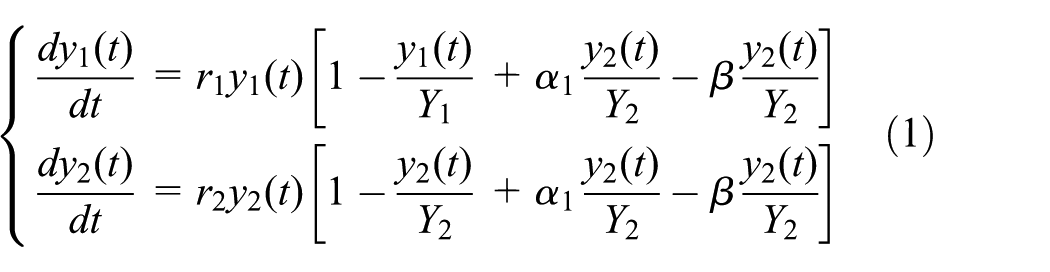
In the formula,
Improvement of industrial cluster mode under the influence of IOT
The IOT reflects that enterprises in virtual enterprise clusters can better collect and exchange information through the IOT. 11 There is an inherent need for the interconnection of enterprise product value. The satisfaction degree of this demand is closely related to the scale of the IOT. With the increase in the scale of the IOT, the costs borne by each enterprise will continue to decline. The scope of information and experience exchange has been expanded, and enterprises may gain greater value from the expansion of the scale of the IOT. When a product with the IOT is just put into the market, the initial users are mostly technology enthusiasts and high-income people who are insensitive to price. The market capacity of the product grows slowly. However, with the increase in the number of users, more and more people will find the value added to the product from the product benefits. When the number of users reaches a certain critical capacity, the product will formally enter the market to achieve leapfrog development (Figure 3).

Industrial cluster mode under the influence of Internet of things.
The space of IOT decides the boundaries of scale effect such as enterprise cluster environment, consumer behavior, and enterprise competition behavior.
12
According to Metcalfe’s law, as the number of network nodes increases, the value of a network will increase exponentially. In other words, the IOT will become more useful as more users access the IOT, which leads to the increasing scale effect of the IOT. It is because of the impact of the scale of the IOT on consumer utility that the factor of the scale of the IOT is added to the consumer utility function, that is, the

In the formula, R is the extreme difference of the cost
Resource integration mechanism of industrial cluster under the environment of IOT
Game model of resource integration in the environment of IOT
Resource integration game model divides member enterprises into two groups: 13 member groups and member groups, repeatedly randomly extracting a member pair from the two groups to start the game, respectively, replication dynamics and evolutionary stability strategy analysis of the two groups.
Members of group 1 and group 2 have two kinds of behavioral decisions: sharing resources or not sharing resources. Let

Resource space enterprise cluster mode.
Assuming that the proportion of members who choose the resource-sharing policy in member group 1 is x, the proportion of members who choose the resource-sharing policy is
Variable parameters summary.

The cluster environment in which the member enterprises are located is uncertain. The resource-sharing process of the enterprise is carried out in the limited rational space of virtualization. At the same time, because of the complex relationship among the members, the resource-sharing strategies among the members are mutually influential. Each member is based on the resource policies of other members. Choose and adjust their strategies according to their relative position in the group. Consider that in general, the excess benefits of resource-sharing strategy of member group 1 and member group 2 are greater than the risk cost of resource sharing, namely
Revenue matrix of game sides.

The profit of member enterprise group 1 when choosing resources is

The profit of member enterprise group 1 when choosing resources is not shared

The average income of the 1 member enterprises group is

Similarly, the average income of the 2 member enterprises group is

The dynamic process of two enterprise groups is constructed

The above two differential equations describe the sharing process of the resource game of the members of the IOT. The first formula shows that the proportion of enterprises adopting resource-sharing strategy in enterprise cluster 1 is stable when
Establishment of resource integration mechanism for industrial clusters under the environment of IOT
Industrial cluster resource planning under the IOT is an optimization method of resource allocation, which enables member enterprises to find the optimal resource scheme. 14 However, in a cluster, member enterprises have no right to control the behavior of another member enterprise. According to the theory of social networking scholars, in the network model of resource allocation, the social relationship between the actors. The formation process is spontaneous; therefore, it is necessary to manage the relationship between member enterprises through the coordination mechanism to further complete and optimize the allocation of resources. 15 Resource integration coordination of industrial clusters under the IOT is the main form of spontaneous interaction between member enterprises. Because member enterprises have a high degree of autonomy and active adaptability, they can decide what action to take. The basis of action decision-making is often a variety of information resources in the cluster. There are some uncertainties in enterprise decision-making. In the process of cooperation among member enterprises, there are both benefits and risks. Coordination mechanism is the key to overcome risks, deal with conflicts, and increase cooperation output. 16
The industrial cluster under the IOT is a self-organized complex network system, when the market opportunity discovery cluster member enterprises, but the lack of integrity of the resources and capabilities, triggering a resource search system for lack of resources in the internal and external resources, locking position, the two sides in the drive of common interests and goals. The coordination mechanism achieves cooperation, which includes the coordination of objectives, tasks, resources, interests, conflicts among cooperative enterprises, and so on. 17 It realizes the emergence of the whole in the complicated interaction and coordination process of member enterprises. Coordination methods mainly include communication and coordination, countermeasure negotiation process, and network learning. The mechanism of resource coordination is illustrated in Figure 5.

Resource coordination mechanism.
All the process of resource coordination is inseparable from communication. 18 Effective communication can enhance the trust between members, strengthen mutual understanding, and reduce the occurrence of conflicts. Using network information technology, such as e-mail, teleconferencing, or network video conferencing, the geographically dispersed member enterprises or partners are brought together to shorten the distance between members and promote remote communication. This article argues that effective communication mechanisms should include the following elements:
Communication main body. It includes two types of subjects, one is the sender of communication intention and the other is the receiver of communication intention.
Communication channels. That is, the media to achieve communication, such as telephone, network, teleconferencing, and video conferencing, they are the basis for the realization of virtual communication.
Feedback. In the process of communication, whether the information transmitted by member enterprises can achieve the desired effect depends mainly on whether it can be responded to and whether the interaction is sufficient. 19 Feedback is divided into positive and negative feedback, combined with feedback to further adjust the communication strategy.
In the utilization of industrial cluster resources, we should actively build and absorb social resources related to smart home, for example, the establishment of smart home online clubs, smart home forums, and smart home industry associations. These organizations can absorb scattered resources such as individuals, groups, and enterprises that are interested in smart home applications. These resources play an important role in promoting the flow of knowledge resources, technological innovation, and resource sharing in the cluster.
Research on information platform of tourism industry cluster under the IOT technology
Theoretical framework of tourism industry information management based on IOT technology
IOT is an advanced technology proposed in the process of rapid development of information technology. It can realize the information acquisition of factory output and production environment. 20 In windows system, industrial cluster information platform realizes data integration by searching Association engine. First, according to the composition of functions, search resource collaboration alliance can also be decomposed into comprehensive functions. First, search is matched according to a single function, then search results are aggregated and synthesized, and the most reasonable resource combination scheme is selected. Resource agent plays an important role in the process of searching, collecting, and feeding back data at different levels. The IOT has the advantages of omni-directional perception, real-time transmission, and intelligent processing. It can connect objects without time and place constraints. It plays a very important role in the construction of agricultural information management platform. The enterprise information management system based on the IOT is composed of three layers, namely, perception layer, transmission layer, and application layer, 21 as shown in Figure 6.

Industrial management system diagram based on Internet of things.
The role of perceptual layer is to transform the influencing factors of factory output and production parameters into data information that can be processed intelligently through a certain technology.
The transport layer can communicate the perceptual layer and the application layer of the IOT. 22 The main function of the transport layer is to collect the information of tourism industry parameters using different types of network technology, so that the integration of agricultural information can be realized and the corresponding processing can be carried out.
The main function of the application layer is to collect factory information and process it, so as to have a better understanding of the actual situation of the factory, and to closely integrate the IOT with the needs of the factory, so as to improve the intelligence of agricultural information management.
Tourism industry information management model based on IOT technology
Data can be processed by gateways, bridges, and switches, and then transmitted to the data server, and stored in the data server. Then, the data is classified and processed, and the algorithm of data processing is determined. 23
The sensor network node is defined as
The monitoring value of node i at moment t is defined as

The maximum probability of t state at i is expressed as follows 24

In the formula,
Simulation
This article selected 20 tourism industry cluster enterprises in a city, including tourism industry derivative products manufacturing enterprises, product sales planning enterprises, product transportation enterprises, product wholesale enterprises, and so on. Through the big data of Internet, we investigate and understand the sales revenue data and the cooperation data of these enterprises in the past 10 years. Then, we use MATLAB software to compile the program. At the same time, we also introduce the resource allocation mechanism to simulate the enterprise relying on the platform of IOT. By increasing the channels of collaborative communication and the number of collaborative communication, we can improve the overall situation, that is, industrial chain revenue. As shown in Figures 7 and 8, the resource collaboration modes of industrial clusters under the conditions of traditional resource collaboration mechanism and IOT platform are illustrated.
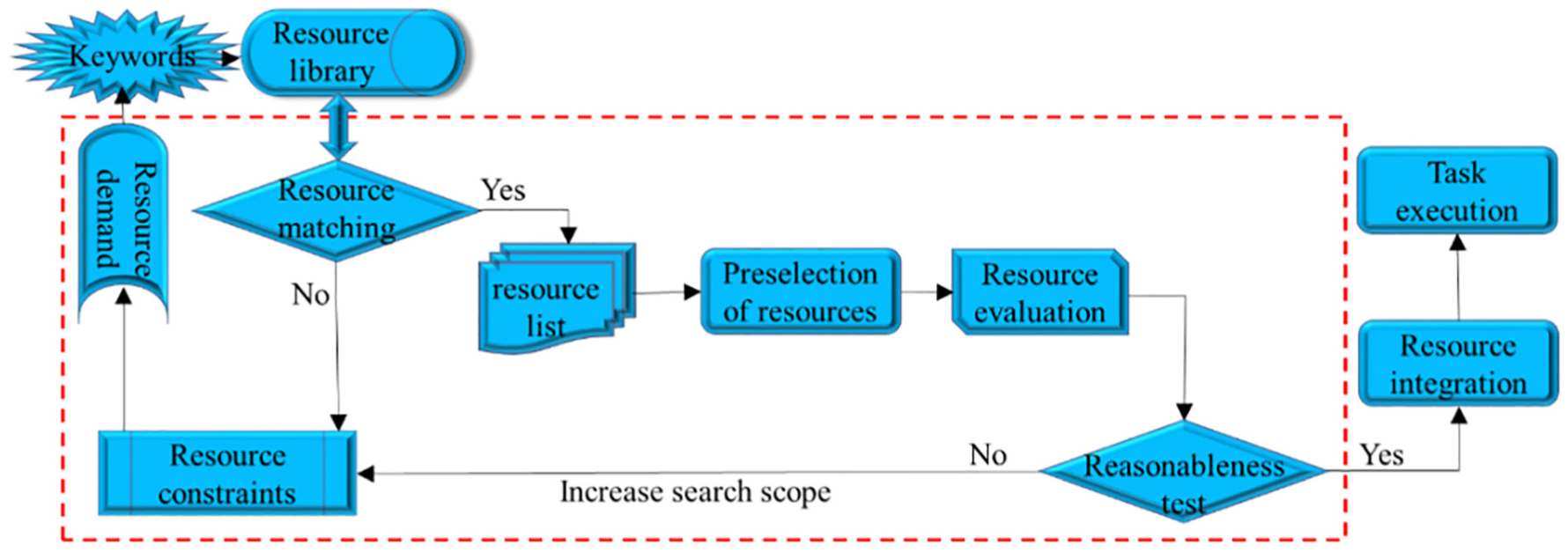
Resources cooperation mechanism of traditional industrial clusters.

Resource cooperation mechanism of industrial cluster under the Internet of things platform.
As shown above, resource collaboration under the IOT platform increases the way industries communicate with each other, thus improving the efficiency of collaboration. By querying the city’s economic and demographic data, it can simulate the industrial production. Assuming that the product consumption population is the city’s population, other cities do not participate in collaboration and consumption. Twenty-four stochastic simulation experiments were conducted on 20 enterprises, and the results were compared with the traditional collaborative real income data from 2002 to 2011, as shown in Figures 9 and 10.

Profit comparison of different resource allocation mechanisms.
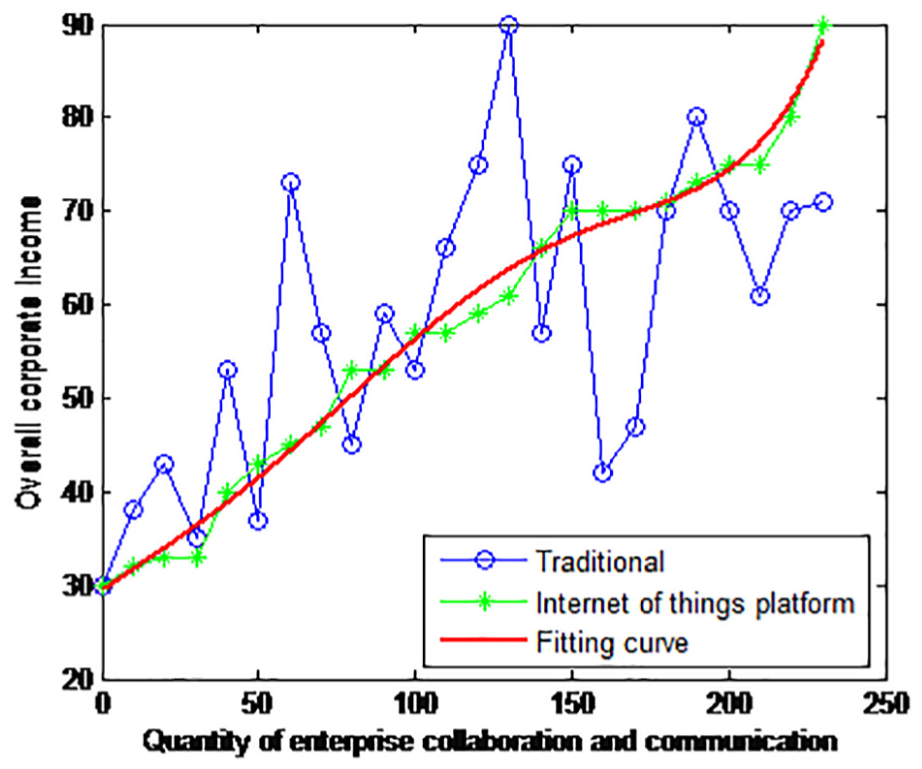
Overall revenue curve under the Internet of things platform.
As can be seen from Figure 9, with the development of simulation, the actual income of the industry under the traditional allocation mechanism is significantly lower than that under the IOT platform. In the actual operation process, the IOT can play a role of industrial ties and can effectively improve the efficiency of tourism industry cooperation. As shown in Figure 10, for the overall return of the industry under different collaborative exchanges, it can be seen from the graph that the overall return of the industry increases exponentially as the number of collaborations increases. That is to say, the cooperative exchange between industries has not only a single effect on the overall income but also a nepotism effect on the income of each enterprise, so that the overall income of the enterprise is greater than the sum of tourism industry income.
Conclusion
The intrinsic motive force of the formation and evolution of clusters is the integration of high-tech value chains in the global scope through the sharing and utilization of the largest range of resources. Efficient resource integration activities can make the material resources, information resources, and knowledge resources in the cluster play the greatest role and realize resource synergy through rational allocation. This article integrates the IOT technology into the construction of tourism industry information management platform, which can realize the integration of industrial information resources, improve the level of industrial management, promote the process of industrial modernization, greatly improve tourism industry production efficiency, and make the industrial information management platform more intelligent. This article mainly studies the tourism industry cluster mechanism under the IOT technology platform:
The niche theory and its theoretical framework in the study of tourism industry clusters are established, and the role of IOT is introduced to improve the industrial cluster model, which provides a theoretical basis for the industrial cluster model under the platform of the IOT.
This article constructs the resource integration mechanism of tourism industry clusters under the environment of IOT. Combining with the game model of resource integration, it puts forward the development of industrial clusters, realizes economies of scale, and forms the competitive advantages of regional enterprises and industries.
Based on the tourism industry information management model of the IOT technology, the information platform of industrial clusters under the IOT technology is constructed, and the simulation research is carried out by MATLAB software programming. It is found that the actual income of the traditional distribution mechanism, that is, the industry, is significantly lower than the collaborative income under the IOT platform.
Footnotes
Handling Editor: Marcin Wozniak
Declaration of conflicting interests
The author(s) declared no potential conflicts of interest with respect to the research, authorship, and/or publication of this article.
Funding
The author(s) received no financial support for the research, authorship, and/or publication of this article.
