




Abstract
Cognitive radio sensor networks offer a promising means of meeting rapidly expanding demand for wireless sensor network applications in new monitoring and objects tracking fields. Several challenges, particularly in terms of quality of service provisioning, arise because of the inherited capability-limitation of end-sensor nodes. In this article, an efficient resource allocation scheme, improved Pliable Cognitive Medium Access Protocol, is proposed to tackle multilevel of heterogeneity in cognitive radio sensor networks. The first level is the network’s application heterogeneity, and the second level is the heterogeneity of the radio environment. The proposed scheme addresses scheduling and radio channel allocation issues. Allocation-decision making is centralized, whereas spectrum sensing is distributed, thereby increasing efficiency and limiting interference. Despite the limited capabilities of the sensor’s networks, the effectiveness of the proposed scheme also includes increasing the opportunity to utilize a wider range of the radio spectrum. improved Pliable Cognitive Medium Access protocol is quite appropriate for critical communications that gain attention in the next 5G of wireless networks. Simulation results and the comparison of the proposed protocol with other protocols indicate the robust performance of the proposed scheme. The results reveal the significant effectiveness, with only a slight trade-off in terms of complexity.
Introduction
Scholarly and commercially interests in wireless sensor networks (WSNs) are increasing day by day. The development of WSN technology enables many emerging applications in new domains in addition to the traditional domains. Potential WSN applications include emerging monitoring and objects tracking applications such as smart cities, e-Health, industrial control and monitoring, asset tracking, and supply chain management. Implementing these applications requires quality of service (QoS) provisioning while coping with the capability constraints of the end-sensor node.1,2 Low data rate, low power consumption, low transmission range, and low computational capabilities are some of these constraints in addition to the hostile radio environment that the WSNs are operating in.3,4
A new radio spectrum management paradigm is proposed, offering a solution to the wireless spectrum scarcity problem while improving the efficiency of licensed spectrum bands utilization. Cognitive radio (CR) is an emerging technology that mitigates the overutilization situation in the license-free spectrum by enabling an opportunistic spectrum access (OSA) mechanism to the licensed spectrum for unlicensed devices. The unlicensed devices are called the secondary users (SUs), and the licensed devices are called the primary users (PUs), which have priority in using the spectrum. In other words, the SUs have many obligations toward the PUs to prevent the harmful mutual interference between signals. The absence of licensed-user activity is called a spectrum hole or a white space, as shown in Figure 1. Typically, an SU performs spectrum sensing (SS) processes in the targeted radio spectrum and detects periods during which the channel is free of PU activities.5,6 The SU is permitted to access the medium in those periods of time and utilize the radio channel.7,8

Opportunistic spectrum access.
The energy detection (ED) is the common SS technique. A channel is considered busy if the energy of the detected signal exceeds a predefined threshold value.9–11 Let

where

The detection probability,

and

Cognitive radio sensor network (CRSN) is an emerging technology promising a widespread deployment of the wireless sensing applications. In the CRSN, some or all nodes are equipped with radio and processing capabilities to perform opportunistic and dynamic utilization of the spectrum holes in the licensed frequencies. In a typical CRSN, ideal sensing nodes coexist with higher capability devices such as smart phones, laptops, and cordless phones. The CRSN consists of many sensor nodes and at least one sink node. Some or all of those nodes are equipped with the CR capabilities.
Resource allocation schemes for wireless networks can be classified into two main types: central-based, where the sink node is responsible for making the allocation decision, and distribute-based. In the latter type, each unit decides what resources it can utilize. The decision can be taken either with or without the cooperation of other units.12–14
The emerging networks for monitoring and objects tracking seem to be heterogeneous, meaning that each network comprises more than one application. This heterogeneity necessitates the provisioning of multilevel QoS. In general, QoS assurance is correlated with the resource allocation scheme, which must be efficient enough to fulfill the QoS requirements. Although the resource allocation elements may vary from one scheme to another, the key elements are power, scheduling, and channel assignment. In wireless networks, particularly in cellular networks, there are two main schemes for centralized channel allocation: fixed channel allocation (FCA) and dynamic channel allocation (DCA). 15 The allocation is static in FCA and cannot be changed, whereas channel reallocation is frequently occurred in DCA. Furthermore, most of the existing studies impose work only in homogeneous radio environments, meaning that exploited channels have similar radio conditions.
This study proposes an efficient resource allocation scheme to tackle twofold of CRSN heterogeneity: traffic and radio resource heterogeneity. The main contributions of this study are summarized as follows:
It presents a novel scheduling and radio allocation scheme that is treating high important data and reducing intra-network and inter-network interference in the same time of maintaining the conventional end-sensor characteristics.
It enables targeting heterogeneous radio environments by allowing utilization of more channels belonging to different radio environments.
The main motivation behind this study is to reinforce the feasibility of implementing CR technique in the emerging wireless monitoring and tracking applications. Most of the existing studies either employ improper architecture of the network, for example, the ad hoc-based topology, or require significant changes for the power supply and the computational capability of the end-sensor node.16–18 Furthermore, these works do not efficiently address the heterogeneous nature of the new wireless networks. In contrast, the improved Pliable Cognitive Medium Access (iPCMAC) protocol proposed in this study maintains the conventional characteristics of end-sensor node, copes with the required QoS for emerging wireless sensor applications, and allows more efficient utilization of the radio spectrum.
The remainder of this article is organized as follows: Section “Related work” reviews related previous works. Section “System model” introduces the proposed scheme and describes the proposed improvements through the system model. Section “Mathematical model” provides the mathematical model. Section “Performance evaluation in heterogeneous radio environment” presents the results of the performance evaluation. Finally, section “Conclusion” concludes this study.
Related work
Existing resource allocation schemes designed for conventional WSNs are not suitable for CR-based WSNs. In general, the main concern of WSN protocols is to maintain low levels of power consumption throughout the duty cycle. WSN protocols are usually designed for homogeneous-type networks with only one application. 19 On the other hand, most studies addressing resource allocation schemes in cognitive radio networks (CRNs) focus only on one aspect and pay less attention to others. These aspects include energy efficiency, latency decrease, interference avoidance, and channel utilization efficiency. Moreover, the proposed algorithms for CRN are also inappropriate for CRSN networks because they do not take into account the limited capabilities of the end-sensing nodes.
To increase the efficiency of power consumption in a CRSN, Han et al. 20 proposed a channel management scheme that also took the protection of the PU signal into account. Similarly, Li et al. 21 exploited an R-coefficient to estimate the residual energy in the sensors and to predict the energy consumption, which helped in assigning channels. Among several studies aiming to maximize the throughput in ad hoc CRSNs via efficient resource allocation schemes, Piran et al. 22 presented a networking paradigm for vehicular communication through TV white spaces in two mobile and stationary modes. In the same way, several studies have concentrated on QoS provisioning as the main factor when proposing their resource allocation schemes. To minimize the energy consumed in SS and provide a given throughput while satisfying reliability constraints, Ejaz et al. 23 examined the energy-throughput trade-off for cooperative SS. Deng et al. 24 proposed a framework to obtain periodic scheduling by adopting both non-linear and linear programming.
The study in Lin and Chen 25 developed an algorithm to enable the simultaneous transmissions in the available spectrum to decrease the delay and fulfill the QoS requirements. Likewise, Liang et al. 13 introduced a framework for CRSN to support real time (RT) traffic using two types of channel switching: periodic and triggered switching. The goal was to decrease the average delay time for RT traffic. A previous study 26 improved and modeled the performance of the dynamic open spectrum sharing (DOSS) MAC protocol, which is carrier sensing multiple access (CSMA)-based and incorporated a multiple channel access in an ad hoc CRSN network.
A new CSMA-based protocol for cluster-based CR sensor networks is proposed in Al-Medhwahi et al. 27 Pliable cognitive medium access control protocol (PCMAC) maintains traditional WSN features such as the low complexity and the low power consumption at the same time it addresses a variety of node traffic criticality in homogeneous radio environments. The latter environment is assumed to have similar radio parameters, such as signal-to-noise ratio (SNR) and PU behavior, for all targeted radio channels. Despite its simplicity, PCMAC protocol is attributed with flexibility and it introduces a robust performance. On the other hand, restricting the targeted radio environment limits the efficiency of the protocol.
System model
This study investigates a CRSN consisting of multiple clusters

Cluster-based CRSN.
The communication inside the cluster between the sensor nodes and the CH is performed via the unlicensed spectrum; however, the communication between the CH and the sink node is performed opportunistically via the licensed spectrum. The sink node, which acts as a network gateway, has
Given the variety of radio characteristics, that is, the heterogeneous radio environment, channels are dynamically ranked and placed into two groups
CH nodes use the CC channel to send their transmission requests to the sink node using CSMA with collision avoidance (CSMA/CA) scheme. The proposed scheme employs an enhanced request to send/clear to send (RTS/CTS) handshake mechanism. The RTS message not only carries the submission request but also encloses the size of the requesting node buffer and type of the traffic, that is, either RT or NRT. Moreover, the CTS message encloses the number of the allocated channel. Once the requesting node receives the CTS message, it tunes its transceiver into the specified radio channel at the same time as the sink node.
The CH node starts sensing the channel in a continuous manner until it finds it free and thereafter commences data transmission. The transceiver of the sink node is “ON” for a period of time sufficient to transmit the volume of data declared in the RTS message. Consequently, the CH node can utilize the allocated channel throughout the predefined period of time regardless of the PU’s behavior since the latter has actually been taken into consideration when defining the time.
If the allocated time has elapsed and the node still has data, it has to evacuate the channel immediately and contend again in the CC channel. The former policy decreases the number of handoff processes since they usually followed by contention processes in the CC channel, which require enormous energy. The other case in which the transmitting node has to evacuate the allocated channel is when it receives no acknowledgment (ACK) message for a packet submitted three times, indicating a failed transmission attempt. Packets transmission is performed sequentially in a burst-based manner which means that the CH node will continue the transmission until its buffer becomes clear of the declared packets.
Note that the algorithm proposed in this study, iPCMAC, is an improved version of the PCMAC protocol proposed in the study. 27 Unlike its predecessor PCMAC, iPCMAC is designed to treat the heterogeneity of the radio environment and improve the efficiency with which the heterogeneity of the traffic is treated. The traffic verity is treated with additional techniques that give priority for the most critical traffic as will be illustrated in the following sections.
Traffic heterogeneity
Considering that the assumed network is heterogeneous, multiple levels of QoS requirements have to be provided. In this study, it is proposed that the network produces two types of traffic: RT and NRT. The former is intolerant to delay, meaning that the RT traffic has to be scheduled earlier than the NRT traffic. In CSMA-based algorithms, nodes desiring to submit their data have to contend to access the medium and to avoid collisions, they have to perform carrier sensing (CS) operations before proceeding with data submission. When the medium is sensed busy, the node has to backoff for a while before it senses the medium again. The backoff time is chosen by the random selection of a value drawn uniformly between zero and a minimum contention window size (
In the proposed algorithm, there are two values for
Radio environment heterogeneity
In CRSN’s homogeneous radio environment, the sink node considers only the current allocation status of the channel, whereas in heterogeneous radio environment, the sink node has to utilize the knowledge it has obtained in the previous transmissions for the upcoming channel allocation. Depending on the statistics of the current transmissions, the sink node updates its database of the targeted channels. Consequently, the channels are ranked according to one or more factors such as the spectrum hole’s average length, the bit error rate (BER), and the bandwidth.
A slight computational capabilities, that is, in memory and processor, must be added to the CH node architecture to address this issue. In our case, it is assumed that channels only vary in their average lengths of the spectrum holes and have similar values for other radio characteristics. Thus, the longer the length of the idle time, the higher the rank in the list of channels. This feature allows the utilization of a wider range of radio channels, even though they do not share similar radio characteristics.
The channels in the sink node’s database are placed into two groups according to their rank. Channels in the first group, that is, those with a longer mean idle time
The algorithm’s simple pseudo code can be written as follows:

Most of the statements in the algorithm are simple, and the running time of each included operation is either constant or linear. In the worst cases, for example, excessive sensing processes of the CC channel and data channels, numbers of operations are proportional to the size of inputs. The inputs for the sensing operations include density of RTS messages and the length of the idle time. Accordingly, the algorithm’s complexity that can be estimated according to the worst cases is linear.
The efficiency of the proposed scheme is proven by two common performance metrics, namely delay and throughput. However, several other metrics that are implied in the employed designing principles reinforce the efficiency of the scheme as illustrated in Table 1.
Additional performance metrics.
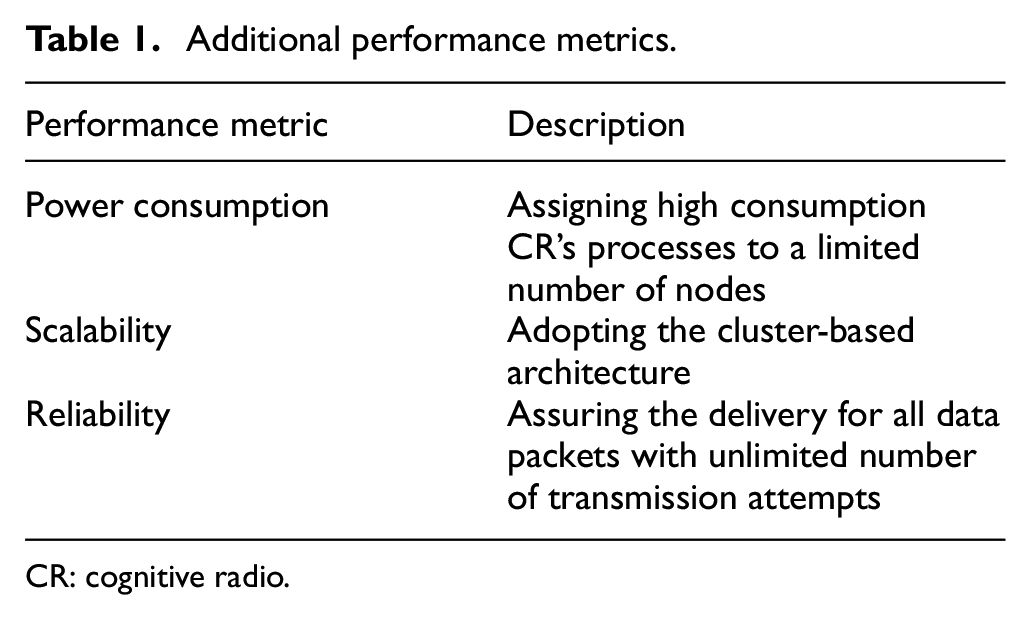
CR: cognitive radio.
Mathematical model
PU behavior
The PU behavior is modeled using a two-state Markov chain to capture the temporal dependency between two consecutive states.29,30 The presence and absence of the PU signal in a channel are represented by the busy and idle states, respectively. The transitions are between adjacent timeslots in the same channel, and they are independent of other channels. Thus, for a channel


Two-state Markovian model for PU behavior.
The probability that the channel is busy in the same timeslot is estimated as

Algorithm model
This study proposes an enhanced
The end-to-end average delay time consists of two parts: the waiting time,

where

where DIFS and SIFS are the distributed and the short inter-frame spaces, respectively. While

where

where

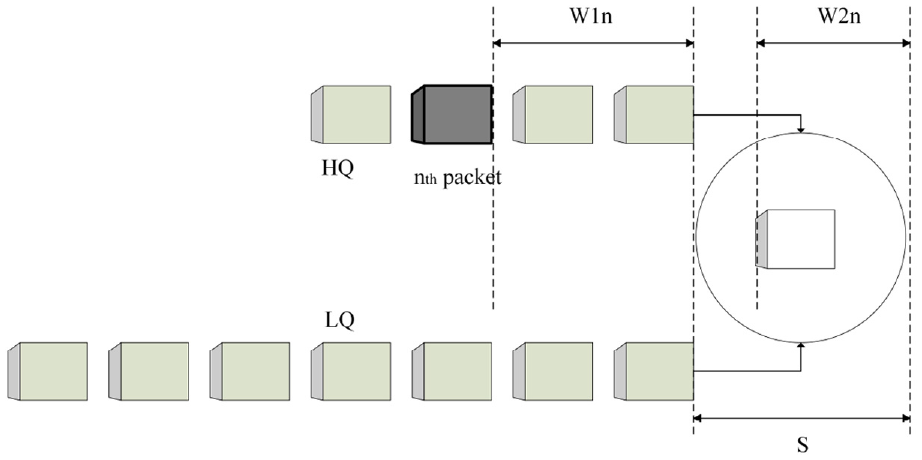
Virtual queues for packets.
The mean observation time can be expressed as


While

where

The arrival of the packets in each virtual queue is assumed to be as a Poisson stream.

where

To maintain the system stability, the occupation rate for the CC channel must be less than one. Similarly, the occupation rate of the data channels after considering the number of utilized channels can be estimated as


It is also assumed that the duty cycle time is 1 s. The mean waiting time for a packet from the HQ is estimated as

where

Using Little’s law and when

This former equation can be rewritten as

where,

Consequently, the mean throughput time, that is, the average delay time, can be estimated as

Considering that the new packet may arrive at any time in an ongoing service with a mean service time,

where

The mean delay time for an NRT packet, that is, belongs to the LQ, can be estimated as


Let

where


Each channel has the same probability of selection among the

The available transmission time equals (

The net transmission time is estimated as

Considering that the probability of a node to submit in a specific idle time is

Regarding the case of the heterogeneous radio environment described in section “Related work,” there are two values for the

where

Within each group, channel selection probability is fair for all channels

Imperfect SS
Perfect sensing was originally assumed; however, imperfect sensing can be included in the model by considering values of
Performance evaluation in heterogeneous radio environment
To evaluate the performance of the iPCMAC, a simulation is performed using MATLAB. The parameters are similar to those defined in IEEE 802.11 MAC and are listed in Table 2. The duty cycle is 1 s.
Simulation parameters.
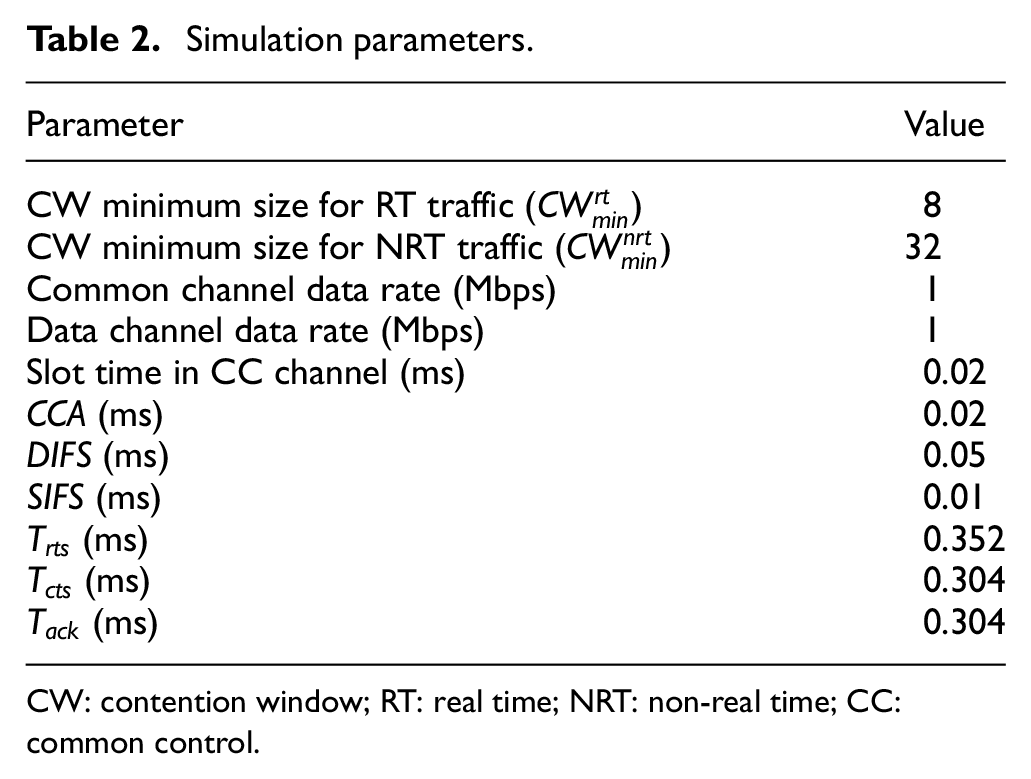
CW: contention window; RT: real time; NRT: non-real time; CC: common control.
Figure 5 describes the relationship between nodes density increase and the induced delay for both RT and NRT packets. This figure also illustrates a performance comparison between the previous protocol designed for the homogeneous radio environment, PCMAC, and the improved version of the protocol designed for the heterogeneous radio environment, iPCMAC. The obtained results indicate that iPCMAC significantly outperforms PCMAC. The average delay of iPCMAC packets is less than that of PCMAC packets, and the delay values start with

iPCMAC delay and a comparison with PCMAC;
Similar to the performance in the PCMAC protocol, the higher priority RT packets exhibit less sensitivity against the exponential behavior than NRT packets in iPCMAC protocol. This is attributed to the impact of assigning a shorter contention window size for the RT traffic, thus giving it the privilege of access to the medium earlier than the NRT traffic.
The relationship between nodes density increase and the induced delay is illustrated in Figure 6. The scenario includes multiple busy times for the G1 group of channels while G2’s busy time is fixed at

Relationship between N and the average delay in case of various values of
Figure 7 shows a comparison between the performance of the proposed iPCMAC, PCMAC,
27
and DOSS
26
protocols in terms of their induced delay. Although the DOSS MAC presents a shorter delay for packets during shorter lengths of busy time, it expands exponentially at longer busy times starting at

Average delay comparison between iPCMAC, PCMAC, and DOSS protocols; M = 10.
The enchantments ensured by the iPCMAC protocol for the system’s throughput are illustrated in Figure 8. The assumed average busy times are

Aggregated throughput relationship with nodes density; M = 7.
The outperformance of iPCMAC protocol is also demonstrated in Figure 9. This figure shows a comparison between iPCMAC and PCMAC protocols in terms of the achievable throughput and the efficiency of channel utilization. The latter measures the ratio between the achieved throughput and the maximum throughput. The utilization ratio of iPCMAC represents the average value of G1 and G2 channels that their idle times are

Relationship between channel utilization ratio and number of channels; N = 10.
Conclusion
Given that data transmission in CR-based networks is performed opportunistically, adopting an efficient resource allocation scheme becomes an essential task, particularly in cases requiring multilevel of QoS. The proposed scheme in this study tackles scheduling and radio channel allocation in a cluster-based CRSN. Our objective is to improve resource allocation for heterogeneous traffic in heterogeneous radio environments and to enable the best resources for the most critical data. RT traffic is intolerant of latency and deserves priority in transmission. Moreover, in emergency cases, transmissions become in burst-nature and require longer transmission times. This paradigm is treated efficiently by the proposed resource allocation scheme and the iPCMAC algorithm. Furthermore, the proposed algorithm offers a chance of utilizing a wider radio spectrum than one using homogeneous environment. Simulation results demonstrate the effectiveness of the proposed protocol, which has been proven to outperform existing ones.
Footnotes
Handling Editor: Daming Zhou
Declaration of conflicting interests
The author(s) declared no potential conflicts of interest with respect to the research, authorship, and/or publication of this article.
Funding
The author(s) received no financial support for the research, authorship, and/or publication of this article.
