




Abstract
The chaotic compound short-range detection system is a new type of short-range detection system, which has strong anti-jamming ability. However, for the deception jamming, the characteristics of the complex short-range detection system are very similar to the detection echo, which poses a serious threat to the detection system. In order to analyze and extract the different characteristics between deceptive jamming and target echo signal, so as to realize the anti-deceptive jamming of chaotic compound short-range detection system, this article analyzes and simulates the mathematical model of deceptive jamming and target echo, and analyzes the bispectral characteristics of the simulated echo and jamming signal, and a set of anti-deception jamming feature parameters has been constructed. The identification of deceptive interference is realized by genetic algorithm–back propagation neural network, and the recognition accuracy is high and the real-time performance is good.
Introduction
Chaotic phase modulation combined with sawtooth-wave frequency modulation short-range detection system is a new type of complex short-range detection system. It has a series of advantages, such as high detection accuracy, high target recognition rate, strong anti-jamming ability, and all-weather work. However, with the development of digital frequency storage technology and high-speed digital signal processing (DSP) chip technology, the real-time performance and adaptive ability of deceptive jamming are getting better and better. The parameters of deceptive jamming can be quickly analyzed according to the echo signal of short-range detection system, and the jamming form can be modulated quickly and the jamming can be transmitted in a short time.1–3 In this case, the conventional anti-jamming measures are mostly ineffective against deceptive jamming, and it is urgent to study new methods and technologies to resist deceptive jamming.
Tao 4 points out the general idea of anti-deception jamming and considers that the premise of anti-deception jamming is to identify whether the radar tracking system is deceived jamming and then take corresponding countermeasures. Therefore, analyzing and extracting the different features between deceptive jamming and target echo, and then identifying and eliminating deceptive jamming false targets, is an effective way for radar to resist deceptive jamming. Yan et al. 5 distinguishes the deception jamming signal from the target echo signal by extracting three kinds of characteristic factors of the signal, but does not recognize the specific deception jamming pattern, generally identifies as “deception jamming” or “target echo signal”; Li et al. 6 analyzed the bispectral features of signals, a support vector machine classifier based on kernel clustering is constructed to identify the specific pattern of deceptive interference signals and analyze the recognition performance. However, the recognition accuracy and real-time performance of the recognition model are still can be further improved. Sun and Tang 7 and Hongchang and Huailin 8 propose to apply atomic decomposition theory to feature extraction of radar deception jamming signals to achieve automatic recognition, but when the noise is relatively low, the recognition effect is not ideal.
Most of the related methods in the above reference are limited to the research on the conventional short-range detection system, and less on the complex short-range detection system, especially the chaotic composite system. Second, these methods cannot solve the problem of high accuracy and real-time performance for deceptive interference recognition, and cannot realize the distinction between different deceptive interference signals. In this article, for the characteristic parameters set of echo and interference, the genetic algorithm is used to optimize the initial weight and threshold of back propagation (BP) neural network. Then, BP algorithm is applied to fine-tune the network in this solution space to search for the optimal solution. Compared with the traditional BP algorithm, this algorithm replaces the random selection of the traditional initial weights, which speeds up the learning speed of the system and improves the approximation ability in the whole learning process.
First, this article expounds the research status of short-range anti-jamming technology and some research methods for short-range anti-jamming technology. The second part expounds the working principle of the chaotic phase modulation composite detection system and derived the accuracy of the distance of this system. In the third part, the bispectral analysis of the echo of chaotic phase modulation composite detection system signal and various deceptive interference signals is deduced and simulated, and the bispectral diagonal slice corresponding to the system echo and three deceptive interference signals is obtained. The four feature quantities of bispectral slice convexity, bispectral slice maximum, bispectral slice mean, and bispectral entropy are proposed as the basis for system echo signals and three deceptive interference signal features. The third part of this article proposes a genetic algorithm–back propagation (GA-BP) neural network algorithm and uses it for the identification of system echo signals and several deceptive interference signals. In the fourth part of this article, 500 sets of system echo signals and deceptive interference signals are classified and simulated by the above methods, and the simulation results are obtained.
Working principle of chaotic phase modulation composite short-range detection system
Radio proximity detection technology uses radio waves to detect targets, mainly through the echo processing of the transmitted radio waves, to obtain the target information, and start at the appropriate time and distance to maximize the lethality of the ammunition. With the development and application of modern electronic technology, radio proximity detection system has evolved from simple to complex, from single systems to complex systems. Compared with the chaotic phase modulation and linear frequency modulation, the composite detection system has obvious advantages in anti-interference.
The chaotic phase modulation combined with sawtooth-wave frequency modulation detection system makes good use of the chaotic “determinacy” and “randomness” to linearly modulate the solid-state source on the basis of chaotic phase modulation. Its principle block diagram is shown in Figure 1.

Block diagram of chaotic phase modulation combined with sawtooth-wave frequency modulation detection system.
Sawtooth-wave generator generates sawtooth-wave signal

The emission signal of detection system.
If the distance between missile and target is R, the system echo is the transmitting signal delay, the delay time

After mixing the echo signal with the local sawtooth LFM signal and filtering the high-frequency components, the output signal is shown in Figure 3


The chaotic code waveform of demodulated.
As the operating range of the short-range detection system is generally several meters to tens of meters, and

Amplified by constant false alarm rate (CFAR)

After the delay, the reference code is

The video signal amplified by CFAR and the delayed reference code act on the correlator together, and the output signal is shown in Figure 4

where
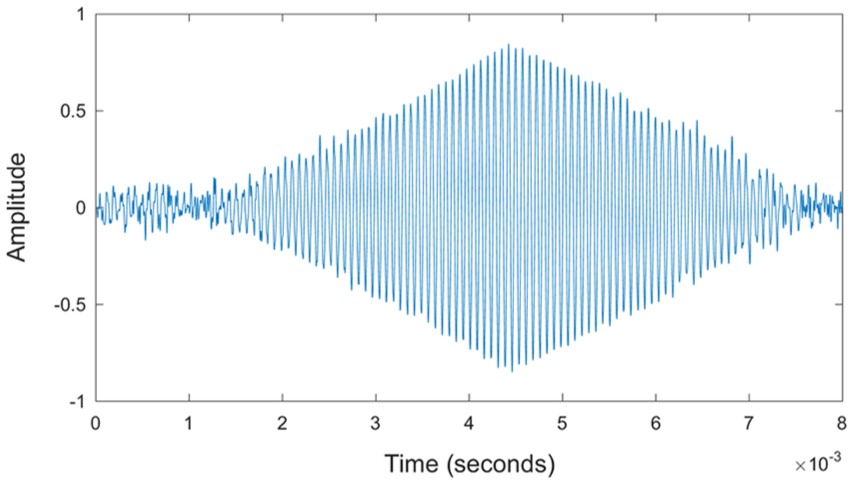
The output waveform of correlation.
Application of bispectral analysis in anti-spoofing interference
According to the definition of the echo signal of the chaotic composite short-range detection system mentioned above, and the definition of deceptive interference and the implementation technology of the current deceptive jammer, the deceptive interference signal can be uniformly expressed as

where

Under constant interference,
Deceptive interference has good real-time performance and adaptive capabilities. Traditional method is difficult to distinguish between deceptive interference and effective echo signals, which has a great impact on the normal operation of short-range detection systems. Bispectral analysis is a further analysis after the third-order cumulant of the signal. It is the generalization and development of the power spectrum. It retains the phase information and amplitude information of the original signal, and it can not only automatically suppress the influence of Gaussian colored noise on the echo signal, but also has good characteristics such as time-shift invariance, scale invariance, phase retention, and time independence.9,10 Therefore, more applications are being applied in the field of signal processing. In this article, the bispectral feature analysis of the detection system echo signals and different types of deceptive interference signals is carried out, and the relevant feature quantities are extracted to realize the identification of deceptive interference.
Bispectral derivation of echo and interference in short-range detection systems
Bispectral is defined as the Fourier transform of the third-order cumulant, that is
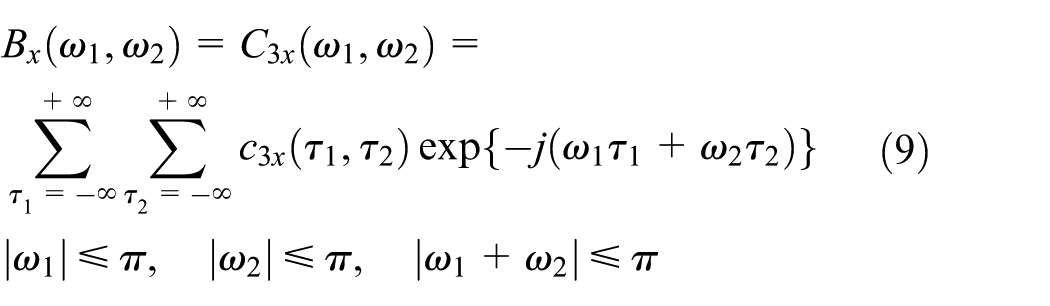
There are many methods for bispectral estimation, such as direct method, indirect method, and complex demodulation method,11,12 and we used the direct method here.
For a finite-length sequence of observations, the Fourier sequence is estimated first and then the triple correlation operation is performed on the sequence to obtain a bispectral estimation. This method is called direct method. Let
Divide the given data into K segments, each segment containing M observation samples, that is, N = KM, and subtract the mean of the segment for each segment of data.
Calculate the discrete Fourier transform (DFT) coefficient

where
Calculate the triple correlation of the DFT coefficients

The bispectral estimate of the given data is given by the average of the bispectral estimates of the K segments, namely

Among them,

where
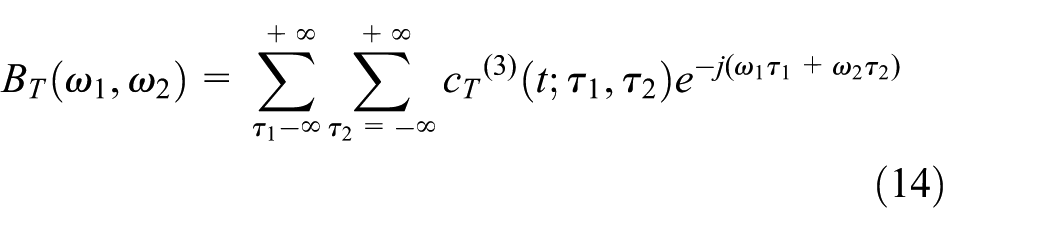
where
When estimating the bispectral, the parameterized bispectral can provide higher resolution and phase information of the signal in the case of shorter data, and the calculation amount is relatively small.13–15 For the analysis of the short-range detection signal, the data are too short to reflect. The characteristics of the detection signal may even cause the loss of important characteristic information; the samples extracted by the detection signal are generally large, so that the important characteristic information can be reflected as much as possible, and the non-parametric bispectral estimation usually used relatively large data. Samples can reduce the estimated variance, but the increase in data brings a large amount of calculation with the rapid increase in the computer speed, and these have not become the main problem; so, non-parametric bispectral estimation was chosen in this article.
The convex feature extraction of bispectral domain
According to equations (4) and (10), the echo signals, angle deception jamming signals, speed deception jamming, and distance deception jamming of chaotic composite detection system are, respectively, bispectral estimation, and three-dimensional map of bispectral estimation is obtained.
Due to the large amount of data in the bispectral analysis, we use the diagonal slice of the bispectral analysis for calculation and analysis. Figures 5–8 show the echo and three deceptive interference bispectral slice extraction maps.

Three-dimensional bispectral of echo.

Three-dimensional bispectral of angle deception.
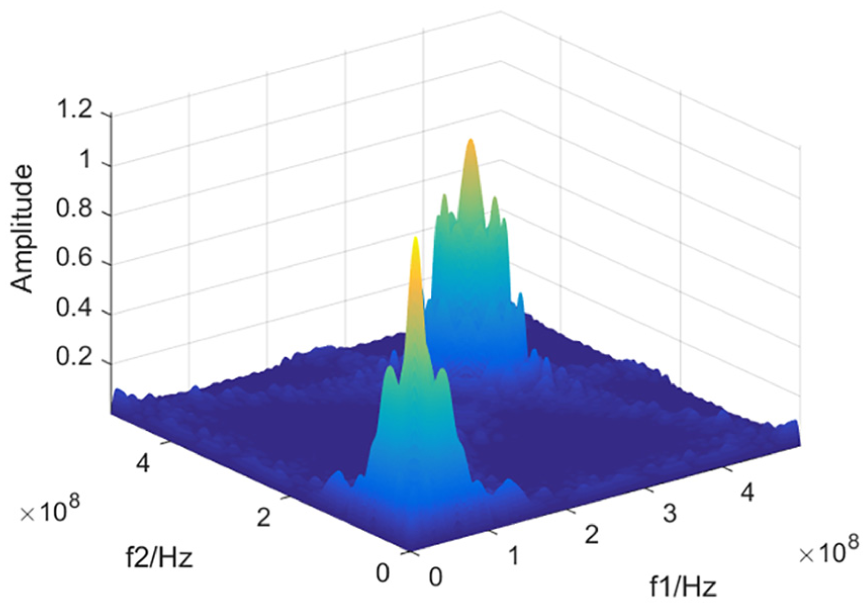
Three-dimensional bispectral of speed deception.

Three-dimensional bispectral of distance deception.
Although the echo signal and the three different deceptive interfering signals are difficult to distinguish in the traditional time-domain and frequency-domain analysis, the distribution in the bispectral domain is quite different. The amplitude of the bispectral slice amplitude of the echo appears convex at a small frequency, and the amplitude value of other regions is basically 0; the bispectral amplitude value of the angle deception interference has obvious dispersibility at the middle frequency of the bispectral slice, whereas in other regions, the average value of the bispectral amplitude is small and approaches 0; the bispectral amplitude value of the velocity deception interference appears convex at two spaced positions in the slice, and the amplitude values of other regions are smaller and relatively stable overall; the distance deception interference is larger in the whole slice area, and the overall fluctuation is more severe (Figures 9–12).

The bispectral slice of echo.

The bispectral slice of angle deception.
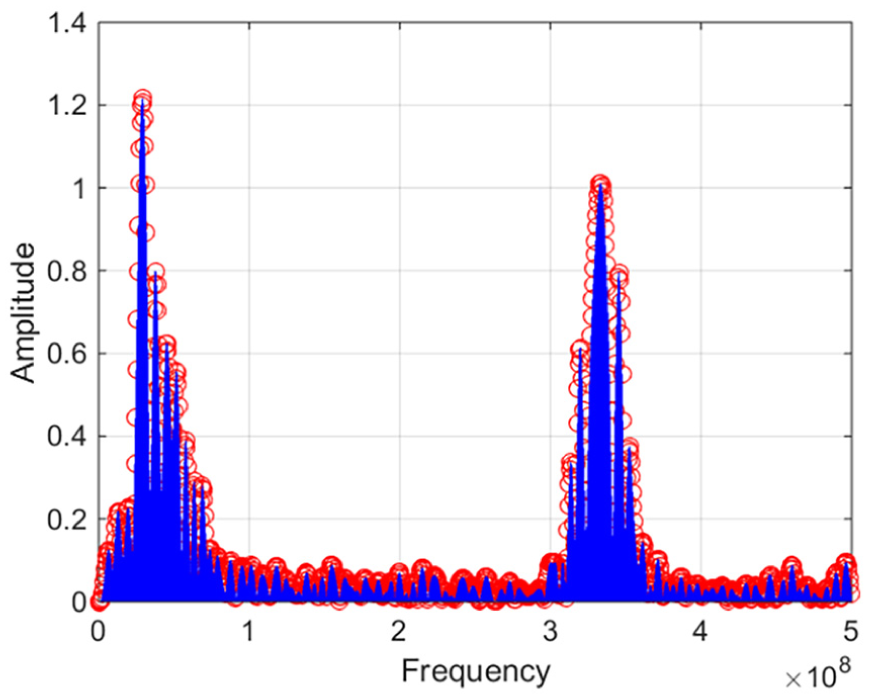
The bispectral slice of speed deception.

The bispectral slice of distance deception.
To further quantitatively analyze the difference between bispectral slices of echo signals and different interfering signals, we extract all peak points of the bispectral slices, as shown in Figures 13–16. Define the convexity of the bispectral slice based on the peak point T

where

The peak point distribution of echo.
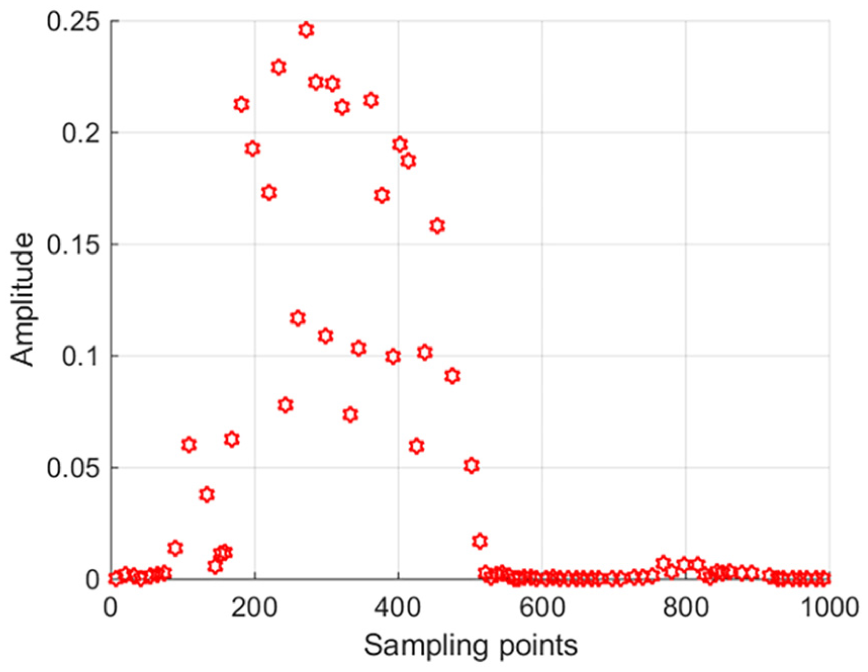
The peak point distribution of angle deception.

The peak point distribution of velocity deception.

The peak point distribution of distance deception.
The feature extraction of bispectral entropy
Shannon entropy, also known as information entropy, is an effective indicator for quantitative evaluation of signal or system state uncertainty. It can be combined with different signal processing methods to achieve signal feature extraction in different transform spaces. Its definition is as follows: let a random variable

The more concentrated the energy of the signal, the smaller the Shannon entropy value. The spectrum slice peak value of the echo signal and the deceptive interference signal is

Substituting equation (17) into
The feature parameter set {T, M, A, E} is constructed using the bispectral domain feature convexity T, the bispectral slice maximum value M, the bispectral slice peak mean A, and the bispectral slice amplitude entropy E as the feature factors. The feature vector space is obtained, which in turn identifies fraudulent interference.
Figures 17–20 show the values of the echo and the three different deceptive interference signals in the parameter set. It can be seen from the figure that when the relevant parameters are certain, there are obvious differences between the parameters of the echo and the three types of deceptive interference signals, and the identification of echo and interference can be realized according to this parameter set.

The bispectral convexity of different signals.

The bispectral maximum of different signals.
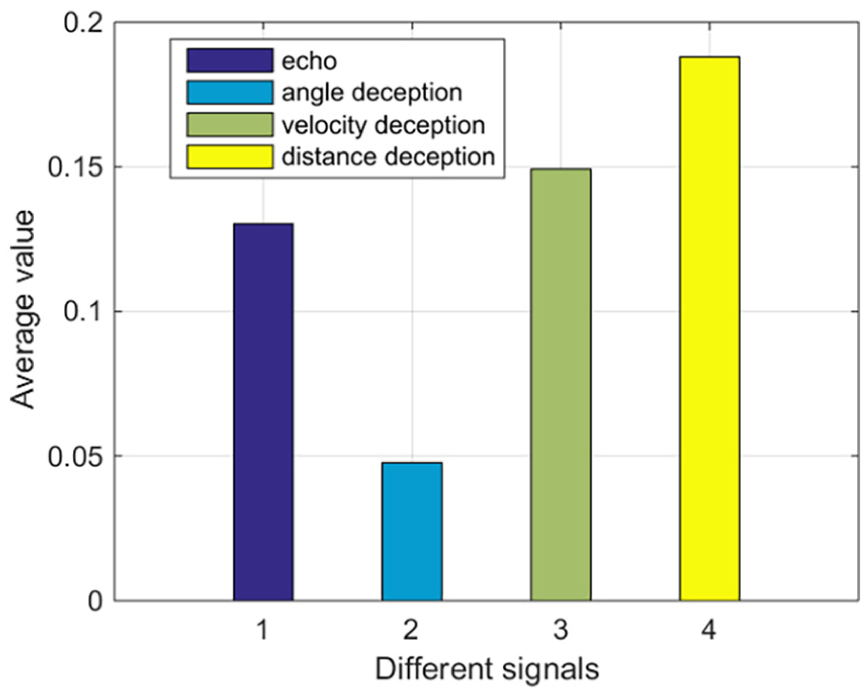
The bispectral mean of different signals.

The bispectral entropy of different signals.
The parameter set {T, M, A, E} is a feature extracted from the diagonal slice of the signal by bispectral transformation. The calculation amount is small and the feature dimension is low, and the echo can be reflected accurately and quickly. Several inherently subtle differences in the form of deceptive interference signals have a high degree of discrimination.
GA-BP classifier design
After the feature parameter set is established, the appropriate classifier is selected to classify the signals to identify specific deceptive interference signals.
In view of the fact that genetic algorithm is a probabilistic adaptive iterative optimization process, it has good global search performance and is not easy to fall into local minimum. Even if the defined fitness function is discontinuous and irregular, it can also find the overall optimal solution with great probability and is suitable for parallel processing. The search does not depend on the characteristics of gradient information and can be used to optimize BP neural network.16–18 The genetic algorithm is used to optimize the initial weight threshold of BP neural network and search in a large range instead of the random selection of general initial weights. Then, BP algorithm is used to fine-tune the network in this solution space to search for the optimal solution or approximate optimal solution. This not only complements the advantages of the two but also exerts the extensive nonlinear mapping ability of the neural network and the global search ability of the genetic algorithm, and it speeded up the network learning speed and improved the approximation and generalization abilities in the whole learning process. Therefore, the article constructs a GA-BP neural network to realize the classification of system echo signals and deceptive interference signals.
GA-BP neural network is a multi-layer feedforward neural network based on genetic algorithm. It has good nonlinear approximation ability, self-adaptive ability, robustness, and fault tolerance. Moreover, it can optimize the weight and threshold of BP neural network using the characteristics of global search ability of genetic algorithm. The deceptive interference pattern classification algorithm of GA-BP neural network includes two parts: BP neural network part and genetic algorithm optimization part. The algorithm flow19–21 is shown in Figure 21.

The flow of GA-BP algorithm.
The mathematical expression of the GA-BP algorithm is

Interference recognition
The deception jamming pattern recognition model is shown in Figure 22.

Recognition model.
In the experiment, the method of generating 500 sets of simulation data is as follows: keep the chaotic sequence generation mode unchanged, uniformly change the parameters of the echo signal and the interference signal, and sample 1000 sets of data. Then, 500 sets were randomly extracted from the samples as experiments. This not only ensures the uniform coverage of the relevant parameters but also guarantees certain randomness.
The simulation generates 500 sets of echo signals and three kinds of characteristic signals of deceptive interference signals, from which 300 sets of data are randomly selected as the training data for training the network, and the remaining 200 sets of data are used as test data to test the network classification ability.
After simulation, the recognition rate of echo reached 95.2%, and the recognition rate of three different deceptive interference signals reached 92.3%, 94.5%, and 93.2%, and since the training process is completed in the early stage, the actual recognition process is short and the real-time performance is good (Table 1).
The recognition rates of echo and three deceptive interference signals.

Conclusion
First, the chaotic phase modulation sawtooth-wave frequency modulation composite short-range detection system has been introduced and analyzed, which proved that the detection system has strong distance–distance capability. Then, for the echo signals and three different deceptive interference signals of the detection system, this article proposes a method of bispectral analysis to analyze the bispectral slices of various signals, and four parameters of convexity, bispectral maximum, bispectral mean, and bispectral entropy have been proposed. With these four parameters, the GA-BP neural network has been used to realize the identification of echo signals and deceptive interference, and different deceptive interference signals are also been realized. This identification method has high accuracy and good real-time performance.
The traditional methods of interference recognition mostly focus on the analysis of the signal itself and the signal spectrum. It is not possible to better exploit the deep features of the signal. When the signal is more complex or the similarity is higher, the traditional method is difficult to achieve classification and recognition. In this article, a bispectral analysis method is proposed to extract the characteristic parameters of echo and interference signals for signal identification. This method utilizes the theory of signal spectrum analysis to better exploit the deep features of the signal and facilitate classification and identification between different signals. For the characteristic parameters proposed in this article, we adopt a BP algorithm based on genetic algorithm. This algorithm optimizes the threshold of BP network by genetic algorithm. Compared with traditional neural network algorithm, the classification recognition is higher.
Footnotes
Acknowledgements
The authors thank anonymous reviewers for their valuable comments and suggestions which lead to substantial improvements of this paper.
Handling Editor: Daming Zhou
Declaration of conflicting interests
The author(s) declared no potential conflicts of interest with respect to the research, authorship, and/or publication of this article.
Funding
The author(s) disclosed receipt of the following financial support for the research, authorship, and/or publication of this article: This research was partially supported by the Natural Science Foundation of Jiangsu Province (no. BK20160848) and Fundamental Research Funds for the Central Universities (no. 30917011315).
