




Abstract
A valid aggregation operator can reflect the decision result more clearly and make the decision effect more correctly. In this article, a linguistic neutrosophic multiset is first proposed to handle the multiplicity information, which is an expanding of neutrosophic multiset. Two Heronian mean operators are proposed to aggregate the linguistic neutrosophic multiset, one is a linguistic neutrosophic multiplicity number generalized-weighted Heronian mean operator, the other is a linguistic neutrosophic multiplicity number improved-generalized-weighted Heronian mean operator, and then their properties are discussed. Furthermore, two decision-making methods are introduced based on linguistic neutrosophic multiplicity number generalized-weighted Heronian mean or linguistic neutrosophic multiplicity number improved-generalized-weighted Heronian mean operators under linguistic neutrosophic multiplicity number environment. Finally, an illustrative example is used to indicate the practicality and validity of these two methods.
Keywords
Introduction
As an important branch of modern decision theory, theories and methods of multi-attribute decision-making are widely used in economy, management, military, engineering, and so on. One of the core issues of the multi-attribute decision-making method is how to aggregate the attribute values of individual attributes (the use of aggregation operators). A valid aggregation operator can reflect the decision result more clearly and make the decision effect more correctly. For the importance of aggregation operator in multiple attribute decision-making, many scholars have done many studies on them, including a variety of information aggregation operators and their properties, etc. According to the decision-making information environment, aggregation operators can be probably divided into the following categories: real aggregation operator; interval number aggregation operator; fuzzy aggregation operator; intuitionistic fuzzy aggregation operator; neutrosophic aggregation operator; language aggregation operator, and so on. The real number aggregation operator is applicable to the decision environment with the real attribute values, and which is the most basic information aggregation operator. Other types of aggregation operators are generally derived by extending the real number aggregation operators. Common kinds of real aggregation operators: Yager 1 proposed an ordered weighted average (OWA) operator. Chiclana et al. 2 and Xu and Da 3 proposed the ordered-weighted-geometric (OWG) operator. Chen et al. 4 proposed the ordered-weighted harmonic averaging (OWHA) operator. Yager 5 merged the generalized averaging and the OWA operator together and defined the generalized-ordered-weighted averaging (GOWA) operator. Bonferroni 6 proposed the Bonferroni mean (BM) operator; then, Zhou and He 7 proposed the normalized weighted Bonferroni mean (NWBM) operator. The generalized-weighted-Heronian-mean (GWHM) operator was proposed by Yu and Wu 8 Common kinds of interval number aggregation operators: uncertain ordered weighted average (UOWA) operator and uncertain ordered-weighted-geometric (UOWG) operator,9,10 uncertain Bonferroni mean (UBM) operator and interval Heronian mean (IHM) operator;11,12 Common kinds of fuzzy aggregation operators: fuzzy ordered weighted average (FOWA) operator, 13 fuzzy ordered-weighted-geometric (FOWG) operator, 14 trapezoidal fuzzy ordered weighted average (TFOWA) operator, 15 trapezoidal fuzzy Bonferroni mean (TFBM) operator; 16 common kinds of intuitionistic fuzzy aggregation operators: intuitionistic fuzzy ordered weighted average (IFOWA) operator, 17 intuitionistic ordered-weighted-geometric (IFOWG) operator, 18 intuitionistic fuzzy Bonferroni mean (IFBM) operator; 19 common kinds of neutrosophic aggregation operators: interval neutrosophic prioritized ordered weighted average (INPOWA) operator, 20 neutrosophic Bonferroni mean (NBM) operator, 21 and neutrosophic Heronian mean (NHM) operator; 22 common kinds of language aggregation operators: linguistic ordered weighted average (LOWA) operator, 23 extended ordered weighted average (EOWA) operator, and extended ordered-weighted-geometric (EOWG) operator, 24 induced uncertain linguistic ordered weighted average (IULOWA) operator. 25 Then, these language aggregation operators were merged with different information, such as intuitionistic uncertain linguistic Heronian mean (IULHM) operator, 26 neutrosophic linguistic number weighted arithmetic average (NLNWAA) and neutrosophic linguistic number weighted geometric average (NLNWGA) operators, 27 linguistic neutrosophic number weighted arithmetic averaging (LNNWAA) operator and an linguistic neutrosophic weighted geometric averaging (LNNWGA) operator, 28 interval neutrosophic linguistic numbers Heronian mean (INLNHM) operator, 29 linguistic neutrosophic number Bonferroni mean (LNNBM) operator, and so on; 30 the neutrosophic uncertain linguistic number improved generalized weighted Heronian mean (NULNIGWHM) operator and the neutrosophic uncertain linguistic number improved generalized geometric weighted Heronian mean (NULNIGGWHM) operator. 31
In this article, we first introduce a linguistic neutrosophic multiset (LNM), which is an expanding of neutrosophic multiset (NM) proposed by Smarandache. 32 An LNM can use pure linguistic to express and deal with the multiplicity information while other neutrosophic sets cannot do it. Compared to linguistic fuzzy multiset and linguistic intutionistic fuzzy multiset, LNM can use three values to express truth, indeterminacy, and falsity, respectively, while the other two multisets cannot do this. Next, we define linguistic neutrosophic multiplicity number generalized-weighted Heronian mean (LNMNGWHM) operator and linguistic neutrosophic multiplicity number improved-generalized-weighted Heronian mean (LNMNIGWHM) operator and discuss the properties of them. In the literature, Fan et al. 33 defined a single value neutrosophic multiset (SVNM) and utilized the weighted cosine measure in SVNM environment. In the literature, Ye 34 defined a dynamic single valued neutrosophic multiset (DSVNM) and utilized the weighted correlation coefficient of DSVNMs. Compared with the literature,33,34 on one hand, the LNMNGWHM and LNMNIGWHM operators can express the pure linguistic values; then it is very suitable for handling the linguistic information; on the other hand, Heronian mean operator can embody the interaction between attributes and not repeatedly consider the relationship between each attribute and the others. Compared with the literatures,22,26–31 the LNMNGWHM and LNMNIGWHM operators can handle the multiplicity problems while other neutrosophic sets in the literatures,22,26–31 cannot deal with them.
The other sections are as follows. The concepts of LNN, GWHM, IGWHM, and NM are described in section “Some basic concepts.” An LNM is proposed in section “LNM.” The LNMNGWHM and LNMNIGWHM operators are proposed in section “GWHM and IGWHM operators of LNMNs.” Multi attributes decision-making (MADM) methods using the LNMNGWHM and LNMNIGWHM operators are proposed in section “Using LNMNGWHM or LNMNIGWHM operator for MADM methods.” Two proposed methods are used in section “Illustrative examples” to deal with an illustrative example. Conclusions and future expectations are given in section “Conclusion.”
Some basic concepts
Linguistic neutrosophic sets
Definition 1
Set a universe

in which
For convenient expression, a basic element
Definition 2
There are three LNNs



Definition 3
There is an LNN


Definition 4
Set
If
If
If
If
GWHM operator and IGWHM operator
Definition 5
Let d, f ⩾ 0, and d, f do not equal 0 at the same time,

then we call GWHM as a generalized weighted Heronian mean (GWHM) operator.
For GWHM has no idempotence property, in order to compensate for this deficiency, the IGWHM operator is proposed.
Definition 6
Set d, f ⩾ 0, and d, f do not equal 0 at the same time,

where
NM
Definition 7
Set a universe

LNM
Definition 8
Set a universe

where
For convenience, we simplify an LNM Q as follows

For example, an LNM Q is given as

Then


Definition 9
Set a universe


Then they have the following relations:
For convenience, a basic element can be expressed using a linguistic neutrosophic multiplicity number (LNMN)
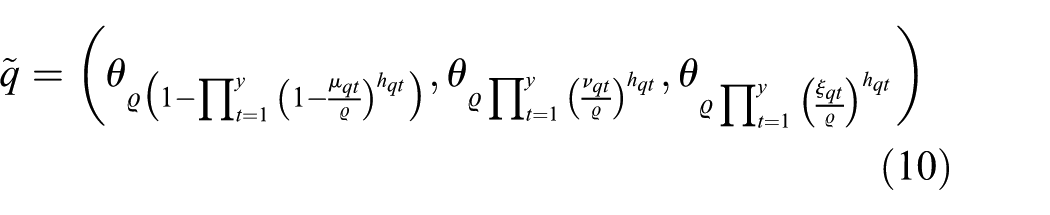
Definition 10
Set
Proof
Set elements
According with the operational rules of LNNs, while t = 1, 2, we can get


Then
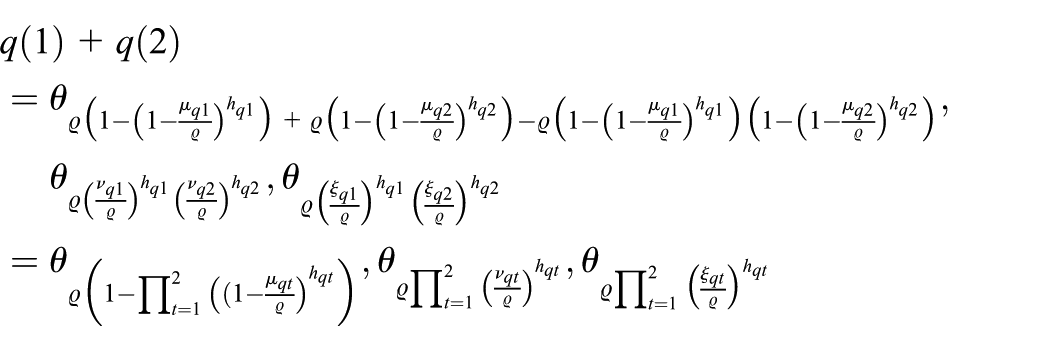
When t = i, we suppose equation (10) is established, then

can be gotten.
Next

The result according to equation (10) while t = i + 1, and then we can obtain that the result of aggregation is also true according to the mathematical induction.
Definition 11
Set




GWHM and IGWHM operators of LNMNs
LNMNGWHM
Definition 12
Let d, f ⩾ 0, and d, f do not equal 0 at the same time, a collection

where
Using Definitions 2, 10, and 12, the following theorem can be gotten.
Theorem 1
Set a collection

where





and



and

Proof
Using equation (10), a LNMN

This proves Theorem 1.
Improved generalized weighted HM operators of LNMNs
Definition 13
Let d, f ⩾ 0, and d, f do not equal 0 at the same time, a collection

where
Using Definitions 2, 10, and 13, Theorem 2 can be gotten as follows.
Theorem 2
Set a collection

where


and


and

We can use the proof of Theorem 1 to prove Theorem 2, so we omit it.
Theorem 3 (idempotency)
Set a collection

Proof
Since qi = q (i = 1, 2,…, n), we can get

This proves Theorem 3.
Theorem 4 (monotonicity)
Set

Proof
Using equation (10), LNMN


Because


Similarly


And


So,
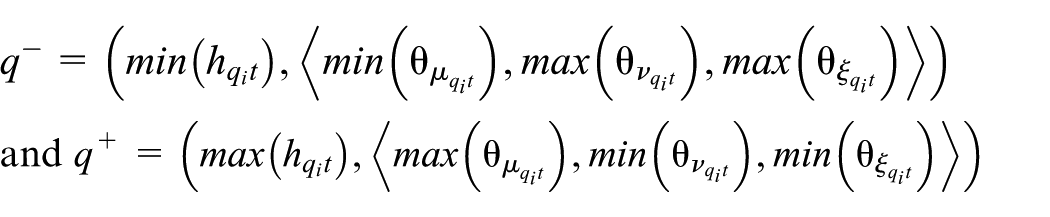
Theorem 5 (boundedness)
Set a collection
then

Proof
Based on Theorems 3 and 4, we can obtain


Then
The proof of Theorem 5 is completed.
Using LNMNGWHM or LNMNIGWHM operator for MADM methods
Here, the MADM method is studied based on LNMNGWHM or LNNIGWHM operator. Set a set of alternatives
Step 1: Using a LNM
Step 2: With LNMNGWHM or LNMNIGWHM operator, we can calculate
Step 3: Calculate O(tr) (C(tr) if necessary) according to formula (5) (formula (6) if necessary).
Step 4: The alternatives can be ranked with the value O(tr) (value C(tr) if necessary).
Step 5: End.
Illustrative examples
Now there is an illustrative example adapted from the literature.
33
A man wants to buy a car from four kinds
LNMN decision matrix.
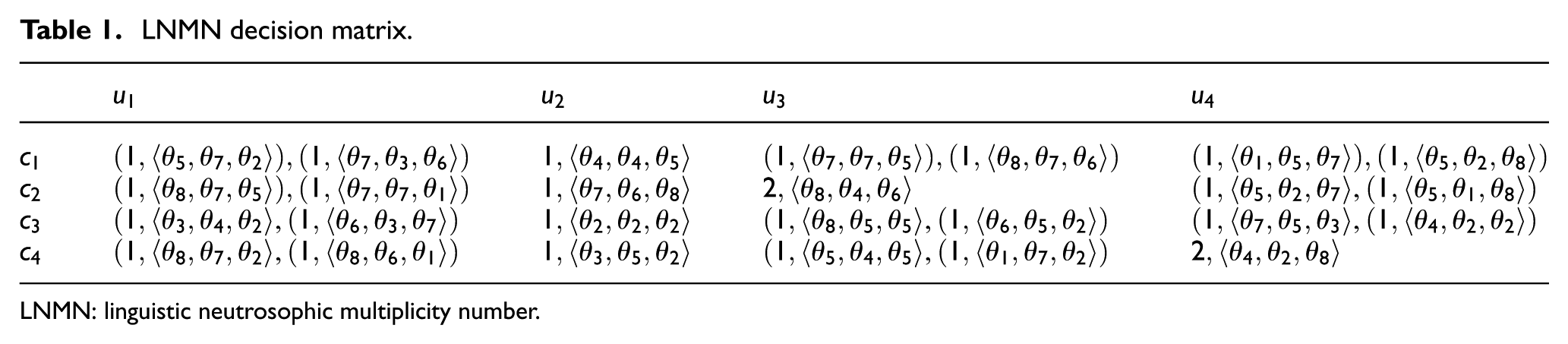
LNMN: linguistic neutrosophic multiplicity number.
Next, the LNMNGWHM operator or LNMNIGWHM operator is used to aggregate the LNMNs.
LNMNGWHM or LNMNIGWHM operator for decision-making process
Step 1: Using LNMNGWHM operator to aggregate the LNMNs (suppose d = f = 1), we can obtain the comprehensive evaluation values


Step 2: Calculate the score value O(cr) according to equation (5) for
Step 3: According to the score value O(cr)
Step 4: End.
Now, the LNMNIGWHM operator (suppose d = f = 1) is used to handle it.
Step 1: Using LNMNIGWHM operator to aggregate the LNMNs (suppose d = f = 1), we can obtain the comprehensive evaluation values


Step 2: Calculate the score value O(cr) according to equation (5) for
Step 3: According to the score value O(cr)
Step 4: End.
Set d and f with different values
Different parameters d and f may have distinct effects on the decision results. In this section, the paper will set d and f with different values and the ranking results can be seen in Tables 2 and 3.
The results with different values d and f based on LNMNGWHM.

LNMNGWHM: linguistic neutrosophic multiplicity number generalized-weighted Heronian mean.
The result with different values d and f based on LNMNIGWHM.

LNMNIGWHM: linguistic neutrosophic multiplicity number improved-generalized-weighted Heronian mean.
The data in Tables 2 and 3 indicate that the ranking results are almost the same when d and f are taken different values. If either d or f equals zero, these two proposed operators cannot gain the interrelationships of individual arguments; therefore, the values of parameters d and f are usually set as d = f = 1.
Comparative analysis
Now, we use the method proposed in the literature 28 for LNM

Its proof is similar to the literature, 28 so we omit it.
Step 1: Using LNMNWAA operator to aggregate the LNMNs, we can obtain the comprehensive evaluation values


Step 2: Calculate the score value O(cr) according to equation (5) for
Step 3: According to the score value O(cr)
Step 4: End.
Compared with the operators of literature, 28 LNMNGWHM and LNMNIGWHM operators can express and handle the multiplicity problems. Compared with the operators of the literature, 33 LNMNGWHM and LNMNIGWHM operators can not only express the pure linguistic values, but also can get more complicated results through considering the interrelationships and prioritizations of the attributes. However, they make the result more practical.
Conclusion
This article proposed the LNMNGWHM and LNMNIGWHM operators for LNMNs. First, we introduced an LNM using pure linguistic value to express the multiplicity information, proposed LNMNGWHM operator and LNMNIGWHM operator, and discussed their related properties. Second, we proposed two methods of MADM based on LNMNGWHM operator and LNMNIGWHM operator in LNMN environment, and the main advantage of these two methods is using pure linguistic values to express and handle the multiplicity problems. Finally, we used these two methods to solve the practical problem and took the different values of d and f to analyze the ranking results. Results demonstrated that whatever values d and f were taken, ranking results were the same, so d and f made little influence on ranking results. Furthermore, we compared these two proposed methods with literature28,33 and found that their results were consistent. Therefore, the proposed methods can make the decision-making results more reliable, and they are practical in real-life situations. In the future, we will make greater efforts to study linguistic NM and apply it to many other fields, such as strategic planning, big data analysis, e-government website evaluation, analytic hierarchy process, smart city.36–42
Footnotes
Handling Editor: Antonino Staiano
Author contributions
C.F. and K.H. originally proposed the LNMNGWHM and LNNIGWHM operators and investigated their properties; E.F., S.F., and J.Y. provided the calculation and analyzed the data; C.F. wrote the paper.
Declaration of conflicting interests
The author(s) declared no potential conflicts of interest with respect to the research, authorship, and/or publication of this article.
Funding
The author(s) disclosed receipt of the following financial support for the research, authorship, and/or publication of this article: This research was funded by the National Natural Science Foundation of China grant number (61603258), (61703280); General Research Project of Zhejiang Provincial Department of Education grant number (Y201839944); Public Welfare Technology Research Project of Zhejiang Province grant number (LGG19F020007); Public Welfare Technology Application Research Project of Shaoxing City grant number (2018C10013).
