




Abstract
With the development of science and technology, the interactions among scientific research teams become more and more frequent, and their relationship and behavior become more and more complex. Many researches mainly adopt complex network to analyze, but these researches only consider some aspects of scientific research factors, so lack of comprehensive consideration. From the aspect of ability, resource, activity, and familiarity, scientific research factors are quantified based on multi-source data of scientific and technological big data, and some factors of text information are similarly quantified. Based on paper citation and project cooperation, a complex network which takes scientific research team as node is constructed and is weighted by quantification of scientific research factor. The experiment of influence spread is carried out by the comparison of unweighted network and weighted network, the comparison of single node and multiple nodes, and the comparison of influence spread and other index. The results show that the scientific research factor is closely related to the influence spread; the proposed scientific research factor quantification improves the analysis of scientific research team relationship. The relationship between influence spread and the number of related communities is greater than the number of adjacent nodes. In addition, the influence spread can effectively reflect the importance of scientific research team.
Introduction
With the development of science and technology, scientific research cooperation becomes frequent among any subject such as person or team, so that their behavior and relationship become more and more complex. Early, the measurement method is used for analyzing the scientific research,1,2 later with the rise of complex network theory; the characteristics of complex network are used to analyze based on complex network established by scientific research information, such as the citation network, the co-author network, and so on.3–6 With research paper in the field of physics, biomedicine, and computer science, a cooperation network is constructed for analyzing characteristics and structure, and a cooperation intensity measurement is further put forward based on co-authored article and co-author number.7,8 The topological structure of cooperation network is analyzed from the perspective of centrality, and four centrality measurements are proposed. 9 The independent cascade model is introduced to solve the influence of user based on expectation–maximization (EM) algorithm.10,11 The most influential and minimal set is explored by the optimal seepage mean of random network. 12 A two-valued relationship model is proposed based on the single fault proportional risk model, and used to discuss the relationship between influence and given relationship.13,14 An iterative algorithm for estimating the infection rate in the transmission process is proposed based on the susceptible infected recovered model (SIR), and the spread coverage is predicted with the average field theory.15–17 An user influence and passivity measurement algorithm is proposed by integrating user’s own popularity and activity, and their friends’ passivity.18,19 The degree centrality of node is represented as the importance of node-based local characteristics of network. 20 An importance evaluation algorithm is given by merging local topology structure and degree of node to solve network global information acquisition problem.21,22 A node influence measurement algorithm is proposed with k-shell value and the number of communities of node. 23
For these researches, the complex network is established based on one or more scientific research factors, such as research paper, so lack of comprehensive consideration. In this article, primary scientific research factors are considered and quantified from four aspects, ability, resource, activity, and familiarity, and some factors of text information are quantified based on text similarity. Based on paper citation and project cooperation, a scientific research team relationship is constructed as complex network, which takes scientific research team as node and weights edge by quantification of scientific research factor. From two aspects of community and importance, scientific research teams’ influence spread is comparatively analyzed.
Quantification of scientific research team relationship
In recent years, some researches take advantage of the rules and laws of physics to study the relationship between nodes in complex networks.24,25 By using the above method, the behavioral interaction among scientific research teams is analyzed based on complex network, which takes the scientific research team as node. 26 In actual scientific research activities, the occurrence of their behavioral interaction is often caused by mutual attractions between both sides, but the attraction of one side is different than the others, for example, a scientific research team has many scientific and technological resources, so its attraction to the others is large, and the attraction of other scientific research team which has few resources is small. By establishing the force model, the attraction between scientific research teams is quantified. The larger the quantification value of their mutual attraction is, the closer is the relationship of two scientific research teams, and so their behavioral interaction is frequent. When one team needs scientific research cooperation, the request may be sent to some teams which are close to it and have larger quantification value.
Attribute dimension of scientific research factor
The relationship between scientific research teams is affected by multiple aspects, such as subject, research field, research direction, organization, staff, territory, instrument and equipment, fund, project, paper, patent, composition, conference, and so on [5]. This article analyzes these aspects from four aspects: activity, ability, resource, and familiarity. These aspects of scientific research teams’ relationship are defined as follows.
Ability
Ability refers to the level of team’s scientific research behavior. The stronger the one scientific research team’s ability is, the more possible the interaction happens when it receives a collaboration request. Ability includes responsiveness.
Resource
Resource refers to the number and variety of team’s scientific research, which can be shared by the other teams. The more the number and variety of resources have one scientific research team, the more possible it provides resource what the other teams need. The scientific research team, which has less number and variety of resources, only occasionally interacts with other teams.
Activity
Activity refers to the frequency of team’s scientific research behavior. The more active the one scientific research team is, the more is the interaction of it with other teams. The scientific research team, which has low activity, only occasionally interacts with other teams. Activity is divided into three parameters: interaction frequency, interaction time, and recent interaction time. The influence of each parameter on the Activity is expressed as

where m and n represent scientific research teams, and k=1, 2, 3 represent, respectively, the frequency, time, and recent time of interaction. Ak(m, n) represents the interaction between scientific research teams m and n, and Ak(m) represents all interaction of scientific research team m’s interaction.
Familiarity
Familiarity refers to the interactions between one team and other teams. The higher the familiarity between two scientific research teams is, the more possible the interaction happens for them. The familiarity of team m and n is expressed as

where friendsetm is the set of team m’s friend.
Quantification of descriptive factor’s text similarity
Some factors mentioned above belong to text information, such as keyword.
16
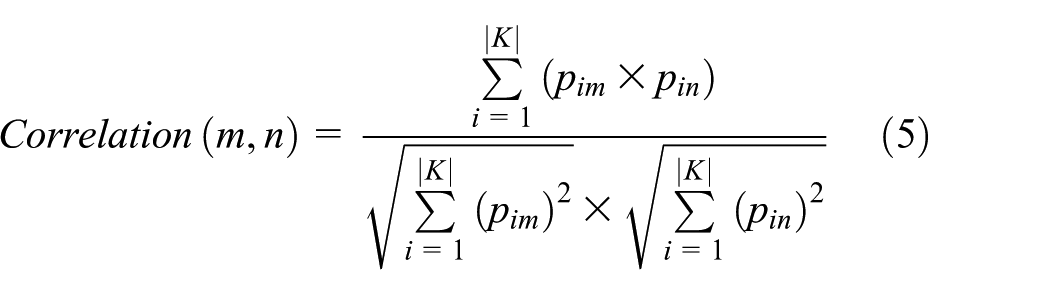
The text information is quantified from two aspects, one is importance of keyword for scientific research team, and the other is correlation of scientific research team by keyword. The set of scientific research teams is expressed as

where wim refers to the number of keywords ki used for scientific research team m, and idfim refers to the proportion of the number of keywords ki used in the number of all keywords, which is calculated as

By the importance of keywords for scientific research teams, the matrix of scientific research team and keyword is established, such as
Quantification of attraction between scientific research teams
From the perspective of physics, the interaction between scientific research teams is the effect of force between nodes. Inspired by the idea of information fusion,27–29 in this article, the relationship between scientific research teams is described as their mutual attractions, which is quantified by these scientific research factors mentioned above and is expressed in equation (3)

Scientific research team relationship network model
With the proposed quantification of scientific research factor, scientific research team relationship network is established as a weighted network, which weights edge based on an unweighted network. The unweighted network takes scientific research team as node and takes the relationship of paper citation and project cooperation as edge.
Community of scientific research team
In scientific research team relationship network, the influence of node refers to not only its adjacent nodes but also its communities, 21 so scientific research team relationship network is divided into communities, which are as follows.
The edge betweenness is calculated based on the unweighted network of scientific research team relationship network. With dividing the above betweenness by weight of scientific research team relationship network’s edge, new weight of edge is calculated and the max weight edge is deleted from the network.
Steps 1 and 2 are repeated until the network does not have any edge. Through the above steps, the division of scientific research team relationship network into some communities is not optimal, so the network modularity is used as the threshold of community division, so as to find the optimal division.
Suppose the number of nodes and edges of scientific research team relationship network are n and m, respectively; adjacency matrix is

Based on the above optimal community division, the evaluation of communities’ number and size connected with node m is calculated as

where Num(m,C) is the number of communities connected with node m, and C is the community set of node.
Importance of scientific research team based on network community
For scientific research team relation network, the importance of scientific research team, which can be expressed as the degree of intimacy between the node and the surrounding nodes, 14 is considered from two aspects:
The sum of forces between node and adjacent nodes can be quantified by attractions.
The node betweenness is the proportion of the shortest paths passing through node v in all shortest paths

where
The importance of scientific research team is calculated as

Influence spread of scientific research team
The influence of scientific research team is simulated based on susceptible infected susceptible (SIS) model. SIS model set susceptible infected status and infected status for node. 9 At time t, the number of nodes N = S(t) + I(t), where S(t) and I(t) are the number of susceptible infected nodes and infected nodes. For the weighted network of scientific research team relationship, the probability of node j influenced by node i is calculated as

where wij is the weight of edge from node i to node j, which is set as attraction. The probability of susceptible infected nodes’ infection is calculated as

where Nj(t) is the adjacent node set of infected node j at time t.
Analysis of scientific research team relationship
Analysis of scientific research team relationship network
The scientific research team relationship network is constructed by more than 300 scientific research teams.
For the constructed network, the degree distribution of nodes is consistent with non-uniformity and diversity, as shown in Figure 1.

The degree distribution of node in scientific research team relationship network.
The parameters of two different networks, which are the unweighted network–based paper citation and project cooperation and the weighted network based on quantification of scientific research factor, are shown in Table 1. N is the number of nodes, m is the number of edges, Q is the modularity of optimal network division, G is the number of communities for optimal network division,
The characteristics of unweighted network and weighted network.

For unweighted network and weighted network, the number of communities G, the size of the smallest community

The community size of unweighted network and weighted network.
Analysis of scientific research teams’ influence spread
From three aspects of unweighted network and weighted network, single node and multiple nodes, and influence spread and other index, scientific research teams’ influence spread is analyzed based on SIS model.
Analysis of single scientific research teams’ influence spread
A single team is selected as initial spread source, defines function F(t) as the number of teams influenced by the initial team at time t. For unweighted network, the probability of influence spread is randomly generated. For weighted network, the probability of influence spread is the normalized weight of edge. The threshold of influence spread
The difference of influence spread’s probability distribution for unweighted network and weighted network is shown in Figure 3. In the figure, the influence spread’s probability of unweighted network distribution is 0.4 to 0.6, and the influence spread’s probability of weighted network distribution is 0.1 to 0.4.

The distribution of influence spread’s probability for unweighted network and weighted network.
The spread of one scientific research team’s influence is shown in Figure 4. In the figure, the coverage area of unweighted network is higher than weighted network, but the spread speed of unweighted network is lower than weighted network. This is because the probability of influence spread is fixed based on the normalized weight of edge for weighted network, and many nodes’ probability is larger than 0.5.
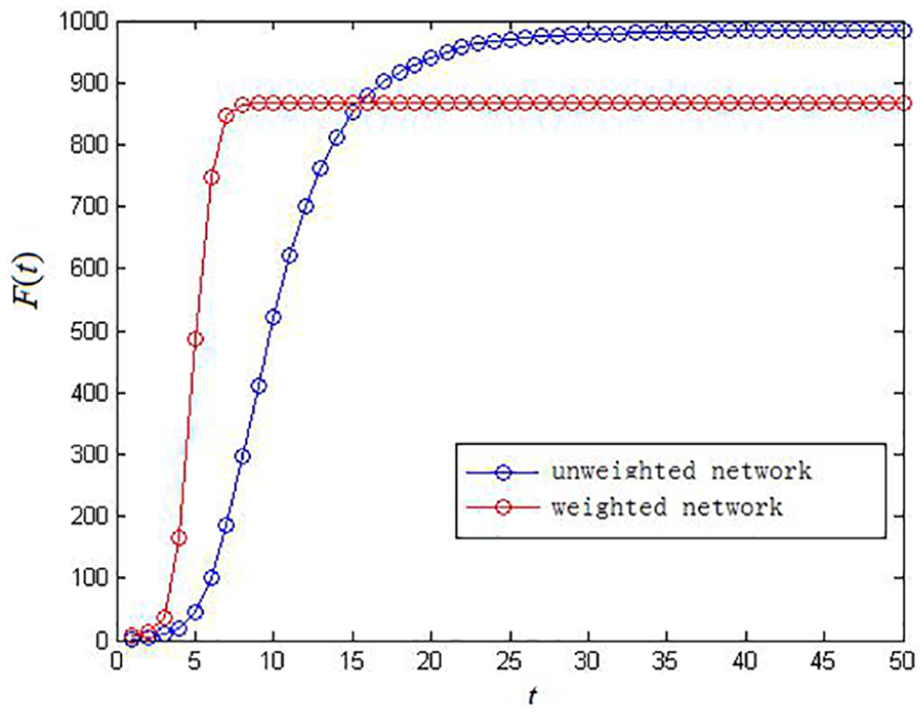
The spread of scientific research team’s influence at threshold, β = 0.5.
The threshold of influence spread is differently selected such as β = 0.5, 0.6, and 0.7. The spread of one scientific research team’s influence is shown in Figure 5.

The spread of scientific research team’s influence at threshold, β = 0.4, 0.5, and 0.6.
In Figure 5, for the same threshold of influence spread, the coverage area of unweighted network is higher than weighted network, and the spread speed of unweighted network is lower than weighted network. With the increase of threshold, the coverage area and spread speed of two networks reduce, and the reduction of weighted network is faster than unweighted network, so the influence spread of node is related to the weight of edge, which is the proposed scientific research factor quantification.
Analysis of multiple scientific research team’s influence spread
The experiment analyzes the influence spread of top 8 maximum degree nodes, which are, respectively, selected from the unweighted network and the weighted network, as shown in Figure 6(a)–(c).

The top 8 maximum degree nodes’ influence spread in unweighted network and weighted network: The comparison of top 8 maximum degree nodes’ influence spread in (a) unweighted network, (b) weighted network, and (c) weighted network at time t = 1.5–2.5.
In the figure, for the top 8 maximum degree nodes, weighted network is partly different to unweighted network, and the differences of the top 8 maximum degree nodes’ influence spread in weighted network are more significant than unweighted network. In addition, for nodes 486, 555, and 558 of weighted network, their order by degree are 558, 555, and 486, but the influence spread of node 486 is higher than nodes 555 and 558 at time t = 1 ∼ 4, as shown in Figure 6(a)–(c). There are same phenomena for nodes in unweighted network, as shown in Figure 6(b). This indicates that node’s influence spread is not proportional to its degree; so, node’s influence spread is related to not only adjacent nodes but also non-adjacent nodes.
According to the above experiments, the relationship between influence spread and the number of related communities is greater than the number of adjacent nodes.
Comparative analysis of influence spread and other index
Based on scientific research team relationship network, the Kendall rank is calculated for scientific research teams’ influence spread (IS) and the evaluation index of complex network, respectively, such as degree centrality of unweighted network (DC) and degree centrality of weighted network (WDC), closeness centrality (CC), betweenness centrality (BC), and k-core (KC). The selected top 50 sequences based on these indexes are compared, as shown in Figure 7.

The comparison of the Kendall rank for evaluation index of complex network.
In the figure, the proposed influence spread is superior to other indexes, so the influence spread can more comprehensively reflect the importance of scientific research team. For degree centrality, the calculation of weighted network is better than unweighted network; this shows that the information carried by weighted edge is indispensable for the evaluation of node influence.
Conclusion
From the two aspects of community and importance, the influence spread of scientific research team is analyzed by complex network, which is constructed for scientific research team relationship based on scientific research factor quantification of ability, resource, activity, and familiarity. The experiment of influence spread is carried out by the comparison of unweighted network and weighted network, the comparison of single node and multiple nodes, and the comparison of influence spread and other index. The results show that the scientific research factor is closely related to the influence spread; the proposed scientific research factor quantification improves the analysis of scientific research team relationship. The relationship between influence spread and the number of related communities is greater than the number of adjacent nodes. In addition, the influence spread can effectively reflect the importance of scientific research team. In future, the heterogeneity of node will be introduced into scientific research factor quantification; double- or multiple-layer networks will be considered for the construction of complex networks, and the influence spread model will be improved to accurately and comprehensively reflect the importance of scientific research team.
Footnotes
Handling Editor: Daming Zhou
Declaration of conflicting interests
The author(s) declared no potential conflicts of interest with respect to the research, authorship, and/or publication of this article.
Funding
The author(s) disclosed receipt of the following financial support for the research, authorship, and/or publication of this article: The authors acknowledge the National Natural Science Foundation of China (Grant 61373160), the Standardization Processing and Application System Development of Science and Technology’s Big Data (Grant 17210113D), and Science and Technology Resource Survey, Statistical Analysis and System Development (Grant 179676334D).
