




Abstract
With the evolution of research on defense strategies in cyber security, the choice of an optimal strategy has become a key problem in current studies. Focusing on the balance between individual cost and overall network cost, we present an application of mean field game in large-scale defenders in cyber security, where players seek to construct an optimal defense strategy at their minimum cost. The contributions are threefold: first, we propose an individual cost function based on the mean field game in Hilbert space and discuss the overall network cost function, where each player has discrete-time dynamics. Then, the Nash equilibrium of the individual cost function with infinite players is researched. Finally, we establish an optimal condition in which the game equilibrium is the optimal solution to the overall cost function. Numerical examples are provided to illustrate the effectiveness of the presented strategy with an appropriate assumption.
Introduction
With the rapid development of computer networks, the Internet has become an indispensable part of daily life. Meanwhile, the Internet is constantly facing various types of cyber security problems such as malware, virus and worm infection, distributed denial-of-service (DDoS) attacks, data hacking, email bombing, and energy attacks. 1 It is essential to study the defense mechanism technology with respect to cyber security problems to make the network safe. 2 However, conventional defense mechanisms such as intrusion detection and firewalls are not sufficient to address the current cyber security issues brought by large energy attackers and new techniques. 3 New defense methods are required to overcome these problems,4–6 and the details will be introduced in section “Related works.”
Since an effective defense scheme should include protection strategies for different attack behaviors, it is difficult to derive this type of defense scheme due to limited network resources and cumulative cost. Moreover, most of the existing works4–9 do not consider the dynamic evolution of attackers, which should be considered in the design of a defense scheme.
In addition to successful defense against attacks, another important aim of a defense system is to minimize its running cost under attacks. 10 In this article, we pay attention to the cyber security problem to minimize the cost of the individual player and the whole network based on the energy state. In this framework, we aim at constructing an optimal defense strategy at the individual cost function, which is also the optimal strategy for the whole network.
In general game models, since we focus on the process of individual decision-making, the optimal defense strategy of the individual player is not the optimal strategy for the overall network. In this article, we try to use mean field game theory by considering a large population of players and try to research the relation between the individual cost and the whole network cost. Mean field game theory was proposed by Lasry and Lions 11 and Huang et al.12,13 as a modeling method for games with a sufficiently large number of players. Each player in the mean field game attempts to minimize its individual energy consumption based on the mean field term, which can be considered as the distribution of nodes with defense strategy. 14 In cyber security, the whole network tries to obtain the maximum defense level at the minimum overall cost. We assume that attackers are randomly distributed depending on the defense strategy. The contributions of this article are as follows:
We formulate the individual cost function and the overall cost function in Hilbert space, which consists of n nodes with different defense mechanisms, where the evolution of defenders depends on the current energy level and the previous moment.
Since the subtle changes among nodes can be negligible if the number of players is sufficiently large, we research the ε-Nash equilibrium of the individual cost function with finite players and prove the existence of the optimal defense strategy of the individual player if
Finally, the optimal condition between the individual cost function and the overall cost function is given, under which the optimal defense strategy of the individual player is also the optimal defense strategy of the whole network.
This article is organized as follows. We introduce related works in section “Related works.” In section “Mean field game–based cost model in Hilbert space,” we present the individual cost model with the mean field term in Hilbert space and elaborate the overall network cost function based on this mean field game model. Next, we prove the ε-Nash equilibrium of the individual game model in section “ε-Nash equilibrium of the individual cost model.” We discuss the optimal condition using convex optimization theory and simulate the optimal defense strategy in sections “The optimality condition” and “Numerical examples,” respectively. Finally, section “Conclusion and future work” concludes the article.
Related works
Defense schemes have been examined in cyber security, 15 and game theory has been introduced for cyber security problems.16,17 For example, Khouzani et al. 4 proposed an optimal control model to evaluate the damage maximization problem inflicted by a malware attack, which minimizes the overall cost of security patches. Huang et al. 5 translated the targeted attacks into random attacks to study the robustness of interdependent networks. The work of Gao et al. 6 compared the effectiveness of the current immunization strategies and proposed the best strategy to mitigate virus spread in email networks. However, these studies have not considered the distribution of attacks.
In the study of Dingankar and Brooks, 7 DDoS attacks were modeled as a non-cooperative game, where the defenders attempted to form an optimal network topology to prevent the attack, while the attackers attempted to deploy zombies in the network. Zargar et al. 8 classified the current DDoS flooding attacks and introduced a comprehensive DDoS defense mechanism. La et al. 9 formulated a Bayesian game model to study the optimal defense strategy in the Internet of Things. Moreover, a Markov game model was proposed in the study of Lei et al. 18 to solve the problem of the optimal strategy selection for the moving target defense. In the work of Eisenstadt and Moshaiov, 19 the interaction between attackers and defenders was designed as a zero-sum multi-objective game model in which each player was undecided about its objective preferences. In addition, the popularization of intelligent terminals in edge network has also caused some security problems. In the study of An et al., 20 a proper fog-intrusion detection system was designed in which an optimal intrusion response strategy was studied based on the differential game theory.
Mean field game theory is one of the most practical branches of game theory and has been used to research a class of complex problems with large number of players. 21 Mean field game model is established by considering various assumptions, for example, players are homogeneous and their behaviors are continuous in time, and the decision-making of each player depends on the mean field term. 22 The homogeneity means that the subtle change among players can be negligible if the number of players is sufficiently large. The continuity leads to an approximation of the game model with a large number of players, and the third assumption indicates that the process of decision-making of each player is affected by others through the mean field term.
Mean field game theory has been applied in economics, 23 engineering, 24 networks,25–27 and other fields. Meanwhile, mean field game models for cyber security have been proposed in the works of Wang et al., 28 Miao and Li, 29 and Khaliq et al. 30 Wang et al. 28 considered an attacker and multiple defenders in mobile ad hoc networks. The legitimate nodes of this model may intelligently select actions to decrease their energy consumption and security loss. In the study of Miao and Li, 29 we studied the binary interactive behaviors between malicious attackers and defenders and derived the specific solutions for the individual strategy of the active defense behavior and the passive defense behavior, respectively. In the work of Khaliq et al., 30 a mean field game model was designed to solve the problem of the cyber-attack detection technique in ad hoc cognitive radio network. Multiple attackers were considered in the proposed model and each node could detect the attacks without incurring additional overheads.
Nevertheless, none of the above works to achieve optimal defense strategy by considering the whole network cost. Based on the advances in mean field game theory, in this article, we introduce a mean field game model based on the overall network cost for the optimal defense problem with the help of Hilbert space theory, under which this problem can be formulated through the minimum norm problem.
Mean field game-based cost model in Hilbert space
In this section, to analyze the relation between the individual defense mechanism cost and the overall network cost, we propose a mean field game model in Hilbert space with an infinite number of network nodes, which are assumed to be rational. The interactions between attackers and cyber nodes are discussed in Figure 1.

Interactions between attackers and cyber nodes.
Let n be the number of network nodes with defense mechanisms, such as intrusion detection systems, intrusion prevention systems, firewalls, and distributed responses for DDoS attacks
31
and m be the number of different defense mechanisms deployed by the individual node. Let H denote the Hilbert space with inner product
We use
We define
The cost of deviation from the whole security intensity is written as

and the cost of energy consumption of the single player is

where
According to the above analysis, the cost of an individual computer can be formulated as

where T is the terminal time of the game.
The current state at time t is related to the state of the previous moment, the current strategy, and attacks. Then, the evolution of the energy consumption level can be expressed by

where
To simplify equations (3) and (4), we define the state of the energy level at different times as vector

subjected to

where
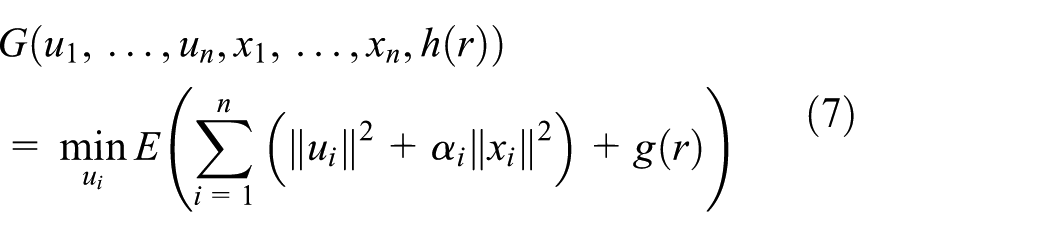
In general, the optimal solution to the individual cost function is not the optimal overall network cost. We assume that
subjected to

This problem can be evaluated using the ε-Nash equilibrium, wherein the key problem is under what condition the individual game equilibrium is the optimal solution of the whole network cost function.
ε-Nash equilibrium of the individual cost model
In this section, we analyze the existence of the Nash equilibrium solution of the individual game model (equation (5)) based on the large-sale players. In the following subsections, we first discuss the ε-Nash equilibrium of the game model with finite players. Then, the existence of the optimal defense strategy of the individual player when
Definition 1
A set of strategies

where
The inequality in equation (9) holds for a finite number of participants. The ε-Nash equilibrium will degenerate into the general Nash equilibrium as the number of players tends to infinity and ε tends to zero.
Each player in our model is assumed to be rational, and the process of decision-making of each node depends on the mean field term. For the individual cost function (equation (5)), a dynamic evolution

where

In equation (10), the best approximation term
We assume that there exists a constant
Lemma 1
For
Proof
For

Thus,
End of proof.
Besides, if

Lemma 2
For
Proof
Considering

Hence, we must prove that the inequality in equation (13) holds.
The functional f is a Fréchet’s differential function with respect to r. According to the definition of Fréchet’s differentials, there exists a constant

Equation (14) can be written as

In finite space, there is a constant
Consider

Hence,
Next, we prove that the remaining functions of the inequality in equation (13) are convergent. The function

Therefore, we have
Based on the above analysis,
End of proof.
Besides, if
Theorem 1
For any

Proof
Similar to definition 1, we must prove that the following inequality holds

First, we prove that there is an
Because the following inequality holds

Based on lemma 1, both
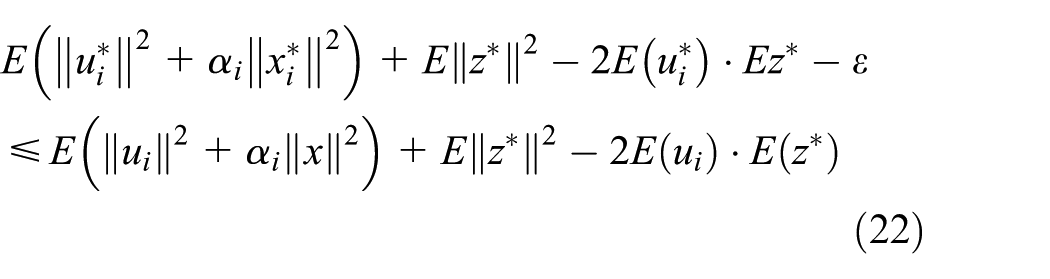
Next, we prove that the following inequality holds

Since
Since
End of proof.
Furthermore, if
The optimality condition
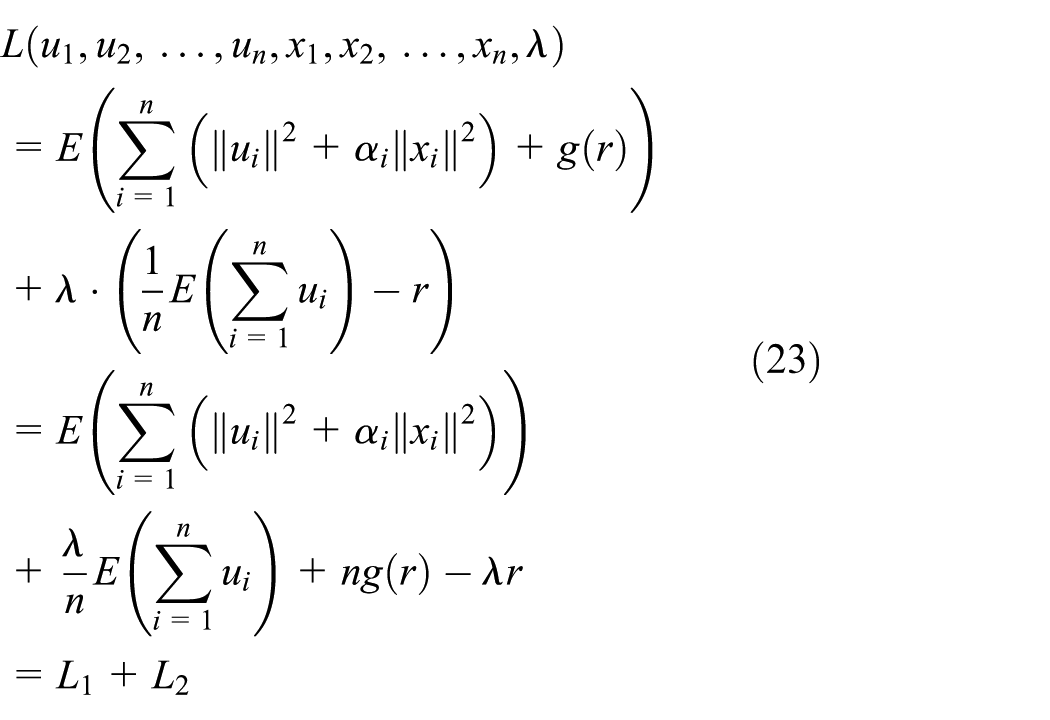
If
We assumed that
where
Let
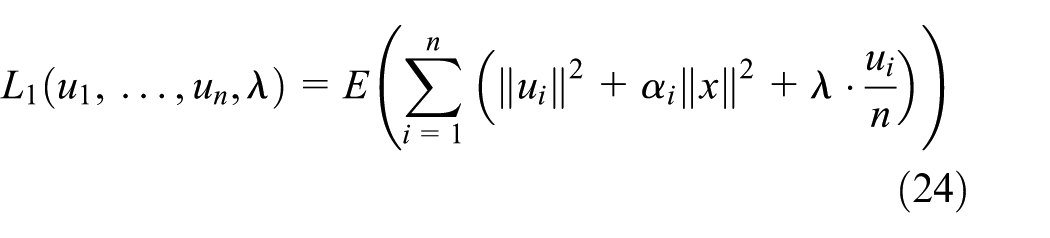

Thus, the objective function of the overall network cost in equation (7) is equivalent to

The optimal solution of equation (26) can be expressed as


where
The derivative of equation (28) with respect to

Based on objective function (10), equation (26) indicates that

Since the overall cost function g is Fréchet’s differential function, from equations (10), (27), and (30), we derive the following optimality condition

According to the above analyses, we provide the following result.
Proposition 1
If the optimal condition

Numerical examples
In this section, numerical examples are provided to evaluate the proposed scheme. For simplicity, we presume that the random distribution of attackers

where c is a real number.
We presume that the iteration number is 50 times greater than time T = 100 s for the simulations. During the game time, each player can provide the energy to reduce the response time of the defense mechanisms or the loss of information assets of nodes. We assume that the coefficient of

Evolution of energy
In addition, we discuss the evolution of the response time and the optimal defense strategy of the node
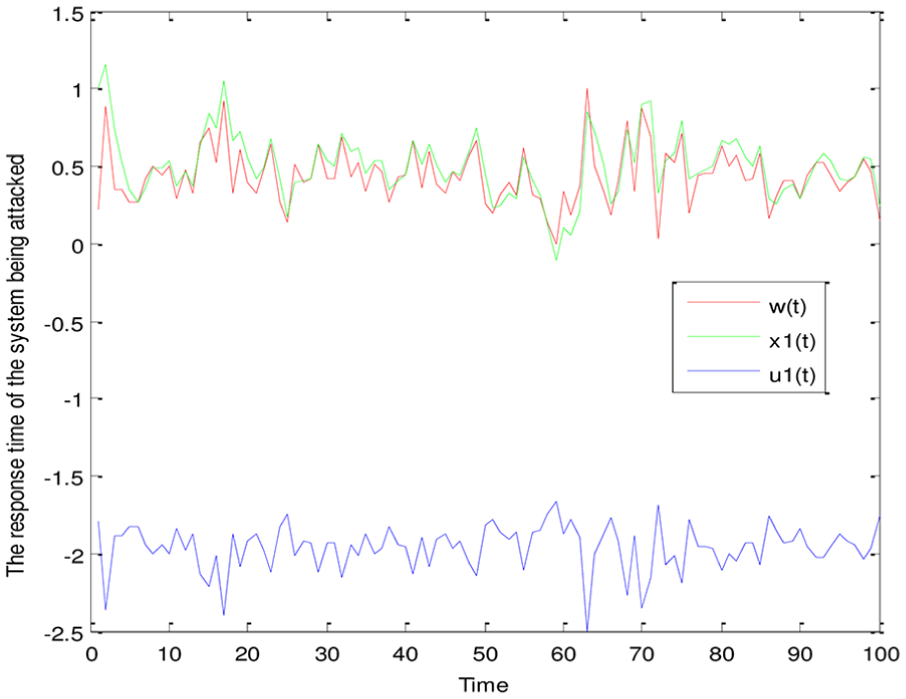
Evolution of the response time under attacks over time.
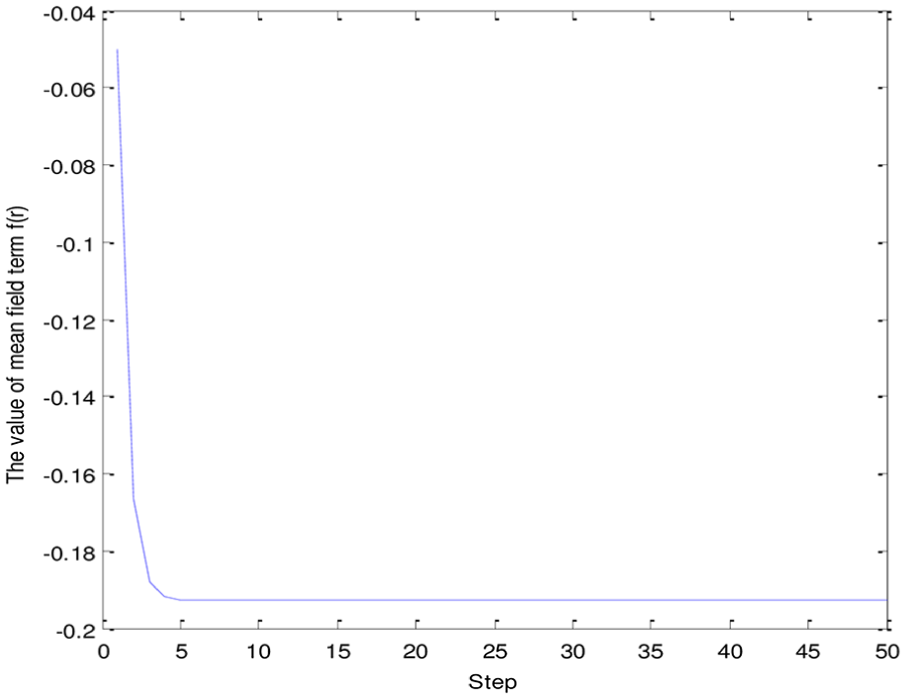
Evolution of the mean field term
In Figure 5, we present the difference between the individual cost function

Difference between individual cost function
Using the overall cost function defined in equation (7) and the optimal condition in equation (30), we calculate the overall cost function G over time. Then, we compare the costs of the proposed scheme and the energy-prioritized strategy 25 in Figure 6. As shown in Figure 6, it can be seen that the proposed scheme consumes more energy than the energy-prioritized strategy at the beginning because of the level attacks, but then the cost is gradually reduced, which indicates that the node has an optimal strategy with a minimum cost at this time.

Cost comparison between the proposed scheme and the energy-prioritized strategy.
Conclusion and future work
In this article, we have proposed a security mean field game model in Hilbert space for large-scale defenders in cyber security. In terms of model construction, we have formed an individual cost model and an overall network cost model based on the mean field game in Hilbert space, where the cost function can be expressed by the minimum norm problem. As the number of defense players tends to infinity, ε approaches zero. Thus, we have evaluated the optimal solution using the ε-Nash equilibrium with a finite number of players. We have derived an optimal condition between the mean field term and the overall cost function, where the game equilibrium of the individual cost model corresponds to the minimum cost of the overall network in virtue of a Lagrange function. In this framework, the optimal defense strategy of the individual cost function is also the optimal strategy of the overall cost function.
We have considered that each defense strategy is independent of each other in this article. In future work, we will investigate the interactions among different defense strategies.
Footnotes
Acknowledgements
The authors gratefully acknowledge the anonymous reviewers who read the drafts and made many helpful suggestions.
Handling Editor: Kim-Kwang R Choo
Declaration of conflicting interests
The author(s) declared no potential conflicts of interest with respect to the research, authorship, and/or publication of this article.
Funding
The author(s) disclosed receipt of the following financial support for the research, authorship, and/or publication of this article: This work was supported by the National Natural Science Foundation of China under grants 1603116 and 61701020.
