We consider an energy harvesting for cooperative wireless sensor networks with a nonlinear power consumption model. The information transmission from the source node to the destination node is assumed to occur via several clusters of decode-and-forward relay nodes. We assume that all the source and relay nodes have the ability to harvest energy from the environment and use that harvested energy to transmit and forward the information to the next hop. Under such assumption, the objective of our design is to improve the total throughput of the end-to-end link over a number of transmission blocks subject to constraints on energy causality, battery overflow, and time duration for energy harvesting. The optimization problem is found to be a nonconvex maximin fractional program, which is difficult to solve in general. We present an efficient iterative algorithm to solve the optimization problem. Specifically, by introducing novel transformations, we apply an approximate convex technique to obtain a convex problem at each iteration. We then propose an iterative power allocation algorithm which converges to a locally optimal solution at a Karush-Kuhn-Tucker point. Numerical results are provided to evaluate the proposed scheme.
1. Introduction
Wireless sensor network (WSN) is basically made up of a large number of various sensor nodes that typically spread over a large geographical area. WSN is used to collect information on surrounding context and environment and employed over a wide range of applications, such as smart buildings, transportation and logistics, health cares, and smart grids [1, 2]. Recently, WSN is considered as one of the key enablers for the Internet of Things (IoT) [3]. Accordingly, design of a WSN has become a promising and an important area of research. In particular, energy consumption is a challenging issue in the design of a WSN, since each sensor node is often equipped with small battery and it is hard to replace due to cost consideration. Therefore, the lifetime of a WSN is quite limited, especially when sensor nodes keep operating in the active mode.
One approach to improving the energy efficiency as well as the coverage and reliability of a WSN is to use cooperative multihop relays. Using multihop relays in a WSN, a source node communicates with a destination node with the help of a number of relay nodes. In particular, the transmission distance per hop is reduced, which directly enhances the channel gain and communication reliability. There have been a lot of prior works in this field [4–6]. Obviously, the link reliability improves as the number of hops between the source and destination nodes increases. However, with larger number of hops, less time interval is available for data transmission in each hop for a given time duration, leading to a reduction in the spectral efficiency [7–10].
On the other hand, energy harvesting has attracted a lot of attention, since it can prolong the lifetime of wireless networks under energy constraints [11, 12]. The energy harvesting refers to a process by which energy is derived from surrounding environment (e.g., wind, wave, solar, and thermal energy), captured, and stored for later use [13, 14]. The harvested energy can be extracted even from a radio frequency (RF) signal [15]. If energy harvesting is employed in a WSN, it has the potential to provide unlimited energy to sensors and enable self-sustaining green communications [16]. In [17], for instance, an optimal scheduling was proposed in a network of multiple relays, and joint energy harvesting and beamforming schemes were considered. A wireless energy harvesting protocol for an underlay cognitive relay network was proposed in [18], where the secondary transmitter and the relay harvest energy from the RF signal transmitted by multiple primary transmitters. Under a deterministic energy harvesting model, a sum rate maximization problem was investigated in [19] for an orthogonal relay channel with energy harvesting at the source and relay nodes. A closely related system model is studied in [14], where the authors proposed a wireless energy harvesting model for a cognitive WSN in the presence of cluster-based decode-and-forward relays and maximized the throughput of the end-to-end link in a single transmission block. However, energy consumption for circuits was not taken into account and optimal scheduling issue was not investigated.
In this paper, we propose the use of energy harvesting for a cooperative WSN with nonlinear power consumption model. Specifically, we use a nonaffine power consumption model and consider that each node spends a part of the total power in circuits [20]. The source sensor node communicates with the destination sensor node via a number of relay nodes. We assume that the transmitters, that is, the source and relay nodes, have no available power supply and they need to harvest energy form the surrounding environment to transmit data. Differently from [14], we consider a more general model in that the throughput is optimized across multiple transmission blocks rather than in a single transmission block. The objective of our design is to maximize the total throughput of the network over N transmission blocks by incorporating optimal power allocation and time scheduling for energy harvesting. However, the resulting problem is neither convex nor concave, and therefore the optimal solution is generally hard to obtain. In order to tackle this issue, we first transform the original problem into an equivalent problem by introducing a new variable, which is still nonconvex but in more tractable form. Consequently, we apply an approximate convex technique to nonconvex parts, which leads to a convex problem. We then propose an iterative algorithm which solves approximate convex program at each iteration, update the invoked variables, and move to the next iteration. Moreover, we show that the iterative solution found by the proposed algorithm converges to a locally optimal solution that satisfies a Karush-Kuhn-Tucker (KKT) point of the problem.
The rest of this paper is organized as follows. Section 2 describes a cooperative WSN based on multihop transmission. The optimization problem formulation is formulated in Section 3, and the optimal solution of the problem is presented in Section 4. In Section 5, numerical results are provided to demonstrate the proposed scheme. Finally, conclusions are drawn in Section 6.
2. System Model
As illustrated in Figure 1, we consider a cooperative WSN that consists of one source node , one destination node , and clusters of relay nodes. The kth cluster is assumed to be composed of relay nodes, , . Assuming that there is no direct link between the source and destination nodes, the source node transmits data to the destination node with the help of the best relay nodes, which are chosen in each cluster of relay nodes. For the selection of a relay in each cluster, we consider a partial relay selection scheme in [14]. We define a time slot to be a period of time for each transmission block. Accordingly, the selected relay node in the kth cluster at the ith time slot (The time slot index i is explicitly specified here, since the optimization in Section 3 will be performed across N consecutive time slots, i.e., N transmission blocks.) is found as
where denotes the channel coefficient between and and and . In addition, we further assume that each node is equipped with a single antenna and has a half-duplex radio, which implies that each hop in between and should happen in K separate time intervals. Let , denote the channel coefficient of the link .
A cooperative WSN with energy harvesting.
We assume that the transmission of each node takes place over a time interval consisting of N transmission blocks. As illustrated in Figure 2, each node harvests energy for a fraction in the ith time slot. The remaining fraction of the time slot is subdivided into K phases of the same length for the K-hop relaying. In the first phase, broadcasts data signal to all the relay nodes in the first cluster and each relay node decodes the data. In the second phase, the selected relay forwards the decoded data to the relay nodes in the second cluster. The process is repeated K times so that the data are delivered to the destination . We assume that all the relay nodes can correctly decode the signal from a relay in the preceding cluster. Energy harvested at each node from the surrounding environment can be expressed as [13, 14]
where is a function of the surrounding energy that is available during the harvesting period. Note that the energy harvesting rate depends on the environment surrounding the node. For simplicity, we assume that every relay node in the same cluster harvests the same amount of energy.
Energy harvesting and information processing at the sensor nodes.
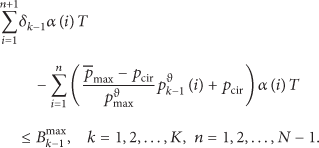
Unlike the conventional power consumption model, we consider a nonideal power consumption model at each node as [20]
where is the maximum power consumption, is the power consumed in the transmitter circuits, () is the power consumed for data transmission, and is a parameter of nonlinearity. In the ith transmission block, the instantaneous signal-to-noise ratio (SNR) at can be computed as
where we assume that the thermal noise at each node has zero mean and unit variance.
3. Problem Formulation
The main objective is to maximize the total throughput over N transmission blocks. In particular, we assume that the harvested energy and the channel state information are available noncausally. Based on the relay selection strategy in (1), the ergodic capacity of the kth hop can be expressed as
As a consequence, the ergodic capacity of the end-to-end link from the source to the destination is found as
As in Figure 2, the time duration is used to transmit data from to and the transmission time for each hop is fixed to , leading to the effective communication time of in each slot. Then, the throughput of the end-to-end link over N transmission blocks can be computed as
where , , and . Given that is fixed, the optimal value in (7) can be found from the following optimization problem:
In problem (8), is fixed and it is easy to verify that (8) is a concave function of . Thus, the optimal value can be found through a one-dimension numerical search.
The transmitted power must satisfy energy causality constraints as [12]
At the beginning of the ith slot, the kth node except for the destination will harvest energy with rate . Let be the energy available at the battery of the kth node. The total energy of the th node at the beginning of the ith slot will be equal to the remaining energy from the th transmission block, that is, , plus the energy that this node harvests during , that is, . Accordingly, the amount of energy at the kth node at the th slot and the updated value at the ith slot have the following relationship:
where denotes the maximum capacity of the battery at the kth node. On the other hand, the total energy at each node must avoid battery overflow as [12]
By incorporating (7)–(11), an optimization problem can be formulated:
The optimization problem in (12a), (12b), (12c), (12d), and (12e) is a nonconvex program in which the objective function is jointly determined by and α. A simple algorithm to solve such a nonconvex program can be described as follows. Suppose that a set of initial values of (, α) satisfy the constraints (12b)–(12e). As mentioned in (8), is concave in α for a fixed . Furthermore, (12a), (12b), (12c), (12d), and (12e) are convex in for a fixed α. Thus, to find a locally optimal solution for a given value of α, we use the KKT necessary condition for optimality [21]. Finally, these steps are repeated until the algorithm converges. However, such a method often exhibits a slow convergence. In the following section, we will propose an iterative method that arrives at a saddle point of (12a), (12b), (12c), (12d), and (12e).
4. Proposed Algorithm for Solving the Optimization Problem
The proposed iterative method in this paper is basically based on the approximate convex optimization problem [22]. The main idea is to transform (12a), (12b), (12c), (12d), and (12e) into a convex optimization problem. In particular, we apply convex approximation to the nonconvex parts and find an optimal solution locally. To start with, (12a), (12b), (12c), (12d), and (12e) can be reformulated as
where denotes the SNR for the best relay selected at the kth hop in the ith time slot. The equivalence between (13a), (13b), (12a), (12b), (12c), (12d), and (12e) is due to monotonicity of the logarithmic function. By introducing new variables and , , we rewrite (13a) and (13b) equivalently as
The equivalence of (13a), (13b), (14a), (14b), (14c), (14d), (14e), (14f), and (14g) can easily be confirmed by justifying that all the constraints in (14b)–(14d) hold with equality at the optimum [22]. Even after the above transformations, (14a), (14b), (14c), (14d), (14e), (14f), and (14g) are still nonconvex and difficult to solve due to nonconvex constraints in (14b)–(14d). We now apply a convex approximation technique that can convert (14a), (14b), (14c), (14d), (14e), (14f), and (14g) into an equivalent convex one.
Transformation of (14b). Without loss of optimality, (14b) can be rewritten as
We recall that is a convex function on the defined domain () [21]. If we upper bound the negative of around the point (, ), we get (Hereafter, the notation is used to represent the value of x at the jth iteration of the iterative algorithm.)
Clearly, (16) is a completely linearized constraint.
Transformation of (14c). We observe that is concave in . According to [23], we recall the following inequality:
In fact, is the first-order approximation of around the point .
Transformation of (14d). The constraint (14d) is equivalent to
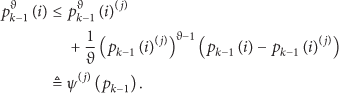
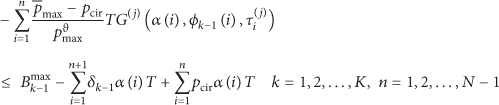
which is nonconvex constraint due to the nonconvexity of . Fortunately, by using the results in [23, 24], we obtain the following inequality:
where is a given positive constant. Since is a convex function of and is an upper bound of , we recall the following property. The equality of (19) is obtained by setting and then . As a result, the approximation yields a nondecreasing sequence of the objective value in (14a), (14b), (14c), (14d), (14e), (14f), and (14g) as the iteration continues.
With the above approximations, at the th iteration, we solve the following convex program:
We outline the proposed iterative algorithm in Algorithm 1, which works as follows. After solving (20a), (20b), (20c), (20d), and (20e) by using numerical solver such as SeDuMi [25], we update () for the next iteration. The iteration continues until the solution converges or the number of iterations reaches the maximum value, .
Algorithm 1: The proposed iterative algorithm to solve the optimization problem.
Initialization: Set and randomly generate
, and so that (20a), (20b), (20c), (20d), and (20e) is feasible.
(1) repaet
(2) Solve (20a), (20b), (20c), (20d), and (20e) to obtain the optimal solutions
and .
(3) Update variables as
.
(4) Set
(5) until The solution converges or .
Generation of Initial Points. To guarantee that Algorithm 1 can start at the first iteration, we generate the initial points as follows. First, we generate to satisfy (14g) and randomly generate in range . Second, can be computed by setting (20b) to equality. Third, can be calculated as , where is obtained by setting (20c) to equality.
Convergence. Let be the objective value at the jth iteration in Algorithm 1. We should note that the optimal solutions at the jth iteration in line 2 of Algorithm 1 are also feasible for the considered problem at the th iteration due to the safe approximations in (20b), (20c), and (20d) [26]. This implies that the proposed method yields a nondecreasing objective value; that is, and at the same time the objective value is bounded above due to the power constraint. Furthermore, following the same arguments presented in [26], it can be shown that the proposed method converges to a locally optimal solution that satisfies a KKT point of (14a), (14b), (14c), (14d), (14e), (14f), and (14g).
5. Numerical Results
In this section, we evaluate the throughput of the proposed scheme by simulation. The channel coefficient is generated as with being the distance between the th hop and the kth hop and entries of follow circularly symmetric complex Gaussian random variables with zero mean and unit variance. The distance from the source to destination is denoted as . For simplicity, we further assume that each cluster of relays consists of 3 relays and the distance between two adjacent hops is equal; that is, . Energy harvesting rate at all the nodes is assumed to be equal; that is, . In addition, we choose , , , and . To solve convex programs, we use the modeling package YALMIP [27] with SeDuMi [25] being the internal solver. The average throughput is computed by averaging over 10,000 independent simulation trials.
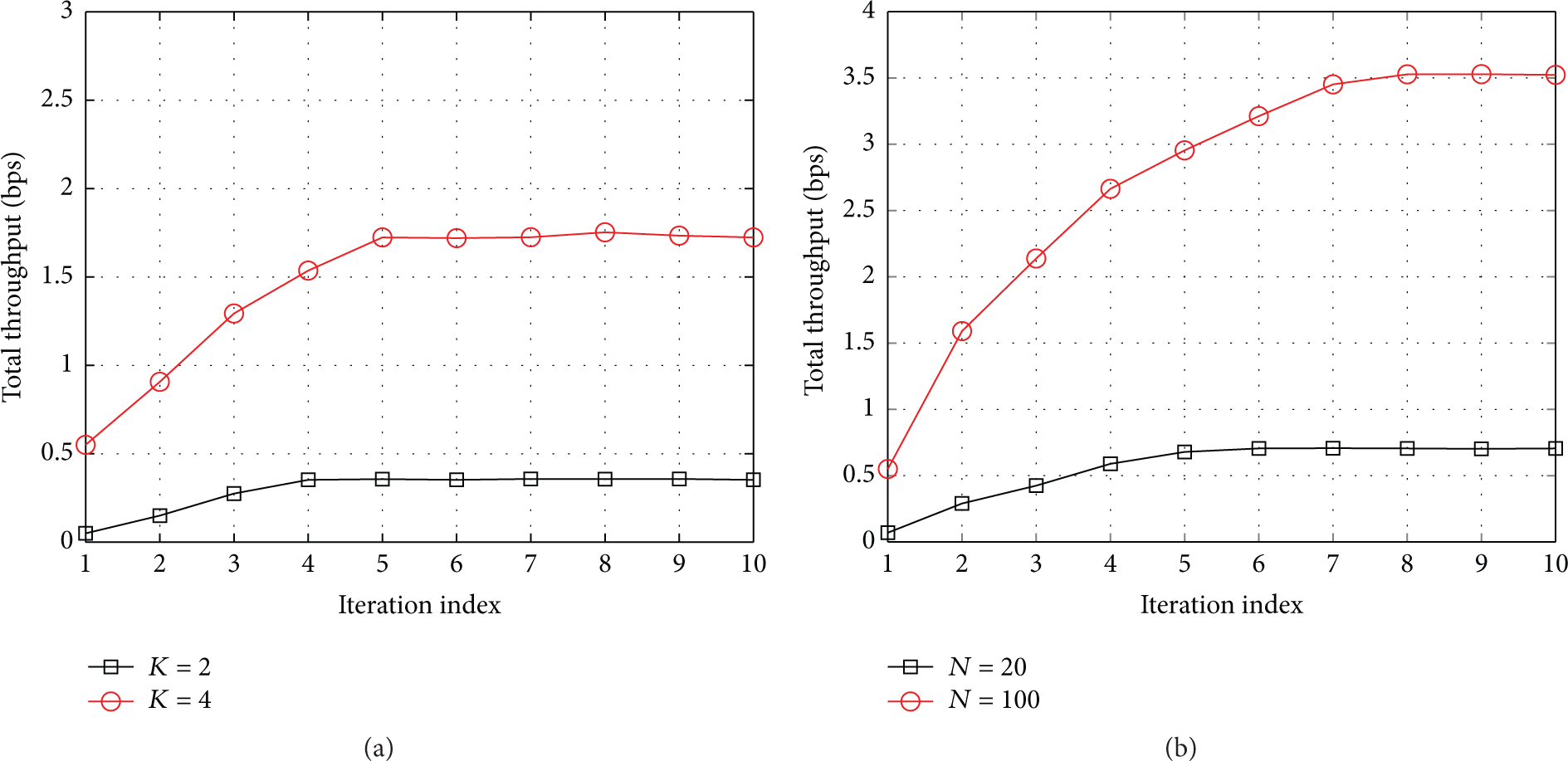
First, we investigate the convergence behavior of the proposed algorithm for the simulation settings given in the caption. In particular, we plot the convergence rate for different number of hops in Figure 3(a) and for different number of transmission blocks in Figure 3(b). As seen in Figure 3, Algorithm 1 convergences within several iterations in all cases.
Convergence behaviors of the proposed algorithm for parameters dB, m, and . (a) Convergence behavior of Algorithm 1 for different number of hops (K), when . (b) Convergence behavior of Algorithm 1 for different number of transmission blocks (N), when .
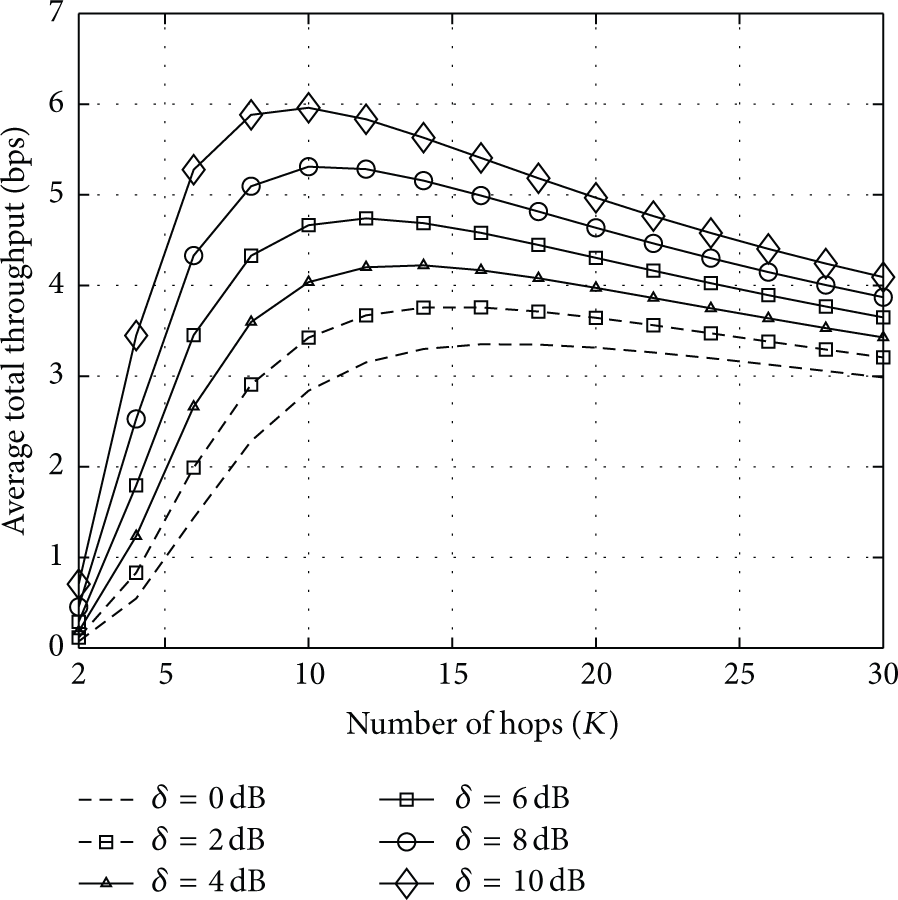
Figure 4 shows the average total throughput versus the number of hops, K. We can see that the performance first improves as K increases but it turns over at a certain point. This is because the channel gains will be enhanced when K increases but the fraction time spent for transmit data is also reduced. Another interesting observation is that the performance of the system improves and the optimal number of hops decreases when the energy harvesting rate is higher. The reason is that increasing energy harvesting rate leads to reduction in the time fraction spent for energy harvesting.
Average total throughput versus the number of hops (K) for various energy harvesting rates, when and .
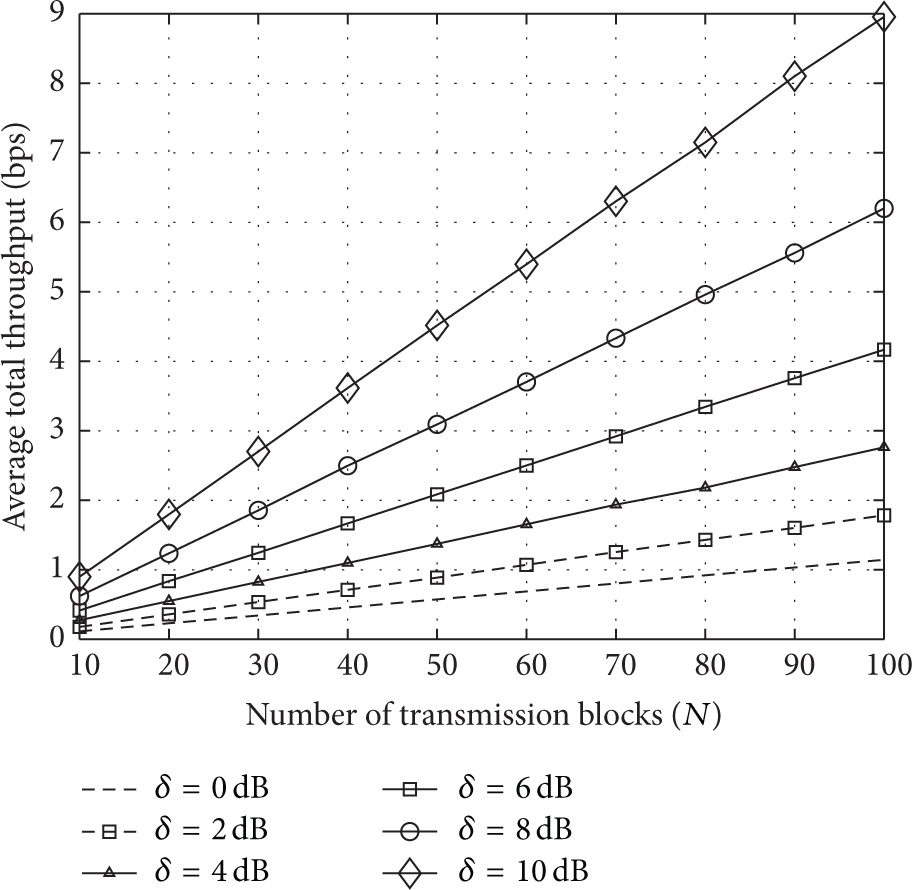
Figure 5 depicts the average total throughput versus the number of transmission blocks, N. It is shown that the system performance improves significantly as the number of transmission blocks and the energy harvesting rate increase. It should be noted that the value of energy harvesting rate δ depends on several factors, such as surrounding environment and conversion efficiency of the device.
Average total throughput versus the number of transmission blocks (N) for various energy harvesting rates, when and .
6. Conclusion
In this paper, we have investigated optimal energy harvesting strategy that maximizes the total throughput of multihop transmissions in a cooperative WSN. The optimization problem has been found to be a nonconvex program which is constrained by the power allocation and transmission scheduling for energy harvesting. We develop an iterative algorithm which jointly allocates the transmit power and the energy harvesting time. Moreover, the proposed algorithm is guaranteed to converge to a saddle point of the nonconvex problem. Numerical results have been presented to verify the performance of the proposed approach.
Footnotes
Competing Interests
The authors declare that they have no competing interests.
Acknowledgments
This work was supported by Basic Research Laboratories (BRL) through National Research Foundation (NRF) grant funded by the Ministry of Science, ICT and Future Planning (MSIP) of the Korean government (no. 2015056354).
References
1.
RawatP.SinghK. D.ChaouchiH.BonninJ. M.Wireless sensor networks: a survey on recent developments and potential synergiesThe Journal of Supercomputing201468114810.1007/s11227-013-1021-92-s2.0-84904043180
2.
ShabanehA. A. A.AliA. M.NgC. K.NoordinN. K.SaliA.YaacobM. H.Review of energy conservation using duty cycling schemes for IEEE 802.15.4 wireless sensor network (WSN)Wireless Personal Communications201477158960410.1007/s11277-013-1524-y2-s2.0-84903588103
3.
ZhanY.LiuL.WangL.ShenY.Wireless sensor networks for the internet of thingsInternational Journal of Distributed Sensor Networks20132013271712510.1155/2013/7171252-s2.0-84885453981
4.
HasnaM. O.AlouiniM.-S.Outage probability of multihop transmission over Nakagami fading channelsIEEE Communications Letters20037521621810.1109/LCOMM.2003.8121782-s2.0-0037604506
5.
KaragiannidisG. K.TsiftsisT. A.MallikR. K.Bounds for multihop relayed communications in Nakagami-m fadingIEEE Transactions on Communications2006541182210.1109/TCOMM.2005.8616792-s2.0-31344475953
6.
KaragiannidisG. K.Performance bounds of multihop wireless communications with blind relays over generalized fading channelsIEEE Transactions on Wireless Communications20065249850310.1109/TWC.2006.16039622-s2.0-33644995715
7.
MaiyaS. V.FujaT. E.One-hop vs. two-hop routing in simple networks with fading: an outage probability analysis addressing spectral efficiencyProceedings of the IEEE Wireless Communications and Networking Conference (WCNC ′08)April 2008Las Vegas, Nev, USA4944992-s2.0-51649113118
8.
SikoraM.LanemanJ. N.HaenggiM.DanielJ.CostelloJ.FujaT.On the optimum number of hops in linear wireless networksProceedings of the IEEE Information Theory Workshop (ITW ′04)October 2004San Antonio, Tex, USA165169
9.
FloreaA.YanikomerogluH.On the optimal number of hops in infrastructure-based fixed relay networksProceedings of the IEEE Global Telecommunications Conference (GLOBECOM ′05)December 2005St. Louis, Mo, USA3242324710.1109/glocom.2005.15783742-s2.0-33846630919
10.
OymanÖ.LanemanJ. N.SandhuS.Multihop relaying for broadband wireless mesh networks: from theory to practiceIEEE Communications Magazine2007451111612210.1109/mcom.2007.43783302-s2.0-36348961436
11.
LeeS.ZhangR.HuangK.Opportunistic wireless energy harvesting in cognitive radio networksIEEE Transactions on Wireless Communications20131294788479910.1109/TWC.2013.072613.1303232-s2.0-84884979976
12.
MinasianA.ShahbazpanahiS.AdveR. S.Energy harvesting cooperative communication systemsIEEE Transactions on Wireless Communications201413116118613110.1109/TWC.2014.23209772-s2.0-84910654630
13.
KrikidisI.ZhengG.OtterstenB.Harvest-use cooperative networks with half/full-duplex relayingProceedings of the IEEE Wireless Communications and Networking Conference (WCNC ′13)April 2013Shanghai, China4256426010.1109/wcnc.2013.65552612-s2.0-84881565337
14.
NguyenV.-D.NguyenH. V.ShinO.-S.Wireless energy harvesting for cognitive multihop wireless sensor networksInternational Journal of Distributed Sensor Networks20152015961316510.1155/2015/6131652-s2.0-84941198806
15.
NguyenV.-D.Dinh-VanS.ShinO.-S.Opportunistic relaying with wireless energy harvesting in a cognitive radio systemProceedings of IEEE Wireless Communications & Networking Conference (WCNC ′13)March 2015New Orleans, La, USA9398
GongS.DuanL.GautamN.Optimal scheduling and beamforming in relay networks with energy harvesting constraintsIEEE Transactions on Wireless Communications20161521226123810.1109/twc.2015.2487459
18.
LiuY.MousavifarS. A.DengY.LeungC.ElkashlanM.Wireless energy harvesting in a cognitive relay networkIEEE Transactions on Wireless Communications20161542498250810.1109/twc.2015.2504520
19.
HuangC.ZhangR.CuiS.Throughput maximization for the Gaussian relay channel with energy harvesting constraintsIEEE Journal on Selected Areas in Communications20133181469147910.1109/jsac.2013.1308112-s2.0-84877752789
20.
DimićG.ZogovićN.BajićD.A wireless transceiver power consumption model and two-hop vs. single-hop energy efficiency ratioProceedings of the 21st Future Network and Mobile Summit (FutureNetw ′12)July 2012Berlin, Germany182-s2.0-84867210943
21.
BoydS.VandenbergheL.Convex Optimization2007Cambridge, UKCambridge University Press
22.
Ben-TalA.NemirovskiA.On polyhedral approximations of the second-order coneMathematics of Operations Research200126219320510.1287/moor.26.2.193.10561MR1895823ZBL1082.901332-s2.0-0035351629
23.
TranL.-N.HanifM. F.TolliA.JunttiM.Fast converging algorithm for weighted sum rate maximization in multicell MISO downlinkIEEE Signal Processing Letters2012191287287510.1109/LSP.2012.22232112-s2.0-84869151965
24.
BeckA.Ben-TalA.TetruashviliL.A sequential parametric convex approximation method with applications to nonconvex truss topology design problemsJournal of Global Optimization2010471295110.1007/s10898-009-9456-5ZBL1220.900952-s2.0-77954761580
25.
SturmJ. F.Using SeDuMi 1.02, a MATLAB toolbox for optimization over symmetric conesOptimization Methods and Software1999111–462565310.1080/10556789908805766MR17784332-s2.0-0033296299
26.
MarksB. R.WrightG. P.A general inner approximation algorithm for nonconvex mathematical programsOperations Research197826468168310.1287/opre.26.4.681MR0503809
27.
LöfbergJ.YALMIP: a toolbox for modeling and optimization in MATLABProceedings of the IEEE International Symposium on Computer Aided Control System Design (CACSD ′04)September 2004Taipei, Taiwan2842892-s2.0-20344396845