In this article, different from the traditional Device-to-Device caching wireless cellular networks, we consider the scalable video coding performance in cache-based machine-type communication network, where popular videos encoded by scalable video coding method can be cached at machine-type devices with limited memory space. We conduct a comprehensive analysis of the caching hit probability using stochastic geometry, which measures the probability of requested video files cached by nearby local devices and the user satisfaction index, which is essential to delay sensitive video streams. Simulation results prove the derivation of the performance metrics to be correct, using Random cache method and Popularity Priority cache method. It is also demonstrated that scalable video coding–based caching method can be applied according to different user requirements as well as video-type requests, to achieve a better performance.
The continuing growth of demand for high-definition (HD) and low-latency mobile video has caused great challenges to the mobile cellular networks.1 Especially, when 5G is emerging and coming into daily life, more than 1 trillion IoT terminals and 20 billion human-oriented terminals are trying to access the mobile networks.2 The traffic load will be extremely high and challenge the backhaul network with constrained transmission capability.3
In this situation, the Cellular Internet of Things (IoT) network, which means IoT devices embedded in cellular network infrastructure, is expected to play a critical role in future 5G networks. Cellular network can provide a ubiquitous coverage and roaming, which also reduce the backhaul traffic by offloading it locally.4 In cellular IoT networks, cellular machine-to-machine (M2M) communications, also known as machine-type communications (MTC), serves as the foundation of cellular IoT.
In this article, we consider the video caching and delivering in cellular IoT networks. The method of caching was originated from content delivery networking in computer networks.5 The files of popular video and other documents are cached in local server during the light loaded time.6 In this way, the burden of wire network can be greatly reduced when the traffic load is high. Furthermore, the capability of network infrastructure in terms of computing and storage has been improved rapidly. It will also benefit the caching performance in wireless networks.7
In practical system, it is interesting that a numerous amount of video traffic is caused by a small fraction of popular video files.8 Hence, the cellular IoT networks can take advantage of the content redundancy to reduce the overall data traffic load in backhaul network, by proactively caching popular files into local surrounding devices.
Different from the traditional caching in wireless cellular IoT networks, scalable video transmission was considered in our work, where popular videos were encoded using scalable video coding (SVC) methods.9,10 SVC can provide scalability in channel quality, frame rate, and resolution, to satisfy different user demands. For example, people prefer high fluency over HD in sport event videos, while prefer HD over high fluency in film videos.
The effect of caching in 5G cellular network has been studied in Wang et al.,11 where the key idea is to store the video closer to users so as to reduce the repetitive video transmissions. Shanmugam et al.12 investigate the caching performance using different caching strategies in homogeneous wireless network, namely, probabilistic content placement (referred to geographic caching) and independent random content placement. A collaborative caching method of small Base Stations (BSs) under the same gateway is proposed,13–15 which extend the video caching to the terminal devices. Golrezaei et al.16,17 divide the D2D network into cluster and non-cluster scenario and evaluated different caching strategies. In Chen et al.,18 an alternative optimization approach is proposed, when BS caching and D2D caching coexist in the wireless network. Furthermore, Wang et al.19 consider that the cooperative caching placement in the scenario of BS and D2D caching coexists. Deng et al.20 take the user mobility into account in a D2D cache network and prove that popularity-based caching is not a system-wide optimal strategy in this scenario. Howerver, devices in MTC network are often with low mobility, even stationary all the time. Furthermore, Rao et al.21 derive the optimal caching placement in D2D networks to maximize the user hit probability. However, these works ignore the impact of wireless transmission. And few studies consider the video coding schemes. Pedersen et al.22 analyze the cache performance considering the Random Linear Coding, without considering the impact of wireless channels. Amer et al.23 consider the impact of wireless transmission, and propose corresponding algorithms to minimize the overall network average delay using queue theory. The aforementioned study mainly investigates the caching performance in different scenarios. Elias and Błaszczyszyn24 analyze the performance of the SVC video transmission in the BS caching-based cellular network. MTC networks are featured by low-power, small deployment costs, which is different from traditional SVC video transmission scenario. However, the previous studies only exploit the popularity of videos and neglect the preference of video quality for different video types. In addition, the differentiated quality requests for videos with respect to different users have been ignored in heterogeneous cellular network, especially in heterogeneous cellular IoT networks. The contributions of this article are summarized as follows:
The closed-form expressions for SVC video transmission in MTC caching-based cellular network are derived using stochastic geometry.
The performance metrics of MTC caching network is derived, including the caching hit probability and user satisfaction. These metrics can be utilized in MTC caching system design and optimization.
The remainder of this article is organized as follows: the system model including cache model, transmission protocol, and the interference models are introduced in section “System model.” The system performance in different MTC cases are described and deducted in section “Performance metrics and analysis.” In section “Numerical and simulation results,” we present the simulation results. Finally, conclusions are drawn in section “Conclusion.”
System model
As shown in Figure 1, we consider a wireless cellular IoT network, in which MTC devices can communicate with both the cellular BS and other devices. The communication among MTC devices is established using D2D underlaid link for the SVC video transmission. MTC devices are modeled by a two-dimensional homogeneous Poisson Point Process (PPP) with intensity . Each device in network has an active probability , which means that the active devices will make a request for a video file and the inactive devices will serve as potential D2D transmitters. Therefore, the distributions of D2D receivers (active) and D2D potential transmitters (inactive) also follow two-dimensional homogeneous PPPs and with intensity and , respectively. We assume that each device has the same cache memory size M and each video file is assumed to have the same unit size. There are N videos totally, denoted by .
System model of MTC caching network.
According to SVC scheme,2 each video can be encoded into two quality layers, Base Layer (BL) and Enhancement Layer (EL) . Through the reception of combinations of different layers, the receiver device can decode the video file with different qualities. The encoded stream only consisting of the BL can be decoded into standard-definition (SD) video , while the encoded stream consisting of the BL and the EL can be decoded into HD video . However, the encoded stream only consisting of the EL will be decoded failed. The HD video size is larger than the SD video size. The ratio of the HD video size over the SD video size is denoted by L. Each video file is encoded into video packets, and it is assumed that the video packet size for the BL and the EL of each video are and , respectively.
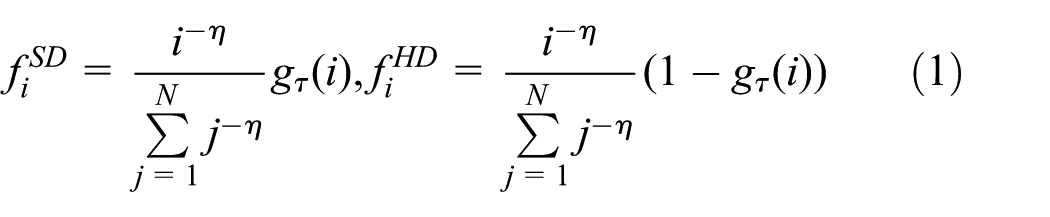
In this article, both popularity and quality of requested videos are considered. The video popularity follows a Zipf distribution with the decay parameter , which is widely used in the literature.15–20 For different video types , the preference for SD and HD qualities of videos reveal different trends. Let and denote the preferences probability for SD and HD qualities for the video of type separately, where . For example, when a film is requested, user may prefer HD quality to guarantee experience, and thus, should be an increasing function with i; but when online courses are requested, user may prefer SD quality to watch video fluently, and thus, is assumed to be a decreasing function with i. It is worthy noting that this article uses SD and HD video to illustrate the impact of different video requirements. Actually, this analytical method can be used in HQ or 4K scenario. can be learned empirically by data fitting.24 So, the probability of requesting file for SD and HD qualities is given by
In this article, we consider a cached-enabled D2D-based underlaid MTC network, where the D2D link and the BS-to-Device (B2D) link are sharing same frequency resource. The transmitting powers of D2D transmitter and the BS are denoted as and , respectively. By considering a dynamic D2D and cell association scheme, we assume that the D2D link and the B2D link operate in the same frequency bands with bandwidth W. The data rate of D2D link is and the data rate of B2D link is . The data rate is equal to , where denotes the signal-to-interference-plus-noise ratio (SINR) of the data link accordingly. For D2D link, without loss of generality, considering the interference from the BS especially, the received SINR of a typical user k, which is served by the local cache, can be expressed as follows
where denotes the desired signal power; denotes the channel fading distribution from the BS to the receiver k, which is exponential distribution with mean in squared magnitude, that is, fading; denotes the background Gauss noise power; and is the pathloss exponent. is the interference from the D2D link. denotes the set of active D2D transmitter within distance d except the serving receiver k; denotes the channel fading from the transmitter j to the receiver k, which follows Rayleigh fading; and denotes the distance from the transmitter j to the receiver k. denotes the interference from the B2D link; we assume ; and denotes the distance from the BS to the receiver k.
For the B2D link, the received SINR can be calculated by
where . We assume that is approximated by Gauss noise here.
Caching model
The video server stores both the BL and the EL of all the N videos. Users can retrieve their requested video files chiefly from the local surrounding device and request uncached video files from the Internet video server via the constrained backhaul between video server and BS.
Considering the decoding constraint that a user device cannot decode the EL without the BL as mentioned before, a potential D2D transmitter (inactive user equipment (UE)) never caches the EL of a video file if the corresponding BL is not cached. Meanwhile, each D2D user device has a limited storage M which can simultaneously cache video files consisting of only the BL and video files consisting of both the BL and the EL, where . Video file cached at the surrounding D2D transmitters d is denoted as . The probability of only caching the BL of video is
and the probability of caching both the BL and the EL of video is
Here, we assumed that all video sizes are fixed, namely, it is a snap-shot of MTC network. When the video size varies, we can use the same method to analyze the network performance.
For the sake of commonality, we considered two specific cache placements, which one of them represents the most random case, and the other follows the character of the popularity distribution of videos.
Random caching (RC). In each UE device, HD video files are randomly chosen and being cached, which contain both the BL and the EL. And SD video files are randomly chosen and being cached, which only contain the BL
Popularity Priority (PP). In each UE device, the most popular videos are cached with the HD video files. Meanwhile, the next most popular videos are cached with the SD video files
Transmission protocol
The transmission protocol is based on video cache distribution and the requested profile. Let denote video files cached at the local surrounding D2D transmitters within a distance d. According to the different request profiles and different cache strategies, including SD/HD request and SD/HD cache placement, there are five cases as follows:
Case 1 is denoted as , in which both the BL and the EL of the HD requested video are cached at . The video stream is transmitted from the D2D transmitter to the receiver at the data rate of .
Case 2 is denoted as , in which only the BL of the HD requested video is cached at . The video stream consisting of the BL is transmitted from the D2D transmitter to the receiver and the data rate of D2D’s transmission is . The video stream consisting of the EL transmitted from video server to the receiver via the BS, and the data rate of B2D’s transmission is . In this case, the data rate of transmission is .
Case 3 is denoted as , in which the BL and the EL of the HD requested video are not cached at . The video stream is transmitted from the video server to the receiver via the BS at the data rate of .
Case 4 is denoted as , in which the BL of the SD requested video is cached at . The video stream is transmitted from the D2D transmitter to the receiver at the data rate of .
Case 5 is denoted as , in which the BL of the SD requested video is not cached at . The video stream is transmitted from the video server to the receiver via the BS at the data rate of .
Performance metrics and analysis
In this section, the cache hit probability and the user satisfaction index are defined as the performance metrics of SVC transmission in MTC networks. As mentioned before, the caching hit probability is the key index to caching system, which can be utilized to evaluate the performances of the proposed caching scheme. The user satisfaction, namely, video transmission delay, is essential for video streams, which will influence users’ watching experience accordingly.
Cache hit probability
The cache hit probability is the probability of a random active user device to find its requested file in its local surrounding inactive user devices within a certain distance d. The SVC video transmission is divided into the SD video and the HD video. The distributions of the SD-video-cached devices and the HD-video-cached devices follow two-dimensional homogeneous PPPs with intensity and , respectively.
When user device requests for a SD video file, only the BL of the requested video will be retrieved. Therefore, the cache hit probability can be obtained as
When the user requests for a HD video file, both the BL and the EL of the requested video will be retrieved. Therefore, the probability of the video file cached in the nearby devices within the distance d is given by
denotes the probability that only is cached at the nearby inactive user devices, and denotes the probability that both and are cached at the nearby inactive user devices. Therefore, the cache hit probability for SD file and HD file within the certain distance d can be derived as follows
The total cache hit probability in the network can be obtained by
User satisfaction
Since the video stream service is delay sensitive, each packet should be transmitted to the destination within a certain time . With the different cache situation and user requested profile, the video stream transmission time is changed accordingly. Let denote the transmission delay of each packet from the Internet video server via the BS, which consists of the backhaul delay and the BS transmission delay. Let denote the data rate of the backhaul network. Furthermore, the BS transmission delay and the occurrence probability of each case are described as follows. Let be the requested video, which means the SD (HD) quality of is requested.
Case : The probability of is given by and the transmission delay is , thus for the requested video , the probability that the video plays fluently in transmission case can be obtained as follows
Case : . The probability of is given by and the transmission delay is , thus for the requested video , the probability that the video plays fluently in transmission case can be expressed as
Case : . The probability of is given by and the transmission delay is , thus for the requested video , the probability that the video plays fluently in transmission case can be derived as
Case : . The probability of is given by and the transmission delay is , thus for the requested video , the probability that the video plays fluently in transmission case can be calculated as
Case : . The probability of is given by and the transmission delay is , thus for the requested video , the probability that the video plays fluently in transmission case can be achieved as
As a result, there are two user satisfaction protocols (Or file accesses) as follows: (a) When the file is requested by a typical active user device, we denote as the distance to the nearest device which stores file . Then, the user satisfaction probability of D2D communication is given by
where is the Laplace transform of the interference ; is the Laplace transform of the interference ; and is the probability density function (PDF) of a D2D distance , which is given by
(b) When the file is requested by the typical active user, but it is not cached by the nearby user devices. we denote l as the distance between the user and the BS, and the user satisfaction probability of B2D communication is given as
where is approximated by Gauss noise, and is the PDF of the B2D distance l which is given by
Noted that according to the calculated formulas, the B2D transmission is more stable than the D2D transmission, which means the probability of is greater than that of . Let u denote the probability that the requested file video plays fluently on the user devices. Meanwhile, u is the probability that the transmission delay is lower than . Therefore, with considering different transmission cases and the user request profile over N videos, the user satisfaction index u can be obtained as
Numerical and simulation results
In this section, simulation results are presented to evaluate the performance of SVC transmission in MTC caching network, using MATLAB as the simulation tool. For numerical evaluation, the system parameters are set as , , , , , , , , , , , , , and . For performance comparison, we compare the performance of RC and PP method.
In Figures 2 and 3, the cache hit probability of the two different caching methods is compared with respect to the different . According to formula (11), the cache hit probability is approximated to a exponential function with of active probability , which can be observed from Figure 2. The PP method outperforms RC method, no matter is an increasing function or a decreasing function. Figure 3 shows that when is a decreasing function and the strategy adopts the PP method, it outperforms others as long as ; the performances of the RC-dec and PP-inc are approximate, and both of them outperform the RC-inc. As for the pp-inc curve, it should be noted that the cache hit probability is independent for different , because the file requests for different are randomly generated in the simulation.
Performance of cache hit probability with different when and .
Performance of cache hit probability with different when and .
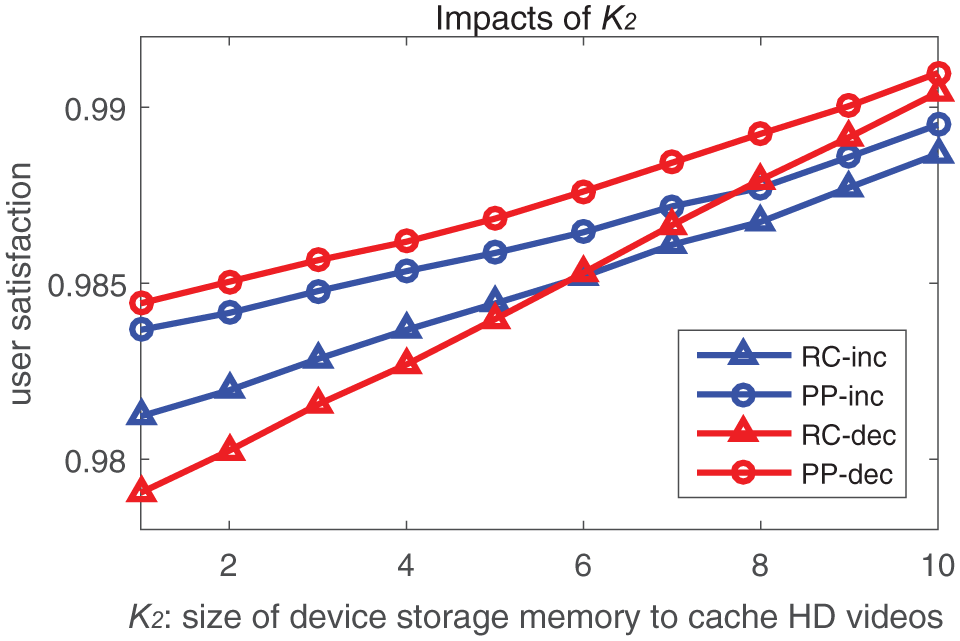
In Figures 4 and 5, we compare the two different caching methods for the user satisfaction under different and L. In Figure 4, the performance of the user satisfaction increases when the HD video storage memory size increases. However, for large values of , the performances approach the similar value. This can be attributed to the fact that a large value of leads to caching more HD videos in the limited storage. In Figure 5, the same trend considering the ratio of HD video size over SD video size L is shown. Usually, the size of a normal HD video is five times bigger than a normal SD video; therefore, we set L varying from 1 to 7. The simulation results demonstrate that the PP method outperforms the RC method correspondingly. Besides, with L increasing, the size of EL packet becomes larger, resulting in a lower SD video caching hit probability and system cache hit probability performance.
Performance of user satisfaction index with different when and .
Performance of user satisfaction index with different L when and .
We analyze Figures 3 and 4 jointly. With the increase in , the number of HD videos being cached is increasing, while the total number of videos being cached decreases. Similarly, the system cache hit probability decreases, while the user satisfaction increases at the same time. The reason for this phenomenon is that the B2D transmission is more stable than the D2D transmission, and more data are transmitted through B2D link. In Figure 5, with L increasing, the size of EL packet becomes larger, resulting in a lower SD video caching hit probability and system cache hit probability performance. Since the B2D links are more stable than the D2D links as mentioned before, the system user satisfaction increases. From the simulation results, we can see that the increase in both and L can reduce the total amount of cached videos and further impact the caching performance of the network. Thus, not only the video compression coding method and device storage memory allocation scheme but also the link state information of B2D and D2D can influence the performance of MTC caching network.
Conclusion
In this article, we consider the SVC video stream transmission in MTC caching network, which adopts RC placement scheme and PP placement scheme. Then, the closed-form expression for the D2D caching hit probability and the user satisfaction index are derived to measure the performance of different caching methods considering different D2D network environment. The impact of the correlative-dependent relationship between the caching hit probability and the user satisfaction index is analyzed. The simulation results show that in the SVC video MTC caching network, the PP caching method is superior to the RC method with consideration of both the caching hit probability and the user satisfaction index. Our research work can provide an analysis model in D2D-based caching MTC networks, as well as be a guideline in caching network deployment.
Footnotes
Handling Editor: James Brusey
Declaration of conflicting interests
The author(s) declared no potential conflicts of interest with respect to the research, authorship, and/or publication of this article.
Funding
The author(s) disclosed receipt of the following financial support for the research, authorship, and/or publication of this article: This paper was supported by the National Science and Technology Major Project of China under Grant 2017ZX03001004, the National Natural Science Foundation of China under Grant 61701042, Beijing Municipal S&T Project Z181100003218003 and 111 Project of China B16006.
References
1.
WuLZhangW.Caching-based scalable video transmission over cellular networks. IEEE Commun Lett2016; 20(6): 1156–1159.
2.
KangKYeRPanZet al. Game-theory-based distributed power splitting for future wireless powered MTC networks. IEEE Access2017; 5: 20124–20134.
3.
CuiQGuYNiWet al. Preserving reliability of heterogeneous ultra-dense distributed networks in unlicensed spectrum. IEEE Commun Mag2018; 56(6): 72–78.
JinSBestavrosAIyengarA.Network-aware partial caching for internet streaming media. Multimedia Syst2003; 9(4): 386–396.
6.
BektaşTCordeauJ-FErkutEet al. Exact algorithms for the joint object placement and request routing problem in content distribution networks. Comput Oper Res2008; 35(12): 3860–3884.
7.
Tamoor-ul-HassanSBennisMNardelliPHJet al. Modeling and analysis of content caching in wireless small cell networks. In: International symposium on wireless communication systems (ISWCS), Brussels, 25–28 August 2015, pp.765–769. New York: IEEE.
8.
ChaMKwakHRodriguezPet al. Analyzing the video popularity characteristics of large-scale user generated content systems. IEEE/ACM Trans Netw2009; 17(5): 1357–1370.
9.
SchwarzHMarpeDWiegandT. Overview of the scalable video coding extension of the h.264/AVC standard. IEEE Trans Circuit Syst Video Technol2008; 25(2): 135–141.
10.
SegallCASullivanGJ. Spatial scalability within the h.264/AVC scalable video coding extension. IEEE Trans Circuit Syst Video Technol2007; 17(9): 1121–1135.
11.
WangXChenMTalebTet al. Cache in the air: exploiting content caching and delivery techniques for 5g systems. IEEE Commun Mag2014; 52(2): 131–139.
12.
ShanmugamKGolrezaeiNDimakisAGet al. Femtocaching: wireless content delivery through distributed caching helpers. IEEE Trans Inform Theory2013; 59(12): 8402–8413.
13.
PantisanoFBennisMSaadWet al. In-network caching and content placement in cooperative small cell networks. In: Proceedings of the 1st international conference on 5G for ubiquitous connectivity, Äkäslompolo, 26–28 November 2014, pp.128–133. New York: IEEE.
14.
MolischFACaireGOttDet al. Caching eliminates the wireless bottleneck in video aware wireless networks. Adv Electric Eng2014; 2014(9): 74–80.
15.
JiMCaireGMolischAF.Wireless device-to-device caching networks: basic principles and system performance. IEEE J Sel Area Comm2016; 34(1): 176–189.
16.
GolrezaeiNMolischAFDimakisAGet al. Femtocaching and device-to-device collaboration: a new architecture for wireless video distribution. IEEE Commun Mag2013; 51(4): 142–149.
17.
GolrezaeiNMansourifardPMolischAFet al. Base-station assisted device-to-device communications for high-throughput wireless video networks. IEEE Trans Wireless Commun2014; 13(7): 3665–3676.
18.
ChenZPappasNKountourisM.Probabilistic caching in wireless D2D networks: cache hit optimal versus throughput optimal. IEEE Commun Lett2017; 21(3): 584–587.
DengTAhaniGFanPet al. Cost-optimal caching for D2D networks with user mobility: modeling, analysis, and computational approaches. IEEE Trans Wireless Commun2018; 17(5): 3082–3094.
21.
RaoJFengHYangCet al. Optimal caching placement for D2D assisted wireless caching networks. In: Proceedings of the IEEE international conference on communications (ICC), Kuala Lumpur, Malaysia, 22–27 May 2016, pp.1–6. New York: IEEE.
22.
PedersenHASassatelliLAparicio-PardoR. Random linear coded distributed caching for video streaming over D2D. In: Proceedings of the 14th annual conference on wireless on-demand network systems and services (WONS), Isola, 6–8 February 2018, pp.1–8. New York: IEEE.
23.
AmerRButtMMBennisMet al. Inter-cluster cooperation for wireless D2D caching networks. IEEE Trans Wireless Commun2018; 17: 6108–6121.
24.
EliasJBłaszczyszynB.Optimal geographic caching in cellular networks with linear content coding. In: Proceedings of the 15th international symposium on modeling and optimization in mobile, ad hoc, and wireless networks (WiOpt), Paris, 15–19 May 2017, pp.1–6. New York: IEEE.