




Abstract
Aiming at solving the issue of the robustness of sensor signal recovery as well as tackling the dilemma of simultaneous spectrum utilization, this article will concentrate on designing a robust wireless statistic division multiplexing scheme. The proposed robust wireless statistic division multiplexing transmits multiple sensor signals and shares the same frequency band simultaneously. The fundamental principle of robust wireless statistic division multiplexing is described as statistical independence or statistical distinction of the sensor source signals. An unsupervised learning mechanism named independent component analysis is used for robust wireless statistic division multiplexing receiving processing. The robust wireless statistic division multiplexing can not only contribute tremendously to enhancing the spectrum efficiency but also bring in attractive anti-noise performance. In this article, first, the fundamental mechanism of robust wireless statistic division multiplexing will be discussed in comparison with that of time division multiplexing, frequency division multiplexing and code division multiplexing. Second, in terms of robust wireless statistic division multiplexing receiving mechanism based on independent component analysis principle, a novel cost function based on minimization mutual information modified by minimum bit error rate constraint is investigated to improve robust performance of source recovery. Furthermore, independent component analysis–based blind source separation method combines with an adaptive moment estimation stochastic optimization for promoting the effectiveness of the source recovery performance. Finally, theoretical analysis and simulation experiments demonstrate the effectiveness and robustness performance of robust wireless statistic division multiplexing.
Keywords
Introduction
In recent decades, with the growing number of users and the increasing growth of demands for wireless services, the shortage issue of spectrum resources has received considerable and remarkable attention in wireless sensor network and wireless communication network.1,2 Therefore, the need to make effective use of radio spectrum resources has never been such urgent as it is now. How to exploit and utilize the finite natural spectrum resource effectively has played an important role in helping accommodate the increasing practical application requirements, such as wireless sensor network, cognitive sensor network, satellite communications and military anti-interference. It must be acknowledged that it appears very important to take effective advantage of radio spectrum resources.1,3
Traditionally, the available communication resources include the time, frequency and code, which can be employed to distinguish different users for allocating reasonable spectrum resource. In view of the efficient communication system, it gives top priority to planning out the resource allocation among system users while no communication resource is wasted, so that the different users can share the resource in an equitable and reasonable manner. The traditional distribution ways of the communication resource are the following: frequency division multiplexing (FDM) – specified sub-bands of frequency are allocated; time division multiplexing (TDM) – periodically recurring time slots are identified; and code division multiplexing (CDM) – specified numbers of a set of orthogonal or nearly orthogonal spread spectrum code are allocated.
It is certainly that FDM, TDM and CDM can make a significant contribution to the improvement of utilization of spectrum resources. Despite the attempt by telecommunication administration to apply the previous techniques in wireless communication system has been a tremendous success, some potential weaknesses also exist in those traditional schemes. FDM and TDM suffer from the detrimental influence of guard interval which results in the performance loss of multiplexing and reduces the channel capacity. CDM withstands a hard limit from the number of orthogonal codes. If non-orthogonal codes are used, the hard limit will be prevented. Nevertheless, non-orthogonal codes will incur mutual interference between users. The more the number of users who simultaneously share the system bandwidth using non-orthogonal codes, the higher the level of interference, which deteriorates the performance of the whole system. A non-orthogonal CDM scheme also requires power control in the uplink to compensate for the near–far effect. Therefore, the TDM, FDM and CDM signals are circumscribed in time interval, or frequency band or code.
In order to construct a highly efficient and flexible multiplexing system, some studies1,3 propose a novel wireless statistical division multiplexing (WSDM), which transmits multiple signals simultaneously in the same frequency band over wireless channel and recovers the source signals at the multiple antenna receiver by utilizing the statistical characteristics of the wireless channel. Thus, WSDM has remarkable and promising frequency efficiency performance improvement. With regard to the receiver in WSDM, the source signals are retrieved by blind source separation (BSS) based on independent component analysis (ICA, such as Fastica and Infomax).1–23 However, the conventional ICA model does not take into account the influence of noise, and the robustness of performance is weak.
Motivated by the previous studies,1,3 this article will focus on investigating a robust WSDM scheme for satisfying simultaneous spectrum access and strong source recovery. Constructing a highly efficient and highly robust system can contribute a lot to promote the frequency efficiency and source recovery performance in noisy contamination circumstance. For achieving this purpose, this article will give top priority to deriving a novel ICA cost function–based minimum mutual information (MMI) modified by anti-noise constraint. In detail, the minimum bit error rate (BER) principle is infused into MMI contrast function to strengthen the anti-noise performance. After that, an adaptive moment estimation (Adam) stochastic optimization 24 is employed to optimize this constructed cost function, which is appropriate for those that are large in terms of data and with noisy. The robust wireless statistic division multiplexing (RWSDM) can benefit remarkable improvement from this effectively innovative ICA algorithm. RWSDM can be considered as an extension of WSDM. Utilizing RWSDM can achieve numerous technique superiorities, which contain the enhanced spectrum efficiency, robust source recovery, parameter estimation avoidance and adaptive signal processing. Theoretical analysis and simulation experiments verify the robustness and effectiveness of the proposed RWSDM scheme.
The outline of this article is as follows. Section ‘The review of WSDM’ gives a review of the traditional WSDM schemes. Section ‘RWSDM’ presents the system model of RWSDM, the modified cost function and stochastic optimization method. Section ‘Performance analysis and remarks for RWSDM system’ describes the performance analysis and remarks. Section ‘Simulation analysis and discussions’ gives the experimental simulations to validate the effectiveness and robustness of the proposed method and scheme. Finally, the conclusions are achieved in section ‘Conclusion’.
The review of WSDM
For the purpose of highlighting and comprehending the proposed RWSDM scheme thoroughly in the next section, the WSDM will be reviewed in this section. In essence, WSDM is a multiplexing technique which reveals that each sensor or user signal can share a communication resource without producing unmanageable interference to each other in the process of detection. Compared to the traditional multiplexing techniques including FDM, TDM and CDM, WSDM becomes increasingly important in future wireless communications. With the increasing requirements of wireless communication services, the simultaneous spectrum access has become an obvious problem. Smart and intelligent signal processing is evoked to assist for achieving interference avoidance. It is coincided that the fundamental of WSDM is based on intelligent processing mechanism with the statistical principle and machine learning rule.
In multiplexing mechanism, it has been proved previously that orthogonal signals play a crucial part in avoiding interference among users. Consider that signal waveforms

where K is a nonzero constant. Multiplexing techniques divide up the total signalling dimensions into channels and then assign these channels to different signals. The most common methods to divide up the signal space are according to the time, frequency and code axes. Then, the classical FDM, TDM and CDM are generated, as portrayed in Figure 1(a)–(c).

Typical multiplexing techniques in wireless communications: (a) frequency division multiplexing, (b) time division multiplexing, (c) code division multiplexing and (d) wireless statistic division multiplexing.
There is an increasing concern that some weaknesses are being disadvantaged for that TDM, FDM, and CDM signals are limited in interval, or frequency band or code. Recent researches indicate that a great number of scholars are eager to seek an alternative fascinating multiplexing to better the system performance. Thus, taking into account the limitation of the above-mentioned multiplexing FDM, TDM and CDM, investigators proposed a new multiplexing scheme called WSDM or SDM. The principle of WSDM depends on the statistical independence of source signals, and source signals simultaneously occupy the same time and bandwidth. The N source signals

According to the previous assumption, the system signalling dimensions can be divided along the statistic axis into non-overlapping channels, and each signal is statistically independent from other signals, as shown in Figure 1(d). In the WSDM system, N source signals can be transmitted in the same frequency band simultaneously over wireless multiple-input and multiple-output (MIMO) channel by dividing the statistic axis into non-overlapping channels. Multiple signals can be recovered using statistical distinction of the source signals. The N sources signals

There is an urgent need to address the robustness problem caused by the noise influence in the process of detection stage with respect to WSDM. Consequently, the WSDM will be extended to enhance the source recovery performance, and the robust version of WSDM will be proposed in the following section.
RWSDM
In this section, to begin with, the system model of RWSDM will be illuminated. Then, the robust detection algorithm–based ICA will be presented. Note that the two components of the ICA algorithm play a pivotal role in deciding the detection of performance, including cost function and optimization method. In order to arrive at the robustness performance, the modified objective function and Adam optimization will be used to improve the effectiveness and robustness of the system performance. The proposed algorithm in association with WSDM mechanism will constitute the RWSDM technique. Furthermore, the relevant theoretical analysis will be discussed.
System model
Over the past few years, the development of wireless communication has motivated engaging interest in multiplexing techniques for the highly efficient and highly robust processing of resource allocation. The typical application scenes of RWSDM in senor network, mobile communication and satellite communication have been illustrated in Figure 2. Utilizing the RWSDM scheme, it is important to achieve co-time, co-frequency interference elimination or simultaneous spectrum access. Therefore, to conceive an effective and robust WSDM mechanism is of great significance for wireless sensor network and wireless network (Figure 3).

Applications of RWSDM in sensor network, mobile communication and satellite communication.

Fundamental system model of RWSDM.
Consider a situation in which there is a collection of signals emitted by some physical objects or sources. These physical sources could be, for instance, sensor signals or radiation sources emitting their electromagnetic waves. Assume further that there are several sensors or antennas. These sensors or antennas are in different position so that each records a mixture of the original source signals with different weights. It is assumed that the mixing weights are unknown because they are inaccessible in general. Of course, the source signals are also unknown because the primary problem is that they cannot be recorded directly. Nevertheless, substantial sensor source signals essentially conform statistical independence condition due to the different physical generation patterns. Up to now, it has been shown as a very utility and attractive statistical principle to construct statistical division multiplexing mechanism. Moreover, with the help of ICA or BSS theory, it will make a generous contribution to interference cancellation and parameter estimation avoidance. The purpose of adaptive signal processing can be gained. It can extract the original signals from their observed mixtures without prior knowledge of the mixing weights and by knowing very little about the original sources. Assume that the number of sources is same as that of sensors in receiver. The noisy mathematical model of observed mixtures is always represented as2,4–27

where the matrix
After implementing separation step, the estimated signals of sources will be derived. The separation operation is described in the mathematical form as

where
The main assignment in separating system is searching for a linear matrix
Note that the addition of noise in ICA statistic model will degrade the performance of the ICA algorithms to separate the mixed source signals. However, the WSDM scheme adopts the conventional ICA algorithms, which do not take into deep consideration of the noise term in the model. Therefore, the robust performance will not be guaranteed in weak signal-to-noise (SNR) condition. In the following section, both the above-mentioned two pivotal steps will be modified for robust and effective performance.
Robust scheme for fulfilling RWSDM
Generally, the purpose of the separation algorithm is to recover source signals that are simultaneously transmitted in the same frequency band from received mixed signals. No prior knowledge of source signals and mixing system is available in the separation process.6–10 The essential framework of the separation algorithms is illustrated in Figure 4.
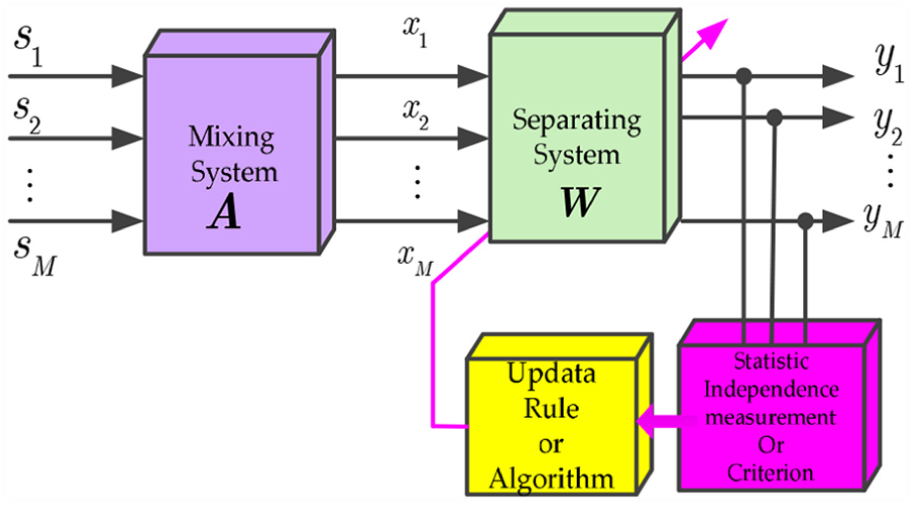
Framework of the separation algorithm.
Constructing cost function for robust separation rule
Mutual information minimization principle
Under the independence assumption, an enormous amount of measurements or criteria have been employed to establish the cost function. A perfect example can be found in mutual information minimization (MMI) principle, which is a significant independent judgement for deriving ICA algorithms. Of course, MMI is not alone in constructing ICA cost function for blind separation methods. There are some representatives of criteria, such as maximum likelihood (ML), non-Gaussianity maximization, nonlinear decorrelation, maximization entropy and negative entropy, which have exerted a great importance role in promoting the development of blind separation techniques. These cost functions of ICA have derived a great deal of prestigious separation methods. Note that these cost functions always have close relationship and equivalent transformation form. In this subsection, the MMI will be described which is important to demonstrate the preparation of subsequent modified cost function derivation.
Given

Obviously, if and only if
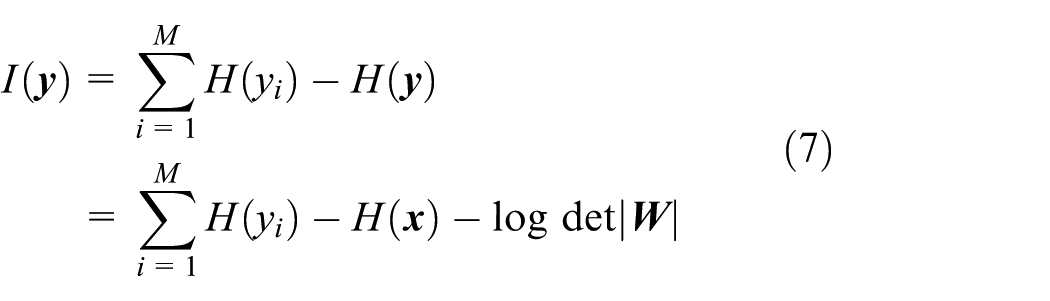
where

Due to the fact that

The de-mixing/separation matrix

In the following, the optimization problem of MMI is implemented by the natural gradient for its fast and accurate adaptation behaviour. The purpose is to determine the gradient of the mutual information with regard to the elements of

The two terms of the previous gradient will be analysed separately. In ICA, a family of nonlinear functions

where

Finally, we are able to compute the natural gradient update step
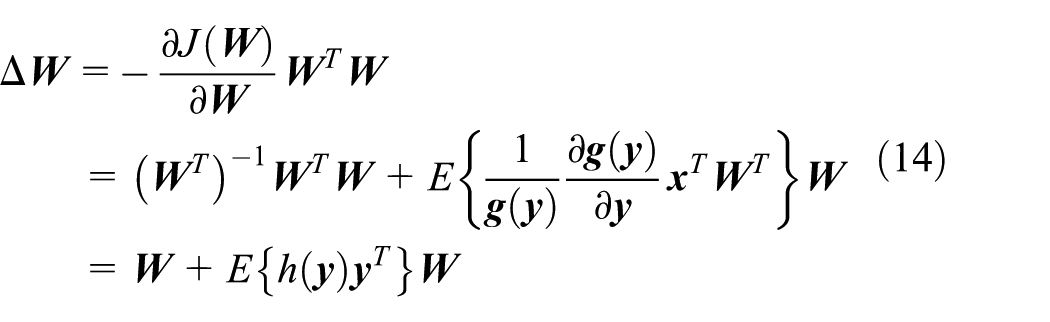
where

The MMI algorithm for ICA will repeatedly perform an update of the matrix

The update step is given by equation (16), where
Mutual BER-modified MMI-based cost function
In this subsection, the minimum BER criterion is derived first. Then, the minimum BER criterion incorporated into MML principle based cost function is built. The BSS problem in RWSDM is equivalent to a blind equalization form. Taking into account of communication signals in system model, the transmitted symbols are equiprobable antipodal symbols (e.g. binary phase-shift keying (BPSK)) uncorrelated with each other, which satisfy 23

The antipodal assumption is made for simplicity, and other constellations can also be used to extend, such as 4-quadrature amplitude modulation (4-QAM)/quadrature phase-shift keying (QPSK). The noise vector

When

Ideally,

in which

By following standard steps, it can be shown that the probability of the mth source symbol with
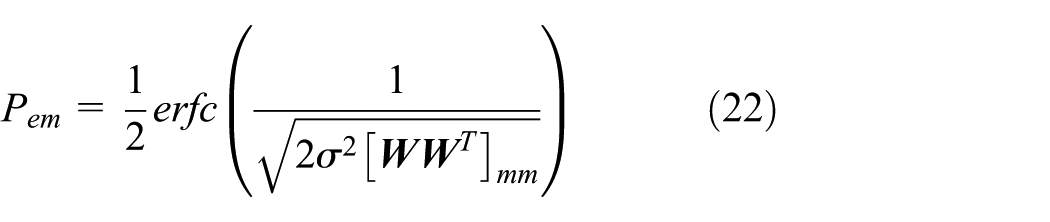
where

If we assume

Therefore, if

Equality in equation (25) holds if and only if

The quantity
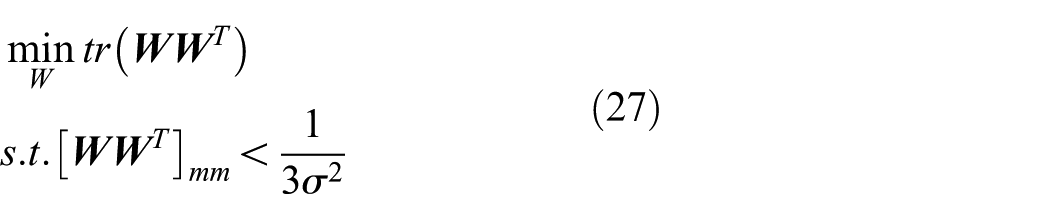
Associated with equation (10), the modified cost function with minimum BER can be obtained as

In order to simplify the previous constrained optimization problem (equation (28)), combined with equation (26), the modified cost function with minimum BER criterion in condition of the moderate-to-high SNRs can be described as a unconstrained optimization problem, that is

where

Regarding the selection of the nonlinear function, there are several alternatives. However, especially in the case of digital communication signals, a good nonlinearity is represented by the following function

Modified optimization by Adam algorithm.21,24
Adam algorithm is an effective and useful optimization scheme for first-order gradient-based optimization of stochastic objective functions based on adaptive estimates of lower order moments.21,24 This method solving the straightforwardly and has advantages of computationally efficient function and low memory requirements as well as invariant character to the diagonal rescaling of the gradients. Utilizing this method is suited for the issues that have the related large data and/or parameters. This method is also fit for non-stationary objectives and problems with very noisy and/or sparse gradients.21,24 The fundamental principle of Adam algorithm will be demonstrated below.
Assume that


where


In equation (35), the vector

where
In the following step, the modified update rule will be proposed by using the Adam optimization method.21,24 Note that Adam algorithm executes in the form of vector parameter, so the vectorization of the gradient (equation (30)) will be firstly carried out to generate a vector transformation form as,

where
For this purpose, the mean and variance vectors are evaluated from the knowledge of the gradient

At last, the vector

In which the function of the operator
The proposed MAMI algorithm.

“%” denotes the annotation indicator, often used in MATLAB.
Performance analysis and remarks for the RWSDM system
Capacity analysis of the RWSDM system
As it is well known, channel capacity is a fundamental and direct property of communication systems. In terms of RWSDM, the capacity of the RWSDM system channel is the maximal information of observed time–frequency mixed signals from sources which is defined as

where

in which

Therefore, we can obtain

In accordance with the central limit theorem, the mixed signals

where

By means of Shannon’s channel capacity theory, we acquire

where B represents the frequency bandwidth and


From the previous equation, we can draw the conclusion that the upper bound capacity of the RWSDM system is M times than that of Shannon’s capacity in the same frequency bandwidth. Moreover, the lower bound capacity of the RWSDM system straightforwardly improves the SNR ratio. In summary, RWSDM can contribute significantly to the improvement of the utilization of spectrum resources in wireless communications.
Complexity and convergence analysis of the proposed algorithm and its performance evaluation
As the estimation of a separation matrix in the presence of noise is rather difficult or inaccurate, the majority of traditional research efforts have been devoted to the noiseless case or assumed that the noises have negligible effect on the performance of the algorithms. However, in the practical application, noise is an inevitable factor in observed mixtures. How to separate the received mixed signal effectively robustly plays a crucial role in meliorating the system performance. This article has devoted every possible effort to promoting the blind separation performance of source signals contaminated by additive Gaussian noise. For the purpose of achieving the attractive performance of de-mixing signals, two modified schemes have been proposed to refine the separation performance of the conventional ICA algorithm.
On one hand, the minimum BER criterion has been recommended for being integrated into the traditional ML-based ICA objective function. The modified cost function takes into account the detrimental influence of noise in the process of constituting the cost function. By contrast, the original ML principle–based cost function neglects the effect of noise. However, the additive Gaussian noise is inevitable in many surroundings, especially in wireless communications. In terms of the update rule, the equation can be rewritten as follows

From the perspective of computation complexity, the proposed cost function has only added the

In the above-mentioned equation, assume that the separation matrix
On the other hand, due to high computational efficiency and easy implementation, the Adam optimization method is introduced for seeking the effective separation matrix. The optimization problem of the cost function for finding the separation matrix will benefit a lot from the excellent properties of the Adam approach. This method has
In summary, we can safely conclude that the proposed algorithm can perform better than the traditional ICA in separation work in the dilemma of noise. The effectiveness and robustness of the proposed algorithm will be verified via simulation experiments in the next section.
Simulation analysis and discussions
For the purpose of corroborating the effectiveness and robustness of the proposed algorithm utilized for realizing RWSDM technology, we conduct comparative computer simulation experiments to evaluate the performance of the proposed method. In order to compare the classical and the state-of-art algorithm, we consider that, the classical Infomax algorithm, 19 the Momentum Infomax 20 and the Adam Infomax 21 are used to complete these experiment analysis. The results are evaluated in terms of Amari Performance Index (PI), defined as in equation (51), and bit error rate (BER) often used in wireless communication,

where
In order to highlight the hybrid mechanism of Minimum BER criterion associated with the Adam algorithm in comparison with the representative algorithm, we consider the similar simulation parameters from the reference 21 to make comparative experiments. In the first comparative experiment, the observed mixtures of the following bad scale independent sources are considered as 21
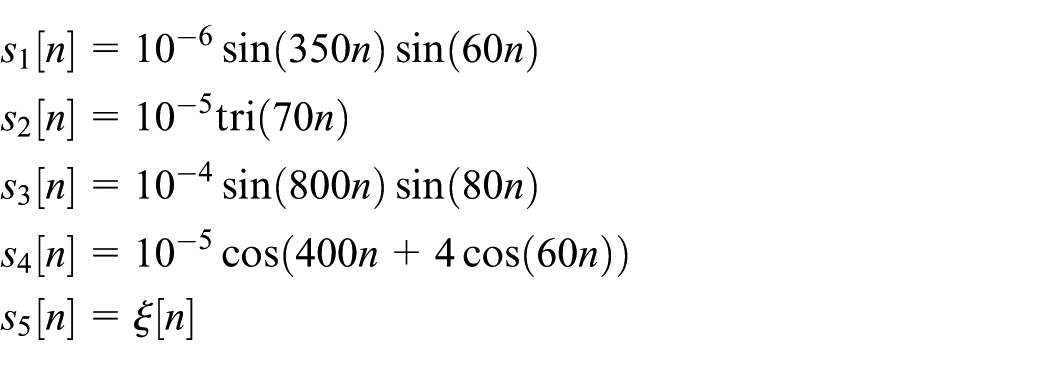
in which the
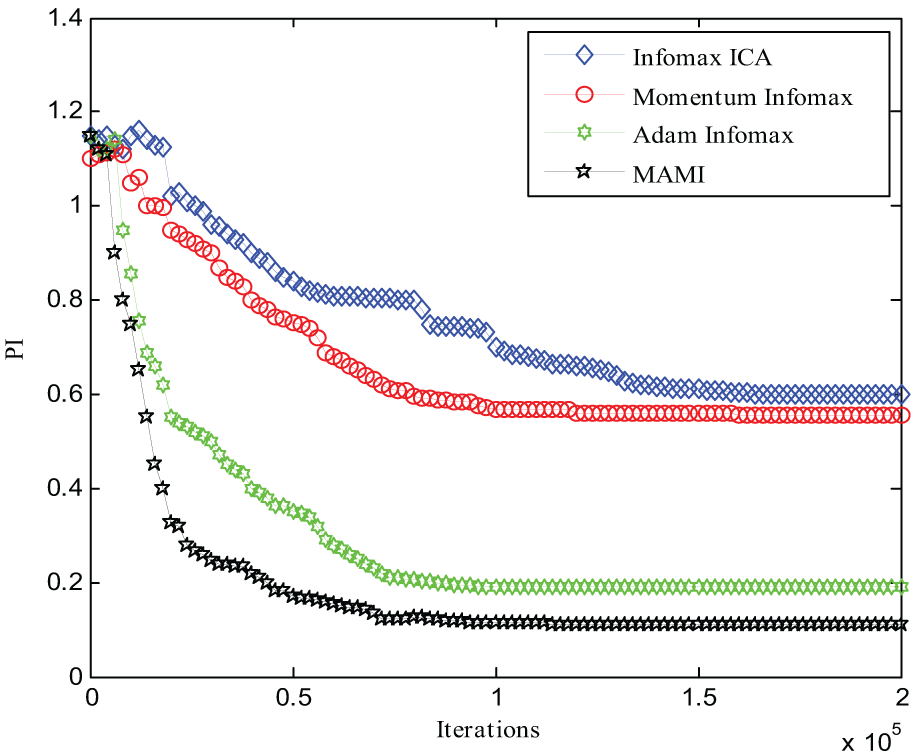
Performance index (PI) performance comparison as a function of iterations for different algorithms.
In a second comparative experiment, we consider that a multiple input multiple output (MIMO) based statistical division multiplexing system, the number of transmitting antenna and receiving antenna is set as 4, and the source symbols are from binary phase shift keying (BPSK). The mixing matrix is generated randomly. A block length of

BER performance comparison as a function of SNR for different algorithms.
In order to further illustrate the superiority of the proposed algorithm, the direct separation exhibitions are portrayed in the following Figures 7 and 8 in the condition of the SNR = 10 dB, and the length of 1000 data samples is shown in the pictures for simplicity. From the separated results in Figures 7 and 8, we can safely verify that the incorporation of minimum BER criterion in ICA principle improves the separation performance. The robustness of anti-noise influence is strengthened and the performance refinement is attained, thanks to the infusion of the minimum BER constraint.

Adam Infomax separation performance: (a) transmitted signals, (b) received signals and (c) separated signals.

MAMI separation performance: (a) transmitted signals, (b) received signals and (c) separated signals.
In the third comparative experiment, the capacity performance of the proposed scheme is shown in Figure 9 when the number of sources is set as

Capacity performance comparison as a function of SNR for different schemes.
Conclusion
It must be acknowledged that the effective utilization of the finite frequency spectrum resource has become increasingly important in wireless sensor networks and wireless communication networks. The reasonable spectrum resource allocation will contribute a lot to enhancing spectrum efficiency and economizing the cost. This article has put forward a robust statistic division multiplexing scheme – RWSDM. This robust statistic division multiplexing technique can transmit multiple user signals in the same frequency band simultaneously, which may be a promising scheme for full-duplex communication. The recovery mechanism of source signals depends on the statistical independence of original sources via blind separation algorithms. The study has demonstrated that RWSDM can serve as a flexible and efficient radio spectrum multiplexing scheme instead of FDM, TDM and CDM. Theoretical analysis and simulation results show that the proposed method is effective and robust compared to the traditional multiplexing methods. The advantageous performance of RWSDM attributes to the proposed two modified mechanisms in separation algorithm. In conclusion, the superiority of the developed RWSDM makes it a promising and remarkable scheme in the future cognitive sensor network and wireless communication network. Further investigations into cognitive radio sensor network (CRSN) for spectrum access, 28 or other statistic distinction conditions, such as sparsity and boundedness of sensor source signals, and anti-interference in sensor signal processing, are strongly recommended.
Footnotes
Handling Editor: Daniel Gutierrez-Reina
Declaration of conflicting interests
The author(s) declared no potential conflicts of interest with respect to the research, authorship, and/or publication of this article.
Funding
The author(s) disclosed receipt of the following financial support for the research, authorship, and/or publication of this article: The paper was supported by the National Natural Science Foundation of China (nos 61801319 and 61871422), the Opening Project of Artificial Intelligence Key Laboratory of Sichuan Province (no. 2017RZJ01), the Opening Project of Key Laboratory of Higher Education of Sichuan Province for Enterprise Informationalization and Internet of Things (no. 2017WZJ01), Sichuan University of Science and Engineering Talent Introduction Project (nos 2017RCL10 and 2017RCL11), the Education Agency Project of Sichuan Province (18ZB0419) and the Major Frontier Project of Science and Technology Plan of Sichuan Province (no. 2018JY0512).
