




Abstract
In this article, a new optical network structure coping with network congestion is proposed, which is based on passive optical network, and adopts data storage devices coupled with optical line terminal to release network burden. It is shown by our network performance simulation that this network has many merits such as free-scale, fewer connections, larger clustering coefficient, and smaller average shortest path length in comparison to the passive optical network. The novel network structure can replace the far-end service connections with the near-end ones, reduce congestions in an optical network, and, furthermore, relieve traffic burden in optical backbone and metropolitan area networks.
Keywords
Introduction
Optical networks are rapidly growing to accommodate the explosion in multiple traffic services introduced by new personal and enterprise applications, such as Internet access, telephone, and television service. 1 Meanwhile, the bursty of services as real-time video communications and streaming media transmissions, has occupied an increasing amount of optical network bandwidth, and has given rise to heavier network congestions as well. In terms of the optical backbone network and metropolitan area network (MAN), one main reason for the congestions is the massive duplicate data transmission requested by different users. Recently, several algorithms and protocols have focused on the issues of optical network congestion 2 and resource utilization efficiency. 3 However, to the best of our knowledge, the investigation of the congestion problem caused by the duplicate service has not been reported in the literature.
To solve the network congestion problem, especially the congestion induced by the duplicate services, a new optical network structure is proposed in this article, named content server–aided passive optical network (CSA-PON). It is realized by adopting a high-capacity storage server to couple with optical line terminal (OLT) named optical line terminal-extended (OLTE). In the MAN, OLTEs are connected in a ring topology. When an optical network unit (ONU) requests far-end services that are also requested by other ONUs in the MAN, the OLTE will save the services to its storage device, and thus all ONUs in the MAN could share the services through OLTEs. The new network replaces the original far-end connection with the near-end one in the MAN, which will reduce the time of connection establishment and data transmission and ease the traffic burden in the optical backbone network.
The simulation results reveal that the clustering coefficient of CSA-PON is larger and the average shortest path length is smaller compared to the PON, which makes CSA-PON present a better performance in network resource sharing and data routing. Especially for duplicate services, the network can reduce the transmission times in the backbone network, cut down hop counts required by far-end connection, and relieve congestions in the optical backbone network and MAN. The new network can deal with centralized and distributed service and is meaningful for the optical network design in the future.
The rest of this article is organized in six sections. Section “Related works” represents the related works. The service model for CSA-PON is investigated in section “Service model for CSA-PON.” In section “Network model for CSA-PON,” the network model for CSA-PON is explained in detail. The performance evaluation of the proposed architecture is presented in section “Simulation analysis and discussion.” Finally, section “Conclusion and future work” concludes this work and outlines the possibilities for future work.
Related works
The Ethernet passive optical network (EPON) is a PON-based network, which is designed to accommodate the requirements of large bandwidth and flexibility for future access networks. The most typical EPON system consists of an OLT residing at the central office and connected to several ONUs with a tree topology. It employs Ethernet as the link-layer protocol and carries data encapsuled in Ethernet frames. As the next-generation optical access architecture, the EPON was first proposed and intensively researched in Kramer and Pesavento. 4 The authors described the evolution of the access network and introduced EPON with its topology, standard, security and market perspective. Houtsma et al. 5 proposed the recent progress in standardization of high-speed EPON, and 25/50/100G EPON architecture as well as their physical and MAC layer specifications was discussed.
Based on the network resource allocation scheme, EPON can be divided into different architectures such as time division multiplexing (TDM) PON, wavelength division multiplexing (WDM) PON, and hybrid time and wavelength division multiplexing (TWDM) PON. However, more attention has been paid to orthogonal frequency division multiplexing (OFDM)-PON recently, which employs OFDM as the modulation scheme to increase the data rate. 6 As compared to the other multiplexing schemes, OFDM-PON enjoys the advantages of higher speed transmission, finer bandwidth granularity, and color-free ONUs. 7
Dealing with dramatically changed bandwidth demands of ONUs, a variety of dynamic bandwidth allocation (DBA) algorithms have been proposed for EPONs. The process of DBA generally consists of two parallel problems: grant sizing and grant scheduling. 8 In Dixit et al., 9 energy-efficient DBA algorithms and their implementation challenges for EPONs are discussed; meanwhile, a new sleep mode–based DBA is exploited and extended with various grant sizing schemes. As one of the fundamental issues for optical access networks, the physical-enhanced security has received significant attention from researchers. Physical layer secure OFDM-PON systems using chaos-based encoding or chaotic pseudorandom radio frequency (RF) subcarriers are discovered in Zhang et al.,10,11 which are regarded as promising physically secured solutions for future OFDM access network.
In recent years, the software-defined networks (SDNs) are extended to the optical networking with efforts on either industrial applications 12 or academic research. 13 A comprehensive academic survey of software-defined optical networks (SDONs) is presented in Thyagaturu et al., 14 focusing on the infrastructure layer, control layer, and the application layer, successively. Talli et al. 15 demonstrated a dynamically reconfigurable TDM-DWDM LR-PON, which converged multi-service traffic on a single physical layer and supports heterogeneous services and modulation formats.
Service model for CSA-PON
In a PON, the OLTs only receive and transmit data, while in our CSA-PON, besides the normal function of OLT, OLTEs also store contents preparing for the service requests of ONUs.
Service storage principle
The preparing contents are stored in the content server, which is coupled with OLT. In order to achieve an accurate and fast service searching, a query table is created in OLTE as well. The query table is formed by three columns: active factor (AF), uniform content location (UCL), and storage OLTE label (SOL).
The AF is a counted number that records the request times of the selected contents. Obviously, it means that the larger the AF, the greater the importance of the contents. If enough storage space is not available for the local content server to store the new data, the contents with the least AF will be abandoned to free up space. To maintain the time effectiveness of the record of request times, AF will keep a continuous decrease with minutes. If the content is not requested for a long time, AF tends to be zero. The UCL is a structure for describing network information resources and a new method to search semantic based on content location. 16 It has been deployed in the asymmetric information sharing network and network security.17,18 The SOL indicates the location of the OLTEs that store the requested contents, which is critical for data routing. The AF and SOL are all first introduced in this article for content storing and searching.
Note that the query table contains the content information of the whole servers in the MAN, not only of its own content server. When the content is altered on any OLTE server, the server will broadcast the update message to all other OLTEs in the same MAN, which can keep the consistency and timeliness of all query tables. This mechanism ensures that all the preparing contents in the MAN can be found through any OLTE, which indicates that one OLTE can search and obtain the needed contents from all other OLTEs.
Service request and transmission
When an ONU requests a new service with UCL, its connected OLTE will search the UCL codes in its query table. Different searching results will lead to different connection schemes:
Scheme 1. If the requested contents are not found in the table, which means that the requested service is not stored in the whole MAN, the service request will be sent to the optical backbone network eventually.
Scheme 2. If the requested contents are found in the query table, OLTE will ensure the location of the content server through SOL first. If the contents are just stored in the local OLTE, the connection will be immediately created between the ONU and OLTE.
Scheme 3. If the requested contents are found in the query table, but the contents are not stored in the local OLTE, then the local OLTE will send a request to the destination OLTE and create the service connection between ONU and the destination OLTE finally.
In order to improve the quality of service, a simplified shortest propagation delay (SPD)-first scheduling 19 scheme is adopted to CSA-PON. The propagation delay can be roughly classified into three different priority levels based on the distances between the ONU and the destination OLTE. As mentioned above, the destination OLTE in the local field has the first priority to be planned, while the destination in the same MAN has the second one, and the other cases all belong to the third priority. The upstream transmission of the ONU with the higher priority of propagation delay is scheduled first.
An example of service transmission is shown in Figure 1. In the PON, ONU1-1 and ONU1-2 both ask ONUN-1 for the same steaming media, so the two ONUs need to build connections (① and ② as shown in Figure 1) in the optical backbone network and MAN to accomplish the duplicate service, which wastes bandwidth and possibly causes congestions. However, in CSA-PON, ONU2-1 also establishes a connection with ONUN-1, but the services are saved in the content server of the local OLTE. Thus, ONU2-2 can get the same services from the local OLTE (③ and ④ shown in Figure 1), which means that the connection between ONU2-2 and ONUN-1 is needless, and the bandwidth is released as a result.

Comparison of PON and CSA-PON.
Network model for CSA-PON
Random and scale-free network
The random networks are characterized by a Poisson distribution of node degrees, and thus they have a certain predictable distribution of connections among their nodes. However, the scale-free networks exhibit a power-law degree distribution, which predicts the existence of a small number of well-connected nodes. 20 For the optical network simulation, both the models mentioned above have been widely used,21,22 and however the accurate model for the real optical network is still under investigation.23,24
In this article, the ONUs and OLTEs are regarded as the nodes in the network, and we only focus on the logical links between these nodes. For the reason that the architecture of the logical topology in optical networks meets the characteristic of the scale-free networks, 25 we employ scale-free network topology for performance evaluation.
Metrics of complex optical networks
To evaluate the network performance of CSA-PON, we first define some basic parameters normally used to characterize complex optical networks as follows:
The degree distribution
The clustering coefficient of node i is defined as

where
The clustering coefficient of the complex network is defined as

where N indicates the number of nodes in the network.
3. The average shortest path length is defined as

where
Formulation
In order to promote the performance improvement of the CSA-PON network, we need to deduce
Suppose that
Condition 1
The node in the original PON network has k connections. While the k connections in the new CSA-PON network all fail to find the needed contents in the OLTE server, which means the node still has k connections in CSA-PON, then the probability of Condition 1 can be expressed as

where
Condition 2
The node in the original PON network has at least k connections, that is, (k + n) connections, n = 0, 1, 2, … At this time, only (k – 1) connections in the new CSA-PON network fail to find the needed contents in the OLTE server. While the other (n + 1) connections successfully find the needed contents, which means that these (n + 1) connections can be replaced by one connection from the node to the OLTE server, the node also still has k connections in the new network. Then the probability of Condition 1 can be expressed as follows

Therefore, the degree distribution of the CSA-PON network can be formed by equations (4) and (5)

Note that the formulation of P(k) is a general result regardless of the original PON model, which is characterized by Pini(k).
Figure 2 shows the theoretical degree distributions of scale-free network and CSA-PON. We set Ps = 0.5 and the scale-free network degree distribution Pini(k) = 0.7/k2.3, and then P(k) of CSA-PON can be computed through formula (6). Obviously, the probability of one degree is 10% higher for CSA-PON, while the probabilities of degrees larger than two become lower. The theoretical results demonstrate that most of the nodes in CSA-PON have fewer connections, leading to less network burden.

Comparison of theoretical degree distribution between scale-free network and CSA-PON.
Logical topology of CSA-PON
Figure 3 shows two topologies of the optical scale-free network and the CSA-PON. The scale-free network is produced by MATLAB codes “B-A scale-free network generation and visualization.” 26 The SFNG m-file is employed to generate all scale-free networks simulated in this article with the same seed network as follows


Comparison of topology between scale-free network and CSA-PON: (a) topology of scale-free network and (b) topology of CSA-PON.
This illustration network consists of 20 nodes and 34 bidirectional links. The corresponding CSA-PON also has 20 nodes, and every 10 nodes connect to one OLTE. The probability Ps is 0.5, which means that half of the connections in the original network are replaced by the links from the node to OLTE in the CSA-PON.
As the number of users is increasing, the complex scale of CSA-PON is the same as the normal PON network. However, OLTEs require a larger storage space to meet the demands of a more comprehensive content searching operation, and the process of searching and responding should be more agile to guarantee the quality of services.
Simulation analysis and discussion
A set of simulations are conducted to validate our analytical models presented in sections “Service model for CSA-PON” and “Network model for CSA-PON.” We simulate the performance of scale-free network and CSA-PON considering three main influencing factors, which are the number of ONUs, the number of OLTEs, and the probability that any connection can successfully find the needed contents in the OLTE server. The simulation parameters are summarized in Table 1.
Simulation parameters.
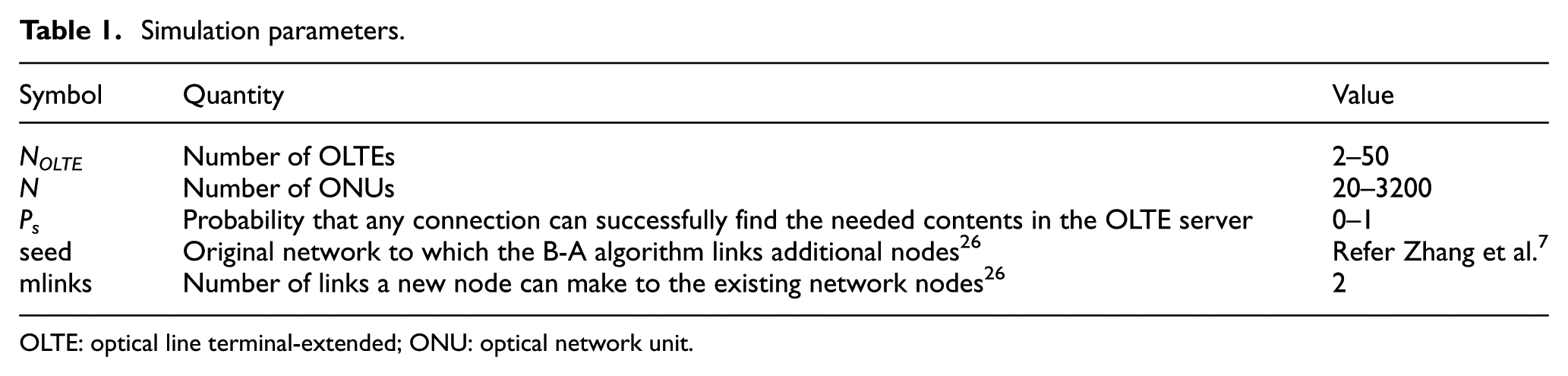
OLTE: optical line terminal-extended; ONU: optical network unit.
Degree distribution
Two different cases are proposed for the degree distribution simulation and analysis. In the first simple case, the topology of the network with 20 nodes is the same, as shown in Figure 3, and the degree distributions are shown in Figure 4. In order to simulate the large-scale optical network, we provide another case with 3200 nodes and 6800 bidirectional links; every 64 ONUs are connected to one OLTE, and the degree distributions are shown in Figure 5.

Degree distributions of scale-free network and CSA-PON with N = 20, NOLTE = 2, and Ps = 0.5.

Degree distributions of scale-free network and CSA-PON with N = 3200, NOLTE = 50, and Ps = 0.5.
With the same network scale, the number of nodes with a very low degree in the CSA-PON is obviously larger than that in the scale-free network, while the number of nodes with a higher degree becomes smaller. The simulation result is consistent with the theoretical conclusion shown in Figure 3, indicating that the degree distribution of CSA-PON has power-law features as well, but with a steeper slope.
Note that the degree distribution probability of the node with 64 links is extremely high in Figure 5, nearly 1%. Almost all these nodes are OLTEs, which have logical links with most of the ONUs physically connected to them. However, the higher degree of OLTEs will not increase the burden of the whole optical network, especially the backbone network. On the contrary, by replacing the connections between ONUs with links, or between ONUs and OLTEs, the massive data flow passing through the backbone network will remarkably decrease.
The variation of degree distribution with different Ps is shown in Figure 6. As the degree distribution probability Ps increases, the number of nodes with higher degrees decreases substantially, and more ONUs can successfully find the needed contents in the OLTE, which means a lower network burden in backbone networks.

Degree distributions of CSA-PON with different Ps, N = 3200, and NOLTE = 50.
Clustering coefficient and average shortest path length
The comparison of clustering coefficients and average shortest path lengths between the CSA-PON and the scale-free network is shown in Figures 7 and 8. The number of trails is 200. In view of Ps as 0.5, and of the number of nodes as 128 in both networks, clustering coefficients of the CSA-PON and the scale-free network are 0.3 and 0.1, while the average shortest path lengths are 2.5 and 3.2, respectively. For the situation of 3200 nodes, clustering coefficients of the CSA-PON and the scale-free network are 0.01 and 0.009, while the average shortest path lengths are 4.5 and 4.6, respectively. With the growth of the network scale, the clustering coefficient and the average shortest path length of the CSA-PON get closer to those of the scale-free network. However, the clustering coefficient of the CSA-PON is always larger, while the average shortest path length is always smaller. All the simulation results reveal that the connections in the CSA-PON are tighter for the reason of OLTE introduction and the hop counts between nodes are smaller than those in the scale-free network.

Clustering coefficients of the scale-free network and the CSA-PON with Ps = 0.5.

Average path length of the scale-free network and the CSA-PON with Ps = 0.5.
The connections between ONUs and OLTEs make the network more centralized, and the smaller average shortest path length makes OLTE connected more easily. In consideration of the practical situation of the CSA-PON, OLTEs in a MAN store frequently requested services. Therefore, subscribers can get these services from OLTEs in the MAN. Unless users cannot seek out the services that they want in a MAN, connections need only to be established in an optical backbone network, even in a MAN. For this reason, far-end connections will reduce such that the traffic transmission will decrease, which improves the network ability of dealing with burst traffic.
Conclusion and future work
An optical network of named CSA-PON that is combined with a content server with the OLT is proposed in this article, where an extended functional optical terminal, OLTE, is introduced to improve the network performance. On account of the CSA-PON architecture and its service model, simulations are conducted by the network analysis method. The simulation results indicate that the degree distribution also has power-law features for the CSA-PON network, but with a steeper slope than that of the scale-free network. Meanwhile, the clustering coefficient of CSA-PON becomes larger and the average shortest path length becomes smaller. The variations of the network parameters mean more centralized services, fewer hop counts, less network burden, and alleviated congestion in an optical backbone network and a MAN. Hence, our CSA-PON will be instructive and meaningful to model and plan an optical network in the future.
As one of the most promising techniques for optical networking, SDONs could be considered to introduce in our proposed network, and the efforts should focus on the control of OLTE servers, as well as service virtualization. Integration of EPONs and metro networks is another valuable research issue for optical network design.27,28 However, the interface between CSA-PONs and metro networks is not specified in this work, but, in the future, an elaborate media access control (MAC) protocol with our proposed architecture could be designed for metro-access network bridging.
Footnotes
Handling Editor: Gianluigi Ferrari
Declaration of conflicting interests
The author(s) declared no potential conflicts of interest with respect to the research, authorship, and/or publication of this article.
Funding
The author(s) disclosed receipt of the following financial support for the research, authorship, and/or publication of this article: This work was supported in part by the National Natural Science Foundation of China (NSFC) under grant no. 61871418 and Open Fund of State Key Laboratory of Advanced Optical Communication Systems and Networks (Peking University), P.R. China.
