




Abstract
In this article, the exponentially time-growing drainage boundary is introduced to study the one-dimensional consolidation problem of double-layered soil. First, the one-dimensional consolidation equations of soil underlying a time-dependent loading are established. Then, the analytical solution of excess pore water pressure and average consolidation degree is obtained by utilizing the method of separation of variables when the soil layer is separately undergone instantaneous load and single-stage load. The validity of the present solution is proven by the comparison with other existing analytical solution. Finally, the influence of soil properties and loading scheme on the consolidation behavior of soil is investigated in detail. The results indicate that, the present solution can be degraded to Xie’s solution utilizing Terzaghi’s drainage boundary by adjusting the interface parameter, that is to say, Xie’s solution can be regarded as a special case of the present solution. The interface parameter has a significant influence on the excess pore water pressure of soil, and the larger interface parameter means the better drainage capacity of the soil layer.
Keywords
Introduction
Natural soils are often composed of several soil layers with different properties. 1 Considering the layered characteristics of ground soil, the consolidation problems of layered soil have attracted increasing attentions of scholars over the past several decades. Gray 2 first investigated the consolidation problem of double-layered soil under instantaneous load. By assuming that the compressibility of soil is proportional to the change of permeability of soil during consolidation process, Davis and Raymond 3 derived an analytical solution for the one-dimensional nonlinear consolidation of double-layered soil. Xie et al. 4 later presented an analytical solution for the one-dimensional nonlinear consolidation of double-layered soil associated with time-dependent loading on the basis of the work in Davis and Raymond. 3 More recently, Lee et al., 5 Zhu and Yin, 6 Chen et al., 7 Liu et al., 8 and Liang et al. 9 further investigated the consolidation problems of multi-layered soil for different engineering conditions. Even though noteworthy progress has been made to study the consolidation problems of layered soil, the related research is still imperfect and needs further study for its complexity.
From the aforementioned literature review, it is worth noting that the drainage boundaries are normally treated as pervious or impervious, namely, Terzaghi’s drainage boundary. However, the drainage at the boundaries of consolidating soil is impeded for most engineering applications. 2 With regard to this aspect, Gray 2 first presented an impeded drainage boundary which was later pursued by Schiffman and Stein 10 to study the consolidation problem of soil with variable coefficient of permeability and coefficient of compressibility. Following Gray’s work, solutions of one-dimensional consolidation have been presented for one-,11–14 two-, 15 and multi-layered soils16–19 with various impeded drainage boundaries. Nevertheless, Lee et al. 5 found that the impeded drainage boundary conditions can be taken as special cases of permeable, yet incompressible, top or bottom soil layer in multi-layered system. Recently, Mei et al. 20 have put forward the exponentially time-growing drainage boundary condition (i.e. continuous drainage boundary as Mei’s definition), including permeable and impermeable boundary conditions as two extremities, to consistently describe the all drainage boundary conditions of saturated soil. Subsequently, investigations on consolidation theory with the exponentially time-growing drainage boundary condition have been conducted for saturated soils with a single layer 21 and multi-layers 22 undergoing instantaneous load, and unsaturated soil with a single layer. 23 The exponentially time-growing drainage boundary may have board application prospect in engineering for it can allow for the excess pore water pressure to dissipate smoothly rather than abruptly from its initial value given by the initial conditions to the value of zero.
The main objective of this article is to derive a general analytical solution for the one-dimensional consolidation of double-layered soil with exponentially time-growing drainage boundaries (abbreviated as ETGD boundary for convenience) underlying a time-dependent loading. Moreover, detailed solution is developed for the excess pore water pressure and overall average consolidation degree in terms of settlement. Then, a comparison between the present solution and Xie’s 24 solution is conducted to verify the proposed solution. The consolidation behavior of double-layered soil is also investigated in detail based on the present solution.
Problem description
The schematic diagram of the one-dimensional consolidation of double-layered soil is shown in Figure 1. The thickness, coefficient of permeability, coefficient of compressibility, modulus of compressibility, and consolidation coefficient of the ith (

Schematic diagram of double-layered soil.
The general governing equation of one-dimensional consolidation problem of soil underlying a time-dependent loading can be written as 2

where,
By virtue of the ETGD boundary, the boundary conditions at the top and bottom surfaces of soil layer can be expressed as

where r indicates the interface parameter reflecting the drainage properties of the top and bottom drainage surfaces of soil layer.
The boundary conditions at the interface of two soil layers can be written as

The initial boundary can be expressed as

Analytical solution for this model
Letting

where

Then, equations (2)–(4) can be rewritten as



For convenience, three dimensionless parameters are defined as

The general solution of equation (5) can be set as

where

where
Apparently, equations (11) and (12) satisfy the boundary conditions (equation (7)). Combining with equation (8), we can obtain


Substituting equation (11) into equation (5) yields



where
Using the following orthogonal relation

one can obtain the coefficient

Using the initial condition equation (9), we can obtain

Combining with the orthogonal relation equation (18), one can obtain


Solution for instantaneous load
For instantaneous load

where p is the instantaneous load acting on the top surface of soil.
Then, the general solution of equation (1) for instantaneous load can be derived as:


Solution for single-stage load
As illustrated in Figure 2, the single-stage load acting on the top surface of soil can be expressed as

where

Single-stage loading model.
Then, equation (6) can be rewritten as

Subsequently, the solution of loading stage can be derived as:
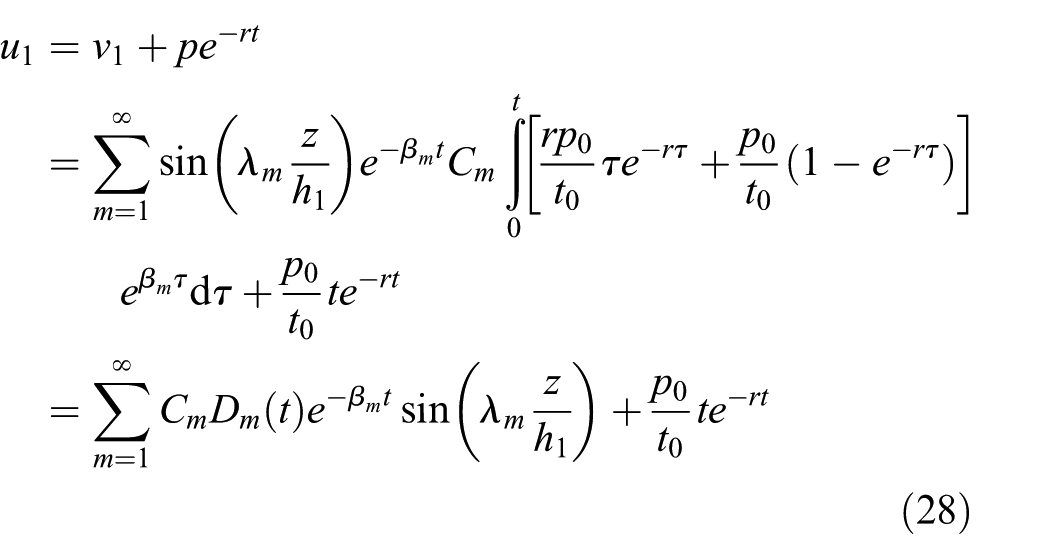

where

The solution of constant load stage can be obtained as
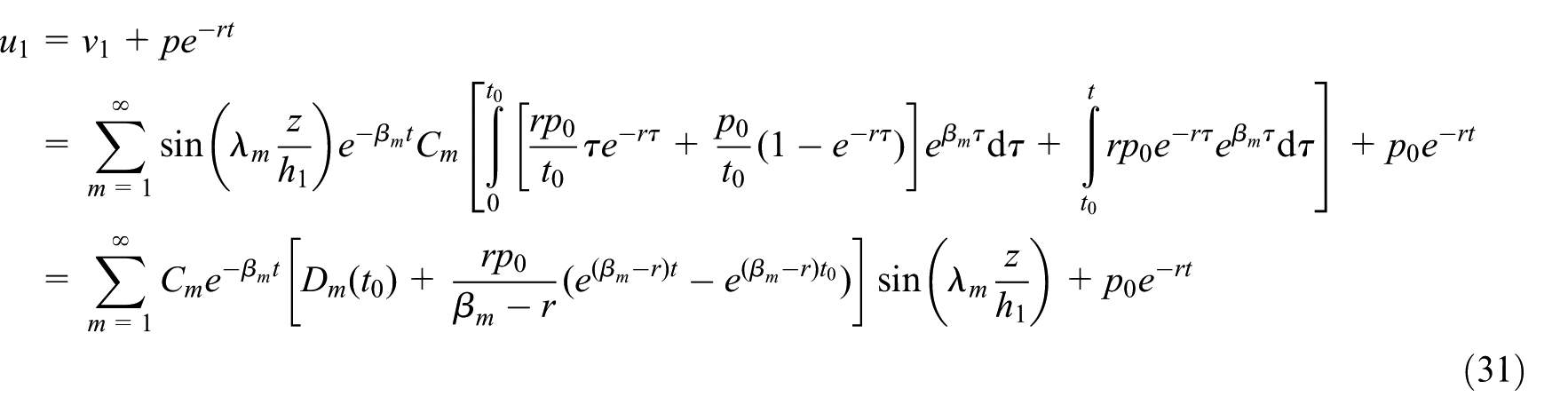

Verification and parametric study
Degeneration of solution
To verify the rationality of the present solution, it is needed to degenerate the proposed solution and compare it with existing solutions. Therefore, this section conducts the verification for both instantaneous load and single-stage load, respectively.
1. Degeneration of solution for instantaneous load
When the interface parameter r approaches infinity, equations (24) and (25) can be degenerated as


Apparently, equations (33) and (34) are consistent with the corresponding equations presented by Xie 24 utilizing the Terzaghi’s drainage boundary.
2. Degeneration of solution for single-stage load
When the interface parameter r approaches infinity, equations (28) and (29) can be reduced as


When the interface parameter r approaches infinity, equations (31) and (32) can be degenerated as


Obviously, equations (35)–(38) are in accordance with the corresponding equations derived by Xie 24 adopting the Terzaghi’s drainage boundary.
Influence of number of terms in series on calculated results
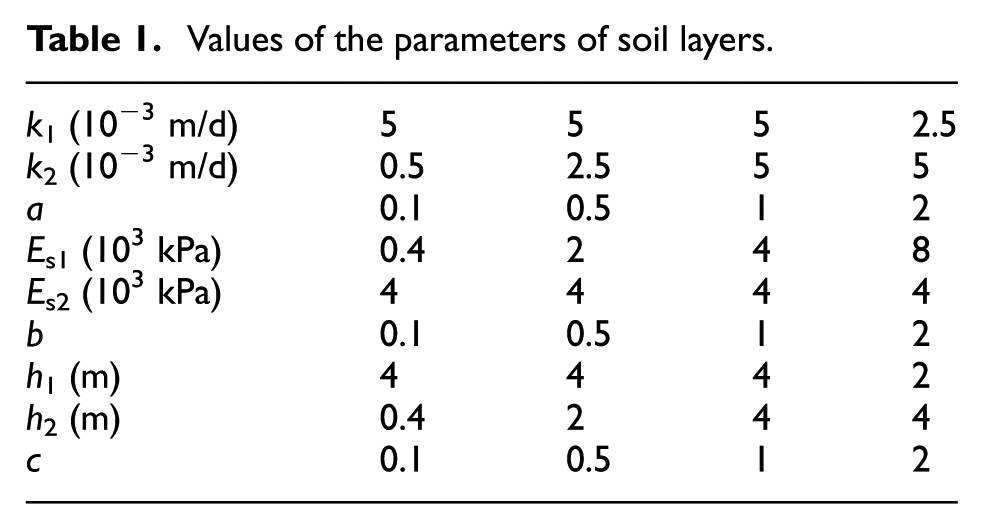
In this section, the influence of number of terms in series on calculated results is studied for the soil underlying an instantaneous load. The interface parameter r is set as
Values of the parameters of soil layers.
As shown in Figure 3, it is observed that it needs more number of terms in series to satisfy the convergence of the present solution when the time factor
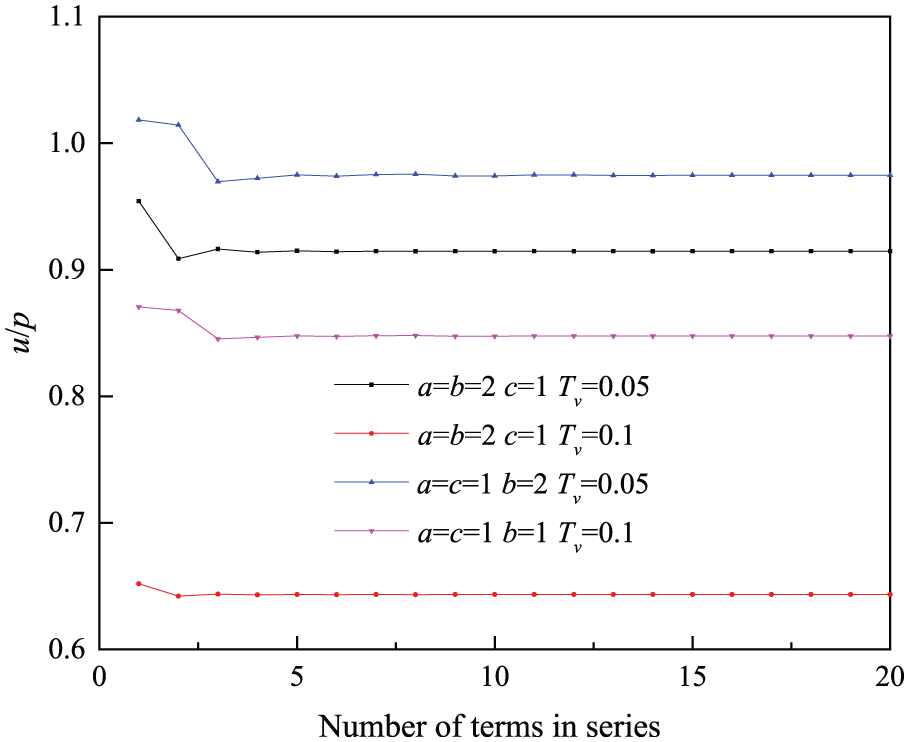
Influence of number of terms in series on calculated results.
Distribution curves of excess pore water pressure under the same consolidation coefficient
Figure 4 displays the distribution curves of the excess pore water pressure of soil with double-drainage boundaries. For Xie’s 24 solution via Terzaghi’s drainage boundary, when the consolidation coefficients of the upper and lower soil layers are the same, the excess pore water pressure of soil with double-drainage boundaries does not change with the variation of a and b, that is, the permeability and compressibility of soil have no effect on the excess pore water pressure of soil with double-drainage boundaries. However, as shown in Xie, 24 the distribution curves of excess pore water pressure vary with the change of a and b for the soil with single-drainage boundary. The result shows that there is a conflict in the consolidation theory using Terzaghi’s drainage boundary when analyzing the consolidation behavior of soil with double-drainage boundaries and single-drainage boundary. For the present solution based on the ETGD boundary, although the upper and lower soil layers have the same consolidation coefficients, the excess pore water pressure of soil with double-drainage boundaries decreases with the increase in a and b.

Distribution curves of excess pore water pressure under the same consolidation coefficient.
Influence of soil properties on the excess pore water pressure of soil
Figure 5 demonstrates the influence of soil thickness on the excess pore water pressure of soil for different values of c when the other parameters of soil are constant. For both the ETGD boundary and Terzaghi’s drainage boundary, the excess pore water pressure of soil with double-drainage boundaries decreases with the increase in the value of c when the permeability of the lower soil layer is better than that of the upper soil layer and the compressibility of the lower soil layer is smaller than that of the upper soil layer. It can also be observed that, the peak value of the excess pore water pressure is located at the upper soil layer. The reason for the mentioned phenomena may be that, the excess pore water pressure in the upper soil layer is not easy to dissipate when the permeability of the upper soil is poorer and the compressibility is higher than those of lower soil layer. In addition, for the same engineering condition, the excess pore water pressure based on Terzaghi’s drainage boundary is smaller than that based on the ETGD boundary, which means that the excess pore water pressure obtained by Terzaghi’s drainage boundary is dissipated faster than that based on the ETGD boundary.
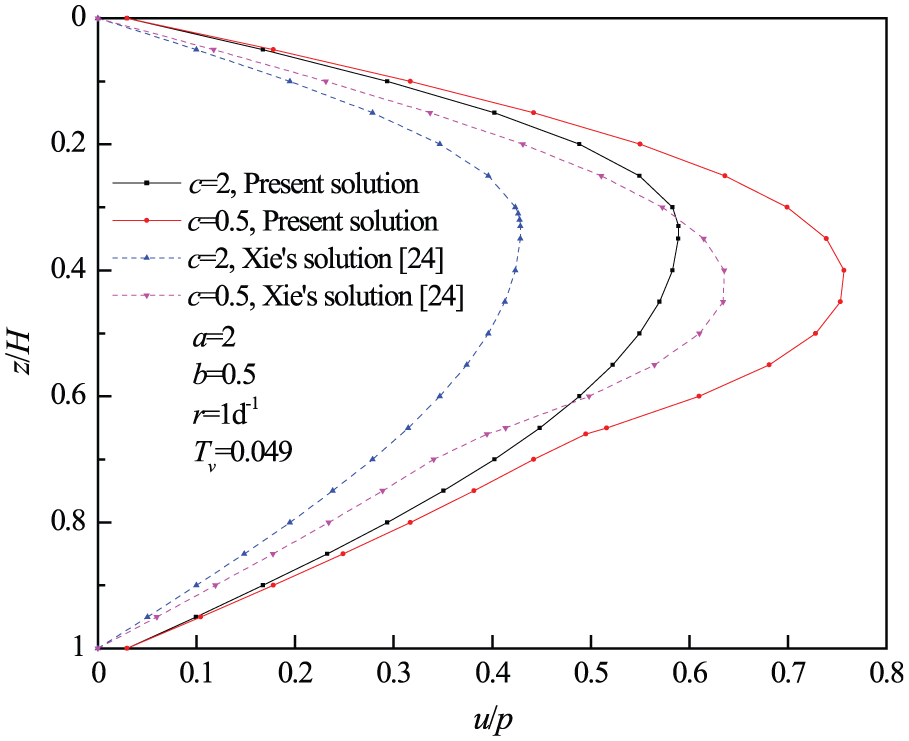
Influence of soil thickness on the excess pore water pressure of soil.
As indicated in Figure 6, when the upper and lower soil layers have the same thickness and permeability of coefficient, the excess pore water pressure of soil decreases with the decrease in soil compressibility, and the peak position of the excess pore water pressure moves downward as the value of b increases. When the value of b is less than 1, the peak position of the excess pore water pressure is always located at the upper soil layer. The peak position of the excess pore water pressure is located at the interface of the two soil layers when
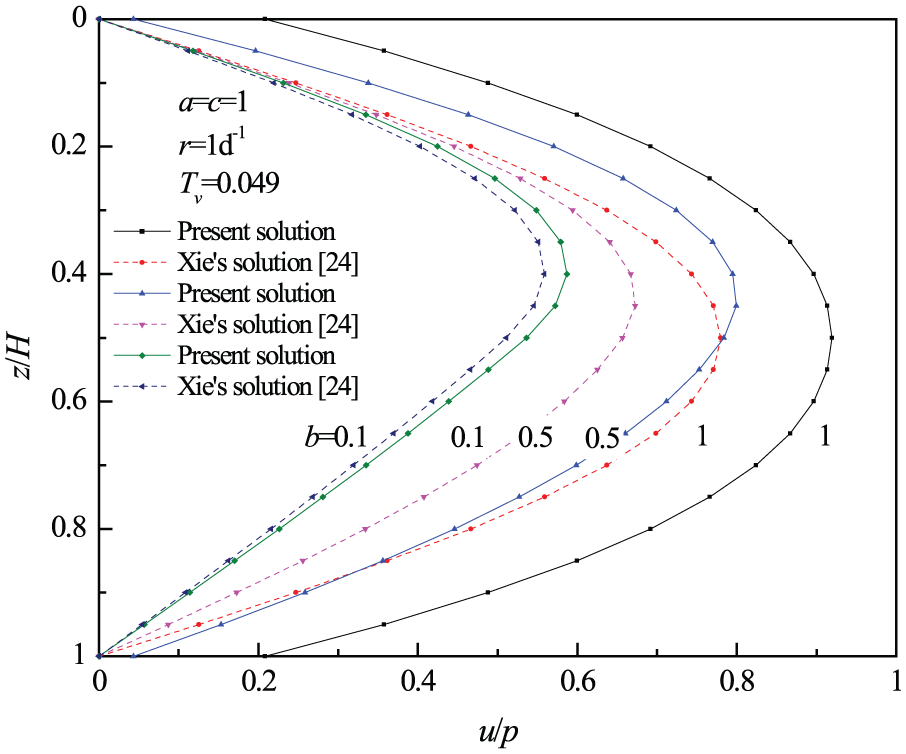
Influence of soil stiffness on the excess pore water pressure of soil.
Figure 7 depicts the influence of interface parameter on the excess pore water pressure of soil when the other parameters of soil remain constant. When the top and bottom drainage surfaces of soil have the same interface parameter, the soil layers exhibit the same permeability which results in that the excess pore water pressure curves are in symmetrical distribution about the interface. In addition, the excess pore water pressure of soil decreases with the increase in the interface parameter, which means that the greater the value of the interface parameter, the better the drainage capacity of the soil layer. With the increase in the interface parameter, the excess pore water pressure distribution curves based on the ETGD boundary gradually tend to that obtained by Terzaghi’s drainage boundary.

Influence of interface parameter on the excess pore water pressure of soil.
Influence of loading scheme on the excess pore water pressure of soil
Figure 8 shows the influence of time factor on the excess pore water pressure of soil underlying a single-stage load. In Figure 8, the initial time factor

Influence of time factor on the excess pore water pressure of soil.
Figure 9 indicates the influence of loading rate on the excess pore water pressure of soil when the other parameters of soil are unchanged. The excess pore water pressure increases with the increase in loading rate because the excess pore water pressure cannot be sufficiently dissipated within the shorter consolidation time when the loading rate is too fast.

Influence of loading rate on the excess pore water pressure of soil.
Analysis of consolidation degree
According to soil mechanics, the overall average consolidation degree of soil in terms of settlement can be expressed as

Then, by substituting equations (24) and (25) into equation (39), the overall average consolidation degree defined by settlement for instantaneous load can be derived as
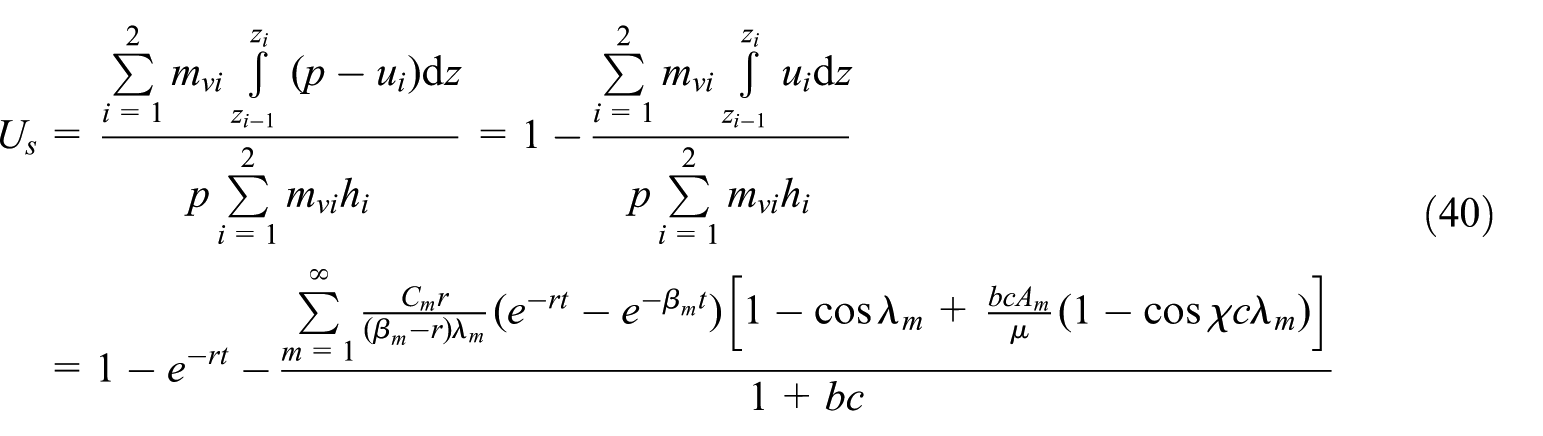
Furthermore, by substituting equations (28)–(32) into equation (39), the overall average consolidation degree in terms of settlement for single-stage load can be obtained as

Figure 10 depicts the interface parameter on the average consolidation degree of soil. The average consolidation degree based on the present solution will approach that obtained by Xie’s 24 solution via Terzaghi’s drainage boundary if the interface parameter is large enough, for the drainage capacity of boundary increases with the increase in the interface parameter and will tend to be pervious boundary if the interface parameter is large enough. On the contrary, if the interface parameter becomes smaller, the average consolidation degree calculated by the present solution will gradually deviate from that obtained by Xie’s 24 solution. It can also be found that, when the time factor is small, the difference between the average consolidation degree obtained by Terzaghi’s drainage boundary and that based on the ETGD boundary is great, but this difference gradually decreases with the increase in the time factor. It can also be observed from Figure 10 that, the early consolidation process of Terzaghi’s drainage boundary is faster than that of the ETGD boundary, but the late consolidation process of the ETGD boundary is faster than that of Terzaghi’s drainage boundary. These results show that, for practical engineering, even though the early consolidation process of the soil with the boundary surfaces designed according to the ETGD boundary is slow, it can make more sufficient dissipation of the excess pore water pressure of the whole soil layer, and it will not lead to the slow drainage of the lower soil layer or even the discharge of water after the consolidation of the upper soil layer. Meanwhile, the ultimate consolidation time based on the ETGD boundary is almost the same as that based on Terzaghi’s drainage boundary. When utilizing the ETGD boundary to design the actual drainage boundaries, there is no need to deal with the drainage surfaces as fully pervious boundaries. It means that the overall economy of the design based on the ETGD boundary is clearly superior to that based on Terzaghi’s drainage boundary.

Influence of interface parameter on the average consolidation degree of soil.
As indicated in Figure 11, the smaller initial time factor
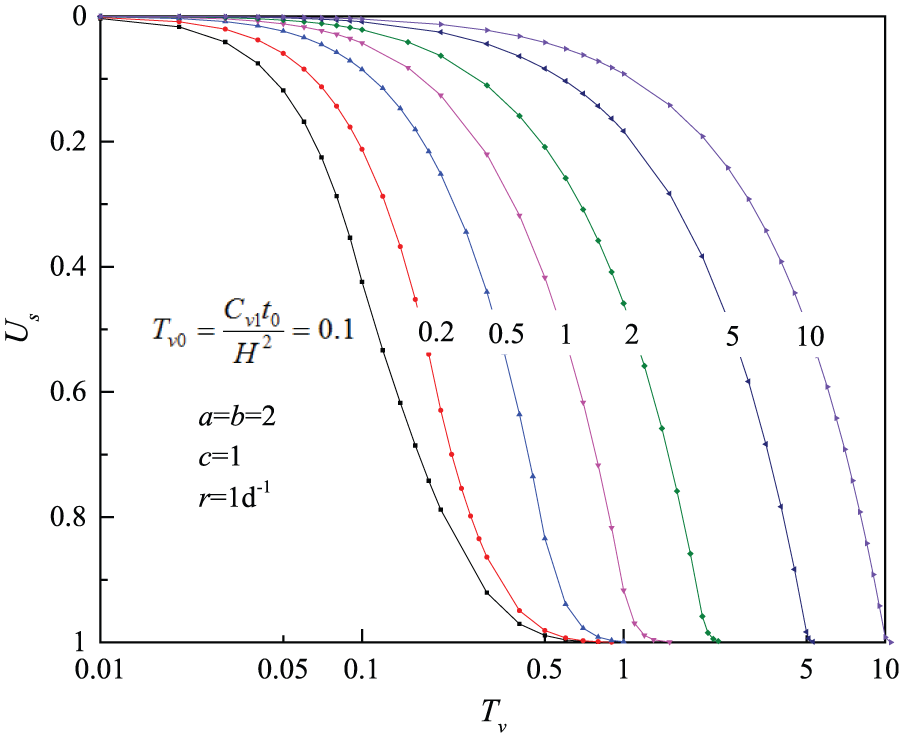
Influence of loading rate of single-stage load on the average consolidation degree of soil.
Conclusion
In this article, by means of the ETGD boundary, a general analytical solution has been presented for the one-dimensional consolidation of double-layered soil separately underlying both instantaneous load and single-stage load. The rationality of the present analytical solution is validated by comparing it with Xie’s 24 solution, and the Xie’s solution can be regarded as a special case of the present solution. Then, an extensive parametric study has been conducted to investigate the consolidation behavior of soil. The results show that, the interface parameter has an important influence on the excess pore water pressure of soil for it can reflect the drainage capacity of the drainage surfaces of soil layer, and the larger interface parameter means the better drainage capacity of the soil layer. In addition, the soil properties and loading scheme also have important influence on the excess pore water pressure of soil. Finally, the average consolidation degree based on the present solution will approach that obtained by Xie’s solution adopting Terzaghi’s drainage boundary if the interface parameter is large enough.
Footnotes
Handling Editor: Zhiwei Gao
Declaration of conflicting interests
The author(s) declared no potential conflicts of interest with respect to the research, authorship, and/or publication of this article.
Funding
The author(s) disclosed receipt of the following financial support for the research, authorship, and/or publication of this article: This research was supported by the National Natural Science Foundation of China (grant nos 41807262, 51578164, 51678547, 51878634, and 51878185) and the China Postdoctoral Science Foundation Funded Project (grant nos 2016M600711 and 2017T100664). The Research Funds provided by MOE Engineering Research Center of Rock-Soil Drilling & Excavation and Protection (grant no. 201402) and the Fundamental Research Funds for the Central Universities-Cradle Plan for 2015 (grant no. CUGL150411) were also acknowledged.