




Abstract
Stability and security are the key directions of VANET (vehicular ad hoc network) research. In order to solve the related problems in VANET, an improved AODV (ad hoc on-demand distance vector) routing protocol based on fuzzy neural network, namely, GSS-AODV (AODV with genetic simulated annealing, security and stability), is proposed. The improved scheme of the protocol analyzes the data in the movement process of the mobile node in VANET, extracts the parameters that affect the link stability, and uses the fuzzy neural network optimized by genetic simulated annealing to calculate the node stability. The improved scheme extracts the main parameters that affect the security of the nodes. After normalization, the fuzzy neural network based on genetic simulated annealing algorithm is used for fuzzy processing, and the node trust value of each node is evaluated. The improved scheme uses node stability and node trust value to control each routing process and dynamically adjusts parameters of the algorithm. The experimental results show that the improved scheme is stable and secure.
Introduction
In VANET (vehicular ad hoc network), the fast moving of vehicles and frequent changes in topology make the traffic density switch back and forth in three states: completely connected, partially connected, or connected, keeping the routing protocol of VANET always in the unstable state, and the link occurs when a link is broken. 1 First, the routing protocol must be able to guarantee a stable connection and prolong the life cycle of the network, and to ensure the security of the routing path and resist the attacks of malicious nodes. With the continuous development of VANET, the attack mode of VANET is increasing. As a classic VANET routing algorithm, AODV (ad hoc on-demand distance vector) is particularly important for its security and stability improvement.
At present for this problem, many domestic and foreign literature on the AODV protocol has been studied and improved. Jain et al. 2 propose an improved TAODV (trusted ad hoc on-demand distance vector) routing protocol based on the trust mechanism, which compares the trust value of the node to determine whether the node is a malicious node. Shoja et al. 3 propose a method to prevent hash chain attacks, protect the volatile parts of the route, and prevent malicious nodes from tampering with routing messages. Balakrishnan et al. 4 construct a new trust model, but there is no precise implementation in the routing process. Hiroki et al. 5 use a fixed-time window to determine whether a node is selfish and has a delay in determining the behavior of the node. Although the protocol in Umeda et al. 6 can detect changes in node behavior, there is a problem of insufficient evidence in calculating trust values. Zhan et al. 7 propose a TARF (trust-aware routing framework) routing protocol that uses a neighbor table to record the trust and energy consumption of each neighbor node and is used to prevent attacks based on routing locations. However, routing protocols increase routing load and control packets. Li and Singhal 8 use the public key to encrypt and identify the IP address. Encryption technology will add a lot of communication, computing, and storage costs during the key distribution process. Rak 9 proposes a content-based multicast (CBM)-AODV improvement scheme, which combines the delivery success rate and link quality, improves the path stability of the routing part, and effectively prevents link failure. Rak 10 propose the LLA method to find a stable communication path, which focuses on the improvement of multi-hop paths and the improvement of link stability, which makes the routing meet the requirements of quality of service (QoS) and provide real-time security information services. Kout et al. 11 propose a reactive routing protocol AODVCS (AODV with Cuckoo Search Algorithm) based on the biologically inspired cuckoo search algorithm (CSA). The protocol uses the CSA to determine the shortest path between two nodes and adds a route trust prediction mechanism.
In the previous research 12 , the description of the fuzzy neural network is not comprehensive, and the important parameters are not clear; the steps of genetic simulated annealing are not complete, and the process of optimization is not clear. Moreover, the stability discrimination and the security discrimination are not separated in the routing algorithm, which is not conducive to the smooth execution of the algorithm, and lacks the corresponding analysis of the various routing processes of the improved scheme. The experimental aspects are not perfect enough, the experimental scheme is not comprehensive enough, the experimental data are not sufficient, and the experimental environment is not complicated enough. Therefore, this article analyzes the stability and security of the algorithm, expands the previous research, and improves the experiment.
In the aspect of stability, several factors affecting the stability of the link are processed, and then the fuzzy neural network based on the genetic simulated annealing algorithm is used for the fuzzy processing. The protocol obtains the quantified node stability and the link quality, which is used as the basis of link stability in the routing process. The node will save the last calculated instance. After the neighbor node loses connection, the node will calculate the actual stability with the neighbor node and store it together with the value of several factors that affect the stability used in the initial calculation. The genetic simulated annealing algorithm is used to optimize the parameters of the fuzzy neural network. In this way, the parameters used in the fuzzy neural network can be dynamically adjusted and correspond to the network conditions in which the current node are located, which is more conducive to use the protocol under different network environments. In the aspect of security, several factors that affect the security of nodes is processed, and then the fuzzy neural network based on genetic simulated annealing algorithm is used for fuzzy processing to obtain the quantified node trust values for routing activities. The node will save the latest calculated instance and the average trust value of all the current neighbors as the training data into the genetic simulated annealing algorithm. The protocol dynamically adjusts the parameters used in the fuzzy neural network and corresponds to the network conditions in which the current node is located, which is more conducive to the agreement to be used under different network environments.
On this basis, the AODV security and stability improvement plan GSS-AODV is put forward. The improvement scheme extracts several factors that affect the security and stability of VANET. Fuzzy neural network is used to compute fuzzy computing, and the node trust value and node stability are obtained, which can be used to control the various routing processes. The simulation results show that compared with the AODV protocol, this protocol improves network performance under different sport environments.
Improving AODV protocol based on fuzzy neural network
Arithmetic statement
The core part of the improved scheme is the stability and security discrimination, and the decision results are needed for each routing process of the protocol. This article improves the routing protocol based on the fuzzy neural network algorithm based on genetic simulated annealing optimization. After dealing with the factors that affect the stability and security of the nodes, the fuzzy neural network based on the genetic simulated annealing algorithm is used for fuzzy processing, and the quantitative node trust value and node stability are obtained for routing activity. The algorithm structure is shown in Figure 1.
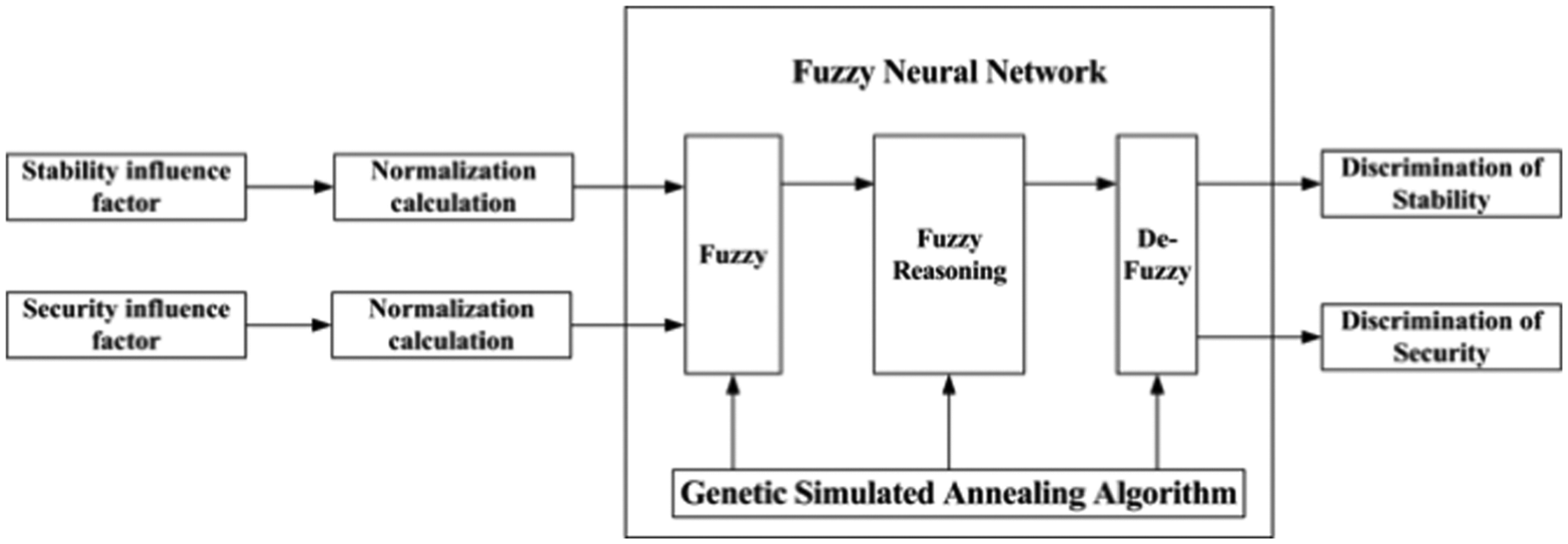
GSS-AODV structure.
Node stability metrics
In this article, on the basis of the original AODV routing protocol, the relative velocity u, relative distance d, and node load q are extracted as reference factors to judge the stability of nodes. After a series of factors are processed, the fuzzy neural network is used for fuzzy processing, and finally applied to the stability discrimination of the improved scheme.
Set

In addition to relative speed, the relative distance between nodes also restricts link stability. The closer the relative distance between nodes, it indicates that at least in a short time, the nodes will not be separated from other’s communication range, and the link stability can be maintained to the maximum extent. Suppose the coordinates of node i and neighbor node j are

Then, the normalized relative distance is defined as formula (3), where

In addition to the above factors, the load of the node itself is also one of the factors that affects the link stability. The greater the load, the longer the waiting time required for the packet, the longer waiting time may cause the packet not to be forwarded but the node has been lost, so the negative load of the node should be included in the influence factors. Suppose the load of neighbor

Node security metrics
The basic characteristics of VANET different from other traditional networks are the vulnerability of routing protocols and the complexity of intrusion methods. The security of VANET compared to traditional networks is that all signals in VANET are transmitted over open wireless channels, making it easier for attackers to steal and tamper with data signals. VANET adopts the decentralized network organization, so the traditional public key authentication system cannot be used. All the authentication relies on the cooperation of each mobile node. The malicious node can easily bypass the authentication and attack the network by means of disguising identity. All nodes in VANET move randomly, the network topology changes frequently, and nodes have dynamic trust relationships. Therefore, traditional static configuration security schemes cannot be adopted.
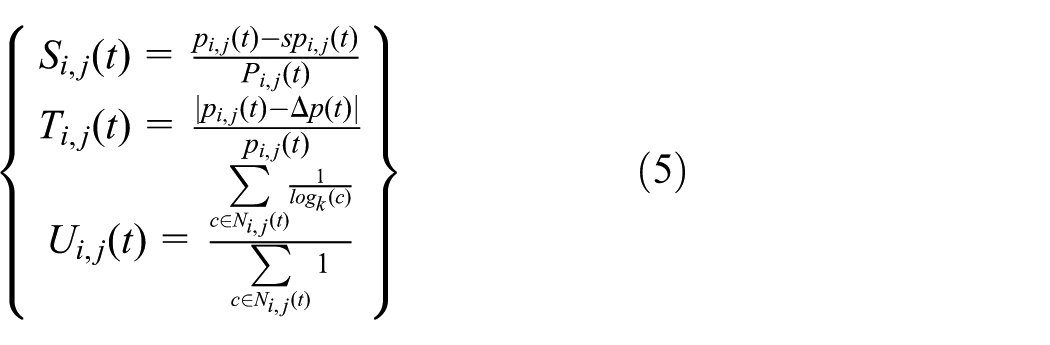
By summarizing the common malicious nodes and their attack methods in VANET, the common malicious nodes, relative to the security nodes, mainly have the following irregular routing activities: no forwarding of packets to a specific node or random discarding of any number of packets, only a partial packet is forwarded. The content of the packet is modified maliciously. Multiple identities or arbitrary routing requests are given an affirmative response, and the surrounding nodes send packets and requests to malicious nodes to achieve the purpose of attack. Long-term or intermittent transmission of fictitious routing requests or packets affects normal routing activities of other nodes. When malicious nodes carry out these abnormal routing activities, it is inevitable that some node parameters will be different from the security node. For example, the routing request or packet content repetition rate is too large; the number of routing requests or packets sent is too large. The neighbor table of neighbor nodes has a certain correlation, the neighbor table between the normal nodes should be repeated in a certain degree, the malicious node shows different nodes among the different neighbors because of the multiple identity, and the node similarity is low. In this article, by extracting the repetition rate of packet content, the number of packets, and the correlation of the surrounding nodes, the trust value of nodes is obtained by fuzzy calculation to assess whether each node is in a safe state, and the nodes are measured as follows.13,14
Set
The normalized node similarity in this article is
Fuzzy neural network
In this article, a multi-input, single-output neural network is used, and the structure is shown in Figure 2. The first layer is the input layer, which is responsible for passing the input variables to the second layer. The input value is the exact value and the number of nodes is the number of input variables. This layer has three neuron nodes, also known as three variables, S, T, and U.

Structure of fuzzy neural network.
The second layer is the fuzzy layer, which is mainly to blur the input values. The S, T, and U is converted into three fuzzy subsets {high, middle, low}, which can be represented as {h, m, l}, and there are nine nodes.

The third layer is the fuzzy rules reasoning layer. Each node of this layer corresponds to a fuzzy rule, which is connected to the fuzzy subset of every variable in the second layer, and there are 27 nodes, which correspond to 27 rules of inference. The fitness of each node is defined as formula (7)

The fourth layer is the de-fuzzy layer. The fuzzy value of fuzzy inference is converted into an exact value, where the gravity method is used to blur it, and the output value of the neural network is obtained, as shown in formula (8). The

In the fuzzy neural network, the parameters that need to be optimized are as follows:
Optimizing the fuzzy neural network with genetic simulation algorithm
In this article, genetic algorithm is used as the main body to search the global optimal solution from a default initial population. First, the initial population is genetically manipulated to produce new individuals. Then, each new individual is simulated annealing operation to calculate the individual fitness value. All the individuals make up a new generation of population and continue the search process. The process is run repeatedly and circularly until the predetermined end criteria are met. To sum up, the theory of simulated annealing algorithm is fused in the operation of genetic algorithm. The simulated genetic algorithm not only has the advantages of genetic algorithm and simulated annealing algorithm, but also overcomes its corresponding shortcomings. 16
The basic steps of simulated genetic annealing algorithm are as follows.
Step 1. Parameter initialization
The group scale M takes 50; the maximum iteration number N takes 200; the cross-probability is
Step 2. Initialize the population
In the chromosome coding method, first the second layer of the parameters of the Gaussian function c domain is divided into three parts, such as the selection of equal interval defined each population size of random numbers as the center value
Step 3. Output control
The fitness of each chromosome was calculated using the training data obtained during routine maintenance. The objective function is defined as formula (9), where


When the iteration count reaches the maximum number of iterations, that is, when
When an individual reaches the progress requirement (the range of value is [0.95, 0.99], the individual is exported or entered the genetic operation.
Step 4. Genetic manipulation
The number of iterations
Selection, replication
Identify the highest fitness and minimum individuals in the current population and set up a global optimal individual. If an individual is found to be superior to the global optimal individual, the global optimal individual is substituted for the worst individual.
Crossover
Each individual generates a crossover probability r, in the range of [0, 1]. If

Variation
Gene values at each individual locus randomly generate a sub-mutation probability s. If
Step 5. Simulate annealing operation
Each individual in the new offspring produced by genetic manipulation is simulated annealing operation.
Initialization of parameter
Initial temperature
Inner loop
In the isothermal cycle, the current temperature is

Near to extend to a more optimal value is infinite; the Metropolis criterion is used to judge whether the new solution is accepted: if
Outer loop
To meet the termination conditions (to reach the upper limit of the outer cycle iteration or to the lower limit of the external circulation temperature), the current solution is output; the reverse cooling is given as
GSS-AODV protocol description
Routing initiation
A node in VANET, the source node, needs to communicate with another node (destination node), and the AODV routing protocol stability improvement scheme will execute a routing initiation process to broadcast RREQ messages to the neighbors. A formal description is shown in algorithm 1.
The neighbor nodes that receive the RREQ package perform the following operations in turn:
Compare the message list, if it is the message that it sends out, that is the loop, discarding the RREP message.
Compare the message list, if the received message is a duplicate message, discarding the RREP message.
Compared to the routing table, whether there is already a reverse route to the source node, if the new route is higher than the original route, or the quality is similar and new, the last hop route is updated. Otherwise, a reverse path should be established with the source node to generate the last hop routing, adding the stability of the RREQ message encapsulation by dividing the route length as the link quality of the current path.
A stable threshold with an initial value of 0.5 is set in the neighbor nodes. During a period of time, the neighbor node will use the stability of the neighbor node stored in the neighbor table to calculate the average node stability and update the stability threshold. When the node stability is greater than 0.5 or greater than the stability threshold, the RREQ message is forwarded. In this way, the stable nodes with stability greater than 0.5 can always participate in the forwarding, and when the node is in the unstable state, the node can be forwarded when the stable threshold is relatively stable. The utilization rate of the nodes is improved, the link quality is guaranteed, and the flooding of the RREQ message is avoided.
A threshold of delivery rate with an initial value of 0.5 is set up in the neighbor nodes. In a time period, the neighbor node will update the delivery rate threshold according to the delivery of data packets around itself and its neighbors. When the node delivery rate is greater than 0.5 or greater than the delivery rate threshold, the node trust value is considered when forwarding the REEQ message request. This can ensure that all nodes can always participate in the forwarding when the delivery rate is greater than 0.5, and when the node environment is in the unsafe state, by considering the trust value, the nodes can be forwarded in the selection of relatively secure nodes, and the utilization rate of the nodes can be improved to some extent, thus the attack of evil intent nodes is avoided.
When the neighbor nodes consider the trust value of the nodes, the average trust value of all neighbors is calculated first. For nodes less than 0.5 and less than the average trust value, the node is labeled as a neighbor node in the state of distrust, and does not participate in the routing process of the current node.
The neighbor node stores the stability after storing it in the RREQ message and continues broadcasting to the neighbor node. When the neighbor node is a relay node, which means the neighbor has a direct path to the destination node, it is different from the AODV routing protocol directly responding to RREP. In this case, the stability of the node still needs to be judged. The link stability of each route is saved in the routing table of nodes. When the node is a relay node, the link stability of the destination node and the link stability of the relay node to the source node will be calculated and averaged. The link stability of the entire path will be obtained and sent to the destination node directly to the RREQ. The destination node decides whether to reply or not, which is helpful for the destination node to select the path to transmit data considering the stability of all paths.
The route initiating process is completed after the destination node is reached.

From the aspect of stability, the main factors affecting the stability of nodes are selected among adjacent nodes, which are relative speed, relative distance, and node load, respectively, to generate the node stability. The greater the node stability, the higher the stability of the two nodes and the lower the probability of fracture. Therefore, node stability accumulation and data fields need to be encapsulated in the RREQ request message. The improved routing protocol participates in the route initiation process only when the node is in a stable state and reduces the RREQ message forwarding volume and the routing overhead while ensuring the link quality. As the original AODV protocol always selects fewer routes when updating routes. When the relay node replies to the RREP message, it does not accumulate the number of hops to the destination node. As a result, the number of hops in the RREP packet of the relay node is lower than the total number of hops that reach the source node; the source node may have a greater probability of selecting the path where the relay node is located for data transmission. When the relay node replies to RREP, the improved routing protocol increases the quality of the link arriving at the destination node, which is more beneficial to the source node for routing.
From the security point of view, through the statistics and analysis of the attacks and manifestations of the attacking nodes, the improved routing protocol comprehensively considers the main performance characteristics of the node security through the fuzzy neural network between adjacent nodes, which are, respectively, the packet repetition rate, the number of packets, and the relevance with surrounding nodes. In mobile ad hoc networks, the authentication of the output data of a node depends not only on the historical data of the node itself but also on the data of other nodes in the same area, and the characteristics of the node behavior often change with time, and the regularity has statistics feature. So, select the packet content of the repetition rate and the number of packets involved in measuring the trust value of the node. The attack analysis on the attacking node shows that for different neighboring nodes, the attacking node will fake multiple forged identities to deceive the trust of the neighboring nodes. This has some weaknesses. For adjacent nodes in the same motion environment, their respective neighbor tables will have the greater probability of repetition. However, attack nodes have different identities among different neighboring nodes, which lead to the fact that their identities in the neighbor tables of all neighboring nodes of the attacked node are not uniform, that is, node relevance is low. Therefore, the improved Adamic–Adar algorithm can normalize the node relevancy to measure the trust value of nodes in different situations.
The higher the node trust value, the better the node security and the lower the chance of attacking the node. Therefore, the node trust value needs to be considered according to the node environment when forwarding the RREQ request packet. The improved routing protocol participates in the route initiation process only when the node is in a safe state. It reduces the RREQ message forwarding volume, reduces the routing overhead, and ensures the link security to defend against black hole attacks.
Routing choice
The node forwards the RREQ message to the destination node. After receiving the RREQ message, the destination node performs a routing choice process. A formal description is shown in algorithm 2:
1. When the destination node receives a new RREQ message for the first time, it does not reply to the RREQ message immediately, but will wait for a routing discovery cycle to receive RREQ messages continuously before the end of the time.
2. After the waiting time is over, the destination node calculates the link stability sum and the hop count according to the RREQ message using formula (13) to obtain the link quality of all paths to evaluate the link stability

The analysis formula shows that when the
3. If a path with a higher quality or a similar quality and a newer link in the routing table is received during the RREQ message receiving process, the corresponding path is replaced and the routing table is updated.
4. The purpose of reception is to receive the RREQ message while the link quality of the path is compared with the path in the routing table. If a higher quality or similar quality and newer path is received, the corresponding path is replaced and the routing table is updated.
5. When the source node receives the RREP message, it first checks whether the reverse route is established with the destination node, and then the routing is judged by comparing the link quality to ensure that the reverse path is always stable, and then the most stable link is selected for data transmission.

After receiving the RREQ packet for the first time, the destination node receives multiple RREQ packets one after another in the waiting period. Different from the AODV protocol that directly replies to the first RREQ packet, the improved routing protocol uses the node stability encapsulated in the RREQ packet to accumulate and calculate the link quality, and finally selects the RREP with the highest link quality and the most stable path return. Like the route initiation process, in the RREP packet encapsulation link quality data field, the source node receives the RREP and sends the data along the optimal path. The routing part of the above method is more reliable than the original AODV protocol, thus overcoming the negative effect that the original AODV protocol only considers the length of the route and neglects the stability of the link due to the motion environment. The improved routing protocol considers link stability and number of hops and can improve network performance.
Routing maintenance
In order to maintain connections between neighbor nodes, AODV periodically sends HELLO messages to maintain connections. In order to distinguish the stability and security, the structure of the HELLO message is modified, and the relative speed, relative distance, and node load of the neighbor nodes are added in the message. Neighbor nodes receiving HELLO messages will perform a route maintenance process.
When a node receives the HELLO message sent by a neighbor node for the first time, it determines that a neighbor node is found. In order to distinguish the stability, the node will add a new neighbor to the neighbor’s table, and use the fuzzy neural network to calculate the node stability of the neighbor node. The node will store the relative speed, relative distance, node load, and the receiving time of the HELLO message as the training data of the simulated annealing algorithm together in the neighbor table, as the training data of the genetic simulated annealing algorithm. In order to distinguish the security, the node will use the fuzzy neural network to calculate the node trust value of the corresponding node, and take the repetition rate of the packet content, the number of packets, the correlation with the surrounding nodes, and the average trust value of all the neighbors as the training data of the simulated genetic annealing algorithm, which is stored in the neighbor’s table. In the neighbor node’s lifetime, every time the new HELLO message is received from the neighbor node, the node will read the node-related information from the HELLO message, update the node stability and the node trust value using the fuzzy neural network, and then extend the survival time of the neighbor nodes in the neighbor table. If the HELLO message of the neighbor node is not received for a period of time, the neighbor nodes have been lost. The node will use the genetic simulated annealing algorithm to optimize the parameters of the fuzzy neural network.
In the process of node stability identification, an improved algorithm is used to calculate the actual stability of nodes. From time to time, the node checks whether the survival time of all the nodes is less than the current time and considers that the neighboring node is lost. In the improved routing protocol, when the node is lost, the time difference

When the link length of the neighbor node is equal to the average link length of all neighbors, the stability of the neighbor node is 0.5. The positive limit of the function is 1, which uses the actual stability as the training data of the simulated genetic algorithm, calls the neighbor information stored in the neighbor’s table as the training data, and uses the genetic simulated annealing to optimize the parameters of the fuzzy neural network. In order to keep the calculation of the actual stability close to the current motion environment of the node, the improved scheme updates the average link time of the node periodically.
From the stability point of view, when the node is in high-speed motion, the node speed is the key factor that determines the stability of the node, and the link speed is not prone to link breakage. So, link time will be higher than other nodes, and the actual stability calculated by the formula will be too high. When the node is in low-speed motion, the distance between nodes is the key factor that determines the stability of the node. The closer the node is, the less likely it is to break. Similarly, the actual stability will be high. When the node moves in a sparse scene, the traffic between the vehicles is not large, the load of the nodes is generally not high, and has little effect on the stability of the nodes. With the increase in the number of nodes, the load of the node itself increases, and other information exchange between nodes frequently causes network congestion, which in turn affects the node’s data transmission and the node stability decreases.
From the security point of view, when the node moves in a sparse scene, the neighbor nodes around the node are relatively few, and the correlation with the surrounding nodes is relatively weak. However, as the number of nodes increases, the attack nodes will show a more obvious disadvantage in the node correlation. When the node is in an idle state, the traffic between the nodes is not large, the repetition rate of the contents of the node’s packets and the number of the packets have little effect on the trust value of the nodes. When a node enters a busy state, the load of the node itself increases and other information exchanges occur frequently between nodes. The repetition rate of the packet content of the node and the size of the packet highly reflect the level of node security.
Therefore, under different sport environments, the proportion of each determinant of stability is different, and the fixed parameters cannot be used to calculate the fuzzy neural network. The improved routing protocols optimize the parameters of the fuzzy neural network using genetic simulated annealing based on the collected actual node data in different environments. Which makes the routing protocols adapt to different sport environments, improve the stability of the selected path, and improve the probability of the chosen security nodes, to enhance the performance of routing protocols.
Performance simulation and analysis
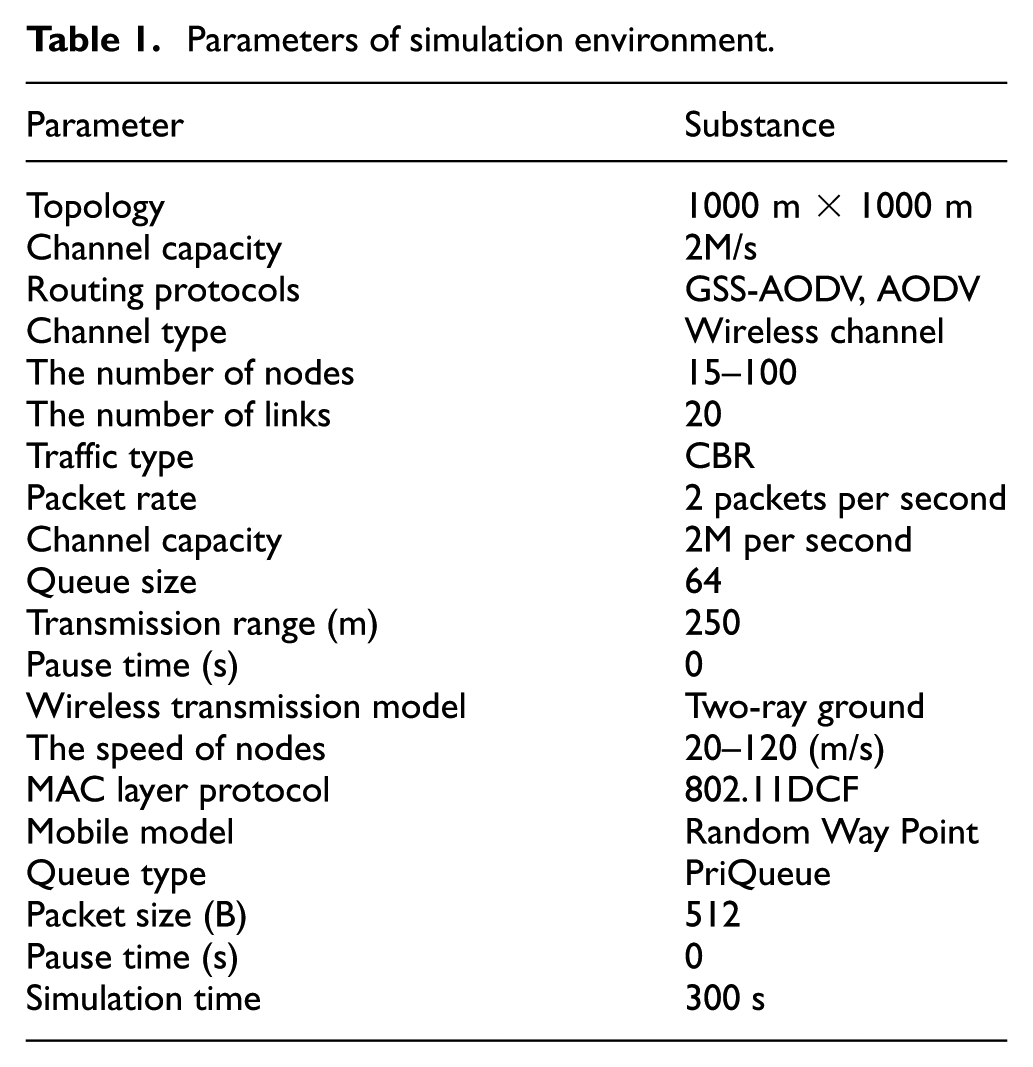
In this article, the network simulation software NS2 (Network Simulator Version 2) 17 is used to simulate the improved GSS-AODV protocol and the original AODV protocol. The parameters of the simulation environment are shown in Table 1.
Parameters of simulation environment.
Stability experimental results and analysis
The routing performance of GSS-AODV protocol under different vehicle nodes is analyzed when the vehicle speed is 20–120 m/s.
Figure 3 shows the change of delivery rate of AODV and GSS-AODV packets as the number of nodes increases. The GSS-AODV routing protocol uses the fuzzy neural network of genetic simulated annealing optimization to make fuzzy calculation of the factors that influence the stability of the extraction and obtain the stability of the node. The link quality is obtained by summing up the stability degree of each node on the link, which is used to evaluate link stability. The destination node transmits the link to measure the link quality and always selects the most stable link, which reduces the data packet loss caused by the link break. And the GSS-AODV routing protocol can dynamically adjust the parameters of the fuzzy neural network to improve the adaptability of the GSS-AODV routing protocol. Therefore, when the number of nodes is the same, the packet delivery rate of GSS-AODV routing protocol is always higher than that of AODV routing protocol, and the relative stability fluctuation is small.
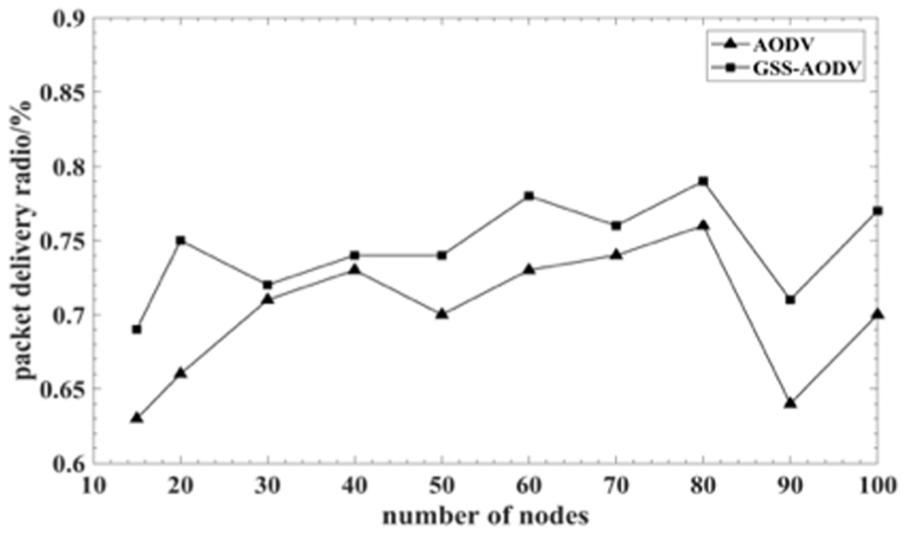
Packet delivery ratio and number of nodes.
Figure 4 shows the end-to-end average delay of AODV and GSS-AODV routing protocols as the number of nodes increases. GSS-AODV routing protocol extracts node load as one of the factors that affect the stability of nodes. Therefore, when the number of nodes is less, the transmission pressure of each node is improved in varying degrees. The GSS-AODV routing protocol can select a stable and relatively low-load node to transmit data, reduce the queuing time, and reduce end-to-end delay. With the increasing number of nodes, the load of each node decreases in varying degrees and the influence of node load on link stability decreases. At this point, the GSS-AODV routing protocol will reduce the weight of node load in the stability of fuzzy neural network calculation, focusing on other factors.

Point-to-point delay and number of nodes.
Figure 5 shows the changes in the normalized routing overhead of the two routing protocols, AODV and GSS-AODV, with the increase in the number of nodes. As shown in the figure, as the number of nodes increases, the control overhead of the AODV and GSS-AODV routing protocols also increases. However, the GSS-AODV protocol determines whether to forward the message according to the node stability decision result in the route initiation part, which limits the flooding of the RREQ message in the network. And GSS-AODV always selects the stable link to transmit data, the link is not easily broken, the number of route repairs is reduced, and the source node does not need to frequently initiate the route, thereby reducing the number of RREQ transmissions. Therefore, the normalized routing overhead of the GSS-AODV routing protocol is lower than that of the AODV routing protocol.
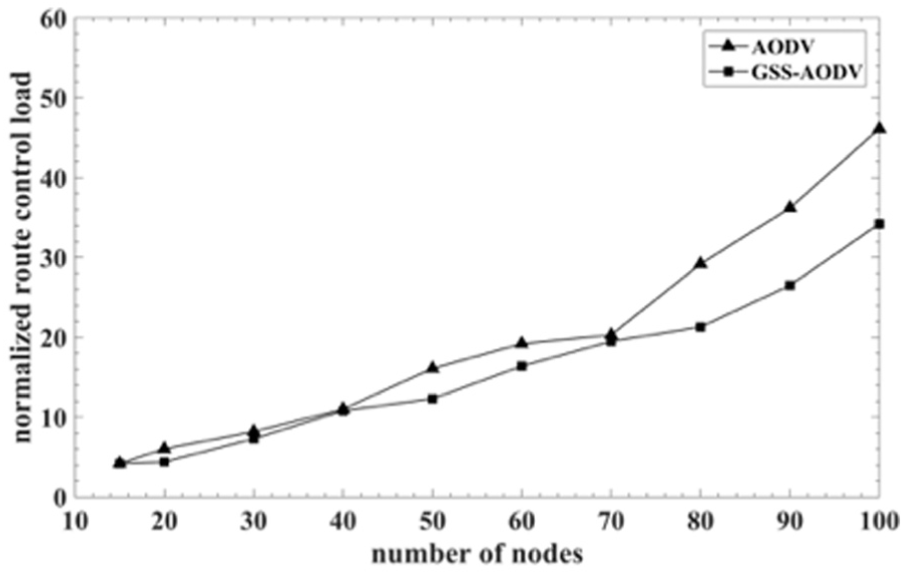
Normalized route control load and number of nodes.
The routing performance of GSS-AODV protocol is analyzed when the number of vehicles is 100 at different maximum moving speeds.
Figure 6 shows the packet delivery rate of AODV protocol and GSS-AODV protocol as the maximum moving speed of vehicle nodes increases. As shown in the figure, as the moving speed of vehicle nodes increases, the links between nodes on the active route tend to be turbulent, and the packet delivery rates of both protocols are in a downward trend. However, because GSS-AODV routing protocol uses fuzzy neural network to calculate the node stability, we can get the link quality to evaluate the link stability. In the route initiation and selection part, a stable link transmission data is always choosen, where the link is not easily disconnected to avoid packet loss. The parameters of the fuzzy neural network are optimized by genetic simulated annealing algorithm under different vehicle speed. The weight of the vehicle speed in the node stability calculation is changed to ensure the stability of the selected link. Therefore, GSS-AODV packet delivery rate is generally higher than the packet delivery rate of the AODV protocol.
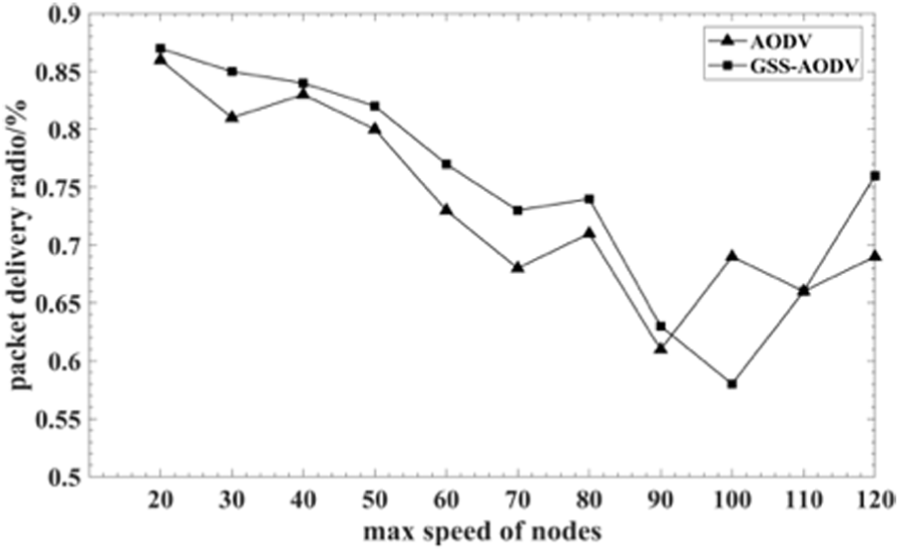
Packet delivery ratio and maximum speed of nodes.
Figure 7 shows the end-to-end average delay of AODV protocol and GSS-AODV protocol as the maximum moving speed of vehicle nodes increases. At low speed, because GSS-AODV waits for a route discovery cycle, it will cause some network delay. However, early restoration is added during route restoration to avoid the delay caused by packet loss. At high speed, the GSS-AODV protocol always selects the stable link to transmit data, reducing the delay caused by the route repair. Therefore, it can be seen from the figure that the average end-to-end delay of GSS-AODV is generally lower than that of AODV protocol.

Point-to-point delay and maximum speed of nodes.
Figure 8 shows the normalized route overhead of AODV protocol and GSS-AODV protocol as the maximum moving speed of vehicle nodes increases. As the vehicle speed increases, the probability of link disconnection increases, and control messages between nodes also increase. Therefore, the routing overhead increases. GSS-AODV can control the RREQ forwarding by the node stability in the initial part of the routing, and adjust the weight of the speed of the fuzzy neural network according to the parameters controlled by the genetic simulated annealing algorithm according to the motion conditions. The GSS-AODV can select stable links to transmit data at different speeds to reduce the routing overhead required for rerouting the links when the links are disconnected. Normalized routing overhead of GSS-AODV is generally less than AODV protocol, and the growth rate is slower.

Normalized route control load and maximum speed of nodes.
Security experimental results and analysis
Under the condition of 100 vehicles, the routing performance of GSS-AODV protocol under different number of black hole nodes is analyzed.
Figure 9 shows the packet loss ratio of AODV protocol and GSS-AODV protocol as the number of black hole nodes increases. As the figure shows, as the number of black hole nodes increases, more REEQ packets are phagocytic, and the loss rate of the two protocols increases. But because the GSS-AODV routing protocol uses fuzzy neural network for calculation of node trust value, select the high trust value of nodes participating in the routing initiated, reducing the probability of attack; in the number of nodes in different situations by genetic simulated annealing algorithm to optimize the parameters of fuzzy neural network, change the node correlation in the node trust value weight calculation the increased probability of select safe node, so the packet loss GSS-AODV protocol packet loss rate is generally lower than the rate of AODV protocol.

Packet loss rate and the number of black hole nodes.
Figure 10 shows the end-to-end average delay of AODV and GSS-AODV as the number of black hole nodes increases. In the environment with fewer black hole nodes, the GSS-AODV protocol preferentially selects the nodes with higher trust values to participate in the routing process, which causes certain network delay. However, routing protocol optimizes the parameters according to the specific conditions and avoids prolonged delay, so that the average delay does not show a large gap. With the increase in black hole nodes, the GSS-AODV protocol always selects the nodes with higher trust values to participate in the routing process and reduces the probability of routing requests being swallowed by the attacking nodes. Therefore, it can be seen from the figure that the average end-to-end delay of GSS-AODV is generally lower than that of the AODV protocol.

Average delay and number of black hole nodes.
Figure 11 shows the normalized routing overhead of AODV and GSS-AODV as the number of black hole nodes increases. As the number of black hole nodes increases, the probability of losing RREQ increases and the number of control messages between nodes also increase. Therefore, the routing overhead increases. However, since the GSS-AODV controls the forwarding of the RREQ through the node trust value in the routing initiation part and uses the genetic simulated annealing algorithm to control the parameters, the weight of the node similarity in the fuzzy neural network is adjusted according to the condition of the black hole node. In different environments, GSS-AODV can select the security node to participate in the routing process to reduce the routing overhead required for initiating the route initiation due to the black hole node attack. Experiments show that the normalized routing overhead of GSS-AODV is generally lower than the AODV protocol, and the growth rate is relatively slow.

Routing cost and number of black hole nodes.
Under the condition that the proportion of black hole nodes is 10%, the routing performance of GSS-AODV protocol under different number of on-board nodes is analyzed.
Figure 12 shows the packet loss rate of AODV and GSS-AODV as the number of nodes increases. The GSS-AODV routing protocol evaluates the node security by calculating the node trust value. Therefore, routing protocol always selects relatively secure nodes to participate in the routing process to reduce the impact of black hole nodes of node communication and improve the packet delivery rate. In addition, GSS-AODV can also dynamically adjust the parameters used by the fuzzy neural network according to different environments to improve the accuracy of selecting a safe node. When the attacking node adopts the way of identity spoofing attack, the attacking node makes a confirmation reply to the routing request of each neighboring node, which leads to the low correlation of its nodes. Therefore, when a node is in a sparse environment, the number of neighbors of each node and the protocol will reduce the weight of the node relevance in the trust value. With the increase in the number of nodes, the node correlation of attack nodes decreases. The protocol will increase the weight of node correlation, reduce the trust value of attacking nodes, and select security nodes to participate in routine activities to improve the packet delivery rate. Therefore, when the number of nodes is the same, the packet loss rate of the GSS-AODV protocol is always lower than that of the AODV protocol, which is close to that of a secure network environment and is relatively stable.

Packet loss rate and number of nodes.
Figure 13 shows the end-to-end average delay of two routing protocols, AODV and GSS-AODV, as the number of nodes increases. When selecting a node to participate in the routing process, the GSS-AODV protocol takes the amount of data packets sent and the repetition rate as influencing factors into the calculation of the trust value of the node. When the number of nodes is small, the GSS-AODV protocol mainly considers the packet repetition rate and improves the weight of the packet repetition rate in the node trust value, which helps the routing protocol to prevent the attack node from repeatedly sending attack messages and affecting the ad hoc network. When the number of nodes continues to increase, the communication between nodes is frequent, and the amount of data packets sent generally increases, affecting the judgment of node security. The protocol of GSS-AODV will reduce the weight of packet sending amount in the trust value of the fuzzy neural network node by simulating genetic annealing optimization algorithm parameters and weaken the impact of denial-of-service attack on ad hoc network. Therefore, the average delay of the GSS-AODV protocol in the figure is lower than that of the AODV protocol and approaches the safety network environment.

Average delay and number of nodes.
Figure 14 shows how the normalized routing costs of AODV and GSS-AODV routing protocols change with the increase in the number of nodes. The experimental data show that the routing protocol needs to send more control messages to keep normal operation when the number of nodes increases, and the network overhead of AODV and GSS-AODV routing protocols increases. However, the GSS-AODV routing protocol determines whether the routing process is involved in the routing process based on the result of the node trust value decision, which limits the flooding of RREQ messages in the network. The GSS-AODV routing protocol always chooses the security node to transmit data, the packet is not easy to lose, and the routing security is increased. The source node does not need to initiate the routing frequently, thus reducing the number of routing information. Therefore, the GSS-AODV routing protocol has a better performance in routing overhead.

Routing costs and number of nodes.
Conclusion
In view of the shortcomings of AODV routing protocol in stability and security, existing works focused on backup routing, multi-path selection, data packet encryption, and so on. The algorithms in these works are not flexible for the complexity and motion of nodes in VANET. As a kind of fuzzy algorithm, the fuzzy neural network optimized by genetic simulated annealing has a simple structure and is easy to use. The main purpose of this article is to apply the fuzzy neural network based on genetic simulated annealing optimization to the AODV routing protocol to improve the stability and security.
In this article, the routing process of AODV routing protocol and the major factors that affect the link stability are studied and analyzed. For improving the security and stability, GSS-AODV routing protocol scheme is proposed. In the aspect of stability, the improvement of the scheme targets for link stability, such as relative rate, relative distance, and load between nodes. The fuzzy neural network is used to calculate the node stability, so the message forwarding to unstable nodes is controlled during the routing process. In the route selection process, the link stability of the accumulative cache in the message packet is used to measure the stability of each link to select the stable link for transmitting data. The simulated genetic annealing is used to dynamically optimize the parameters during the routing maintenance process, so that the routing protocol can also operate well in different environments with various moving pattern.
By summarizing attacks and forms of malicious nodes in VANET, as well as comparing routing activities of malicious nodes and normal nodes, we found that the data packet repetition rate, the number of packets, and the node similarity are necessary to measure the trust values of the nodes. The improved scheme uses fuzzy neural network to calculate the trust values of nodes, control the forwarding of unsafe nodes in the process of routing, and ultimately limit the impact of malicious nodes on routing activities. In the process of routing maintenance, simulated genetic annealing is used to dynamically optimize the parameters. According to the dynamic optimization parameters of the malicious nodes in different environment, the improved routing protocol also works well.
The results of a set of simulations on various node moving patterns demonstrate that the proposed scheme outperforms the original AODV protocol.
Footnotes
Handling Editor: Wei Li
Declaration of conflicting interests
The author(s) declared no potential conflicts of interest with respect to the research, authorship, and/or publication of this article.
Funding
The author(s) disclosed receipt of the following financial support for the research, authorship, and/or publication of this article: This work was supported by the National Natural Science Foundation of China under grant no. 61262072.