




Abstract
In this article, a new multidimensional discrete chaotic system is proposed, and the characteristics and advantages of the multidimensional discrete chaotic system are analyzed. The multidimensional discrete chaotic system is designed using digital technology, and the system has the complexity of hyper-chaotic system, and it can avoid the choice of step size, at the same time, the design of the circuit is simple, the resource occupancy rate is low, it is suitable for the design of digital system, and so on. It can be used in constructing chaotic sequence generator, chaotic encryption, and visual sensor networks.
Introduction
Visual sensor networks (VSNs) are networks that consist of a large number of sensor nodes which have imaging capabilities. With rapid improvements in sensors, embedded computing, and video coding techniques, VSNs have been widely used in traffic enforcement, factory monitoring, habitat sensing, and many other surveillance applications. As the visual sensors of VSNs are usually deployed in unprotected or even hostile environments, security is an issue of great concern. The establishment of a VSNs security system with complex structure is particularly important for simplifying the data transmission encryption algorithm, reducing the resource occupancy rate and improving the flexibility of the application. This article proposes a multidimensional discrete digital chaotic encryption system which can be applied to VSNs system. Chaotic dynamics is an important branch of complexity science and a popular discipline in the past three decades. Chaos is a seemingly random movement that occurs in a deterministic system. The system is described by a deterministic theory, and its behavior is indeterminate, non-repeatable, unpredictable, and that is chaos.1–6 Chaos is an inherent characteristic of nonlinear systems, which is a common phenomenon in nonlinear systems. Newton’s theory of certainty can deal with mostly linear systems, and linear systems are mostly simplified by nonlinear systems. Therefore, chaos is ubiquitous in real life and practical engineering problems.
Chaotic secure communication is an important field of chaos for application. First, the sensitivity to initial values of the output, and the complexity and the singularity of chaotic system, make the research of chaotic communication more challenging.7–10 The initial parameters of the chaotic system are usually composed of the initial value of the system and the system parameter. In order to ensure that the output state of the system is in the chaotic region rather than the periodic region, the chaotic system parameters are set to fixed values. The sensitivity to initial values of the chaotic system is important for data encryption and secure communication because the initial value can be used as key space of encryption and decryption. Second, because chaotic system is very sensitive to initial value, it is suitable for secure communication. For one-dimensional Logistic chaotic systems, the key space can reach
The chaotic dynamical system can be composed of continuous chaotic systems or discrete chaotic systems. Whether it is continuous or discrete chaotic system, the multidimensional chaotic system has more chaotic attractors, so the high-dimensional chaotic system has stronger randomness, better confidentiality, greater amount of information, and higher communication efficiency; however, the complexity of the system itself will be greater. Several classical continuous high-dimensional chaotic systems, such as the Lorenz chaotic system, the Chen chaotic system, and the Chua chaotic system, have been implemented by analog circuits. However, if these chaotic systems are applied to the digital circuit system, it is necessary to discretize the continuous chaotic system, that is, discretizing differential equations. The methods of discretization of differential equations are Euler method, Runge–Kutta RK4 method, explicit Runge–Kutta method, implicit Kutta method, Crank–Nicolson method, and so on. In this article, Lorenz chaotic system is taken as an example to illustrate the realization of discrete chaotic system, and a multidimensional discrete chaotic system is designed to analyze the chaotic characteristics and advantages of the multidimensional discrete chaotic system. This kind of multidimensional discrete chaotic system will establish a good module, which can be used in constructing chaotic sequence generator, chaotic encryption, and VSNs.
The characteristics of Lorenz chaotic system
In the analysis of Lorenz dynamics, the main contents of the analysis are chaotic attractors and Lyapunov exponents. The following analysis is carried out one by one.
Lorenz attractor
In explaining the turbulence in the fluid, E N Lorenz proposed the following forced dissipative system model in 1963. The Lorenz attractor is projected in two-dimensional coordinates as shown in Figure 1(a)–(c). Based on the projection of the Lorenz attractor in the three-dimensional (3D) coordinates, as shown in Figure 1(d), we can see the obvious characteristics of chaotic attractors

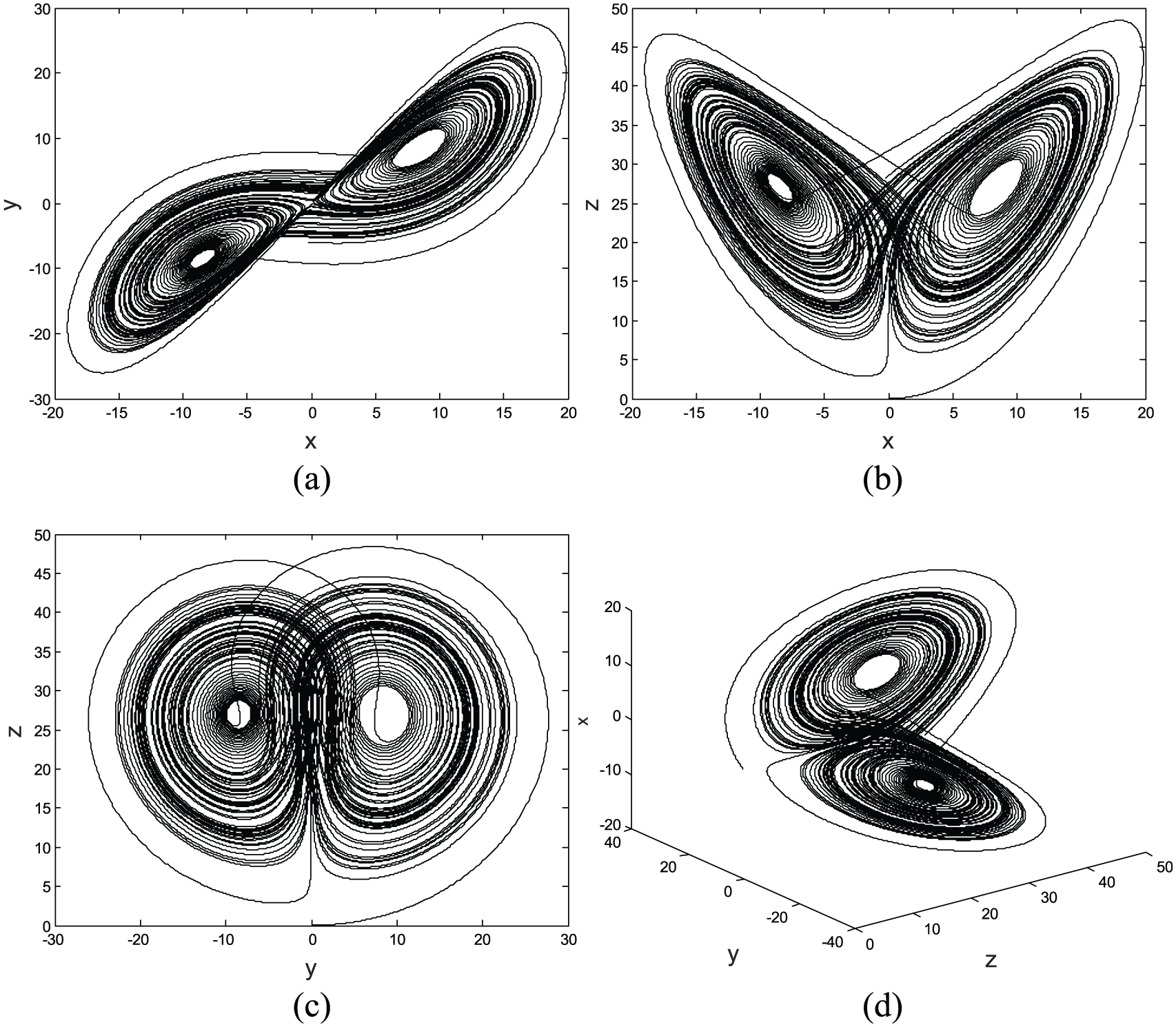
Projection of Lorenz attractor in two-dimensional coordinate: (a) X–Y coordinate projection, (b) X–Z coordinate projection, (c) Y–Z coordinate projection, and (d) X–Y–Z coordinate projection.
Lyapunov exponents of Lorenz system
The Lyapunov exponent of a dynamical system is a quantity that characterizes the rate of separation of infinitesimally close trajectories in phase space. The number of Lyapunov exponents is equal to the number of dimensions of the phase space, a positive Lyapunov exponent is usually taken as an indication that the system is chaotic, and the greater the positive Lyapunov exponent, the faster the divergence of phase space trajectories, and the system will be more sensitive to the initial parameters, and the chaotic characteristics of the system are also stronger. We can use the Jacobi method which has high computational reliability to calculate the Lyapunov exponents. Let the multidimensional chaotic mapping system equation be as follows

Its Jacobian matrix is

If the deviation of the initial point


where

For the Lorenz mapping, the initial values are
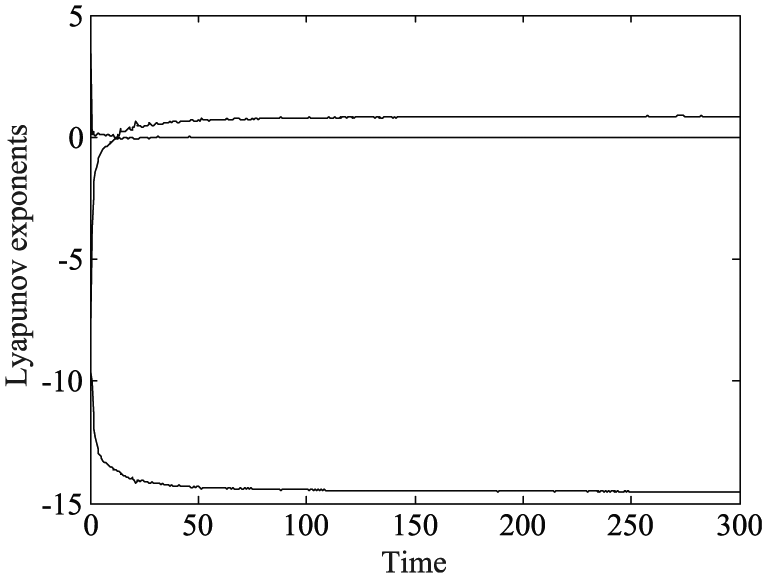
Lyapunov exponents of Lorenz system.
Construction of discrete chaoticsystem by Runge–Kutta method
Compared with low-dimensional chaotic systems, multidimensional chaotic systems have four advantages: (1) multidimensional chaotic system has higher complexity than low-dimensional chaotic system; (2) multidimensional chaotic system can produce multiple sequence outputs and can be applied to multiple key sequence generators; (3) multidimensional chaotic system has more initial parameters and initial variables, and the key space is large; and (4) multidimensional chaotic system is suitable for applications in secure communication systems. Generally, common multidimensional chaotic systems are composed of continuous chaotic dynamical equations, which need to be discretized when applied in digital systems. This section will discretize the Lorenz system.
The Lorenz system is a high-order nonlinear ordinary differential equation. In the solution, the Runge–Kutta algorithm is an algorithm with high accuracy and good gliding property.
The fourth-order Runge–Kutta algorithm of the high-dimensional equations are described as follows

where
The geometric interpretation of the fourth-order Runge–Kutta algorithm for 3D nonlinear differential equations is shown in Figure 3:
Through the point
Find the middle coordinates
Find the middle coordinate
Through the point

Geometric interpretation of the fourth-order Runge–Kutta algorithm.
The Lorenz chaotic system has three variables, X, Y, and Z, whose slope is represented by K, S, and M, respectively. The numerical solution of the fourth-order Runge–Kutta algorithm for the nonlinear differential equation of variable X is given by equation (6)

The expressions for Y and Z are similar to those of X. Replace
Construction of Lorenz system by Euler method
The Runge–Kutta algorithm has a good accuracy, but the algorithm is complex and difficult to design and implement in the digital system. The algorithm is generally discretized by the difference method of the equation, and the differential equation is usually transformed into the difference equation to solve. Solve the approximate value of

Geometric interpretation of Euler method.
Let
From the definition of the derivative, we know that for the sufficiently small

Euler method needs to set the step size, the selection of the step size in the numerical solution is very important, if the step is too big, after each step of the calculation, there will be a large local truncation error. If the step size is too small, although the value of the truncation error calculated for each step is smaller but when the scope of the calculations has been determined, a small step size results in the need to complete more calculation steps, which not only increases the amount of calculation but also the accumulation of calculation errors. Digital systems should use as few calculations as possible to meet specific error requirements, while also minimizing the amount of calculation and the accumulation of unnecessary errors.
A new 3D discrete chaotic system
In this article, a new three-dimensional discrete chaotic system (3DDCS) is proposed. The left end of the equation is simpler than the 3D Lorenz chaotic differential equation. If the characteristic meets the requirements, it can be used instead of the traditional Lorenz system in digital secure communication system.15–18 Through a large number of experimental tests and data analysis, a new 3DDCS is found. A new 3DDCS is shown in the following equation

The Lyapunov exponents of 3DDCS are as follows:
The 3DDCS has two equilibrium points, and the points are as follows
According to the eigenvalues of the Jacobian matrix of the equilibrium point

According to the eigenvalues of the Jacobian matrix of the equilibrium point

When the initial condition is

Orbit evolution graph of new 3D discrete chaotic mapping: (a)
According to the Lyapunov exponent, the system is hyper-chaotic system. According to the chaotic map orbit evolution graph, it can be seen that the system has chaotic deterministic regional distribution characteristics and can be applied to chaotic secure communication system.
Based on the field-programmable gate array/complex programmable logic device (FPGA/CPLD) development tool Quartus II 64-Bit, the 64-bit 3DDCS system programmed with programmable hardware description language verilog is shown in Figure 6, which uses 20 9-bit multipliers and 356 logical elements. For the actual comparison, the 64-bit Lorenz system uses 40 9-bit multipliers and 1272 logical elements. The comparison between these two resources is shown in Table 1. The complexity of the hyper-chaotic system avoids the procedure of the selection of step size, while the resource occupancy rate is low. It can be applied to the application of encryption system or secure communication synchronization system.

Circuit diagram of 3DDCS.
Resource occupation comparison table of Lorenz and 3DDCS.
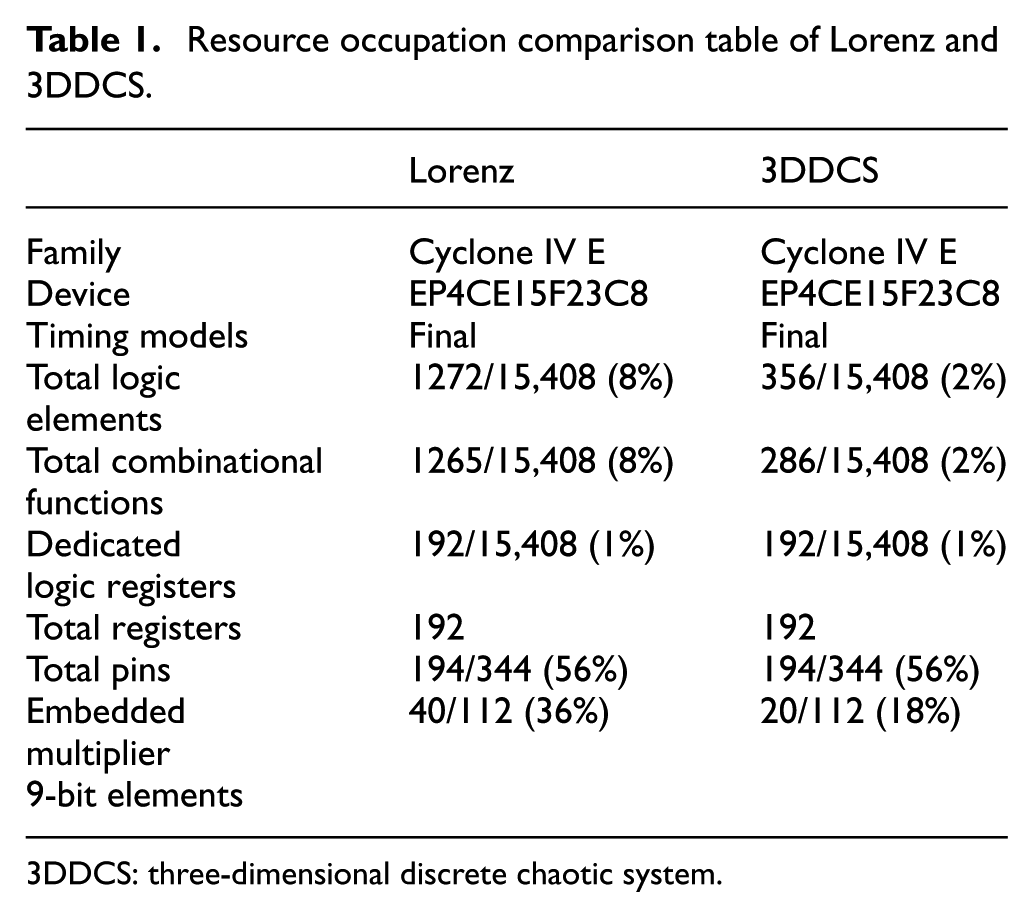
3DDCS: three-dimensional discrete chaotic system.
From the Lorenz and the 3DDCS resource occupation comparison table, 3DDCS has advantages in some aspects, the circuit is simple to implement, and further application designs can be carried out.
The three outputs X, Y, and Z of 3DDCS are quantized by interval quantization, and the mathematical expression is as follows

where m is arbitrary integer that is greater than 0, and
Resource occupation comparison table of Lorenz and 3DDCS.

Here we take color image encryption as an example to illustrate the encryption process. The color image is composed of tricolor matrices, which are divided into three color components: R, G, and B. Each color component matrix is composed of pixel matrix values, which are denoted as three integer matrices of

where
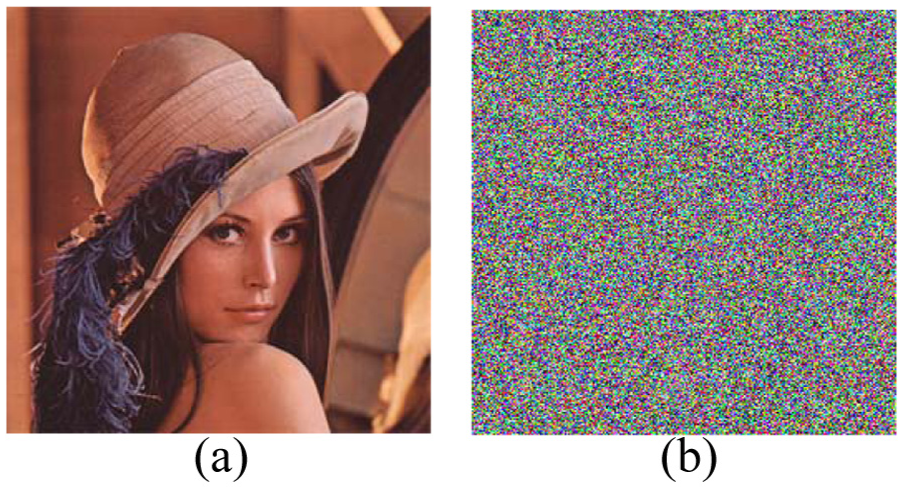
Experimental results of encryption Lena image: (a) the original image and (b) the encrypted image.
Correlation analysis of adjacent pixels.

Furthermore, the process of image decryption is the inverse of the encryption process, that is, the encrypted image and the chaotic sequence to do a bit-wise XOR operation, then you can restore the original image. The formula for implementing encryption is as follows

where

The outstanding advantage of this algorithm is that it is easy to operate, and the encryption and decryption process is simple and easy to implement. In the case of large amounts of information such as image information, this encryption algorithm has obvious advantages and is suitable for VSNs applications.
Conclusion
In order to facilitate the application of VSNs, this article explores the realization method of multidimensional chaotic discrete system. In the method of discretization of multidimensional chaotic continuous system, the Runge–Kutta method and the Euler method are analyzed. The former calculation complexity is high, which is difficult for the application of digital system design. The latter is dependent on the discrete step size, the need to select the step size will increase the calculation steps. In this article, we propose a 3DDCS method and find its Lyapunov exponents, which prove that there exist two positive Lyapunov exponents, so 3DDCS is a hyper-chaotic system. By the distribution map simulation of chaotic region, we can identify that the distribution is uniform. On the basis of this, the hardware design of the two chaotic systems in the same environment is realized, and the Lorenz and 3DDCS chips are realized, and the resources occupied are compared. Through the multi-comparison analysis, it is superior to the Lorenz system in terms of resource utilization, and at the same time, we designed a scheme based on 3DDCS sequence image encryption, which can be applied to VSNs. Since there is no more systematic method for constructing chaotic systems, the construction of chaotic systems is often stochastic. Therefore, this article will further explore the systematic method of constructing the discrete multidimensional chaotic system in order to avoid the step length selection problem and apply it to the lightweight digital encryption field.
Footnotes
Handling Editor: Jeng-Shyang Pan
Declaration of conflicting interests
The author(s) declared no potential conflicts of interest with respect to the research, authorship, and/or publication of this article.
Funding
The author(s) disclosed receipt of the following financial support for the research, authorship, and/or publication of this article: This work is partially supported by the Natural Science Foundation of China (grant no.: 61471158)
