




Abstract
A new form of network has been created with the communication between objects in the Internet of Things environment. Users began to take interests in outdoor activities such as sports and leisure activities while sharing photographs and videos each other. In order to minimize the damage caused by unexpected accidents in response to outdoor climate change, Internet of Things technology is applied to emergency rescue system for quick and efficient rescue. In this article, the unmanned remote smart rescue platform applying Internet of Things technology quickly responds by real-time monitoring of the occurrence of a distress call. The system was developed so that the emergency situation is transferred to the management center and rescue victims within 4 min. The real-time monitoring system of unmanned remote smart rescue box is developed in such a manner that the equipment can be checked for theft and damage from external sources. Sensor multifunction printed circuit board module is developed under Internet of Things environment to be interconnected to single-board computers and various sensors. Thus, the installation of unmanned remote smart rescue box at the actual site delivers accurate positions of rescuees to promptly dispatch personnel to carry out efficient rescue operations.
Keywords
Introduction
After the start of the Hyper-connectivity Society 1 in 2010, the use of smartphones has escalated and further transformed into new paradigms. The smartphone2,3 has been miniaturized which is different from past mobile phones, has an Operating System (OS) as a PC, and installs desired applications 4 of the user. In the Internet of Things (IoT)5,6 environment, smartphone users are accessing the network via wireless Internet without any restrictions on time and space while sharing various information.
Digitimes Research predicted that the worldwide shipments of smartphones in 2016 would increase than the previous year and reach US$1.222 billion, and this total would be US$1.52 billion in 2017, which is a 7% increase over 2016. 7 The worldwide number of users owning smartphones should exceed 7.8 billion people in 2021. It is predicted that the number of devices will eventually reach 11.6 billion. 8
The wireless interaction between objects constructed communication with each other in the IoT environment. International Data Corporation (IDC) expects that by 2023, more than 90% of the IoT data will be from the use of cloud computing, while it has been predicted that the rates of database (DB) usage, data storage, and the application of open-source software technology will increase to secure competitiveness. 9 In the Internet environment10,11 based on IoT, users have formed new social relationships through free communication, sharing of information, and expansion of people.
With the advent of social networking service (SNS),12,13 users can use smartphones to share personal information in real time that magnifies new hobbies and special activities. The user takes photos and footages on smartphone during the outdoor activities and shares them with the messages. The expansion of SNSs has promptly provided information on outdoor activities due to the change of lifestyles of users adapting to the IoT environment and spread of enforcement activities on a 5-day weekly basis. This affects the occurrence of events and accidents due to the dense flow of population who perform outdoor activities on weekends. Worldwide, the international disaster mitigation power organization has experienced serious environmental damage to more than 2.5 million lives due to climate disasters and damage of 4 trillion dollars over 30-year period from 1970 to 2000. Since 2012, about 4.4 billion dollars of economic damage has occurred.14,15 Various accidents occur due to the continuous change of climates, which necessitates the management of safety. Moreover, despite the fact that rescue equipments are installed at various attractions such as valleys, rivers, and beaches, missing victims occur every year. Rescue equipments installed at the sites lack continuous safety inspections and are poorly managed. At outdoor activity sites, proper managing of rescue facilities is difficult as they are stored without a separate lock, making them vulnerable to theft and damage.
The rescue team must be able to reach the rescuees within 4-min window16,17 to secure the golden time from the mobilization time to the cardiopulmonary resuscitation (CPR) method. Therefore, it is necessary to develop rescue system that develops the performance of effective rescue standards to secure golden time by applying IoT technology and to increase the reliability of the system.
Mizuki Murase et al. develop human management systems equipped by Bluetooth Low Energy (BLE) devices to secure the employee’s personal information and natural disasters. Through the BLE beacon devices, smartphone gather beacons and uploads locational information to the cloud, which is then provided to the administrator. 18 To operate a system that collects data from beacon devices, many beacons are required. Amitangshu Pal and Krishna Kant have developed a mechanism to transmit data of disaster-affected area by different network using a smartphone-based Wi-Fi tethering technique. 19 It is essential to add multiple sensors so that the administrator is provided with effective information. Despite any smartphone’s cellular network fails in a disaster-affected area. Osnat (Ossi) Mokryn et al.’s HelpMe system solved the communication problem in the calamity by providing smartphone-based ad hoc communication through Wi-Fi. The HelpMe client provides iOS applications based on Haggle middleware. 20 Due to the frequent disconnection on the Wi-Fi, it needs to be provided to the various OS users for the better solution. Md Norozzaman Jiko et al. designed an amphibious smart rescue robot to easily control anytime using a computer or smartphone. These robots, equipped with waterproof technology, can float above and submerge in water. In addition, as well as the remote control and video streaming, the data are transmitted. 21 It is essential to add multiple sensors to provide effective information to the administrator. Despite the fact that the necessity of a system that can provide emergency contact in the event of a safety accident is increasingly highlighted, it is difficult to install it due to communication problems. The field situation is difficult to anticipate, and efficient management measures are required for diverse safety accident situations.
Recently, to prevent safety accidents, IoT technology is used to respond to big data analysis,22,23 data modeling,24,25 decision support system,26,27 and real-time monitoring.28,29 IoT technology has been applied to expand the area so that the area can be managed quickly and accurately in the presence of a disaster.
In this article, unmanned remote smart rescue platform (URSR-P) applying IoT Technology was developed. The single-board computer30,31 and long-term evolution (LTE) router 32 module are connected in areas where the accidents are likely to occur to locate the disaster exactly. The unmanned remote smart rescue box (URSR-B) is designed for real-time monitoring, notifying the management center, and thus, swift actions from rescuers are possible. The application for the administrator maintains and manages rescue equipment safely while keeping the temperature inside the URSR-B constant. In all, an unmanned remote smart rescue cloud system (URSR-S) has been developed that continuously monitors accident occurrence processes in the event of an unmanned remote smart rescue ship opening or deviation from rescue equipment.
As a result, the URSR-P processes the information of the accident site accurately in real-time monitoring for the smooth structure of the victim and contact the emergency agency. The administrator can systematically maintain the rescue equipment continuously, the condition of the rescue equipment, the condition of the rescue equipment locker, and the complement of the equipment. In addition to preventing water leisure safety accidents, it is also believed to secure golden hours to be used in various fields.
The functions for the URSR-B are summarized as shown in Figure 1. Hence, the overall composition of this article is briefly summarized. Section of sensor multifunction printed circuit board module (SMPM) for IoT function development describes the functions applied in the URSR-B. Section of implementing and providing information about URSR-S conducted a real-time monitoring of the system 24 h and stored items generated at the site in the DB. Section of verification of URSR-S and the URSR-B is recognized as an emergency situation by operating the sensor which detects the door opening upon a single open. Real-time monitoring information is sent to the server and notifications are sent to the manager of the emergency situation.

Functional description of unmanned remote smart rescue box (URSR-B).
SMPM for IoT function
Safety accidents in modern society reflect uncertainty, interaction, and complexity. Accordingly, it is important to accurately manage a safety accident in advance and discover the accident severity element. The IoT technology has expanded its scope of coverage and is seeking ways to deal with disasters. The IoT is needed to prevent safety accidents in various industries, as new technologies are applied to safety accidents and on-site situations. In order to link a variety of things, a typical single-board computer such as Arduino, 33 Artik, 34 and Raspberry Pi35,36 can be used as an open source to develop the desired functionality. Arduino uses low cost and low performance of Atmel Corporation, while Raspberry Pi uses a high-performance chip produced by Broadcom. In addition, Arduino is difficult to assemble if it is used in conjunction with a non-competitive part of the hardware configuration. Features from Raspberry Pi allow users to configure the required functions by organizing the required function and incorporating the printed circuit board (PCB) design with the use of general-purpose input/output (GPIO) pins. Raspberry Pi’s configuration, which links the desired parts of the user, has a power supply through the microphone via a micro-USB terminal. The lower section of the Raspberry Pi is equipped with an SD card slot with OS installed, and it is easily connected to a monitor. Additional accessories can also be connected supporting up to maximum of four USB ports, for example, a keyboard, mouse, and Wi-Fi dongle. Detailed specifications of Raspberry Pi include Broadcom UCC-7 (Quad-core, 90 MHz), 1 GB RAM, and a Broadcom VideoCore IV graphics processor, which is based on the ARM Cortex.
Raspberry Pi was connected to various sensors, including several services such as an alarm,37,38 temperature control, 39 remote lighting control, 40 and camera41,42 were viewed and developed.
This study describes the development of an URSR-P using IoT technology to improve current operational practices and systems that are found to be inefficient in the event of a safety accident. As shown in Figure 2, an uninhabited, remote smart rescue structure was designed to request and promote assistance in an effective manner.

Diagram outlining the unmanned remote smart rescue platform (URSR-P).
The URSR-B converts solar energy by an electrical method through the solar module and 12 V battery supply. SMPM is coupled to the Raspberry Pi with an inverter converting input voltage into 5 V from 12 V. The SMPM is designed to activate a buzzer when the rescue tube is pulled out from the smart rescue box. Also, a cooling system is added inside the smart rescue box to maintain constant internal temperature.
A SMPM has been developed, which enables necessary functions by releasing the door of the URSR-B. As shown in Figure 3, when opening the URSR-B door or removing the rescue tube, the door sensor detects the activity and activates a beeping sound and buzzer to inform about the crisis.

Testing of sensor multifunction PCB module (SMPM) with door sensor.
As shown in Figure 4, light-emitting diode (LED) lighting was confirmed via the illuminance sensor so that it could be used externally. The URSR-B internal environment included a cooling fan that operates full time to keep the internal temperature constant for the purpose of unattended remote monitoring.

Test sensor multifunction PCB module (SMPM) for applying light sensor and temperature sensor.
Even at night, the LED lights were visible so that the URSR-B could be visually easily located and accessed. The installed cooling fan inside the URSR-B is built in such a way that the sensor values of temperature and humidity are reflected, thus controlling both temperature and humidity by inhaling the external air and maintaining the temperature and humidity inside the rescue box.
First, the operations of the required sensors were verified when the door of URSR-B was opened. To design an SMPM, the power consumption rate was calculated according to product specifications as displayed in Table 1.
Detailed module specifications for the design of sensor multifunctional PCB module (SMPM).
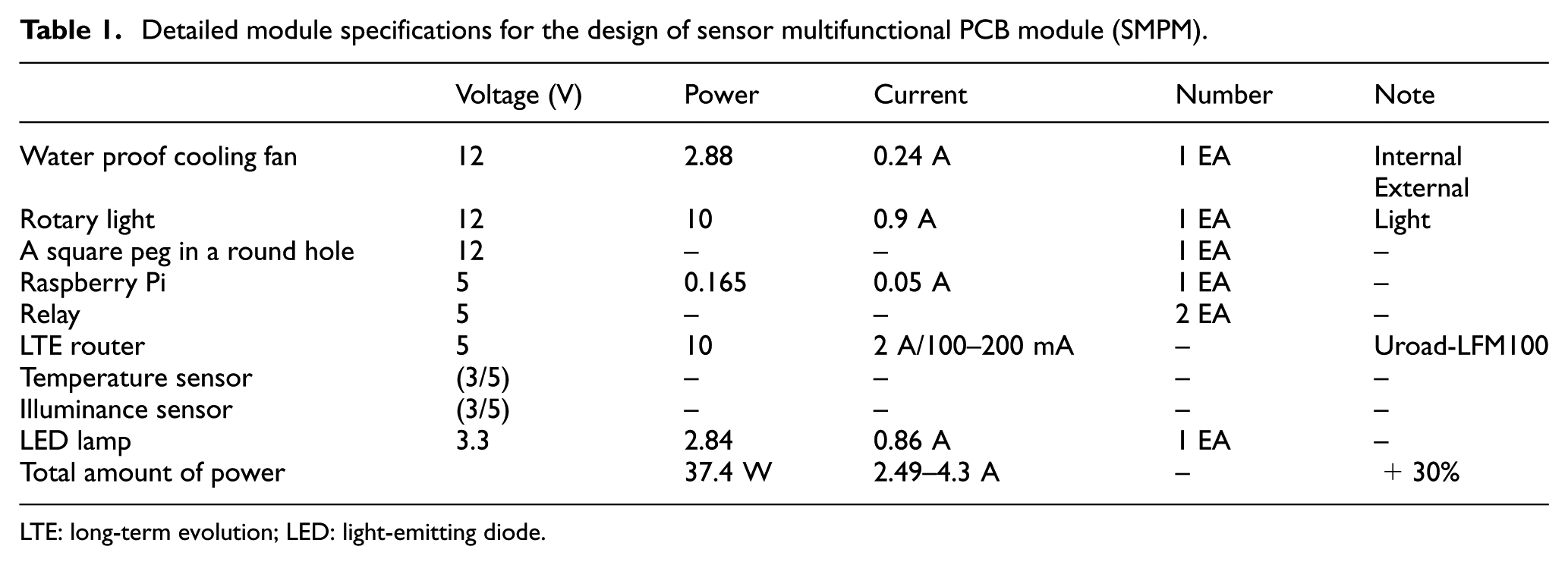
LTE: long-term evolution; LED: light-emitting diode.
Considering the operating situation of an URSR-B, a total of 13 ports are required with the voltage values arranged at 12, 5, and 3.3 V. Among them, three blocks require 12 V output, six blocks require 5 V output, and 1 block requires 3.3 V to about 3.3 W (electric current 1 A). As a result, the total power used in the SMPM was designed with an expected consumption of about 12.5 W (electric current 2.5 A). Including a power margin of 30%, the total expected electrical energy consumption of the URSR-B is 28.8 W. SMPM that is connectable to the GPIO pin of Raspberry Pi expressed the circuit operation by applying the circuit parts.
As shown in Figure 5, the circuit copper wire and the arranged sensor were designed so that it could be connected to the sensor multifunction PCB and operate 13 ports continuously.

Development of sensor multifunction PCB module (SMPM) by circuit diagram.
The circuit drawing specifies the connections between the sensors and the connection of the grounded pins during the artwork for the production of the SMPM. Factors such as direction, hole location, and dimensions were taken into consideration during the developmental stage of SMPM so that it can operate under field conditions. SMPM is supplied with a 12 V power supply and designed to operate when the door to the URSR-B is opened.
Implementing and providing information about the URSR-S
Currently, installed rescue structures have difficulties in accurately locating the region where the emergency situation has occurred, identifying condition of the particular facility, and contacting emergency agencies.
For prompt and accurate rescue activities, LTE router technology is applied to IoT environment. The LTE router is equipped with a GPS module providing location-tracking services. In addition, the virtual private network (VPN) feature solves security issues that can be a problem when connecting to Internet.
As shown in Figure 6, the door sensor of the URSR-B sends history of accidents to the server at a regular basis. By the use of history information, administrator is able to progress to expected location of accident, acquire precise timing of the rescue activity, and contact with an emergency institution. The personal smartphone of the administrator will proceed remote monitoring, making the analysis and response of various incident accidents will be more accurate and quicker. Also, various incident information is backed up to the real-time server, allowing administrators to access the web front-end and, if necessary, access directly the back-end DB. Real-time data that are uploaded are stored continuously, kept encrypted, and important patches are distributed and managed within 1 or 2 weeks. These data can be confirmed accordingly to the manual set by the server. Additionally, a variety of event information is backed up to the real-time server, and the administrator can verify the server access rights according to the manual set up by the server.

The diagram outlining the unmanned remote smart rescue cloud system.
The URSR-B is the result of the identification of the underlying data and emergency situations in the field, as shown in Figure 7, by sending the relevant data to the server to confirm the status information.

Server receives result of the unmanned remote smart rescue cloud system.
This process allows information management to be backed up by the server frequently, which enables the access to the server and information by the administrator.
The server broadcasts the signal from the SMPM and provides the IP address and port number to register the administrator’s ID. In most cases, servers are set to synchronize for every second when there are certain changes to the data. However, in case of URSR-S, the data are synchronized automatically every 0.3 s by the server that is installed on the subnet in the network for efficient rescue operations. The reason for such high frequency of synchronization is that the network traffic of the server and loading time for the administrator can be elongated. Depending on the sampling method, the compressibility and the size of the image can be reduced. Therefore, 0.3 s of sampling rate can extract image regions partially using the coordinate values or clip images along predefined layouts for synchronization.
Raspberry Pi and multifunctional PCB sensor are monitored in real time to store the data and backup in the server. The server must generate full backup data every 7 days to secure the space in the data repository. Currently, through using the prototype, there are no distinct problems with the amount of data stored. However, considering the fact that the size of the data is increasing, further studies will be conducted with distributed processing method.
When the URSR-B is opened or the rescue tube is removed from the box, the information is transmitted to the server via the LTE router technology in response to the Raspberry Pi and SMPM. If additional information is needed, you can actively access the server via the SMART RESCUE of the application administrator.
The administrators SMART RESCUE was developed using Android Studio version 1.5.1 for Windows 7. The administrators SMART RESCUE arranged a TextView and Button, and when the Button is pressed, the contents of the TextView are changed according to the occurrence of situation of the event. As shown in Figure 8, the administrator of SMART RESCUE confirms the material to be stored in real time on the server, such as the image data and the accident location.
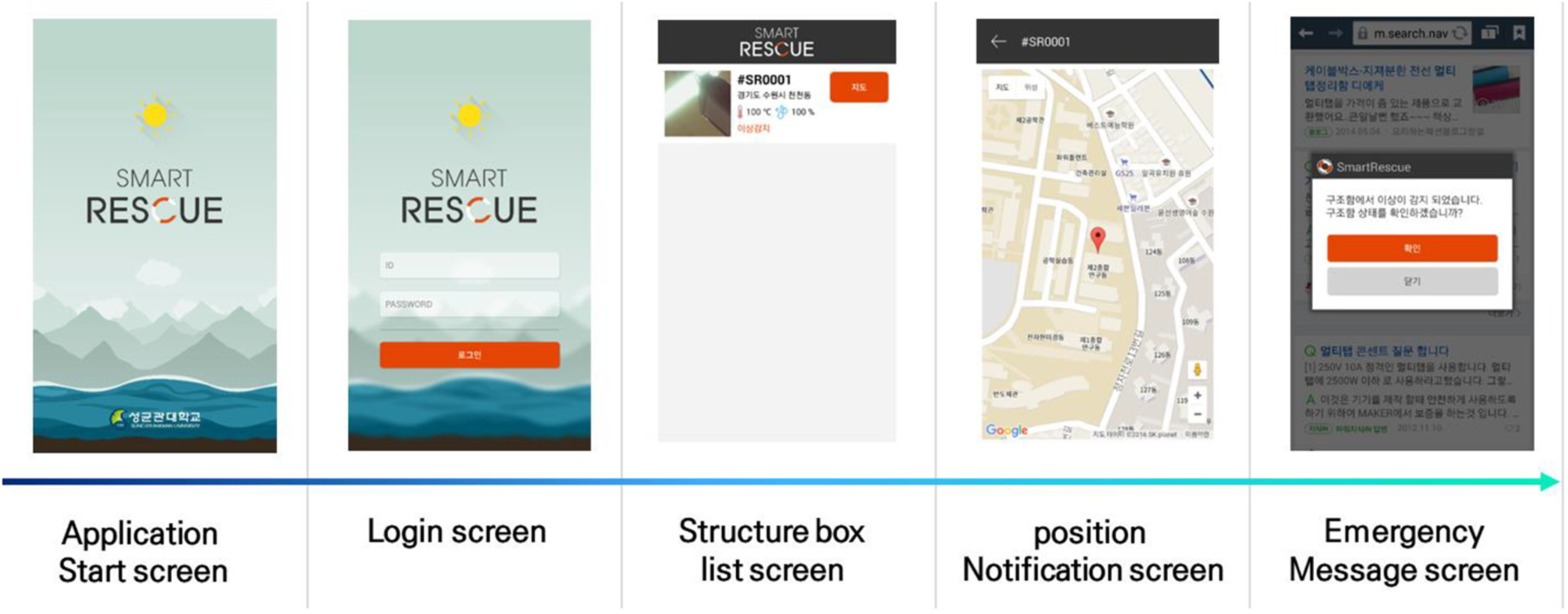
Operation of SMART RESCUE application.
Additionally, the list of URSR-B that the administrator is in charge of is displayed on the screen when the application is operating with administrator’s ID. When the administrator chooses the location of the selected structure and the current situation, the real-time data are downloaded to the administrator.
A real-time connection message window is displayed when the URSR-B is confirmed to be abnormal. In addition, the application will automatically run if the status check button in the connectivity status window is touched. When the close button is pressed, the alert is removed or muted for 1 h. Administrator SMART RESCUE enables the management of URSR-B in critical situations throughout 24 h around the clock. As shown in Figure 9, the administrator SMART RESCUE monitoring algorithm for administrators was designed.

Administrator SMART RESCUE monitoring algorithm.
The administrator continuously realizes the detection of abnormalities in the safety aspects of the URSR-B and provides notification through vibration, warning tones, and warning pop-up signs. After checking the pop-up messages within 10 s, the administrator will record the status of the URSR-B and the current situation with an image indicating that abnormalities are detected. This process allows administrators to identify problems and gain access to the server to identify problems.
Verification of an URSR-P
To provide the power supply for the URSR-B, the battery was connected to the conductor (+ and −), which enables the activation of the buzzer and LEDs. Also, to ensure a continuous supply of electric power, two batteries were used. While one battery is being charged, the other battery supplies power to Raspberry Pi and LTE router. As shown in Figure 10, an energy-saving algorithm was designed to build an unmanned remote monitoring system. The solar panels of the URSR-B are used to draw energy from the sun to produce electricity, thereby producing electricity itself and saving energy. Also, when the power consumption is met with poor battery power, the administrators are notified with an alarm and warning pop-up.

Energy-saving algorithm of the unmanned remote smart rescue box (URSR-B).
The URSR-B using solar power is usually less inconvenient than replacing batteries and managing them. Moreover, LED lights can be easily checked at night, thus enabling real-time monitoring to prevent emergency situations from occurring 24 h.
The SMPM combined with the Raspberry Pi takes 60–70 photographs per minute for 24-h surveillance. These capabilities minimize the possibility of theft and damage both inside and outside of the URSR-B.
The process of developing the URSR-S, which applies the Raspberry Pi and LTE routers, is shown in Figure 11.

Development of the unmanned remote smart rescue box (URSR-B).
A photograph of the URSR-B is transmitted to the main server so that it is confirmed using SMART RESCUE application by the administrators. As shown in Figure 11, with the Android Mobile OS, the administrator SMART RESCUE can easily obtain information of the list of managed URSR-B, alert location, and emergency message screen at an Android mobile OS. Also, real-time remote monitoring gathers information about the theft and loss situation of rescue equipment (Figure 12).

Operating process of the unmanned remote smart rescue platform (URSR-P).
The URSR-B recognizes an emergency situation by operation of the door sensor upon one opening. Under emergency situations, 60–70 photographs are taken in minute and transmitted to the server.
The server collects data such as the predicted location of the accident occurrence, the time of the accurate rescue activity, and the weather environment. The server creates backup data in real time and constructs a separate analysis of various incidents that require inspection by the administrator in the management server to be checked upon by the administrator. The administrator confirms the results of the accident analysis with administrator SMART RESCUE.
During the standby status, the URSR-B sends 8–10 photographs to the main server within 1 min. The contents of the generated events can be checked on the server by the administrator’s application. Thus, unmanned remote-mart human rescue box was verified by conducting more than 70 experiments.
Potential errors and loss of time that can occur during the mid-stage steps can be reduced by decreasing the risk of managing the administrative staff by enabling the direct management of administrative responsibilities. As shown in Figure 13, an operational algorithm of the URSR-S is outlined. When the door of an URSR-B is opened or the life tube is dislodged, the SMPM, combined with Raspberry Pi, identifies an emergency situation. The flashing emergency warning light at the exterior and photographs of the situation at the scene are taken and the data are transmitted to the server based on the manual. The URSR-B with rescue tube collects information regarding temperature, humidity, and illuminance.
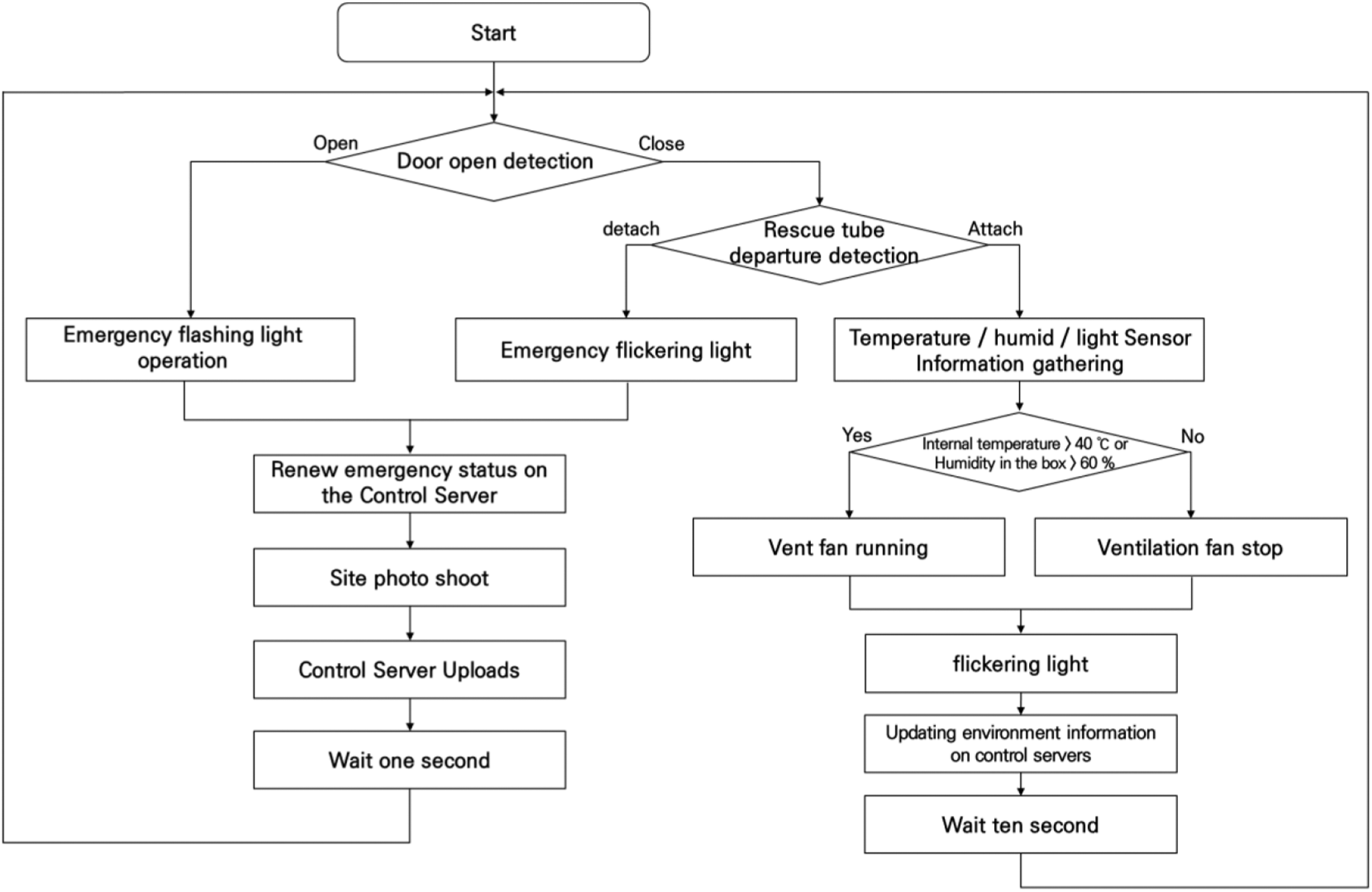
Operating algorithm of the unmanned remote smart rescue platform (URSR-P).
An internal ventilation fan can be activated to maintain an internal temperature of 40°C and a humidity of 60°C on average to update the server environment information in real time.
The URSR-B operates by transmitting the electrical energy obtained by the solar module to a SMPM combined with Raspberry Pi for use in areas where power is not available. The URSR-S conducted verification tests according to the test items as shown in Table 2. Test items were sent with the following information: number of operational errors, photographing performance, and door opening detection.
Verification experiment for the unmanned remote smart rescue box.
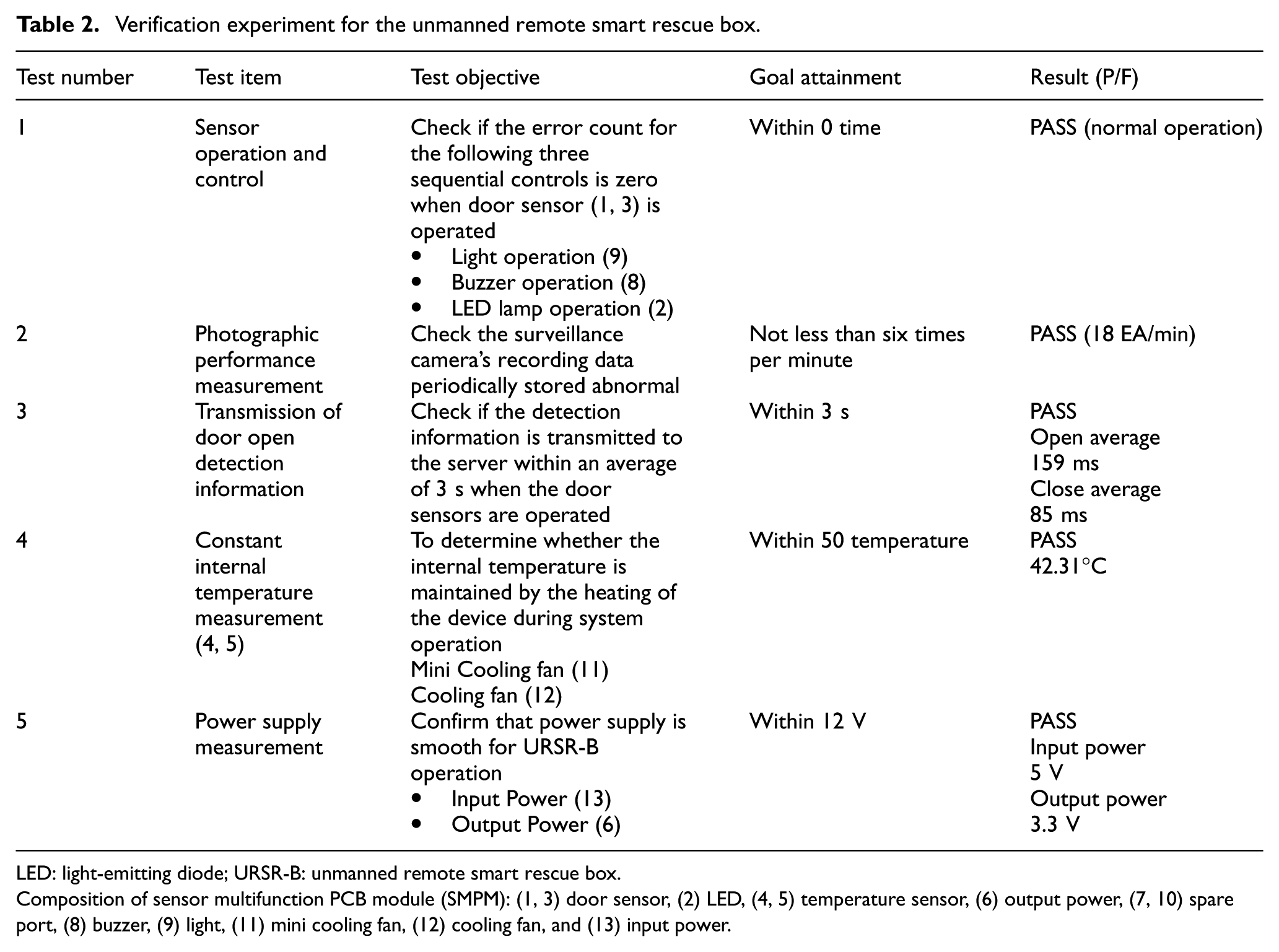
LED: light-emitting diode; URSR-B: unmanned remote smart rescue box.
Composition of sensor multifunction PCB module (SMPM): (1, 3) door sensor, (2) LED, (4, 5) temperature sensor, (6) output power, (7, 10) spare port, (8) buzzer, (9) light, (11) mini cooling fan, (12) cooling fan, and (13) input power.
The priority for the operation of the door sensor was achieved by controlling the operation of the light beam, buzzer, and illumination of the LED lamp so that the number of error was zero. In all, 10 consecutive experiments were performed to check whether the door sensors are normally operating as shown in Table 3.
Experiment result of sensor operation and control.

For 24 h, the monitoring cameras were checked to ensure that the recording data were stored regularly on the server regularly over six times per minute, using the monitoring cameras to record the span of time. When the door to the URSR-B was opened, the average transfer time for the sensor information to reach the server was less than 3 s. Again, 10 consecutive experiments were performed to check whether the door sensors can distinguish the operations between opening and closing of the door as shown in Table 4.
Experiment result of transmission of door open detection information.

Through these test runs, URSR-P accompanied with IoT technology was checked for reliability and improved in their performance. By utilizing this platform, an effective real-time monitoring and swift rescue operations can be performed. It is expected that by supporting for effective rescue operations, one can minimize the tolls in emergency situations.
Conclusion
As the demand for marine leisure has soared, the casualty figures from the accidents have also increased, leading people to become more aware of safety issues. In addition, alternatives are needed to avoid human accidents and minimize human loss due to the occurrence of various accidents depending on climate changes. An URSR-S was installed in an area where a disaster could occur using solar cells to convert solar heat into direct electrical energy and combined a power supply to sensors into a separate electrical energy. In this article, an URSR-P was developed using IoT technology. Real-time monitoring system was established in areas where drowning could occur to prevent unexpected accidents. In order to rescue the victim in an emergency situation in less than 4 min, a continuous rescue equipment was managed. The URSR-S used a SMPM that combines the heat from the sun directly into electrical energy using a solar cell.
In order to constantly and continuously supply power to the URSR-B, two separate battery packs are used. This enables one battery pack to charge backup power, while the platform is driven by the other. When the opening of the door of the URSR-B is detected by the sensor, 60–70 photographs and related information are transferred to the server per minute. Also, 8–10 photographs are taken and sent to the server during the standby status to be checked by administrator’s application.
Functions that are enabled after detecting an opening of the door are prioritized as flashing of emergency warning light at the exterior, buzzer sound, and lighting of LED lamp to be verified for zero error rate. Moreover, to ensure full surveillance around the clock, the camera module was tested and verified to transfer surrounding visual information to the server with at least six photographs per minute. It has been confirmed that the time taken to transmit detected information to the server was less than 3 s. Through this process, server collects various information such as expected location of the accident, exact time in rescue operation, and weather condition.
The internal temperature and humidity condition were maintained to have temperature around 40°C and humidity of 60°C. This temperature and humidity control is achieved by a ventilation fan inside the URSR-B to manage the conditions of life-saving appliances.
The real-time notification system was constructed to remotely detect the door opening of the URSR-B through an application that can be utilized by administrators. This notifying enables prompt dispatch of field personnel to carry out rescue operations as soon as possible.
This article develops a full chain of system from emergency site to administrator emergency rescue. Development of application that is interconnected to the system makes the suggested system exceptional from preceding works. To implement the IoT environment, combination of single-board computer with SMPM and LTE communication environment has created noticeable potential. However, despite the fact that the system is applicable to various environments besides drowning accidents, this article was developed in focus of water safety accidents. In the aspect of extendability, it is expected that the work can be applied to more general cases where human casualties are likely to occur and can be integrated with the internal structural expansion and management system if needed. It is possible to be utilized in a wide range of crowded places, including mountains, sea, concert halls, amusement parks, resorts, and campgrounds.
Footnotes
Handling Editor: Wenbing Zhao
Declaration of conflicting interests
The author(s) declared no potential conflicts of interest with respect to the research, authorship, and/or publication of this article.
Funding
The author(s) disclosed receipt of the following financial support for the research, authorship, and/or publication of this article: This research was supported by Basic Science Research Program through the National Research Foundation of Korea (NRF) funded by the Ministry of Education (2017R1D1A1B03031469).