




Abstract
In practical application, the generation and evolution of many real networks always do not follow rigorous mathematical model, making network topology optimization a great challenge in the field of complex networks. In this research, we optimize the topology of non-scale-free networks by turning it into scale-free networks using a nonlinear preferential rewiring method. For different kinds of original networks generated by Watts and Strogatz model, we systematically demonstrate the optimization process and the modified networks to verify the performance of nonlinear preferential rewiring. We conduct further researches to explore the effect of nonlinear preferential rewiring’s parameters on performance. Simulation results show that various non-scale-free networks with different network topologies generated by WS model, including random networks and various networks between regular and random, are turned into scale-free networks perfectly by nonlinear preferential rewiring method.
Introduction
The interdisciplinary field of complex networks is a young and attractive area of scientific research. It is generally accepted that network science is an important tool to model and explain many real complex systems in the world, for instance, the World Wide Web,1,2 power grid,3–5 social collaborations,6–8 and protein–protein interaction.9–11 However, practical networks are always difficult to be described accurately and completely. One of the great challenges in understanding the structure and function of networks is to propose effective mathematical models, which at least capture the key properties of the entire networks.
Erdős–Rényi (ER) random graph model is a simple and useful model to generate random graphs which is based on probabilistic theory.12–14 ER model assumes that all pairs of nodes are connected with the same probability. ER graphs tend to have low clustering coefficients and short average path length. However, though the importance of ER model should not be underestimated, many practical networks do not follow the ER model because of its oversimplified assumption. Networks generated by ER model do not capture two important properties which are generally observed in real networks: the local clustering and the formation of hubs. The collaboration graph of film actors and the electrical power grid are shown to have short average path lengths as well as high clustering coefficients, which is always called “small-world” networks according to the six degrees of separation theory.15–17 Watts and Strogatz (WS) model is proposed to generate graphs with small-world properties. It is generally accepted that most practical networks are neither regular nor random graphs, and WS model can produce between random and regular networks by random rewiring from a regular lattice. The degree distribution of graphs produced by WS model converges to a Poisson distribution. In contrast, real complex networks often have non-homogeneous structures that demonstrate a power-law degree distribution, and these networks are often called scale-free networks.18–20 Barabási–Albert (BA) model is proposed for the first time to generate scale-free networks according to two critical mechanisms: growth and preferential attachment. In BA model, a node is more likely to connect to nodes with higher degrees. In addition, there are several mathematical models have been proposed based on BA model, such as the local-world evolving network model,21,22 and the model of growing scale-free networks with tunable clustering.23,24
While BA model and its modifications and extensions do capture the property of power-law degree distribution, there are still several limitations in technological application. For instance, when constructing sensor networks,25,26 there are usually several sensors need to be added simultaneously rather than one-by-one as proposed in BA model. In addition, it is possible that these sensors waiting to be added already have links between them. The demand for global information to implement preferential attachment in constructing process is also unrealized. In total, it is difficult to construct a scale-free sensor network practically by applying BA model. However, scale-free networks have an excellent property—the robustness to failure, and this property is critical to sensor networks. As a result, it is important to optimize network topology by turning non-scale-free networks into scale-free networks. To the best of our knowledge, there is little attention has been paid to this field. It is shown that in socio-ecological systems, rewiring random networks with bounded rationality would lead to scale-free networks in the process of converging toward Nash equilibria. 27 This method optimizes the topology of random networks at the expense of high complexity. Furthermore, it is shown that by preferential rewiring, complex networks can reach a stationary state, even with a power-law distribution.28,29 However, the existing preferential rewiring methods are sensitive to parameter selection and demonstrate a poor performance in power-law distribution when degree is large.28,29 Herein, we propose a novel method to turn non-scale-free networks into scale-free networks by a new nonlinear preferential rewiring (NPR) method.
The rest of this research is organized in the following manner. Section “NPR method” introduces the mechanism of NPR method. Section “Modification of networks by NPR method” describes the experiments which are conducted to test the performance of NPR in network topology optimization. Section “Exploring the effect of NPR’s parameters” explores the effect of NPR’s parameters on the optimization performance. The conclusions and discussions of this study are presented in section “Conclusions and discussions.” Dynamic features of whole rewiring process are presented in Supplemental information.
NPR method
WS model is used to generate non-scale-free networks here.
17
There are three critical parameters in WS model: the desired number of nodes (N), the mean degree (K, assumed to be an even integer), and rewiring probability
For a given complex network
For every node Node1, if its degree is equal or greater than two, randomly choose a node Node2 that is connected to the selected node Node1.
Choose a node Node3 with a probability that is an increasing function of the number of links that the existing nodes already have.
A rewiring is implemented by replacing the link between Node1 and Node2 with a link between Node2 and Node3 if the following three conditions are satisfied: the degree of Node1 and Node3 is not equal; Node3 is a different node from Node1 and Node2; and there is no link between Node2 and Node3.
After all nodes are processed, a modified network is generated. In order to generate a complex network with scale-free degree distribution, the processes 1, 2, and 3 should be repeated several times till a termination condition is satisfied. In addition, the function about choosing
First, we reorder all the nodes by sorting their degree in ascending order. Resorted nodes and their corresponding degree are denoted by

where

here, we introduce a positive constant


where
The probability of choosing node

If these processes are repeated

Each network can be represented by a symmetric adjacent matrix

where
The change between network



The number of changed links is denoted by

A rate describing the changed links in the transformation from network

The value range of
Modification of networks by NPR method
WS model is used to generate non-scale-free networks. Two different experiments are implemented to show the process of this method and the modification of networks. In order to visually demonstrate the change in the topology between original non-scale-free networks and the networks modified by NPR method, the number of nodes is set relatively small. Each experiment is repeated 30 times independently. The parameters are set according to Table 1. The visualization of networks is organized by Gephi software. 30
Parameters of WS model and NPR method.
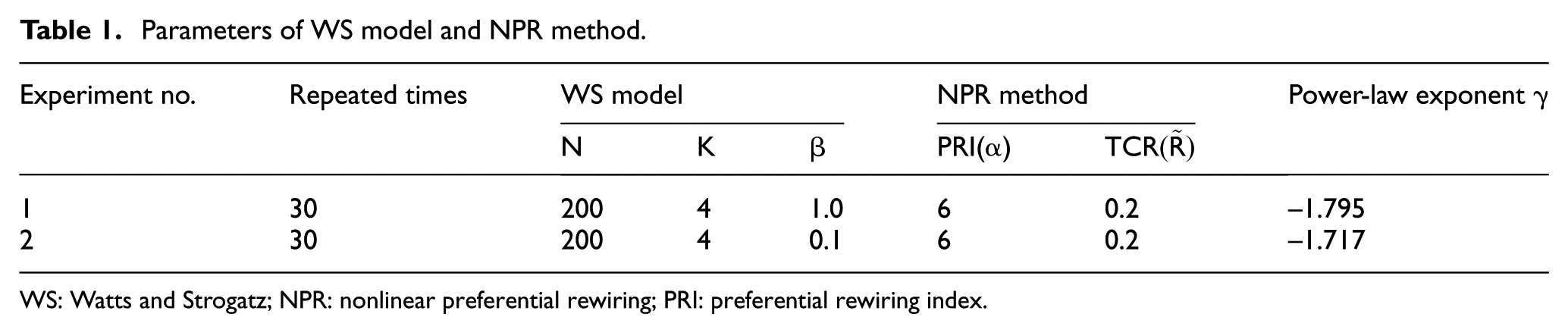
WS: Watts and Strogatz; NPR: nonlinear preferential rewiring; PRI: preferential rewiring index.
The results of the first experiment are illustrated in Figure 1. The original complex network is a non-scale-free network, actually a random network, generated by WS model with parameters of N = 200, K = 4, and

Original and modified networks. (a) Topology of non-scale-free network generated by WS model with parameters of N = 200, K = 4, and
The results of the second experiments are shown in Figure 2. The original and modified networks are shown in Figure 2(a) and (b), respectively. The topology of the original network is between regular and random graph as illustrated in Figure 2(a), and it is a non-scale-free network and demonstrates high clustering coefficients. A part of the modifications of network are illustrated in Figure 2(c), where the removed links (red dots) tend to gather together as a result of the WS model with little value of

Original and modified networks. (a) Topology of non-scale-free network generated by WS model with parameters of N = 200, K = 4, and
Exploring the effect of NPR’s parameters
The following experiments are implemented to explore the effects of NPR’s parameters on the optimization of network topology. The performance of NPR method in turning non-scale-free networks into scale-free networks is denoted by the extent to which the degree distribution of modified network follows the power-law distribution. In order to demonstrate the degree distribution better, complex networks with enormous nodes are considered here. The original networks in the following experiments are generated by WS model with different values of

Degree distribution of original and modified networks with different PRI. Original networks generated by WS model with different values of

Degree distribution of original and modified networks with different TCR. Original networks generated by WS model with different values of
PRI
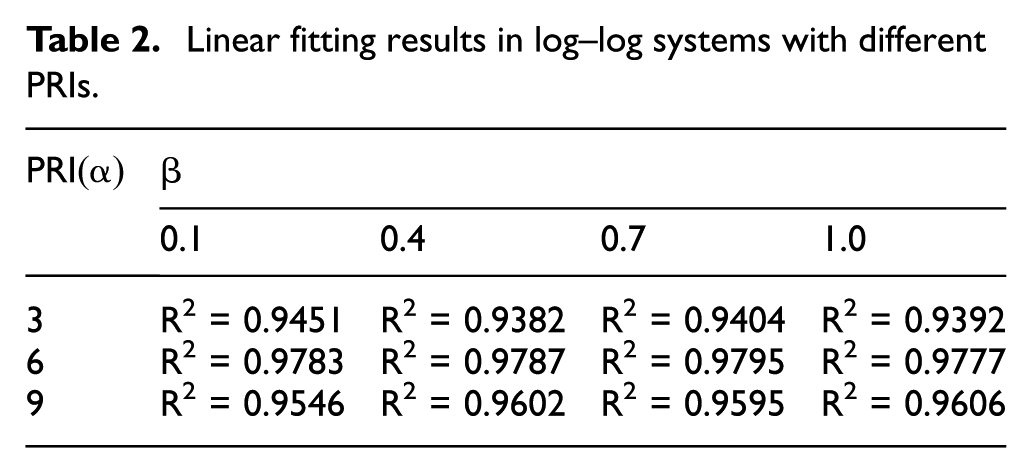
Average degree distributions of original and modified networks are illustrated in Figure 3 and Table 2. Three different PRIs are considered for each kind of experiment: PRI(α) = 3, 6, 9. The results of topology optimization of original networks with
Linear fitting results in log–log systems with different PRIs.
TCR
Average degree distributions of original and modified networks are illustrated in Figure 4 and Table 3. Three different TCRs are considered for each kind of experiment:
Linear fitting results in log-log systems with different TCRs.
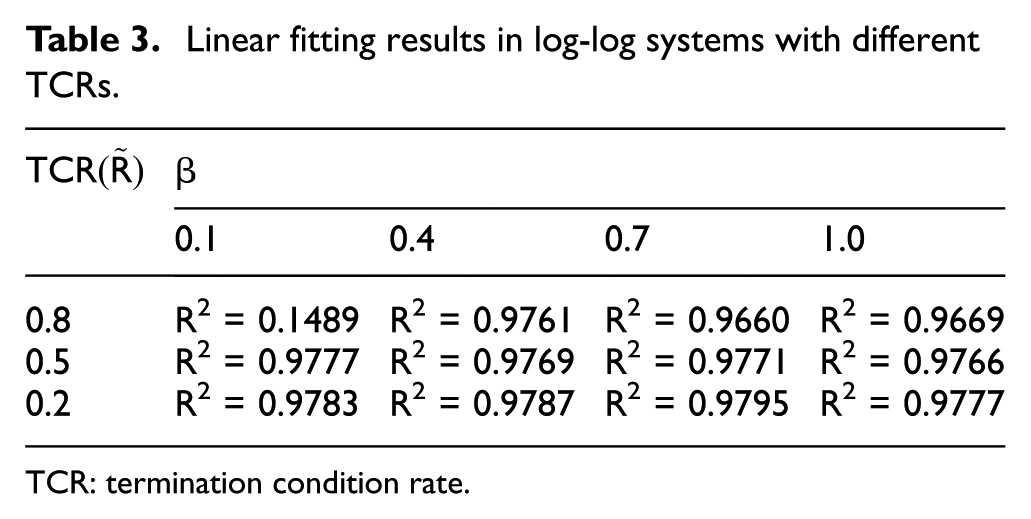
TCR: termination condition rate.
Conclusion and discussion
The main objective of this research is topology optimization of existing complex networks, and our study resulted in promising findings. Usually, many practical networks such as sensor networks do not follow the generation process of rigorous mathematical models. As a result, many practical networks need to be optimized. For example, topology optimization of wireless networks plays an important role in regulating transmission power of the entire network in wireless communication area.31,32 In addition, the topology optimization problem of wireless network is usually a dynamic process and evolves to efficient architecture temporarily. 33 Network topology optimization is a new challenge which is even difficult than constructing a totally new network, where not only the network topology is considered, but dynamical evolution and optimization expenses are also taken into account.
Preferential attachment is the key mechanism in BA model referring to generate scale-free network. 20 In addition, rewiring is also a critical point when generating small-world network in WS model. 17 BA model exhibits growth processes by adding new nodes and edges, while WS model exhibits topology modification processes by rewiring. As a result, it is reasonable to combine preferential attachment process with rewiring process in network topology optimization problem. In this study, we proposed a NPR method to optimize network topology, by turning non-scale-free networks into scale-free networks. The mechanism of this NPR method was introduced, and several experiments were implemented to demonstrate the effect of this method on many kinds of non-scale-free networks, including random networks and several networks between regular and random. Conclusively, simulation results showed that regardless of the original networks, the networks modified by our method demonstrated power-law degree distribution perfectly. At technological level, such nonlinear preferential attachment method will help developing smart complex networks which are able to adjust to different conditions in real time to improve efficiency.
Supplemental Material
Supplemental_information – Supplemental material for Network topology optimization by turning non-scale-free networks into scale-free networks using nonlinear preferential rewiring method
Supplemental material, Supplemental_information for Network topology optimization by turning non-scale-free networks into scale-free networks using nonlinear preferential rewiring method by Feng Su, Peijiang Yuan, Yuanwei Liu and Shuangqian Cao in International Journal of Distributed Sensor Networks
Footnotes
Acknowledgements
The authors thank Dr Li jianmin of Tsinghua University for beneficial discussions and valuable comments on this work. Feng Su and Peijiang Yuan contributed equally to this work.
Handling Editor: Amiya Nayak
Declaration of conflicting interests
The author(s) declared no potential conflicts of interest with respect to the research, authorship, and/or publication of this article.
Funding
The author(s) disclosed receipt of the following financial support for the research, authorship, and/or publication of this article: This work was supported by the National Natural Science Foundation of China (No. 61375085) and the Foundation of Shanghai Aircraft Manufacturing Co., Ltd (no. 32284001).
References
Supplementary Material
Please find the following supplemental material available below.
For Open Access articles published under a Creative Commons License, all supplemental material carries the same license as the article it is associated with.
For non-Open Access articles published, all supplemental material carries a non-exclusive license, and permission requests for re-use of supplemental material or any part of supplemental material shall be sent directly to the copyright owner as specified in the copyright notice associated with the article.
