




Abstract
Mobile micro-learning has received extensive attention in the research of smart cities because it is a novel fusion service mode of the mobile Internet, cloud computing, and micro-learning. However, due to the explosively increased applications of the mobile micro-learning and the limited resources of mobile terminals, an effective energy saving approach for mobile micro-learning is urgently required. For this end, this article proposes an efficient task joint execution strategy to reduce energy consumption. First, a new matching method of time series is proposed to obtain the latest requested record, which can provide guidance for the selection of a future service mode. Second, a mapping-level service mode and a cloud-level service mode are proposed to achieve seamless switching. Finally, the genetic algorithm is used to find the optimal executive strategy. In addition, the experimental results show that the proposed method can effectively realize the target of energy saving by using real data set.
Introduction
As a novel fusion service mode of the mobile Internet, cloud computing, and micro-learning, mobile micro-learning has attracted extensive attention in the research of smart cities. Moreover, its running is not limited by time, space, and region; the mobile micro-learning business presents an explosive growth trend, which needs more computing, storage, bandwidth, and energy. However, since the mobile terminal takes a great deal of power to deal with the applications of mobile micro learning, which directly restricts the development of mobile micro-learning.. For this reason, we focus on the efficient, reliable, and low energy consumption service in mobile micro-learning.
The “mobile-Cloudlet-cloud” architecture is generated by the fusion of mobile computing and cloud computing technology. As the middle tier of the architecture, Cloudlet can bring the cloud closer to the terminal user. Therefore, it can avoid some problems, for example, the latency and bandwidth limitation of Wide Area Network. In addition, Cloudlet is a mobility-enhanced small-scale cloud data center, which is placed at the edge of the Internet. Thus, it also has the advantage of the cloud platform, such as powerful processing power and storage capacity. Furthermore, to reduce computation and storage pressure of mobile terminals, offloading compute-intensive task to the remote resource-rich cloud server has been proven to be an effective method.1–4 However, the distance between the physical locations of cloud servers and the mobile terminal users is remote, which could cause network latency and increase battery-empowered mobile terminal resource consumption. Therefore, this article uses Cloudlet to replace cloud as a service provider.
Introducing Cloudlet into the micro-learning is a promising method for energy saving because users can make full use of high computation and huge storage power of Cloudlet. However, many researchers focus mainly on the user behavior collection, 5 learning style analysis, 6 framework design, 7 high attrition rates, 8 and so on. The energy consumption of mobile micro-learning is rarely discussed.
However, low energy consumption and high dependability are two crucial factors for the development of mobile micro-learning. For this reason, we propose a task joint execution strategy to reduce mobile terminal energy consumption and ensure the dependability of mobile micro-learning within the threshold time. The major contributions of this article can be summarized as follows.
First, we propose a time-series framework to describe the process of mobile micro-learning. Meanwhile, we also propose a new time-series matching method to obtain user history request record. In addition, our method overcomes the limitations of traditional studies, for example, splitting internal similarity between the user requests and using fixed resource consumption.
Second, we propose a joint task execution strategy that can achieve seamless switching between mapping-level service mode and cloud-level service mode based on users’ personalized requirement and energy-aware.
Third, in order to ensure green and reliability of mobile micro-learning, we propose a new algorithm based on time-series matching method and genetic algorithm (GA). The simulation results show the superiority of our proposed algorithm.
The remaining article is organized as follows. We review related literature in the “Related work” section. We briefly describe mobile micro-learning system architecture and propose a task joint execution strategy model in the “Task joint execution strategy modeling” section. We formulate energy consumption based on our model in the “Problem formulations” section. We propose a new algorithm based on the model in the “Optimization algorithm based on GA” section. The simulation and numerical results are presented in the “Simulation and analysis” section. Finally, the conclusion and the future works are provided in the “Conclusions and future works” section.
Related work
Because of the convenience and ubiquity of cloud services, people are becoming more dependent on smart cities. Facing irreversible development tendency of smart cities, scholars devote great effort to research-related projects, such as energy, construction, transportation, healthcare, education, human services, and so on.9–12 However, smart learning and education are the key areas of the smart city in those projects. 13 At the same time, a new round of smart city construction has also put forward new requirements for education. Thus, mobile micro-learning, as a kind of intelligent education, has received extensive attention in the smart city. For example, Markovic and Sofronijevic 14 focus on large-scale learning resources in the smart city and collect education-related data. Salerno 15 mainly studies relationships between knowledge society and smart city. The knowledge society allows the smart city to use potential resources for the benefit of their citizens, and the smart city offers live, advanced, first-quality knowledge resources to the knowledge society. A real application of intelligent education is established in Liu, 16 which is English teaching platform for the non-English majors in colleges. Malek et al. 17 design a framework for smart city learning scenarios. The framework has friendly graphical interfaces, and it simulates adaptive learning activities of learners. The customized smart teaching and smart learning system are proposed in Elhoseny et al. 18 Hammad and Ludlow 19 propose a structural framework for the successful application of smart learning environments in the context of smart city governance. A real-life case “Smart People for Smart Cities!” is studied in Kadar, 20 which simulates the real conditions of the smart city and creates an enhanced learning and teaching environment. Meanwhile, Yin et al. 21 present context-aware mobile learning for professional situations in the smart city. In addition, Souza and Amaral 22 study the theory, concept, and model of mobile micro-learning. Sun et al. 23 design micro learning as a service (MLaaS) with the help of cloud platform. The MLaaS can provide adaptive micro-learning contents and institute the learning paths customized for each individual learner. Kim et al. 24 discuss the impact of mobile wireless technology on mobile learning. Chen et al. 25 collect and analyze a large number of non-organized micro-learning units and excavate users’ personalized needs. To the best of our knowledge, the energy consumption of mobile micro-learning is rarely discussed.
The research on energy saving of mobile terminals has been a hot topic in recent years. Offloading compute-intensive task to resource-rich cloud server has been considered as a potential energy saving solution for the mobile terminal. Fekete et al. 26 propose an energy-efficient job scheduling model and measurement architecture. Shu et al. 27 study energy-efficient data transmission strategy between cloud and mobile terminal based on Lyapunov optimization. Haridas et al. 28 propose a cloud offloading algorithm under the guidance of inherent patterns of task sequences. Chatzopoulos et al. 29 propose a framework that integrates incentive scheme and reputation mechanism, which is a Device-to-Device offloading strategy.
During the process of task offloading, the location of the task execution after the offloading is a difficult problem. Mobile Edge Computing (MEC) provides information technology (IT) and cloud computing capabilities within the Radio Access Network (RAN) in close proximity to mobile subscribers. 30 Thus, the edge server of the cloud data center is considered to be a good task execution location. Intharawijitr et al. 31 study communication and computation delay of the mobile application by introducing MEC; the results show that relaxing latency constraints and choosing a server with minimal total latency can improve the system performance significantly. Wei et al. 32 propose “MVR,” which is an innovative architecture for computation offloading in MEC. To minimize service delay and operational cost, Xu et al. 33 put forward an efficient reinforcement learning based on resource management algorithm. The algorithm can learn the optimal policy of dynamic workload offloading and edge server provisioning. Wang et al. 34 present an integrated framework based on computation offloading and interference management in wireless cellular networks. The framework can make decisions, such as computation offloading, resource allocation and optimal, by the trade-off cost between the local computing and offloading computing. Cao and Cai 35 discuss computation offloading based on game theory in the multi-channel wireless competition environment. A new scheduling technique is proposed by Abd et al., 36 which can achieve energy efficiency, reliability, and time management at the same time. The main purpose of Cloudlet is to support resource-intensive and interactive mobile applications by providing powerful computing resources to mobile devices with lower latency. Therefore, this article uses Cloudlet assistance to model for the energy consumption in the mobile micro-learning from different angles.
The user behavior of mobile micro-learning is close to the lifestyle, job category, operational habit, interest, and so on. Although user request has randomness and suddenness to a certain extent, user operation behavior is relatively stable in the long term. Lippi et al. 37 emphasize the correlation among time series. Ye et al. 38 point out that the user requests are time series; thus, the problem of cloud service composition can be solved through time-series similarity. Wang et al. 39 study access control based on resource allocation. The researches provide ideas and methods for the analysis of user requests. Therefore, we can take positive efforts to analyze the changes of user demand and establish the performance model of mobile micro-learning according to the similarity of the time series.
Task joint execution strategy modeling
At the beginning of this section, we briefly describe the system architecture of mobile micro-learning. Then, we propose a new model of mobile micro-learning based on time-series similarity and GA.
Mobile micro-learning system architecture
Mobile micro-learning is the combination of mobile learning and micro-learning. As an ideal non-traditional learning mode, its mobility can meet the needs of learners in a dynamic environment. The micro-characteristic can facilitate learners to learn in a fragmented time. The ubiquity and interactivity mean that learning happens anytime, anywhere, and on demand. Therefore, it can be defined as a learning model. In this model, learners use multiple devices to access Cloudlet platform through the mobile network and obtain the learning resources from Cloudlet platform whenever and wherever they need.
The system architecture of the mobile micro-learning is shown in Figure 1. As shown above, mobile micro-learning is influenced by the mobile terminal, mobile network, and learning resources of the cloud platform. More specifically, the platform function of the mobile terminal determines whether the mobile micro-learning process can be completed or not. Mobile network status affects the dependability of operation selection. The interactivity and accuracy of learning content are the two main factors that affect mobile micro-learning effects. In order to provide users with continuous cloud services and achieve the target of energy saving, we will consider mobile micro-learning from three aspects that are the resource of mobile terminal, the status of mobile network, and the service resource of cloud platform.

Mobile micro-learning system architecture.
From the above description, we know that mobile micro-learning is tightly integrated with the smart city. On one hand, smart city has a wealth of learning resources and advanced infrastructure. The development of smart city will promote fusion between mobile micro-learning data and smart city data, and achieve unified management of mobile micro-learning data. Therefore, learners can learn without the limited time and space. On the other hand, mobile micro-learning should not be a self-enclosed area. It is necessary to make mobile micro-learning combined with the data in smart city, because it can provide the requisite condition for seamless learning.
In Figure 1,
Task joint execution strategy model
The task joint execution strategy model is shown in Figure 2. The model consists of three parts that are user module, service mode selection module, and GA optimization module. Its main function is to select the optimal strategy of task execution that can achieve energy saving and high dependability within the threshold time. The major contents of this model are explained in detail in the next paragraph.

Task joint execution strategy model for mobile micro-learning.
Users’ personalized demands are obtained by the user module, which will provide guidance for service mode selection. As for service mode selection module, the initial service mode selection is the top priority according to users’ personalized demand and time-series matching method. For example, if a user requires the cloud-level service mode to provide service, the system will directly put the task into cloud-level service mode database, and vice versa. Else, we choose the suitable service mode under the guidance of time-series matching method. The implementation process of time-series matching method will be discussed in detail in the “Time series matching method” section. In service mode selection module, mapping-level service mode and cloud-level service mode are proposed to achieve seamless switching. Its working process is presented next. First, the time-series matching method is adopted to get the latest request record, which is consistent with the requested service. If the record has existed, we can get its resource consumption. If not, we directly put the task into cloud-level service mode database. Second, we can use the control monitor to obtain the current network resource situation. If the existing resource can meet users’ resource needs and cannot affect other assemblies on the system, the service will be provided by mobile terminal mapping-level service mode. Otherwise, the task will be put into cloud-level service mode database. With all the operations above, we can get two databases: cloud-level service mode database and mapping-level service mode database. The main function of the GA optimization module is to put the request back together and try to find out the optimal task execution strategy, which is a task joint execution strategy that can achieve energy saving and reliability.
Problem formulations
In this section, we mainly discuss the time-series matching method and formulate energy consumption of mobile micro-learning according to the task joint execution strategy.
Transforming mobile micro-learning process into time-series model
To demonstrate the model, we define user set as
As we all know, the user request trajectory consisted of the long interest model and the short interest model. The short interest model records the user recent interests. If users care about something continuously during a period of time, it will be added to the long interest model. Therefore, the long interest model is made up of the short interest in different time slices. Because the short interest is a short-term burst of users’ interest, the trend of the long interest model will decline gradually. As a result of different background, interest, and motivation, everyone’s demand for learning resource is specific. However, the study reveals that personality has some correlation with users’ information source preferences. Therefore, regardless of which model you use, reviewing the history of user interest development and analyzing its evolution trends will provide guidance for studying users’ personalized demand to a certain extent.
Time-series matching method
In this section, we propose a time-series matching method. Our goal is to find the latest user history request exactly that is consistent with user current request. More importantly, the study results provide not only guidance on resources for the current user request but also reference for service mode selection of mobile micro-learning.
The time-series matching method is shown in Figure 3. As is shown, we define a five-step procedure to implement the time-series matching method. Before we discuss the major operations in detail, the degree of correlation between user requests is introduced to obtain relationships between one user request and another; it is

where

Time-series matching method.
In the process of time-series matching, the historical trajectory is seen as a string, and the current user request is considered to be a substring. 1. we set three variables
When steps 1–5 has been completed, we can get the matching accuracy ratio; it is defined as

where
Utility function
In this section, we will discuss the energy consumption of two service modes, respectively; our motivation is to formulate the energy consumption of mobile micro-learning and provide guidance for GA optimal model.
We denote the Cloudlet set by
We assume that the execution time of the task is only influenced by the size of the task and the execution rate of the task. When the task is performed by the mapping-level service mode, the time cost is given by

When the mapping-level service mode performs the task, the energy consumption cost is calculated as follows

Similar to equations (3) and (4), when the task is executed by Cloudlet platform, the time cost is

When Cloudlet platform performs the task, the energy consumption cost is calculated by equation (6)

If the resource demand of a task is exceeding the available resources of mobile terminal, the mapping-level service mode cannot provide the required service to the mobile micro-learning users within the threshold time. Therefore, to ensure quality of service (QoS) of mobile micro-learning, the task is offloaded from the mapping-level service mode onto the cloud-level service mode. Facing with offloading process, we need to consider the cost of offloading.
The time cost of offloading process can be defined as follows

The energy cost of the offloading process is given by equation (8)

In this article, the cloud-level service mode consisted of the offloading process and execution process of task. Therefore, when the user obtains the service from the cloud-level service mode, the time cost is

When cloud-level service mode provides the service, the energy cost can be formulated as

The total time cost and energy cost are associated with the time cost and energy cost of each task. Therefore, when the service is provided by mapping-level service mode, we get the total energy cost

where
When the service is provided by mapping-level service mode, the total energy cost can be expressed as

When users get service from cloud-level service mode, the total time cost is defined in equation (13)

When users get service from cloud-level service mode, the total energy consumption cost is given as follows

The mobile micro-learning may be affected when Cloudlet capacity is insufficient or mobile terminal is beyond the service scope of Cloudlet. To ensure the smooth completion of mobile micro-learning and achieve the target of energy saving, we need to find a suitable service mode and offloading destination. For this purpose, we assume the demand for central processing unit (CPU), memory, and bandwidth is



A normalization process is necessary while CPU, memory, and bandwidth have different units. Next, we illustrate it in the content of CPU but is easily generalized to memory and bandwidth

where
We extend the normalization process to memory and bandwidth. Similar to equation (18), we defined a normalization process of memory and bandwidth that is shown in equations (19) and (20), respectively
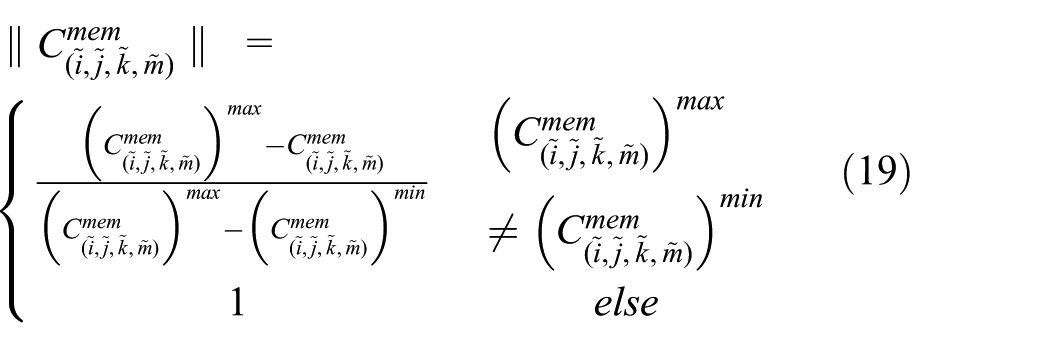
where

where
There is no clear definition of resource consumption in a dynamic network environment. Therefore, we cannot accurately calculate the resource consumption of each task. Similar to previous work,
40
we give a definition for the available resource of

where
The insufficiency of any kind of resource can be a bottleneck, which influences the performance of the system. Therefore, to guarantee the dependability of service, the task success ratio as an evaluation index is defined as

where
In order to meet the goal of the green city, we need to find the minimum energy consumption cost. Meanwhile, in order to ensure user satisfaction, response time of user request does not exceed the time threshold that is expressed by


Subject to






The purpose of the formula (23) is to find the minimum energy cost, where
Optimization algorithm based on GA
At present, the heuristic method is a common method to search global optimization solution, such as Simulated Annealing (SA), 41 Ant Colony Optimization (ACO), 42 Tabu Search (TS), 43 Particle Swarm Optimization (PSO), 44 and GA. 45 The SA algorithm is easy to fall into the local search, so it is not appropriate to find the optimal solution. The TS algorithm provides memory capacity to record the previous action, which can avoid the emergence of the local optimal solution, but it may cause a lot of memory waste. The ACO algorithm is not suitable for recursive prediction, because it has higher time complexity. The GA can solve the complex optimization problem by using crossover, mutation, and selection operation. More importantly, the GA is more efficient and faster than brute force search algorithm. Therefore, genetic algorithm based on time series matching method (GATM) for optimal energy consumption is presented in this section. The algorithm integrates time-series matching method and GA to achieve energy saving on the premise of guaranteeing the quality of service.

The core of this algorithm is using historical trajectory to provide guidance for future service mode selection. Steps (3)–(21) are to perform a preliminary service mode selection. Steps (22)–(33) are to find the optimal solution by GA. More specifically, steps (5)–(10) are to execute service mode selection according to users’ personalized needs. Steps (11)–(21) are to execute service mode selection according to system capability and historical record. After completing the steps described above, we can obtain mapping-level service mode database and cloud-level service mode database. Step (22) is to encode candidate solutions, which are represented in binary as strings of 0s and 1s. Step (23) is to generate an initial population randomly. Step (24) is to evaluate the fitness of every solution. Steps (28)–(31) select the best solutions and execute crossover, mutation strategy to form a new solution. Step (32) is to repeat the above operation until the termination condition is satisfied. Step (33) is to print the optimal solution. If the process is terminated due to a maximum number of generations, a satisfactory solution may or may not have been reached.
Simulation and analysis
In this section, we evaluate the performance of the task joint execution strategy from three aspects: the matching accuracy ratio of time-series matching method, mobile terminal energy consumption, and task success ratio. The experimental parameters and experimental results are given as follows.
Simulation environment and parameters
To evaluate the performance of the GATM method, we choose three methods for comparison. They are GA method, CE method, and local execution (LE) method. The GATM method and GA method are task joint execution strategy. The CE method is a cloud execution strategy. The LE method is a local execution strategy. For CE method, the service is provided by the cloud-level service mode. For LE method, the service is provided by the mapping-level service mode. The GATM, GA, CE, and LE methods are implemented in Python language. The performances are measured in PC with Intel Core i3-2130 3.40 GHz processor and 4.00 GB memory. Simulation parameters are
Numerical results
In this section, we evaluate the performance of the time-series matching method, and the results are shown in Figures 4 and 5. In addition, the results of GATM, GA, CE, and LE methods are shown in Figures 6 and 7.
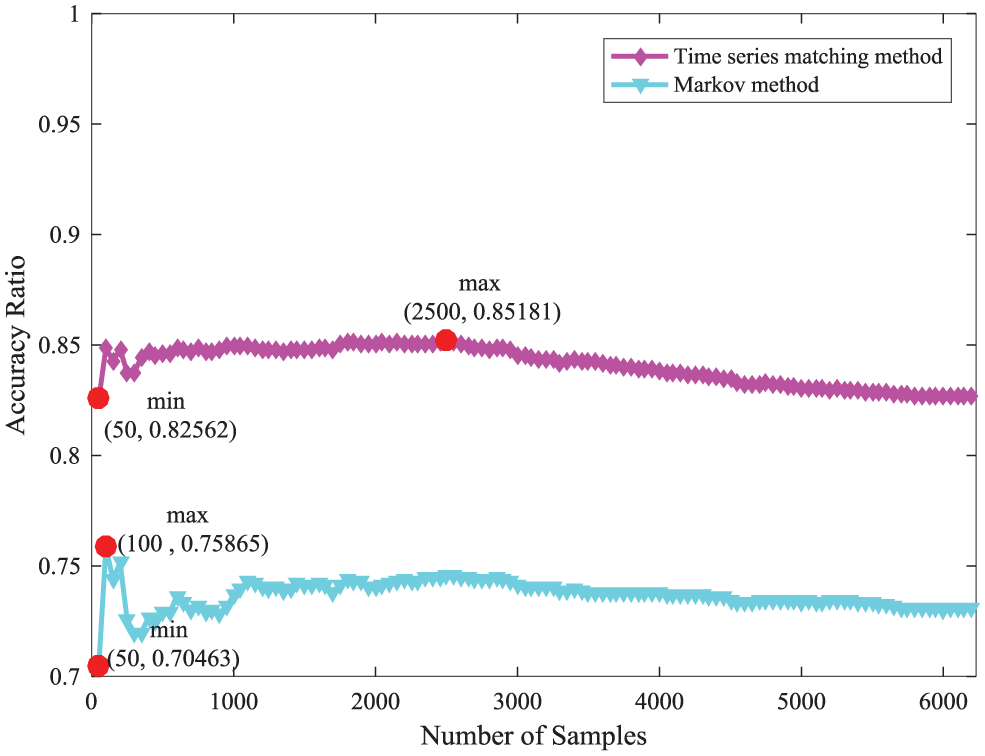
The accuracy ratio versus sample size.

The accuracy ratio versus the shortest match length.
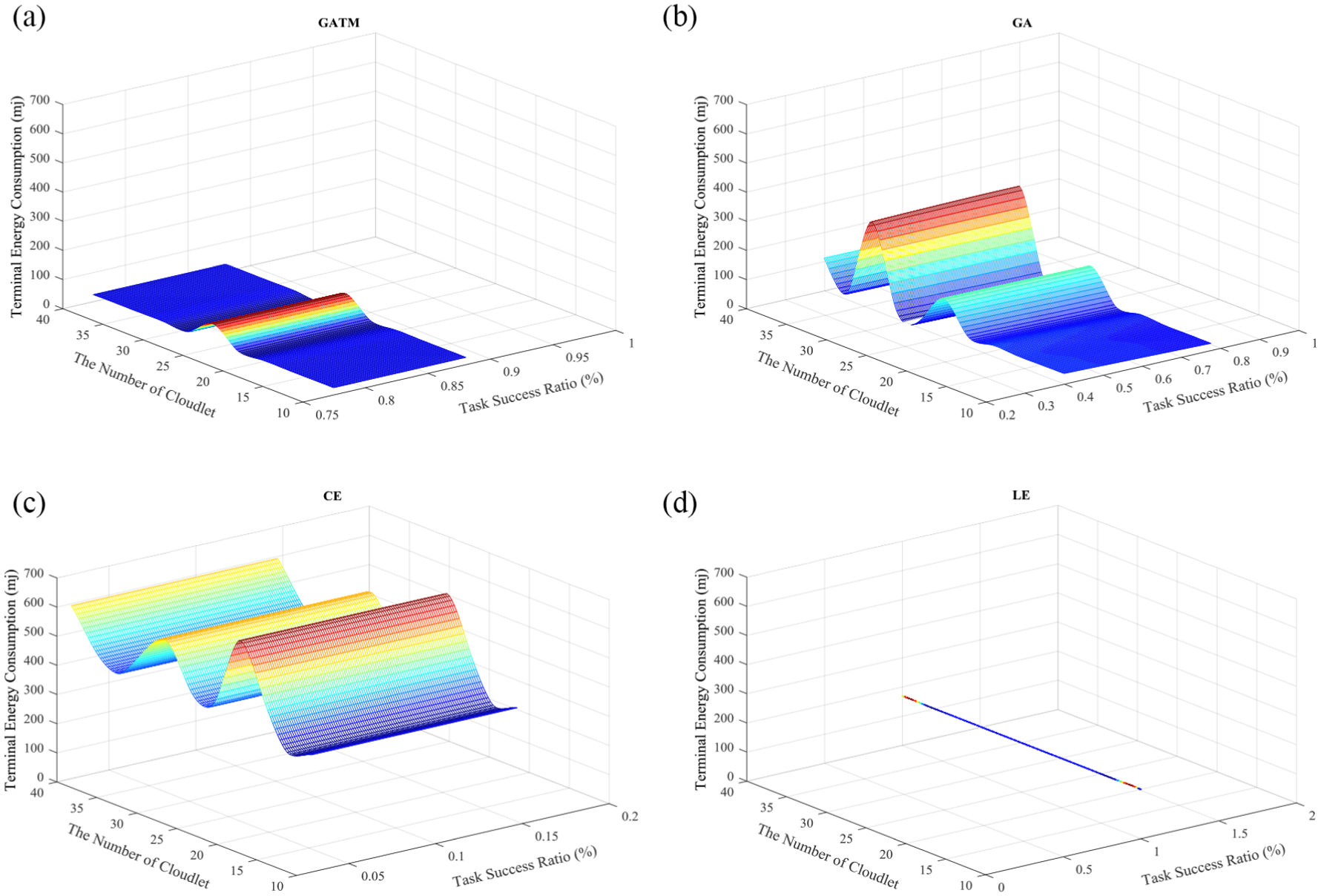
Terminal energy consumption, the number of Cloudlet, and task success ratio of different methods.

Terminal energy consumption, latest finishing time, and task success ratio of different methods.
It can be seen from Figure 4, with the increasing of sample size, the accuracy ratios of the time-series matching method and the Markov method are increasing gradually. In the initial stage, the accuracy ratios of the time-series matching method and the Markov method increase rapidly. After the number of sample size reaches a specific value, the accuracy will keep a stable value approximately. But the time-series matching method has higher accuracy than the Markov method. For example, the maximum accuracy ratio of time-series matching method is 85.181% and that of Markov method is 75.865%. The minimum accuracy ratios of the time-series matching method and the Markov method are 82.562% and 70.463%, respectively. More importantly, the maximum accuracy ratio and minimal accuracy ratio of time-series matching method increase by 9.316% and 12.099%, respectively. The results show that the time-series matching method has better performance. The main reason for this phenomenon is that the Markov method equally treats every task, and Markov process dissevers the internal correlation between user requests.
Figure 5 shows the relationship between accuracy ratio and the match length. With the increasing of match length, the accuracy ratios of the short interest model and the long interest model are increasing gradually. After match length reaches a specific value, the accuracy will keep a stable value approximately. The accuracy ratio of the short interest model increases to 95.253% from 80.049% and that of the long interest model increases to 87.136% from 63.043%. This proves that the short interest model is effective in mobile micro-learning. The main reason is that the short interest model has a more powerful influence on the next requests.
The terminal energy consumption and the task success ratio of different methods are shown in Figures 6 and 7. In Figure 6, the constraint condition is the number of Cloudlet. In Figure 7, the constraint condition is the latest finishing time.
The relationships among terminal energy consumption, the number of Cloudlet server, and task success ratio are shown in Figure 6. For the same number of Cloudlet, the simulation results show that the GATM method is effective in energy saving and reliability. The realistic evidence is that the terminal energy consumption of GATM is lower and its fluctuation is less. Conversely, terminal energy consumption that calculated by GA method and CE method are not only high but also volatile. For LE method, its energy consumption has been maintaining at a relatively stable level. Based on the above analysis, we think that the GATM method is more advantageous in terms of energy saving. At the same time, the task success ratio of GATM method is significantly higher than that of the GA, CE, and LE methods. The GATM method maintains a high task success ratio that is between 75% and 90%. Meanwhile, the task success ratio of the GA method is lower than 80%. The task success ratio of the CE method is less than 20%. For LE method, it has the high task success ratio, but its energy consumption is also high. The above analysis proved the GATM method is energy saving and reliability.
To further evaluate the performance of our method, the average energy consumption (AEC) and average task success rate (ATSR) are used to measure the energy saving and reliability. The experimental results are shown in Table 1.
AEC and ATSR under the constraint of the number of Cloudlet.
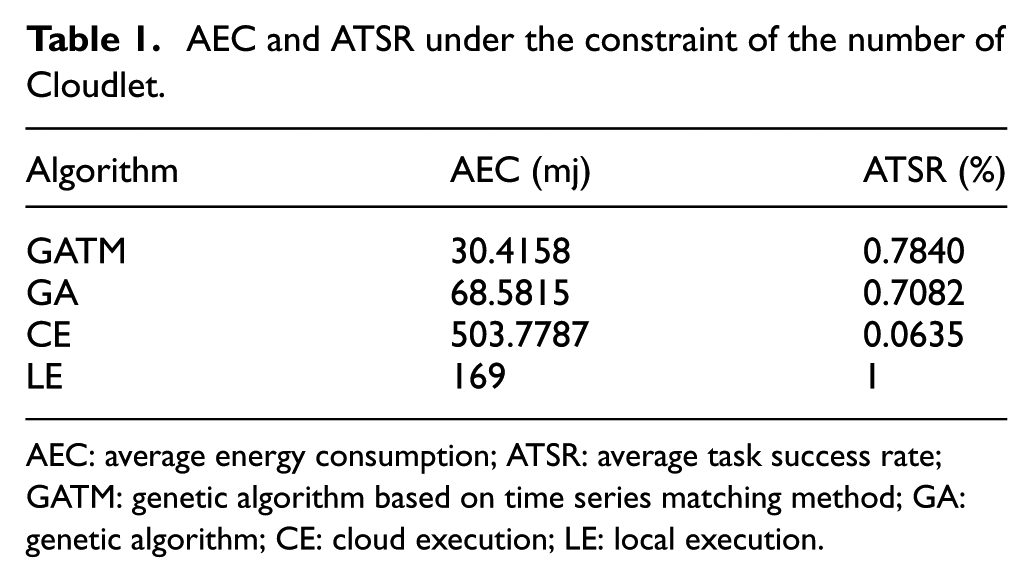
AEC: average energy consumption; ATSR: average task success rate; GATM: genetic algorithm based on time series matching method; GA: genetic algorithm; CE: cloud execution; LE: local execution.
From Table 1, we can see that the AEC and ATSR of the GATM method are obviously higher than other methods. The AEC and ATSR of GATM method are 30.4158 mj and 78.40%, respectively, which is higher than that obtained by the GA, CE, and LE methods. Therefore, GATM method achieves the goal of energy efficiency. Meanwhile, the variance of the GATM, GA, CE, and LE methods is 320.1352, 7780.8759, 9503.7129, and 0, respectively. This proves that the GATM method is stable in energy saving. The task success ratio of the GATM method is 0.7840, which is 0.0758 higher than that of the GA method and 0.7205 than the LE method. At the same time, the variance of those methods is 0.00101376, 0.016899178, 0.00150530, and 0, respectively. Given the above, GATM method has better performance in reducing energy consumption and ensuring service reliability than other methods do.
The relationships among terminal energy consumption, latest finishing time, and task success ratio are shown in Figure 7. When users have same latest finishing time, GATM method achieves the trade-off between energy consumption and task success ratio. The terminal energy consumption of GATM method is 0 to 50 mj, and its task success ratio is 60% to 80%. The task success ratio of the GA method is relatively high, but its terminal energy consumption is complex and volatile. Although CE method achieves energy saving, the task success ratio is relatively low. The LE method has the highest task completion rate, but it also has the highest energy consumption. Therefore, experimental results prove that GATM method is efficient in energy saving and reliability.
To show the green and reliability of the GATM, GA, CE, and LE methods, AEC and ATSR of the GATM, GA, CE, and LE methods with the limitation of the latest finish time are shown in Table 2.
AEC and ATSR under the constraint of the latest finish time.

AEC: average energy consumption; ATSR: average task success rate; GATM: genetic algorithm based on time series matching method; GA: genetic algorithm; CE: cloud execution; LE: local execution.
From Table 2, we can see that the AEC of GATM method is 30.1188, that of GA method is 291.8555, that of CE method is 182.8367, and that of LE method is 338 mj, respectively. Meanwhile, the variance of GATM is 13.9422, that of GA is 7780.8759, and that of CE is 182.8367. Thus, the AEC indicates that GATM method is energy saving. More importantly, the ATSR of GATM, GA, CE, and LE methods is 0.7515, 0.6502, 0.0635, and 1, respectively, which prove the GATM method is reliable. Therefore, GATM method is energy saving and dependability.
The experimental results of Figures 6 and 7 show that GATM method can achieve the goal of energy efficiency and ensure the reliable execution of the task. It is largely thanks to three processes that are time-series matching, service mode selection, and GA optimization. The accuracy ratio of time-series matching method can provide guidance for the initial service mode selection. The service mode selection module provides two service modes, which can achieve seamless switching by offloading operation. In GA module, the task is actually performed with the limitations of the network environment and resource status. Therefore, even in the case of a matching error, the optimal task execution strategy can be found through the service mode selection module or the GA optimization module.
Conclusion and future works
In this article, a task joint execution strategy is proposed to reduce the energy consumption of mobile terminal in mobile micro-learning. First, we mine the latest trajectory of the service from the historical database according to the sequential and relative stability of mobile micro-learning. Second, the mapping-level service mode and cloud-level service mode are provided to achieve seamless switching based on resource and users’ personalized need. Finally, to achieve energy saving target, we adopt the GATM method to find a suitable service mode. The simulation results show that the task joint execution strategy can reduce the mobile terminal energy consumption and ensure the dependability of mobile micro-learning within the threshold time. In the future work, we will focus on the optimal match length of the time-series matching method, the precise location of the users, selfishness of Cloudlet, additional energy consumption, time cost caused by other operation, and so on.
Footnotes
Handling Editor: Aitor Almeida
Declaration of conflicting interests
The author(s) declared no potential conflicts of interest with respect to the research, authorship, and/or publication of this article.
Funding
The author(s) disclosed receipt of the following financial support for the research, authorship, and/or publication of this article: This work is partially supported by the National Natural Science Foundation of China (NSFC) under grant nos 61602155, 61370221, and U1604155; in part by Henan Science and Technology Innovation Project under grant nos 164200510007 and 174100510010; in part by the Program for Science & Technology Innovation Talents in the University of Henan Province under grant no. 16HASTIT035; in part by the Key Scientific and Technological Projects Henan Province under grant no. 172107000005; and in part by the support program for young backbone teachers in Henan Province under grant no. 2015GGJS-047.