




Abstract
Location information plays a remarkable role in wireless sensor networks in collecting information to support distributed spectrum sensing and directional wireless charging. To decide the optimal operating frequency band of wireless sensor network, the location information of the wireless sensor network nodes should be known to fulfill the geographical map of the spectrum using the technique of distributed spectrum sensing. In addition, wireless charging also needs the location information of the wireless sensor network node for the directional wireless charging is much more efficient than the omnidirectional wireless charging. The location of the wireless sensor network node is estimated by Wi-Fi signal because the Wi-Fi infrastructures are widely deployed not only for Internet wireless access but also for the communication between wireless sensor network nodes. The most of our daily life is spent in the indoor environment, and the channel state information is one of the most important parameters of fingerprint in indoor localization. The channel state information is not a constant parameter for various timing synchronization and frequency offset even in the same location; therefore, a new parameter—normalized amplitude of channel state information—is proposed to be a robust parameter, which is insensitive to timing synchronization and frequency offset. In this article, we first formulate the received signal in a multipath channel by taking timing synchronization and frequency offset into consideration, then we derive the closed-form expression of channel state information, and propose the new parameter—normalized amplitude of channel state information. Finally, the robustness of the new parameter is verified by numerical simulations.
Introduction
Wireless sensor networks (WSNs) are widely deployed to support a lot of applications, such as intelligent transportation systems, smart cities, smart homes, e-healthcare systems, and power grids. WSNs are usually composed of sensors with limited battery, which also operate in the ISM unlicensed bands. 1 In order to utilize the unlicensed bands, spectrum sensing technique is incorporated into WSNs. 2 As we know, spectrum sensing is of three dimensions, namely, frequency, time, and location. For some WSN nodes are movable such as in smart homes and e-healthcare systems, we have to track their location. With distributed spectrum sensing technique, which takes the location information into consideration, we could plot the geographical map of the spectrum and optimally choose the operating frequency band. Also, spectrum sensing-based dynamic spectrum sharing is one of the key innovative techniques in future 5G communications. When realistic mobile scenarios are concerned, the location of primary user is of great significance to reliable spectrum sensing.3–5 The location information could be used in wireless cooperative communication in WSN.6–8 To improve the link quality, the distributed nodes are arranged in an array which is formed by virtual multiple-input multiple-output (MIMO) technology. In addition, to extend the coverage, relay transmission is utilized in this scenario. Beamforming technique is taken into consideration to match the wireless link. The location information of the array of the relay should be known prior to inject the power from the source to the relay and form the relay to the destination by directional transmission. The WSN nodes are battery supported and wireless charging technique can be used to provide energy, 9 where mobile chargers can transfer energy wirelessly to the WSN nodes. If the locations of the nodes are unknown, the energy transmission is omnidirectional, which is very inefficient. Thus, the location information is of vital importance for directional wireless charging. 10 The information transmission between the WSN nodes is accomplished by Wi-Fi signal for Wi-Fi operates also in the ISM bands and is widely deployed as the wireless access technique. Enormous WSNs exist in indoor environment for over 80% of our daily life is spent therein. Thus, indoor localization with Wi-Fi signal is considered in this article. 11
Comparison of several representative Wi-Fi-based indoor localization systems is shown in Table 1 12 where the localization parameters can be mainly classified as received signal strength indicator (RSSI), channel state information (CSI), direction of arrival (DOA), round-trip time (RTT), and time of arrival (TOA). We show the properties of these parameters from four aspects, namely, scheme of mapping, system, localization algorithm, and precision. The scheme of mapping can be categorized into geometric mapping and fingerprinting mapping. The localization algorithms include k-nearest-neighbor (KNN), genetic algorithm, and prior non-line-of-sight measurement correction (PNMC). The localization parameters, namely, RSSI, CSI, DOA, and TOA, are calculated by the sampling values; meanwhile, the RTT value is extracted from the field of the IEEE 802.11 frame. RSSI is the power of one frame, CSI is estimated by the pilots of the frame, DOA is calculated by the phase difference between the signals received by various antennas, and TOA is the transmission time between the transmitter and the receiver.
Wi-Fi-based indoor location sensing systems.

KNN: k-nearest-neighbor; RSSI: received signal strength indicator; CSI: channel state information; DOA: direction of arrival; PNMC: prior non-line-of-sight measurement correction.
The RSSI characterizes the attenuation of radio signals during propagation and has been adopted in a large body of indoor localization systems. Although RSSI can achieve meter-level localization accuracy, it suffers from shadowing fading and multipath effects. 23 However, the PHY layer power feature, channel response, is able to discriminate multipath characteristics. 24 The Wi-Fi signal is on the basis of IEEE 802.11 standards 25 and the channel response is in the format of CSI, which reveals a set of channel measurements depicting the amplitudes and phases of every subcarrier of the orthogonal frequency division multiplexing (OFDM) signal. In addition, fingerprinting is a prevalent mapping method. 26 Therefore, CSI is considered in this article with the method of fingerprinting mapping.
Timing synchronization and frequency offset are two important factors that impact the reception of Wi-Fi signal, which also have great influence on the CSI. For various timing synchronization and frequency offset, CSI is not a constant parameter even in the same location. Thus, the parameter associated with CSI should be insensitive to the timing synchronization and frequency offset. In this article, we propose a new parameter—normalized amplitude of CSI, which is robust to the timing synchronization and frequency offset. The superiority of this new parameter to the conventional CSI is given in the numerical simulation.
The rest of this article is organized as follows: first, we formulate the received signal in a multipath channel by taking timing synchronization and frequency offset into consideration; second, we derive the closed-form expression of CSI; third, we propose the new parameter—normalized amplitude of CSI; and finally the robustness of the new parameter is verified by numerical simulations.
The multipath transmission of a signal
In this part, we formulate the received signal in a multipath channel by taking timing synchronization and frequency offset into consideration.
Assume that N is the number of transmitted subcarriers and

where

Assume an M-path multipath channel, which can be represented as

where

After substituting equations (2) and (3) into equation (4), down converter and low-pass filter, the signal can be described as 12

where, for brevity, we set

As

we obtain

According to equation (8), the transmission of a multipath signal is shown in Figure 1.

The closed-form expression of CSI.
The closed-form expression of CSI
As shown in Figure 1, the timing synchronization instant is

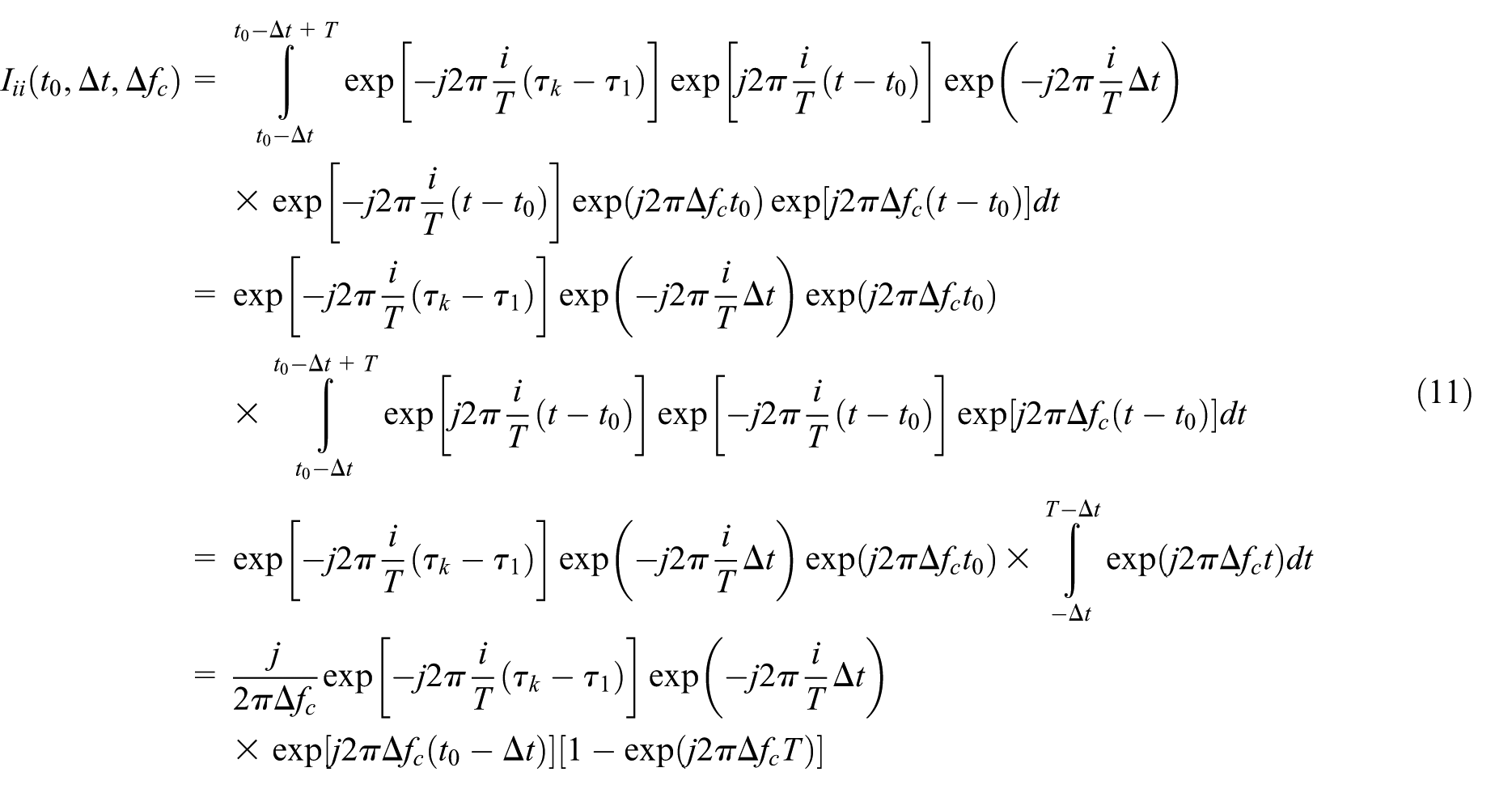
where

where
where

Here


Substituting equations (11) and (12) into equation (10), and substituting equation (10) into equation (9), we can formulate the CSI as

where


where
The robust parameter—normalized amplitude of CSI
The impact of timing synchronization on the CSI
We first consider the impact of timing synchronization on the CSI. To focus our analysis on the essence of the problem, we ignore the effect of frequency offset and noise term. Therefore in equation (14), we have

which is collected as fingerprint in the fingerprint collecting process. In the mapping process, suppose that the transmit power is
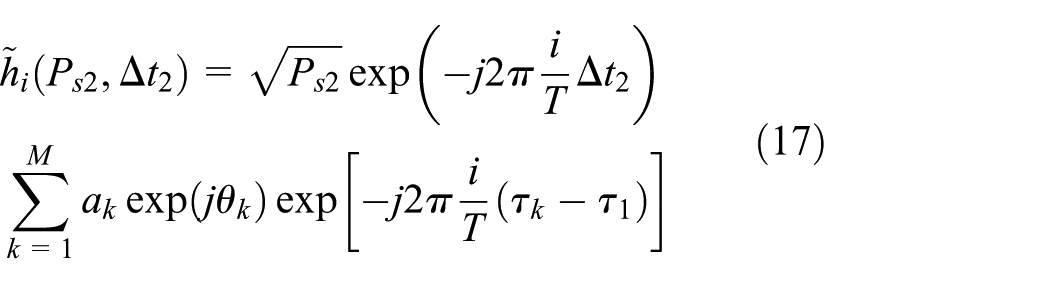
For the CSI of equation (16) and that of equation (17) are in the same location, their Euclidean distance should be 0 in the mapping process. However, the actual Euclidean distance is13,18

Thus, the mapping between the measured CSI and fingerprint is not applicable.
To solve the problem, we propose a new parameter—normalized amplitude of CSI, which is

Theorem 1
In the fingerprint collection process, the CSI of the ith subcarrier in a predefined location when the transmit power is

Proof
The proof of Theorem 1 is given in Appendix 1.
Therefore, the normalized amplitude of CSI can be utilized as the parameter for fingerprinting for various timing synchronization.
The impact of frequency offset on the CSI
We then consider the impact of frequency offset on the CSI. As above, we ignore the effect of timing synchronization error and noise term. From equation (14), as
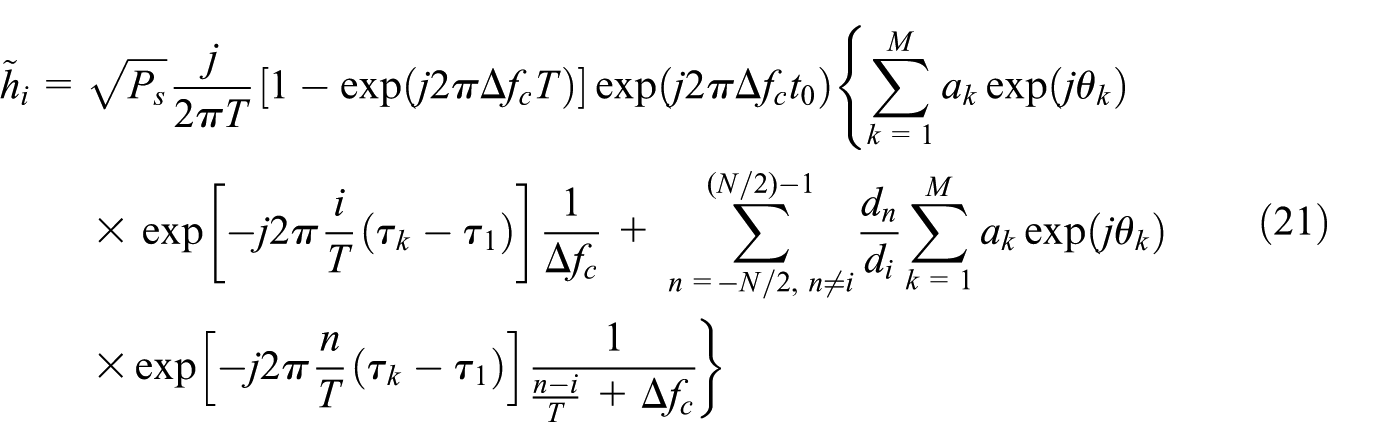
In the receiver, after signal processing, the frequency offset should satisfy

Substituting equation (22) into equation (21), we can rewrite the CSI as
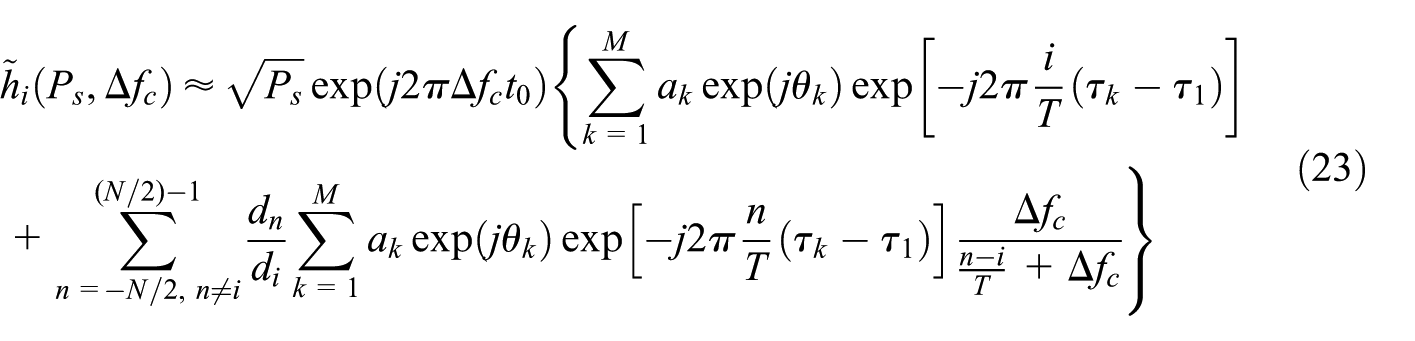
Suppose that the CSI of the ith subcarrier in a predefined location when the transmit power is
Also, we propose the normalized CSI, which is

Theorem 2
In the fingerprint collection process, the CSI of the ith subcarrier in a predefined location when the transmit power is

Proof
The proof of Theorem 2 is given in Appendix 2.
Thus, the normalized amplitude of CSI can be utilized as the parameter for fingerprinting for various frequency offset.
From equations (20) and (25), we draw the conclusion that the proposed new parameter—normalized amplitude of CSI—is insensitive to timing synchronization and frequency offset, which is a robust parameter.
Numerical simulation
In the simulation, we compare two parameters, namely, CSI and normalized amplitude of CSI. We consider fingerprinting mapping, and the mapping metric is the Euclidean distance. Assume the delay, amplitude, and phase of multipath transmission in a predefined location given in Table 2.
The delay, amplitude, and phase of multipath channel.

Suppose that the transmitted Wi-Fi signal abides by the IEEE 802.11n protocol with 20 MHz bandwidth; the preamble of the training structure is shown in Figure 2. The symbols are transmitted by 52 subcarriers with their indices from −26 to −1 and 1 to 26. The CSI of the 52 subcarriers is estimated by

The OFDM training structure.
Assuming
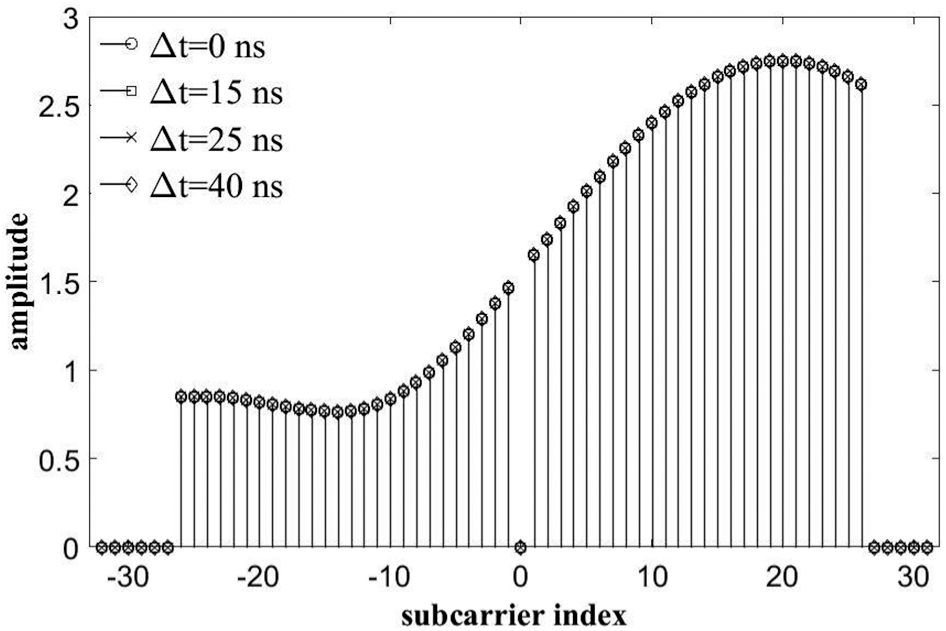
The amplitude of CSI with various timing synchronization.

The angle of CSI with various timing synchronization.
Assume that the CSI of the ith subcarrier is

Also, the Euclidean distance of the normalized amplitude of CSI can be calculated as

From Figure 5, we have
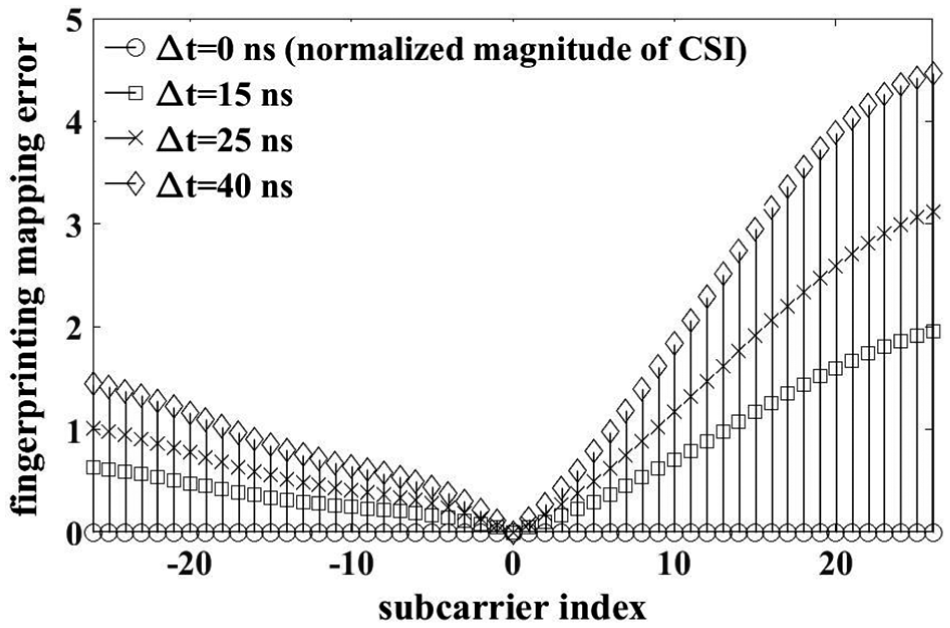
The fingerprinting mapping error of different CSI parameters.
The impact of various frequency offset on the amplitude of CSI is shown in Figure 6, where

The amplitude of CSI with various frequency offset.
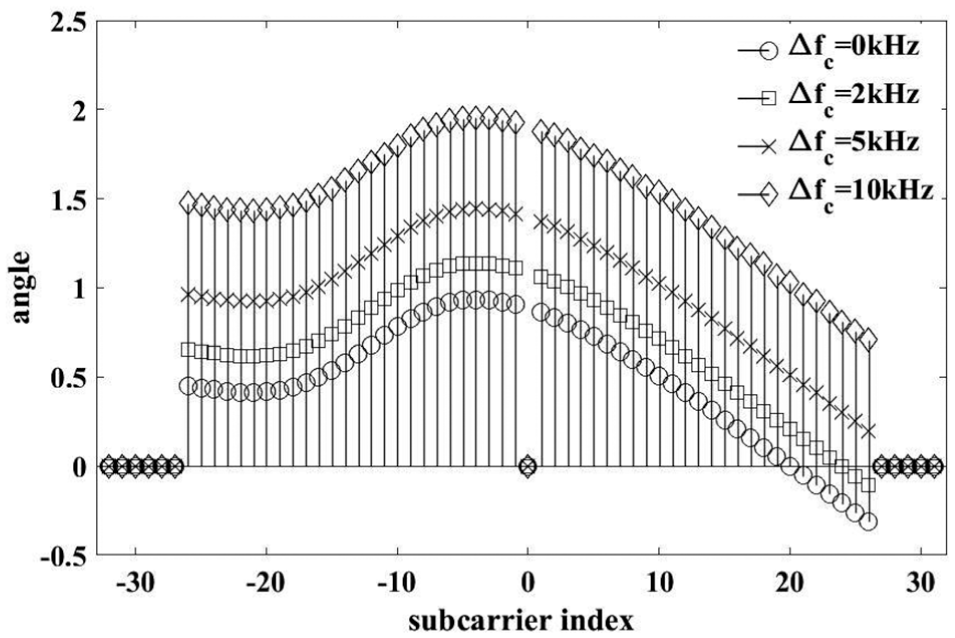
The angle of CSI with various frequency offset.
From Figure 8, we have

The fingerprinting mapping error of different CSI parameters with various frequency offset.
Conclusion
Location information plays a remarkable role in WSNs in collecting information to support distributed spectrum sensing and directional wireless charging. The CSI is one of the most important parameters of fingerprint in indoor localization; however, CSI is not a constant parameter for various timing synchronization and frequency offset even in the same location. In this article, a new parameter—normalized amplitude of CSI—is proposed to be a robust parameter, which is insensitive to timing synchronization and frequency offset. The robustness of the new parameter is verified by numerical simulations.
Indoor localization has been extensively studied for the past two decades and is continuously attracting vast research attention with the huge growth of mobile computing. With the fact that users spend about 89% of their time indoors, a smartphone-based indoor localization algorithm by deeply combining wireless signals to improve the localization performance will be a challenging problem in the future.
Footnotes
Appendix 1
Suppose that the CSI of each subcarrier is normalized by the CSI of the lth subcarrier, then the normalized amplitude of the CSI of the ith subcarrier in a predefined location can be formulated as
In the mapping process, the normalized amplitude of the CSI of the ith subcarrier can be denoted as
From equations (27) and (28), the Euclidean distance between the measured normalized amplitude of CSI and that of fingerprint is
Appendix 2
For the normalized amplitude of CSI, when the transmit power is
For
Substituting equation (31) into equation (30), we have
In the mapping process, with similar derivation, when the transmit power is
From equations (32) and (33), we have the Euclidean distance between the measured normalized amplitude of CSI and that of fingerprint as
Handling Editor: Ning Zhang
Declaration of conflicting interests
The author(s) declared no potential conflicts of interest with respect to the research, authorship, and/or publication of this article.
Funding
The author(s) received no financial support for the research, authorship, and/or publication of this article.