




Abstract
In body area networks, sustainable energy supply and reliable data transmission are important to prolong the service cycle and guarantee the quality of service. In this article, we build a system model to capture the stochastic processes in body area networks, including energy harvesting process, spectrum pricing process, and data sampling process. In the system model, energy harvesting technology and cognitive radio technology are adopted to provide green energy and improve transmission environment for body area networks. Based on the proposed model, we formulate an optimization problem of system utility maximization. Since this problem is a multi-objective mixed-integer problem under multiple restrictions, we decompose the problem into several subproblems by Lyapunov optimization theory. Based on this, we design an efficient online energy and channel transmission management algorithm to solve these subproblems and achieve a close-to-optimal system utility without any priori knowledge. We analyze the optimality of proposed algorithm and derive the required battery capacity and the size of data buffer. Simulation results demonstrate the effectiveness of the proposed algorithm.
Introduction
The phenomenon of aging population has became an inescapable issue that the government, medicine, and academic must face. On one hand, more and more old people need to come to the hospital for regular medical checkup, which places a heavy burden on the limited medical resource. On the other hand, many chronic diseases require real-time monitoring to prevent further deterioration of physical condition. 1 However, traditional medical system cannot provide such services for the elderly at home or in public place. Thus, we need a new type of medical monitoring system which is able to run without the limits of time and place. Body area networks (BANs) have shown significant promise in healthcare domain and can be used in many scenarios, 2 such as health monitoring, telemedicine, and fitness tracking. A typical BAN includes a personal device (PD) and several sensors which are low-power, wearable, and implantable. Those sensors collect and store physiological data, such as temperature, oxygen saturation, blood pressure, and electrocardiogram, and transmit data to the PD. Then, PD sends the gathered data to medical institutions for data analysis and disease surveillance. 3 Therefore, BANs are promising medical system for improving healthcare and quality of life while reducing medical costs. However, BANs still face many challenges.
One of the major challenges in BANs is the sustainable power supply, 4 which determines whether sensors can provide long-term continuous healthcare service for the user. Therefore, it is necessary to replace the battery or recharge it. However, the battery capacity in the sensor is limited by its size, which results a small battery capacity. So, it is not desirable to replace the battery or recharge it frequently for users. In addition, changing the battery is unrealistic for the medical application that embeds sensors inside human body. In this condition, energy harvesting (EH) technology is studied and developed, 5 and already deployed into BANs, known as energy harvesting body area networks (EHBANs). EHBANs are capable of supplying energy for sensors continuously, which prolongs network lifetime and reduces maintenance cost in communication. The energy that EHBANs can harvest usually comes from three basic types, 6 which are light energy, heat energy, and kinetic energy. Among these sources, the heat energy is gained from the difference in temperature between vitro and vivo; the kinetic energy is gained from various internal and external motions, such as walking, heartbeat, and blood flow.
The other major challenge in BANs is communication performance, 7 which determines whether BANs can guarantee the quality, integrity, and timeliness of data transmission. BANs typically operate in the 2.4–2.5 GHz band, 8 which belongs to unlicensed industrial, scientific, and medical (ISM) bands. However, with the remarkable growth of wireless service in recent years, the ISM bands have become so crowded, which leads to an intense competition for spectrum resource among various unlicensed wireless networks. Meanwhile, a survey of global spectrum utilization reveals that the actual utilization time of licensed wireless spectrum is only around 5%–10%. 9 Therefore, in order to improve the efficiency of wireless resource usage, an emerging technology is developed, which is cognitive radio (CR). Through equipping BANs with CR technology, 10 in addition to the use of ISM band, sensors can dynamically and opportunistically access the unused licensed bands for transmission, thereby enhancing the robustness, scalability, and utility of BANs. Such networks are referred as cognitive radio body area networks (CRBANs).
Although the problems of energy supply and channel transmission can be solved by EH technology and CR technology, there are still some new challenges to face. 11 First of all, the EH process is dynamic and stochastic, which makes a challenge to balance energy consumption and supply. 12 Second, the price of licensed spectrum is also dynamic, which makes providing stable, fast access to licensed spectrum challenging. 13 Since the aim of EH technology and CR technology is harvesting resource, the BANs equipped with the two technologies above are referred to as resource harvesting body area networks (RHBANs). In RHBANs, the process of accessing licensed spectrum involves the process of energy consumption, and there is an inherent link between each other. Therefore, in these stochastic and dynamic processes, managing and allocating resource for RHBANs becomes challenging.
Motivated by the challenges above, we develop a framework based on Lyapunov optimization in a single-hop RHBANs consisting of a PD and a few medical sensors, by jointly considering three stochastic processes: EH, spectrum pricing, and data sampling. The sensors harvest energy by EH technology to sense biologic signals and transmit it to PD over licensed spectrum. We propose an efficient online energy and channel transmission management (ECTM) algorithm to achieve a close-to-optimal system utility, 14 while ensuring the system sustainability. The main contributions of this article are summarized as follows:
We propose a stochastic formulation of the system utility optimization problem subject to the stability of RHBANs system, by characterizing the stochastic nature of the three processes, that is, EH process, spectrum pricing process, and data sampling process.
We develop a framework based on Lyapunov optimization to decompose the system optimization problem into three subproblems, that is, energy control optimization (ECO), sampling optimization (SO), and channel transmission optimization (CTO).
Based on the developed framework, we design an online ECTM algorithm which runs at each time slot and achieves closed-to-optimal time-average system utility. Moreover, the algorithm does not need any priori knowledge of system running.
We analyze the performance of the ECTM algorithm in terms of the required battery capacity, the bounds of data queue and debt queue, and the optimality of the ECTM algorithm. Specifically, we compute the required battery capacity to support the channel trading and data transmission; we compute the upper bound of data queue and debt queue to guarantee the stability of system; and we compute the optimality of ECTM algorithm to compare the gap between time-average system utility and optimal system utility.
Related works
Energy efficient resource allocation scheme has been widely designed for EHBANs to improve the performance of networks in the works.15–20 Liu et al. 15 designed an optimization framework to maximize the energy efficient and proposed a transmission rate allocation policy to minimize energy consumption, subject to constrains of quality-of-service (QoS) metrics. Seyedi and Sikdar 16 addressed the problem of developing energy efficient transmission strategies for BANs and studied the trade-off between the energy consumption and pack error probability. He et al., 17 Liu et al., 18 and Ventura et al. 19 all used the Markov method to build resource allocation model. He et al. 17 modeled the EH process at each sensor as a discrete-time Markov chain and formulated and solved the steady-rate optimization problem to prolong the lifetime of sensors. Liu et al. 18 proposed an optimal transmission power and time slots allocation strategy which can adaptively change the transmission power and transmission time to provide a sustainable service. Ventura et al. 19 developed a Markov model for capturing the energy states of sensors and provided simplified analytical models for predicting the probability of a sensor running out of energy. Through prediction models, the network designer can set the requirements for the battery capacity of sensor nodes. The models15–19 developed do not well reflect the stochastic features of EH process as they require sufficient statistical knowledge of harvestable energy. Huang and Neely 20 developed an online energy-limited scheduling algorithm, which achieved a close-to-optimal system utility and did not require any knowledge of EH process.
The application of CR technology in BANs has been investigated to improve the system’s performance.21–24 Yu et al. 21 proposed a network architecture for cognitive and cooperative communications in BANs and presented two cooperative transmission schemes for different applications to decrease the bit error rate and reduce energy consumption. Mahbub et al. 22 investigated the interference temperature limit and outage probability in CRBANs, while focusing on the interference and power constraint issues. Moungla et al. 23 developed an analytical model using a continuous-time Markov chain for the interference attenuation in channel switching systems. The proposed approach insured the channel quality by reducing the packet loss rate and mitigating interferences. Syed and Yau 24 presented two architectures, two applications of CRBANs to address two critical concerns, which were the reduction of electro-magnetic interference to sensors and the enhancement of system performances.
In RHBANs, there is interrelation between energy management and channel transmission. However, for the improvement of system performance, it is not enough only to study one of them, just like the works above.15–24 To fill this research gap, we propose a framework to capture the stochastic processes of EH and channel transmission and design a online ECTM algorithm to achieve an close-to-optimal system utility.
System model and problem formulation
We consider the single-hop RHBANs in which all the sensors with

Resource harvesting body area networks architecture.
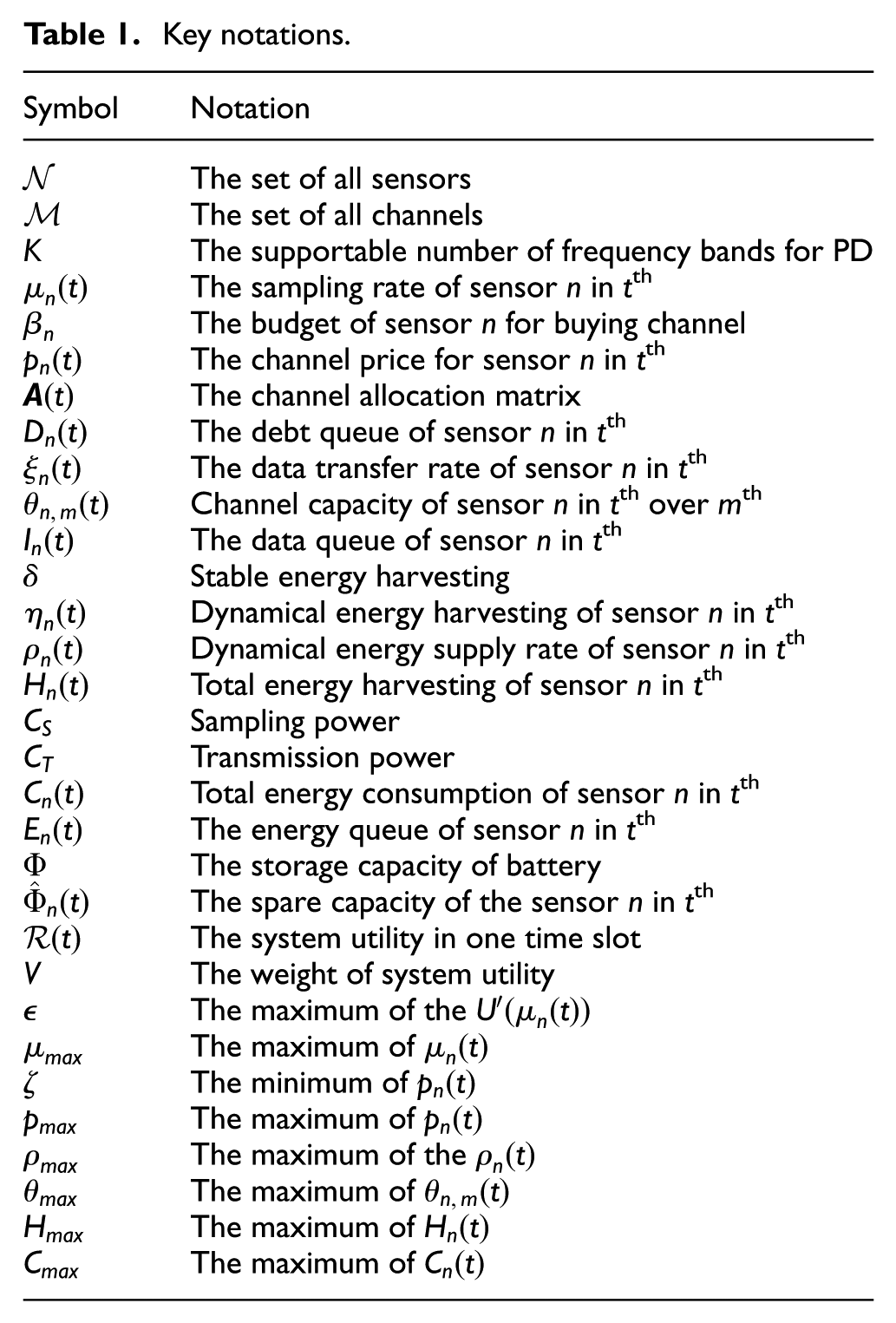
Key notations.
Sampling rate and system utility
At every time slot, sensor device senses data from body at a sampling rate

Similar to the work by Huang et al.,
20
we define the utility function of sensor
Channel trading and debt control model
At the beginning of each time slot

The state

where
We define the channel allocation matrix

To avoid the channel collision, we define each sensor can only use one channel and each channel can only be allocated to one sensor at most in each time slot. In addition, since the PD communicates over

To evaluate the debt of sensors about the budget and expense, for all

The debt queue is stable only if time-average input rate

Data transmission and data queue dynamics model
The channel capacity is denoted by
The channel capacity

We build the dynamic data queue

To ensure the single-serve queuing system is stable, data queue should meet the constraint that the time-average occupancy of sensor is finite, that is

Besides, the amount of data transmitted by the

EH model
We consider that the energy can be harvested from two aspects. One is stable energy source, like heat energy from the body. The other is dynamic energy source, like movement or light energy from the surrounding environment.
We define the stable energy harvested by the

However, we define the dynamic energy harvested by the

The dynamic energy supply rate

Since the stably harvested energy is a fixed value
Energy consumption and energy queue dynamics model
In RHBANs, the factors that affect energy consumption come from two aspects: data sampling and data transmission. For data sampling, senor senses health data from body area with sampling rate

Since the sampling rate
Based on the EH

in which we use

For another, we assume the storage capacity of battery

Optimization problem formulation
Based on the models discussed above, we formulate the time-average system utility optimization problem, which can be written as

For the sake of convenience, we use
At this point, we can get the maximum system utility (MSU) by optimizing

Because the
Proposed framework
The framework proposed in this article is based on Lyapunov optimization. We decompose the utility maximization problem
Lyapunov optimization
Based on the three queue formulas (4), (7), and (12), we define the Lyapunov function

In

By minimizing
It is obvious that minimizing

where
Since
Lemma 1
The upper bound of

where the

Proof
We can get

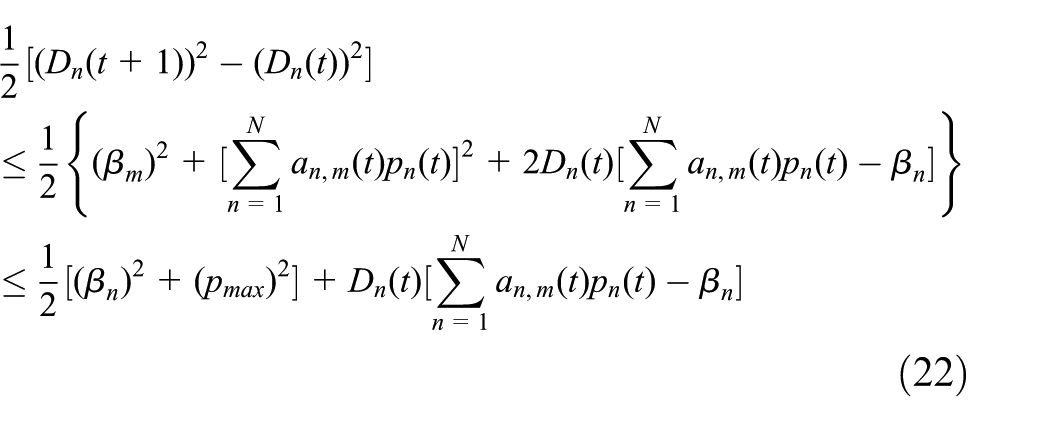
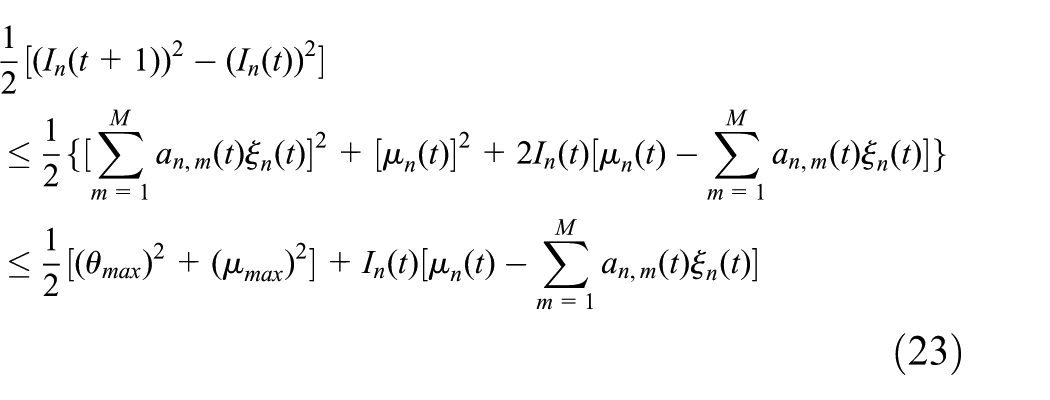


By squaring both sides of equation (4), we can get equation (22). Note that
In the process of rearranging equations (22)–(24), we combine the terms who have the same variable to one collection. Finally, we get the
So, we can minimize the
ECO problem
For energy control problem, it is the optimization goal that minimizing the first term of equation (25) under the constraints (11) and (14), as follows

Thus, we can get the optimal solution by maximizing dynamic energy

SO problem
For SO problem, it is the optimization goal that minimizing the second term of equation (25) under the constraint (1), as follows

Since the system utility

where
CTO problem
For channel transmission problem, it is the optimization goal that minimizing the third term of equation (25) under the constraints (3), (6), and (9), as follows
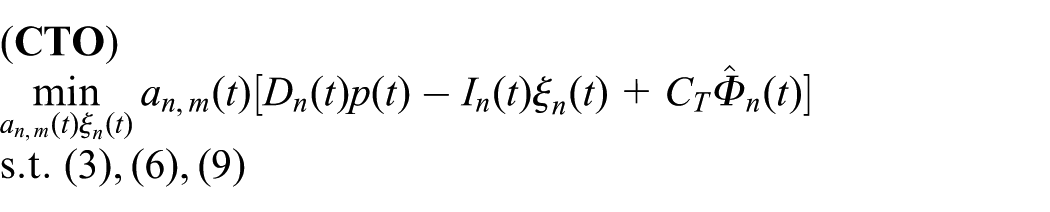
By optimizing
First, there is no sense in optimizing the problem

Second, by maximizing data transfer rate

Finally, data transfer rate

After above analysis, we can replace

CO problem is a matching problem, which can be solved by the Hopcroft–Karp algorithm. The complexity of Hopcroft–Karp algorithm is
Algorithm and performance analysis
ECTM algorithm
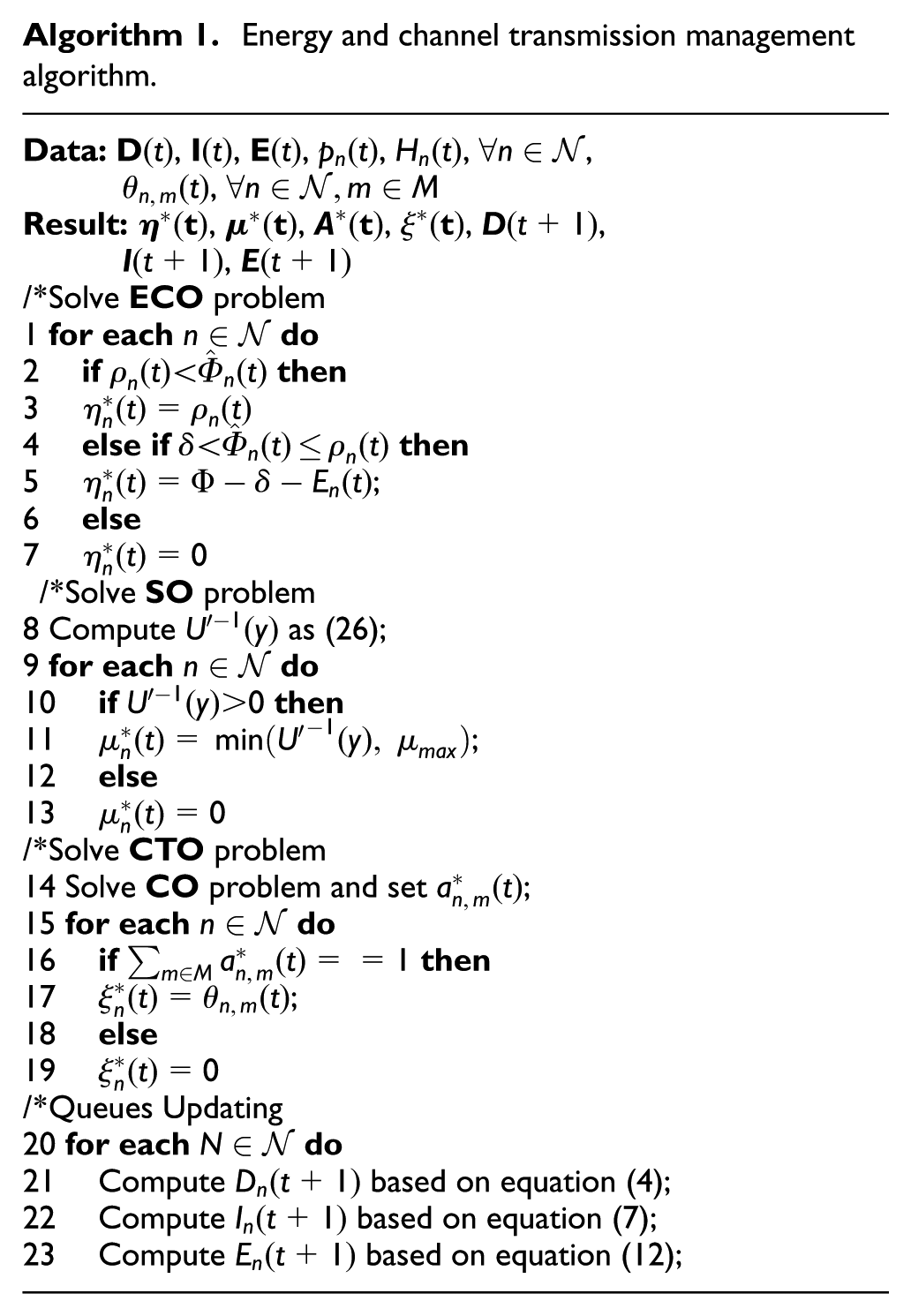
In this subsection, we design the ECTM algorithm in Algorithm 1 to optimize the three subproblems mentioned above, that is,
Since
Energy and channel transmission management algorithm.
Required battery capacity
To ensure sensors have enough energy to work, we derive the required battery capacity in the case that the available energy is less than the maximum energy consumption. In other words, sensors will not collect or transmit data in this case. We show the required battery capacity
Theorem 1
For

if and only if
Proof
We prove Theorem 1 in two ways.
First, we derive

Considering that

Second, we derive

To ensure sensor

Thus, Theorem 1 is proved.
Bounded data queue
In Theorem 2, the upper bound
Theorem 2
The upper bound of data queue as follows

where

Proof
Theorem 2 is proved by induction. First, at
If sensor
If sensor
Thus, equation (33) holds at time slot
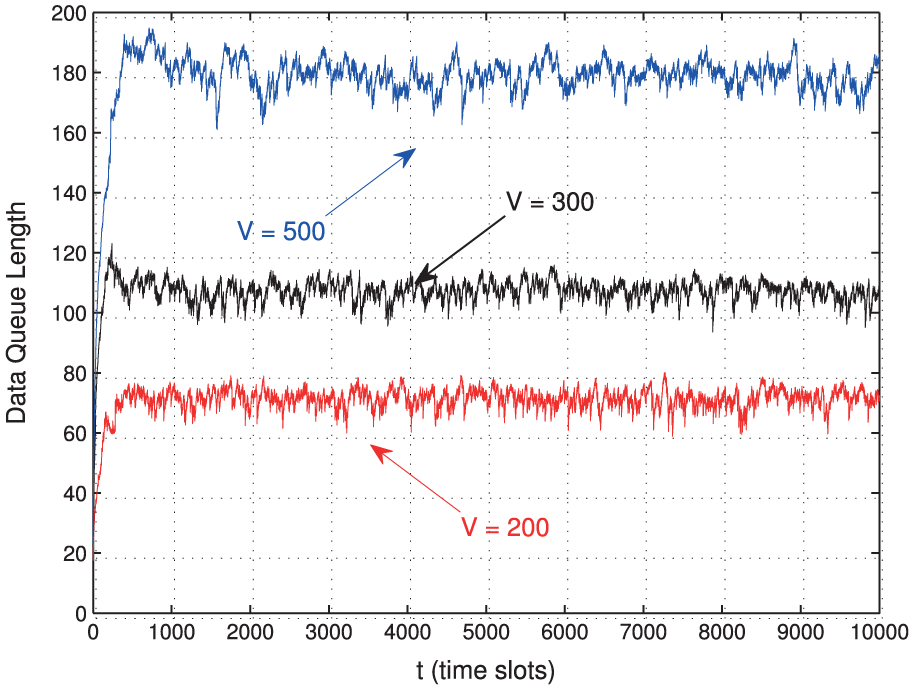
From the Theorem 2, we can see the bound of data queue increases linearly with the weight of system utility. So, a large V means sensors need a longer data buffer to realize a bigger system utility.
Bounded debt queue
In Theorem 3, we derive the upper bound of debt queue to ensure the the length of debt queue is limited, that is, guarantee its stability.
Theorem 3
For

we have

Proof
We use induction to prove Theorem 3. First, at
For CO problem
If
If
Summarily, we have
From Theorem 3, although sensors may continue to be in debt, there will be a cap on their debt levels, that is, the debt constraint (5) can be satisfied.
Optimality of algorithm
In Theorem 4, we analyze the optimality of ECTM algorithm and compare the performance between time-average system utility and optimal system utility.
Theorem 4
We assume that the optimal system utility is

where
Proof
We prove Theorem 4 by comparing Lyapunov drift of ECTM algorithm with that of another random algorithm, which denoted by

where
In each slot time, we minimize the four parts of Lyapunov drift

According to Theorem 2 by Huang et al.,
20
equation (37) can be proved. Note that

where the superscript of

Take expectations on both sides, we have

Since
According Theorem 4, we can see the performance gap between
Simulation results
In this section, we evaluate the performance of ECTM algorithm by MATLAB simulation. We consider the RHBANs composed of
We assume that the budget
For the relevant parameters of channel capacity
We assume that the battery capacity is full in time slot
Network utility and queue length
The system utility is plotted in Figure 2 under different weights

System utility versus the value of
The 95% confidence interval of the system utility.
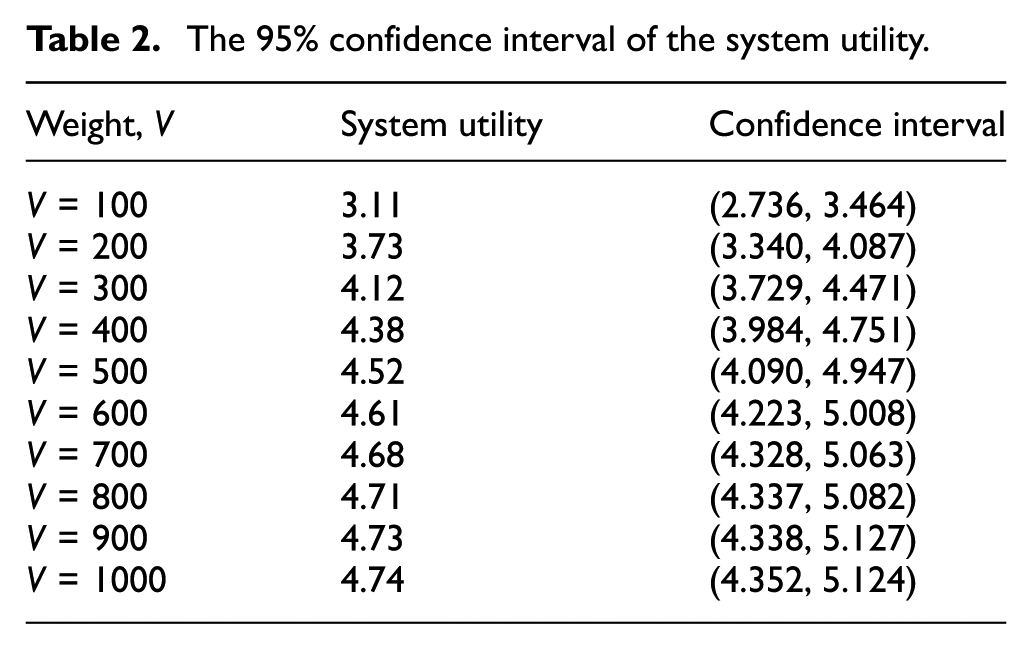
Figure 3 shows the relationship between

Time-average queue length versus

Debt queue dynamics.
Data queue dynamics.
Energy queue dynamics.
Besides, comparing Figures 2 and 3, we can get that while increasing
Queue dynamics
Figure 4 shows the debt queue dynamics with different values of V over 10,000 time slots. The lengths of debt queues increase rapidly with the increase in the time
Figure 5 shows the data queue dynamics with different values of V over 10,000 time slots. Similar to the debt queue dynamics shown in Figure 4, the lengths of data queues increase and converge quickly after
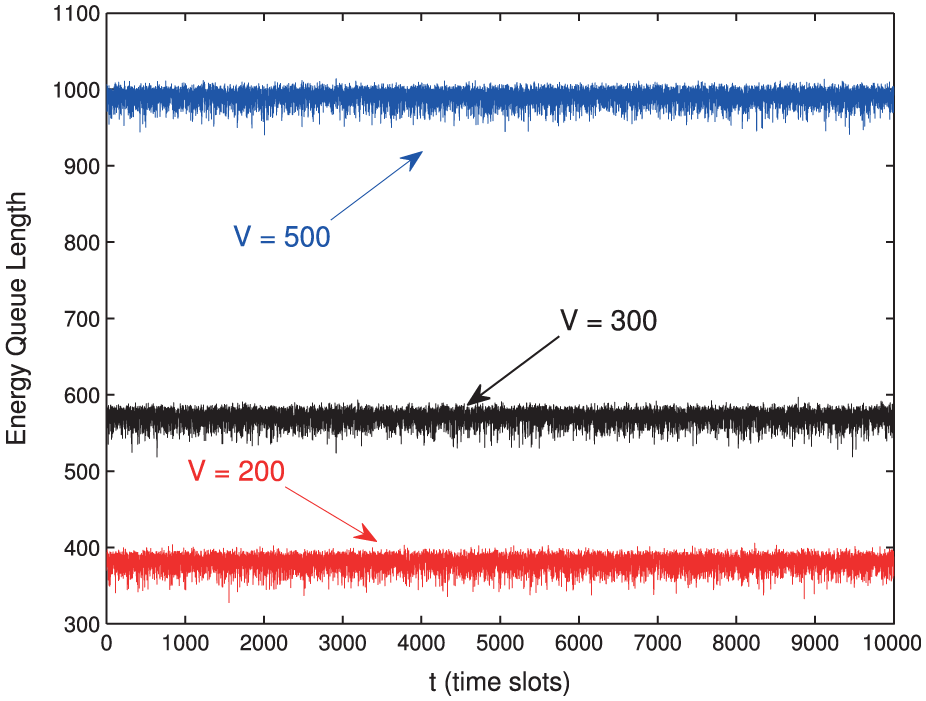
Figure 6 shows the energy queue dynamics with different values of V over 10,000 time slots. We can see that the time-average lengths of energy queues fluctuate around a time-average value in the whole time slots. This is regulated by two aspects. On one hand, sensor consumes energy in the data collection and transmission process; on the other hand, the sensor itself is constantly gaining energy.
Impact of parameter variations
In this section, we evaluate the impacts of system parameters on the system utility. Similar to Figure 2, the system utility for each

Impact of
Figure 8 shows the impact of the maximum dynamic energy supply

Impact of
From Figures 7 and 8, we can see that, for improving system utility, it is not enough to simply increase one of the system parameters.
Conclusion
In this article, we have designed a framework for optimizing system utility in RHBANs. In this framework, three stochastic process are included, which are channel trading, EH, and data transmission. Moreover, in order to solve the system utility optimization problem, the framework decomposes it into three subproblems: ECO, SO, and channel trading and data transmission optimization. Then, the ECTM algorithm is designed to solve the three subproblems. Besides, we have derived the bounds on debt, data, and energy queues, as well as the gap between optimal system utility and approximately optimal solution. At last, simulations verify that the ECTM algorithm can stabilize system status and improve system utility. The outcomes of this work can be used to guide the design of ECTM algorithm in practical RHBANs.
For the future work, we plan to investigate channel auction and energy conversion efficiency. In addition, the channel interference will be considered.
Footnotes
Handling Editor: Katsuya Suto
Declaration of conflicting interests
The author(s) declared no potential conflicts of interest with respect to the research, authorship, and/or publication of this article.
Funding
The author(s) disclosed receipt of the following financial support for the research, authorship, and/or publication of this article: This work was supported, in part, by the Major Program of National Natural Science Foundation of China (No. 71633006), the National Natural Science Foundation of China (Nos 61672540 and 61379057), and the Fundamental Research Funds for the Central Universities of Central South University (No. 2017zzts203). Also, this work was supported partially by “Mobile Health” Ministry of Education—China Mobile Joint Laboratory.