




Abstract
To apply the algorithms in Internet of Things for physical world objects, the relationship between physical objects is becoming more and more complicated. As we know, social relationship is widely used in human world and social Internet of Things to solve the multiple object problems. Thus, a way via combining social relationship with physical object to solve the problem with a huge number of objects or complicated interactions among objects has been analyzed. This article proposes a new concept of “Physical Objects’ Social Relationship” for describing, managing, and predicting the relationships between physical objects in Internet of Things. The classification method for physical objects’ social relationships is proposed using the spatial-temporal attribute of social relationships. Moreover, the logical expression method for physical objects’ social relationships is discussed.
Keywords
Introduction
With the development of the Internet of Things (IoT), more and more physical things are mapping to cyber space, and more and more connections are built between them. In the studies of IoT, researches mainly focus on the way to describe the physical objects’ attributes, such as spatial-temporal attributes and color attributes.1,2 Besides the physical attributes of physical objects, the interactions among physical objects are important in the studies of physical things. These interactions (like the interaction between a knife and a fork or the interaction between a computer and its mouse) establish the relationships among physical objects. These relationships change when they are in different situations, and different relationships will change the state of the physical object. It is necessary to find a way to describe, manage, and predict the relationships between physical objects.
The concept of society was first proposed for the mankind, which is defined as a group of people interacting with each other constantly, or a large social group sharing the same geographical or social territory. 3 The subject ranges from individual agency and interaction to the social structure. There are two issues that we should consider in social studies. The first is social object. In human social researches, social objects are mapped by a single person or a group of people. The other thing is the relation between social objects, which is normally called social relationship. A social relationship is any connection, association, or bond with at least one other person in a social situation. 4 Through the study of social relationships, we can get different kinds of social network of human and analyze the rumor spreading when it happens. 5 These influences between human beings can be summarized as human social attributes.
The study of smart things’ social relationships is also called Social Internet of Thing (SIoT). 6 SIoT extends human social relationships to smart items in the IoT. Smart items can take the initiative to build social relationships and are determined by the working environment and the social relationships between their owners. However, the general physical objects, which have no intelligence or life such as a desk or a flower, have various relationship between them. Different from relationships among smart items which are normally built by the items themselves, the relationships among general physical objects are established by different physical events. All the relationships between physical objects can be described as social relationship or physical objects’ social relationship. By studying physical objects’ social relationship, it is convenient to solve the multi-physical object collaborative work problems.
Other researchers solve the relationship between objects in the IoT in different ways. Sun et al. 7 try to use the semantic relations among objects to understand and control the situation in the context of connected systems. Sun et al. 8 force on smart and connected communities to establish the smart cities.
The research on physical objects’ social relationship connects with the physical space and social space through cyber space, and it is a reflection of cyberlogic in cyber-enabled physical and social spaces. 9 By studying the physical objects’ social relationship, there are three main advantages: (1) we can understand the interactions between different physical objects more accurately and intuitively, as the social relationships between them maybe changed as time goes by; (2) social relationship provides a way to understand physical world through sociological approaches; and (3) it helps us classify physical objects in the IoT and provides us a new perspective to understand the physical world by summarizing the relationships between physical objects.
The remainder of this article is organized as follows. Section “Social attributes in cyber, physical, and thinking spaces” introduces the reflection of social attributes in each space. Section “Social relationships” introduces the present situation of social relationship and the physical objects’ social relationship. Section “Classification of physical objects’ social relationship” introduces the classification method of the physical objects’ social relationship. Section “Logical expression method” introduces the logical expression method of physical objects’ social relationship based on second-order logic. Section “Application of social relationship” introduces the application of physical objects’ social relationship in the search engine of the IoT. The conclusion and future work is given in section “Conclusion.”
Social attributes in cyber, physical, and thinking spaces
Social attribute is the basic attributes of social objects, and it reflects in two aspects: the individual influences on the whole and the whole influences on the individual object. It is the impact of social relationships on social object.
Social attributes exist not only in social space but also in cyber, physics, and thinking spaces:
Physical space refers to the real world with three linear dimensions.
Cyber space refers to the generalized information resources, including virtual and digital abstractions.
Thinking space refers to the space made by human thoughts and smart things’ thoughts. 10
The cyber, physical, social, and thinking spaces constitute the whole living spaces for mankind. The social attributes in cyber, physical, and thinking spaces are shown in Table 1.
Social attributes in cyber, physical, and thinking spaces.

In physical space, the reflection of social attributes is mainly related to spatial-temporal factors, which are two of the most important factors in physical space. For example, a traffic accident is a social attribute for a car; it is easily suffering from the time of day or seasons influences. Like the driver’s vision is not good in evening time or the weather is too hot which makes the cars prone to explosion and so on. Spatial factors are also related to the social attributes of physical objects, such as the road with steep slopes or sharp turns make the possibility of traffic accidents become high. Besides, having cancer is a social attribute for mankind. The worse living environment (polluted water, bad air condition) impact the rate of suffering from cancer.
In cyber space, the social attributes reflect on the relations between objects. With the development of cyber space, cyber space has become part of our daily life. Our social activities are more and more relied on cyber space. It is the embodiment of human’s social attribute in cyber space. In other words, by mapping people to cyber-man, cyber-man owns human social attributes.
In thinking space, the social attributes reflect on external factors that affect the individual behaviors. As human beings are social creatures, human thoughts are easily influenced by others, and those influences reflect on human activities. For example, human’s living habits and daily behaviors change with the change of the surrounding environment. What’s more, the thinking space can affect the human physiological function in some way. A typical example is the impact of human thought on cancer. As we know, one person with a positive mental state will have a greater chance to be cured of cancer compared to those with negative mental state. In this article, as each thinking objects mapped with one physical object, we refer these objects as smart objects, and its social relationship is a kind of physical objects’ social relationship.
Social relationships
Social relationships in human society
Social attribute is one of the most important attributes for human beings, and it is an attribute derived from the mutual influence of human community life. Social relationship is the basic area for studying social attributes of human beings. People compose different social networks through different kinds of social relationships, and these social networks compose the whole society of human beings.
Social relationships are associated with specific social attribute, such as friendship often related to gregariousness of that man. By collecting and analyzing social relationships of one person, we can get a clear understanding of this person’s social attributes. Therefore, the way to get the social relationships among people is one of the main research points of social researches. Sometimes, it is difficult to get a person’s social relationships directly. As social relationships are usually connected to other social relationships, such as blood lineage, your father’s father is your grandfather. In social network, even though we are unable to get complete social network. We can reason the missing social relationship in social network through known social relationships.11,12
The social relationship is established by influences between people and the influences are realized by social activities in people’s daily life, so we can get the social relationship from people’s daily activities. For example, with the development of the Internet, people’s social life is increasingly dependent on the Internet, using the Internet to understand, predict, and manage human social behaviors becoming possible. By extracting the social network data of an user, a natural classification model is used to evaluate the different social relationships in the social group to which the user belongs to. 13 To obtain the social relationships among people, a three-dimensional social relationship model is built for online social relationship, face-to-face social relationship, and self-report relationship. By analyzing the social data of people’s daily life, we can accurately get the relationships. In most multi-user-related applications, a basic problem is how to group those users. Social relationships can be a better way to classify people in social applications compared to the age and gender ways as those applications often related to people’s daily activities. Moreover, by combining the social relationships between two persons walking together, we can optimize the machine’s action when it comes to passing obstacles during side-by-side motion. 14
Physical objects’ social relationship
The physical objects’ social relationship is any interaction or connection among physical objects, includes smart items and general physical objects. It solves the various relationship among physical objects using the sociological point of view. By dividing different social relationships into different social situations, the various relationships among physical objects are well described and managed through the establishment of social network to predict the unknown social relationship.
Existing researches focus on their attention on human social relationships and relationships between smart objects. As human being and smart object are part of the physical objects, social relationship of physical object includes the relationship of human being and the relationship of SIoT. And it also includes the social relationships between physical objects without intelligence. Figure 1 shows some physical objects’ social relationship between physical objects without intelligence. For example, a large cube consists of several small cubes, there are social relationship “part of” between the large cube and the small ones. The computer and its mouse also have social relationship between them, as the mouse is a part of a whole computer, the social relationship “belong” is built between them.

The physical objects’ social relationship.
Atzori et al. 6 proposed a social network of smart objects named SIoT to solve the problem that it is difficult to find the things and the services we need in a huge IoT. Unlike from those studies on human social network, RN1SIoT focus attention on smart objects. Smart objects represent those objects in the IoT with the abilities to connect to the Internet by themselves, and they can establish, change, and end the social relationships between them.
In SIoT, smart objects built in the same period by the same manufacturer can establish parental object relationships. 15 Those objects constantly stay in the same place can built co-location object relationship. Co-work object relationship established whenever objects collaborate to provide a common IoT application. Ownership object relationship represents those smart objects that have the same owner. Social object relationship represents the owners of those smart objects are friends. These social relationships constitute the basic social relationships in SIoT. Through these smart object social relationships, smart objects can have a better cooperation. For example, in the scene of smart home, smart washing machine and smartphone are two smart objects with same owner. When the washing machine has little detergent, the smartphone which has ownership object relationship with the smart washing machine can order detergent automatically.
Social network is also important in social researches. Through the social network built by smart objects, we can easily find the object we need. For example, when we use our mobile phone to find a way to some places, the smartphone can get the information of the road from those cars with the same destination, with these real-time road information, an unobstructed and time-saving way can be provided. The social relationship for smart objects provides an efficient and safe way to change information between smart objects.
In the existing IoT applications, semantic networking is also used to solve the complex interactions among devices. 16 The devices are mapped to a set of data in the semantic IoT by building the ontology of the devices, so the interactions among devices can be solved by ontology model. 17 Although there are existing solutions to solve the interaction problems in IoT applications, there are some deficiencies about these methods: (1) existing methods force on the single IoT application, the interaction problem in the ubiquitous has not solved; (2) existing methods force on the interactions among smart objects in the IoT, the interaction among those non-intelligent objects in IoT is not considered. A more complete method is needed.
Classification of physical objects’ social relationship
There are lots of social relationship between physical objects. In different social scenes, two physical objects have different social relationships. We need a way to classify these social relationships in order to understand the connections between social relationships, physical objects, and social scenes.
Basic concepts
When we talk about physical objects’ social relationship, there are three basic concepts we should confirm.
Physical object
For the studies on social relationship in the past, most focus on human social relationships. Others focus on smart objects’ relationships in SIoT. An obvious feature of those studies on social relationship is they all study on objects with intelligence. In traditional viewpoint, only people and animals can establish social relationship as they can move and have their own minds. So, social relationship is defined for the relationships between human beings. Then, as smart items can also establish, change, and end social relationship by themselves, researches on SIoT has been extended. If social relationship is built as there are interactions among two things, all the physical objects should be considered as any physical object influence other physical object in some way.
In traditional researches, as those physical objects without intelligence have no autonomous behaviors, they cannot map to social object and build social relationships by themselves, the interactions between them are not regarded as social relationships. In cyber-enabled physical space, with the help of various sensors, it is easy to build a social object for any physical object. Studying the social relationship of all the physical objects becomes possible.
Social relationship
Social relationship is the emphasis of this article; it establishes the link between two physical objects. The same kind of social relationships among a group of physical objects constitutes a complex social network of physical objects, and different social networks constitute the social space of physical objects.
Physical event
The relationships between physical objects are built of interactions among physical objects and changed when interactions among them changed. In physical space, physical event represents an action or a behavior which affects physical objects. Those effects are the causes of the changes of social relationships. For example, when you are driving a car, this physical event changes the social relationship between you and the car, and then someone take the driving place of you, it will also change the social relationship. In this article, physical event represents those actions or behaviors that affect the relationships between physical objects.
Classification method
In social relationship researches, we need to study the social network. When social network is built by a kind of social relationship, it is necessary to classify the social relationships.
In traditional social researches, we classify the human social relationship through different social situations, such as, when we are in working situation, our social relationships are workmates and superior while when we are in family situation, our social relationships are parents and children. When we are in different social situations, the relationship between two persons will change, for example, two persons are father and son, they work in a same company, so in the family situation, they are father and son, and in the working situation, they are workmates. This classification method shows the complex types of social relationships between two persons.
The traditional classification of social relationship focuses on different types of social situations; it shows the complex social relationship between two persons, but different social situations have no relation between each other, which make it even more difficult to analyze the relationship between two persons from whole aspects. For example, if we are trying to qualify the closeness between two persons, it is difficult to find a way to calculate the multitudinous social relationships between them.
Xu and Su 18 classified human social relationships into four kinds: blood relationship, geographical relationship, work relationship, and interest relationship. Blood relationship means two persons are relatives, and geographical relationship denotes two persons living in a same area. Work relationship means two people work in the same place, like colleagues and schoolmates. Interest relationship exists in two people with the same interest. For example, two persons become friends because they always play football together, the interest relationship will be built between them. Those interests are related to spatial-temporary attributes of physical objects, such as work relationship and geographical relationship are related to spatial attribute and interest relationship may changes as time flows. The blood relationship between two persons is stable, no matter the change of the two persons’ staying place or time lapse. Different from traditional classification method, in this method, the relationship between two people is yes or no. For example, two persons have blood relationship and they do not have work relationship.
This classification method shows us a way to compare the classiness between two persons, as the blood relationship is the closest relationship, it is closer than geographical relationship, and geographical relationship is closer than work relationship, the interest relationship is the least closeness social relationship.
In this article, we classify the social relationship of physical objects into four parts, the relationship with spatial attribute, the relationship with temporal attribute, the relationship with spatial-temporal attributes, and the relationship with nor-spatial-temporal attribute. Each part contains some sets which consist of social relationships. The classification of physical objects’ social relationships is shown in Figure 2.

The classification of social relationships.
The social relationships with spatial attribute refer to those social relationships built due to the special position relationship between them. For example, two cars collided together is one of special position relationship, which causes the car accident relationship between them. In the kitchen, when the kitchen knife is placed on the knife holder, this special position relationship causes the “place” social relationship between them, and it will last until the knife is picked up from the knife holder.
The social relationships with temporal attributes refer to those social relationships which change with time even though there are no other physical events occuring on these two physical objects. Besides, the relationship only takes the effect in particular time also belongs to social attributes with temporal attributes. For example, two friends will become strangers if they are not interconnected for a long time; it shows that friendship will deteriorate with time passing. Besides, at the scene of the crime incident, we can find many items related to the suspect, such as footprints and fingerprints. However, only the one left at the particular time makes sense.
The relationship that occurs at a specific time and place is the social relationship with spatial-temporal attributes, any difference in position or time leads to a difference in social relations. For example, when you are driving a car, the driving relationship will be built between you and your car, and this social relationship shows you and your car stay together at a particular time and place.
The social relationship that does not change with time and space are called social relationship with nor-spatial-temporal attributes. These social relationships usually relate to those unchanged attributes of physical objects. For example, the family relationship of human beings never changes no matter when and where they are. The parental object relationship in SIoT also belongs to social relationship with nor-spatial-temporal. In our daily life, when you buy something, like a pencil or a computer, it will build the “own” social relationship between you and the thing you bought.
Logical expression method
In order to formalize physical objects’ social relationships, we try to use predicate calculus to express the physical objects’ social relationship. Because the social relationship is predicate in our model, the second-order logic is needed when we try to quantify the social relationship. The alphabet of a second-order language consists of first-order/second-order variables; first-order/second-order predicates; first-order functions; logical connectives ∧,∨,¬,⇒ and ⇔ and quantifiers ∀ and ∃.
For convenience,
Formalization of social relationship instance
We axiomatize social relationship instance using second-order predicates and variables. Let

The

This axiom indicates that there exist
An instance of physical objects’ social relationship
An example of the legal social relationship instance is the

The instance

The instance of physical objects’ social relationship can also be defined by physical events. Let

The physical event

The instance of
Social relationship instance with spatial-temporal attributes
According to Kaneiwa et al.,
1
the predicate

By the extended predicates, the instance of physical objects’ social relationship without spatial-temporal attributes can also be defined as follows. Let

This axiom indicates that for every time
Social relationship with temporal attributes

Social relationship with spatial attributes

Social relationship with spatial-temporal attributes

Application of social relationship
Current situation of the IoT search engine
With the development of the Internet and the information processing technologies, search engine has become an important component of the Internet. The IoT is a new field of the Internet research, it brings us lots of benefits and as well, it also brings a new challenge to the search engine. There are two aspects where the search engine of the Internet is different from the search engine of the IoT:
The search object. In the Internet, data are the compose part of the Internet, the search engine picks out the data we need from the database. In the case of the IoT, physical object is the composition of the IoT. Various sensors mapping the physical objects to the cyber space, the search engine should find out the physical object we need in the collection of physical objects.
The search engine users. For the search engine in the Internet (like Google, Yahoo, and Bing), human being is the main user of the search engine. On the contrary, the computer program and the computer algorithm are the main users of the search engine of the IoT.
The physical objects are mapping to the cyber space through various sensors. These sensors describe the different attributes of physical objects (like spatial-temporal attributes, temperature attributes, and light intensity attributes). The search engine of the IoT should find the physical object we need according to the given attributes. Because of the different types of attributes and the huge quantity of physical objects, it is necessary to find a way to search objects in the IoT.
New search engine based on social relationship
Ding et al. 19 propose a search engine for the IoT. It works well in real-time retrieval of massive sensor sampling data.
Based on the researches of search engine in the IoT, the main process of the search engine in the IoT can be summarized. Usually, the data collected from various sensors can be classified into five categories, they are temperature data, light intensity data, GPS data, natural language data, and image data. First, sensors collect different kinds of data from the physical object. Then, all these data will be sent to the server and store. When the index needs to be updated, server will read the data from metadata files and update the index for every kind of data and store them in the index files. At the same time, server also updates the ontology files for all physical objects. This process is shown in Figure 3.
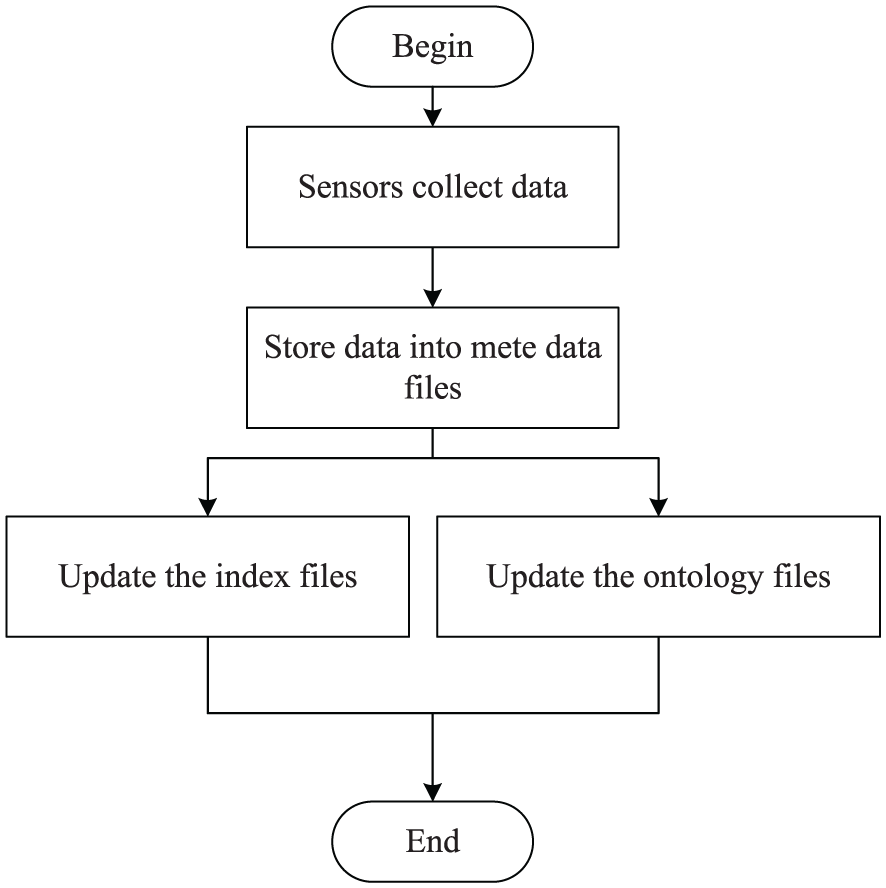
The process of update index in original search architecture.
When a search request comes, the user will give a number of attributes of the required physical object. The search engine will find the possible physical objects for each attribute value according to the corresponding index. Then, the search engine will calculate the similarity of the possible physical objects, and the set of physical objects closest to the given attribute value. This process is shown in Figure 4:
Due to the absolute error and the relative error when sensor measured, there is a gap between the measured value and the actual value.
The sensor will continue measuring the attribute values of the physical object, and some of these attribute values will change over time (such as light intensity attributes and temperature attributes), the given attributes value may be from any time.
Some attribute values are numerical type attribute values (such as light intensity attributes) and others are non-numerical value attributes (such as natural language description, picture information). These heterogeneous attribute values give the search more complexity.

The process of search in original search architecture.
In order to speed up the search process, there are two main solutions:
Research on faster and more accurate attribute value matching calculation algorithm, especially for those heterogeneous value attributes (natural language description, picture, etc.).
Research on how to find the possible physical object set more quickly, reduce the number of physical objects that should calculate the attribute similarity value. In this part, we mainly study the use of physical objects’ social relationship to reduce the calculate number.
For search engines, the process of indexing is the process of associating physical objects with similarities in a certain way, but for physical objects in the IoT, each physical object has multiple attributes. By establishing social relationship between two physical objects with similar physical attributes, a social network can be established to find the possible physical objects more accurate and faster.
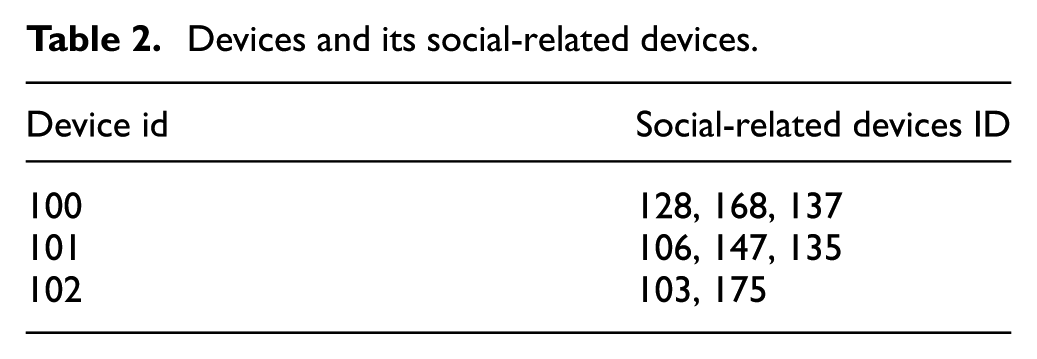
In the new search engine for the IoT, the social relationship index is added to solve the problem of slow search in a large number of devices. The social relationship index is established after original search architecture completely establishes all original index. The search engine calculates the similarity between two physical objects and establishes the social relationship index for those physical objects. For example, in the first line of Table 2, the device whose id is 100 has social relationship with the devices with ids 128, 168, and 137. The social relationship between devices is computed by the retrieval process. This process is shown in Figure 5.
Devices and its social-related devices.

The process of update index in new search architecture based on social relationship.
When the search request comes, the new search engine finds all the possible physical objects by setting a threshold value and using the original index to compare the similar properties. Then, the new search engine will select the physical object that meets the most required attributes. The new search engine will calculate the similarity of the select physical objects. Then, the new search engine will add the physical objects which have social relationship with the select physical object to the select set. If the similarity degree is higher than a threshold, the search engine will add these devices into result list. Finally, the search engine returns all the results to the user and show them. This process is shown in Figure 6.

The process of search in new search architecture based on social relationship.
For example, when we want to find an object in IoT, for the original search engine, it uses the index algorithm to calculate the index value of each item and matches it in the index table of the item. Any possible object will calculate its overall match point by the search engine to get a set of results. By adding the physical objects’ social relationship, the new search engine is the most suitable object in the step of match index value in the index value. When the new search engine finds one of the results we need, it can find other possible objects through the social relationship built by these objects. As the social relationship improves the possibility of the new search engine hit the result, the new search engine works faster than the original one.
Discussion
In this part, we provide a number of advantages that use physical objects’ social relationship in the search engine:
In the search engine of the IoT, the physical attributes of physical objects are used to establish the “similar” social relationship between physical objects. The social relationship “similar” stay unchanged even if physical attributes of the physical objects changes. By establishing the social network of the social relationship “similar,” when the search engine find a physical object which fit the requirement, it is easy to find those physical objects through social network which have strong possibility to fit the requirement. Therefore, the search engine is able to find the physical object that meets the requirements faster than the origin search engine of the IoT.
The update of social relationship in the new search engine can be achieved by analyzing the given search results. In the application of the IoT, the user of the search engine will select some results as the right answer. This physical event can change the social relationship between physical objects. For example, in a search request, the search engine gives a result list of objects 1, object 2, and object 3. The user use objects 1 and object 2. This physical event will establish the social relationship between objects 1 and object 2. By establishing this kind of social relationship between physical objects, once the search engine finds an object that meets the requirements, other eligible objects can be quickly found through this social relationship, which makes great improvement in the accuracy of the search engine.
There are many social relationships between physical objects, such as “ownership” and “right to use relationship.” In the search engine of the IoT, these social relationships of physical objects can help the user to find the corresponding physical objects without search. Beyond that, by reasoning social relationship in the social network, the search process in the IoT will be faster than normal search process.
The physical objects’ social relationship model we proposed is easily used in the search engine of IoT, it increases the search engine by adding social relationship between objects, no matter how many characters of the IoT object we use, and no matter what match algorithm we use, the model we proposed will have an effect.
Conclusion
A new concept of “Social Relationship for Physical objects” for describing, managing, and predicting the relationships between physical objects is proposed in this article. Different from the human social relationship and the social relationship in SIoT, which establish social relationship by human or smart things, the physical objects’ social relationships are established using physical events. The typical social relationships between general physical objects are given in this article. According to how spatial-temporal attributes affect the physical objects’ social relationships, the classification method is proposed. Moreover, the way how to express different social relationships in different social situations and the logic of social relationship are also provided. Based on physical objects’ social relationship, we improved the speed of the search process in the IoT, confirming the availability of physical objects’ social relationship.
We still have a lot of work to do in the future; for example, we need to develop a model for the physical objects’ social relationship, which can establish, change, and end the social relationship between different physical objects.
Footnotes
Handling Editor: Michele Amoretti
Declaration of conflicting interests
The author(s) declared no potential conflicts of interest with respect to the research, authorship, and/or publication of this article.
Funding
The author(s) disclosed receipt of the following financial support for the research, authorship, and/or publication of this article: This work was supported by the National Natural Science Foundation of China (Nos 61471035 and 6177030596).