




Abstract
Multi-sensor deployment is usually utilized in recent structural health monitoring of rotating machinery. Conventional wavelet transform is widely applied in relevant data processing tasks. However, wavelet transform still suffers from deficiencies such as lacking of frequency adjustability and shift variance property. In this article, an enhanced frame expansion is constructed via filterbank topology approach, which addresses these problems but at the same time can be implemented via fast numerical algorithm. In this scheme, different discrete complex wavelet frames are deployed at different processing stages within the filterbank structure. Enhanced frame expansion is obtained via integration of multiple translation-invariant frames. The derived timescale analyzing properties of enhanced frame expansion, whose wavelet functions form approximate Hilbert transform pairs, were investigated. It is also verified that the enhanced frame expansion satisfies the necessary constraints of complex-valued wavelet frame and other beneficial merits. Another major advantage presented by the enhanced frame expansion, which is different from complex-valued wavelet frame, dwells in its nondyadic frequency-scale paving. Moreover, the constructed enhanced frame expansion is also of low computational burden due to its inheriting of tree structure filterbank. The proposed enhanced frame expansion is applied to vibration feature extraction from multi-sensor data of a turbo-machinery. The processing results from the displacement signal as well as the acceleration signal indicate the rub-impact fault.
Introduction
Over the past few decades, structural health monitoring (SHM) has become a hot topic attracting wide and significant attentions. Schematic illustration of a typical and popular SHM system for rotating machinery can be demonstrated in Figure 1. Thanks to the development of the advanced time–frequency analysis, many new techniques have been added into and are playing an important role in this field, especially in machinery fault diagnosis.1–5 In conventional monitoring cases, utilizations of single-sensor data are emphasized, and therefore, related signal-processing techniques are often equipped with severe computational burden. In recent applications, owing to the complexity of mechanical systems, multi-sensors are often deployed to monitoring the dynamical processes. Therefore, a major concern lies in how to effectively extract hidden fault information with high efficiency. In other words, since multi-sensor data are collected and recorded, there is a new demand of effective signal-processing approaches which are implemented at low computational cost.

Illustration of the remote vibration monitoring and diagnostic system.
Wavelet analysis has been popular in all kinds of scientific and engineering fields due to its multi-resolution analyzing capability.6,7 Apart from the classical orthonormal bases constructed by Daubechies, there are currently other wavelet families such as “Symmlet,”“Coiflet,” as well as the second-generation wavelet bases constructed via lifting scheme.8,9 They are investigated by many researchers and have gained enormous contribution to the current condition-based monitoring and reliability analysis.10,11 However, it has been always neglected that there are some intrinsic deficiencies existing in the current discrete wavelet bases available. For one thing, most of them are all dyadic bases. That is to say, the frequency-scale paving generated by such bases are fixed in dyadic manner. Moreover, their frequency resolution is fixed, thus not flexible to be adjusted. However, they are shift variant, which make them less effective in extracting repetitive impulsive vibration contents. As a result, they possess inferior fault detecting ability when the spectra of the potential faults are located in transition areas of dyadic frequency-scale paving. These deficiencies cannot be perfectly resolved by developing new bases which are still dyadic ones. Complex-valued wavelet frame (CWF) is a relative new enhancement to critically sampled discrete wavelet transforms (CSDWTs). 10 Although it does not give an ultimate solution to the deficiencies mentioned above, the ideas it introduced can be beneficial.
In recent years, the development of overcomplete wavelet frame (WF) has become a major trend in the field of signal decomposition. Chen et al. 11 investigated the extraction of gearbox fault features using an overcomplete rational dilation wavelet transform. He et al.12,13 proposed an improved ensemble super wavelet (SW) decomposition strategy based on the tunable Q-factor wavelet transform (TQWT). Cai et al. 14 utilized TQWT to separate signal components according to their differences in oscillatory behavior. It is noted in He et al. 13 that the concept of SW is proposed for the first time with a clarified definition. The SW is defined as a hybrid wavelet system that incorporates more than one complete wavelet basis with specified analyzing purposes. In essence, the successful applications of these overcomplete WFs lie in parameterization of the mother wavelet transform. It means that a highly redundant wavelet dictionary is utilized and causes severe burden in computational cost. Perhaps, artificial interfering is required during signal processing. Therefore, the critical demand becomes how to achieve good trade-off between redundancy and efficiency, especially when processing massive data from an array of sensors.
In this article, we propose a new strategy for constructing overcomplete WF via adjusting configurations of filterbank topology. Different from the current CSDWTs, the enhanced frame expansion (EFE) constructed is derived from fusing of multiple complex WFs. That is the reason we use different CWFs at different decomposition stages. The CWF used at the first stage originates from a real-valued wavelet tight frame that consists of one scaling function and two distinct wavelet functions. And the one used at other decomposition stages are discrete complex wavelet bases constructed using a joint time–frequency domain–based method. To make the multiple CWFs compatible, we devise a hybrid implementing filterbank topology to conduct the relevant numerical computation. As a result, EFE can not only bring about extra improvements compared with CSDWT but also equipped with comparatively low computation burden. We demonstrate that the constructed EFE is nearly shift invariant, and the frequency scaling paving of its wavelet subbands are quite different from those of the dyadic ones. Therefore, EFE is especially suitable to process multi-sensor data of modern vibration-based condition monitoring.
We apply this EFE algorithm to analyze vibration data of a turbo-machinery. In this case study, to detect the current states of the machine, five eddy current vibration transducers, installed on the bearing houses of a turbo-machinery, were deployed at different locations for sensing the structural vibrations containing fault information. Some of them recorded displacement signals, and the others collected acceleration signals. In the displacement signal, there are abundant harmonic components that can be revealed in the lower frequency band, which helps to identify developed dynamical imbalance. EFE was used to investigate the nonstationary components of the vibration signals. Via multi-level decomposition, EFE successfully decomposed the impact signals belonging to different modes. On the basis of the information from different sensors, we get a final conclusion that rub-impact fault occurred. The correctness of the conclusion is verified after checking the coaxiality of gear transmission chain. As comparison, the signal was analyzed by other popular signal decomposition technique. It is shown that the results of EFE are superior to those of the comparison methods.
Fundamentals of overcomplete frame expansion
Basis expansion aims at decomposing a signal into a linear combination of predetermined
function dictionaries.15,16 A
motivation of basis expansion lies in its convenience in identifying salient characteristics
from another domain rather than the original domain. Let the function be demoted by

where the notation “*” represents the complex conjugate operation. Moreover, in the above
equation,

where
To synthesize the original signal, the following formula is introduced

where

while for a biorthogonal case, there exists relationships

In comparison, in a overcomplete expansion, the number of vectors in
Constructing of elements of the proposed fast frame expansion
Conventionally, a wavelet basis is realized via the celebrated Mallat’s algorithm that employs one unique scaling function and one unique wavelet function, both of which are uniformly applied among all decomposition stages. Rather than inheriting the conventional strategy, we attempt to integrate multiple WFs at different decomposition stages and attempt to construct a new complete wavelet analysis system via novel configuration of filterbank structure.
To facilitate the following mathematical derivations, a few notations are clarified first.
Let the Z transform of a discretized signal

Furthermore, the Hilbert transform of a continuous signal

WF at the first decomposition stage
The WF we use at the first decomposition stage is a real-valued WF consisting of one
scaling function and two distinct wavelet functions
Step 1. Set the least vanishing moment of
Step 2. Construct the prototype filter of

where M is the order of the filter and the variable

Let the prototype filter of the scaling function be defined as

with the constraints of

And

where L is a positive integer that makes

where the operator
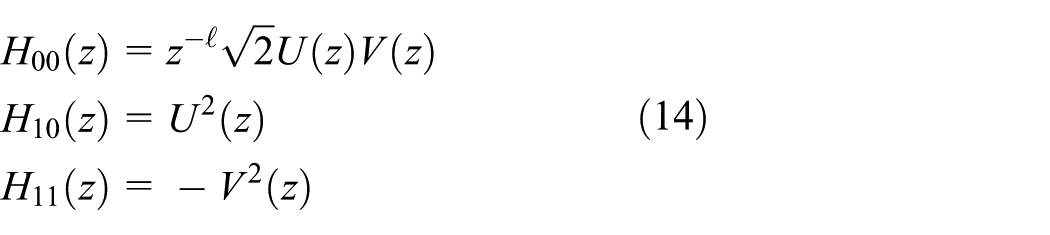
where the filter length

and the factored filters

Step 3. Impose perfect reconstruction (PR) condition and two-scale
relationship on
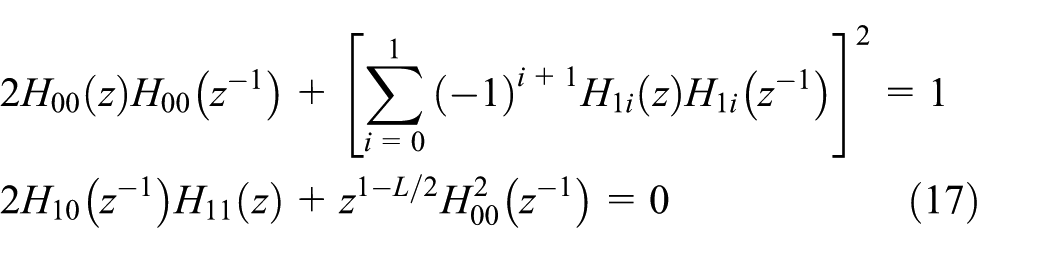
where L is the length of
Step 4. Determine the variable of a by setting the
discriminant of

where
Step 5. Adjust the coefficients of

such that they have distinct frequency response.

(a) The impulse response of
Choosing

(a) The impulse response of
Wavelet element at other decomposition stages
In the proposed EFE, we employ a joint time–frequency domain method
18
to construct the wavelet
tight frame at other decomposition stages. This complex-valued wavelet tight frame
contains two dyadic critically sampled wavelet bases that operate separately on the same
input signal. While the two wavelet functions in the two filtering branches,

where

where

For an orthogonal SWF, the coefficients of
Step 1. Determine the magnitude spectrum of

Step 2. Impose the Hilbert-pair constraint to the phase spectrum of
Step 3. Truncate the

where

where the notation “*” stands for convolution operator and (1, :) represents the first
row vector of
Step 4. Improve the orthogonality of DCWB in the time domain. In
order to make the design basis orthogonal, the filter

where

the nonlinear equation (27) can be reduced to a linear iteration problem as

where

(a) Envelope of the complex scaling function, (b) envelope of the complex scaling function, (c) 3D plot of the complex wavelet function, and (d) 3D plot of the complex wavelet function.
Construction of EFE via filterbank topology configuration approach
Filterbank topology configuration approach
In this section, a filterbank topology configuration approach is utilized to take advantage of the constructed SW frame elements. The wavelet function (WTF) used at the first decomposition stage is a real one, while the one used at the others is complex valued. As such, a specialized filterbank is devised to implement the wavelet decomposition. The analysis phase and synthesis phase of the devised filterbank are shown in Figure 5. However, to generalize the real-valued WTF into a complex-valued one such that the two WTFs can be compatible, the filters used at the imaginary part of the filterbank structure at the first decomposition stage are taken as

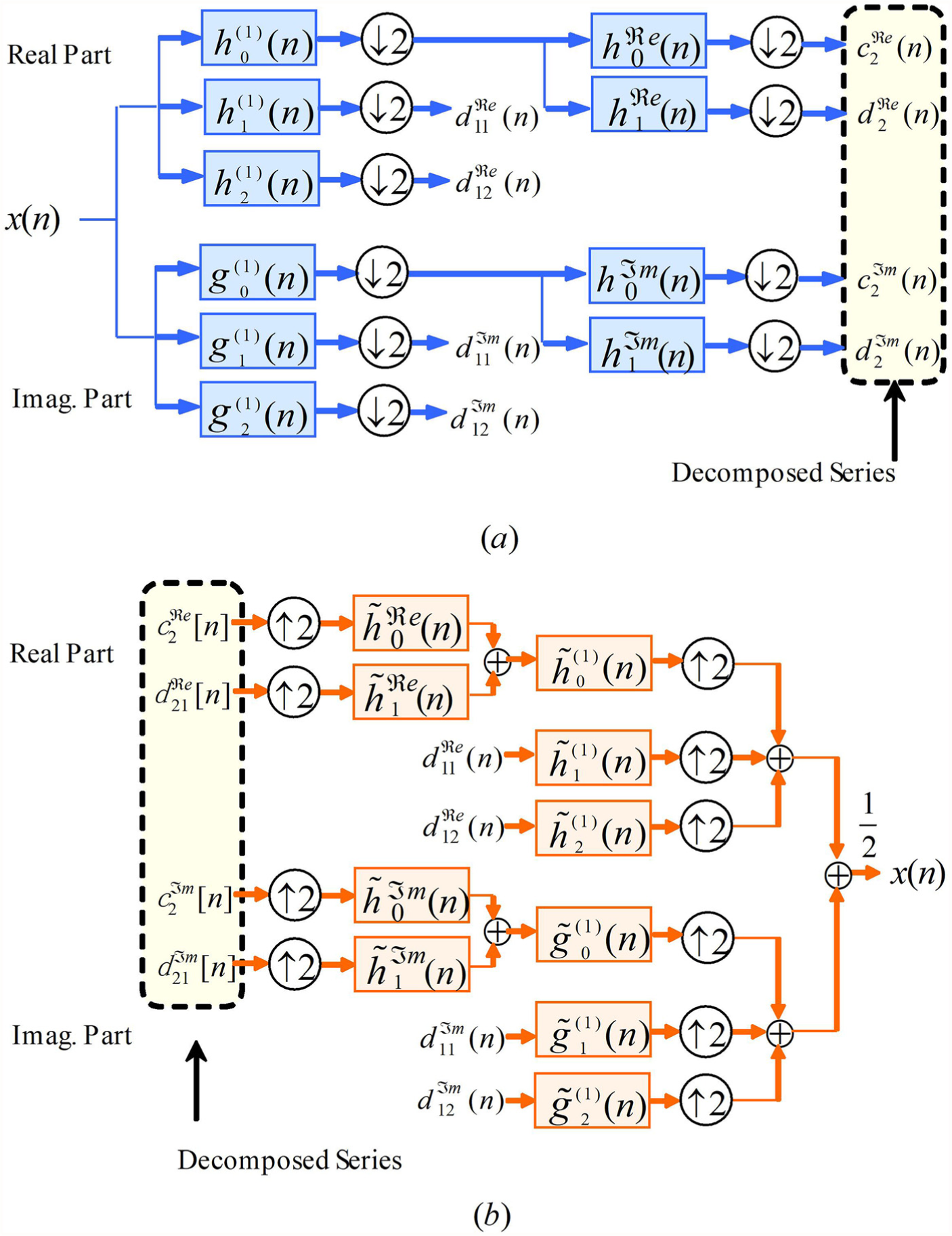
(a) Analysis part of the implementing filterbank and (b) synthesis part of the implementing filterbank.
While in the implementing filterbank, the filters used in the synthesis part are obtained by flipping the coefficients of their corresponding filters in the analysis part, that is

where the operator
However, because the filter response of
With the constructed WFs, a specialized implementing filterbank is developed to derive
the nonconventional timescale WF. Recalling the structure of the filterbank shown in Figure 5, the redundancy factor of the
constructed EFE is ranged in the real-valued interval

(a) The resulting scaling function, (b) the resulting wavelet function, and (c) the frequency responses of the EFE.
Observing the impulse responses of the resulting scaling function as well as the resulting wavelet function, which are shown in Figure 6(a) and (b), we can find they are almost symmetric and finitely supported at any decomposition stage. And in the Fourier domain (Figure 6(c)), the three wavelet subbands located in the highest frequency range show significant differences from those of dyadic ones.
To further illustrate the differences between the time–frequency properties of constructed EFE and those of the conventional CSDWT, the temporal responses and frequency responses of a CSDWT basis (Daubechies’ DB8 wavelet basis) is shown in Figure 7. As can be seen, the scaling function and the wavelet function are not symmetric at all, and more oscillations are found in the waveforms. The essential differences lie in the different timescale paving due to filterbank structure.

(a) The wavelet function of DB8 basis, (b) the scaling function of DB8 basis, and (c) the filterbank structure of CSDWT.
Other properties of the constructed EFE
In this subsection, we move on to investigate the time–frequency properties of the constructed EFE. As a special case of overcomplete frame expansion, EFE is no longer orthogonal. Some major advantages of EFE can be summarized as below:
Sharp resolution in the time domain
As can be seen in Figure 8, a three-stage EFE decomposition can generate five wavelet subbands, and the temporal waveforms of each subband are displayed, respectively. A shorter support indicates associated higher frequency subband in the spectral domain. It is observed that all the impulse responses are of low oscillation, therefore very suitable for extracting transient signature in the recorded vibration signal. Comparing impulsive responses in Figure 8 with those in Figure 7, we confirm that there are improvements of temporal resolution in the EFE via filterbank topology configuring scheme.

The impulse response of each wavelet subband of EFE in a three-stage decomposition.
PR
In Figure 8, let
Nearly linear phase property
The impulsive responses in Figure 8 are almost symmetric and ensure small distortion in each wavelet subband after applying signal branch reconstruction.
Nearly shift-invariant property
In order to test the shift-invariant property of the constructed EFE, we employ
discretized Dirac sequences with unit amplitude as the input of EFE decomposition. That
is to say, the functions,

Shift-invariant property of EFE using Dirac sequences as the input.
Fast numerical implementation
Inheriting tree-structured iterated filterbank scheme, the computational burden of EFE can be almost the same as common complex-valued wavelet tight frame. This property ensures high-efficient processing of multi-sensor measurements in vibration-based condition monitoring.
Numerical simulation
The proposed EFE is a good alternative to classical CSDWT in mechanical fault feature
extraction. In this section, EFE is compared with CSDWT (DB8 basis) and ensemble empirical
mode decomposition (EEMD)19,20 in
multicomponent signal decomposition. EEMD is also a popular adaptive signal analysis tool.
It is reported that EEMD shows similar octave band decomposition manner which is similar to
wavelet transform. The simulated signal

Equivalently, the compound signal

where the coefficients
Parameters of the four components in the simulation signal

The time-domain wave and its associated Fourier spectrum of the simulation signal

(a) Time-domain wave and (b) Fourier spectrum of the simulation signal.

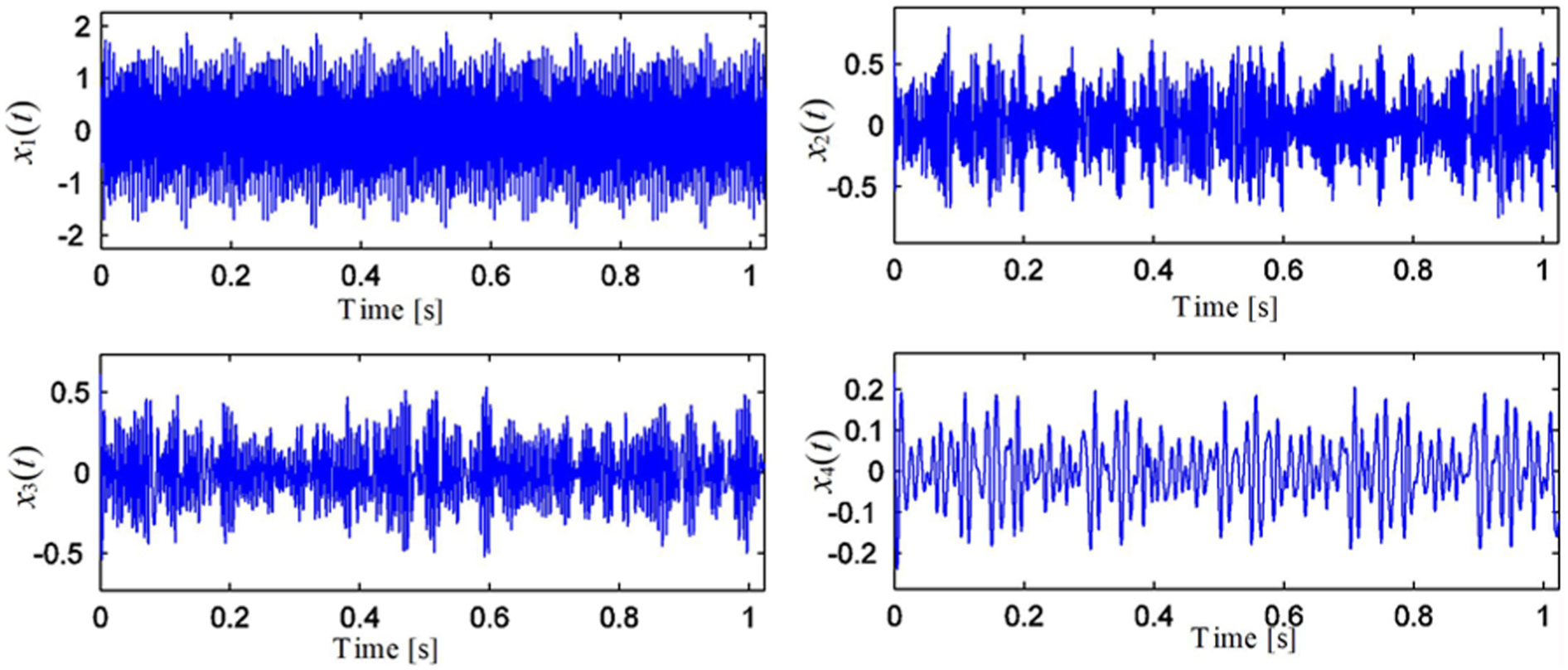
Time-domain waves of four simulation components.
By performing four-stage EFE decomposition on the simulation signal, we obtain the wavelet subbands, and they are shown in Figure 12. It can be observed that the signal in each subband is very similar to their original signal. Only the low oscillatory harmonic component shows attenuation in amplitude. This phenomenon actually comes from the fact that the frequency of low oscillatory harmonic is located in transition band of two adjacent wavelet subbands.

Decomposition results by the proposed EFE.
As comparison, the simulation signal is also processed by DB8 orthonormal wavelet basis and EEMD. The decomposition results of DB8 basis is shown in Figure 13. It can be seen that the signal in each wavelet subband shows evident distortion with different severity, especially the extracted low oscillatory harmonic display false modulation effect.

Decomposition results by DB8 orthonormal basis.
The four intrinsic mode functions (IMFs) by EEMD are plotted in Figure 14. The decomposition results by EEMD show
severe mode cracking. None of the IMFs recover the feature of the four signal contents. The
spectra of the four IMFs are also given in Figure 15, and it can be seen that features of
Four IMFs of the simulation signal using EEMD.

Fourier spectrum of the four IMFs derived by EEMD.
In order to make a quantitative analysis of results in Figures 11–14, an indicator of correlation
coefficient (CC), which can make precise assessment of the similarity between two series

where
Correlation coefficients between the actual component and the estimated component.

EFE: enhanced frame expansion; CSDWT: critically sampled discrete wavelet transform; EEMD: ensemble empirical mode decomposition.
In Table 2, the CCs between the
actual components and the estimated components are computed and enumerated. For any of

Correlation coefficients of two wavelet bases to the original signal contents.
From the above results, it is remarkable that the performance of EEMD is inferior to that of basis expansion methods. Although EEMD is reported to be an effective self-adaptive signal-processing technique driven by the input data, it is difficult to control its time–frequency properties. When the added noise is not carefully manipulated, the results may be not so good.
Engineering application to turbo-machinery condition monitoring
Turbo-machinery is a type of major equipment extensively used in many modern industries, such as power generation, oil refining, and even aircraft manufacturing.21,22 Owing to hard working conditions, mechanical faults have threatened the performance and safety operations of turbo-machinery.23–26 In the above literature, it is seen that multi-sensor deployment is very popular to interpret the faulty information contained in the vibration measurements. The rub-impact fault is a common malfunction in engineering mechanical systems.27,28 However, related mechanical signatures of rub-impact fault are quite diversified and difficult to be analyzed. In this section, the constructed EFE was applied to rub-impact analysis of an engineering turbo-machinery.
Figure 17 shows the structural sketch of a flue gas turbine unit for heavy oil catalytic cracking units in oil refineries. The unit is composed of a flue gas turbine, a fan, a gearbox, an electric motor, couplings, and bearings. The transmission ratio of the gearbox is 120/31. The rotating speed of the flue gas turbine and the fan is running at 5850 r/min. Accordingly, the rotating frequency of the motor can be calculated at 25.19 Hz.

Structural sketch of the engineering flue gas turbine unit.
In order to prevent major mechanical downtime, a condition monitoring system was developed for this turbo-machinery. Because the machine is large in volume, single-channel sensor does not meet the demand, and incipient fault features may be omitted, and a multi-sensor measurement strategy is designed. Sensors were mounted on the bearing housing of the shaft. Displacement signals were taken from the measuring points of 1–5 bearings by eddy current transducers and digitized at a uniform sampling frequency of 2000 Hz. The vibration signal of the measuring point 5, and its Fourier spectrum is illustrated in Figure 18.

(a) The time-domain waveform of the measured displacement signal and (b) the Fourier spectrum of the displacement signal.
A seemingly fluctuant sine waveform can be observed. However, there was no explicit information which indicates the hidden fault of the flue gas turbine unit. In the Fourier spectrum, the magnitudes of the second order and third order of the working frequencies are quite large. This phenomenon usually indicates the occurrence of severe dynamic imbalance. In Figure 19, the Hilbert envelope spectrum of the original vibration signal is computed, from which it can be seen a dominant component of the working frequency is found.

The envelope spectrum of the original vibration signal.
To further investigate the implicit information of the displacement signal, the constructed EFE is employed to perform a four-level decomposition on the displacement signal, with the result shown in Figure 20.

Wavelet subbands of the displacement signal decomposed by EFE.
From Figure 20, it can be seen that the working frequency of the low-speed shaft (A5) and the working frequency of the low-speed shaft (D5) are reasonably decomposed. While in D1–D3, many impulsive contents are detected. Let X denote the working frequency of the high-speed shaft (X = 97.5 Hz). The D3 wavelet subband in Figure 20 is reproduced in Figure 21, from which a series of repetitive impulses occurring at the rate X/3 are quite evident.
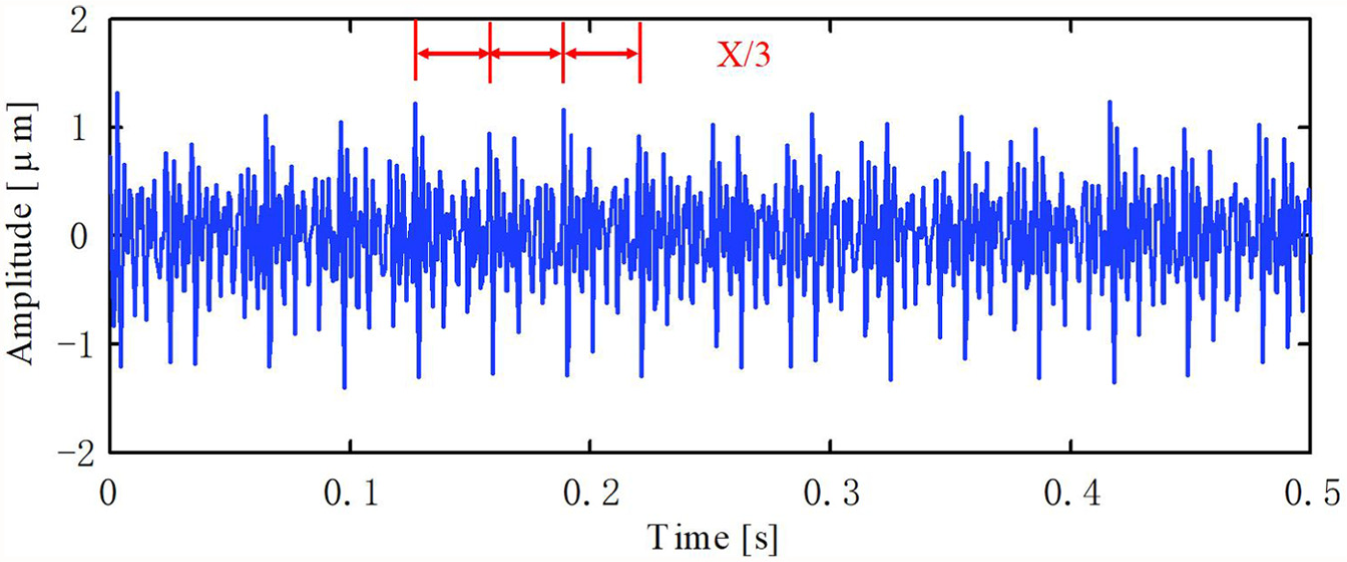
D3 wavelet subband of the displacement signal (decomposed by EFE).
However, in the Hilbert envelope spectrum of the D3 wavelet subband (Figure 22), we find the frequency peaks spaced at the interval of X/3 with the initial one X/3. With the acquired information, we can claim with confidence that there are indeed decaying vibration impulses in the signal. The frequency of X/3 is an important symptom of rub-impact fault in rotating machinery, especially at the early stage. 21 Consequently, the extracted 1/3 fractional harmonic component implies that the rub-impact fault had been developed in the flue gas turbine unit.

Hilbert envelope spectrum of the D3 wavelet subband in Figure 20.
To investigate the causes of the rub-impact fault, we noticed that in the flue gas turbine, the fan, and the gearbox were connected using a diaphragm coupling. They were not properly aligned when the system was assembled. In order to compensate the misalignment of the shafting, the diaphragms were slightly sliding and dislocated between each other during operation. This tiny change led to the rub-impacts in the diaphragm coupling B during operations of the unit.
As comparison, the CWF basis of length 24 and the DB8 orthonormal basis were also used to process the displacement signal and their subbands, whose theoretical passing band are similar to D3 generated by the EFE, are shown in Figure 23. It can be seen that neither of the two contrasting methods provided comparable processing result as that of the constructed EFE.
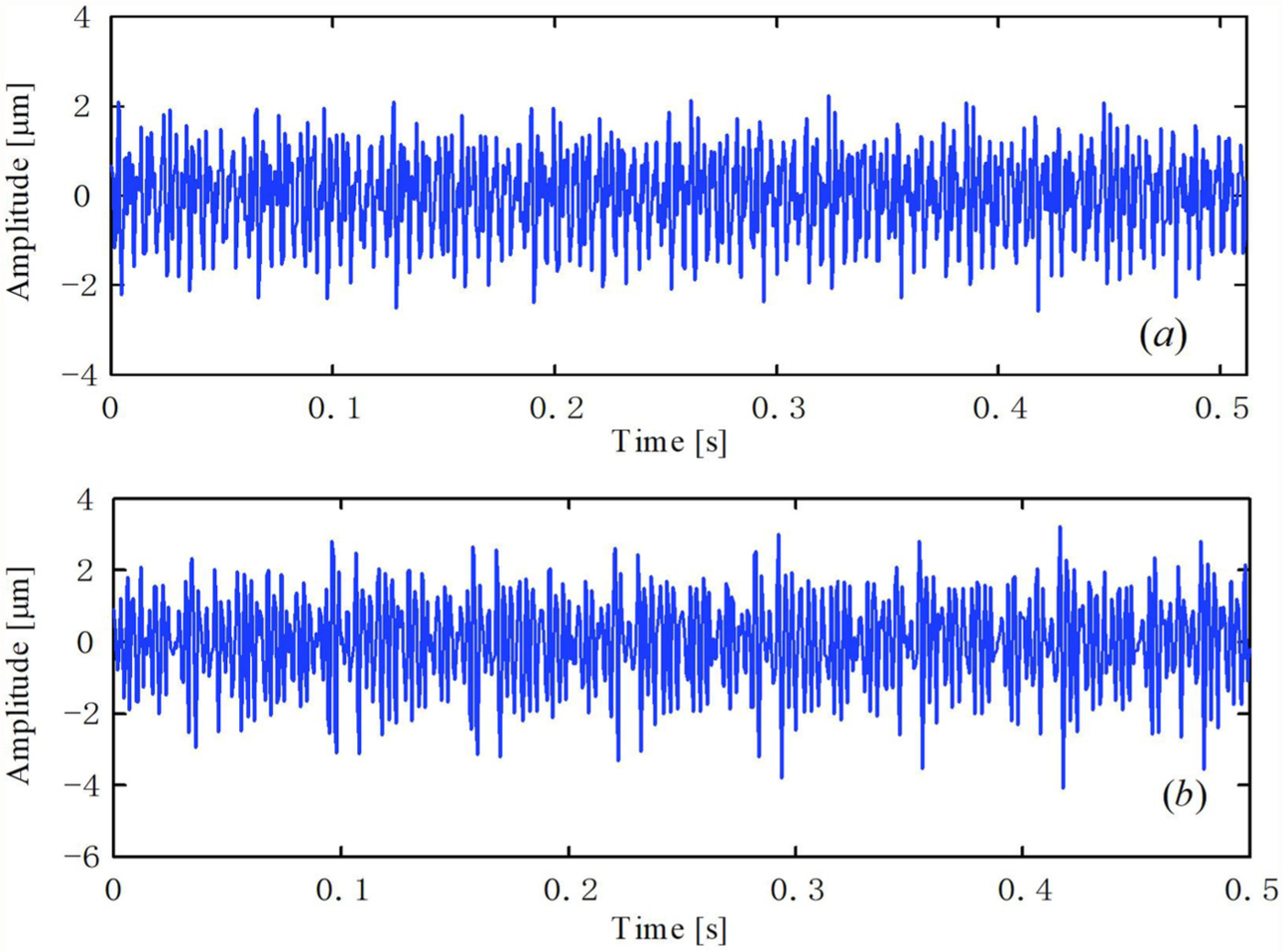
(a) D2 wavelet subband of the displacement signal decomposed by the CWF basis of length 24 and (b) the D2 wavelet subband of the displacement signal decomposed by DB8 basis.
In Figure 24, we apply EEMD to decompose the original vibration signal, and four IMFs of nontrend components are plotted. The results failed in revealing the transient feature space at the frequency of X/3. Moreover, it can be observed that mode crack is still a problem in IMF1 which is of the highest frequency band among all scales.

IMFs generated by applying EEMD to the original vibration signal.
Conclusion
In this article, a novel hybrid wavelet tight frame representation methodology, named as EFE, is constructed via configuration of filterbank topology for improving the intrinsic deficiencies that exist in the critically sampled wavelet transforms. The construction of the EFE is inspired by the ideas introduced in the CWF. Multiple WFs are integrated in the EFE, and a specialized implementing filterbank is devised to make the multiple CWFs compatible with each other. It is shown that the constructed EFE inherits the feasible merits of the CWF and is still of low computation burden. Moreover, the time–frequency properties of the EFE are quite different from those of the CSDWTs. The proposed EFE was applied to analyze the vibration signal of an engineering flue gas turbine unit and successfully detected the incipient rub-impact fault signatures, especially the sub-harmonic symptoms, at the early fault stage. The processing result is compared with those of the CWF and the DB8 wavelet transform as well as EEMD, and it was found that the result of the proposed method is superior. The most important advantage of EFE lies in its high-efficient numerical implementation, which makes it especially suitable for rapid processing multi-sensor data of vibration-based condition monitoring.
Footnotes
Acknowledgements
The authors would like to thank School of Mechanical Engineering, Xian Jiaotong University, for providing the necessary experimental conditions.
Handling Editor: Zhi-Bo Yang
Declaration of conflicting interests
The author(s) declared no potential conflicts of interest with respect to the research, authorship, and/or publication of this article.
Funding
The author(s) disclosed receipt of the following financial support for the research, authorship, and/or publication of this article: This work was financially supported by the Natural Science Foundation of China (grant no. 51605403), the Natural Science Foundation of Fujian Province, China (grant no. 2016J01261), the Natural Science Foundation of Guangdong Province, China (grant no. 2015A030310010), the Ministry of Industry and Information Technology (MIIT) 2016 related to comprehensive and standardized trial and new model application of intelligent manufacturing (grant no. Yu Luo Industrial Manufacturing [2016]07744), and the Fundamental Research Funds for the Central Universities (grant no. 20720160078).