




Abstract
Space information networks are proposed to broaden the observation area and realize continuous information acquisition using satellites and high-altitude platform stations. Space information networks are able to enhance detection and transmission capabilities compared to the current single Earth observation satellite. The satellite–terrestrial network is an important component of the space information networks. Hence, the major contribution of this article is to propose a new transmitted link selection scheme in a satellite–terrestrial network. Switch-and-stay combining scheme is used by destination to have a trade-off between the complexity and efficiency. The satellite, terrestrial relays, and destination user are influenced by hardware impairments, respectively. The closed-form expressions for the outage probability and throughput are derived. In order to analyze the system performance at high signal-to-noise rate, the asymptotic expressions for the system performance are also derived to give a special view on the impact of hardware impairments on the considered network. What is more, numerical results are derived to verify the correctness of our analytical results.
Keywords
Introduction
Recently, with the fast development of space exploration, the space information network (SIN) becomes an attractive and hot research field.1–6 The concept of SIN was first proposed in 1998. To spread the terrestrial Internet to the space, the Defense Advanced Research Projects Agency (DARPA) supported the Jet Propulsion Laboratory (JPL) to investigate space Internet to realize end-to-end communications. 1 The National Aeronautics and Space Administration (NASA) began to sponsor this project in 2002 and then the concepts were extended. In 2006, NASA proposed the NASA space communications data networking architecture in a NASA Technical Report. 3 From then on, more efforts were done on SIN. For example, Hefei and Yuan 4 presented a feasible mesh-based network architecture to suppose the scalability and compatibility of SIN. And some key technologies of SIN were discussed in Dai and Zhu. 5 Nishiyama et al. 6 proposed a promising multilayered satellite network to provide global ubiquitous broadband communication and discussed the corresponding routing scheme for the proposed network. In general, a SIN is a network that is capable of achieving real-time acquisition, transmission, and processing space information using different space platforms, that is, geostationary Earth orbit (GEO) satellites, middle Earth orbit (MEO) satellites, low Earth orbit (LEO) satellites, stratospheric balloons, manned and unmanned aircraft, and so on. The SIN plays an important role in many areas, such as ocean-going voyages, emergency rescue, navigation positioning, air transport, and aerospace measurement and control. Moreover, it can support real-time transmission to meet the requirements of both satellite–terrestrial communications and deep space exploration and communications. Considering the appealing features of SIN, it has become an important research field for universal scientists, which leads to many new topics in information theory, communications theory, and network theory.7,8
SINs have been proposed in recent years, the satellite–terrestrial network is an important part of the SIN. The communication between long distance mainly relies on the satellite–terrestrial networks. As for this reasons, satellite–terrestrial networks attain a great attention because of its utility in several applications such as broadcasting, disaster recovery, defense, and so on. 9 There are two main challenges in satellite systems. One is masking effect and another is latency. In masking effect, the line of sight (LOS) between satellite and terrestrial user is blocked by the obstacles. To resolve this issue, the hybrid satellite–terrestrial cooperative systems have been proposed in Evans et al.; 10 in these systems, masked earth station (ES) received the signals of satellite through relay ES, situated at the ground. Furthermore, in order to overcome the masking effect, several satellite diversity techniques have been proposed in Schodorf and Wu 11 and Chini et al. 12 Disaster recovery is another important issue which requires establishment of broadband access from a disaster area to the rest of the world. Geostationary satellites can be used to provide broadband communication links in the disaster area when terrestrial infrastructure is destroyed.
On the contrary, spatial diversity with multi-antenna nodes has been considered to further improve the performance of the satellite communication systems.13–15 In Arti 15 and Arti and Manav, 16 the beamforming and combining method for satellite–terrestrial networks were analyzed. In Lin et al., 17 multi-terrestrial satellite–terrestrial networks were studied, and outage probability and symbol error rate were analyzed. In Nikolaos et al., 18 multi-antenna relay node was considered in the satellite network, in order to derive better system performance, maximum ratio transmission (MRT), and maximum ratio combining (MRC) beamforming technologies were used at source and destination, respectively. The closed-form expression of the outage probability was derived in this article. Recently, An et al. 19 have researched a multiuser satellite–terrestrial network with opportunistic user scheduling. Especially, outage probability of the system was got by the authors. In Prabhat and Pankaj, 20 max–max user relay selection scheme was used in multiuser and multi-relay hybrid satellite–relay system. The analytical and asymptotic expressions for the outage probability were provided. In Iqbal and Ahmed, 21 the authors analyzed the hybrid satellite–terrestrial networks under independent and nonideal shadowed Rician and Nakagami-m channel. Amplify-and-forward (AF) and MRC protocols were used in the system, respectively. Especially, the analytical approach was derived to evaluate the performance of the system in terms of outage probability and symbol. The authors just discussed the system in ideal hardware case, which ignored the hardware impairments.
Apart from the conventional diversity combining techniques, several variants of the switched-diversity combining techniques, such as switch-and-stay combining (SSC), switch-and-examine combining (SEC), and SEC with post-selection (SECps), were proposed in Yang and Alouini, 22 Tan et al., 23 and Yang et al. 24 due to their simplicity of implementation. In particular, the multibranch SSC scheme was first addressed in Hong and Alouini, 25 which reduced the implementation complexity of multichannel communication scenarios. In the multibranch SSC scheme, if the channel quality of the currently connected branch exceeds a predetermined threshold, then this branch is kept. Otherwise, no matter what the channel quality of the switch to branch is, the scheduler settles on that branch for the next transmission burst. 25 In Diomidis and George, 26 the authors proposed and analyzed the performance of a distributed switch and stay combining (DSSC) scheme, which utilizes a single decode and forward (DF) relay. The outage probability and spectral efficiency of the considered system was analyzed by the authors. In Katiyar et al., 27 SSC scheme was used in the relay networks, where the relay was a multi-antenna-input–single-antenna-output (MISO) node. The analytical expression for the outage probability was derived for the considered network. However, SSC scheme was rarely studied in the satellite–terrestrial networks. Hence, the work of this article is necessary.
Common to all these works dealing with SSC scheme is the assumption of perfect transceiver hardware (i.e. ideal hardware) of the terminals. However, in practice, the transceiver hardware is imperfect due to phase noise, I/Q imbalance, and amplifier nonlinearities.28–30 Few works have investigated the effect of hardware impairments on dual-hop cooperative networks, and they are briefly discussed next.
In Bjornson et al., 31 the authors summarized the former works and proposed a normal hardware impairment model which was easy to follow. The closed-form expressions of the outage probability for the AF and DF relay networks were derived, which provided fast ways to evaluate the impact of hardware impairments on the transceiver networks. In Bjornson et al., 32 the authors analyzed the multiple-input and multiple-output (MIMO) networks with hardware impairments. An optimal beamforming scheme was used to derive better system performance. In Matthaiou et al., 33 the authors analyzed the impact of hardware impairments on two-way relay networks, and the accurate and asymptotic expressions were derived to investigate the effect of hardware impairments on the considered networks. In Pankaj and Prabhat, 34 the impact of hardware impairments was first considered in the cognitive networks. In Duy et al., 35 partial relay selection and opportunistic relay selection schemes were used in the multi-relay networks with hardware impairments to obtain better system performance. In Hung et al., 36 the impact of hardware impairments on the secrecy networks was first discussed. The authors discussed the system performance in three conditions and gave the analytical expressions for the secrecy outage probability. In Guo et al., 37 the authors first analyzed the effect of hardware impairments on the outage probability of the satellite–relay networks. To its regret, the authors just considered the classical one source, one relay, and one destination model which just had relay link and ignored the direct transmitted link between source and destination. From the above analysis, we know that hardware impairments are a hot topic to be studied.
To the best knowledge of the authors, the satellite–terrestrial network with hardware impairments using SSC scheme has not been reported in the literature thus far. We are, therefore, motivated to examine the outage probability and throughput of the considered network. The main contributions of this article are summarized as follows:
First, we propose a transmitted link selection scheme between the satellite–user link and the satellite–relay–user link. The scheme is that the satellite will always use one transmitted link when the signal-to-noise and distortion rate (SNDR) of this transmitted link is above the given threshold. Otherwise, the satellite will use the other transmitted link no matter what the quality of that transmitted link is. In the relay link, partial terrestrial relay selection scheme is used to choose a suitable relay to gain better performance.
Second, the closed-form expressions for the outage probability and throughput are derived, which shows that the outage probability will have an upper bound when the given threshold increases to a fixed value, and the expressions also provide a fast way to evaluate the impact of hardware impairments on the throughput.
Finally, the asymptotic expressions of the outage probability and throughput at high signal-to-noise rates (SNRs) are also derived. We can find the impact of hardware impairments on the considered network through the asymptotic analysis.
The rest of this article is organized as follows: The system model is described in section “The system model.” In section “The system performance,” closed-form expressions and asymptotic expressions for the outage probability and throughput are derived. Simulation results are presented in section “Numerical results” along with representative numerical results. Finally, this article is concluded in section “Conclusion.”
The system model
As shown in Figure 1, we consider a satellite–terrestrial relay user network. A signal antenna satellite (S),

The system model.
SSC scheme is introduced as follows:
S broads its signal both to D.
Then S examines the SNDR of satellite–destination (S-D) transmitted link
If the received SNDR of S-D transmitted link is larger than the switching threshold
If the quality of S-D link drops below
In the next transmitted stage, when switching S-R-D transmitted link, if the SNDR of S-R-D transmitted link is larger than
In S-R-D transmitted link, transmission takes two time slots. In the first slot, S broads its signal to all R, as partial relay selection scheme is used in the relay selection. Hence, in the second slot, only R which has the largest SNDR of S-R link will forward the received signal to D. In particular, DF protocol is used by R. MRC and MRT technologies are used by the relay in the first and second slots, respectively.
Remark 1
In partial relay selection scheme, the satellite can select a relay Earth terrestrial (ET) based on the knowledge of the instantaneous SNRs of the satellite–relay ET and relay–destination ET links. For practical application of such a complex scheme, channel state information (CSI) of all relay ES-destination ES links is required at the satellite, which is provided using feedback from the destination ES to the satellite. Since in satellite systems, latency is very high, it is very difficult to provide CSI of all links at the satellite. Therefore, we consider a simple relay ES selection scheme, where the satellite only requires the CSI feedback of the satellite–relay ET links from the relays. In this article, we demonstrate analytically that using a simple relay ET selection scheme, it is possible to significantly lower the outage probability and achieve improvement in the diversity gain and consequently the performance of the considered system. In satellite systems, this performance gain is very important because by achieving this gain, satellite needs to transmit less power (approximately half for 3 dB SNR improvement), which can help in reducing the dimensions and weight and subsequently cost of the satellite system. Therefore, the proposed scheme is very useful for hybrid satellite–terrestrial communication systems.
The system performance
In this section, first, we derive the SNDR of the system; second, we obtain the closed-form expressions for the outage probability and the throughput of the considered system; finally, we derive the asymptotic expressions for the outage probability and throughput.
The end-to-end SNDR of the system
In this subsection, the end-to-end SNDR of the system is derived. As SSC scheme is used at destination of the system, at first, we analyze the direct transmitted link. S broads its signal to D. Hence, the received signal of direct transmitted link at D is given by

where

where
Next, if S selects the S-R-D transmitted link according to SSC selection scheme, then in the first slot, the received signal at ith R is given by

where

where
From equation (3), the SNDR of

where
As mentioned above, partial relay selection scheme is used in the first relay link; hence, the SNDR of the first hop is given by

In the second slot, the selected R will forward the received signal to D. The same with equation (3), the received signal at D is given by

where


where
From equation (7), the SNDR of the second hop is given by

where
As DF protocol is used by R, the SNDR of the S-R-D link is given by

Preliminaries
Before we derived the outage probability of the considered system, first, with the help of Nikolaos et al.,
18
the probability density function (PDF) of

where
Second, in the S-R transmitted link, we assume that each antenna link has the same channel parameters, from Nikolaos et al.,
18
the PDF of

where

and
Third, the PDF of

where
Outage probability of the system
In wireless systems, the outage probability is an important quality-of-service (QoS) performance measure, which is defined as the probability that the output instantaneous SNDR

From Yong et al., 39 we know that the outage probability of the considered system is given by

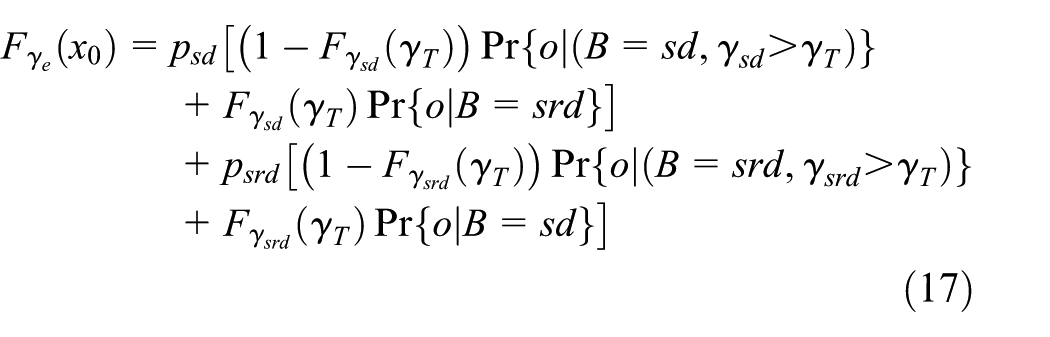
Suppose that

Equation (16) can be written as a simple expression, which is given by
where


Note that the conditional outage probabilities in equation (17) are taken from the general form

By substituting
Firstly, the cumulative distribution function (CDF) of

Next, the CDF of

From equation (22), we know that we should first obtain

Because partial relay selection is used in the first hop of S-R-D link, with the help of equation (6), the CDF of

Next,

Substituting equations (25) and (24) into equation (22), equation (22) is given by equation (26)

By substituting equations (18)–(21) and (26) into equation (17), the outage probability of the system is derived.
Throughput of the system
As mentioned in Diomidis and George, 26 the throughput is defined as

where

Since the equation is too long, it is left out here.
Asymptotic analysis of the system
In this subsection, the asymptotic analysis of the considered system is derived. From the above analysis, we know that the key point of the analysis is deriving
Before deriving the asymptotic expressions, we first give the PDF for the S-D link, S-R link, and R-D link, respectively. From Prabhat and Pankaj,
20
the PDF of

Substituting equation (29) into equation (21),

From Prabhat and Pankaj,
20
the PDF of

With the help of equations (5) and (23),

As partial relay selection is used by the system, the final CDF of

From Bletsas et al.,
40
the PDF of

With the help of equations (9) and (34),

Substituting equations (33) and (35) into equation (22), the asymptotic expression of

In the same way, substituting equations (18)–(20), (30), and (36) into equation (17), the asymptotic expression for the outage probability is derived.
Substituting equations (30) and (36) into equation (28), the asymptotic expression for the throughput is derived. Above all are the asymptotic analysis for the considered system.
Numerical results
This section provides numerical results to validate the theoretical analysis and show the effects of key parameters on the system outage performance and the throughput. Here, the simulation results are obtained by performing
Channel parameters.
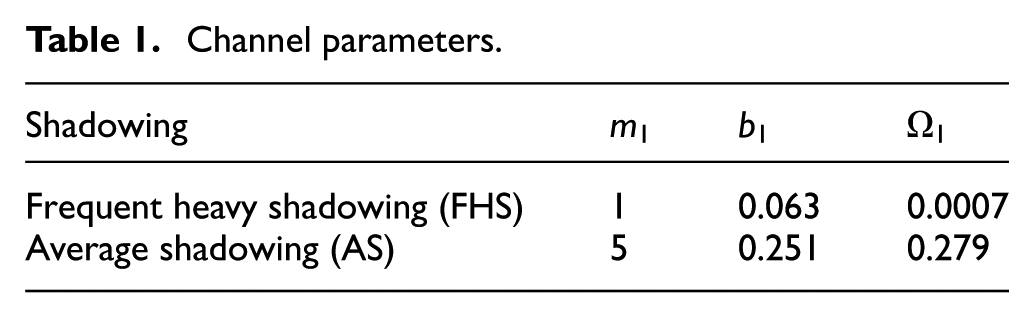
Some illustrations for the simulations and figures:
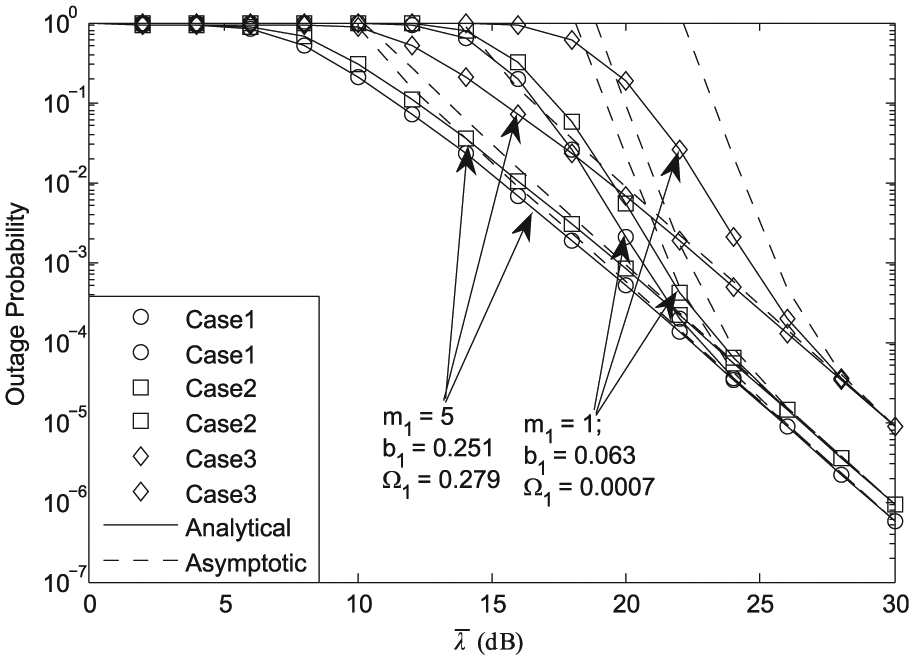
The impairments level of the system
Case 1:
Case 2:
Case 3:
Figure 2 plots the outage probability of the system with

Outage probability of the system with
Figure 3 examines the outage probability of the system with
Outage probability of the system with
Figure 4 depicts that the outage probability of the system with

Outage probability of the system with versus different
Figure 5 illustrates the outage probability of the system with

Outage probability of the system versus different
Figure 6 shows the throughput of the system with

The throughput of the system with
Conclusion
This article first introduced the SIN, and from the introduction, we knew that satellite–terrestrial network was an important component of SIN. The major contributions of this article were that this article first analyzed the system performance of the satellite multi-terrestrial relay network with hardware impairments using SSC scheme. Then, we proposed a new transmitted link selection scheme in a satellite–terrestrial network. SSC scheme was used by destination to have a balance between the complexity and efficiency. Especially, we derived the accurate and asymptotic closed-form expressions for the outage probability and throughput of the system, respectively. The results revealed that the outage floor appeared when the hardware impairments existed. In addition, a system threshold bound occurred once the system suffered from hardware impairments. In other words, the outage probability would be always 1 when the threshold was larger than the bound. What is more, from the simulation results, we found that when the transmitted SNR became larger enough, the outage probability would be a fixed value, which just had the relation with the impairment level. The throughput of the system would be half the value of
Footnotes
Acknowledgements
The authors would like to extend their gratitude to the anonymous reviewers for their valuable and constructive comments, which have largely improved and clarified this article.
Academic Editor: Katsuya Suto
Declaration of conflicting interests
The author(s) declared no potential conflicts of interest with respect to the research, authorship, and/or publication of this article.
Funding
The author(s) disclosed receipt of the following financial support for the research, authorship, and/or publication of this article: This work was supported by the National Science Foundation of China (no. 61501507) and the Jiangsu Provincial Natural Science Foundation of China (no. 20150719).