




Abstract
With the explosive demand for wireless communications, users are always experiencing poor quality-of-services. Spectrum auction is a promising approach to allocate spectrum resources in wireless networks. Most of the previous works ignored social characteristics of users in wireless networks which influence the allocation of spectrum resources. In this article, we study the spectrum auction problem in a femtocell network and jointly exploit the social reciprocity of users for optimizing the allocation of spectrum resources. We propose an auction incentive framework combined with social reciprocity in the femtocell network. Such a matter is formulated as an integer programming optimization problem, and a modified quantum genetic algorithm is developed to solve the optimization problem. Besides we propose a payment rule satisfying truthfulness and individual rationality properties. Simulation results show that our algorithm can achieve the optimal solution to the optimization problem.
Introduction
The increasing demand for wireless services has posed challenges to the existing wireless communication networks. Also, most of these growing data streams have occurred indoors, and weak signal area and even fade area often happened due to signal transmission fading. Therefore, it is important to improve the quality of services (QoSs) of users through efficient resource allocation. One question arises, that is, can we leverage user’s social features appeared in social networks to improve the efficiency of resource allocation? So, how to efficiently and flexibly utilize radio spectrum resources becomes a key design challenge of the next-generation wireless network.
Femtocell is a newly emerging technology to address the problem of poor indoor coverage and wireless capacity limitation. 1 In the two-tier macro-femtocell network, femtocell access point (FAP) owners can autonomously deploy it in room to increase hot-spot service, 2 so femtocell is enabled by a short-range low-cost home base station (BS) installed by end consumers to provide high-speed data access. FAP can help users to access the core network via themselves as a relays with less power. 3 Femtocell connects with the core network through broadband Internet Protocol (IP), such as digital subscriber line (DSL) or cable modems. In addition, it is important to choose the proper access control mechanism. According to De la Roche et al., 4 there are three mainstream access control mechanisms: (1) closed access, only femtocell users can access the femtocell; (2) open access, any user can access the femtocell; (3) hybrid access, femtocell users can access the femtocell and other users can access the femtocell with certain restriction. Furthermore, Zheng et al.5,6 have proposed a new network model to improve user experience by pushing the scheduling problem to the task layer, which improves quality of experience (QoE) through link scheduling.
As we know, dynamic spectrum sharing has been considered as an effective method to better utilize the limited spectrum resources. 7 In order to use the spectrum effectively, Zhang et al.8,9 proposed novel routing metrics that estimate both the future spectrum availability and the average transmission time. And many research works have dedicated to optimize the spectrum resource management,10,11 which can achieve the Pareto optimal payoff vectors. As we know, auction theory is a special game. It is the most well-known market-based mechanism to redistribute resources. 12 Auction has been widely applied to wireless communications, especially in spectrum auction.13–15 By dynamically distributing the idle channels of primary users (PUs) to secondary users (SUs), the spectrum utilization can be greatly improved. Wang et al. 16 proposed a truthfulness auction between PUs and SUs to avoid market manipulation and considered both QoS demands and spectrum spatial reuse. Zheng et al. 17 studied the problem of dynamic channel redistribution by jointly considering the five design challenges, including strategy-proof, spatial reusability, channel heterogeneity, bid diversity, and system utility maximization. Also, an extensible and flexible truthful auction framework has been designed, which has proposed attribute-aware auctions that take the channel diversity into consideration, using a novel procedure to prevent bidder self-collusion resulted from the bid diversity. 18 Chen et al. 19 have addressed the incentive issue of access femtocell, and the utility of both wireless service provider and femtocell owner was significantly improved. Hua et al. 20 proposed a truthful Vickrey–Clarke–Groves (VCG) auction-based incentive framework for open access femtocells, but they only considered the selfish of femtocell owners. Zhan et al. 21 have considered a coexistence network that involves one spectrum provider sharing unused spectrum resources to multiple heterogeneous secondary networks, designing a unilateral VCG-based auction for multiple heterogeneous secondary networks. However, they did not consider the demand of users. Some papers have proposed the reverse auction for spectrum auction; Chen et al. 1 proposed a reverse auction framework for fair and efficient access permission transaction, which allows range outcome. Zhang et al. 22 studied resource allocation among multiple network service providers and designed a reverse combinatorial auction game for optimal total system throughput with personal QoS requirement. Finally, they get the suboptimal solution.
However, the number of network users has increased dramatically, whether user can generate more system benefits with a band or reduce the own costs for the same utility. As we know, user devices are carried by human beings who have social relationship with each other. Can we use the user’s behaviors appeared in social network to improve the efficiency of the whole system? Certainly, with the explosive growth of online social networks and diverse network access methods, more and more people are actively involved in social interactions; hence, the connections of social ties among human beings are strengthened and stabilized. 23 Research on mobile social network has exhibited stable social structure, for instance centrality, bridge, and social community. 24 Gong et al. 25 designed an incentive mechanism to provoke users to help each other using a synergistic marriage of social trust and social reciprocity. Besides, users with social ties in the social network may stay far away from each other, others with shouter physical are more convenient to share resources, and social ties play an unprecedented role in user’s interaction with others. For example, individuals with close friendship may have similar interests, which means they tend to have similar preference for the same data content. 26 They can get information from each other. Therefore, we construct the social reciprocity mutual considering both physical and social factors. Users with similar interests are likely to have similar behavior, such as downloading the same popular contents, and users can select an appropriate partner who has the target content. Then, a user can obtain his or her needs from his or her partner, also the users who have the desired contents would like to share their data with partner, so the entire system performances can be improved. 27 In this article, we leverage the social property appearing in the human social network to improve the performance of resource allocation. During the spectrum auction, A and B compete for the same frequency band and they submit the same bid. If A can share data with others and produce a better system utility than B, then A gets the band, even A’s bid is lower than B.
This article aims to maximize the system utility of the spectrum resources. In addition to maximizing the system utility, we also consider the frequency spatial reuse. As far as we know, this is the first work to consider spectrum auction mechanism with spatial frequency reuse and social reciprocity in femtocell networks. In order to solve the optimization problem finally formed, we have developed a modified quantum genetic algorithm (MQGA) based on the auction mechanism. The major contributions of this article are summarized as follows:
We combine the user’s social characteristics with spectrum allocation in femtocell network and propose a spectrum auction mechanism in femtocell networks.
We develop the MQGA to obtain the solution to the final formation of the problem.
We propose a new payment rule and demonstrate that can ensure both truthfulness and individual rationality.
The rest of this article is organized as follows. In section “System model,” system model and spectrum auction model have been described. In section “Problem formulation,” we introduced the problem formed in detail. Section “Solution algorithm” describes the quantum genetic algorithm based on the auction mechanism to obtain the solution to the spectrum auction. In section “Payment rules,” we introduce the payment rule in detail and prove its properties. Next, simulation results are presented to evaluate the proposed algorithm in section “Simulation results.” Finally, section “Conclusion” draws the conclusions of this article.
System model
In this section, we describe our spectrum auction model combined with social reciprocity in detail. We first describe the femtocell network and then introduce users’ relationship of mutual benefit embodying in social network. Next, the spectrum auction model is explained.
Femtocell network
We consider a two-tier macro-femtocell network with some FAPs and femtocell user equipments (FUEs), as shown in Figure 1. Macrocell base station (MBS) is located at the center, and FAPs are distributed within the coverage of MBS. MBS can collect the channel state information and request from buyers. The macrocell user equipments (MUEs) are regarded as PUs who have licensed spectrum band and FUEs are regarded as SUs who need to get frequency band to access network, and SUs can access the cellular network if they are under the cover of the FAP. All the SUs are randomly distributed under the coverage of the femtocell. Specially, it is closer to practical application than FAPs sparsely deployed scenario and each FAP only serves one user in time slots. For analytical tractability, we assume the number of users served by femtocells is not beyond the capacity of the FAPs and all SUs are equipped with a single antenna. The SUs share spectrum with PUs when the PUs have vacant bands. All femtocells are connected to the core network through fibers and then to MBS. SUs want to get spectrum bands from PUs to transmit their data. Meanwhile, PUs would like to lease bands to SUs for monetary gains. In our model, a trusted third-party serves as auctioneer who helps to coordinate the whole auction. Due to the fact that femtocells can shorter the communication distance between users, it reduces the transmission power of both femtocell and SUs. When SUs communicate via different femtocells, they can share the licensed spectrum band synchronously if there is no interference between them.

Femtocell system model with social reciprocity.
Social reciprocity extraction
With the introduction of femtocells, the number of users can form a mobile social network. There are two domains in the proposed framework: social domain and physical domain. Each user in the physical domain corresponds to a human being in the social domain. Different users may have the same characteristics in networks, such as interest similarity, social trust, and social reciprocity. In fact, users with similar interests are more likely to become friends, and individuals with strong social strength have similar interest in the same content. They are willing to cooperate to help get data for each other and share information. They may both benefit from this situation. Such social feature information can be easily obtained from online social networks. We think all users have their own interest list, and there are

where

where
Specially, as shown in Figure 1, the user in same color has the characteristics of social reciprocity properties. They can assist each other, as SU1 and SU2. They are interested in same network resource. With the human social properties, they will help cache the data for each other. They can use the frequency band for information communication, and to a certain extent, they can share their resources.
Auction model
The auction mechanism consists of three entities: the spectrum owners, the secondary wireless service providers, and a third-party auctioneer who manages the auction. We assume that each buyer (seller) demands (supplies) only one channel and each channel is allowed to be sold to the buyers who do not interfere with each other. Thus, the channel allocation can be modeled as double auction, which is controlled by an auctioneer, and time is slotted. We consider the number of PUs and SUs are
For each buyer, according to the difference of spectrum, such as channel quality and degree of buyers demand, we define the evaluation function of buyers. Without loss of generality, we deem that all SUs use same valuation function. Even though the function is shared, the values of the parameters of the function are private.
29
We use

where
As there are a lot of SUs competing for the limited spectrum resources, this can lead to a phenomenon that some SUs obtain multiple bands, while others are starved.
30
Spectrum can be reused among SUs subjecting to the spatial interference limits: buyers in close proximity cannot use the same spectrum band simultaneously but well-separated buyers can.
31
In our system, SUs are served by multiple FAPs. The interference between two SUs is the interference between the two serving FAPs. If there are two SUs interfering with each other, the distance between their serving FAPs is shorter than the interference distance threshold
Problem formulation
According to the principles discussed above, our target is to improve the spectrum efficiency in femtocell networks, so the auction mechanism is designed to maximize system utility, equal to the sum of all winner valuation, which will reflect the win users’ efficiency of frequency band. Then, we can get an optimization problem and propose an algorithm to solve this problem and get a suboptimal allocation.
Overall, we define the utility of SU

where

In order to solve the assignment problem, the goal of allocating spectrum bands to the SUs who value them most, that is, to maximum system utility, can be formulated as the following optimization problem

The first constraint in equation (6) indicates that if one wins a spectrum band,
Obviously, our problem can be converted into a 0–1 programming problem. As we know, the optimization problem is NP-hard (non-deterministic polynomial-time hard). There is no polynomial-time algorithm to solve it. It is a challenge to obtain the optimal solution. In theory, it can get the optimal solution by enumeration methods. But considering the fact that the computational complexity of exhaustive searching methods is exponential, when the number of users is large, it becomes an infeasible solution. So, we develop a quantum genetic algorithm to solve this problem and have resulted in a good solution.
Solution algorithm
As the spectrum auction problem can be inherently seen as an optimization problem, we have developed an MQGA to solve it. It has three sections: chromosome code, measures, and update. It is a new optimum method that combines quantum computation with genetic algorithm and has significant value in research and application. MQGA is established on the basis of the quantum state vector expression, applying the probability of quantum bits in the chromosome code, which makes a chromosome to be expressed as the stack of multiple states, and uses quantum rotating gates to realize the chromosome update operations, and are mutated by quantum non-gate.
Getting feasible matrix
According to the seller’s ask and buyer’s bid and the matrix interference among SUs, through the auction mechanism, we can get a feasible matrix
Overview of the algorithm
We use binary encoding in our algorithm. After obtaining the feasible matrix
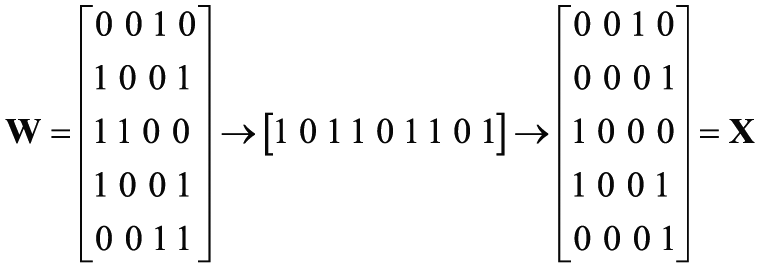
Example of chromosome structure and its matching.
The initial value of every bit in chromosome is measured by quantum rotating gates. The qubits in chromosome are expressed as

where
Step 1. Based on the initial chromosomes
Step 2. Inspect the initial distribution matrix
Step 3. If there are no interference among SUs who competed for the same frequency band, SUs who have no mutual interference can gain the band. If there are mutual interference among SUs is 1, we should according their bids to select the SU who has maximum price, and the allocation value remains 1, other set 0.
Step 4. Then, check whether a band is not occupied in the distribution matrix; if exist, choose the band which has the highest valuation among SUs who have no occupied band.
Then, we use MQGA to optimize the result of Step 4. We directly use the objective function as the fitness function. MQGA uses quantum rotate gate to realize population evolution; once the quantum rotate gate and the population are updated, the update operation of the quantum rotate gate is expressed as

where
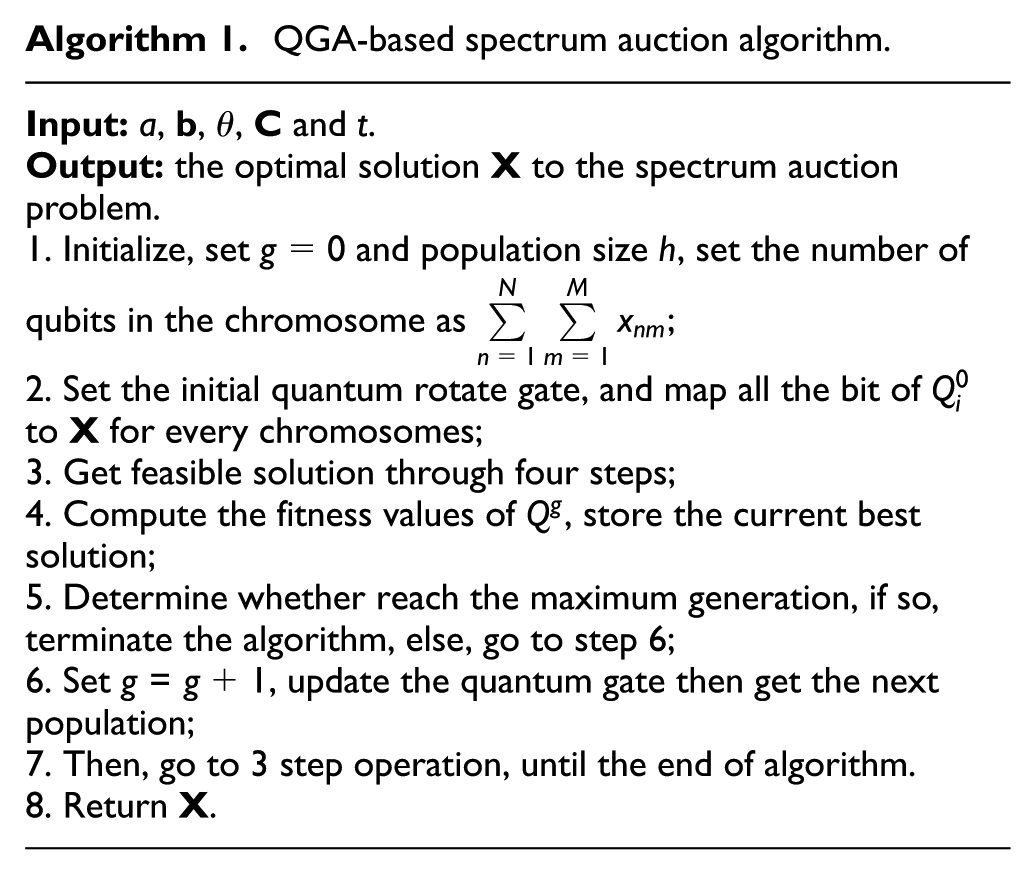
The result of spectrum auction is a suboptimal solution. In order to check up the accuracy of the algorithm, we get the optimal solution by applying the exhaustive search method. Moreover, we compare with greedy algorithm to verify the performance of our algorithm.
Computational complexity analysis
We compare the computational complexity of our algorithm with exhaustive search and greedy algorithm. The optimization problem is a classic NP-hard. There is no exact algorithm to solve this kind of problem. Exhaustive search needs to traverse whole solution space and then get the optimal solution. It can be easily proved that the computational complexity of exhaustive search is
For the proposed algorithm, which aims to get the optimal solution in each iteration, the population size is set to
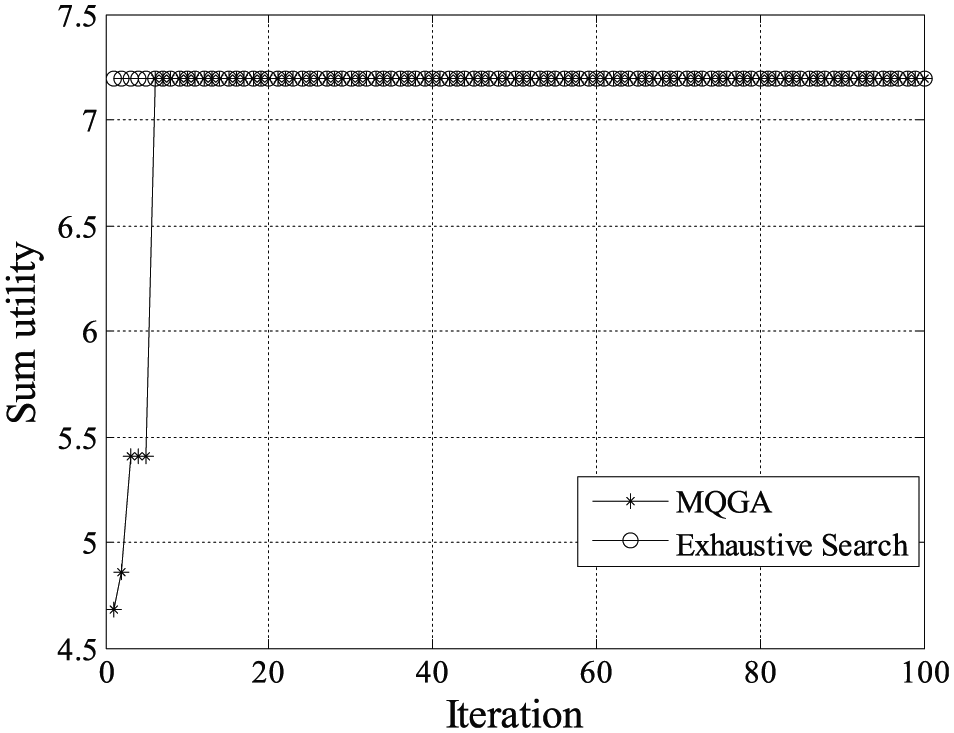
Sum utility comparison between MQGA and exhaustive search.
Payment rules
After getting the solution, the third-party computes the price each buyer should pay according to plan of resource allocation. 20 we define it as follows

where
Truthfulness
The payment rule satisfies the truthfulness property, and its bid is equal to its private valuation, a weakly dominant strategy.
Proof
Similarly, we let
The utility of the bid submitted by bidder

In the other, when bidding a false valuation

where

Since

As the unreal bid
Individual rationality
The utility gained for each winner seller is not negative value.
Proof
According to the above, as we have proved that our scheme is truthful,
Simulation results
The main purpose of our simulation is to show the advantage of social network feature to resource allocation and compare the performance of our proposed algorithm to exhaustive search method. We use MATLAB to verify the proposed algorithm.
For simplicity, we consider a BS standing in the center of a cell. We assume that FAPs are randomly distributed in the range of [500, 500]. The coverage range of each FAP is fixed as 15 m, and SUs are distributed under the scope of femtocell. Besides, the interference distance threshold is set to
Our work is dedicated to maximum system utility, which is the total valuation of winning buyers in the auction. As shown in Figure 3, the suboptimal solution is almost as good as the optimal solution in terms of sum utility. With the update of the population, we can find the sum utility gradually increases, ultimately achieves the optimal value. Our designed mechanism can reach convergence only after six iterations. Considering the high computational complexity of exhaustive search when a large number of users participate in the spectrum auction, our developed algorithm is more applicable.
Next, we examine the impact of social reciprocity factor on the utility of the femtocell network. As shown in Figure 4, we consider the influence of social reciprocity among SUs. We can get a higher sum utility than that without social reciprocity. Besides, through comparison, when considering the social reciprocity factor, the spectral efficiency has been improved after an SU obtains a frequency band. Also, it can improve the satisfaction of users under the coverage of the femtocell. This also motivates SUs to have higher valuation for the frequency bands.
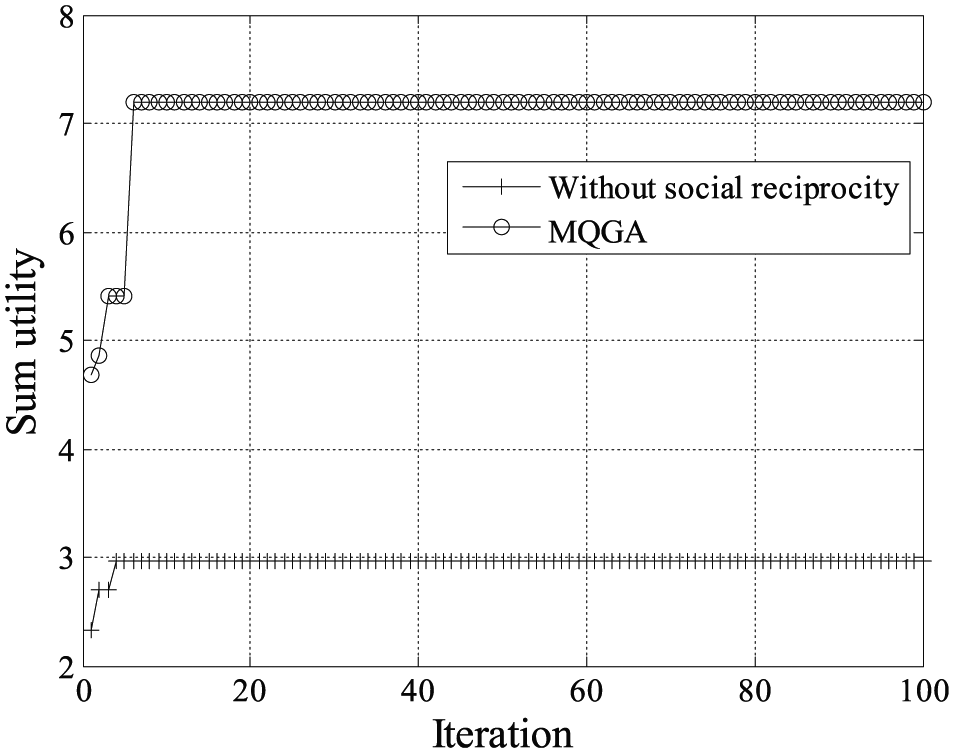
Sum utility comparison with and without social reciprocity.
In Figure 5, the number of frequency bands provided by PUs is changed from 1 to 10 in order to compare the utility obtained by two different cases. From Figure 3, we clearly know that our proposed algorithm can approach the optimal solution. From Figure 5, we can see that all of them possess a rising trend. Obviously, our proposed spectrum auction mechanism can significantly improve the femtocell network utility than the one without considering the effect of social reciprocity.

Comparison of the utility versus number of frequency bands.
Figure 6 shows the variation trend of the sum utility when the number of frequency bands increases. We can see that the sum utility increases with the number of frequency bands for both greedy algorithm and MQGA. Furthermore, our proposed algorithm has a better performance than the greedy algorithm.

Sum utility comparison versus number of frequency bands.
Conclusion
In this article, we combined the social reciprocity to formulate a spectrum auction mechanism. The SUs in femtocells can obtain the available unused bands from multiple licensed users. An auction incentive framework was proposed, and an optimization problem was formulated which was NP-hard. Then, we proposed an MQGA to solve the optimization problem for spectrum allocation. Besides, a payment rule was proposed to guarantee the truthfulness and individual rationality properties. Simulation results showed that our proposed scheme could achieve the optimal solution to the optimization problem.
Footnotes
Declaration of conflicting interests
The author(s) declared no potential conflicts of interest with respect to the research, authorship, and/or publication of this article.
Funding
The author(s) disclosed receipt of the following financial support for the research, authorship, and/or publication of this article: This research was supported by the National Natural Science Foundation of China (61471135 and 61671165), the Guangxi Natural Science Foundation (2015GXNSFBB 139007 and 2016GXNSFGA380009), the Fund of Key Laboratory of Cognitive Radio and Information Processing (Guilin University of Electronic Technology), Ministry of Education, China and the Guangxi Key Laboratory of Wireless Wideband Communication and Signal Processing (CRKL150104 and CRKL160105), and the Innovation Project of GUET Graduate Education (2016YJCX87, 2017YJCX39).