




Abstract
Secure and anonymous routing is required in many underwater acoustic network applications such as marine military. However, the characteristics of underwater acoustic networks cause existing secure scheme designed for traditional terrestrial networks to be inapplicable. This article presents a secure routing design for underwater acoustic networks. First, considering the difficulty of setting a trusted third party in underwater acoustic networks, a short signature algorithm without any online trusted third party is proposed and is used in the procedure of route setup for authentication between source and destination node pair. Analysis shows that the proposed signature scheme can resist forgery attacks effectively and improve communication security and signature efficiency. Second, a trap-door scheme in routing messages based on bilinear map is presented, which achieves anonymity of communication nodes to forwarding nodes. Finally, the anonymity of intermediate nodes in the routing path is also realized by encoding their session ID. Simulation results show the secure routing scheme has moderate network performance under the premise of secure communication.
Introduction
Recently, research on underwater acoustic networks (UANs) has attracted significant attention due to its potential application in environmental monitoring, resource investigation, disaster prevention, and so on.1–4 UANs usually include underwater nodes, surface repeater, ship-based receiving stations, satellites, and ground stations. Underwater acoustic nodes are randomly deployed in the monitoring area. In order to monitor in an all-round way, underwater nodes usually float at different depths. The nodes can move with water currents or other underwater activities and form a network through self-organization. The information collected is forwarded by neighbor nodes hop-by-hop, then arrives at the water surface repeater after several transmissions, and finally reaches the ground base station via satellite or the Internet. The communication model of UANs is shown in Figure 1.

Communication model of UANs.
UANs adopt acoustic communication, and acoustic channel is characterized by high bit error, long propagation delay, and narrow bandwidth. Compared with conventional modems, acoustic modems are more energy consuming. However, nodes are battery-powered and it is difficult to recharge and replace the batteries in harsh underwater environments. Furthermore, underwater nodes are usually deployed more sparsely, most nodes can move passively with water currents or other underwater activities, and some nodes will fail due to energy depletion or hardware fault, so the network topology of UANs usually changes dynamically. All those characteristics result in terrestrial-based communication protocols and are either inapplicable or inefficient for UANs, and UANs call for a new communication protocol.
The application of UANs in some areas such as business and military is usually sensitive, and outsiders are not allowed to access sensitive information. However, the nature of opening and sharing of underwater acoustic channel makes UAN communications vulnerable to eavesdropping and interfering, so secure anonymous communication has a broad application prospect. However, there are few papers on security communication scheme for UANs so far.5–8 The highly dynamic nature and the lack of centralized management and control bring about great challenges to the design of secure routing protocols.
In this article, a new digital short signature scheme without any real-time trusted third party is proposed. Based on the signature scheme, we realize two-way authentication between source and destination node pair as well as resolve the problem of key escrow in UANs. Furthermore, we present a trap-door scheme for route messages, which achieves anonymity of communication nodes to the intermediate nodes in routing path. Finally, the anonymity of intermediate nodes in the routing path is realized based on the idea of multi-protocol label switching (MPLS).
The main contributions of this article are summarized as follows:
Traditional secure routing requires a trusted public key generate (PKG), which has the pair of public and secret keys of each node, and each node has to trust the PKG unconditionally, which is impractical for UANs where attack and hostile nodes are present, and the PKG can forge routing messages. In this article, we provide an algorithm of signature and verification without trusted PKGs.
In traditional secure routing, source nodes need to request the public key of destination node to an online PKG, which significantly increases communication delay and is also impractical for UANs. In our design, the PKG publishes its system parameters and generates session IDs (SIDs) for other nodes offline.
In our secure anonymous routing scheme, an attack node cannot obtain the identity information of source node, destination node, or forwarding nodes by analyzing routing messages, so our scheme realizes the anonymity of node identity.
Our routing scheme realizes two-way authentication between the node pair of source and destination and can resist the forgery attacks from other nodes (e.g. the PKG). In addition, our routing scheme realizes location privacy, that is, an attack node cannot obtain the information of location and hop count of other nodes by analyzing the routing messages.
To the best of our knowledge, it is the first work to study secure anonymous routing scheme for UANs.
The remainder of the article is organized as follows. Section “Related work” briefly discusses related work. Section “Design of digital short signature” presents the scheme of digital short signature, and the efficiency of the proposed scheme is analyzed. Section “Design of secure anonymous routing scheme” presents the design of trap door and secure routing in detail. Section “Protocol analysis” analyzes the security and anonymity of the routing scheme. In section “Experiment and conclusion,” we evaluate the performance through simulations and make a conclusion.
Related work
Network security has been well studied in terrestrial networks and improved solutions are continually being developed.9–11 However, the nature of the underwater acoustic channel makes existing terrestrial defenses unable to be directly applied to UANs. In UANs, if some nodes are captured, the security of the entire network will be threatened. Therefore, the node’s security remains essential, and the security of UANs has been an increasing serious problem, but limited work has been conducted on studying security mechanisms in UANs. In this section, we present a few related works in security-related technologies of UANs.
Dong et al. 5 analyzed the security issues of UANs, investigated the goals and challenges of UAN security, and classified the security threats according to their harm to UAN. However, the authors did not propose a specific security algorithm design. Cong et al. 6 analyzed the threats and attacks in UANs. They pointed out that owing to the unique characteristics, UANs are more vulnerable to malicious attacks. They suggested to design layered security structure to resist hybrid attacks. However, they neither presented how to carry out the security structure nor provided any efficient algorithms. Dini and Lo Duca 7 presented a cryptographic suite which can protect end-to-end communication, and a ciphertext stealing (CTS) mode was used to avoid ciphertext size expansion. The cryptographic suite provided algorithms of membership management service, the key management service and the secure dispatching service, which were used to provide vehicle authentication, messages confidentiality. However, the cryptographic suite requires a trusted real-time group management system (GMS), which is a difficult problem in open UANs. Ji et al. 12 analyzed the requirements and security issues of UANs and considered a symmetric scheme of data encryption and decryption which did not involve the realization of anonymity or authentication. Zhang and Zhang 13 introduced a set of neighbor discovery protocols based on the direction-of-arrival (DoA) estimation of acoustic signals, which consist of four schemes: basic Neighbor Discovery Protocol (B-NDP), double-Verification Neighbor Discovery Protocol (DV-NDP), Strict Double-Verification Neighbor Discovery Protocol (SDV-NDP), and Mobility-Aware Neighbor Discovery Protocol (MA-NDP). All of the four schemes are resilient to wormhole attacks without conventional requirements on secure localization and accurate time synchronization. It is the first secure neighbor discovery protocol for UANs. Wang et al. 14 presented a distributed technique to detect wormhole links in UANs without any special hardware. The nodes can reconstruct the local network topology using multi-dimensional scaling (MDS) and locate fake connections, and adapt to the dynamic network topology of UANs.
From above work, it can be seen that security-related research is being actively conducted, but it is still in its nascent stages. The security research of UANs so far mainly focused on the challenge analysis, classification and detection of attack, wormhole thwarting, algorithms of symmetric encryption and secret key generation,15–17 and lightweight encryption scheme. 8 A few among them were designed considering anonymous routing aspects of UANs, and the protection of privacy in existing secure technologies for UANs is far from enough. In UANs, an intermediate node can obtain easily the IDs of the source, destination, and forwarding nodes, which is not applicable for those requiring anonymous communication. Additionally, most existing authentication methods for UANs are based on asymmetric cryptosystem which requires an online public key infrastructure (PKI), which is difficult for UANs. So, anonymous routing and secure communication of UANs have become an urgent problem to be solved. In this article, a digital signature scheme without trusted third party is proposed, which can solve the problem of key escrow. Based on the schemes of short signature and trap door, we design an anonymous secure routing scheme and realize secure communication in UANs.
Design of digital short signature
Considering the difficulty of setting a trusted third party in UANs, in this article, we improve the digital short signature algorithm by Chen et al. 9 and propose a more efficient signature scheme without an online trusted third party. Before presenting the improved sign scheme, three intractable problems assumptions are introduced first.
Assumptions
Let


Here, three intractable problems are assumed, computational Diffie–Hellman (CDH), decisional Diffie–Hellman (DDH), and discrete logarithm problem (DLP), which are shown in Table 1. If there is an algorithm by which the CDH and DDH problems can be solved in polynomial time but the DLP cannot be solved, we call
Intractable problems assumption.

DLP: discrete logarithm problem; CDH: computational Diffie–Hellman; GDH: gap Diffie–Hellman.
Scheme design
The nodes in the scheme are classified into three types: signature nodes, authentication nodes, and an untrusty third party. The implementation of the scheme is divided into four phases: system initialization, user key extraction, signature, and verification, which are as follows.
System initialization
The first phase is system initialization. An untrusty third party (as a PKG) constructs a cyclic additive group


The PKG randomly selects
User key extraction
The second phase is key extraction. Here, the ID of a node is used as the public key of the node. The signature node randomly selects a number

Signature
The third phase is signature. Given the message M, the signature node computes u and v, as in equations (6) and (7), respectively, then sends


Verification
The fourth phase is signature verification. After receiving the signature information


If equation (9) is true, the receiving node successfully verifies the signature; otherwise, the signature is considered to be forged.
Validity of the signature scheme
Lemma 1
The signature scheme is verifiable.
Proof
From equations (5), (7), and formula

So, the following three points are confirmed:
The
The partial private key t of the signature node is registered with PKG.
The signature node has proved that it does know the partial private key without exposing t.
Efficiency analysis
The efficiency contrast between the signature scheme and the scheme in Chen et al. 9 is shown in Table 2.
Contrast of sign efficiency.

The operation symbols used in Table 2 are explained in Table 3.
Operation symbols in Table 2.
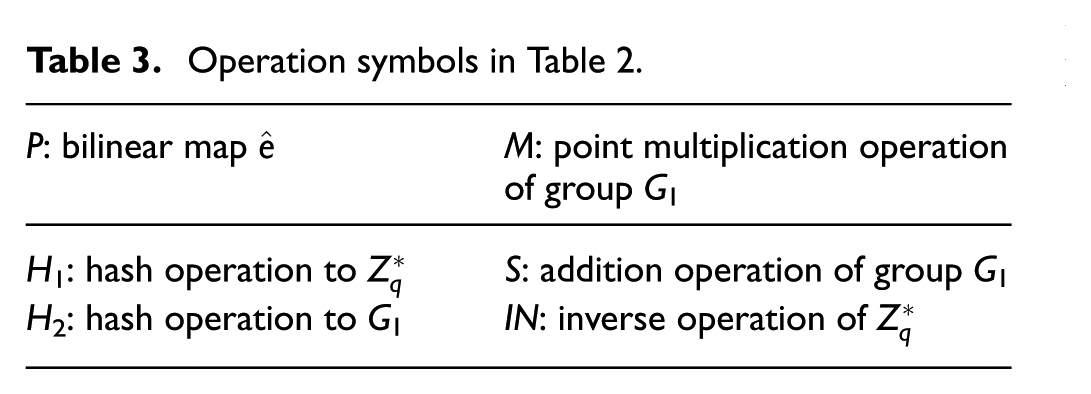
Two signature algorithms are implemented based on C++ on a PC (Windows 10, Intel Core™ CPU 2.20 GHz, 4 GB memory), and the contrast of operation time of two schemes are shown in Table 4.
Contrast of operation time(s).

From Tables 3 and 4, it can be seen that, compared with Chen et al., 9 our algorithm reduces computational complexity and is more efficient whether in signature or verification process, so applicable for resource-constrained UANs.
Design of secure anonymous routing scheme
Strong anonymity and two-way authentication are the main objectives of secure anonymous routing scheme. Two-way authentication of communication parties is realized by aforementioned short signature algorithm. The identity anonymity of communication nodes to intermediate nodes in the routing path is implemented through a trap-door design, and the identity anonymity of intermediate nodes is realized by encoding their SID. Moreover, in a routing request (RREQ; response) message, a random number is introduced in the fields of hops, which is used by the source (destination) node to protect its location privacy. The secure anonymous routing scheme is shown in Figure 2.
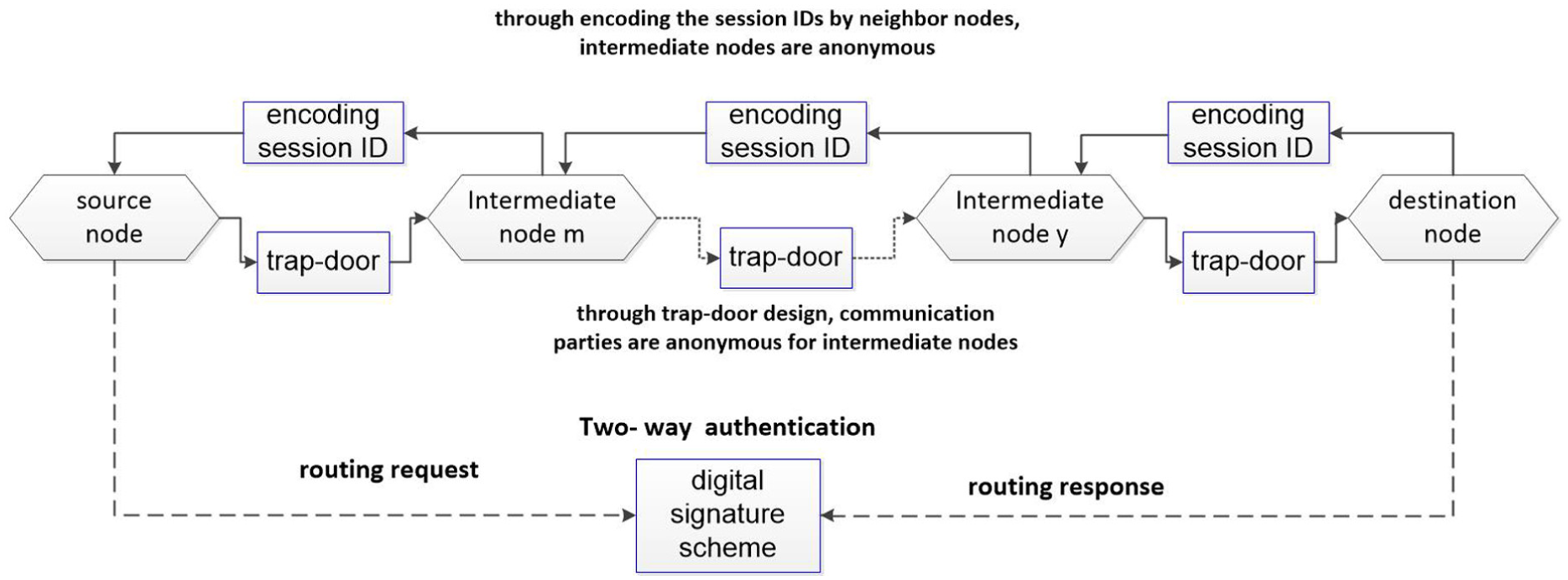
Design of secure routing scheme.
Trap-door design and anonymity realization of communication nodes
In our secure routing scheme, the anonymity of communication nodes is realized by constructing trap door in routing messages. Trap door is a special token attached in packets, which is constructed using encryption function. Only the designated node can open the trap door, other nodes can neither open the trap door nor know which node can open it. In RREQ or response messages, the IDs of source and destination nodes are replaced by trap door, and only the destination node can open it, so the IDs of the node pair which are communicating are anonymous to other nodes. The anonymity of forwarding nodes is realized through encoding their SIDs.
There are usually two ways to construct trap door. One is based on PKI and asymmetric encryption. A source node uses the public key of the destination node to construct trap door, thus a trusted third party is required, but it is impractical for UANs. In the second way, each pair of source and destination nodes shares a secret key. With the increase in network size, each node has to maintain more and more shared keys, consequently increases memory cost and reduces the scalability of the network.
In this article, we use bilinear pairing to construct the shared key of trap door, and the procedure is detailed as follows:
In the initialization phase of section “Scheme design,” the PKG defines the third hash function
In the phase of user key extraction, the PKG computes
The source (signature) node computes the shared key


In equation (12),
4. The receiving node, whose

Lemma 2
If the
Proof
If the

so the trap door opened by receiving node is
RREQ and identity authentication
The self-organized characteristic makes UANs lack an authoritative certification party to verify the identity of each node, which can be exploited by malicious nodes to steal information or attack network deliberately. In UANs, the information such as the identity, location, network topology, and moving mode are more sensitive. So, two-way authentication of node pair of source and destination is vital in some situations. In this article, identity authentication is based on the short signature scheme presented in section “Design of digital short signature.”
When a source node S has a message to transmit, it searches for the route to the destination node

In the head of RREQ, seq is the sequence number of route discovery, which can be generated by

Before transmitting a RREQ message, the source node S adds a record in its routing cache as follows

in which the last field is used to record the route to the destination node D. After transmitting the RREQ message, the node S starts a timer for the message. If the node S fails to receive a routing response (RREP) message from node D after the timer expires, the node S starts a new round of RREQ.
Anonymous design of intermediate nodes
Besides the anonymity of source and destination nodes, the anonymity of intermediate nodes in the routing path is also realized in our secure source routing protocol. Inspired by the idea of MPLS, each forwarding node in our protocol creates a SID for each session. In order to achieve anonymity of intermediate nodes, the SIDs in
Each node in our protocol needs to maintain three tables. The first is the SID table for neighbor nodes shown as Table 5, the second is the SID table for itself shown as Table 6, and the third is the encoding length table shown as Table 7. To facilitate better understanding, we use the topology shown in Figure 3.
Session ID table for neighbor nodes of node X.

Local session ID table of node X.

Encoding length table of node X.


Routing topology.
In Table 7, the “start” column denotes the start value from which the node encodes the SIDs of upstream neighbors, and the “bits” column denotes the number of bits of encoded SID for neighbor nodes. Different SIDs of local node can use different start values and number of bits for encoding. Using the topology shown in Figure 3, after receiving the RREQ message forwarded by node M for the first time, node X takes out the SID of node M,
RREP and location anonymity
Upon receiving a RREQ message, the node D computes the shared key
Before generating a RREP message, the destination node first generates a session ID,
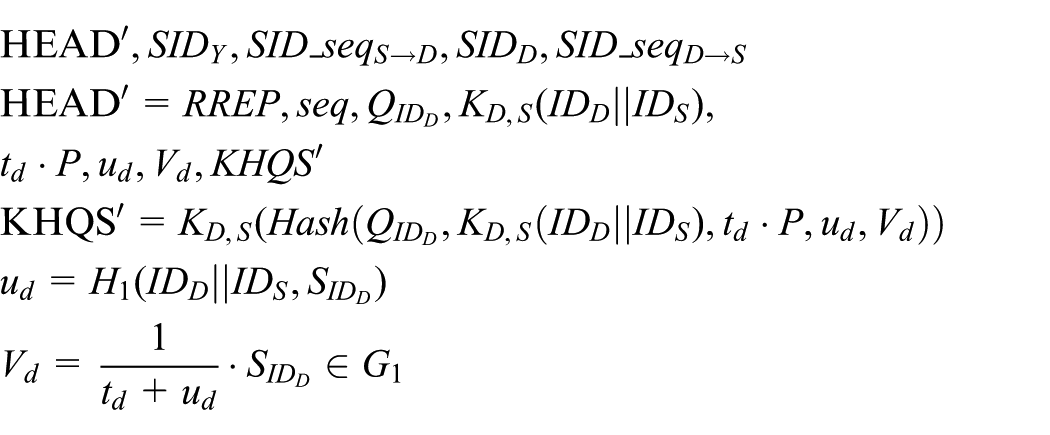
In our protocol, the RREP message is processed according to the flowchart shown in Figure 4. From Figure 4, we can see that node S authenticates the identity of node D by the same way as section “Routing request and identity authentication,” so two-way authentication is realized. Finally, node S records the route to node D in its routing table. The format of routing table is shown in Figure 5.

Processing flowchart of RREP message.

The format of routing table.
Protocol analysis
Security analysis
1. The attacker is difficult to forge the identities of other nodes.
From section “Design of digital short signature,” we can see that
2. If an untrusted PKG forges the signature of other nodes, it can be exposed.
Lemma 3
The PKG can select randomly a number
Proof
The complainant node sends
The arbitrator selects randomly
The node computes
If

The arbitrator computes
3. Multiple attackers are difficult to collude with each other to forge node identity.
Considering the worst case, the PKG is involved in the conspiracy attack, namely, the


Here, we define the k–w CDH problem as follows: given the values of
Now, we can prove k–w CDH problem is equivalent to the k + 1EP problem in polynomial time as follows.
Proof
Given the values of k + 1 items in
As in Mitsunari et al., 18 the k-CAA problem can be proved equivalent to k − 1–w CDH problem in polynomial time. Based on above analysis, intractable k-CAA problem is equivalent to k exponent problem (kEP) problem in polynomial time. So, statistically, there is no algorithm to solve the kEP problem in polynomial time, and the signature scheme is secure under random oracle model.
Anonymity analysis
From the trap-door scheme presented in section “Design of secure anonymous routing scheme,” we can see that the IDs of source and destination nodes are encrypted in either route request or response message. The encryption key is calculated by bilinear mapping, and only the source and destination nodes can reach a common key and open the trap door. Other nodes can neither open the trap door nor be aware of which node can open it, so our protocol can realize the strong anonymity of communication nodes.
In our protocol, the forwarding nodes are identified by their SIDs, and the SIDs are encoded by neighbor nodes. Each node can encode the SIDs of its neighbor with different lengths. The encoded IDs are concatenated into routing sequence
Computation overhead analysis
Overhead for anonymity of forwarding nodes
The anonymity design of forwarding nodes is inspired by the idea of MPLS. The label routing sequences
Overhead for anonymity of communication nodes
The anonymity of communication nodes to intermediate nodes is realized by trap-door design, and the computation overhead is mainly introduced by the following calculation:
The source node

The destination node

We can see that trap-door construction requires two hash operations, one bilinear pairing map, and one symmetric encryption operation, while trap-door opening requires one hash operation, one bilinear pairing map, and one symmetric encryption operation. The overhead for anonymity of communication node is irrelevant to the number of nodes on routing path, which can be applied to large-scale UANs.
Overhead for identity authentication of communication nodes
The identity authentication of communication nodes includes two steps, signature and verification. The signature procedure involves one point multiplication, one hash operation, and one inverse operation. By contrast, verification involves one point multiplication, one hash operation, one addition operation, and two bilinear pairing map operation. Compared with the signature scheme in Chen et al., 9 in which the verification process involved four bilinear pairing operations, the identity authentication of our protocol has low computational complexity and can be applied to resource-constrained UANs.
Experiment and conclusion
Experiment
In this section, we evaluate the performance of our routing scheme by simulation experiments. All simulations are performed using the network simulator (NS2) with an underwater sensor network simulation package AquaSim. We randomly deploy 49, 64, 81, and 100 sensor nodes successively in a three-dimensional (3D) region of 9000 m × 9000 m × 4000 m, and a stationary sink node is randomly deployed on the water surface. The simulation parameters are shown in Table 8. After numerous experiments, we vary the simulation scenario by deploying the nodes evenly in the region. Figure 6 shows the experiment results of route setup time and hop count.
Simulation parameters.

MAC: medium access control.

Route setup time versus hop count.
To the best of our knowledge, our secure anonymous routing scheme is the first source routing protocol for UANs so far, and route setup time is one of the main performance criteria for source routing. From Figure 6, we can observe the average route setup time increases with hop counts, which is understandable. A route can be setup only after the source node sends a RREQ and receives the RREP from the destination node. For RREQ and RREP messages, the more the hop counts, the longer the end-to-end delay. The aforementioned secure anonymous routing protocol has no asymmetric encryption and decryption operations. The signature scheme of our secure routing protocol is based on node identity. The source node does not have to apply for the public key of the destination node to PKG, which avoids additional delay, bandwidth, and energy consumption for finding route to the PKG. So, the proposed routing scheme improves the performance and scalability of UANs and is particularly suitable for UANs characterized by high bit error, long propagation delay, and narrow bandwidth.
Furthermore, we conducted a number of experiments to compare the performance of our scheme with geographic information routing protocol based on partial network coding (GPNC) in Hao et al. 19 and level-based adaptive geo-routing (LB-AGR) in Du et al. 20 in terms of energy consumption, throughput, and packet delivery rate as in Figure 7.

Performance comparison: (a) energy consumption, (b) throughput, and (c) packet delivery rate.
From Figure 7(a), we can see that the total energy consumption of all the three protocols increases with the number of nodes, and the total energy consumption in our protocol is slightly higher than LB-AGR and GPNC, which is reasonable. The more nodes participated in routing and forwarding, the more energy consumed. Since our scheme realizes authentication and anonymity, the implementations of signing, verifying, encrypting, and encoding introduce extra energy consumption. Moreover, our scheme is essentially an on-demand routing, in which RREQ messages need to be flooded across the whole network during the routing discovery process and consume more energy.
From Figure 7(b), we can see that the throughput of all the three protocols increases with the number of nodes, and the throughput of our scheme is slightly lower than LB-AGR, but higher than GPNC. GPNC uses broadcast routing. Broadcast consumes large bandwidth and is congestion-prone in UANs with limited bandwidth. When the nodes in network outnumber a threshold, the broadcast packets from each node bring about the rapid consumption of bandwidth and network congestion problems. So, as shown in Figure 7(b), the throughput of GPNC with broadcast routing is lower than both our scheme and LB-AGR. Figure 7(b) shows that network congestion occurs when the number of nodes is more than 49, and the throughput starts to decrease in networks using GPNC routing protocol. Both our scheme and LB-AGR use unicast routing. However, our scheme is an on-demand routing and the RREQ messages flooded across the whole network consume more bandwidth, so the throughput of our scheme is lesser than LB-AGR.
Figure 7(c) shows that the packet delivery rate increases with the number of nodes in both our scheme and LB-AGR. However, for GPNC, the packet delivery rate increases at first with the number of nodes, then decreases quickly. When the number of nodes is lesser than 49, there is no congestion in network regardless of which scheme, and GPNC achieves the highest packet delivery rate using broadcast routing. When the number of nodes is more than 49, GPNC results in network congestion and the packet delivery rate decreases quickly. Since our scheme is an on-demand routing and the routing path is usually updated timely than LB-AGR using periodic updating, the packet delivery rate of our scheme is always higher than LB-AGR as in Figure 7(c).
Conclusion
Without a trusted third party, the presented digital signature technology solves the key escrow problem of UANs, improves communication efficiency, and avoids the third party PKG from colluding with other nodes for forgery attack. Only in the initializing phase, the source node applies for a partial private key to the third party PKG, avoiding the intractable problem of real-time PKG in UANs. By the designs of digital signature and bilinear map trap door, the routing scheme achieves strong anonymity and two-way authentication of source and destination nodes, avoids identity deception between the source and destination nodes, and provides security for UANs communication. Moreover, the trap-door design in our protocol avoids overheads of maintaining a large number of pre-shared keys, and opening trap door only includes one hash operation and one bilinear mapping operation, which is feasible in UANs.
Footnotes
Academic Editor: Jaime Lloret
Declaration of conflicting interests
The author(s) declared no potential conflicts of interest with respect to the research, authorship, and/or publication of this article.
Funding
The author(s) disclosed receipt of the following financial support for the research, authorship, and/or publication of this article: This work was supported by the National Natural Science Foundation Projects of China (61162003), Qinghai Office of Science and Technology (2015-ZJ-904, 2015-ZJ-718 and 2017-Z-Y21), and Hebei Engineering Technology Research Center for IOT Data Acquisition & Processing.