




Abstract
In wireless sensor networks, sensor nodes are deployed to collect data and deliver the sensed information to a base station in a wireless manner. Due to the broadcast nature of wireless sensor communications, relay-sensor-based secure transmission remains a challenging issue. This article proposes a joint cooperative beamforming and jamming scheme in the relay wireless sensor networks, where the switching strategy from cooperative beamforming to cooperative jamming is applied to weaken the signal-to-interference-plus-noise ratio of the eavesdropper when the decoding threshold is not triggered. In particular, based on Charnes–Cooper transformation and S-procedure, semi-definite programming is constructed to solve the robust cooperative beamforming and jamming with a low implementation complexity, respectively. Additionally, we adopt the global power constraints in semi-definite programming to take full exploitation of the power at relay sensor. Finally, simulation results demonstrate the superiority of the proposed scheme in comparison with the traditional decode-and-forward robust scheme and the non-robust scheme.
Keywords
Introduction
Wireless sensor networks (WSNs) have been envisioned as one of the most important research areas due to its tremendous potentials in civilian and defense-related applications such as vehicular tracking, military surveillance, environmental monitoring, biomedical observation, and other fields.1,2 Generally speaking, typical WSNs are composed of low-cost and low-power homogenous or heterogeneous sensor nodes, which capacitate sensing, simple computations, and short-range wireless communications. In many WSN applications, the lifetime of the network is limited due to the constraints in energy resources and accessibility of the actual sensor nodes. 3 As such, some two-tiered relay network architectures have been investigated to extend the lifetime of WSNs.4,5
Due to the possible failure of some sensor nodes, the WSNs may be divided into several isolated blocks. To this end, an alternative solution is to settle relay sensor nodes to reconnect such blocks.6–9 Generally, the assistance of relay sensors is powerful (e.g. have more energy supply and a larger transmission coverage than regular sensors). However, it still suffers from the high possibility of information leakage due to the broadcast nature of the wireless propagation environment. Therefore, the physical layer security (PLS) for relay-aided WSNs has attracted much attention since it can prevent eavesdropping without upper layer data encryption. In WSNs, two efficient techniques were proposed to improve the secrecy rate, that is, beamforming and cooperative jamming. Due to the ability of improving the intended signal power while reducing the interference, beamforming has been widely applied in wireless communication. 10 As for secure transmission, the information leakage to the eavesdropper is significantly reduced via beamforming technology.11,12 Meanwhile, cooperative jamming can reduce the signal-to-interference-plus-noise ratio (SINR) of eavesdropper so that it cannot decode the confidential information, thus improving secrecy performance.13,14 Recently, by incorporating the cooperative beamforming and jamming together, the works15,16 took the advantages of the both approaches to further improve the security.
In most of the above works, transmit powers are carefully designed to ensure transmission security. To be specific, in Yang et al., 11 Lin et al., 16 and Wang et al., 17 the individual power constraint is considered, which is suitable for some specific scenes where the targeted power constraints for different nodes are required. Under the individual power constraint, the complex optimization problem can be simplified by reformulating it into several easier subproblems. 17 However, in most sensor networks, it is impossible to exactly define the individual constraint due to its dynamics and time variability. In this case, the global power constraint condition has been widely adopted in the published technical literature.10,12,13,15,18 From the aspect of optimization, the global constraint also means a larger feasible region and leads to a better feasible solution. However, the couple characteristic of global constraint makes the distributed optimization techniques much more challenging. Furthermore, for the sake of secure transmission in cooperative networks, the relay node plays a critical role for cooperative beamforming, where the decode-and-forward (DF) protocol is usually adopted.10–12,15–18 However, most of the involved literatures usually assume that the cooperative relay can decode the received signal successfully. In fact, if the received SNR at the cooperative beamforming node is lower than the specified threshold and the relay decodes the signal in a poor performance, how can the corresponding node cope with?
In this article, we will answer the above two questions. We consider the WSNs in the presence of one single-antenna eavesdropper, where a single-antenna transmitter communicates with legitimate receiver with the help of a multi-antenna relay sensor (the reason for our assumption is twofold. First, we suppose there exists one single-antenna eavesdropper because the malicious users are in the minority in reality. 5 And we focus on multi-antenna relay since it could not only reduce the energy consumption but also further enforces the secrecy rate, which is supported by our experimental results in section “Simulations and discussions,” that is, deploying more antennas in relay sensor can achieve more secrecy rate gain). In addition, we consider a practical scenario, where only imperfect channel state information (CSI) about the eavesdropper is available. Under the global power constraints, we propose a secure switching scheme, where the relay adaptively switches to emit jamming signals or send cooperative beamforming signals to degrade the receiving of eavesdropper. As such, the secrecy performance will be greatly enhanced. To deal with the coupled global power constraints in this article, without the aid of complex alternating optimization techniques, 19 we resort to the “keep it simple and straightforward” (KISS) principle 20 and propose a new low-complexity algorithm, which solves two convex semi-definite programming (SDP, that is, one for cooperative beamforming, while the other for cooperative jamming) separately and achieves a near-optimal solution. Some existed papers have researched global optimization techniques.21–23 Haupt and Werner 21 gave an introduction on the use of genetic algorithms (GAs) to optimizing electromagnetic systems, which is proved to be tenacious in finding optimal results. An overview of differential evolution-based approaches used in electromagnetics is investigated in Rocca et al. 22 P. Rocca et al. presented an overview of evolutionary algorithm as applied to the solution of inverse scattering problems, which is on the use of optimization algorithm for the objective in an unaccessible regions. 23
This article is closely related to our previous work, 16 which separately optimizes the cooperative beamforming and jamming problem via a worst-case robust formulation. However, the differences between our work and Lin et al. 16 are twofold: On one hand, we adopt the Charnes–Cooper transformation 24 to reformulate the traditional non-convex beamforming subproblem to a single SDP, while for Lin et al., 16 the iterative bisection method will result in constructing multiple SDPs and thus needs much more CPU consumption. On the other hand, the distributed optimization technique in Lin et al., 16 cannot be applied to our problem since the global power constraints are coupled and cannot be directly separated. To the best of authors’ knowledge, our proposed worst-case-based robust optimization scheme that incorporates global power constraints into relay switching scheme has not been addressed in the open literatures. Furthermore, the ideology of our proposed method can be generalized to other optimization problem, such as increasing location accuracy in WSN.25,26
Notation: Throughout this article, we use the lowercase (uppercase) boldface symbols to represent vectors (matrices). Inverse, Hermitian transpose, and identity matrix are expressed as
System model
System description
As shown in Figure 1, we consider a multi-antenna relay WSNs. In the network, all nodes are equipped with a single antenna except that the relay are equipped with

Illustration of system model.
Note that in a completely passive relay setting, the perfect information about eavesdropper cannot be obtained at the legitimate nodes. But partial eavesdropper’s CSI (ECSI) is still possible to be obtained through channel estimation and feedback. 27 In this article, we model the uncertainty of ECSI by a bounded region and model the channel uncertainty with the worst-case condition 28 as follows

where
In this article, we assume that the perfect security can be achieved in phase I (broadcasting phase). 17 In practice, it can be insured by sending jammers from some cooperative nodes; 17 the details of this process are beyond of our discussion. In phase II (relay phase), constructing jamming nodes also degrades the channel conditions of eavesdroppers. However, adding jammer nodes means additional static and dynamic power consumptions. In this article, without the assistance of additional nodes but a switching software-based scheme, the relay multiplexing can generally improve the whole secrecy rate while keeping lower power consumption. Simulation results are provided to verify the effectiveness of the proposed method.
Secure switching-based transmission model with joint power control
The legitimate user or eavesdropper can exploit the received signals in both phases. Based on our previous work, 16 the worst-case secrecy rate maximization (WCSRM) problem under the global power constraint is given as

where the probability of beamforming adopted at relay
We first analyze the priority of beamforming and jamming. Since the relay probability

And the other is jamming subproblem with the residual power constraint

The above strategy is usually divided into two cases (in fact, the idea of switching is a greedy strategy through the following heuristic: “After computing the successful decoding probability, the power tends to be allocated to the bigger gain of secrecy rate between cooperative beamforming and cooperative jamming.” This heuristic need not find a best solution, but simply divides the complicated primal problem into two easier subproblems, while directly finding an optimal solution typically requires unreasonably CPU consumption). One is that the power
DF beamforming with preferred power supply
In the imperfect CSI case, subproblem (3) involves inner minimization over estimation errors and is distinctly a non-convex problem. By introducing a new variable
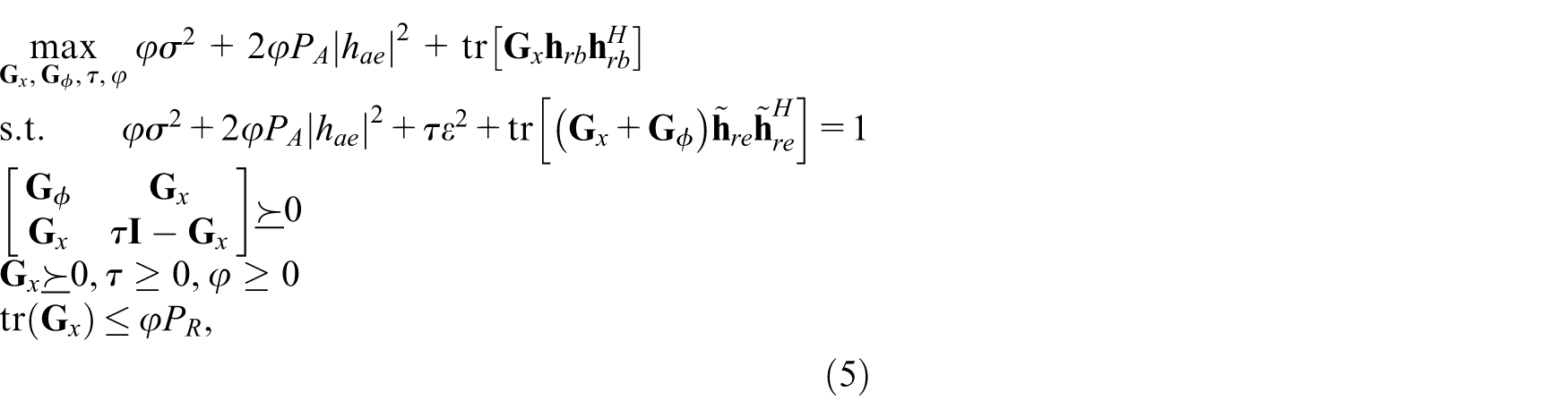
where
Interestingly, the optimal

To solve the above model, its dual form is given as follows

where the equivalence of equations (6) and (7) is presented in Appendix 2. Then, we have
With the cooperative beamforming matrix
Robust cooperative jamming
In most cases, it is impractical for the relay to obtain perfect ECSI (e.g. passive eavesdroppers). Therefore, we consider the classical deterministic error uncertainty model (DEUM), which finds the optimal cooperative jamming (CJ) beamformer using the zero forcing (ZF) constraints 23

By defining

According to S-procedure,
30
there exists an

Letting

Please note that equation (11) is an SDP problem with a set of linear matrix inequality (LMI) constraints. Therefore, the optimal solution

Similar to equation (6), the above model can be reformulated as the following dual model

Then, we have
With the cooperative jamming matrix
Simulations and discussions
In this section, we carry out computer simulations to verify the superiority of our proposed scheme. Here, we consider the transmit power as
Figure 2 shows the curves of secrecy rate versus transmit SNR with different schemes, including our proposed scheme (denoted as “Proposed method” in the legend), robust secure transmission scheme 16 (denoted as “Method” in Lin et al. 16 ), and the perfect global power-constrained condition (denoted as “Perfect CSI”). To make the comparison fair, the x-axis is the total transmit SNR by the source node and the relay sensor node. From Figure 2, it is observed that our proposed scheme outperforms the robust secure transmission scheme 16 with different relay antennas. In addition, we can see that having more antennas at relay can provide much more secrecy rates for each scheme. Furthermore, we can find that as the transmit SNR increases, the secrecy rate would arrive at a constant. This is because while the power of relay increases, the transmission of second slot would cause more information leakage to eavesdropper.
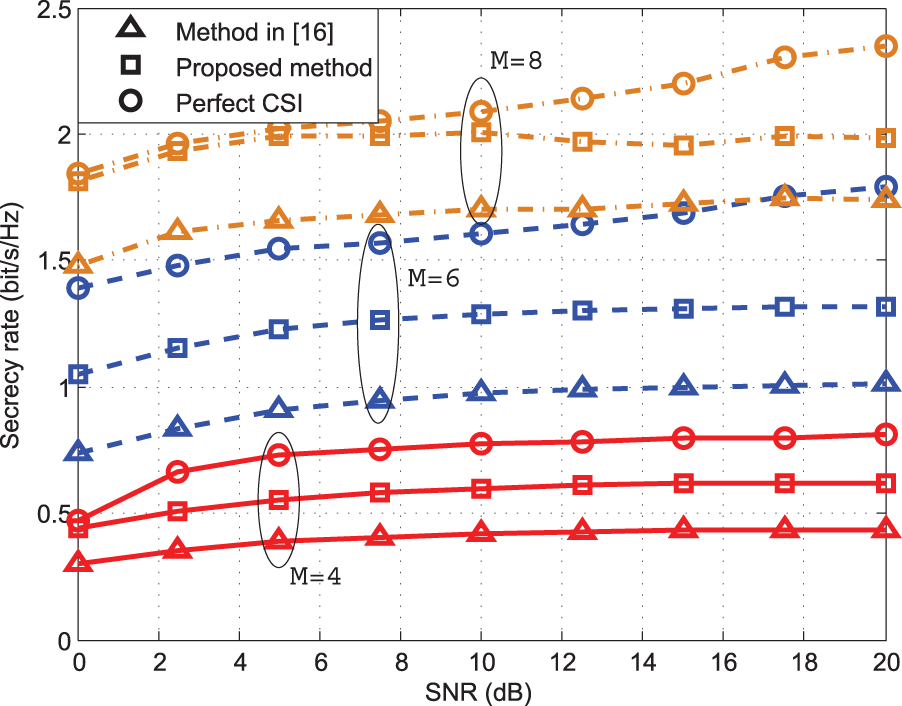
Secrecy rate versus transmit SNR with channel error
To show the impact of the channel error to secrecy performance more clearly, Figure 3 depicts the secrecy rate of different methods versus channel uncertainty

Secrecy rate versus errors
In Figure 4, we illustrate the effect of relay-switching threshold on the secrecy rate. As can be readily observed, the secrecy rate is independent of the switching threshold with antenna number

Secrecy rate versus relay-switching threshold with channel error
Figure 5 shows that the proposed beamforming model (5) achieves a considerable time-saving for computational efficiency compared with the traditional bisection strategy adopted in Lin and colleagues,15,16 which clearly shows the advantages of developing optimal DF beamforming algorithms for the considered networks. From the figure, the computational efficiency of traditional bisection algorithm is 3.8 s while the antenna number is 4, which is eight times by proposed method. When the antenna increases, bisection method remains with worse computational efficiency than our proposed method. This is because that bisection is not suitable for every antenna conditions while considering computation time.

Computational efficiency versus different DF beamforming model with antenna number
Conclusion
In this article, we have proposed the global power-constrained robust secure transmission scheme for multi-antenna-relaying sensor networks, where the cooperative relay explores switching technique between cooperative beamforming and cooperative jamming to jointly degrade eavesdropper channels. Although the global power constraint is coupled, we decompose it into two easier subproblems, and then based on Charnes–Cooper transformation and S-procedure, we adopt SDP to solve the robust cooperative beamforming and jamming with a low implementation complexity. Simulation results demonstrate the superiority of our proposed robust-secure transmission scheme using Charnes–Cooper transformation in comparison with the state-of-the-art robust schemes.
We should mention several works in progress. Here, we have considered a single-antenna eavesdropper in relay sensor network instead of several eavesdroppers with multi-antennas. And it would be more practical to consider multi-antenna eavesdropping scene. Moreover, we will take the feedback delay for all the channels into account in our future work. Due to page limitation, such assumptions are not considered in this article, but would be considered in the future.
Footnotes
Appendix 1
Note that equation (3) can be rewritten as
Applying the S-procedure, 25 the constraints of equation (14) can be expressed as
Using the technique of Schur complement, we have the following inequality which is equivalent to equation (15)
Combing equations (16) and (14), the model (3) becomes
Using the Schur complement again, we have
To further reformulate the above fractional programming into SDP, we make a change of variables as
The above model is exactly the same as equation (5), which completes the proof.
Appendix 2
Applying Lagrangian function to equation (6) yields
where
Then using the technique of Schur complement, we have the following SDP
Note that equation (6) belongs to the trust region methods which assure strong duality with non-convex objection function, 31 thus, the optimization models (6)–(22) are equivalent, and the proof is completed.
Acknowledgements
Z.L. carried out the simulation and participated in the design of the study; B.G. contributed to the conception and design of the study; F.S. wrote and revised the manuscript; Y.H., M.Y., L.L., and M.N. helped perform the analysis with constructive discussions and helped to draft the manuscript. All authors have read and approved the final manuscript.
Academic Editor: Giacomo Oliveri
Declaration of conflicting interests
The author(s) declared no potential conflicts of interest with respect to the research, authorship, and/or publication of this article.
Funding
The author(s) disclosed receipt of the following financial support for the research, authorship, and/or publication of this article: This work was supported in part by the Shandong Province High School Science & Technology Fund Planning Project (J12LN02), Research Fund for the Doctoral Program of Higher Education of China (20123702120016), and Key Projects in the National Science & Technology Pillar Program during the 12th 5-year Plan Period (2011BAD 32B02).