




Abstract
A hybrid method for optimal sensor placement is introduced to position detection sensors on hydro-structures to maximize the monitored structural dynamic information. In the hybrid method, modal assurance criterion matrices and effective independence vectors were applied as the optimization principle for adding and eliminating potential sensor locations in coordinate sets. The energy revision factor was implemented to measure the modal strain energy and ensure the arrangement of sensors at the large energy locations. QR decomposition of the modal matrix was employed to decrease the influence of the initial sensor positions. A computational simulation of an arch dam model, considering 20 sensors and the first six orders of modal vibrations, was used to demonstrate the feasibility of the method. The advantages and disadvantages of existing methods were demonstrated by comparison criteria including the modal assurance criterion, modal kinetic energy criterion, Fisher information matrix, and root-mean square error criterion. The results showed that the method proposed in this article provides linear independent and orthogonal modal vectors, minimizing the relative mean square error of the measured vibration modes, which fundamentally indicates that the identified vibration characteristics of the concrete arch dam are accurate and reasonable.
Keywords
Introduction
A hydro-structure, such as a dam, is a large-scale concrete water retaining structure. A dam is built for comprehensive utilization of hydropower resources in a valley with heights of approximately 100–300 m.1,2 Hidden dangers can be developed in these structures due to a combination of factors including high water pressure, alternating temperature, and seismic and other environmental erosion factors. Therefore, structural health monitoring is critical in these projects to discover and resolve the hidden safety problems.3–5 One of the research focusing in hydro-structural health monitoring is to study how a limited number of sensors can be arranged in the appropriate positions 6 to gain more accurate structural dynamic response information and evaluate damage7–9 under artificial 10 or environmental excitation measurements11–13 such as earthquakes, flow pulsation, and hydroelectric unit vibration.
In recent years, optimization techniques such as the modal assurance criterion (MAC) method, effective independence (EI) method, and modal strain energy (MSE) method have been developed to optimize sensor placement for better identification of the dynamic response of structures. The MAC method14–17 is commonly used to obtain the optimal sensor placement (OSP). This method is based on obtaining a large space angle for the measuring mode vector within the measurement selection process and preserving the characteristics of the original model. The principle of the EI method, proposed by Chang and Pakzad 18 and Kammer, 19 is to select a set of sensor locations from a larger candidate set according to their contribution to the linear independence of the target modal partitions. The final sensor placement maximizes the determinant of the corresponding Fisher information matrix. Other algorithms, including the EI driving-point residue (EFI-DPR) algorithm, 20 energy coefficient-EI (EC-EI) algorithm 21 and orthogonal triangular decomposition (QR decomposition), 22 have been proposed to improve upon the EI algorithm. By weighting the average MSE value at the sensor elements, the MSE method23–25 arranges the monitoring sensors at locations with high strain energy. However, the results of the above-mentioned methods are affected by the finite element model meshing. Without considering the symmetry of the measuring points, information redundancy will occur.
Given the disadvantage that some OSP methods only consider a single aspect in the fitness function, a class of comprehensive methods has been proposed. A hybrid optimization strategy 26 is developed to use the MSE method to conduct the initial sensor placement, while an adaptive genetic algorithm is utilized to determine the optimal number of sensors and their location. The root-mean-square of the off-diagonal elements in the MAC matrix is the fitness function. Another algorithm 27 integrates the advantages of the kinetic energy method, EI method, MAC, and many other optimal methods. This method is proposed to avoid information redundancy and maximize the signal-to-noise ratio. Some stochastic optimization algorithms, such as genetic algorithms, 28 the random elimination (RE) algorithm, and the heuristic random elimination (HRE) 29 algorithm, have been introduced to solve the OSP problem. Generally, these hybrid methods, usually integrated with optimization algorithms, are better for use in large-scale computation of huge hydro-structures because of their improved calculation efficiency and overall searching capability. However, disadvantages such as too many iterations and low search reliability are still present.
The existing single methods are implemented based on assumptions that are ineffective and inefficient for sensor location arrangement. Therefore, a hybrid method is proposed in this article to determine the OSP. In this method, the QR decomposition of a modal matrix was used to decrease the influence of the initial sensor positions, and the MAC matrix and EI vector were applied as the optimization principle for arranging sensor locations. The energy revision factor was utilized to maximize the MSE energy of the sensor placement. Significant research on sensor placement optimization has been performed in recent years. However, most of these studies have been demonstrated on simple structures, such as boards, beams, columns, simple trusses, and bridges. Insufficient research has been performed on dynamic response optimization of large and complex structures, such as high arch dams, which are often located in strong earthquake zones and are under high stress due to the surrounding land. Therefore, another goal of this article is to introduce and extend the sensor placement optimization theory to the monitoring of high dam dynamic response.
Basic theories
Optimal sensor placement for hydro-structures
According to vibration theory, the modal vectors of the theoretical modal matrix should
be independent. Assuming that the value of the model degrees of freedom is
N, the number of vibration modes needed to be identified is

where
The purpose of OSP in hydraulic structure engineering is to obtain the best estimate of
the target modal coordinates

where
MAC matrix
According to the principle of structural dynamics, the natural frequencies and corresponding vibration modes that reflect the structure vibration characteristics are the eigenvalues and corresponding eigenvectors of the structural modal matrix, respectively. They can be formed with a set of orthogonal vectors by the values of the nodes of the natural structure vibration mode. For actual measurements, the number of measuring points is significantly less than the structural degrees of freedom of the numerical model. Additionally, the environmental noise and system measurement precision significantly affect the reliability of the measurements. Therefore, the structural modal vectors obtained commonly lack good orthogonality. Maximizing the obtained structural dynamic features and avoiding the loss of some important modes caused by a small modal vector space angle, the maximum space angle of the modal vectors is considered to be the objective function when optimizing sensor placement. Accordingly, the MAC matrix is introduced, and OSP is achieved by minimizing the values of the off-diagonal elements of the MAC matrix as follows

where
During the process of OSP based on the MAC matrix, a three-dimensional (3D) finite element model of the hydraulic structure is established, and the required structural modal information is computed by modal analysis with the finite element method (FEM) method; then, the MAC matrix of the initial measuring point group is calculated, and the remaining optional degrees of freedom of the structure are added to the initial point group successively as the MAC matrix is updated. Consequently, the measuring points with the minimum–maximum off-diagonal elements of the MAC matrix are selected and added to the initial point group; then, the iteration is repeated until the optimal dynamic sensor layout is obtained.
Diagonal element of the effective independence vector
To determine the best estimate of the modal coordinates

where
From equation
(4),

The elements of
From the derivation process of the methods detailed previously, if the obtained modal parameter vectors do not satisfy the largest space angle, orthogonality for all modal vectors cannot be ensured. In addition, similar to the MAC matrix method, considering the diagonal elements of only the EI vector may cause low-energy OSP selection and the loss of some important structural vibration information, without considering the inconsistent distribution of the structural energy.
Modification of the energy coefficient
To avoid selecting points with low energy as in the above methods, the energy modification coefficient 26 is introduced to characterize the contribution of each candidate point to the structural MSE of each order.
By assuming the number of selected modal orders to be


where
The matrix

The corresponding candidate points with the minimum diagonal elements of
Step 1. Establishing the finite element model, conducting the modal analysis, and determining the number of modals;
Step 2. Calculating the effective independent distribution matrix by
Step 3. Calculating the contribution of each candidate point to the
structural MSE of each order by
Step 4. Modifying the effective independent distribution matrix
Step 5. Saving the modal parameters of the remaining points in the new modal matrix.
Steps 2–5 should be repeated until the required number of sensors is obtained.
Selection of the initial measuring points
To minimize the influence of the initial sensor layout scheme on sensor placement optimization and ensure the integrity of the obtained modal information, QR decomposition of the modal matrix was introduced to control the initial position of the sensor measuring points. Then, the measuring points with the minimum maximum off-diagonal MAC matrix element values were selected successively from the remaining degrees of freedom until reaching the threshold value and obtaining the OSP.
The measurable modal shape matrix of the established 3D finite element model was assumed
to be

where
New analytical model
The implementation steps of the new hybrid method of sensor placement optimization for hydro-structures are as follows:
Establish a 3D finite element model of the dam structure and obtain a matrix of modal vectors through mode analysis to determine the focusing mode order value.
Use the MSE and EI methods to select all the degrees of freedom of the dam structure to determine the range of candidate sensors in the MAC method (assume n candidate sensors need to be deployed for measurements).
Perform QR decomposition for the modal matrix, acquire the initial sensor deployment,
and calculate the corresponding MAC matrix and its maximum off-diagonal element value
Pick a point arbitrarily from n candidate points (assume the chosen
point is measuring point k) and add it to the initial measurement
points; then, calculate the new MAC matrix of the modal matrix and its maximum
off-diagonal element value
Calculate the value of
Repeat steps 3–5 for each candidate measuring point or sensor and determine a set of
values
Replace the initial sensor group with the new group with the addition of one
measurement point; repeat steps 3–6 until
Visualize the sensor locations, remove the relatively nearby locations to avoid redundant information, and determine the sensor deployment arrangement. The quantitative standard of determining whether two sensors are nearby can be conducted by the following equation

where
The calculation flow chart of the new MSE-EI-MAC hybrid method is shown in Figure 1.
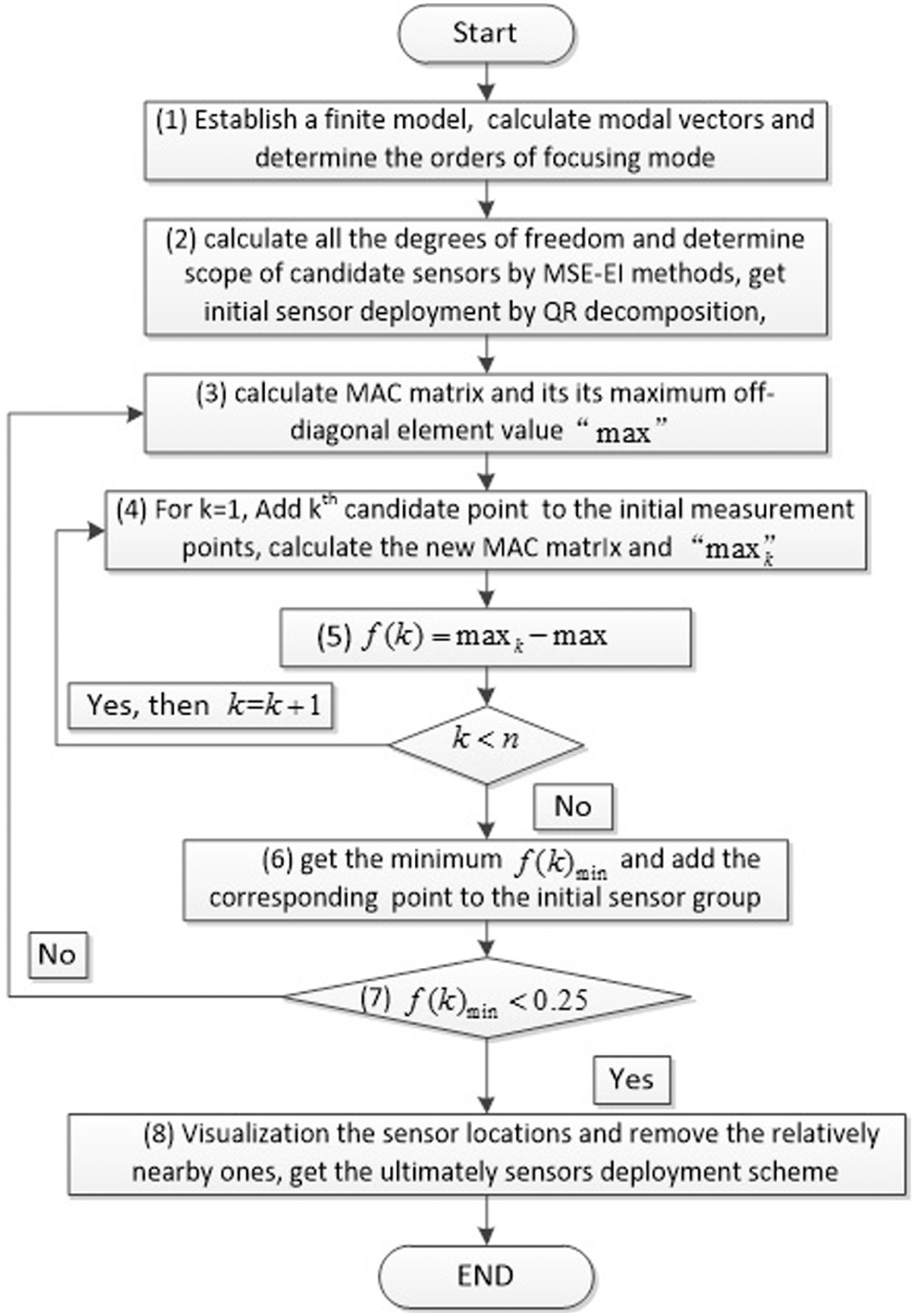
Flow chart of the new hybrid algorithm.
Numerical examples on an arch dam
Model information
A concrete arch dam, with a maximum dam height of 305 m, a crest width of 16 m, and a foundation thickness of 63 m, is used as an example. The dam is divided into 142,254 elements by HyperMesh software. The 3D FEM model of the arch dam is shown in Figure 2(a), and the model parameters of different materials are shown in Table 1.

Mode shapes calculated using the finite element method (FEM): (a) 3D FEM model of an arch dam, (b) stationary state of the dam, (c) first-order modal shape, (d) second-order modal shape, (e) third-order modal shape, (f) fourth-order modal shape, (g) fifth-order modal shape, and (h) sixth-order modal shape.
Material parameters of the concrete arch dam for the FEM model.
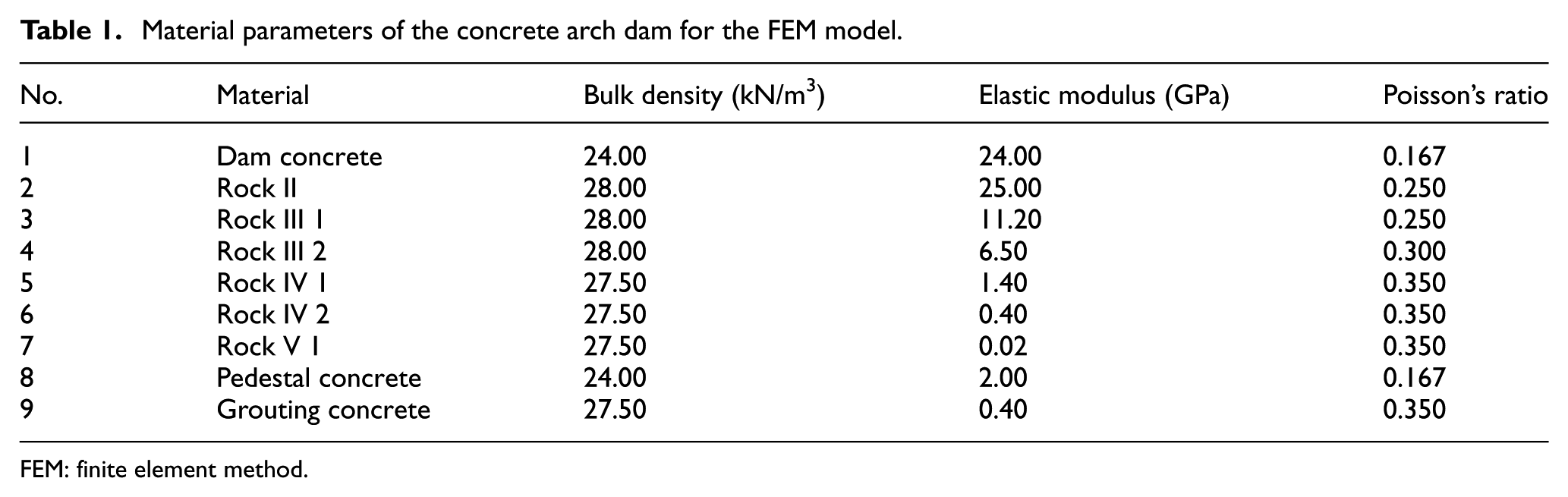
FEM: finite element method.
The natural frequencies of a dam are influenced by the changing of environment loads, such as water level and temperature. Researches show that the impacts from the fluctuation of water level present in two aspects:30,31 on one hand, a rising water level brings an increase in additional force upon dam, which results in reducing of natural frequencies of a structure; on the other hand, the joints and cracks in dam foundation may shut accounting for the increase in water pressure; in this case, the structural overall stiffness and corresponding natural frequencies will increase. Therefore, the changing relation between water level and hydro-structural natural frequencies is the integration of these two effects. For the environmental temperature factor, the natural frequencies will decrease when it increases, and the decrease in lower degree of frequencies is more obvious.32,33 In order to minimize the influences of these factors, the numerical instance of OSP is conducted under the designed normal water level and long-time stable temperature field of the dam.
The structural modal analysis of the dam is performed using the ABAQUS finite element software. The natural frequencies of each order and corresponding structural mode shapes are shown in Figure 2 and Table 2.
Natural frequency.

From the modal calculations, the participation factor of the arch dam in the first six orders of modal shapes is 0.96, and the structural vibrational energy in the downstream direction is greater than that in the cross-river direction and vertical direction. Therefore, the first six orders of modal shapes on the dam face of the downstream side are selected as the target modes for sensor placement optimization. Considering that the measuring point closer to the dam crest will have a larger vibration response and is more conducive to the identification of modal parameters, the degrees of freedom in the upper-half of the downstream dam face (758 total degrees of freedom) are selected as the candidate degrees of freedom for OSP.
Application of the new hybrid method
The new hybrid optimization algorithm is used to calculate the MAC matrices of the first six orders of modal displacement on the 758 candidate points. QR decomposition of the MAC matrices of the 758 measuring points is used to obtain six initial sensor positions and the corresponding MAC values of matrices. The results are shown in Figures 3 and 4. Considering the effectiveness of candidate points, from a total of 758 samples, 100 candidate points are selected based on the MSE-EI method. Then, the 100 candidate points are added sequentially to the initial measuring point group. It should be pointed out that the number of candidate points (namely, 100) is selected after comprehensive consideration of available degrees of freedom (758) and the size of a dynamical monitoring system in concrete arch dam (commonly 10–20 sensors). In the numerical example, an increase in sensor number brings a lower minimum off-diagonal value of MAC matrix. But a set of 100 candidate points is enough to get a satisfying sensor placement scheme.

Six initial sensor locations.

MAC values obtained by QR decomposition.
The iterative computation continues until the maximum off-diagonal element value of the MAC matrix exceeds the set threshold. The calculation of maximum value off-diagonal element value of the MAC matrix can be conducted by the method provided in “MAC matrix.” It is demonstrated that if the value is greater than 0.9, then the modal vectors are relevant and they are not easy to be resolved. However, if it is lower than 0.25, the two modal vectors can be considered as orthogonal to each other. 34 Therefore, the threshold is picked as 0.25 in this numerical instance.
The changing curve of the maximum off-diagonal element of the MAC matrix is shown in Figure 5. The changing curve shows that the value begins to exceed the 0.25 threshold when the number of sensors reaches 20. Therefore, 20 locations are selected as the intermediate layout scheme of the sensors in the arch dam. Figure 6 is the preliminary sensor layout scheme.

Maximum off-diagonal value of the MAC matrix.

Preliminary sensor layout.
In the preliminary layout scheme, since some sensors near the dam crest are close to one another, the measured dynamic responses of these sensors are relatively similar. Therefore, the contribution of these close points to the variation of the MAC matrix maximum off-diagonal element value is calculated separately, and the sensor measurement location with a smaller contribution is removed. Meanwhile, to ensure that there are 20 total sensors, another sensor location from the candidate measuring point set is added to the set. The replaced sensor location should meet the two following requirements: minimizes the maximum off-diagonal element value of the ultimate MAC matrix and is less than the threshold value (0.25). After substituting these locations, the final sensor layout in the high arch dam is determined, as shown in Figure 7. The maximum off-diagonal element value of the MAC matrix is 0.249. The final MAC matrix of the optimal 20 sensors is shown in Figure 8.

Final sensor layout after deployment optimization.

Best MAC matrix after deployment optimization.
Result comparison
To investigate the effectiveness of the new hybrid method, the MAC, EI, and MSE-EI
methods were also used with the same arch dam for result comparison. The final sensor
layouts of the three methods are shown in Figures 9–11, and the corresponding MAC matrix
is shown in Figures 12–14. In the MAC method, the maximum off-diagonal
element of the MAC matrix is 0.279, and the method is feasible for OSP on the concrete
arch dam. In the EI and MSE-EI methods, the minimum diagonal element value of the
idempotent matrix

Sensor placement layout of the MAC optimization method.

Sensor placement layout of the EI optimization method.

Sensor placement layout of the MSE-EI optimization method.

MAC matrix of the MAC method.
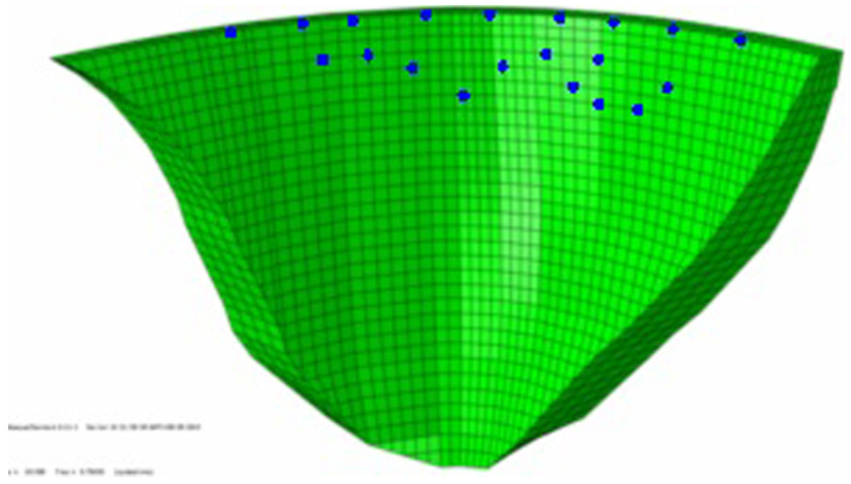
MAC matrix of the EI method.
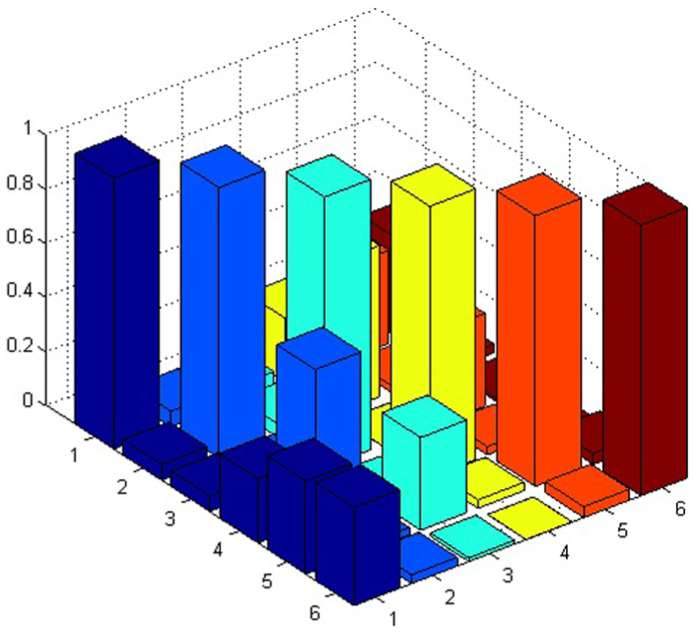
MAC matrix of the MSE-EI method.
To compare the advantages and disadvantages of the layouts above, four types of commonly used evaluation criteria are selected. The evaluation criteria include the MAC, modal kinetic energy criterion, Fisher information matrix, and root-mean-square error criterion. 26
MAC
According to the case studies of OSP by the hybrid, MAC, EI and MSE-EI methods, the maximum off-diagonal MAC matrix element value is 0.249, 0.279, 0.528, and 0.539, and the average off-diagonal MAC matrix element value is 0.060, 0.083, 0.123, and 0.146. The maximum values of the off-diagonal MAC matrix elements and the average diagonal MAC matrix element values for the hybrid method are less than the values obtained using other methods. Moreover, the sensor layout scheme determined by the hybrid and MAC methods would provide better orthogonality of the measured modal vectors.
Modal kinetic energy criterion
The average modal kinetic energy of each order for the four schemes is 5809, 3479, 4059, and 6204. The energy of the sensor optimization using the MSE-EI method is the highest, followed by the hybrid method, and those of the MAC method and EI method are the lowest. Compared with the EI and MAC methods, the former two methods have larger ratios of signal to noise, which provides higher precision in the modal parameters of dynamical response monitoring. In addition, this also avoids ignoring important modal information accounting for sensor placement in the low-energy position.
Fisher information matrix
Since it is difficult to determine the variance of noise in this case, the relative value of the Fisher information matrix is chosen. The Fisher information matrix values, which are generated by the modal matrix of the measuring sensors determined by the hybrid, MAC, EI, and MSE-EI optimization methods, are 25,673, 18,901, 19,420, and 29,678, respectively. This suggests that the hybrid and MSE-EI methods contain more modal information, which is beneficial for modal parameter identification of concrete arch dam structures.
Root-mean-square error criterion
Based on the sensor placement determined by the four methods, the dynamic response values at the dam crest, 275 m in elevation and 245 m in elevation, are calculated by FEM. The response values at other elevations are calculated with cubic spline interpolation. The relative root-mean-square error between the values calculated using FEM and the values obtained using the extended method is shown in Table 3. From Table 3, the relative root-mean-square error of the first six orders of modal vibration for the hybrid method is 3.92%, significantly less than the error of the three other methods; that is, the measured vibration modes of dynamic sensors placed by the hybrid method are closer to the theoretical modes, indicating that the arch dam modal vibration mode can be accurately identified.
Comparison of root-mean-square errors.

MAC: modal assurance criterion; EI: effective independence; MSE: modal strain energy.
In summary, sensor placement based on the hybrid method presents satisfactory results in terms of accuracy of modal expansion, linear independence, and modal vector orthogonality. The relative mean square error of the measured vibration modes and theoretical modes is lowest using the hybrid method. Therefore, the hybrid method used for sensor deployment optimization in the arch dam has more advantages in the identification of dynamical modal parameters than other methods.
Conclusion
This article focuses on the optimal placement of dynamic response monitoring points of a high arch dam. A new hybrid algorithm has been proposed for OSP that guarantees good linear independence, orthogonality, signal-to-noise ratio, and modal information of modal vectors and the minimum relative root-mean-square error between the measured modes and theoretical modes. The hybrid algorithm accurately identifies the structural modal information and ensures modal expansion results that can be used for optimal placement of dynamic response monitoring points of a high arch dam.
In this article, only two aspects of OSP, including the number of sensors and their location, are studied using numerical simulation. However, the types of sensors selected and the arrangement of sensor angles are not considered. The designed normal storage upstream water level, the highest water level in normal operation of a reservoir, is considered in the numerical example of this article. However, the natural frequencies of a dam also depend on environmental variations, such as water level and temperature. Therefore, more effort should be made to solve these problems to decrease the gap between research and practical applications of OSP in hydro-structures.
Footnotes
Academic Editor: Riccardo Colella
Declaration of conflicting interests
The author(s) declared no potential conflicts of interest with respect to the research, authorship, and/or publication of this article.
Funding
The author(s) disclosed receipt of the following financial support for the research, authorship, and/or publication of this article: This work was supported by the research funds from the National Natural Science Foundation of China (grant nos 51139001, 51379068, 51279052, and 51179066), Jiangsu Natural Science Foundation (grant no. BK20140039), Jiangsu Basic Research Program (grant no. BK20160872), project funded by the Priority Academic Program Development of Jiangsu Higher Education Institutions (grant no. YS11001), and Key Laboratory of Earth-Rock Dam Failure Mechanism and Safety Control Techniques, Ministry of Water Resources (grant no. YK914002).