




Abstract
Given the unprecedentedly dense deployment of wireless networks due to the proliferation of inexpensive, widely available wireless devices in the limited spectrum bands, many of these wireless networks should operate at least partially overlapped or even on the same spectrum band. Incompatible communication pattern of different networks with different applications (e.g. Internet of Things, wireless sensor networks and individual wireless communication) would cause serious wireless networks coexistence problem. For the representative, two bands, 2.4 GHz industrial, scientific and medical band and the TV white spaces, effective signalling protocols, as well as radio resource allocation mechanisms could achieve an efficient and fair utilization of spectrum. In this survey, we report and analyse the recent technical advance and development of coexistence protocols. Aiming at tracing the latest developments in this field, we attempt to deliver a comprehensive coverage on existing literatures with a proper technical depth to introduce the design idea and philosophy and analyse the pros and cons of each surveyed coexistence solution. We also discuss a number of important and relevant research challenges that have not been addressed in the existing literatures and that deserve further research attention and investigation.
Keywords
Introduction
The last two decades have witnessed an unprecedented success of wireless networks due to the proliferation of inexpensive, widely available wireless devices, resulting in a significant densification of deployed wireless networks, which have been applied from individual body monitoring to satellites communication.
However, given the limited spectrum resources, many of these wireless networks should operate at least partially overlapped or even on the same spectrum band. Such phenomenon, termed as networks coexistence, is pronounced through a lot of spectrum bands, especially in 2.4 GHz industrial, scientific and medical (ISM) band. 1 As multiple wireless communication network standards (e.g. Bluetooth, ZigBee and WiFi) are operating on this band for different applications (Internet of Things (IoT), wireless sensor networks (WSNs), individual wireless communication etc.), the wireless networks communication in this band has more complexities than other bands.2,3
On the contrary, some authorized spectrum bands are only used in limited geographical areas or periods of time, which lead a lot of spectrum resources wasted. In order to reutilize these vacant spectrum resources, cognitive radio (CR), as a promising technology, has emerged to allow secondary users (SUs) unlicensed networks to access underutilized spectrum bands which is authorized to the primary users (PUs).4,5 So that, CR technology has many benefits on wireless networks’ data transmission under complex environment by improving spectrum utilization, which gives out numerous novel ideas (e.g. CR for IoT, CR in vehicle networks and CR WSN).6–8 Due to the ongoing research of CR networks, new CR network standards are required to propose on TV White Spaces (TVWSs) for experiments. Incompatible communication pattern of heterogeneous CR network standards has also caused spectrum competing, and new CR networks coexistence challenges which are different with traditional coexistence scenario have been appeared.9,10
Therefore, in order to introduce heterogeneous networks coexistence precisely, the wireless networks coexistence mechanisms of 2.4 GHz and TVWSs would be studied as representatives in this article. Due to the heterogeneous natures of the coexisting networks, the coexistence task is particularly challenging. Specifically, the heterogeneity may contain one or more following aspects:
Heterogeneity in wireless technologies at the physical layer: Coexisting networks may employ different wireless technologies, such as IEEE 802.11 (WiFi), 11 IEEE 802.15.1 (Bluetooth) 12 and IEEE 802.15.4 (ZigBee), 13 all of which share the same 2.4 GHz ISM band. Due to their different physical (PHY) layers, each two networks of them cannot decode the packets of each other directly.
Heterogeneity in medium access mechanisms: Coexisting networks may use different medium access mechanisms, for example, WiFi and some ZigBee networks are based on Carrier Sense Multiple Access (CSMA) mechanism, while the other types of ZigBee networks use Time Division Multiple Access (TDMA)-based medium access pattern. They are by nature conflicting with each other.
Heterogeneity in network protocols: Coexisting networks may use different network protocols with different packet formats. As a result, they cannot communicate with each other directly as the packets are not interpretable by others.
Heterogeneity in power level: Coexisting networks may transmit their data packets at different power levels, for example, the maximum transmission power of a WiFi node is 20 dBm compared with that of a ZigBee node which is only 0 dBm. The heterogeneity in power level may cause the hidden terminal problem, which, as analysed later in our survey, may significantly degrade the system performance.
Heterogeneity in applications and Quality of Services (QoS) requirement: The applications running in coexisting networks may be heterogeneous. A ZigBee network which is utilized for WSN usually has low bitrate application traffic with high stability guarantee, while a WiFi network may support real-time multimedia applications. Consequently, the QoS requirement of these networks are by nature heterogeneous.
We now illustrate the above heterogeneity using the examples of the 2.4-GHz ISM band and TVWSs:
2.4 GHz ISM band: The coexistence problem in this spectrum band is mainly between ZigBee and WiFi networks due to their ubiquitous deployments nowadays. The coexistence has a devastated effect on the performance of ZigBee if the traffic of the WiFi network becomes dense. The reason is that the transmission power of ZigBee nodes is order of magnitude lower than that of WiFi nodes, making it difficult for the latter to be informed of the existence of the former. Even in some particular cases where the WiFi nodes are aware of the existence of the ZigBee nodes since they use different wireless technologies and communication protocols, they cannot coordinate between each other to regulate the access to the spectrum.
TVWSs: Due to the development of digital television technology, analogue TV broadcast signals are massively transferred to digital pattern. Then, vacant TV spectrum bands are announced to be experimental bandplan ‘TV White Spaces’ by FCC (Federal Communications Commission) for novel CR networks working. 9 Examples include IEEE 802.22 wireless regional area networks (WRAN), 14 IEEE 802.11af (WiFi over TVWSs) 15 and ECMA 392 (wireless personal area network (WPAN) over TVWSs). 16 The heterogeneity mentioned above is also present in this scenario such as the incompatible medium access control (MAC)/PHY designs of coexisting networks and the heterogeneous QoS requirements.
Formally, we use the term heterogeneous networks coexistence to denote the problem of designing distributed coordination and/or resource allocation mechanisms to achieve harmonious and efficient share of the spectrum resources among the coexisting networks. The coexistence mechanisms should
Enable communication and information exchange among heterogeneous networks;
Ensure efficient and fair resource allocation among networks; in some cases, this means striking a balance between system-level optimality and fairness among each individual network.
To tackle the problem of heterogeneous networks coexistence, we identify the following research challenges:
Designing coordination and signalling mechanisms: Given the heterogeneity in wireless technologies and communication protocols, the coexisting networks cannot exchange coordination information among them. However, without coordination, it would be too hard to achieve harmonious coexistence among them. Hence, one fundamental step is to design effective coordination and signalling protocols that can enable communication and information exchange among heterogeneous coexisting networks.
Solving the hidden terminal problem: The hidden terminal problem in heterogeneous networks is more complex than the original version in CSMA networks. Specifically, we distinguish two scenarios of the problem:
- Asymmetrical scenario: Consider two networks 1 and 2. The transmission power of the nodes in network 2 is higher than that of nodes in network 1, as illustrated by Figure 1(a). Due to such power asymmetry, node 1 in network 2 cannot be aware of the transmissions of the nodes in network 1; thus, data collision cannot be avoided and causing the hidden terminal problem.
- Symmetrical scenario: Again, consider two networks 1 and 2. In the symmetrical case, the transmission power of the nodes in network 1 is the same (or comparable) as that of nodes in network 2, as illustrated by Figure 1(b). Node 1 is transmitter and node 2 is receiver without power emitting in both networks. In this case, the communication of node 2 in network 1 may be interfered since signal emitters in two networks cannot sense each other. Hence, despite the symmetry in transmission power, the hidden terminal problem still exists because the two networks may have different communication protocols and different PHY interfaces, 17 making the classic CSMA/CA (Carrier sense multiple access with collision avoidance) mechanism inapplicable in this scenario.
Designing efficient resource allocation mechanisms: Another important issue is the design of efficient resource allocation mechanisms, meeting the heterogeneous QoS requirements of the coexisting networks. Ideally, the radio resource should be allocated among the networks proportionally to their QoS requirements. How to achieve such an equilibrium in a distributed way is the key design problem here.
Coexisting with PUs: In TVWSs, the impact of PUs should also be taken into consideration when designing coexistence mechanisms and protocols. In this regard, relevant problems include how to identify a primary signal, how to distinguish the primary signal from secondary signals and how to coordinate the access to spectrum holes left by the PUs among the secondary networks.

Illustration of the hidden terminal problem: (a) asymmetrical scenario and (b) symmetrical scenario.
Due to the fundamental importance of the heterogeneous network coexistence problems in the future wireless communication systems and the particular design challenges brought by the heterogeneity analysed previously, we devote this survey to reporting and analysing the recent technical advance and development of coexistence protocols. Aiming at tracing the latest developments in this field, we attempt to deliver a comprehensive coverage on the existing literatures with a proper technical depth to introduce the design idea and philosophy and analyse the pros and cons of each surveyed coexistence solution. We complete the survey by pointing out a number of important and relevant research challenges that have not been addressed in the existing literatures and that deserve further research attention and investigation.
The remaining sections are organized as follows. Section ‘Overview and taxonomy of existing coexistence solutions’ points out the existing main coexistence solutions on 2.4 GHz and TVWSs. And introduces them in different classifications. Section ‘Survey on 2.4 GHz coexistence’ provides the main coexistence scenarios and research progresses in 2.4 GHz. Section ‘Survey on TVWSs coexistence’ provides main coexistence scenarios and research progresses in TVWSs. Section ‘Conclusion and challenges’ concludes the coexistence solutions mentioned in this article with future research directions which have not been addressed.
Overview and taxonomy of existing coexistence solutions
In this section, we present a high-level overview on the existing work on the heterogeneous network coexistence. Specifically, we present a comprehensive taxonomy that classifies the existing coexistence mechanisms using a set of typical criteria, as illustrated in Figure 2. Through the taxonomy presented in this section, we aim at establishing an overall picture on the existing coexistence solutions and the related design ideas and philosophies, which can further stimulate novel solutions in this field.
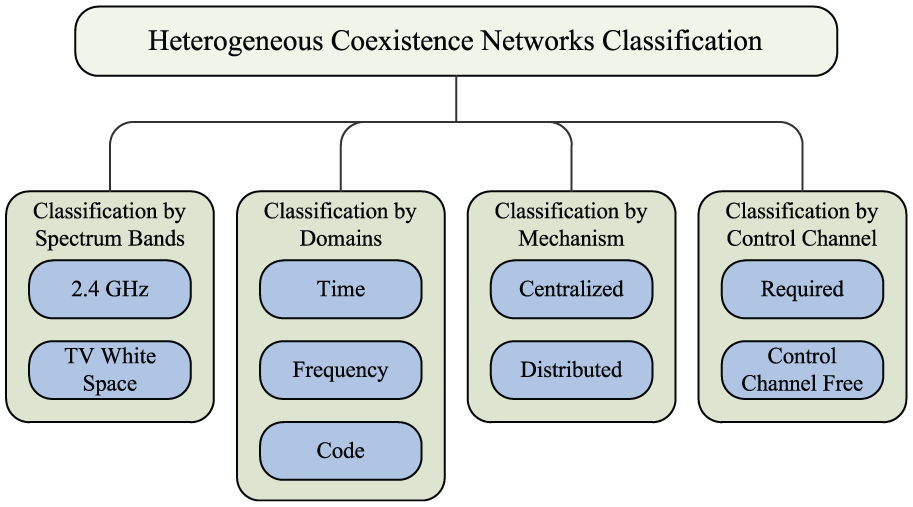
Taxonomy of existing coexistence solutions.
Classification by spectrum bands
Perhaps the most natural classification criterion of networks coexistence is their operating spectrum bands. Using this criterion, the representative solutions could mainly be divided into two spectrum bands, the 2.4 GHz ISM band, mainly from 2400 to 2484.5 MHz, and the TVWSs, mainly on very high frequency/ultra high frequency (VHF/UHF) bands ranging from 54 to 806 MHz in the case of USA. The reasons that these two bands have attracted both academic and industrial research attentions are as follows:
The ISM spectrum bands are radio bands reserved internationally for the use of radio frequency (RF) energy for industrial, scientific and medical purposes other than telecommunications. Due to its license-free nature, many communication equipments are designed to operate on this spectrum band, among which two representative ones are WiFi 11 and ZigBee. 18 Given their ubiquitous presence in daily life and personal applications, designing coexistence mechanisms between them becomes a pressing topic.
The FCC has recently authorized license exemption for operations of CR devices in TV bands left available by the transition from analogue to digital TV systems. 9 Given the overcrowding of the ISM band and a number of desirable signal propagation properties of TV bands, a large number of emerging standards based on CR have targeted them as their operation spectrums.14–16,19 Heterogeneity by nature, these networks are expected to coexist in the same spectrum band, thus calling for efficient coexistence protocols among them.
In what follows, a summary of coexistence solutions in these two spectrum bands would be stated.
Coexistence solutions on 2.4 GHz ISM band
Given the ubiquitousness of WiFi and ZigBee technologies and the heterogeneity between them, most of the existing solutions are focused on the coexistence of either WiFi networks or WiFi and ZigBee networks. Some representative solutions are listed in the following for illustration. A detailed survey is presented in section ‘Survey on 2.4 GHz coexistence’:
WiFi–WiFi coexistence: Since there are only three independent channels which can be used by different WiFi networks simultaneously, when there are more WiFi networks, they are required to coordinate among them to share the spectrum. In this regard, Zhang and Shin 20 study the partial spectrum overlapping between WiFi networks and propose a distributed mechanism called adaptive subcarrier nulling (ASN) to enable coexistence among partially overlapped WiFi networks by sharing overlapped spectrum. And in the work by Han et al., 21 Zhang’s group introduces a coexistence mechanism between IEEE 802.11ac and IEEE 802.11a for settling single interference caused by asymmetric spectrum bandwidths. A new fine-grained spectrum sharing (FSS) mechanism is proposed to minimize networks’ channel bandwidths and reallocate them into appropriate spectrum bands to decrease heterogeneous networks’ spectrum overlapping. An adaptive channel bonding (ACB) protocol is introduced by Huang et al. 22 using alterable bandwidth approach to mitigate inefficiency and unfairness in heterogeneous coexistence scenario. Another research strand, represented by the Flashback mechanism developed in the work by Cidon et al., 23 consists of establishing in-band control channels to exchange control information among coexisting networks on top of data packets.
WiFi–ZigBee coexistence: There exists a significant asymmetry in terms of transmission power between WiFi and ZigBee nodes. Given such asymmetry, a coexistence mechanism, as developed in the work by Zhou et al., 24 is to make WiFi signals distinguishable to ZigBee nodes through detecting periodic beacons of WiFi networks, and in the work by Yan et al., 25 a wide-band antenna is utilized on reprogrammed ZigBee nodes for decoding WiFi signals and rearranging ZigBee networks’ communication channels, while in the work by Hao et al., 26 periodic beacons of WiFi are applied to calibrate ZigBee networks’ synchronization. Another solution, developed by Liang et al., 27 increases the robustness of ZigBee signals to make them survivable under WiFi interference. While in the works by Yubo et al. 28 and Yang et al., 29 multiple-input multiple-output (MIMO) system is employed to alleviate WiFi interference in ZigBee data. The third research direction on this topic is to design coordination mechanisms among WiFi and ZigBee nodes. In this regard, Zhang and Shin30–32 designed two types of solutions: they developed a coordination mechanism called cooperative carrier signalling (CCS) or cooperative busy tone (CBT) that uses asymmetrical bandwidth between WiFi and ZigBee networks and puts a high power level busy signal on adjacent ZigBee channel to inform WiFi devices; in the work by Zhang and Shin, 33 a Gap Sense (GSense) mechanism is devised that puts a high-power preamble before TDMA networks’ (e.g. ZigBee) packets to inform CSMA networks (e.g. WiFi) devices and uses gaps between beacons in preamble to exchange control information; and a Dynamic medium access control (DynMAC) protocol is presented by Correia et al. 34 for the coexistence problem in TDMA tree topology WSNs. By utilizing CR technology, nodes in tree are reconfigurated into different time slots, and appropriate channels are evaluated by DynMAC and allocated to each node in order to avoid CSMA networks interferences.
Coexistence between WiFi and high-power non-WiFi sources: This type is a special one as it focuses on the WiFi networks coexisting with high-power non-WiFi sources which can emit the cross-technology interference (CTI) on 2.4 GHz band. Due to rare attention, there is only one solution presented by Gollakota et al., 35 a MIMO system is applied to WiFi network to enhance the robustness of WiFi signals and mitigate the CTI.
Coexistence solutions in TVWSs
As mentioned previously, many emerging CR networks are designed to operate on TVWSs band with a number of self-coexistence mechanisms depicted in the related standards. Specifically, both IEEE 802.22 and ECMA 392 provide self-coexistence mechanisms:14,16 a two-degree coexistence mechanism is designed in IEEE 802.22 (networks coexistence and cells coexistence) to guarantee that distinct channels are chosen between neighbour base stations (BSs) and no conflicts exist in terminals’ communication; coexistence beacons are employed in ECMA 392 to allow adjacent devices channel sharing. In IEEE 802.16h, 36 two types of coexistence mechanisms, uncoordinated mechanism and coordinated mechanism, are proposed in heterogeneous and homogeneous scenarios, respectively. Besides the solutions in existing standards, a number of novel coexistence mechanisms have been proposed for specific scenarios and applications. Zhao and colleagues37,38 proposed a fair MAC protocol to solve coexistence problem between CR networks and between CR networks and PUs using a three-state model. Bian et al. 17 introduced Spectrum Sharing for Heterogeneous Coexistence (SHARE) mechanism to mitigate hidden terminal problem and Symbiotic Heterogeneous Coexistence Architecture (SHARE) to establish coordination between heterogeneous CR networks.39,40 But a calculating fault in the work by Bian and colleagues39,40 has been found, so Zhang et al. 41 provided a better ecology-based spectrum sharing mechanism.
Classification by domains
However, coexistence mechanisms for the heterogeneous wireless networks are distinctive with each other, but they could also be classified into different domains which their coexistence approaches work in. Then, we would like to introduce some representative solutions under time, frequency and code domains in this part.
Coexistence in time domain
In this class of coexistence solutions, each coexisting network gets a time share of the total radio resource. A coordination protocol is required to negotiate how time is shared among coexisting networks, so that the collision can be avoided. A representative coexistence solution in time domain is the SHARE mechanism developed by Bian et al. 17 SHARE divides communication time slots into different types in order to carry the frames of different networks. An algorithm is developed to allocate time slots among coexisting networks with the objective of achieving fairness among them. And in the work by Amjad et al., 42 heterogeneous CR networks’ data transmission periods are split into equal small time slots and allocated in appropriate channels by game-based algorithm, so that data collisions between CR networks could be minimized and coexistence is realized.
Coexistence in frequency domain
Another coexistence solution is to allow coexisting networks to coexist in the frequency domain. Specifically, they are required to coordinate their operation frequencies in order to switch to non-overlapping channels. A coexistence mechanism in the frequency domain is provided by Zhang and Shin 20 where ASN mechanism is developed to divide a channel into several subbands and to regulate the coexistence on the basis of subbands. While in the work by Sun et al., 43 a novel spectrum sharing mechanism is proposed for coordinating licensed users and CR sensor networks’ spectrum shares and data rate through utilizing Stackelberg game theory in order to improve victim nodes’ overall throughput.
Coexistence in code domain
This type of solutions is based on code domain, and by utilizing specific codes, a side channel could be constructed for transmitting control messages on top of data packets. As an example, Wu et al. 44 proposed to create a side control channel through special interference codes on top of data communication.
Classification by mechanisms
Depending on whether the decision and the coordination mechanisms are performed by a centralized entity or in a distributed fashion, the coexistence solutions can be categorized into centralized and distributed approaches.
Centralized coexistence approach
In centralized approaches, the coexistence decision is performed by a central entity, which is then sent to each coexisting network. An example of centralized approach is that defined in IEEE 802.19.1, 19 where a mediator is designated to make the coexistence decision.
Distributed coexistence approach
In distributed coexistence approaches, on the contrary, the decision is made in a decentralized fashion without relying on a central entity. An example of distributed approaches is Gap Sense, 33 where the coexistence is coordinated distributively via the preambles of data packets.
Classification by control channel requirements
In some coexistence solutions, one or several control channels are required to convey the control and coordination information. In other coexistence approaches, the coordination is achieved without a control channel.
Control channel is essential to MAC protocol and coexistence mechanism. Consequently, the existence of control channel can divide coexistence solutions into two part.
Coexistence approaches requiring a control channel
In many cases, a control channel is essential to the MAC protocol and can significantly facilitate many basic network functionalities such as coexistence. A coexistence control channel is specified in IEEE 802.16h, 36 which is dedicated to the synchronization, spectrum detection and inter-system coordination among secondary cognitive users.
Control channel free
In many practical scenarios, a control channel is impractical or too expensive to maintain. In this case, coexistence is negotiated and coordinated without a control channel. As an example, the BuzzBuzz protocol devised by Liang et al. 27 does not require any form of control channel. Instead, it increases the robustness of the ZigBee packets via repetition and error correction to make ZigBee networks coexist with WiFi networks.
To conclude this section, we would like to emphasis that the above classifications are by no means mutually exclusive on to another. On the contrary, one coexistence solution can belong to multiple categories in the classification or support several operation modes in different categories. In the following two sections, we provide a comprehensive survey on the existing coexistence solutions following the classification based on the operation frequency of the coexisting networks. Specifically, section ‘Survey on 2.4 GHz coexistence’ is dedicated to the coexistence solutions on 2.4 GHz ISM band and section ‘Survey on TVWSs coexistence’ is focused on TVWSs.
Survey on 2.4 GHz coexistence
In this section, a comprehensive survey on 2.4 GHz coexistence solutions is presented. As introduced in the previous section, three main coexistence scenarios, WiFi-WiFi coexistence, WiFi-ZigBee coexistence and the coexistence between WiFi and high-power non-WiFi sources, are particularly pronounced in this spectrum band. In the following, we organize our survey based on these three scenarios.
WiFi–WiFi coexistence
We start with WiFi–WiFi coexistence. Figure 3 illustrates the default spectrum operation setting of most WiFi networks today. Specifically, 14 channels of 22 MHz each are available on the 2.4-GHz ISM band, resulting a total bandwidth of 83.5 MHz. Among the 14 channels, there are only three non-overlapping channels, namely, the channels 1, 6 and 11 according to the IEEE 802.11 standard. Given the high density of the deployment of WiFi hot-spots today, it is inevitable that a WiFi network shares part or all of its operating spectrum band with neighbour WiFi networks. Consequently, designing coexistence mechanisms among WiFi networks becomes an urgent research problem. The problem of WiFi–WiFi coexistence becomes even more pressing as IEEE 802.11ac 45 further envisions to increase the channel bandwidth to 80 and 160 MHz.

WiFi–ZigBee spectrum.
Coexistence via partial spectrum sharing
Current WiFi networks rely on CSMA/CA to coordinate transmissions on the same channel. However, the CSMA/CA cannot coordinate the transmissions of different WiFi networks operating on partially overlapping channels. In response to the problem of coexistence of WiFi networks on partially overlapping spectrum channels, Zhang and Shin 20 developed a solution called adaptive subcarrier nulling.
The main purpose of ASN is to mitigate collisions due to partial overlapping by enabling wireless local area networks (WLANs) sharing overlapped spectrum. To motivate the design of ASN, a comprehensive measurement about partial overlapping interference in IEEE802.11b/g networks is conducted. 20 Particularly, due to orthogonal frequency division multiplexing (OFDM) PHY layer of IEEE802.11g, partial overlapping may cause more destructive damage to data transmission in IEEE802.11g than in IEEE802.11b since full overlapping and partial overlapping may both lead to all packets loss in IEEE802.11g network. Specifically, this damage may cause two types of problem as shown in Figure 4, ’A’, ’B’, ’C’ represent different networks nodes’ transmission channel width, and (a), (b), (c) in Figure 4 are different overlapping scenarios:

Heterogeneous channel width and partial overlapping interference in IEEE 802.11 networks.
The first type, illustrated in Figure 4(a), is called partial channel blocking. As CSMA/CA mechanism is employed by IEEE 802.11, when part of channel is occupied by co-located narrow band WLANs, the entire channel should be suspended.
The second, illustrated in Figure 4(b) and (c), is called channel starvation. In these two scenarios, node A can transmit only if nodes B and C are both idle. It is rare that both B and C complete transmission at the same time and lose contention with A. So, A would remain starvation with large probability.
ASN is proposed to address the above problem. In ASN, a WiFi channel is split into several subbands. As shown in Figure 3, the minimum overlapping spectrum bandwidth between adjacent channels is 5 MHz in 802.11 g, each channel of 20 MHz is thus split into four subbands. When mutual interference is detected, a node can adjust its bandwidth on the basis on subbands so as to share the spectrum with other nodes. In ASN, since the transmission spectrum may change, receivers cannot detect and decode packets as in original IEEE 802.11 networks. Hence, a suite of mechanisms is proposed in ASN in this context, including packet detection, synchronization and decoding. Moreover, adjacent subbands may generate interference even though they are orthogonal. To mitigate interference between subbands, narrow guard bands are introduced in ASN. Specifically, two adjacent subbands should be separated by three subcarriers.
In summary, ASN is easy to implement in existing network devices without any other extra equipment and can increase the overall throughput of heterogeneous networks and decreases collisions among them by facilitating spectrum sharing. However, due to adjacent channel interference, guard bands should be configured at the subband level, which may decrease the overall spectrum efficiency.
Coexistence via control channel
However, an additional in-band control channel mechanism Flashback is proposed by Cidon et al. 23 to coordinate heterogeneous WiFi networks coexistence.
In current WiFi networks communication, ordinary extra control channel construction is unappropriate to apply, since the ISM band is overcrowded, no extra spectrum can be equipped as control channel. For example, a 2-MHz control channel is employed in a WiFi channel, and an extra 1.875-MHz guard band must be added to eliminate the mutual interference between control channel and data plane. Hence, control channel would occupy 25% bandwidth of one channel in a 20-MHz WiFi channel at least, collapse of throughput cannot be avoided. This extra cost is too high for WiFi networks communication. While another solution of this problem, orthogonal frequency division multiple access (OFDMA) protocol, can realize the data and control packets transmitting at the same time on different frequency without extra spectrum requirement. But OFDMA protocol requires tight clock synchronization among all network nodes which is not suitable for WiFi network. And other solutions like RTS (request to send) and CTS (clear to send) packets are also unappropriate for WiFi network due to extra consumption of transmission duration which lead to decrease in throughput too. So, using in-band control channel approach without consumption on throughput is the best idea to solve this problem.
To realize this idea, there are two challenges, link margin and flashes decoding. First is link margin; before its explanation, we should present the concept of flash at first. As shown in Figure 5, flash is a type of simple high-power sinusoid and has same frequency and duration to a OFDM subcarrier since WiFi networks have the OFDM PHY layer. In essential, flash is a kind of noise to normal data. However, link margin is a kind of statistic data to estimate current channel quality. It is the difference between the instantaneous channel signal-to-noise ratio (SNR) and the minimal SNR which must be guaranteed to decode packet. Therefore, link margin is designed to measure the interference from flash to ordinary data transmission. The flash emitting should not surpass the link margin constraint so that flashes and ordinary data both can be decoded correctly in receiver, and in-band control channel can be constructed. Second is flashes decoding, which is easy to be understood. As the literal meaning, flashes are only a simple sinusoid signal which is impossible to bring complex message in a single signal, and this challenge is to design a method to transmit and decode the control messages in flashes.

Flash on top of data transmission.
Consequently, to address these problems and challenges, Flashback technique is proposed. First, flashes transmission is important. By applying subcarriers of OFDM PHY, each flash can be transmitted in one OFDM symbol, which only occupied 1/64 of channel and last for 4 µs in WiFi network. Hence, compared to whole WiFi packet transmission, the transmission of flashes is rare, which would not cause important impact on data transmission in WiFi network. And for one period of data packet transmission, flashes may appear at different subcarrier in different time slot, so these dynamical transmission pattern can be abstracted into a time–frequency coordinate matrix, which is convenient for locating and encoding flashes of Flashback, so that control messages can be encoded in these matrix. Second, for each flash decoding, erasure mechanism is designed. For each packet receiving, flashes and packets are received simultaneously by detecting flashes first, and the error bit which is flashed would be erased since correcting it would cost much more than erasure. Due to the burst feature of flash, the duration of decoding flash is much shorter than data packet transmission, receiver can easily use algorithm to decode whole packet without the erased error bits, so control message and data can be received completely. Third, due to asynchronous WiFi devices, ordinary time–frequency grid cannot be applied to encode and decode control messages directly. Hence, a distance detecting mechanism is employed. It is easy to understand this mechanism, for instance, two flashes can be sent at the same time at subcarriers 2 and 27, so that the distance between them is 25, which can be the code of control messages. Using distances, control messages can be sent on an average 175 Kbps bitrate, meanwhile, an 8-bit cyclic redundancy check (CRC) is also added into control packets for error correction. Finally, the link margin is very easy to be guaranteed using an algorithm to calculate the appropriate transmitting power before each flash transmission can eliminate this problem perfectly.
In general, by detecting control messages, coordination between WiFi nodes can be completed well, the interference can be mitigated without any extra cost and an extra control channel is constructed to transmit information. But this solution only focuses on nodes coexistence in same WiFi network, which is not suitable for heterogeneous IEEE 802.11 standard networks coexistence.
WiFi–ZigBee coexistence
In this subsection, we focus on WiFi–ZigBee coexistence. The coexistence between WiFi and ZigBee networks has attracted significant research attention recently due to the following reasons: first, due to ubiquitous employment of WiFi and ZigBee networks in daily life, coexistence problem between them becomes a pressing problem, and hence, WiFi–ZigBee coexistence solutions have a practical impact; second, WiFi–ZigBee coexistence represents a very typical coexistence between heterogeneous networks, and consequently, research on this particular scenario can be easily extended to a broader coexistence context.
The major design challenges of coexistence protocols between WiFi and ZigBee networks are twofold: the asymmetry in transmission power and channel bandwidth, recaptured as follows:
Asymmetry in transmission power: The transmission power of ZigBee devices is 20 dBm lower than that of WiFi devices. Consequently, ZigBee devices cannot be properly sensed by WiFi devices. In contrast, WiFi signal may severely interfere ZigBee receivers.
Asymmetry in channel bandwidth: Each ZigBee channel occupies 5 MHz, while each WiFi channel occupies 22 MHz, which overlaps four ZigBee channels.
In the following, we present major existing WiFi–ZigBee coexistence mechanisms and how they address the above design challenge.
Exploring WiFi white spaces
Huang et al. 46 propose a coexistence approach termed WISE (WhIte Space-aware framE adaptation) that exploits the white spaces between WiFi frames. The motivation of WISE is that the WiFi traffic is highly bursty and thus leaves significant amount of white spaces between WiFi frames that can be exploited by ZigBee transmission.
To address the coexistence problem using the white spaces, Huang et al. presented an experiment to measure the interference caused by WiFi nodes based on which they identified three types of terminal problem, hidden terminal problem, exposed terminal problem and blind terminal problem, which are shown in Figure 6 and summarized as follows:

Terminal problems in WiFi–ZigBee scenario: (a) hidden terminal, (b) exposed terminal and (c) blind terminal.
Hidden terminal problem: The ZigBee receiver is in the interference range of WiFi nodes but the sender is outside the range.
Exposed terminal problem: The ZigBee sender is in the interference range of WiFi nodes, while the receiver is not.
Blind terminal problem: The ZigBee sender and receiver are both in the interference range of WiFi nodes but WiFi nodes cannot sense them.
Both hidden terminal problem and blind terminal problem can lead to data collision. WISE addresses the blind terminal problem. WISE consists of two main components, white space modelling and frame adaptation:
The first component predicts the white spaces duration. According to experiment, WiFi frames form clusters with inter-frame durations typically less than 1 ms within clusters. ZigBee packet headers being more than 544 μs at least, inter-frame durations within clusters cannot be used by ZigBee nodes. The real white spaces which can be used are intervals between clusters. Given that the WiFi traffic arrival process exists self-similarity, Pareto model is applied to fit the arrival process of WiFi frame clusters and to predict WiFi white spaces duration.
The second component calculates the size of ZigBee frames based on the outcome of the first component. The ZigBee frames are then divided into sub-frames which are suitable for transmission in white spaces without collision. Session IDs and delimiter mechanism are also applied for frame reconstruction and correction.
To summarize, WISE resolves the blind terminal problem with no extra consumption and cost at ZigBee devices. However, this approach needs to suspend ZigBee transmissions when WiFi traffic arrives, which may decrease ZigBee throughput. It is also unsuitable for TDMA packets and delay-sensitive applications where the Pareto model is only an estimation.
Among other solutions that detect WiFi signals and use WiFi white spaces, Zhou et al. 24 developed a system ‘ZiFi’ which utilizes ZigBee radios to detect WiFi signals from noise signals. As WiFi networks broadcast beacon signals periodically, WiFi access points (APs) can be discovered by sensing these signals. But due to the heterogeneity of WiFi and ZigBee networks, ZigBee devices cannot decode WiFi’s signals. To address this problem, the authors developed a digital signal processing (DSP) algorithm Common Multiple Folding (CMF) to amplify unknown periodic signals in received signal strength (RSS) sample using folding technique, first used in pulsar searching on large radio telescope. A constant false alarm rate (CFAR) detector is designed to detect WiFi beacons in the results of CMF. The advantages of ZiFi include high accuracy, low overhead and low delay. However, the mitigation of interference between ZigBee and WiFi is not addressed.
Enhancing robustness of ZigBee packets
Due to power asymmetry between WiFi and ZigBee, ZigBee packets suffer from the interference from WiFi signals. Liang et al. 27 designed a novel approach called BuzzBuzz to enhance the robustness of ZigBee packets such that they can be successfully decoded at the receiver side even under the presence of WiFi signals.
To guide the design of BuzzBuzz, the authors conducted a series of experiments to measure the interference between WiFi and ZigBee on bit level. The experimented scenarios can be divided into two types, which can be analogized to symmetric and asymmetric scenario as shown in Figure 1. The following observation is drawn:
In the symmetric scenario, the bit errors of ZigBee packets due to collision are distributed at the beginning of ZigBee packets since CSMA mechanism can work and WiFi transmissions are suspended shortly after detecting ZigBee transmissions.
In the asymmetric scenario, which fails to sense of ZigBee signals, WiFi transmission cannot stop when ZigBee data are transmitted. Consequently, bit errors are distributed across the whole ZigBee packet.
Based on the above observation, BuzzBuzz contains two components, each addressing a scenario:
In the symmetric scenario, the starting bits of ZigBee packets are corrupted by WiFi signals, thus leading to CRC check failure at the receiver side, despite the remaining bits are received correctly. If there exists some approach that can make ZigBee packets pass CRC check, data transmission can be completed successfully. Motivated by this argument, the Multi-Headers (MH) mechanism is proposed, which puts several headers into the beginning of data part in ZigBee frame such that the remaining headers can pass CRC check when some headers are collided by WiFi signals.
In the asymmetric scenario, due to the even distribution of bit errors across the whole packet, the MH mechanism cannot work any more. The forward error correction (FEC) approach is introduced to recover the ZigBee packets using Reed–Solomon (RS) code, a block-based linear error-correction code widely used in digital communication. The authors developed a full-featured TinyOS-compatible RS library (TinyRS) to decode the ZigBee packets.
In conclusion, the advantages of BuzzBuzz include the low cost, the ease of using and the low consumption. The major disadvantage is the overhead created by the MH and the FEC components in terms of packet size and extra processing overhead.
Enabling WiFi–ZigBee coordination
Another research strand on WiFi–ZigBee coexistence is to devise coordination protocols between them.30–33 The main challenges of the coordination mechanism design are the asymmetry in transmission power, operation bandwidth and PHY layer protocols. Moreover, for ZigBee networks in CSMA mode, the fastest clear channel assessment (CCA) operation takes 128 μs and the rx/tx switching time 192 μs, while the CCA duration of WiFi networks lasts 20 or 9 μs. As a result, WiFi nodes may pre-empt transmission channel when ZigBee switches from receive mode to transmit mode and may cause collision.
To address these design challenges, Zhang and Shin30–32 provided an approach called Cooperative Busy Tone, whose core idea is illustrated in Figure 7:
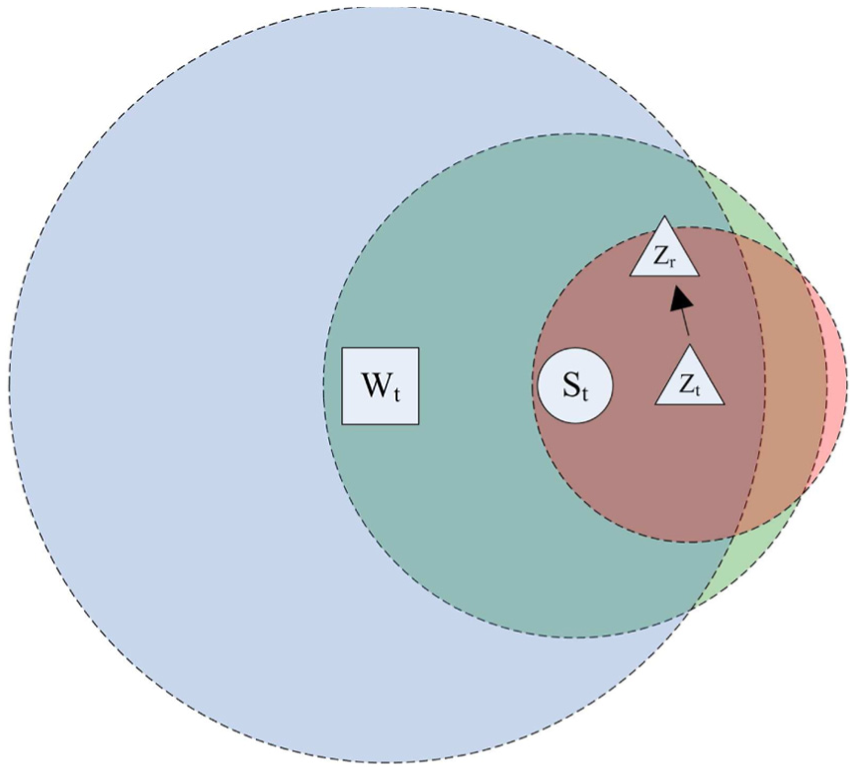
CBT illustration: Zt, Zr, St and Wt are ZigBee transmitter, ZigBee receiver, signaller and WiFi transmitter, respectively.
A ZigBee signaller is deployed to solve the problem of WiFi–ZigBee power asymmetry. The signaller is a separate ZigBee node, which is close to the WiFi network or has more power than ordinary ZigBee nodes. It is designed to emit busy tone to inform WiFi nodes when the ZigBee network has data to transmit. Note that busy tone can be sensed without decoding.
As busy tone can interfere ZigBee network’s communication too if they are working in the same channel, and channel bandwidth asymmetry (one WiFi channel bandwidth covers four ZigBee channels) is utilized to solve the problem. A frequency flipping mechanism is developed such that when ZigBee nodes are transmitting data, the signaller will transmit busy tone on adjacent channel.
To avoid collisions caused by asymmetric CCA duration, two different approaches are further developed for ZigBee CSMA and TDMA modes:
- In CSMA mode, ZigBee devices transmit data after sensing and contention. In CBT mechanism, every data transmission must be initiated by the signaller, who broadcasts a notification message (referred to as CTS) on original channel and then switches to adjacent channel to start emitting busy tone. Meanwhile, ZigBee transmitter contends for channel access normally. Under such mechanism, WiFi nodes can sense busy tone before ZigBee transmission. When ZigBee devices complete communication, an ACK packet is transmitted. When hearing the ACK packet, the signaller stops broadcasting busy tone.
- In TDMA mode, each data transmission is also initiated by the signaller, who performs CCA for at most Km times before transmission. If the Kj th CCA is idle, the signaller hops to adjacent channel to broadcast busy tone until the end of the transmission. Hence, busy tone broadcasting is (Km − Kj)CCA earlier than data transmission. In this case, WiFi nodes can also sense busy tone before data transmission and avoid collision.
To summarize, the CBT mechanism can coordinate coexistence between ZigBee and WiFi networks effectively and avoids collisions. Such advantage comes with the price of deploying an extra ZigBee channel and an extra device (the signaller). Moreover, fairness is another concern when long duration busy tone is broadcast.
Zhang and Shin 33 have also developed another mechanism called Gap Sense to coordinate heterogeneous wireless networks using a preamble construction and detection algorithm. The core idea of GSense is to send a number of energy pulses in the preamble of each packet and encode information using the time gap between two consecutive pulses. Heterogeneous networks then utilize such control channel to exchange control information and coordinate with each other. The disadvantages of GSense are as follows. First, the preambles extend the duration of data packets and decrease the network throughput. Second, the sensing and interference ranges of different networks may be asymmetric, meaning that the pulses need to be amplified to be sensed by other networks, leading to extra energy consumption. Third, for TDMA-based networks, it is expensive or even impractical to monitor channels continuously.
Coexistence between WiFi and high-power non-WiFi sources
Besides WiFi–WiFi and WiFi–ZigBee coexistence analysed previously, CTI from high-power non-WiFi sources has recently become a major problem which may have detrimental effect on WiFi performance due to the deployment of such sources including surveillance cameras, baby monitors, microwave ovens, digital and analogue cordless phones and outdoor microwave links. A traditional solution to CTI is to increase the robustness of the WiFi transmission by reducing its transmission rate. However, this approach cannot work with high-power interference. An alternative approach is to let the interfered WiFi communication hop to non-interfered channels, but this channel hopping–based mechanism is less effective nowadays with more and more devices being deployed in the 2.4-GHz ISM band, making it more and more difficult to find available channels without interference.
In response to the above problem, Gollakota et al. 35 proposed a novel system called TIMO (Technology Independent Multi-Output) using the MIMO capability inherent to 802.11n to mitigate high-power CTI.
Specifically, TIMO uses multiple interfaces in one device to decode a signal of interest, even when the channel from other concurrent transmissions is unknown. The core idea of TIMO is presented as follows via a simple illustrative example. Consider a pair of two-antenna WiFi nodes that want to communicate in the presence of a high-power unknown interferer. Let s(t) be the signal of interest and i(t) the interference signal. The receiver node receives the following signals on its two antennas


where
The main flowchart in a TIMO receiver is shown in Figure 8, which uses equations (1) and (2) to calculate the signal of interest s(t). A TIMO receiver consists of three main components:
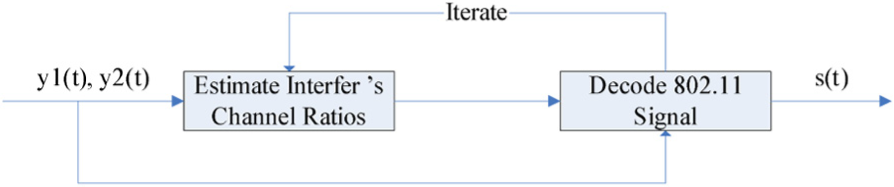
Flowchart of TIMO.
An algorithm for computing the interferer’s channel ratio in an OFDM subcarrier without any prior knowledge. Note that the interferer’s channel ratio is calculated for each OFDM subcarrier.
A decoder that allows the receiver to decode the signal of interest, given the interferer’s channel ratio in every OFDM subcarrier. As the inter-symbol interference (ISI) in some wide-band CTI, which can lead to low accuracy of decoding, an inverse filter approach is also employed in receiver to eliminate the ISI.
An iteration mechanism that reduces the noise in the computation of channel ratios, hence increasing SNR. By iterating computed signal of interest of the last time slot, the signal of interest can be estimated more accurately and can conversely increase the accuracy of interference channel ratio.
In summary, TIMO leverages the MIMO capability inherent to 802.11n to mitigate high-power CTI. The price paid is the loss of performance gain (in terms of throughput) brought by MIMO.
Survey on TVWSs coexistence
In this section, we present a comprehensive survey on heterogeneous networks coexistence in TVWSs, which has become a pressing research problem because many CR networks operate on TVWSs with PUs (typically TV signals). Due to specialities of CR networks (e.g. the presence of PUs), the coexistence problem in TVWSs is more complex in certain aspect than that in 2.4 GHz presented in section ‘Survey on 2.4 GHz coexistence’. This section is structured in the following way. We first present CR network standards in TVWSs developed recently and the coexistence mechanisms in the standards. We then survey the state-of-the-art coexistence solutions proposed by the research community.
Coexistence mechanisms in CR standards
We start with CR network standards coexistence. Emerging CR network standards on this band include IEEE 802.19.1, 19 IEEE 802.22, 14 IEEE 802.11af, 15 ECMA 392, 16 and IEEE 802.16h 36 . These emerging standards have heterogeneous spectrum bandwidth, transmitting power and PHY and MAC layer. In general, the coexistence scenario in these standards is completely asymmetric. Hence, most of them have their own coexistence mechanism. But due to the focuses of standards are different, the coexistence mechanism types and targets are different.
IEEE 802.22
We first review the coexistence of homogeneous networks in the CR standards. There are two standards addressing the homogeneous coexistence issue, IEEE 802.22 and ECMA 392. This subsection is focused on IEEE 802.22.
There are mainly three challenges in devising homogeneous network coexistence mechanisms:
Presence of PUs: A particularity of CR networks is the presence of PUs. How to distinguish a primary signal and a secondary signal and how to react accordingly should be taken into consideration in the design of coexistence mechanisms;
Multi-channel access and allocation: CR networks are by nature multi-channel environments. Coexistence mechanisms should specify how to coordinate cells’ channel selection and/or share the channel;
Inter-network information exchange: Since different networks may operate on different channels, how to exchange coordination information among coexisting wireless networks should be addressed.
To address the above design challenges, a coexistence protocol is developed in IEEE 802.22 called coexistence beacon protocol (CBP). CBP has two types of homogeneous coexistence approaches:
The first approach is spectrum etiquette which manages the coexistence of different IEEE 802.22 networks operating on different channels. Specifically, as illustrated in Figure 9, spectrum etiquette is responsible for channel selection and coordination. The main objective is to ensure that the operation channel and the first backup channel of a BS is different and orthogonal to those of its neighbour BSs and PUs. To realize the objective, a self-coexistence window (SCW) is deployed before each frame to exchange control information.
The second approach is on-demand frame contention, which manages the coexistence of cells operating on the same channel. In this approach, superframe control headers (SCH) are employed to decide each frame allocation in same channel. When hearing SCH, cells can decode the channel allocation information. Only the cell to whom the channel is allocated transmits data on the allocated channel while others stay silent.

Spectrum etiquette.
ECMA 392
ECMA 392 has another homogeneous network coexistence mechanism. In ECMA 392, due to the deployment of beacon period (BP) mechanism in frame construction, frames of various devices in same network can be allocated appropriately. Each BP contains several different signal windows, which is designed for the contention and reservation, so different devices can emit their beacons in BP to compete the frames allocation after BP. Using this mechanism, intra-cell collisions can be eliminated. For inter-cell coexistence, three types of self-coexistence scenario are specified in ECMA 392:
Coexistence of two master–slaver networks;
Coexistence of two peer-to-peer networks;
Coexistence of a master–slaver network and a peer-to-peer network.
To realize coexistence in these three types of coexistence scenario, a lot of coexistence mechanisms are developed which can be summarized as two types:
The first one is BP merging that merges the BPs of different networks based on a set of strategies, so that different networks in different coexistence scenarios can use the same BP to allocate their frames and thus avoid collision.
The second one is changing coexistence scenario, for all cell networks, to keep only one master cell and let the other cells be in the slave mode. By this mechanism, all cells’ frame schedules in different networks can be managed by the master to coordinate the coexistence.
IEEE 802.16h
We now turn to heterogeneous network coexistence, which is by nature more challenging than homogeneous network coexistence. In this subsection, we survey the coexistence mechanism in IEEE 802.16h. IEEE 802.16h specifies two types of coexistence mechanisms, coordinated and uncoordinated mechanisms, targeted to coexistence scenarios with recognized devices and non-recognizable devices, respectively:
Coordinated mechanism: The coordinated mechanism mainly manages coexistence of IEEE 802.16h devices. The first step is to synchronize the devices’ MAC frames and to separate base station from its subscriber station transmission. The second step is to allocate a dedicated channel as a control channel to exchange coexistence information using dynamic channel selection (DCS) and adaptive channel selection (ACS). Finally, by utilizing coexistence frame, coordinated scheduling and fairness algorithm are used to share the channel among different networks.
Uncoordinated mechanism: The uncoordinated mechanism is focused on networks with non-recognizable devices, including PUs and SUs. Specifically, a dynamic frequency selection (DFS) protocol is developed to manage the coexistence with PUs by searching the channels free of PUs and switching SUs to such idle channels. The DCS protocol is used to coordinate coexistence of SUs by finding the best operating channel to be shared with other SUs.
The main advantage of the coexistence mechanism in IEEE 802.16h is its generic nature which is applicable in a wide range of scenarios in TVWSs. The disadvantage is its high complexity which makes it implementable only in high-speed CPUs.
IEEE 802.19.1
IEEE 802.19.1 is a generic coexistence protocol that plays the role of a mediator to coordinate coexistence of heterogeneous CR networks.
The architecture of IEEE 802.19.1 is illustrated in Figure 10. IEEE 802.19.1 has three main components, coexistence manager (CM), coexistence enabler (CE) and coexistence discovery and information sever (CDIS):
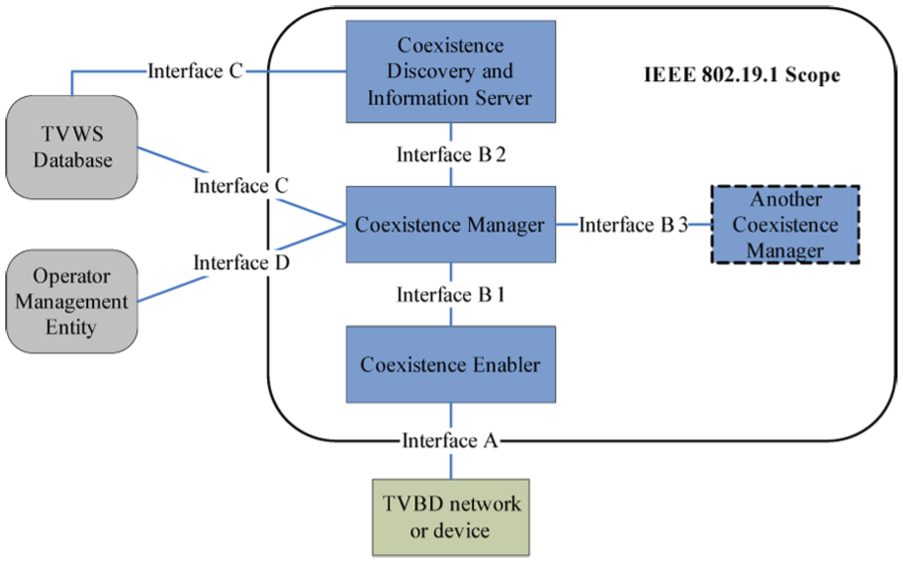
IEEE 802.19.1 system architecture.
CM is the core component in the IEEE 802.19.1 systems because it is responsible for coexistence decision-making and discovers and communicates with other CMs. Coexistence decision-making is the process of exchanging the coexistence information, sending correspondent requests, commands or control messages to other CEs.
CE connects CMs and TV band devices (TVBD) or TV band networks. It has two functionalities. The first one is to provide coexistence information from TVBD network or device to CMs. The second one is to transfer the control messages, commands and requests from CMs to TVBD network or device.
The function of CDIS is to allow CMs to obtain information about other CMs and that related to TVWSs coexistence and PUs collected by CDIS or from TVWSs database, which stores PU-occupied channel list. The Operator Management Entity in Figure 10 maintains the operator-related information and provides support for CMs.
The advantage of IEEE 802.19.1 is its generality that can be used in a wide range of CR scenarios. However, it is still too complex to be implemented in practical devices and may not scale.
Other CR coexistence mechanisms
In this subsection, we survey other novel coexistence solutions proposed by the research community. These solutions are mainly concentrated on the coordination among secondary networks and the coexistence with primary networks, which are surveyed as follows.
As pointed out in section ‘Introduction’, one of the design challenges of heterogeneous network coexistence mechanism is the asymmetry in transmission power, which may cause the hidden terminal problem. The hidden terminal problem is particularly challenging if the nodes involved belong to two heterogeneous networks in terms of network protocols.
In this regard, Bian et al. 17 developed a novel protocol to solve the hidden terminal problem between a Time-division multiplexing (TDM)-based CR network and a CSMA-based CR network in TVWSs, a typical coexistence scenario.
The coexistence scenario is illustrated in Figure 11. The TDM-based network has long-duration superframes and quite period (QP). The CSMA-based network has short time slots and CSMA frames have short sensing operation time, so that they can fit in the QP of the TDM superframes. In the work by Bian et al., 17 a coexistence protocol Spectrum sHARing for heterogeneous coexistencE (SHARE) is proposed to address the hidden terminal problem in the following two cases:

Superframe structure of TDM networks.
Avoiding collision at CSMA receivers: By approximating the packet arrival time of CSMA-based networks using Poisson distribution,31,46 Bian et al. 17 develop the collision avoidance algorithm to avoid collision at CSMA receivers. Specifically, each TDM transmitter estimates the CSMA packet transmission frame length and then configures the QP termination time to keep silence for one more CSMA packet transmission or terminate QP for TDM packets transmission. To ensure the fairness in terms of channel access time between the TDM-based network and the CSMA network, a weight-fairness maintenance mechanism is designed in SHARE to adjust the channel access time of the two networks by adding or removing additional time slots in future QPs.
Avoiding collision at TDM receivers: A beacon transmission mechanism is provided in SHARE to avoid collisions at TDM receivers. Specifically, SHARE lets TDM receivers broadcast short beacon signals at the beginning of each time slot to inform CSMA nodes to suspend data transmission. Since the TDM frame duration is fixed, the estimation of transmitting duration for CSMA nodes is feasible. The configuration of BPs in SHARE also takes into account the channel conditions via estimation.
Bian and colleagues39,40 presented an ecology-inspired framework, Symbiotic Heterogeneous coexistence ARchitecturE (SHARE), to coordinate heterogeneous network coexistence. The core idea comes from the similarity of the interaction between heterogeneous networks and that between ecology species in ecosystems (symbiotic relation). Specifically, two types of biological algorithms are developed under the symbiotic framework to address the coexistence problem:
First, an ecology-inspired spectrum share allocation algorithm is proposed in which by analogizing classical Lotka–Volterra (L-V) predator-prey model 47

where Ni represents the population size of predator, and Ki is the maximized population size of species i. While αi,j indicates mutual impacts between species i and j, ri indexes intrinsic rate of increase. The spectrum bandwidths which are needed by CR networks could be transformed as predators’ population, and total spectrum shared by heterogeneous networks is similar to prey’s amount. Hence, a fair spectrum competition mechanism is constructed.
Second, a foraging-based channel selection algorithm is introduced to coordinate coexistence. Based on the analogies between animals’ foraging behaviours and channel selection process, the algorithm enables CR network agents to select appropriate channels to reach an equilibrium point of the whole system.
However, Amjad et al. 42 provided a novel coexistence protocol for heterogeneous CR WSNs with game theory on frequency and time dimensions.
As shown in Figure 12, suppose three heterogeneous CR networks (CRN 1, CRN 2 and CRN 3) coexistence with three channels for communication. Then, coexistence scenarios could become

Channel access pattern of CR Networks: (a) selfish behaviour from CR networks for best quality channel (channel 1) will always result in a collision, (b) fair distribution of spectrum resource when CR networks mix their choice of channels and (c) fair and efficient resource distribution with correlated equilibrium.
Because the quality of channel 1 is the best, selfish channel selection mechanism in these networks would cause congestion as shown in Figure 12(a).
Even heterogeneous CR networks employ ordinary fair spectrum resources allocation mechanism, and results are also hard to avoid data transmission collisions perfectly as shown in Figure 12(b).
In this case, Amjad et al. 42 split different CR network frames into unified time slots and introduce the pure and mixed strategy Nash equilibria game solution which is called correlated equilibrium on the evaluation of relationship between unified data frames and channels selection, so that fair and efficient communication resources distribution could be realized as shown in Figure 12.
A particularity that makes the coexistence of CR networks challenging is the presence of PUs. In this regard, Zhao and colleagues37,38 developed a suite of solutions to address the coexistence problem between CR networks under the presence of PUs. More specifically, a fairness-oriented media access control (FMAC) protocol is proposed that mainly contains two components:
A cooperative spectrum sensing mechanism is proposed to estimate the location of the PU under the assumption that the location of PUs is fixed and already known by cognitive nodes. In such context, the distance between the primary transmitter and an SU can be estimated through signal strength received by the SU receiver. Mathematically, it is well known that if three CR users measure the distance between them and the PU, the location of the PU can be calculated as shown in Figure 13. Then, the primary signal can be distinguished from a secondary signal.
Once the primary signal is distinguished, a three-state sensing model is proposed to classify the sensed channel occupation states, as shown in equation (4)

where xs is the emitted signal strength of an SU, xp is the emitted signal strength of a PU and ni is zero-mean additive white Gaussian noise (AWGN). The three-state model classifies the channel states into H0 (idle), H1 (occupied by a PU) and H2 (occupied by a SU). If a PU is present, the SU transmission should be refrained. Otherwise, the secondary network can compete for the occupation of channel with other secondary networks.
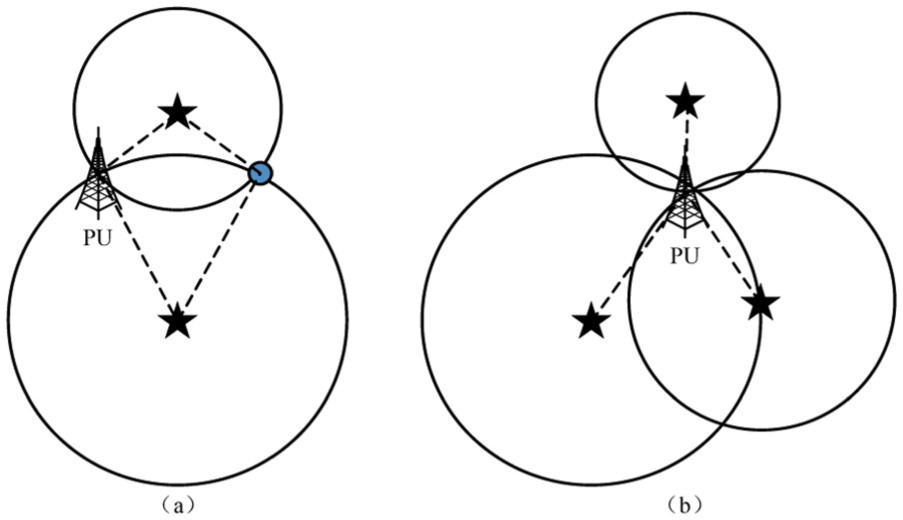
Estimation of PU location: (a) two CR users are not enough and (b) three CR users are sufficient.
The solutions proposed by Zhao and colleagues37,38 consist of MAC protocols for coexisting CR networks. The major drawbacks are the assumption that the PUs’ locations are fixed and the prior knowledge on the PU locations, which limit their application.
Conclusion and challenges
In previous sections, we have surveyed the latest developments of heterogeneous networks coexistence by structuring the existing work on the 2.4-GHz band and the TVWSs. Despite the large body of heterogeneous network coexistence solutions proposed in the literature, especially in the past few years, there are still some research challenges left unaddressed, which may attract future research attention.
Coexistence of networks with different QoS constraints
One of the challenges for heterogeneous networks coexistence is how to coordinate heterogeneous networks with heterogeneous QoS constraints. Most of existing solutions on coexistence problem only focus on heterogeneous networks coexistence without any specific QoS consideration for the coexisting networks. The work of Bian et al. 17 partially addresses this challenge using a weighted fairness maintenance algorithm to divide transmission time into two portions WiFi and ZigBee networks to meet their different QoS requirements. However, the ratio between the time allocated to the heterogeneous networks is fixed and does not take into account real-time QoS constraints. Therefore, we think that research efforts should be devoted to filling this gap by developing dynamic and adaptive QoS-aware coexistence protocols.
Moreover, different applications would lead different QoS requirements (i.e. WSNs in complex industry environment need more reliable communication than high-speed data transmission), which could not approve overall system throughput performance requirements of existing coexistence mechanisms. In this regard, it seems necessary to integrate the heterogeneous QoS constraints of the coexisting network into the performance metric in the design of coexistence protocols in order to strike a desired balance between maximizing the overall throughput and accommodating specific QoS constraints.
Coexistence under presence of PUs
As mentioned in the previous section, in TVWSs, a particularity that makes the coexistence of CR networks challenging is the presence of PUs, whose transmission may not necessarily follow a predictable pattern. Hence, coordination among heterogeneous secondary networks under the presence of PUs consists of an importance design. We point out that although the PUs issue is mentioned in a number of CR coexistence standards (e.g. TVWSs database in IEEE 802.19.1 19 ), the problem of how to react when PUs arrive has not been specified. For example, in IEEE 802.19.1, it is mentioned that a PU list in TVWSs database can provide PU information to CMs to manage spectrum hopping of the coexisting networks, but the problem of coexistence under the presence of PUs is not specified.
Zhao and colleagues37,38 develop a solution to this problem. However, their solution requires that the locations of PUs are prior known to the coexisting networks and are fixed. Such assumptions may be too strong although impractical in many cases. Even in the cases where the assumptions hold, their solution may not be effective or even fail to work if PUs are geographically close to cognitive nodes, which makes it difficult to distinguish the primary signal from secondary signal.
Given the above argument, a primary building block enabling coexistence of CR networks with the presence of PUs is the detection of primary signals. Once the primary signal is detected, distributed mechanisms should be devised to let cognitive nodes react and coordinate the spectrum access among them. We illustrate the challenge in this phase via the following example. Two CR networks (A and B) operate on a band of 30 MHz. A occupies first 20 MHz and B occupies last 20 MHz with an overlapped 10-MHz band in the middle part that they share. The event that a PU arrives at first 10 MHz will not only trigger A to relocate its spectrum but also probably impact B who might need to adapt its operation band.
From two-network to multi-network coexistence
Finally, the coexistence of multiple networks consists of another important future work. We note that most of existing coexistence mechanisms are focused on the canonic two-network coexistence scenario, the simplest coexistence scenario we can imagine. When there are multiple coexisting networks, the problem becomes much more complex, thus calling for more generic coexistence solutions.
Specifically, we identify the following three typical multi-network coexistence scenarios:
Homogeneous multi-network coexistence: The simplest scenario of multi-network coexistence is the coexistence of multiple homogeneous networks, that is, networks using the same technology operating on a swath of spectrum bands. In this scenario, some solutions have been proposed in the existing literature, for example, the spectrum etiquette mechanism in IEEE 802.22. 14 However, these approaches are usually centralized mechanisms. The development of distributed coexistence mechanisms consists of an important direction for future research.
Heterogeneous multi-network coexistence: In contrast to the first scenario, the second coexistence scenario is the coexistence of multiple heterogeneous networks problem, that is, networks using different technologies operating on a swath of spectrum bands. Again, solutions based on a centralized coordination mediator as in IEEE 802.19.1 19 may fail to function in distributed environments. Moreover, CSMA-based mechanisms suffer from the problems of heterogeneous transmitting power and spectrum and are not directly applicable in this context.
Hybrid multi-network coexistence: The third scenario is a combination of the previous two. Consequently, the challenges in the previous two scenarios should be addressed here.
Footnotes
Academic Editor: Riccardo Colella
Declaration of conflicting interests
The author(s) declared no potential conflicts of interest with respect to the research, authorship, and/or publication of this article.
Funding
The author(s) disclosed receipt of the following financial support for the research, authorship, and/or publication of this article: This research is supported by the National Natural Science Foundation of China (Grant Nos 51475343 and 51675389) and International Science & Technology Cooperation Program, Hubei Technological Innovation Special Fund (Grant No. 2016AHB005).