




Abstract
In mobile wireless sensor networks, linear network coding has been shown to improve the performance of network throughput and reduce delay. However, the linear dependence of coded packets caused by linear network coding will result in significant instability of the entire network during data transmission. Moreover, current linear network coding schemes do not distinguish between the real-time requirements of different packets. To solve the above problems, a weighted Vandermonde echelon fast coding scheme is proposed based on an analysis of various coding schemes such as random and linear network coding. Weighted Vandermonde echelon fast coding scheme can reduce the dependence problem of the network coding matrix and distinguish between different packet priorities. The accuracy of the proposed weighted Vandermonde echelon fast coding method is investigated through a theoretical analysis and then its outstanding delivery performance is verified through discrete event simulation experiments.
Keywords
Introduction
Compared to mature Internet technologies, a mobile wireless sensor network (MWSN) 1 has numerous inherent uncertainties and problems that must be addressed, especially the problem of unstable network transmission caused by node mobility. Network coding provides an appropriate approach to solve these problems.2–5
Since Ahlswede and Cai 6 first proposed the principle of network coding, many scientific researchers have shown strong interest in this area.7,8 Because a network coding protocol can utilize network bandwidth more reasonably, it can significantly improve network performance in MWSNs that use multicast. Most of the traditional performance optimization schemes for MWSNs try to use each available communication link in the network to increase system bandwidth.9–11 In the network coding method, in-network coding can significantly improve performance of the whole network when all the available links are utilized.
The network coding schemes adopted in MWSNs include random network coding, 12 deterministic network coding,13,14 and some optimized schemes.15–17 During the random network coding process, 12 data are packed with a global coding vector. Intermediate nodes recode these packets with their global encoding vectors when they receive these coded data packets from upstream nodes. This operation does not require knowledge of the topological information of the entire network. After receiving a certain number of coded packets, the destination node can acquire the original data by decoding these packets.
In deterministic network coding, the local coding coefficients of the intermediate nodes are fixed, and each coding vector is transmitted in the network simultaneously with the coding result. The deterministic network coding method was initially proposed by Koetter and Médard 13 This study designed a relatively complete linear network coding scheme based on the decomposition model of a global transition matrix. A deterministic network coding scheme presented by Fragouli et al. 14 applied an upper triangular matrix to perform video coding. The deterministic network coding scheme has the advantage of a stable coding coefficient; therefore, the transmission of the coding coefficient in the network involves only small amounts of information, which reduces network overhead.
The coding strategies of most network coding algorithms are based on random linear network coding. However, the main shortfall of random linear network coding is that it cannot ensure the linear independence of the coding vector. Consequently, the source node must send far more coded packets than the source packets (one original data block can be encoded to one source packet) to ensure that the destination node can decode the source packets successfully. This redundant packet requirement increases the network load significantly causing high energy consumption due to retransmission of useless packets. To achieve encryption, energy control, and linear independence of packets, deterministic network coding adopts a deterministic matrix to encode the packets, solving this problem through proper deterministic coding.
This article consists of the following: first, we study random linear coding and two deterministic network coding schemes (the upper triangular matrix coding and Vandermonde matrix coding). Then, we analyze the dependence between the coding matrix of the above coding strategies and their application scope. Subsequently, we propose a weighted Vandermonde echelon fast coding scheme (WVEFC) that, when applied to MWSNs, can ensure the independence of the coding matrix and distinguish coding in accordance with various real-time requirements of packets. The fast coding scheme significantly reduces the time required for large-scale node operations. Finally, we conduct simulation experiments and analyze the coding strategies of the network model. The results of the experiments show that the proposed coding scheme can ensure node coding efficiency and maintain a high data transmission throughput.
The rest of this article is organized as follows. In section “The linear dependence of network coding methods,” we analyze the linear dependence of the coding matrix in random linear coding and two deterministic network coding strategies (the upper triangular matrix coding and Vandermonde matrix coding). In section “The WVEFC algorithm,” we propose the fast coding algorithm called WVEFC to improve the robustness of MWSNs. Section “Simulation results” presents comparisons between the fast coding algorithm, WVEFC, proposed in this article and other coding algorithms to demonstrate the effectiveness and accuracy of WVEFC.
The linear dependence of network coding methods
Random network coding–based data transmission schemes sometimes fail when coded packets are not correctly received by the destination node. Moreover, coding vectors may have linear dependence. If the source node cannot find the problem in time, the entire scheme will fail. Therefore, redundancy strategies have been adopted in several optimized schemes3–5 by which in-network nodes generate and transmit additional coded packets. In this way, these schemes ensure that a destination node can supplement the width of the decoding coefficient matrix by substituting these linear dependent vectors. Both network delay and transmission redundancy are important factors when evaluating the efficiency of these optimized network-coding-based schemes. In the following, we analyze the linear dependence problem of several classical schemes.
Dependence of random linear coding
Random linear coding refers to randomly choosing a set of coding coefficients from a specified Galois field. First, we consider selecting an

If the row vectors of

where
The traditional deterministic network coding method performs well in square matrix coding. However, due to the unreliable data transmission characteristic of MWSNs, redundant coded packets must be encoded and transmitted through several optimized schemes. Therefore, the occurrence of linearly dependent coded packets should be considered when using an expanded coding matrix. Consider randomly obtaining an

If column vectors are used to conduct encoding, because there are only two source packets, the destination node needs to receive only two random linearly independent coded packets to successfully decode the source packets. If the arbitrary two column vectors in

where

where n and
We consider an

in which
Assume
In

where
Next, we consider an

If we denote

where
In conclusion, we can obtain
In an actual sensor network, the number of packets sent by the source node is not fixed and neither is the number of extra coded packets sent to prevent linear dependence. Therefore, it is necessary to discuss a coding matrix with unknown dimensions. As shown by the proof given above, the probability of the coding vectors being linearly dependent when using an expanding matrix to conduct a random linear coding operation is basically consistent with that of the original matrix. We should take the

In accordance with the proof above, the probability

In formula (11),
The linear dependence of adopting an upper triangular matrix as the coding matrix
When an upper triangular matrix is adopted to conduct the linear coding operation, its coding coefficients are randomly extracted from a Galois field

where

where

where
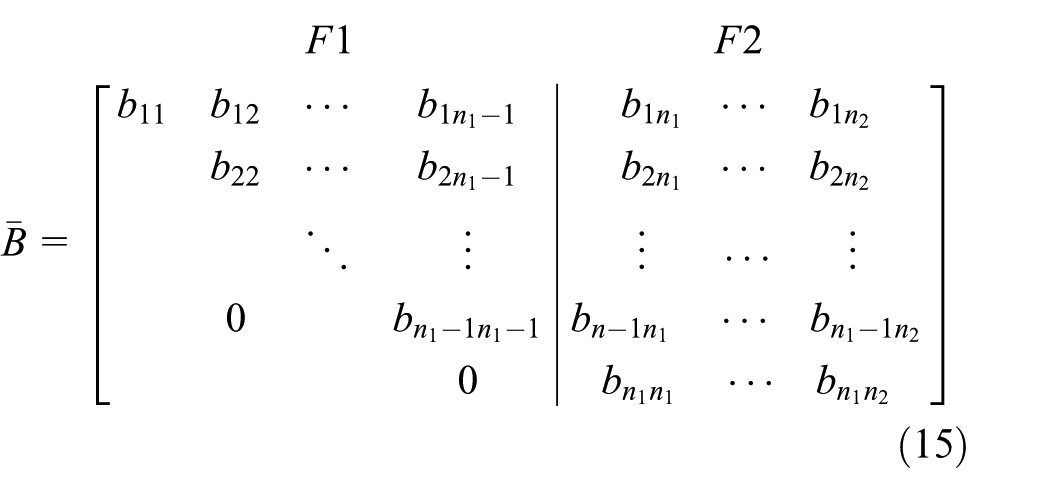
For convenience, matrix
1. When


where
We denote
We denote

In
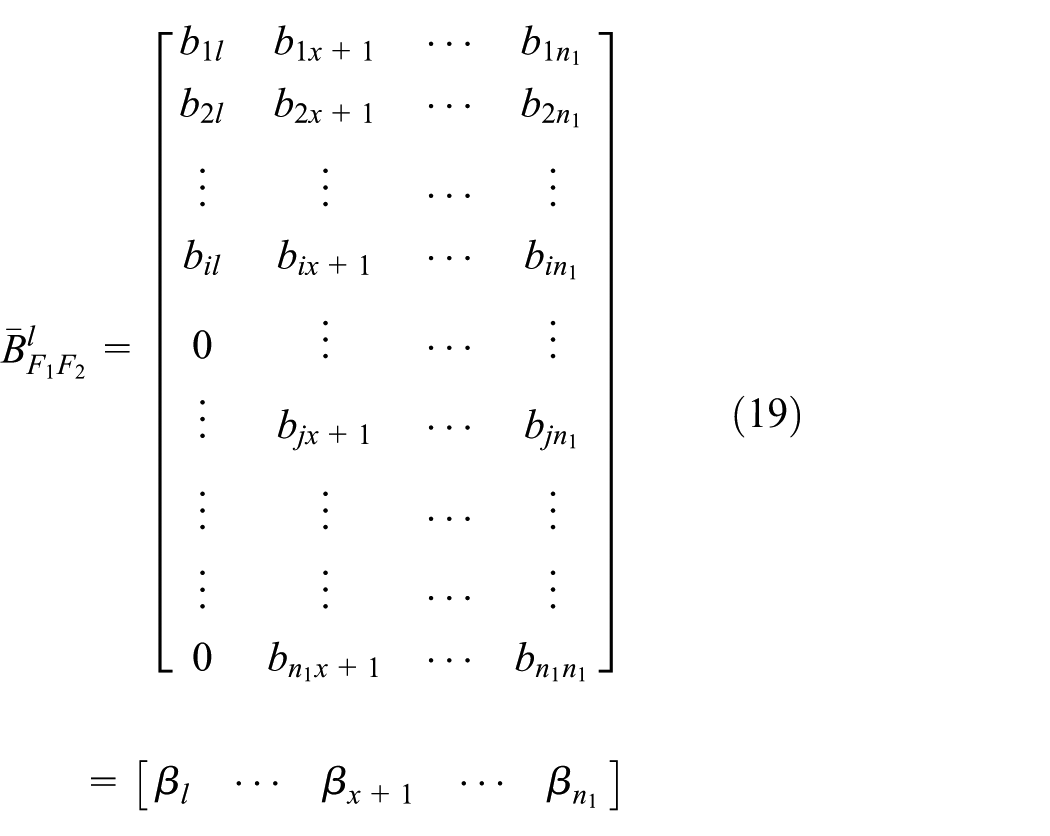
In
On the row

where

2. If


where
We denote
We denote
Because the column vectors of sub-matrix

Therefore, in accordance with formulas (17), (22)–(24), we can obtain

If an upper triangular expanding matrix

Linear dependence of adopting the Vandermonde matrix as the coding matrix
Given the special characteristics of the Vandermonde matrix, the network coding results are different from those randomly obtained matrices. If the Vandermonde matrix is adopted to conduct the linear coding operation, the nodes need to select only a group of unequal constants to establish a Vandermonde matrix. In accordance with the characteristics of the Vandermonde matrix, any column of this matrix is linearly independent. Therefore, using the Vandermonde matrix to conduct linear coding, the coding operation is guaranteed to generate linearly independent coded packets. The general idea is that a Vandermonde expanding matrix
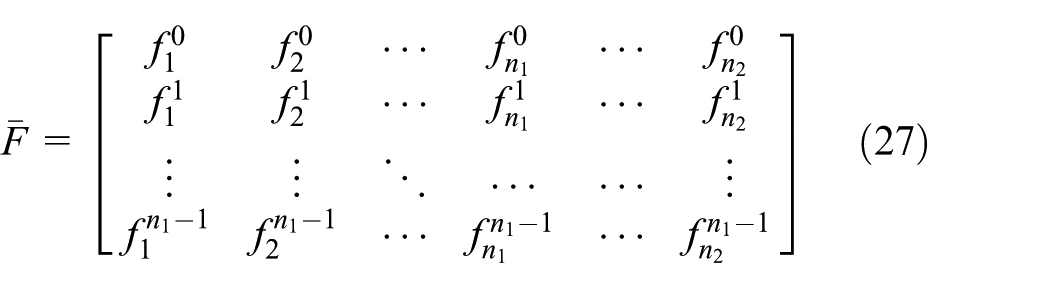
in which
The WVEFC algorithm
In MWSNs, transmitted information can be classified into two categories. The first is data, which are generally sent from the sensor node to the sink node and may require encryption, in which case eavesdropping nodes cannot decode any information from the source packets even if they obtain some coded packets. The second is control information, which is generally sent from the sink node to the sensor nodes. Control information is used to make timely adjustments to the overall network deployment when the network environment changes, to better adapt data transmission to the environment. Control information consists of only simple control commands that do not require encryption.
If the traditional full-rank matrix network coding method is adopted, taking the Vandermonde expanding matrix as an example, the control commands can be decoded only after the destination node has received all the packets. However, these control commands often need to be identified by the node quickly, so that the control changes can be made. Some data also contain time-sensitive information that the destination node should receive as soon as possible. The above problems cannot be solved by adopting the traditional network coding scheme. However, the WVEFC can be used to solve them.
The basic idea of WVEFC is that the source node divides data information into different groups when it assigns a transmission task. The basis of grouping is the priority-secret (P-S) weight of data. The P-S weight reflects the importance and timeliness of this packet, for example, the information contained in the packet should not be wiretapped, or a huge loss could occur if a packet becomes invalid or fails to reach the destination node in time. The coding matrix
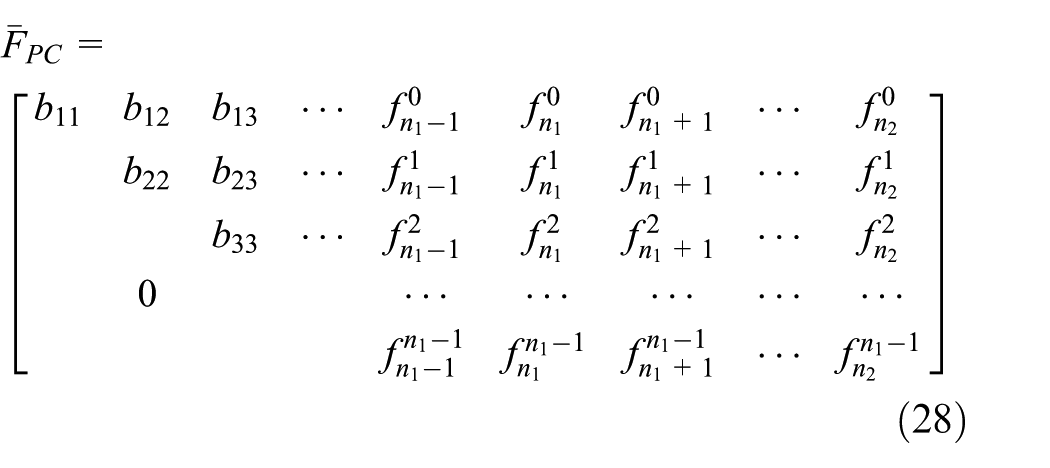
In the WVEFC coding scheme, different column vectors in
In this article, the packets transmitted over the network are divided into data information packets and control information packets. Both types of packets are classified into five levels, from one to five, denoted as


The coding matrix

in which a and b are adjustable parameters that are generally set to 50 and 400, respectively. Unless stated otherwise, the values of these two parameters are constant in the remainder of this article.
Before each coding operation, in addition to specifying the row and column numbers of the generated coding matrix, we also need to specify the sequence in which packets need to be coded. This sequence should be determined by the priority and secrecy levels of a packet. In the matrix to be encoded, assume that the column index of each packet to be coded is

where a and b are adjustable parameters that represent different degrees of importance for the coding node; these two parameters are generally regarded as equally important, that is,
In conclusion, the procedure to encode
Step 1: Calculate the number of packets that requires redundant coding
Step 2: Generate the
Step 3: Determine the position of

Step 4: Obtain the final coded matrix through the coding matrix obtained in Step 2

During each coding operation, in accordance with the requirement of the actual situation, the first

in which
However, it is possible to find linear dependence of any

where
The WVEFC coding scheme has four advantages: first, the WVEFC is energy efficient. When too many packets do not require encoding, the coefficients in columns satisfying
Simulation results
In this section, we provide results of a simulation to demonstrate the efficiency of the WVEFC fast coding algorithm proposed in this article. The experiment was coded using VC++ 6.0 and MATLAB 7.0. Table 1 shows the parameters used in the experiment.
Simulation parameters.

CBR: constant bit rate.
The epidemic routing model used in this experiment is typical for a restricted network. Because packet transmission can be achieved through broadcast, this model is suitable for the tested network coding schemes.
The delivery time of network data is related to the size of the data flow in the network. Here, 50 nodes are randomly deployed in the network, the node radius is 600 m, the deployment area is a
Figure 1 depicts the relation between delivery time and data stream. It shows that the upper triangular expanding matrix coding method has no obvious correlation with the order of the coding matrix. Due to linear independence, the WVEFC coding scheme also has no obvious correlation with the order of the coding matrix. However, random linear coding is significantly related to the delivery time of random linear expanding coding and the order of the coding matrix. In the high-order coding matrix, the delivery time of random linear coding and random linear expanding coding is close to both the WVEFC and the Vandermonde expanding schemes.

The relation between delivery time and data stream.
In the random epidemic routing network, the communication radius of a node is still an important factor that might affect the efficiency of the whole network. For different node radii, adopting different strategies leads to significantly different network performances. In a real wireless network, different nodes generally have different communication radii. In the following, we will analyze the impact of radius change on different network protocols.
In the simulation network, 50 nodes are randomly deployed; the node movement area is a
Figure 2 depicts the influence of increasing node transmission radius with a different coding field on transmission delay. We find that by increasing the size of coding field, the possibility of linearly dependent packets appearing will gradually decline in the following schemes: random linear coding, random linear expanding, and upper triangular expanding matrix coding. With an increase in the power exponent in the Galois field, the performances of several coding methods converge. When the Galois field

Transmission delay for sending two packets in a 50-node network.
Similar to the above environment, 50 nodes are randomly deployed in the simulation network, the node movement area is a
Figure 3 depicts the change in transmission delay as the node radius gradually increases when the source node needs to send three packets. As the random number field range increases, in the networks that use random linear coding, random linear expanding coding, or upper triangular expanding matrix coding, the possibility of linearly dependent packets occurring gradually declines. As the power exponent in the Galois field increases, the performances of several coding methods converge. Through a comparison with Figure 2, we find that as the Galois field changes, the transmission delays converge faster.

Transmission delay of sending three packets in a 50-node network.
When a source node needs to send four source packets, the coding methods require using a fourth-order coding matrix; the linear dependence of coded packets will have change further as shown in Figure 4.

Transmission delay from sending four packets in a 50-node network.
Figure 4 depicts the change in network transmission delay as the node radius gradually increases in the following environment: 50 nodes are randomly deployed, node movement occured within a rectangle area of
In the following, based on the previous experimental data and conclusions, we investigate the probability of generating linearly dependent packets in different conditions involving different network coding methods, sending different numbers of packets from the source node, and adopting different Galois fields. The results are shown in Figures 5–7.

The relation between the probability of linear dependence in two-order matrices and the size of the Galois fields.

The relation between the probability of linear dependence in a three-order matrix and the size of the Galois fields.

The relation between the probability of linear dependence in a four-order matrix and the size of the Galois fields.
Figure 5 depicts the probability of linearly dependent packets appearing when delivering two packets under different coding fields. The coding operation requires using a second-order coding matrix or a second-order expanding coding matrix. We find that the probabilities of both the WVEFC coding scheme and the Vandermonde expanding matrix coding scheme are 0; therefore, in these two types of networks, the curve overlaps with the horizontal axis. The network that uses the upper triangular expanding matrix coding method has the highest probability of linearly dependent packets occurring. In accordance with the relation between linear dependence and the number of known zeros, we can conclude that the method adopting upper triangular expanding matrix has the highest probability of linearly dependent packets appearing because the upper triangular expanding matrix has the highest number of known zeros. The probabilities of random linear coding and random linear expanding coding are basically the same, which also testifies the validity of formula (11). In the following, we analyze sending three packets from the source node, as shown in Figure 6.
Figure 6 depicts the probability of linearly dependent packets appearing when delivering three packets under different coding fields. The probabilities of both the WVEFC and Vandermonde expanding matrix coding scheme are 0. The probabilities of random linear coding and random linear expanding coding are basically the same. Among these schemes, the upper triangular expanding matrix coding scheme has the highest probability of linearly dependent packets appearing in the network, but it is only a slight increase. The probabilities of linearly dependent packets appearing in the networks that use random linear coding and random linear expanding coding both decline.
Figure 7 depicts the probability of linearly dependent packets appearing when delivering four packets under different coding fields. The probabilities of both the WVEFC and Vandermonde expanding matrix coding scheme remain at 0. The probability of linearly dependent packets appearing with the upper triangular expanding matrix coding method is the highest, while the probabilities of random linear coding and random linear expanding coding are basically identical. To conclude, Figures 5–7 show that in networks that use network coding, the probability of linearly dependent packets satisfies two rules:
The probability of linearly dependent packets appearing declines as
In the network that uses the upper triangular expanding matrix coding scheme, the probability of linearly dependent packets appearing is not dependent on the order of the coding matrix, while in the networks that use random linear coding and random linear expanding coding, the probabilities of linearly dependent packets appearing decline as the order of the coding matrix increases.
During the experiments, when using the WVEFC algorithm and Vandermonde expanding matrix coding, the number of linearly dependent packets is 0. In all 10,000 experiments, in the networks that used WVEFC for coding, the number of linearly dependent packets has been 0. The experiments also showed that WVEFC has the same efficiency as the Vandermonde expanding matrix coding method but is more flexible. Moreover, the WVEFC can provide different coding strategies for source packets with different weights, so it can adjust transmission efficiency and coding as needed. It can also significantly reduce time that nodes have to operate in the network, which saves node energy. These qualities are particularly important in MWSNs, which have poor computation ability and limited energy reserves.
When using the WVEFC algorithm, the fast delivery capability is shown in Figures 8 and 9. In both experiments, 50 nodes were randomly deployed in the network, node movement occurred within a rectangular area of

The relation between the percentage of control information packets and average delivery time.

The relation between number of packets and average delivery time.
In Figure 8, 50 packets were sent in total, which involved control information packets (priority level 1 and secrecy level 5) and data information (priority level 5 and secrecy level 1). In Figure 8, the curve shows the change in the average delivery time of messages as the ratio of control messages to total messages increased. Generally speaking, in all coding methods, the delivery time changes very little as the ratio of control messages changes. The WVEFC coding method and the upper triangular expanding matrix coding method provide faster network delivery because both these two coding matrixes involve a triangular matrix; consequently, a large proportion of the control messages can be decoded quickly, while other coding methods need to decode all the messages at one time. Comparing these two methods, the delivery time of the network that uses WVEFC coding is shorter than that of the upper triangular expanding matrix. This probably occurs because the probability of linearly dependent columns appearing in the WVEFC coding matrix is lower; therefore, it requires fewer packets for decoding.
Figure 9 depicts experiments in which several packets need to be sent; the control information packets (priority level 1 and secrecy level 5) account for 20% of the packets. The data information packets (priority level 5 and secrecy level 1) account for the other 80%. The curve shows the change in the average packet delivery time as the number of packets increases. We can see that in all coding methods, as the number of packets increases, the delivery time also increases. The WVEFC coding method, upper triangular expanding matrix coding method, and Vandermonde expanding matrix coding method all provide rapid network delivery. The first two methods involve a triangular matrix; consequently, a large proportion of the control messages can be decoded quickly. However, because of high linear dependence, the delivery time of the upper triangular expanding matrix is longer than that of the WVEFC coding method. As for the Vandermonde expanding matrix coding method, because the linear dependence of its coding matrix is 0, nodes can decode all messages after receiving a very small number of packets. However, because of its more complicated computation, its delivery is slower than that of the WVEFC coding method.
Conclusion and future work
This article studied the network instability caused by the linear dependence of a coding matrix during network coding in MWSN environments; several coding methods were selected for comparison. We proposed a new fast coding algorithm, called WVEFC, and verify the advantages of this algorithm through simulation experiments. Without considering the delay caused by the computation required for the network coding itself, our proposed algorithm is as efficient as the Vandermonde expanding matrix coding method. Considering that the Vandermonde expanding matrix wastes a large amount of node computation resources and takes longer, our WVEFC algorithm achieves better overall system performance. In the fast delivery experiment shown in Figure 8, the WVEFC algorithm exhibits better performance than other coding algorithms.
In this article, the specific number of columns in WVEFC or how various nodes negotiate the number of columns is not regulated. In MWSN environments, node energy is limited; therefore, during the node coding process, node energy consumption should also be considered when selecting a coding scheme. Therefore, in future work, we plan to investigate the balance point between the number of columns in WVEFC coding and network environment conditions to further strengthen the practicality of the WVEFC method in a real-world environment with limited energy.
Footnotes
Academic Editor: Yingtao Jiang
Declaration of conflicting interests
The author(s) declared no potential conflicts of interest with respect to the research, authorship, and/or publication of this article.
Funding
The author(s) disclosed receipt of the following financial support for the research, authorship, and/or publication of this article: This research was supported by the National Natural Science Foundation of China (nos 61640020, 61301108, and 61671244), the Key Research and Development Program of Jiangsu, China (BE2016368-1), the Agricultural Innovation Program of Jiangsu, China (nos CX(13)3054, CX(14)2114, and CX(16)1006), and the Program of Jiangsu Six Talent Peaks (XYDXXJS-033).