




Abstract
Transmission power allocation in modern mobile telecommunication systems is one of the most important aspects affecting overall performance. Addressing this issue has huge impact on improving state-of-the-art for mobile telecommunication systems such as Long Term Evolution—Advanced by reducing inter-cell interference. To approach global optimality, some sort of cooperation between base stations is needed to overcome many shared limitations. This article proposes cooperative transmission power assignment mechanism based on the coordinated multiple points’ concept. It provides mathematical treatment and technical development for the proposed solution. This solution works in distributed fashion which is one of the main strengths of our approach. The proposed transmission power mechanism adopts auction theory approach to allocate power level for each base station. The proposed solution has showed tremendous good performance in extensive simulation experiments.
Keywords
Introduction
The most noticeable feature of the current and future telecommunication networks is their large size. 1 An autonomous modern telecommunication network which belongs to a single service provider can expand to cover an entire country. Sometimes, it even covers an entire continent. Hence, these networks usually have very sophisticated infrastructures with many operational base stations. The increasing large number of base stations is due to the adoption of micro and pico base stations. 2 These base stations have very small transmission radii. Therefore, to cover the intended area, increased number of these base stations is needed. In addition, machine-to-machine (M2M) communication is combining both the wireless sensor networks (WSN) and large mobile telecommunication systems. 3
Both the reduced transmission radii and increased number of base stations worsen interference problem for mobile users at the cell edge. As the transmission radius decreases, the percentage of mobile users who are considered at the cell edge increases. 4 Hence, the negative impact of interference increases as well since there are more mobile users who are experiencing interference from closer and closer neighboring base stations. This fact raises interference problem and transmission power control to be among the most important issues in mobile telecommunication.
It comes naturally that cooperation with the neighboring base stations is needed to mitigate interference since they are the reason behind it. Intuitively, base stations need to cooperate on global scale to achieve global optimality. Nevertheless, it is practically very complex to operate such global cooperation. 5 In other words, it is very complex and challenging to establish a cooperation structure that achieves global optimality. 5
The next choice is to establish local cooperation among the neighboring base stations. Such local cooperation may approach optimality in local terms 6 and dramatically addresses local limitations experienced by the neighboring base stations. This goal was the main motivation behind coining coordinated multiple points (CoMP) concept. There are several interesting works in the literature which try to tackle interference problem based on CoMP concept. For example, Chen et al. 7 were concerned about the interference between macro and femto base stations under CoMP framework. They proposed a bisection algorithm to split spectrum between macro and femto base stations. In addition, their proposed method assigns the transmission power. However, their modeling approach led to non-convex problem which is complex to optimize.
The work published by Baccelli and Giovanidis 8 modeled base stations distribution based on Poisson point process. 9 Their main idea is to serve user from two base stations where the allocated transmitted power for the user is divided between two serving base stations. This idea managed to reduce interference. The main drawback of this approach is that it requires user data to be available and synchronized in two base stations. On another front, Zappone et al. 10 were concerned about power allocation in relay-assisted networks. They focused on amplify-and-forward relays with multiple antennas. Their approach is based on sequential convex optimization where it managed to achieve very good results. However, it requires centralized processing which introduces system bottleneck.
Du et al. 11 focus their work on improving fairness. They utilized max–min fractional programming to achieve their goal. Nevertheless, they had to divide transmission problems into sub-problems to reach their good results. On the other hand, Xu et al. 12 proposed a precoding approach under CoMP framework in heterogeneous networks. They optimized for energy efficiency where many constraints were taken into consideration such as minimum user data rate and maximum transmission power of base stations. Their experiments showed good results. However, their method requires specific topologies of heterogeneous networks to be effective.
This research tackles interference problem and power control without adopting many assumptions which may reduce practicality in specific scenarios. Cooperation among base stations is assumed to be optional which increases stability and reliability of the proposed solution. Keep in mind that the proposed solution leads to situations where cooperation is beneficial for base station based on their self-interest. At the same time, it improves the overall system performance. However, if there is a base station which is not cooperative, this will not disturb cooperation among the remaining base stations. This aspect of the proposed solution differentiates it from other approaches in the literature. For classification purposes, the proposed solution in this article can be categorized as coordinated scheduling/coordinated beamforming (CS/CB) solution under CoMP framework. 13
The remaining of the article is organized as follows: the next section presents the adopted system model. After that, development of the proposed solution is delivered. Then, extensive simulation experiments will be presented. Finally, the article will be concluded with conclusion section.
System model
In modern and future telecommunication systems, spectrum reuse factor is one which means that all base stations will use the same spectrum to serve their users.14,15 Each one of these base stations will cause interference to its neighbors if they do not agree on controlled transmission power policy. 16 This research proposes a solution which helps cooperated base station to reach such agreement.
Each base station is surrounded by the neighboring base stations according to commonly adopted architecture.
17
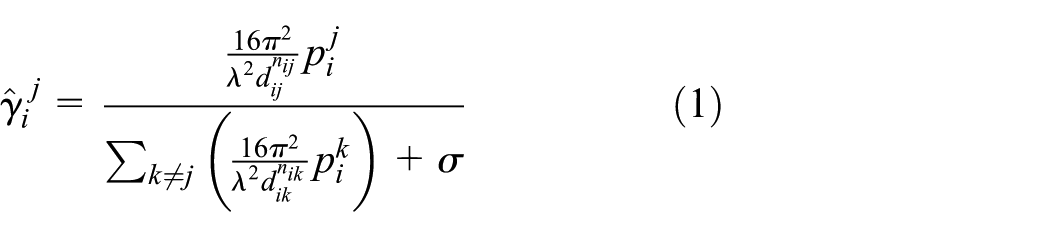
These base stations distribute critical information to their neighbors such as points of interest locations, resource scheduling decisions, and the required data rate at each location to achieve the required quality of service. This information will be used by every base station to assign the transmission power for each one of their mobile users in distributed fashion. Let
where
It is well-known that as the receiver (mobile user) of the wireless signal moves away from the transmitter (base station), the transmitted signal gets weaker. 20 Several works in the literature proposed models for signal propagation.21–23 Free-space path loss (FSPL) 22 will be considered as a model of signal propagation in this research development to simplify the analysis. However, the developed model can be easily extended to incorporate other wireless environment features such as shadowing and fading.
The first step is to calculate the desired SINR (

BW represents the used bandwidth. The relationship between these parameters can be re-formulated as in the following equation

In equation (3), the right-hand side represents the thermal noise and interference coming from the neighboring stations after being normalized by the path loss. In other words, this equation describes the relationship between the transmission power of jth base station and the transmission power of the neighboring base stations that achieves the desired data rate. Here, the fact that minimizing interference is the objective can be exploited to ease the optimization process of transmission power assignment. This can be done by converting equation (3) into inequality as follows

The above inequality (4) states that the normalized interference can be at most equal to the transmission power (upper bound) as described in equation (3). However, this normalized interference is allowed to have values lower than this upper bound (as a consequence, a lower value will lead to higher data rate). This inequality can be used as constraint for optimization as shown in the following section.
Optimal transmission power assignment
At this point, a technique to assign the transmission power can be developed by utilizing constraint defined in previous section. Keep in mind that the base station has to decide the transmission power over each resource block separately. Therefore, the proposed transmission power assignment technique is the same for all resource blocks. In addition, the proposed technique can be repeatedly executed at every base station. This repeated execution will produce the same result at these base stations assuming that the distributed information is consistent. Note that repeated execution may be less expensive than communication overhead if centralized approach is used.
The first step is to define a utility function of the transmission power to be optimized. Such utility function should promote fairness 24 among the neighboring base stations. At the same time, this utility function should be convex 25 to ease the optimization process. This research proposes to use the following function

Note that

Subject to

Since the previous optimization problem equation (4) is concave, an optimal solution can be calculated or approximated if it exists. 26 Such solution may not exist because the problem domain (which is defined by problem constraints) may be an empty set. 27 This is the most probable when only mobile users at cell edge are under consideration. It is highly probable that there is no power assignment of all base stations which guarantees the required data rate for all mobile users at the cell edge. Therefore, it is wise to only apply this approach to mobile users who are near cell center. The following section addresses transmission power allocation for cell edge mobile users.
Auction-based transmission power assignment
This section develops a cooperative mechanism for transmission power allocation based on auction theory. 28 This solution can be used to assign transmission power for mobile users at cell edge. The main idea is that each base will submit a bid for the requested power. Then, based on this bid, base station will be awarded fraction of the maximum allowed transmission power. Keep in mind that auction game is iterative. The past values of bids and power assignments have direct relationship with future values. One way to assign transmission power for ith mobile user in jth base station at tth iteration

where
Next, a utility function should be defined which is the function that needs to be optimized. This function should be defined in a way which leads to preferable situation and status after it was optimized. The following utility function will be used by all players (i.e. base stations) in the game

where
Every base station will try to maximize its utility function. This can be done by increasing data rate. At the same time, the submitted bids should be decreased for utility function to be maximized. Hence, this will create a motive for base stations so that they do not aggressively compete in the auction game. As a result, higher level of cooperation will be achieved.
Auction game equilibrium
In context of transmission power assignment and game theory, optimal transmission power assignment

where
Here, the concept of Nash equilibrium 30 arises. In any game, players will keep changing their actions depending on other players’ actions. Sometime, players reach a point where changing their actions will make their situation worse. As a result, players stick to their current actions so that they do not worsen their situation. This point in the game is called Nash equilibrium. Preferably, game designers would like Nash equilibrium to be the optimal point. For this research, having Nash equilibrium which satisfies equation (9) is desired.
The set of all base stations
Theorem 1
Auction game
Proof
For Nash equilibrium to exist in such game, two conditions have to be satisfied.
31
First, the set of possible strategies for each player in the game has to be nonempty subset of Euclidean space which is compact and convex. Since each player can choose transmission power within interval
The second condition requires utility function to be continuous and quasi-concave
32
with respect to
Let data rate be calculated based on Shannon 33 formula

where


From equations (11) and (12), we can calculate the second derivative for utility function as follows
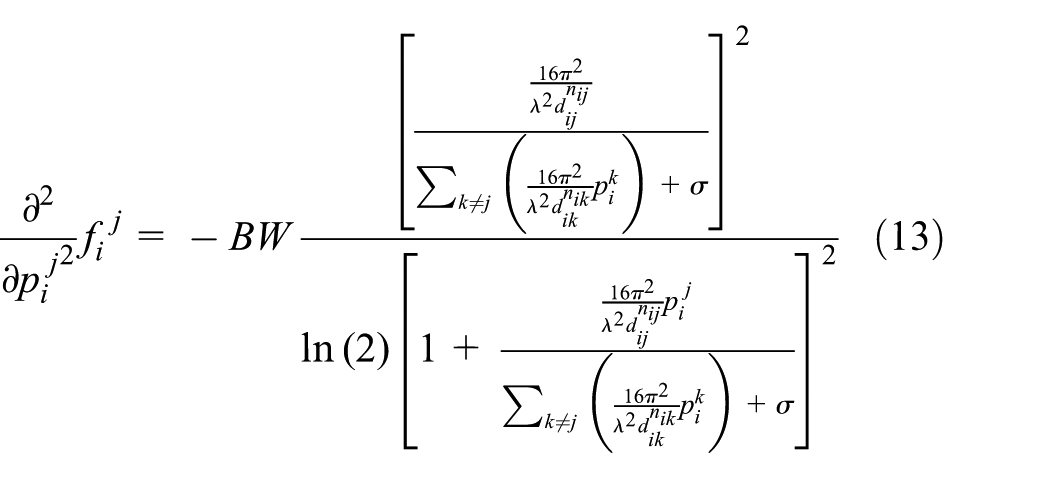
From equation (13), it can be seen that the second derivative of utility function with respect to the transmission power is always negative which concludes the proof. □
Based on Theorem 1, there exists transmission power assignment which is Nash equilibrium. The next step is to design the bidding mechanism so that this equilibrium can be reached.
Bidding mechanism
To develop the bidding mechanism, the fact that utility function is concave will be exploited. The first derivative of the concave (and convex) functions is equal to 0 at the optimal point. 25 Therefore, to keep transmission power assignment at equilibrium, bids should be assigned in way that guarantees the following
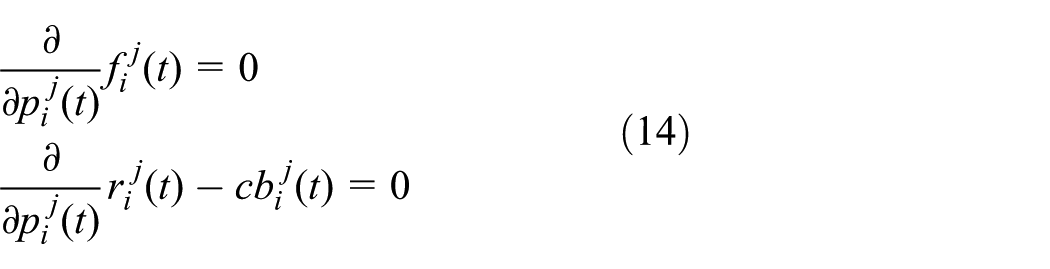
By solving equation (14), the exact value of bids can be calculated as follows

Keep in mind that for the first iteration,

Hence, the maximum transmission power assignment corresponds to the lowest bidding value and vice versa. Because the maximum transmission power assignment is used at the first iteration, the bid value will be at the lowest. Then, this bid value will keep increasing until it reaches the equilibrium. Convergence time (T) depends on the number of bidders which is the size of mobile user set (
Evaluations and discussion
The proposed solution can be improved by utilizing the fact that Long Term Evolution (LTE) systems implement multi-input multi-output (MIMO) in the base station side.
35
The received signal (

where x is the transmitted signal,
Simulation parameters
All the simulation experiments in this work adopted LTE release 8.39–41 These experiments were performed using Vienna University LTE simulator. 42 Features such as MIMO antennas and wide bandwidth of 20 MHz were used in these simulation experiments. Transmission frequency was set at 2 GHz. Each simulation experiment was run for 100 s. Updates for transmission power were performed at the beginning of each transmission time intervals (TTIs). Each second has 1000 TTIs. Therefore, there were hundred thousand transmission power updates during each simulation experiment. The total number of base station was set to 91 which means that five rings of hexagon transmission areas were used. Each one of these base stations has three sectors. The thermal noise density during all the simulation experiments was set to −174 dBm/Hz.
As seen in Table 1, there are five values for each performance variable. The number of mobile users ranges between 20 and 100 per base station. The distance between base stations ranges from 100 to 500 m. The transmission power of base stations ranges from 35 to 50 W. Finally, mobile users’ speed ranges from 5 to 25 km/h. The results presented in the graphs in the following sections are the average of multiple simulation experiments to reduce the effect of randomness of mobile user placement in the coverage areas.
Simulation parameters for transmission assignment.

TTI: transmission time interval.
Average mobile user throughput
The average throughput of mobile users is one of the most important performance metrics to be investigated. Figure 1 shows the performance of the evaluated transmission power assignment mechanisms as the number of mobile users increased for each base station in the simulated mobile to the communication network. It is clear that as the number of mobile users increases, the average throughput of these mobile users decreases. This kind of behavior is expected since finding optimal transmission power assignment is harder for larger number of mobile users. For the proposed mechanism, having larger number of mobile users will lead to more constraints in the optimization process. As a result, the feasible set of possible transmission power assignments will be empty. Hence, finding an optimal transmission power assignment will be impossible. However, Figure 1 shows that the proposed mechanism in this research outperforms other evaluated mechanisms from the literature.

Average mobile user throughput as number of mobile users per base station is increased.
The next investigated performance variable is the base station transmission power. Figure 2 shows that increasing transmission power of base stations leads to reducing average throughput of mobile users. The reason behind such behavior is due to the fact that increased transmission power would lead to increasing interference experienced by mobile users. Higher interference makes finding optimal transmission power assignment more difficult. However, the proposed mechanism outperforms other evaluated techniques. Keep in mind that behavior in Figure 2 suggests that the average mobile user throughput stabilizes as the transmission power of base station increases beyond 50 W. In other words, the reduction rate of mobile user throughput shrinks as the transmission power of base station increases. Having smaller coverage area of base stations may stabilize the behavior at lower values of base station transmission power. The value of 50 W is linked to 500 m radius of the base station coverage area. Increasing/decreasing coverage area radius will increase/decrease the stabilizing value.

Average mobile user throughput as transmission power of eNodeB is increased.
The same stabilizing behavior can also be seen in Figure 3. In this figure, the performance variable is the radius of the base station coverage area. As this area increases, the average mobile user throughput increases as well. The link between the radius of the coverage area and transmission power of base stations is also confirmed in this figure. It is clear that as the distance between base stations increases beyond a specific point, the effect of this distance on the average mobile user throughput stabilizes. Increasing base station coverage area increases freedom of mobile users’ distribution within this coverage area. As a result, interference profiles of mobile users will greatly differentiate. Hence, better transmission power assignments can be found that can exploit this differentiation. Superiority of the proposed technique compared to the other evaluated mechanisms can easily be seen in the figure.

Average mobile user throughput as geographical distance among eNodeBs is increased.
Increasing mobile users’ speed has a negative impact on their average throughput. Assigning the transmission power depends on the current configuration of the network to achieve its goal. To keep any decision regarding the transmission power optimal, network configuration should not change dramatically. A network with mobile users who are moving with high speed is constantly changing. As a result, such network cannot guarantee that a decision regarding transmission power assignment will stay optimal and valid. Hence, the performance will decrease as mobile user speed increases as seen in Figure 4.

Average mobile user throughput as mobility speed of these users is increased.
The proposed mechanism consists of three stages where the first stage finds an optimal transmission power assignment for a subset of mobile users. This stage guarantees that at least some mobile users will have the best possible transmission power assignment. This helps the proposed mechanism to outperform other evaluated techniques.
Fairness of mobile user throughput
It is well-known that improving throughput telecommunication networks usually has a negative effect on fairness among mobile users. The challenge is to improve system throughput without reducing fairness drastically. Figure 5 shows fairness performance of the evaluated techniques as the number of mobile users per base station is increased. The proposed solution has lower fairness compared to other evaluated techniques when the number of mobile users is small. As base stations have more mobile users, the proposed solution bypasses other techniques in terms of fairness. This is achieved without harming throughput performance compared to other evaluated solutions. The proposed solution was able to deliver such performance because it tries to satisfy transmission requirements for each mobile user.

Mobile user fairness as number of mobile users per base station is increased.
Figure 6 shows the effect of manipulating the transmission power of base stations on fairness among mobile users. The proposed mechanism has slightly lower fairness performance compared to other evaluated techniques. However, as seen in the figure, the proposed solution fairness improves with increment of base station transmission power. On the other hand, the evaluated techniques experience degradation of their performance with increased transmission power. This suggested that the proposed solution has the ability to exploit the increased power while avoiding the increased interference. Such ability is very hard to acquire since increased interference does not equally affect mobile users. However, other evaluated mechanisms were able to outperform the proposed solution. The dissimilarity in behaviors of the proposed and evaluated solutions indicates that they have major differences about how they approach serving different mobile users with diverse transmission requirements.

Mobile user fairness as transmission power of eNodeB is increased.
Similar distinguished behaviors of the proposed and evaluated mechanisms can be seen in Figure 7 where the performance variable is the inter-distance between base stations. Increasing distance between base stations leads to enlarging area where mobile users are distributed. As a consequence, more mobile users will get farther from their serving base stations. This wide distribution increases differentiation among mobile users. Hence, it becomes harder to operate in a way that increases fairness. This is clearly seen in the performance of the evaluated mechanisms except for the proposed solution. Here, the proposed solution improves its fairness as the distance between base stations is increased. Keep in mind that this improvement does not push the proposed solution performance to outperform other evaluated techniques. It is clear that the proposed solution prefers to increase system performance in terms of throughput than to achieve superior performance in terms of fairness. However, the degradation in fairness performance for the proposed solution is minimal.

Mobile user fairness as geographical distance among eNodeBs is increased.
Figure 8 shows how manipulating the mobile users’ speed affects fairness among these users. As said before, networks which have mobile users moving with high speed are highly dynamic and they experience rapid changes. Such rapid changes require an extraordinary level of adaptability which is very difficult to guarantee. As seen in previous experiments, increasing mobile users’ speed has a negative impact on the performance of the evaluated techniques. This is very apparent in Figure 8. It is worth noting that behavior of the proposed solution in this figure does not imitate other fairness experiments. In the other experiments, as environment gets harsher, the performance of the proposed solution either improves slightly or outperforms other evaluated solutions. In this experiment, the performance of the proposed solution keeps degrading as environment gets harsher with the same rate as other evaluated solutions.

Mobile user fairness as mobility speed of these users is increased.
Peak mobile user throughput
Peak mobile user throughput represents the average throughput of a subset of mobile users who achieved the highest performance during simulation. The subset is about 5% of the simulated mobile users. Figure 9 shows how manipulating the number of mobile users per base station affects peak throughput. It is clear that as the number of mobile users increases, the performance decreases due to increased competition and interference. Increased competition leads to the reduction in the available resource blocks that can be allocated to any mobile user. More importantly, having larger number of mobile users increases the complexity for the interference profile of the network. As a result, it becomes much harder to find near-optimal transmission power assignment which addresses such complex interference profile.
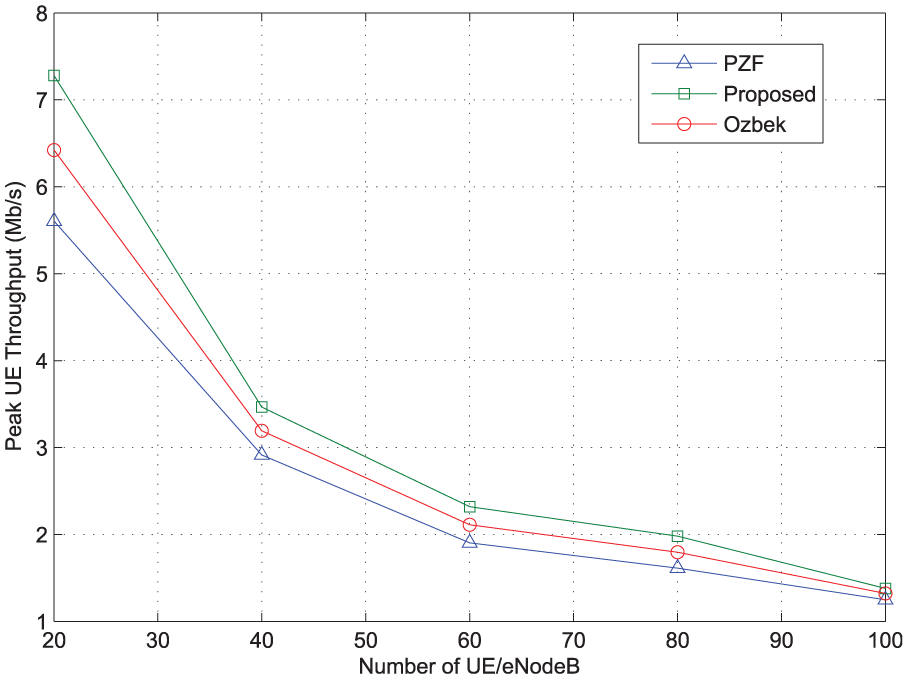
Peak mobile user throughput as number of mobile users per base station is increased.
Figure 2 shows how increasing transmission power of base stations has a positive effect on the evaluated techniques. It is well-known that increasing transmission power leads to increased interference. Therefore, it is expected that the performance would degrade as the transmission power of base stations is increased. Nevertheless, having improved peak throughput of mobile users (when transmission power is increased) suggests that the evaluated mechanisms favor mobile users who can achieve the best performance. This fact can be clearly noticed when comparing Figure 10 with Figure 2. In the later, the average throughput of mobile users is depicted. It shows that increasing transmission power of base stations negatively affects the average throughput of all mobile users. On the other hand, Figure 10 suggests that the negative effect is not experienced by mobile users equally. Most of the mobile users suffer from the increased interference due to the increased transmission power, while other mobile users benefit from such increment of transmission power.
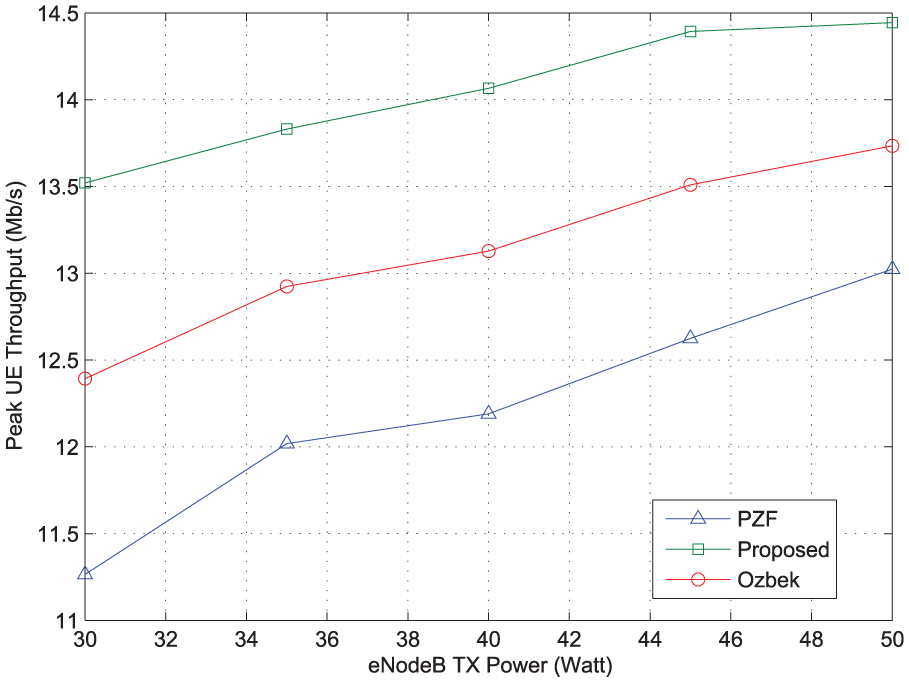
Peak mobile user throughput as transmission power of eNodeB is increased.
Figure 11 shows how manipulating the inter-base station distance affects peak throughput of mobile users. As said before, the freedom of configuration increases with larger coverage areas of base stations. In such areas, there are many possible ways to distribute mobile users. This leads to highly differentiated interference profiles for each one of these users. Therefore, the possibility of finding better transmission power assignments for all mobile users increases as the coverage area of base stations increases. The proposed mechanism is able to outperform other evaluated mechanisms for transmission power assignment as depicted in Figure 11. Also, the figure suggests that peak throughput of mobile users converges to specific points as the inter-distance between base stations increases beyond specific values.

Peak mobile user throughput as geographical distance among eNodeBs is increased.
Figure 12 describes how manipulating the mobile users’ speed affects peak throughput of these users. The proposed mechanism is able to outperform other evaluated solutions as depicted in the figure. As said before, this behavior is due to the fact that a subset of mobile users is enjoying optimal transmission power assignment when the proposed mechanism is adopted. Probably, this subset includes large portion of mobile users who are achieving the peak throughput. Also, Figure 12 shows that Ozbek solution performs worse than the standard PZF solution when mobile user speed is high. In addition, the gap between the proposed mechanism performance and PZF is shrinking as mobile users’ speed increases.

Peak mobile user throughput as mobility speed of these users is increased.
Edge mobile user throughput
Edge mobile users are the most sensitive among all users to the performance of the transmission power assignment mechanisms. In general, these mechanisms try to mitigate interference negative impact on mobile users. Since edge mobile users are the most affected by interference, the performance transmission power assignment mechanism with regard to this set of users is very important. Any slight improvement is highly appreciated since such improvement may lead to achieving the minimum quality of service for edge mobile user. However, any designed mechanism for transmission power assignments should not be solely focused on edge mobile user performance. The number of edge mobile users is increasing as the adoption of smaller cell size is adopted. A delicate trade-off between the performance of edge mobile users and all other users should be considered when designing the transmission power assignment mechanisms.
Figure 13 shows how performance of edge mobile users in terms of throughput is affected by increasing number of all mobile users per base station. The proposed mechanism is capable to outperform other evaluated solutions. Note that the difference in performance between the evaluated mechanisms is almost constant over different values of mobile user population size. The reduction in performance is due to the increased competition and interference as a result of having more mobile users to serve.

Edge mobile user throughput as number of mobile users per base station is increased.
Figure 14 depicts how manipulating the transmission power of base stations is affecting edge mobile user throughput. Increasing transmission power leads to the increment of interference caused by the neighboring base stations. Therefore, the degradation of performance is noticed during this experiment. However, the proposed mechanism is able to outperform other evaluated mechanisms. In addition, the performance of all evaluated mechanisms is not constant as seen in the previous experiments. Here, the gap between the proposed mechanism and Ozbek solution shrinks as the transmission power is increased. On the other hand, the gap between PZF mechanism and the other evaluated solutions increases as the transmission power of base stations increases. This behavior suggests that there are similarities of the evaluated mechanisms directly affecting how they manage transmission power.
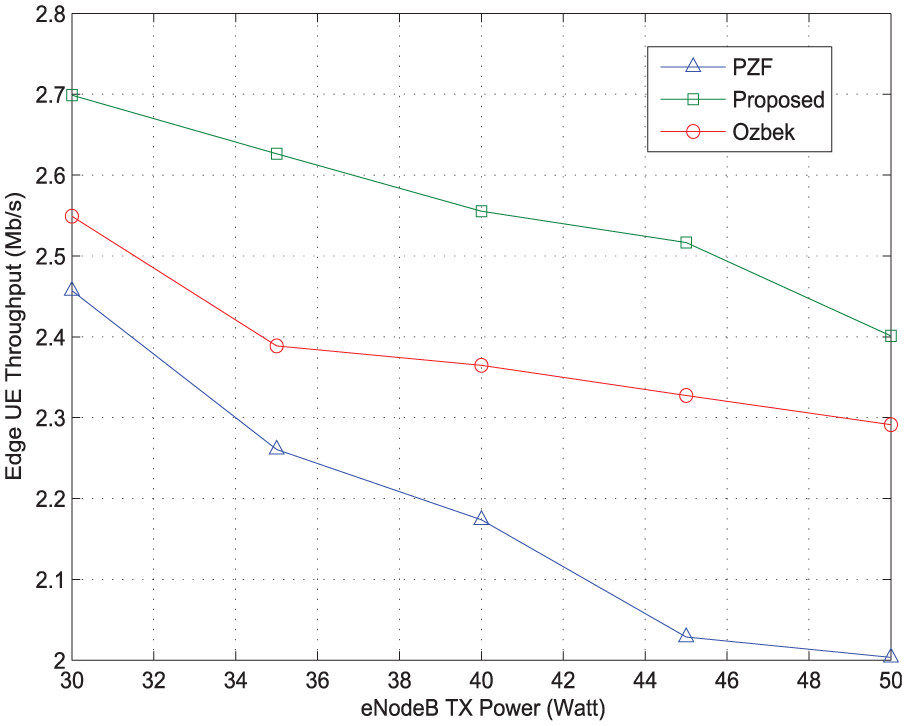
Edge mobile user throughput as transmission power of eNodeB is increased.
In addition, the differentiation of the evaluated mechanism behaviors can be noticed in Figure 15. This figure depicts how increasing inter-distance between base stations affects edge mobile user throughput. Increasing such distance will increase the coverage area. As a result, interference from the neighboring base stations is supposed to decrease. At the same time, the distance between edge mobile users and the serving base station increases as well. The degradation of edge mobile user throughput as the inter-distance between base stations increases suggests that the positive side (reducing interference) of such increment (increasing inter-distance) does not outweigh the negative side (edge mobile users are farther from serving base station). Furthermore, the gap of performance between the evaluated mechanisms is increasing as the distance between base stations increases. The proposed mechanism is clearly outperforming other evaluated solutions in terms of edge mobile user throughput when the coverage areas of base stations are large.

Edge mobile user throughput as geographical distance among eNodeBs is increased.
Figure 16 shows that increasing mobile user speed has dramatic impact on edge mobile user throughput. As mentioned before, any slight change in performance for edge mobile users can be the difference between successful and unsuccessful transmission. The transmission power assignments for these users are very delicate and sensitive to network stability. If the network is changing rapidly due to high-speed mobile users, then the transmission power assignment for edge mobile users will fail to achieve successful transmission. This can be noticed in Figure 16. However, the proposed mechanism is the most robust among the evaluated mechanisms in terms of edge mobile user throughput when mobile users’ speed increases.
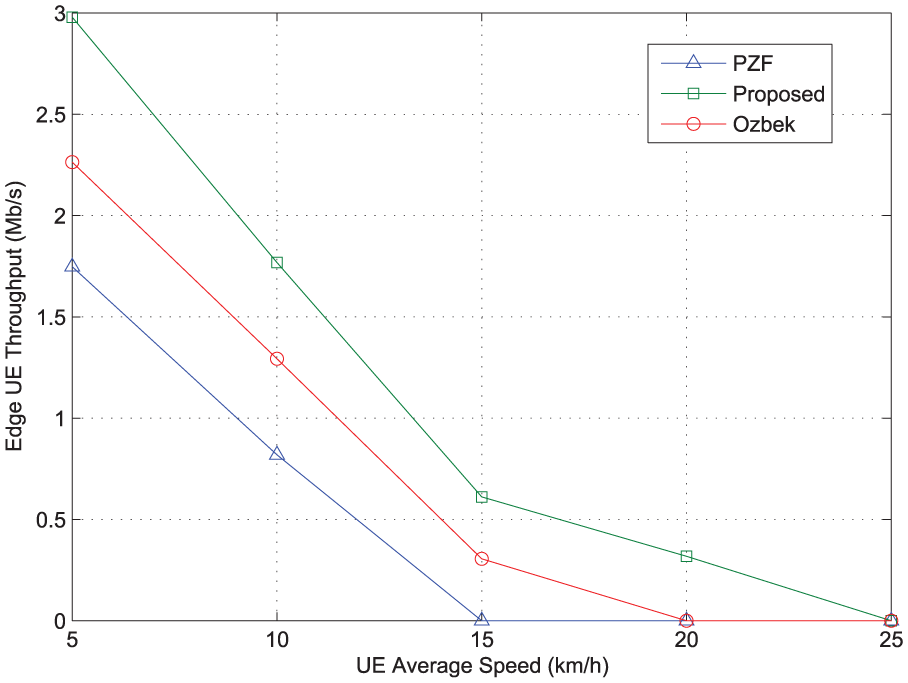
Edge mobile user throughput as mobility speed of these users is increased.
Average eNodeB throughput
In this section, the average throughput of base station is investigated. Here, base station throughput is the total throughput which is delivered to its associated mobile users. In general, any proposed mechanism for wireless communication tries to maximize this performance metric. However, trying to improve on only this metric may not be wise. For example, base stations can select the nearest mobile user and allocate all resources to such user. By following this strategy, base stations are guaranteed to achieve the maximum possible total throughput. However, such strategy clearly does not serve the overall objective of mobile communication systems which are serving the largest possible number of mobile users. Hence, the proposed solutions should try to improve this performance metric while considering other metrics such as fairness.
Figure 17 shows how increasing number of mobile users per base station decreases the total throughput of these base stations. Since the general objective of these base stations is to serve as many mobile users as possible, compromises would be made. These compromises lead to losing portions of total throughput. As the number of mobile users increases, competition over base station resources increases as well. Therefore, trying to satisfy all mobile users leads to reduction in base station performance. However, the proposed mechanism is capable of finding better compromises than other evaluated mechanisms.

Average base station throughput as number of mobile users per base station is increased.
Reduction in base station performance in terms of total throughput can be noticed in Figure 18 as the transmission power of these base stations increased. This reduction is clearly due to the increased level of interference caused by the neighboring base stations. Figure 18 is the ultimate statement of how good evaluated transmission power assignments’ mechanisms handle the interference caused by the neighboring base stations. The proposed mechanism is clearly the best among other evaluated mechanisms in terms of base station throughput with regard to the transmission power.

Average base station throughput as transmission power of eNodeB is increased.
The result in Figure 19 confirms that the general reduction in performance in Figure 18 is due to increased interference from the neighboring base stations. Figure 19 shows how increasing inter-distance between base stations has a positive impact on base station total throughput. As this distance increases, the interference coming from the neighboring base station decreases. Therefore, the performance of base station throughput slightly improves as the distance between base stations is increased. This can be clearly seen in Figure 19. Also, the proposed mechanism outperformance is depicted in Figure 19.

Average base station throughput as geographical distance among eNodeBs is increased.
Finally, Figure 20 shows how increasing mobile users’ speed negatively impacts base station throughput. The same argument discussed in previous experiments is adopted here as well. Mobile users with high speed lead to unstable networks. Therefore, the validity of the transmission power assignment as optimal assignment is short lived. Mobile users’ situations are rapidly changing in highly dynamic environment. Assigning the transmission power for a mobile user in the current position may not be optimal in near future if such mobile user is moving with high speed. Nevertheless, the proposed mechanism is able to outperform other evaluated solutions.
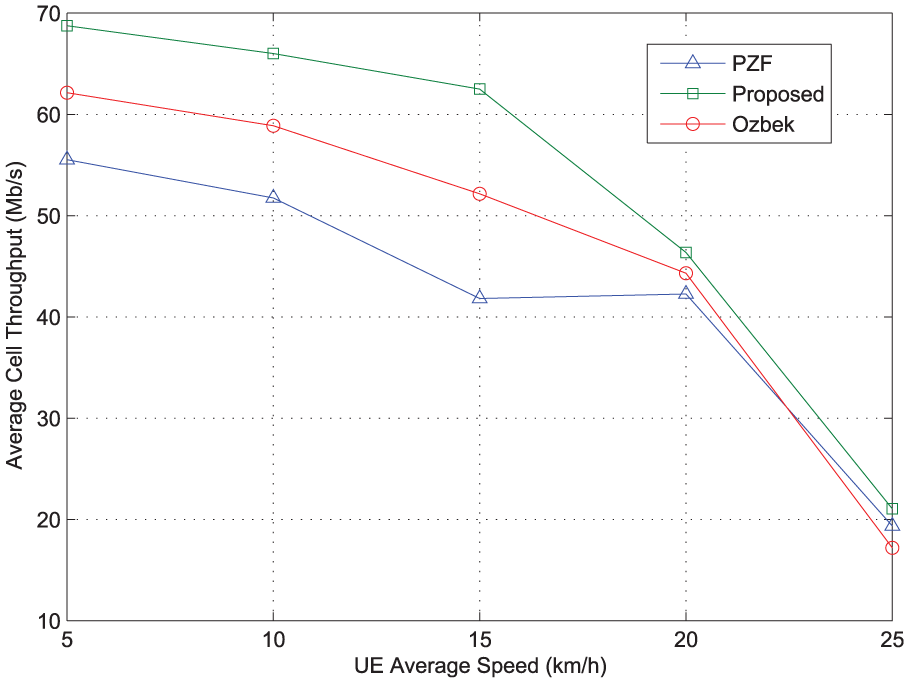
Average base station throughput as mobility speed of these users is increased.
Conclusion
This article addressed interference problem in modern mobile telecommunication systems. The main idea behind addressing this problem is by controlling the transmission power of the neighboring base stations so that the interference is mitigated. CoMP concept was utilized. This concept has been proposed to increase cooperation among base stations in LTE systems. In addition, the proposed solution used action theory to balance between base station self-interests and global stability of cooperation. Many simulation experiments were conducted which showed the ability of the proposed solution to outperform the existing methods of cooperative transmission power. Keep in mind that the proposed solution requires sharing of power information among cooperative base stations. However, the amount of shared information is minimal and it does not overwhelm the system since new standards of mobile telecommunication systems already have built-in mechanisms of sharing. 1
Footnotes
Declaration of conflicting interests
The author(s) declared no potential conflicts of interest with respect to the research, authorship, and/or publication of this article.
Funding
The author(s) received no financial support for the research, authorship, and/or publication of this article.