




Abstract
It is crucial to stimulate active participation of smartphone workers in crowdsourced sensing systems. This is due to the fact that it takes a smartphone worker considerable cost in terms of dedicated smartphone resources, human intervention, and possible privacy breach. Many incentive mechanisms have been proposed. However, existing incentive mechanisms suffer a serious common problem: they all assume full rationality of smartphone worker. Such fully rational smartphone workers are often too idealized! A smartphone worker may not be able to get the complete information and hence fails to compute the optimal strategy. In the real world, however, smartphone workers are usually bounded rational. Being bounded rational, a smartphone worker would not change the current strategy until its utility becomes too low. In this article, we propose an evolutionary stable participation game framework for crowdsourced sensing systems with smartphone workers of bounded rationality. Based on the evolutionary dynamics, we design and implement an evolutionary stable participation mechanism. It is proved that the system converges to an evolutionary equilibrium, which is globally asymptotically stable and robust to any degree of perturbations of the workers. Extensive simulation results show that the evolutionary participation mechanism leads the system to an evolutionary equilibrium quickly.
Introduction
Smartphones have become necessary for most people today. The powerful sensors embedded in smartphones, such as accelerometer, gyroscope, microphone, global positioning system (GPS), and camera, allow one to easily collect sensing data about surroundings and share the data with remote users. As a consequence, crowdsourced sensing has emerged as a compelling paradigm to collect sensing data on a large scale. It envisions a wide variety of application domains, including health, commerce, social network, environment monitoring, transportation, safety, and privacy. 1
A crowdsourced sensing system 2 consists of a platform and a large group of smartphone workers, as illustrated in Figure 1. The platform hosts a number of lasting sensing processes which recruit smartphones to contribute sensing data of a specific type to support a monitoring application (e.g. traffic congestion monitoring, and noise level monitoring). A smartphone worker may join one of the sensing processes by collecting the required sensing data and reports the sensing data to the platform to be leveraged by the specific sensing process.

The system structure of a crowdsourced sensing system.
It is crucial for crowdsourced sensing systems to stimulate smartphone workers to actively participate in sensing processes by contributing sensing data. This is due to the fact that it takes a smartphone worker considerable cost in terms of dedicated smartphone resources central processing unit, bandwidth and energy), human intervention, and possible privacy breach. Many incentive mechanisms have therefore been proposed.3–6 Reverse Auction based Dynamic Price (RADP) 3 is the first reverse auction incentive mechanism for crowdsourced sensing systems. Yang et al. 4 propose two different incentive mechanisms for a platform-centric model and a user-centric model in crowdsourced sensing systems. A reverse auction-based incentive mechanism 5 is proposed for user participation level determination and payment allocation. Liu and Zhu 6 consider maximizing the performance of a crowdsourced sensing system with an incentive mechanism.
Existing incentive mechanisms are good in theory, but suffer a major common problem: they all assume full rationality of smartphone worker. Being fully rational, a smartphone worker always selects the best strategy to maximize its own benefit. In the meanwhile, such a fully rational worker needs the complete system information and possesses the sufficient computational ability. Such fully rational smartphone workers are often too idealized! This is due to the fact that a smartphone worker may not be able to get the complete information and hence fails to compute the optimal strategy. In the real world, smartphone workers are instead usually bounded rational. Being bounded rational, a smartphone worker would not change the current strategy until its utility becomes too low. When choosing a new strategy, a smartphone worker may only access to incomplete information and then decides the new strategy. Thus, bounded rationality can better characterize smartphone workers in the real-world crowdsourced sensing systems.
In this article, we propose an evolutionary stable participation game framework for a real-world crowdsourced sensing system with smartphone workers of bounded rationality. We study and analyze the dynamic behavior of such smartphone workers. We then propose a fast and distributed evolutionary stable participation algorithm to allow the workers to evolve their strategies simultaneously in parallel. A worker makes its decision in a comparative manner (i.e. comparing its payoff with the system average payoff). The system will eventually evolve to an evolutionary equilibrium which is globally asymptotically stable, that is, it is robust to any degree of perturbations of the workers. We have performed extensive evaluations, and the numerical results verify the key features of the distributed evolutionary stable participation algorithm.
The main results and contributions of our work are listed as follows:
We build the first evolutionary stable participation game framework, to the best of our knowledge, for crowdsourced sensing systems with smartphone workers who are bounded rational. We study the evolutionary dynamics of bounded rational workers.
We propose an evolutionary stable participation mechanism based on the evolutionary dynamics. We prove that the proposed mechanism converges to the evolutionary equilibrium, which is globally asymptotically stable.
With extensive numerical results, we show that the evolutionary stable participation mechanism achieves desirable performance and robustness to any degree of perturbations of workers.
The rest of this article is organized as follows. The related work is presented in section “Related work.” We describe the system model and evolutionary stable participation game in section “Preliminaries.” We then propose the evolutionary stable participation algorithm in section “Evolutionary stable participation game.” The performance of the proposed mechanism is evaluated in section “Simulations.”We finally conclude in section “Conclusion.”
Related work
In this section, we review related work. First, we present applications of crowdsourced sensing. Second, we discuss several incentive mechanisms for crowdsourced sensing. Next, we present the use of evolutionary games in other areas. Finally, we also discuss other issues of crowdsourced sensing.
Crowdsourced sensing applications
In the past few years, there are many crowdsourced sensing–based applications being studied and proposed.7–11 In Zhu et al., 10 the authors proposed a participatory urban traffic system using buses as probe vehicles to sample the road traffic conditions. Simoens et al. 12 proposed a scalable Internet system called GigaSight to collect videos from remote devices continuously. For bus arrival time prediction, Zhou et al. 13 proposed a participatory system with cell tower signals, movement status, and audio recordings. Hyperfit was proposed in Jarvinen et al. 14 to develop tools for personal nutrition and exercise management. In Bulusu et al., 15 the authors proposed two mobile camera-phone sensing systems to track price dispersion in homogeneous consumer goods.
This article focuses on modeling the participation dynamics of smartphone workers, which provides useful insight for developers of crowdsourced sensing applications.
Incentive mechanisms
Since providing incentives is a critical issue, there have been a number of studies of incentive mechanisms.3–6 Most existing studies are based on theoretical auctions. With auctions, smartphone workers submit reverse bids for sensing tasks; the auctioneer would decide the set of winning bids and also the payments to each of the winning bids. The objective of the auctioneer is to maximize the total social welfare or the total revenue of the platform. Such auction-based mechanisms are typically able to guarantee truthfulness and individual rationality.
Such auction-based mechanisms typically make the following assumptions. First, smartphone workers are completely strategic and always able to select their respective strategies for optimizing their own utilities. Second, every smartphone worker has an accurate estimation on the cost of performing a sensing task. In reality, however, such assumptions are impractical.7,16 In addition, these existing mechanisms typically consider in a crowdsourced sensing market, there is only one crowdsourcer which requests for sensing data from sensing smartphone workers. Nevertheless, a practical crowdsourced sensing market may have many crowdsourcers.
In this article, we study the evolving dynamics of smartphone workers in a practical setting. More specifically, a smartphone is able to choose different crowdsourcers over time.
Evolutionary games
The evolutionary game theory was originally exploited to study the interactive behavior of animals which belong to a population 17 and later was applied in economics and sociology for studying behaviors of human players. It is especially useful to learn and understand how individuals of a large population converge to an evolutionary equilibrium based on the replicator dynamics. 18 There are some studies which apply evolutionary game theory in cognitive radio network 19 and wireless networks. 20
However, these studies consider specific issues related to the context and hence they are inappropriate for being applied in crowdsourced sensing.
Other issues in crowdsourced sensing
Besides providing incentive to smartphone workers, there are other issues21–25 in crowdsourced sensing systems. A framework called ARTsense was proposed in Wang et al. 21 to solve the problem of “trust without identity” in crowdsourced sensing systems, with an anonymous reputation management protocol. In Boutsis and Kalogeraki, 22 a crowdsourced sensing system with privacy preservation was proposed, which enables users to disclose information without compromising their privacy. Xing et al. 23 developed a mutual privacy preserving regression modeling approach called M-PERM. Liu et al. 24 focused on the issue of efficient 3G budget utilization when the 3G communication capability of users is limited. Focusing on the problem of social welfare and fairness maximizing, Luo et al. 25 proposed two schemes for information service crowdsourcing scenarios.
Preliminaries
We introduce the system model of a crowdsourced sensing system and the background of evolutionary game theory briefly in this section, for the sake of completeness. The detailed introduction of the evolutionary game theory can be found in Smith. 18
System model
We consider a crowdsourced sensing system with a platform and a finite set of smartphone workers

The three steps in a single time slot of crowdsourced sensing procedure.
The basic procedure of crowdsourced sensing is described as follows. A worker joins one sensing process and submits its selection to the platform. The worker then conducts the task which belongs to the sensing process, obtains the required sensing data, and sends it to the platform. The platform receives the sensing data and makes the payment to each of the workers.
Evolutionary game
An evolutionary game has the following main characteristics, which make the evolutionary game applicable in a crowdsourced sensing system:
Bounded rationality. Each play in an evolutionary game has only bounded rationality. This is either due to the lack of complete information or the computational ability.
Dynamics of the game model. In an evolutionary game, a player observes other players, learns from the observations, and makes the decision based on its acquired knowledge. The evolutionary game model captures the strategy dynamics and interactions among a large number of players in the same population, which can be modeled by the replicator dynamics to study the evolvement of the system.
Evolutionary equilibrium. The concept of Nash equilibrium is widely used as a solution in traditional games. It ensures that given all the strategies of other players, no player can improve its payoff by deviating from the equilibrium. However, in dynamic systems where players are free to choose their strategies simultaneously, a better solution concept is needed. The evolutionary equilibrium is such a solution concept, by which the equilibrium is robust to the perturbation caused by a small fraction of players.
Replicator dynamics and evolutionary stable strategy
Replicator dynamics
As mentioned above, the evolutionary game theory is proposed in biology to study interactions among animals of the same population. 17 The game consists of a large population of animals (i.e. players), choosing different strategies and therefore having different fitness (i.e. payoffs). Animals with the higher fitness reproduce more offsprings, which truthfully inherit the strategy of their parents. The composition of the population changes as the reproduction process takes place over time. This process can be modeled by a set of ordinary differential equations called replicator dynamics.
Formally, a player in the population chooses a pure strategy i in a finite strategy set

where
Evolutionary stable strategy
The evolutionary stable strategy (ESS) is a refined equilibrium concept of the Nash equilibrium, which naturally leads to the idea of evolutionary equilibrium.
18
Suppose that most of the players of the population choose strategy i, and only a small fraction
Definition 1 (ESS)
A strategy i is an ESS if for every strategy
This definition implies that if strategy i is an ESS, then the mutant strategy j cannot invade the population, as long as the percentage of mutant players is small enough.
Definition 2 (strict Nash equilibrium)
A strategy i is a pure Nash equilibrium strategy if for every strategy
Setting
Evolutionary stable participation game
We next present the evolutionary stable participation game and introduce its properties. We first propose the evolutionary stable participation game model and then propose the evolutionary dynamics of the system based on the strategy evolvement of a single worker. As a result of following the evolutionary dynamics, the system eventually converges to an evolutionary equilibrium. Furthermore, we prove that the evolutionary equilibrium is globally, asymptotically stable, that is, the system is robust to any degree (not necessarily small) of perturbations of the workers.
Evolutionary stable participation game formulation
An evolutionary stable participation game is defined by a tuple
Step 1: Collecting data. The worker collects the sensing data for the sensing process.
Step 2: Sending data and getting payment. The worker sends the data to the platform and gets the payment from the platform, along with other statistical information about the previous slot.
Step 3: Adapting strategy. The worker decides whether to change its selection of the sensing process, based on the evolutionary stable participation algorithm (described in section “Evolutionary stable participation algorithm”).

where
Evolutionary dynamics
We next present the algorithm for worker to adapt its strategy over time. We first discuss a worker’s behavior in strategy evolvement. In the third step of each time slot, a worker selects the sensing process for the next time slot. A common assumption is that the worker is fully rational and always chooses the strategy that maximizes its own utility. However, this assumption is unrealistic for two main reasons. First, it is clear that the worker needs to collect all the payoff functions and the strategy profiles of other players. But this is impractical due to privacy issues. Second, several prior studies7,16 show that workers would like to participate because of improving one’s creative skills, having an opportunity of taking up freelance work, being part of a community, or even just for fun. Thus, a more practical assumption is that a worker has only bounded rationality, meaning that the working is not always maximizing its utility. Instead, it sticks to the current strategy and does not change its strategy until its payoff is too low. We make an assumption that the threshold is the system-wide average payoff.
We then discuss two factors that affect a worker’s choice in strategy evolvement. The first factor is the fraction of workers participating in the sensing process, shown in equation (3). In the real world, a worker observes the trend and follows it. The second factor is the “extra percentage of payoff” of a sensing process. It reflects the appealing of improving the utility of a sensing process. We assume that the platform is responsible for collecting the statistics and computing the average.
We next propose the algorithm for each worker based on the evolutionary game model. The algorithm is repeated in each time slot (i.e. in each generation). A worker chooses one sensing process (i.e. strategy m) based on a probability distribution denoted by the product of above two factors. At the end of each time slot, the worker receives the payment, along with the statistics from the platform. Then, it decides whether to change its strategy or not. The basic idea is to let a worker choose a better sensing process if its payoff is lower than the system-wide average payoff. The probability is based on two factors, that is, the “extra percentage of payoff”
The rate of strategy adaptation is governed by the evolutionary dynamics, as shown by Theorem 1.
Theorem 1
The evolutionary dynamics of the evolutionary stable participation game is given as

where
We then propose the evolutionary stable participation algorithm for each worker as follows.
Analysis on evolutionary equilibrium
We then investigate the evolutionary equilibrium of the evolutionary stable participation game. Since we have

according to Theorem 1.
We then propose the evolutionary equilibrium in Theorem 2, based on equation (4).
Theorem 2
The evolutionary stable participation algorithm converges to an evolutionary equilibrium

and it is globally asymptotically stable.
We prove that the ESS in equation (5) is globally, asymptotically stable. It is an important characteristic since the evolutionary stable participation algorithm is robust to any degree of mutations of the workers.
Theorem 2 implies that the system eventually evolves to the evolutionary equilibrium
Corollary 1
The evolutionary stable participation mechanism converges to the equilibrium

Analysis on complexity and cost
In this section, we analyze the complexity of the framework and the cost of each smartphone worker. The result of this analysis would show that this framework is lightweight and the cost of each smartphone work is minimal. This indicates that the framework can be adopted in real-world application scenarios.
As we can see in section “Evolutionary dynamics”, according to the framework, in each time slot, the platform collects information from different sensing processes and disseminates simple statistics about the previous time slot to all smartphone workers. Such complexity is minimal to a platform which typically has abundant computing resources.
In each time slot, a smartphone worker decides if to change the current selection of sensing process. This decision is made on a simple comparison of its payoff against the system-wide average. If the decision is to change to another sensing process, a random variable is then generated. Then, the worker performs the sensing task as required and sends the sensing data to the platform. It is clear that the cost of a smartphone worker is constant. This suggests that the cost per worker is small and a worker easily affords such a cost in practice.
Evolutionary stable participation algorithm
We then describe the evolutionary stable participation algorithm in Algorithm 1. The algorithm is designed in a distributed and parallel manner. Workers can evolve their strategies simultaneously in each time slot. The platform confirms the selected sensing processes (i.e. the strategies) of all the workers, makes the payments, and disseminates the necessary statistical information to all the workers.

The dynamics of worker participation in our algorithm can be described with the evolutionary dynamics in Theorem 1.
Simulations
In this section, we conduct simulations to evaluate our evolutionary stable participation algorithm. We first determine the strategy adaptation factor
Simulation setup
We consider a crowdsourced sensing system with N workers and M sensing processes, and we set
We also implement another distributed decision-making approach, the best response. In this approach, each worker selects the sensing process that maximizes its utility with an assumption that all the other workers’ strategy profiles are the same as those in the previous slot. The feedback of the best response approach is simply based on the previous slot. Hence, some games do not converge, for example, the Paper-Scissor-Rock game. Nevertheless, since it requires only few information and computation, the best response approach is still a useful baseline.
Strategy adaptation factor
The strategy adaptation factor

The convergence time of the evolutionary stable participation mechanism with different strategy adaptation factor
In the following simulations, we set the strategy adaptation factor
Convergence time
We evaluate the convergence time of the evolutionary stable participation algorithm. Numerical results with

Fractions of the workers choosing each sensing process and the payoff of each sensing process with
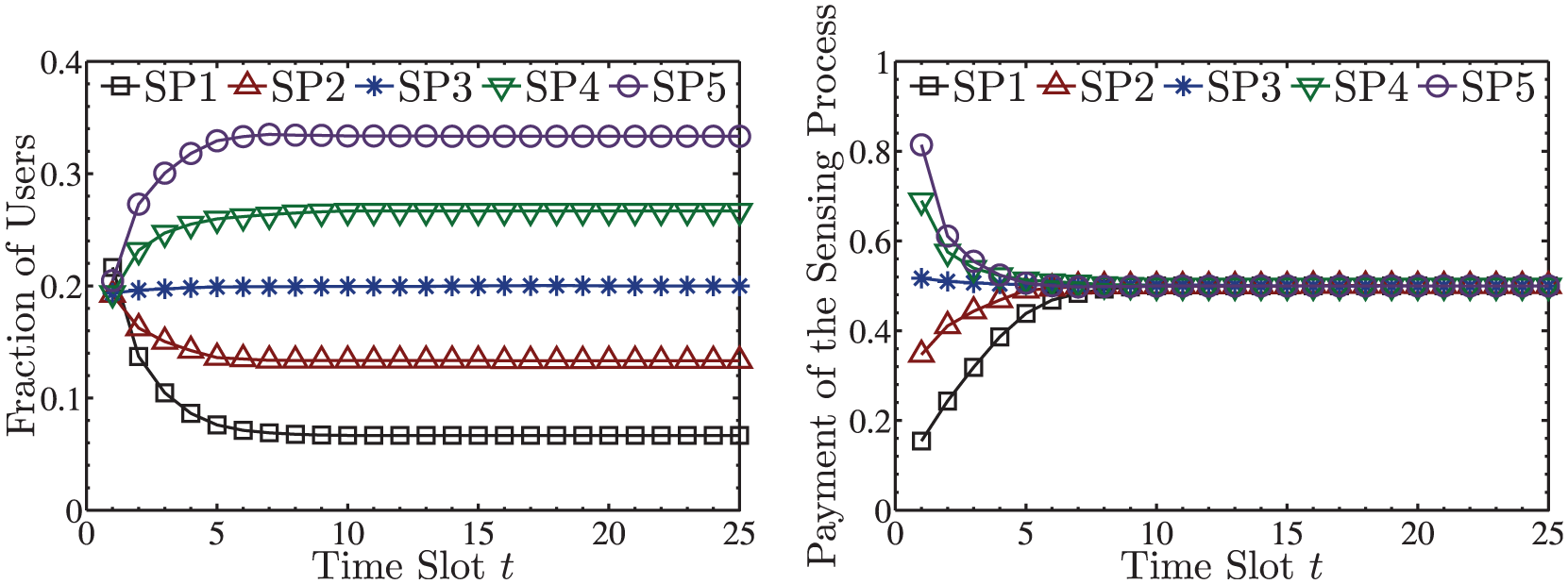
Fractions of the workers choosing each sensing process and the payoff of each sensing process with
However, the convergence of the best response approach is not guaranteed at all, shown in Figures 6 and 7. We observe that distinct strategy thrashes between the sensing process 4 and 5. Note that they are the best and second best strategy if all the workers act toward the assumption. All the other workers do not change their strategy profiles. Each worker tries to maximize its own utility based on the assumption. It is clear that a better adaptive distributed approach which utilizes the historical information is required.

Fractions of the workers choosing each sensing process and the payoff of each sensing process with

Fractions of the workers choosing each sensing process and the payoff of each sensing process with
Global asymptotic stability
We then evaluate the global asymptotic stability of the evolutionary equilibrium. When the algorithm converges to the evolutionary equilibrium, we randomly pick up a fraction

Fractions of the workers choosing each sensing process and the payoff of each sensing process with

Fractions of the workers choosing each sensing process and the payoff of each sensing process with
With the evolutionary stable participation algorithm, the system can quickly recover from the mutant states in less than 10 time slots. This demonstrates that the algorithm is robust to the perturbations of the workers. Considering that a worker may change its choosing sensing process by following the popularity, it is important to ensure the stability of data collection in the crowdsourced sensing systems.
The performance of the best response approach is shown in Figures 10 and 11. Notice that in this case the best response approach never converges to an equilibrium. Thus, the impact of the mutant is not studied.

Fractions of the workers choosing each sensing process and the payoff of each sensing process with

Fractions of the workers choosing each sensing process and the payoff of each sensing process with
Conclusion
We propose a novel evolutionary stable participation game framework for crowdsourced sensing systems with a large population of workers. In the real world, considering the privacy issue and worker behavior, it is unrealistic to assume that the workers are fully rational. Instead, bounded rationality is more suitable for characterizing the workers. We propose an evolutionary stable participation algorithm based on the evolutionary game theory. Rather than maximizing its utility, a bounded rational worker learns and improves its strategy over time with the statistical information provided by the platform. The system converges to an evolutionary equilibrium in short time, which is globally and asymptotically stable.
Footnotes
Academic Editor: Hongke Zhang
Declaration of conflicting interests
The author(s) declared no potential conflicts of interest with respect to the research, authorship, and/or publication of this article.
Funding
The author(s) disclosed receipt of the following financial support for the research, authorship, and/or publication of this article: This research was supported by Wenzhou Science and Technology Bureau (Nos 2016G0024 and 2016G0001) and the Key Project of Wenzhou Vocational & Technical College (No. WZY2016004).