




Abstract
In the coming Internet of Things era, billions of users and devices will be connected to the Internet; this will lead beyond the era of super-connection to the era of super-fusion. In this era, it is more important than ever to design a highly scalable Internet of Things infrastructure by mass customization for cost-effective production of exponentially increasing numbers of Internet of Things systems to provide more intelligent service in smart spaces. The purpose of this article is the design of mass-customization-based Internet of Things system through three-level analysis of the building; it proposes a new concept of a systematic design for providing economical Internet of Things systems for intelligent service in smart building spaces through three-level analysis comprising environmental-, service-, and functional-level analyses.
Keywords
Introduction
At the Consumer Electronics Show (CES) 2015 in Las Vegas, a key theme was the Internet of Things (IoT), which exceeds the era of “super-connection” and moves into the era of “super-fusion.” The key drivers of IoT are “energy efficiency,”“safety,”“healthcare,”“entertainment,”“security,”“connectivity,” and “control and monitoring,” demonstrating a fusion of technologies. In IoT, billions of users and devices will be connected to the Internet, configured as a cooperative society and creating new economic opportunities by providing a platform that will connect all people to a global community. 1 As a result, Gartner predicted that the number of Internet-connected devices would be 4.9 billion more in 2015 than in 2014 and will increase by 30% to 25 billion by 2020. The number of consumers, businesses, and government agencies exploring the use of IoT technologies has increased dramatically, and IoT is expected to have an even greater economic impact.
One of the primary challenges of IoT is the “economic production and intelligent design of IoT systems through mass customization” for the explosion of IoT devices. The large number of IoT devices will lead to increased overlapping of service coverage areas, thus incurring unnecessary energy and financial losses. In addition, with the explosive increases in IoT devices, the challenge of how to produce IoT devices economically becomes more important. Thus, to solve this problem, it is important to design a cost-effective IoT infrastructure through three-level (3-L) analysis: environmental-level analysis, service-level analysis, and functional-level analysis of the service domain.
The following represents comments on the importance of a mass-customization-based IoT infrastructure configuration. Shawn G (Consumer Electronics Association (CEA) strategic analysis team of the CES 2014) showed that technology is trending toward “sensor technology” and unmanned systems via “mass customization.” Sonny V (beGLOBAL 2015 in Seoul, South Korea) said that aspects of IoT infrastructure and software are developed based mostly on iOS, and the hardware is different for each machine. The speed of hardware development is a constant topic of discussion. For mass production, IoT devices must be tailored by enhanced engineering to achieve low costs. The number of customers who are willing to pay high prices is in increasing decline. It is very important to reduce the manufacturing costs of IoT devices. This article proposes a mass-customization-based IoT system to provide a cost-effective and intelligent service consistent with these important IoT aspects.
Current IoT system versus proposed IoT system in a BEMS
Figure 1 shows configuration method of the proposed IoT system compared to the current IoT system. The current IoT implementation of a building energy management system (BEMS) is installed in a dispersed manner in a variety of environments within a building, such as rooms, stairs, corridors, and parking lots. 2 The system operates well. The problem is not in the energy and system aspects when viewed individually; the problem is that each IoT system, from the viewpoint of an entire BEMS, incurs financial and service-side waste. The reasons include the following:
Variety of environments. Current systems are distributed environment systems; they are installed separately in each of the various environments. 3
Redundancy of services. Because of environmental diversity, distributed and separately installed IoT systems have many overlapping regions of sensor radius and service application zones.4,5
Non-standardization of IoT devices. There is no common standardized framework for various IoT devices, which incurs a high cost when designing and manufacturing sensors and IoT devices.6,7

(a) Current IoT system versus (b) proposed system in a BEMS.
To solve the above problems, this article proposes a mass-customization-based IoT infrastructure through a 3-L analysis of BEMS satisfying the following:
Hierarchical analysis of environment. This article suggests a hierarchical analysis method of distributed BEMS environments for intelligent installation of IoT systems.
3-L analysis for top-down approach of services. This article suggests a method of service application through environmental-, service-, and functional-level analyses and a top-down approach to the BEMS.
Mass-customization-based IoT devices. This article presents a mass-customization-based IoT device manufacturing method through analysis of various BEMS environments and optimal production to reduce IoT device production costs. 8 The following section discusses the literature on mass customization, its meaning, and related case studies in this article.
Related works
Literature reviews on mass customization
In this section, we discuss the literature on mass customization. It is known that Hayes and Wheelwright 9 were the first to mention the concept of mass customization. The term itself was first used in “Future Perfect,” written by Davis. 10 He explained that mass customization is “the ability to supply individually designed products and services to all consumers by fast and flexible process.” The concept of mass customization combining the advantages of mass production and customization is suggested by Pine and Davis, 11 who carried out a more detailed study on marketing and production management.
Pine and Davis 11 defined mass customization as the “process of realizing a product diversification and a customization according to flexibility and immediate correspondence”—that is, accomplishing mass production and customization simultaneously. Whereas mass production seeks low cost in terms of “economies of scale,” mass customization realizes low cost through “economies of scope.” It is important to use standard parts for devices to increase the diversity of final products when manufacturing innumerable standard parts. Pine et al. 12 compared the differences among mass production, continuous improvement, and mass customization. Conventional mass production includes low cost and standard products and services. Continuous improvement seeks high quality while maintaining the benefits of mass production. Mass customization is defined as the added customization benefits for continuous improvement—in other words, to “provide high-quality customized products and services at a lower cost.” An essential element in the success of mass customization is modularization. Hart 13 defined mass customization as “producing the tailored products and services by same price of the mass production standard using flexible processes and organizational structures.” A collaboratively designed system, flexible production processes, and learning relationships are the components of mass customization strategies. Mass customization and implementation strategies also include elements considering customer sensitivity, process amenability, a competitive environment, and organizational readiness. Da Silveira et al. 14 defined mass customization as a system that produces a similar cost for a mass-produced product using information technology, flexible processes, and organizational structure for a diversity of services and products to meet customer needs. 15 Da Cunha et al. 16 suggested a modular design for cost-effective mass-customization-based supply chain management that is based on demand patterns, which are determined by a mix of modules and their stock by two heuristic algorithms. Moreover, Dietrich et al. 17 showed that mass customization is introduced as a competitive strategy for diversified markets by combining the principles of mass production and individualization. They present an approach for mass customization that is based on service-oriented architecture (SOA), and they illustrate it with a case study from the shoe industry. Zhong et al. 18 defined mass customization as a competitive mode of producing a wide variety of customized products using a large-scale mass production strategy to satisfy diverse customer requirements. This article presents a radio frequency identification (RFID)-enabled real-time manufacturing execution system for mass customization management that includes real-time data collection.
Recently, several papers related to mass customization have been published in the information and communication technology (ICT) field. First, Chiu and Chiou 19 proposed a three-phase approach to develop a technical service platform for planning based on a company’s competitive advantage and the future market trends. They also presented a service-oriented platform for the manufacturing field by accounting systemically for the technical benefits, commercial benefits, industrial chain completeness, and risk attributes. Moreover, Mai et al. 20 proposed a customized production framework for a three-dimensional (3D) printing service platform for cloud manufacturing. It allows consumers to buy a variety of customized products and permits them to design and create their own products in the cloud. The following section shows some representative case studies on mass customization.
Case studies
In these case studies, we introduce some of the mass-customization-based products that are widely used in core business strategies in the fashion, food, and ICT fields. First, Nike in the United States manages to apply mass customization in the fashion field. Nike customers can choose the shape, material, and color of their shoes for an additional cost of US$10, under the slogan of “my own shoes, existing only one in the world.” Moreover, menswear brand “Brooks Brothers” in New York has instituted marketing that it can measure the various dimensions of a customer through a body scanner within 12 s, and then select the design, color, and textiles in the showroom to allow customer to have “my dress” after 3 weeks. The Siemens factory in Germany controls and manages the plant with RFID attached to each product for real-time control to allow the customers to be aware of all the product information. Dell also has a mass-customization-based marketing method to allow customers to order a combination of desired specifications directly through the Internet, and it has become popular enough to surpass 50% of total sales. In addition, in the ICT and mobile fields, a representative case study of mass customization is the LG G5 smartphone. This consists of the main body module, a camera module, a speaker module, and a battery module. It provides various customized functions to set each module according to the user’s preference at any time.
These mass-customization-based marketing methods are applied to fashion, food, clothing, and household appliances to provide users with a customized service innovation in manufacturing. However, although there are many convenient user-centric products and much research about mass customization, the research and literature about the fields of service-oriented ICT and IoT are still in a relatively early stage.
In this article, we propose a mass-customization-based IoT sensor system for use inside a building in the expected IoT environment as presented in section “Introduction.” The main purpose of this article is to produce a highly scalable IoT sensor system by the intelligent arrangement of the number of sensors or services for the various users and environments inside the building and to design a cost-effective IoT system. In this article, we introduce “Mass-Customization-based Cost-Effective Internet of Things Sensor System in Smart Building Spaces” for application in the IoT environment from the viewpoint of ICT fields. Tables 1 and 2 show summaries of the mass-customization-related work proposed above. Table 1 compares the cited literature, while Table 2 compares the case studies, all with reference to the proposed system and by descriptions of their mass customizations, purposes, similarities, and differences. In addition, section “Mass-customization-based IoT” illustrates the concept of mass-customization-based IoT that is presented subsequently in this article.
Summary of cited literature on mass customization.

SOA: service-oriented architecture; 3D: three-dimensional.
Case studies on mass customization.

ICT: information and communication technology; IoT: Internet of Things; PC: personal computer; RFID: radio frequency identification.
Mass-customization-based IoT
Mass customization is a marketing method for a highly competitive ability to customize and mass produce products. 21 In this article, using this concept from an engineering viewpoint, mass customization for IoT design is represented by the conceptual diagram shown in Figure 2. Mass customization incorporates economic concepts considering a large consumer group with individual needs. It refers to a mass production method to meet the various needs as far as possible by identifying and categorizing common consumer requirements. 10 As shown in Figure 2, it is an economic concept for reducing production costs by minimizing marginal costs through customization of various and specific parts of the sensors and mass production of common parts of the sensors to satisfy various IoT services. 1 This article presents a method for cost-effective IoT device production that addresses the grand scale of the IoT paradigm through the above economic concept.
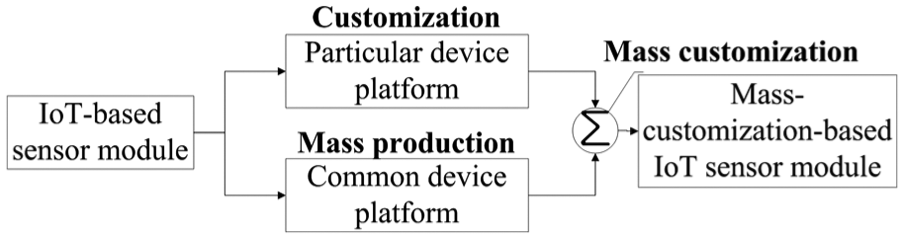
Concept of mass-customization-based IoT.
Section “3-L analysis of mass-customization-based IoT in a BEMS” of this article explains the meaning and method of mass-customization-based IoT design through 3-L analysis and presents the connections and analyses between each level. Section “Implementations” presents BEMS scenarios based on mass-customization-based IoT design and shows and compares the advantages of the proposed system and the decreased production costs of IoT devices according to expansion of IoT infrastructure. Finally, section “Conclusion” presents the total results and future aspects.
3-L analysis of mass-customization-based IoT in a BEMS
Figure 3 shows the proposed methodology of mass-customization-based IoT in a BEMS. It consists of three analysis layers: the environmental level, service level, and functional level. First, at the environmental level, the environmental factors (space, area, quantity, and number of users) are analyzed. Second, in the service level, the service factors (context-aware, energy-aware, and safety) are analyzed and determined on the basis of the environmental analysis results. Third, in the functional level, the sensor devices are determined by analyzing the size, battery lifetime, and sensing radius of the sensor elements for the configuration of the determined application service. Finally, in the mass customization layer, final IoT sensor devices are configured through the mass-customization-based combination of sensors, and these devices are then installed in the IoT-based smart spaces in a building.

Methodology for manufacturing IoT sensor devices by mass customization.
Table 3 is the code classification table for all factors used in this article. Table 4 lists the information of the building investigated at the College of Engineering in Chung-Ang University in Korea. The environmental-level analysis in Table 4 consists of a total of nine places, and each place is classified according to the total area, quantity, and expected number of users. From the environmental-level analysis, the five representative environmental factors can be collected and are classified as common factors or particular factors. This classification of environmental factors leads to effective configuration of the mass-customization-based IoT devices. Through the service-level analysis, service factors are classified into five factors (context-aware, energy-aware, safety, security, and green information technology (IT)) and are further classified in more detail into seven factors (light-emitting diode (LED) management system; heating, ventilation, and air conditioning (HVAC) system; power and monitoring management system; safety; disaster prevention; crime/intruder prevention; and gas/CO leakage monitoring). Through the functional-level analysis, the five sensor factors to configure the services can be classified, and the optimal sensor configuration can be determined for each service and application. Section “Environmental-level analysis” represents the interconnection of levels 1 and 2 to further explain Figure 1.
Code table.

LED: light-emitting diode; HVAC: heating, ventilation, and air conditioning.
Overall three-level (3-L) analysis classification table.

Environmental-level analysis
The first step is the environmental-level analysis. Figure 4 indicates the necessary services for a particular space (e.g. “Class”) through environmental analysis in a BEMS by arrows. As shown in Figure 4, it is determined that the required service for a “Class” in a BEMS is context-aware; an “LED system” and an “HVAC system.” The block of the area, quantity, and number of users are detailed classifications of the environment, such as the total area of that type of space, quantity of that type of space, and the number of users to apply the optimal services. Table 5 shows the classes for each range of the area, quantity, and number of users. The routing table is a guidance chart of the kinds of services and where they can be applied; a routing table is made from the code of each space, area, quantity, and number of users.

Analysis of connection between the environmental- and service-level layers.
Detailed classification and ranges.

Table 5 shows the ranges for the area, quantity, and number of users. For example, in Figure 4, “Class” is selected in the bottom layer and is linked with application services in the service-level analysis layer. There are three blocks—area, quantity, and number of users—in the environmental-level analysis layer; they contain information of the “Class” space’s area, quantity, and number of users. As shown in Table 4, the total area of “Class” is 3072, the quantity is 48, and the number of users is approximately 20–50; each of the classes is adjoined in the environment-level routing table denoted by arrows. The routing table is configured through levels 1–3 and finally is used for the information map to produce the mass-customization-based IoT devices. Section “Service-level analysis” discusses the analysis of the connection between the service- and functional-level layers.
Service-level analysis
Figure 5 shows the selection of optimal sensor devices by arrows for configuration of the proposed service. For example, in Figure 4, it can be found that three kinds of sensors are selected to apply to the “LED and HVAC systems” in the “Class” space. The selected sensors are motion, illumination, and temperature sensors, which are determined by more detailed specifications such as size, battery lifetime, and sensing radius; this will be addressed with greater detail in the next functional-level analysis.
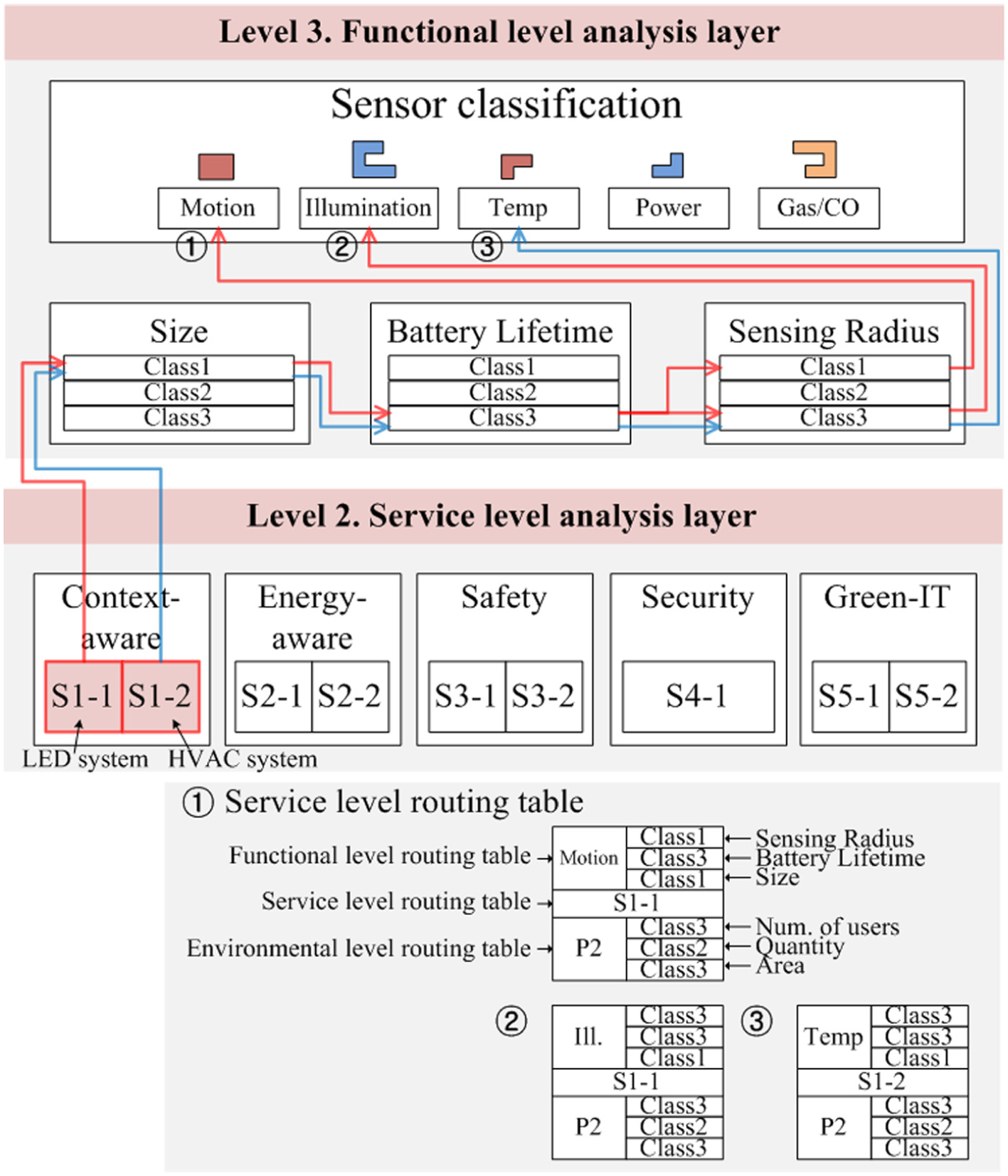
Analysis of connection between the service- and functional-level layers.
Table 6 discusses the service-level analysis of the proposed system in terms of the applicable services represented in level 2. It classifies a total of five service factors (context-aware, energy-aware, safety, security, and green IT), which are classified in more detail into eight services (user-customized LED management service, 22 HVAC system, 23 power and monitoring management, 24 safety, 25 disaster prevention, 26 crime/intruder prevention, 27 gas/CO leak monitoring, 28 and environmental conservation 29 ).
Service-level analysis and classification.

LED: light-emitting diode; HVAC: heating, ventilation, and air conditioning; CCTV: closed-circuit television; IT: information technology.
Functional-level analysis
The next step is the functional-level analysis. Table 7 shows the sensor classification for the configuration of each service presented in Table 6. As mentioned for the service-level analysis in Table 6, Table 7 shows the required sensor factors to configure the services in the functional-level analysis. Table 8 shows the detailed specification of IoT sensor devices in terms of size, battery lifetime, and sensing radius. The sensor size, sensing radius, and battery lifetime are determined according to classes 1–3 presented in the previous environmental analysis. For example, as represented in Figure 5, three kinds of sensors (motion, illumination, and temperature) are selected to configure the “LED and HVAC systems” in the “Class” space. In the case of the motion sensor, to configure the LED system in the class, three factors are determined: the sensor size must be below 27, the battery lifetime must run more than 1 year, and the sensing radius must be below 3 m. The next section shows that in the mass customization layer, mass-customization-based IoT devices are finally configured through environmental analysis, service analysis, and functional analysis.
Sensor classification for configuring of each service.

LED: light-emitting diode; HVAC: heating, ventilation, and air conditioning; IT: information technology.
Detailed classification and ranges.

Configuring of mass-customization-based IoT devices in a BEMS
This section explains the method for mass-customization-based sensor and device configuration, as shown in Figure 6. The sensors are classified into a total of five sensors in level 3; the IoT sensor device is configured by a combination of the five sensors. For example, to establish the “LED and HVAC systems” in the “Class” space of level 1, the motion, illumination, and temperature sensors are selected, and one sensor device is configured by a combination of these sensors. To configure the sensor device, the sensors are first classified as common factor and particular factor; the common factor is produced by mass production, the particular factor is produced by customization, and they are applied to the BEMS. At this time, the routing table is used for information regarding what services are applied and where as well as the sensor specification for configuring the optimal IoT system in the BEMS. The routing table represents the destination place P2 (classes 1–3: a more detailed factor of P2 is class 3, class 2, and class 3), the applied services are S1-1 (LED system) and S1-2 (HVAC system), and the used sensors are motion, illumination, and temperature. The detailed specifications of each sensor are as follows: motion sensor is class 1, class 3, and class 1; illumination sensor is class 1, class 3, and class 3; and temperature sensor is class 1, class 3, and class 3.

Manufacturing of IoT sensor devices by mass customization.
Implementations
This section describes service scenarios in a building. It suggests four service scenarios (BEMS HVAC system (BHS), BEMS intelligent LED management system (BILMS), BEMS unmanned security system (BUSS), and gas/CO leakage monitoring system (GLMS)) and how they are applied to the building by mass customization of IoT. Figure 7(a) represents a blueprint of the College of Engineering in Chung-Ang University in Korea, which consists of a total of seven floors, with a lobby, corridor, stairs, and several offices. There are four IoT systems (BHS, BILMS, BUSS, and GLMS) in the building, and they use four sensors (motion, temperature, illumination, and gas sensor) and three actuators (intelligent LED system, air conditioning and heating system, and alarm). Figure 7(b) and (c) shows the method of mass-customization-based sensor device configuration of these four IoT systems, and Table 9 shows the 3-L analysis of proposed scenarios. Note that the detailed discussion is provided in section “Fusion of the systems by mass customization.”

Proposed system scenarios (fusion of four service systems): (a) blueprint of the building, (b) method of 3-L mass-customization-based IoT devices, and (c) configuration of IoT systems in a BEMS.
3-L analysis of proposed scenario.

BHS: BEMS HVAC system; BILMS: BEMS intelligent LED management system; BUSS: BEMS unmanned security system; GLMS: gas/CO leakage monitoring system; 3-L: three-level.
Service scenarios
The four service scenarios are as follows:
BHS. The HVAC system in BEMS is a representative IoT-based energy management system that adjusts temperature and humidity within a specified range after measuring the temperature and humidity using sensors. 30
BILMS. The purpose of this system is the management of the LED system for intelligent energy management using motion and illumination sensors installed in LED lighting system in smart space. 31
BUSS. The goal of this system is detecting an intruder using motion sensors in the LED management system installed in the office with additional motion sensors outside windows, for security.
GLMS. This is a monitoring system for detection of gas/CO leakage near the gas pipeline in the danger area. If the gas sensor detects gas leakage, the actuator sends a danger signal to the administrator with an alarm. 32
In this study, these systems are designed for a mass-customization-based cost-effective IoT system. Figure 8 represents the four system configurations. The central server is connected to four gateways by Ethernet, and each sensor network collects data through the gateway by ZigBee wireless network to the central server to produce a service. As shown in Figure 8, the motion sensors in the BILMS are linked with BHS and BUSS’s motion sensor. That is, the overlapped sensors can be reduced by the manufacturing method based on mass customization in the building. The proposed idea is that it can be designed for an optimal intelligent cost-effective IoT system in a BEMS through the connection of these four systems. Next, a concrete service implementation is described.

System configuration.
Fusion of the systems by mass customization
Figure 7(b) and (c) shows the method of mass-customization-based sensor device configuration of an IoT system. The mass-customization-based IoT devices are configured by combination of all sensors. BILMS (B) can be produced by mass production because it is a common factor for mass customization, and particular factors are (A), (C), and (D), which are produced by mass customization. Figure 7(b) shows the method of 3-L mass-customization-based IoT devices represented in Figure 3 to produce economical sensor devices based on the above four scenarios. Through the environmental-, service-, and functional-level analyses of the building, and by classifying the common and particular factors, the sensor devices of the common factors are mass produced, and those of the particular factors are customized. For example, as shown in Figure 7(b), the laboratory (P3) and corridor (P5) are selected at the environmental level, and the application services are BILMS (S1-1), BHS (S1-2), and BUSS (S4-1) in a laboratory, and BILMS (S1-1) and GLMS (S5-1) in a corridor. To manufacture the IoT system for configuration of these services, the five sensors are combined at the functional level. Finally, at the mass customization level, the sensors are divided into two factors: common factor and particular factor. The IoT sensor device is manufactured by mass customization and applied to each place.
Figure 7(c) shows the four identified services applied in the laboratory (P3) and corridor (P5) of a building. The first service is BHS. As shown in Figure 7(c), (A), there are two temperature sensors in a room, and the temperature is measured by the average of the two sensors. The BHS operates actuators and maintains the optimal temperature according to measured temperature data. However, BHS must operate only when there is a person in a room, so the motion sensor is needed. At this time, the motion sensors are the linked motion sensors, as shown in Figure 8, and these sensors are also used in the BILMS which is the second service. The BILMS service provides optimal LED light through detection of motion and illumination using motion and illumination sensors, as shown in Figure 7(c), (B). The third system is BUSS. As shown in Figure 7(c), (C), there are three sensors outside and inside the room; when motion is detected from outside to inside, the server determines that there is an intruder and sends an alarm to the administrator. That is, one pair of motion sensors should be outside the window, and one should be inside the room; the sensor inside the room is connected with the BILMS motion sensor. The final system is GLMS. As shown in Figure 7(c), (D). The gas sensor is installed near the entrance of the gas pipeline to the laboratory. If a gas leakage occurs, the gas sensor detects it and sends a danger signal to the server and an alarm to the administrator. These four systems comprise ordinary IoT technology, but this article proposes an integrated design based on mass customization of IoT through 3-L analysis of these four systems.
Until now, the design of a mass-customization-based IoT system and 3-L analysis method by application scenarios in a BEMS has not been performed. Because the main purpose of this article is to solve the high cost of the surprising increase in IoT devices, the next section will show the effects of the proposed system according to integration and expansion of the IoT infrastructure using the above four systems in a BEMS.
Results
This section presents the differences in the IoT system configuration costs between applying and not applying the mass-customization-based IoT system methodology. As previously mentioned, the purpose of this study is the solution of the problem with rising IoT device costs because of the explosive increase of IoT devices. Therefore, this section shows the economic effects of whether the methodology is applied in smart building spaces on IoT system configuration costs according to the expansion of IoT service infrastructure. Figure 9(a) shows the main cost reduction factors of the proposed system according to the expansion of IoT infrastructure. The effects of proposed system and the reason of cost reduction are as follows.

Variation of sensor number and cost according to fusion and integrate of IoT service infrastructure: (a) expansion of IoT infrastructure, (b) number of service and type of sensor, (c) number of sensor and decrease rate, and (d) cost of sensor.
The reason of the cost reduction: removal of overlapped sensors by mass customization
The factor of cost reduction is the removal of the redundant and overlapped sensor elements due to the customization of IoT system. Figure 9 shows the result of proposed system according to expansion of IoT service infrastructure. As IoT systems are expanded from only one system to four systems (i.e. from only BILMS to whole system), the number of sensors was decreased. Figure 9(c) shows that sensors in the BILMS interconnect with BUSS and were reduced by 216 (10%), additional sensors in the BILMS interconnect with BHS and GLMS and were reduced by 216 (10%), and a total of 540 sensors were reduced (19%) in whole system according to the fusion of above proposed scenarios. These results show that the required sensors are decreased, and the redundant sensors are reduced, as IoT service infrastructure is expanded and integrated.
The effects of proposed system
High scalability of IoT system
Figure 9(b)–(d) shows scalability of proposed system according to expansion of IoT service infrastructure. As IoT systems are expanded in a building, it represents that the rate of sensor increase and sensor cost were decreased.
High efficiency and low cost of IoT system
As shown in Figure 9(b), the type of sensor is increased as the IoT service infrastructure is extended, and also the total number of sensors is increased, as shown in Figure 9(c). At this time, the important thing is that the rate of sensor increase is decreased, and the total sensor cost is also decreased in the proposed system compared with the current system (Figure 9(d)). It shows that the scalability and cost efficiency of IoT system are increased, as IoT infrastructure is expanded.
Conclusion
This article presented a method for cost-effective IoT device production that addresses the grand scale of the IoT paradigm through a mass-customization-based intelligent IoT system. Furthermore, this article suggested a method for service application through a mass-customization-based IoT system by 3-L analysis (environmental-, service-, and functional-level analyses) to address the problems of the current IoT system, which incurs high costs when designing and manufacturing sensors and IoT devices because of a distributed infrastructure in a BEMS. The 3-L analysis is a new concept for configuring an optimal IoT system by combining mass production and customization of IoT devices and provides a hierarchical and integrated approach to environmental, service, and functional analysis by a top-down approach to BEMS. Moreover, this article presents smart building scenarios based on a mass customization IoT design and compares the advantages of the proposed system and the decreased production costs of IoT system. This research is expected to be a great contribution to future society in the ICT field as it advances to smart homes, smart buildings, smart cities, and smart countries.
Footnotes
Academic Editor: Haiping Huang
Declaration of conflicting interests
The author(s) declared no potential conflicts of interest with respect to the research, authorship, and/or publication of this article.
Funding
The author(s) disclosed receipt of the following financial support for the research, authorship, and/or publication of this article: This research was supported by the Ministry of Science, ICT and Future Planning (MSIP), Korea, under the Information Technology Research Center (ITRC) support program (IITP-2016-H8501-16-1018) supervised by the Institute for Information & Communications Technology Promotion (IITP), and by the Human Resources Development (no. 20154030200860) of the Korea Institute of Energy Technology Evaluation and Planning (KETEP) grant funded by the Korean government’s Ministry of Trade, Industry and Energy.