




Abstract
This paper proposes a novel and energy efficient Internet of Things (IoT) communication scheme for next generation Wireless Local Area Network (WLAN). There are a couple of crucial requirements among unique IoT requirements: a large number of communication devices must be supported, and they must have low power consumption. Since sensor-type IoT devices, which are expected to be one of the major types of IoT devices, normally generate uplink traffic rather than downlink traffic, an energy efficient multiuser uplink transmission scheme is a crucial feature of IoT communication. In the next generation WLAN, IEEE 802.11ax, Orthogonal Frequency Division Multiple Access (OFDMA) is adopted to support a greater number of devices. However, uplink OFDMA procedures that consider the unique IoT requirements have not been fully considered in the next generation WLANs. A random access-based WLAN uplink OFDMA transmission scheme is proposed in this paper, and analytical modeling of the proposed scheme is provided. The proposed random access-based WLAN uplink OFDMA transmission scheme is able to dynamically adjust the number of contending users by uniquely applying congestion status in a very simple and distributed manner. Our numerical analysis and extensive simulation corroborate the fact that the proposed scheme is able to support a greater number of IoT devices with less power consumption.
1. Introduction
Nowadays, an ever-increasing number of devices are connected to the Internet, and it is anticipated that IoT will be one of the major communication types in future wireless communications. Since, as normally occurs in IoT, a substantial number of battery-powered devices transmit packets to their network, the requirements of IoT wireless communication systems differ from the conventional wireless communication systems. There are a few crucial requirements among the unique IoT requirements: the ability to support a large number of communication devices and low power consumption [1, 2]. IEEE 802.11-based Wireless Local Area Network (WLAN), which operates at the 2.4 GHz and 5 GHz bands, has been a very popular wireless access technology and has been deployed for various applications.
An IEEE 802.11ah task group [3] began standardizing WLAN IoT communication from October 2010 to support IoT. IEEE 802.11ah's primary objective is to provide long range communication at sub-1 GHz license-exempt bands for cost-effective and large-scale wireless networks. Since available Industrial, Scientific, and Medical (ISM) bands are scarce at sub-1 GHz frequency, IEEE 802.11ah has designed a new physical (PHY) layer based on IEEE 802.11ac [4], which is an IEEE 802.11 amendment that provides very high WLAN throughput. New IEEE 802.11ah Medium Access Control (MAC) features have been developed to meet the objectives of IEEE 802.11ah. Since IEEE 802.11ah operates at sub-1 GHz ISM bands without considering backward compatibility with legacy IEEE 802.11 systems operating at 2.4 GHz or 5 GHz, IEEE 802.11ah is able to define new PHY and new MAC frame formats, and new procedures for IoT. However, the scarcity of sub-1 GHz ISM bands, the IEEE 802.11ac-based PHY layer, and Distributed Coordination Function (DCF) contention-based access have limitations to fully meet the requirements of IoT.
A next generation WLAN air interface standard, IEEE 802.11ax, commenced its standardization from May 2014. IEEE 802.11ax's objectives are to enhance its performance at least 400% for the average throughput per station in a dense deployment scenario, while maintaining or improving the power efficiency per station [5]. IEEE 802.11ax adopted Orthogonal Frequency Division Multiple Access (OFDMA), which allows multiple users to transmit or receive at the same time, to enhance the system throughput. The target wake time (TWT) power saving scheme of IEEE 802.11ah is adopted in IEEE 802.11ax [6]. Sufficient available ISM bands, efficient multiuser support with OFDMA, and advanced power saving schemes make IEEE 802.11ax a good candidate for advanced IoT WLAN systems. However, since the current IEEE 802.11ax basic uplink OFDMA scheme does not fully consider the two crucial IoT requirements, a new uplink OFDMA transmission scheme has to be defined.
A novel uplink OFDMA transmission scheme that meets the requirements of IoT is proposed in this paper. Since uplink transmission consumes more battery power and is more difficult to design than downlink, the primary concern of this paper is the uplink transmission scheme. The proposed scheme consists of two stages: random access-based status collection and uplink data transmission. Since the proposed random access-based status collection employs an uplink OFDMA random access transmission scheme, the proposed scheme is able to support a large number of users.
However, it is well known that WLAN's performance degrades as the number of simultaneously contending users increases. The proposed scheme further provides a novel dynamic OFDMA congestion control feature to support a large number of IoT devices, regardless of the number of simultaneously contending users. Since efficient power consumption can be provided with very short MAC access delay and narrow subband transmission by using the proposed scheme and a large number of users can be supported with autonomous congestion-controlled multiuser OFDMA transmission, the two important IoT requirements can be met.
The two main contributions of this paper are a novel power-efficient uplink multiuser transmission scheme with autonomous congestion control and analytical modeling of both the IEEE 802.11ax OFDMA transmission and the proposed schemes. This paper is organized as follows. Section 2 provides a description of the IEEE 802.11ax OFDMA transmission procedure and the proposed scheme. Mathematical analysis of the IEEE 802.11ax OFDMA random access and the proposed scheme are presented in Section 3. In Section 4, the analytic results are compared with the simulation results and a performance evaluation of the proposed scheme is presented. Finally, Section 5 contains concluding remarks.
2. System Model
2.1. IEEE 802.11ax Uplink OFDMA Procedure
The general uplink OFDMA transmission procedure of IEEE 802.11ax is depicted in Figure 1. According to the latest IEEE 802.11ax Spec Framework Document (SFD) [7], every uplink multiuser transmission is followed by a trigger frame (TF), the format of which is depicted in Figure 1. The main purpose of TF is to solicit an immediate response of multiuser Physical Layer Protocol Data Units (PPDUs) from multiple stations (STAs). As one of the main requirements of IEEE 802.11ax is coexistence with the legacy IEEE 802.11 systems [5], the frame format of TF reuses the legacy MAC frame format. This means that any legacy STAs can understand the basic information such as duration, Receiver Address (RA), and Transmitter Address (TA).

Uplink OFDMA procedure and trigger frame (TF) format in IEEE 802.11ax.
As depicted in Figure 1, the main information that TF contains is per STA information, which indicates which STA should transmit using which resource unit (RU). Since the uplink OFDMA procedure is triggered by AP, AP is in charge of determining the duration of the uplink PPDU transmission (PPDU length). Upon successful reception of TF, all solicited STAs make the uplink PPDUs with the indicated duration and transmit the packets (PPDUs) using the indicated RUs. If a STA's packet length is shorter or longer than the indicated duration, the packet should be padded or fragmented to make all uplink OFDMA PPDUs' transmissions finish at the same time. After the transmission of uplink OFDMA PPDUs, AP sends downlink Multistation Block Acknowledgment (MBA). With the transmission of MBA by AP, the whole uplink OFDMA procedure ends and ordinary single user (SU) transmission mode begins until AP triggers the next uplink OFDMA transmission.
IEEE 802.11ax also provides a random access (RA) TF-based uplink OFDMA transmission scheme. AP can allocate certain uplink RUs as random access RUs. These random access RUs can be indicated with special STA identification (ID) values (e.g., Association ID (AID) 0) by the TF. Any STA can transmit using the randomly selected random access RUs following the RA TF-based uplink OFDMA rule [8]. An example of an RA TF-based uplink OFDMA transmission scheme (MU-RA) is shown in Figure 2(a). Regarding IEEE 802.11ax uplink multiuser transmission, only the basic procedure in Figure 1 is defined at the time of writing the paper. Therefore, the details of random access procedures may vary.

Random access TF-based uplink OFDMA transmission (MU-RA).
2.2. The Proposed UL-OFDMA Scheme
Uplink OFDMA is expected to enhance the overall system throughput by reducing the number of contentions. However, there are a couple of consideration points in the design of an efficient uplink OFDMA transmission scheme. The first consideration point is the packet size distribution. Based on the real IEEE 802.11 traffic measurement results, both small-size packets (smaller than 100 bytes) and large-size packets (larger than 1470 bytes) are dominant IEEE 802.11 packets [9]. In the uplink OFDMA transmission, since the uplink OFDMA transmissions should all finish at the same time, the scheduling of different packet sizes degrades the system throughput. The second consideration point is the STAs' statuses. Since the receiver (AP) performs contention on behalf of the STAs in the uplink OFDMA, the AP should be aware of both which STAs have uplink packets and what their packet sizes are. If STAs without uplink packets are polled for uplink OFDMA transmission or STAs are polled at a wrong transmission timing, allocated uplink resources are wasted leading to system throughput degradation.
A novel uplink OFDMA transmission scheme is proposed that takes these consideration points into account. The proposed scheme is a combined procedure of the basic uplink OFDMA procedure and the RA TF-based uplink OFDMA procedure. The proposed scheme consists of two stages. First, STA status reports are collected using the RA TF-based uplink OFDMA transmission scheme to eliminate the uncertainty of packet sizes and STA statuses. Second, uplink data are transmitted using the basic uplink OFDMA transmission scheme based on the received STAs' status reports. Since the performance of WLAN RA degrades as the number of simultaneously contending STAs increases, the RA TF-based uplink OFDMA transmission scheme has its limitations for supporting a large number of STAs under highly congested situations. A p-persistent OFDMA RA congestion control scheme can be additionally used at the first stage to autonomously control congestion. The proposed p-persistent OFDMA RA congestion control scheme employs transmission probability (

The proposed uplink OFDMA transmission (MU-BSR).
Since the traffic pattern of IoT devices would be similar depending on the IoT traffic types, IoT devices can be grouped depending on the IoT traffic types and the proposed scheme is periodically repeated based on the group. The periodic transmission of TF can be easily accommodated since an adopted TWT-like operation can be applied to the proposed scheme. TWT is a function that permits an AP to define a specific time or set of times for STAs to access the medium. In the current version of the IEEE 802.11ax specification [7], AP schedules TWT and broadcasts corresponding TWT information elements with beacon frames and prove response frames. Since the TWT information elements include the next TWT and the wake duration, once IoT STAs are associated with AP or have received any beacon frames, they could participate in the scheduled UL MU transmission at the indicated target wake time. At the end of the TWT period, they could turn to a doze state until the next TWT to save power.
We propose that AP accesses the channel with PCF InterFrame Spacing (PIFS) for transmitting TF at the beginning of each TWT period to prioritize the TF transmission that combines multiple UL STA contention periods. The access mechanism of the proposed scheme is described in Figure 4.
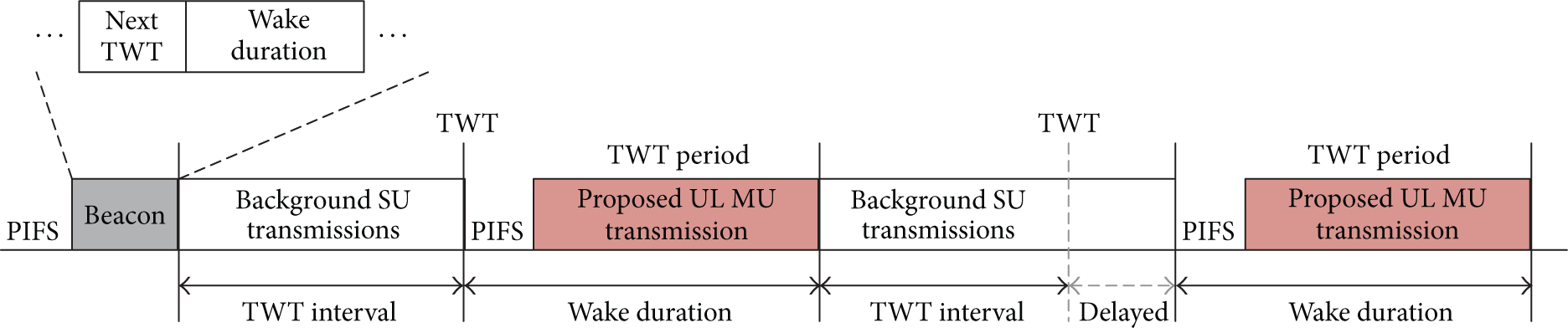
Medium access of UL MU procedure.
3. Numerical Analysis
In this section, analytical modeling of both the basic RA TF-based uplink OFDMA transmission of IEEE 802.11ax and the proposed two-staged IEEE 802.11ax uplink OFDMA transmission scheme is provided in terms of mean transmission delay and network throughput.
3.1. The System Throughput of IEEE 802.11ax
As described in the previous section, it is assumed that AP periodically triggers multiuser uplink OFDMA with TF (denoted as MU), and IoT devices, which are active at the current TWT period, participate uplink MU transmission. Between TWTs, AP and other non-IoT devices perform single user transmission (denoted as SU) independently, which is a conventional DCF transmission, as a background traffic. In order to guarantee the higher priority of uplink MU transmission than other SU transmission at any given TWT, we propose to use PIFS without backoff for the AP's TF transmission, which is similar to the beacon transmission. Under the assumptions of the proposed scheme, each individual IoT STA does not have to choose a random backoff value for uplink transmission. Therefore, the average throughput of uplink MU procedure is not affected by the interval of incoming traffic of each STA, but it is affected by the snapshot value of the number of active STAs having uplink data. Hence, in order to reduce the complexity of mathematical modeling, we assumed a fixed number of STAs with saturated traffic. However, the number of STAs does not necessarily mean the actual number of IoT STAs in the network, but it represents the average number of active STAs among IoT STAs at the given TWT period. Assuming the TWT interval is sufficiently long so that any duration of MU transmission does not exceed the TWT interval, the system throughput of SU and MU can be defined by the time proportion of the expected throughput of SU and MU transmission. Therefore, the system throughput,

The mean access delay of a tagged STA using DCF backoff algorithm is fully derived in [10, 11]; that is,


In case of MU transmission, contrary to SU case, not only the mean access delay but also the average PPDU size of a MU transmission might vary depending on the details of MU procedure and the result of resource unit (RU) allocation. In the following subsections, therefore, we provide mathematical modeling of the proposed two-staged IEEE 802.11ax uplink OFDMA transmission scheme (denoted as MU-BSR) and compare the numerical results with the basic IEEE 802.11ax RA-based uplink OFDMA transmission scheme (denoted as MU-RA).
3.2. The Mathematical Modeling of Uplink MU-RA
In this subsection, we first derive the throughput of the basic IEEE 802.11ax RA-based uplink OFDMA transmission scheme (MU-RA). From the assumption of saturated traffic, every active IoT device participates RA triggered by AP, so the medium is occupied by MU PPDU which is the response to the RA TF with the predefined duration,

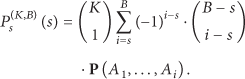
In (5),
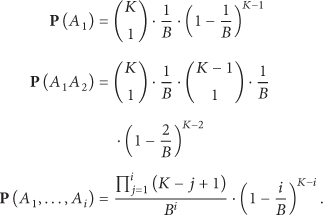
By referring to Figure 2,

The transmission time of a PPDU,

According to currently defined OFDMA numerology of 11ax [7], with expanded FFT size (from 64 to 256), each OFDMA symbol has 16 microseconds of symbol duration (


Since AP should allow the same size of RUs for any randomly accessing STAs, if we assume the same MCS level for each UL STA, then the STA index,


Applying (3), (4), and (12) to (1), the system throughput of IEEE 802.11ax with the general UL MU procedure can be obtained.
In the next subsection, the mathematical modeling of the proposed scheme (MU-BSR) is provided.
3.3. The Mathematical Modeling of Uplink MU-BSR
In case of MU-BSR, STAs cannot transmit their UL data unless AP broadcasts the result of RU allocation based on BSRs. If all STAs fail to access a RU caused by collisions, AP does not send trigger frame containing RU allocation information. Therefore, MU-BSR also has two different delay profiles, the delay of access failure case,
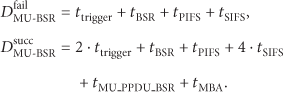
Contrary to MU-RA, the duration for UL MU PPDU,


However, as AP allocates various sizes of UL data into different integer numbers of RUs, the problem of finding

In (16),


Using (16), the expected transmission delay of MU-BSR with s successful BSRs is


Since AP does not limit the amount of UL data for each STA in the proposed scheme, the expected value of the effective UL data with s successful attempts is

3.4. p-Persistent RA
In order to achieve the maximum throughput of RA, the number of accesses must be the same as the number of accessible RUs. It is widely known that the maximum throughput of slotted-ALOHA is achieved when the traffic load is equal to 1 as shown in Figure 5 where the vertical axis is the expected number of successful accesses [12]. Therefore, if K STAs are currently active with UL data with B RUs being allowed for random access, then the optimal transmission probability,


Expected number of successful accesses of IEEE 802.11ax uplink random access (B: 9).
Applying the proposed p-persistent rule to MU-RA and MU-BSR, the active STAs must pass a Bernoulli trial with the estimated probability

Therefore, by replacing
4. Performance Evaluation
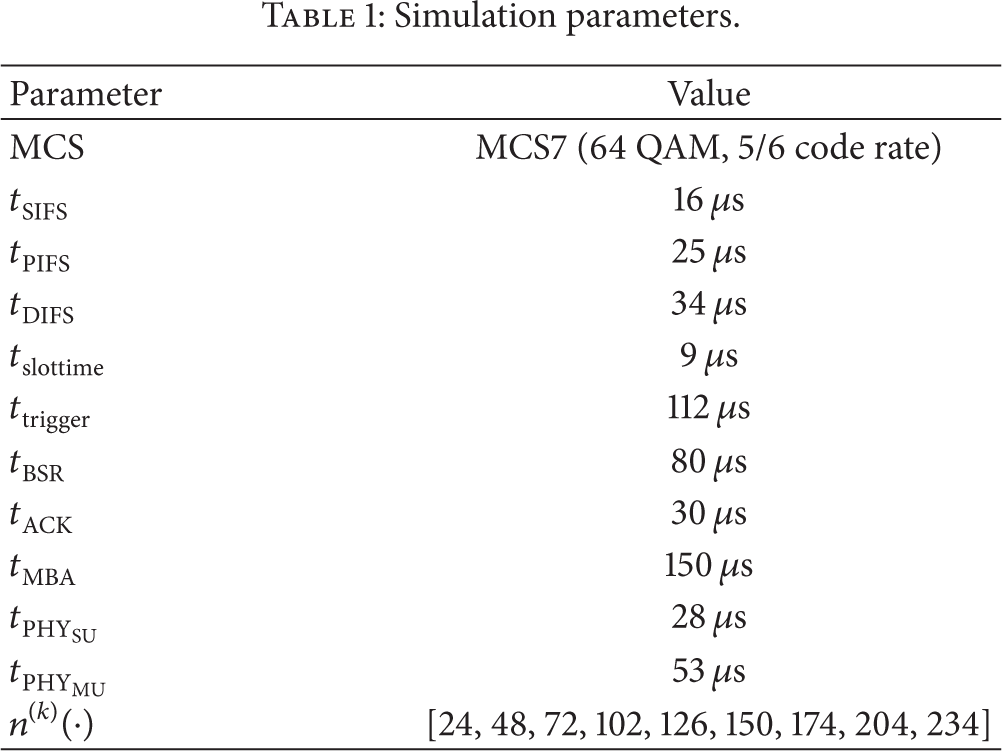
The objectives of this section are verifying the mathematical models provided in the previous section with simulation and studying how the characteristics of the MU transmission of IEEE 802.11ax vary with networks parameters, such as the number of active STAs and the data sizes. We built a MAC level simulator for IEEE 802.11ax for the simulation using MAC and physical parameter values, listed in Table 1, fully complying with the simulation scenario of IEEE 802.11ax [13]. In the simulation, all STAs have saturated traffic with uniformly distributed data size, and one 20 MHz channel with 9 RUs is considered. First the system throughput modeling in Section 3 is verified with the simulation.
Simulation parameters.
Although the system throughput model combined with background traffic is provided by (1), only MU transmission without background traffic is considered in this section. Because AP does not participate in medium contention for triggering MU transmission following the proposed MU procedure and IoT devices only transmit their data during the scheduled TWT durations as mentioned in Section 2, the MU traffic is independent of the background traffic. Thus, background traffic can be eliminated from the simulation to show the effective performance enhancement and the characteristics of the proposed UL MU scheme clearly.
The system throughput values from the simulation and the numerical values using the equations derived in Section 3 are compared with an increasing number of active STAs in Figure 6, in which four different cases are plotted. The first case is the proposed scheme with the optimal transmission probability,

Validation of the numerical analysis on the system throughput (
Figure 7 depicts the effective throughput of MU-RA and MU-BSR with an increasing number of active STAs. The throughput of DCF-based conventional SU transmission of IoT devices with the same transmission parameter values is also depicted in Figure 7 for the control group of the performance evaluation. The results show that the throughput of the proposed MU-BSR scheme outperforms the throughput of MU-RA, regardless of the number of active STAs and the range of data size. This implies that the gain from reducing the amount of padding by RU allocation is greater than the overhead increase (BSRR and BSR). In particular, as the data size increases, the gap between the MU-BSR and MU-RA also increases, because the airtime of data transmission dominates the overall transmission delay compared to the protocol overhead when transmitting large-sized data. Thus, the throughput loss that comes from inefficient use of resource is further emphasized.

Expected throughput of IoT STAs using the proposed MU schemes with different ranges of IoT traffic sizes.
As shown in Figure 7(a), the proposed scheme shows better performance with relatively small-sized data (
Since DCF is able to adapt to network congestion through exponential backoff, the overall network throughput can be maintained as the number of active STAs increases, while the probability of successful BSR could only continue to drop to zero, which explains the reason for the throughput reversal. However, the multichannel operation of IEEE 802.11ax supports 160 MHz channels with up to 72 RUs, and the expected number of successful accesses increases with the increased number of RUs, while the medium access delay of DCF is not affected by the channel bandwidth. Thus, the range of the number of active STAs can be expanded with the multichannel operation of IEEE 802.11ax, which guarantees the proposed scheme has better MU capability.
Figure 8 shows how the transmission probability

System throughput with the optimal and an imperfect transmission probability,
5. Conclusion
We have proposed a novel and energy efficient Internet of Things (IoT) communication scheme for next generation Wireless Local Area Network (WLAN) in this paper. MU-BSR is a random access-based WLAN uplink OFDMA transmission scheme that allows multiple access for a large number of IoT devices with a very short MAC access delay, and the proposed scheme is able to dynamically adjust the number of contending users by uniquely applying congestion status in a very simple and distributed manner. We have also provided mathematical models of the proposed scheme and the newly defined MU procedure of IEEE 802.11ax. Our simulation, which fully complies with the simulation scenario of IEEE 802.11ax, has shown that the proposed scheme can support a greater number of IoT devices and has low power consumption.
Footnotes
Competing Interests
The authors declare that they have no competing interests.
Acknowledgments
This research was supported through the Institute for Information & Communication Technology Promotion (IITP) funded by the Ministry of Science, ICT & Future Planning (R0166-16-1030).