




Abstract
The emergence of fifth generation networks opens the doors for Internet of Things environment to spread widely. The number of connected devices to fifth generation networks is expected to increase to more than 1.7 billion users by 2025. Each year, millions of modern devices go online at the beginning of the school year and after the holidays, and you can even notice the publicity of Internet of Things devices swinging with the seasons. Nowadays, these devices are considered to be very important to our daily life. That is because they provide power to our homes, organize our work operations and let communications more suitable. As a result of the increasing number of connected devices to fifth generation networks, the necessity to protect these Internet of Things devices against different types of cyber-attacks is also increased. For this reason, many researchers proposed different protocols and schemes to achieve the security of the Internet of Things devices. In this article, we introduce a survey of some protocols proposed by researchers in different domains and make a comparative study between them in terms of their category, authentication process, evaluation methodology, advantages, target, development year and applications within Internet of Things environment. The objective of this survey is to provide researchers with rich information about these protocols and their uses within Internet of Things systems, whether they can be used for cloud radio access networks, Internet of Things general purposes, telecommunications systems, e-healthcare systems or drone delivery service systems. It can also assist them in choosing the proper protocol to be used according to the type of their Internet of Things system.
Introduction
5G is the fifth-generation mobile broadband (MBB) network which has begun spreading among cellular phone companies worldwide since 2019. It is predicted that 4G Long Term Evolution (LTE) connection will be replaced by the 5G network, and by the year 2025, it will have more than 1.7 billion users worldwide according to the Global System for Mobile communications Association (GSMA). GSMA’s main vision is to accommodate billions of Internet of Things (IoT) devices and applications as it provides faster speed, very low latency, higher data rate and connection reliability.
Despite several advantages of using the 5G networks, it still has a big disadvantage in the context of security and privacy. The reason behind this is a huge number of devices connected to the network within a small area which increases the chance of the attack surface on these devices. This challenge motivated the researchers to look for a mechanism to protect the IoT devices and users from these attacks.
One of the researchers’ main concerns is the mutual authentication. Using 4G network and earlier, mutual authentication was considered as one of their weaknesses. 1 Mutual authentication is usually achieved when a device connects to a home network. However, if the user is roaming, the authentication can be achieved by connecting via the serving network. This allows the involvement of the serving network in the process, and consequently having an access of the device International Mobile Subscriber Identity (IMSI)/ Subscription Permanent Identifier (SUPI) (https://www.etsi.org/). In this case, IMSI/SUPI is sent in plain text (unencrypted) over radio interface, making it subject to interception and reuse.
These weaknesses in the authentication process motivated 5G network to make the authentication decision only by home network. The protocol works as follows: when a device requests authentication, the home network sends an authentication vector (a large random number) as a challenge to the device, then this device must encrypt it again as a response using a shared key, then the home network can decrypt the response and check if it corresponds to the value that was originally has been sent. This means that the device’s data in 5G network are always encrypted.
Another way of mutual authentication is called AUTH (authentication token) which is used by both 4G and 5G. AUTH allows the devices to authenticate the network using a token returned by the network and a shared key. In earlier generations, this authentication token was only encrypted over radio link. However, once a device is authenticated in 5G, the protocol decides how the traffic will be encrypted and the subsequent messages using a Subscriber Concealed Identity (SUCI) (https://www.etsi.org/) to identify the device. This traffic is encrypted throughout the whole infrastructure. The mutual authentication process is illustrated in Figure 1. In recent years, researchers have developed protocols and schemes to achieve strong mutual authentication between 5G networks and devices (User Equipment (UE)) in IoT environment, such as Authentication and Key Agreement (AKA) and Elliptic Curve Cryptography (ECC) protocols. In this article, a survey on some of these mutual authentication protocols with a comparison between them is introduced.

Simple mutual authentication process.
These days, a huge number of cyber-attacks in IoT environment due to the increasing number of new connected devices to 5G networks come up with a real security challenge, which needs to be solved. 2 That motivated us in our research project to present a survey of some protocols suggested by researchers in different fields and make a comparative study between them in terms of their category, authentication process, evaluation methodology, advantages, target, development year and applications within IoT domain. The aim of this survey is to enrich researchers with precious information about these protocols and their applications within IoT fields, whether they used for cloud radio access networks (RANs), IoT general purposes, telecommunications systems, e-healthcare systems or drone delivery service systems. This survey will provide researchers with the chance to choose the convenient protocol according to the kind of their IoT system.
In this survey, we divided mutual authentication protocols into four categories, namely AKA-based, Public Key Infrastructure (PKI)-based, ECC-based and others. Each category has a separate section, that is, sections ‘AKA-based protocols’, ‘PKI-based protocols’, ‘ECC-based protocols’ and ‘Other protocols’ are dedicated to survey AKA-based protocols, PKI-based protocols, ECC-based protocols and others protocols in which we survey the protocols that do not fall into any of the previous categories. In section ‘Protocols comparison’, we made a comparison between these protocols in terms of their category, authentication process, evaluation methodology, advantages, target, development year and applications within IoT domain. Protocols in section ‘Other protocols’ have not been included in the comparison, as there is no available information specified about them in the table fields. Finally, section ‘Conclusion’ concludes the article.
AKA-based protocols
With the emergence of 5G networks, many IoT applications have appeared. These applications and the devices that rely on must be protected from cyber-attacks. Therefore, many protocols and schemes were developed to achieve the security and privacy of these devices by mutual authentication. Mutual authentication with AKA is illustrated in Figure 2.
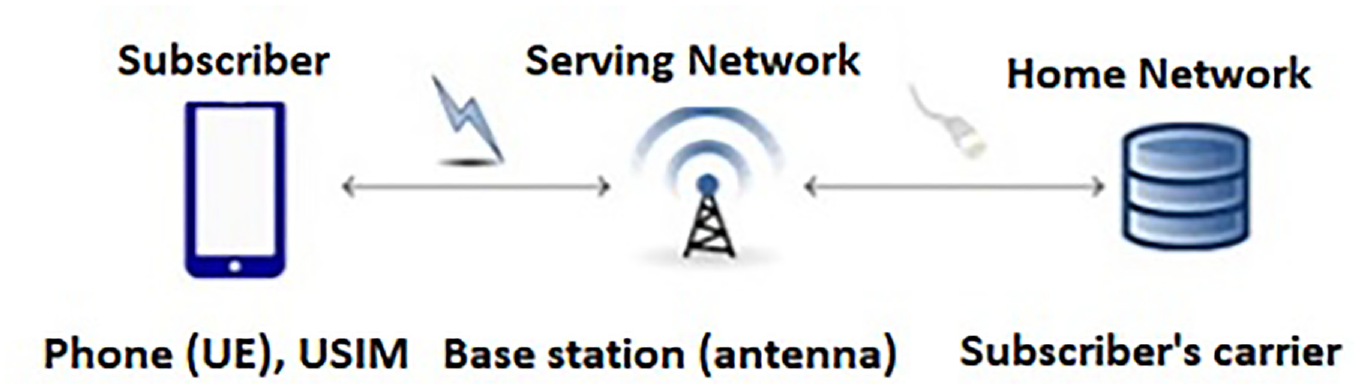
Mutual authentication with AKA.
The history of AKA protocols started with the proposal of Li et al. 3 using neural networks. After that, during the last two decades, a lot of AKA protocols incorporating both symmetric cryptography as in Kumar and Om 4 and asymmetric cryptography as in Xu et al. 5 have been proposed. Recently, many researches developed authentication protocols to resolve a specific problem, whereas some of them introduced critical deficiencies in the existing literature, developing a break-fix-break chain.
In 2020, Zhang et al. 6 proposed a Flexible and Anonymous Network Slicing (FANS) method for cloud RAN to enable authentication of emerging 5G service. FANS is basically based on AKA protocol to achieve mutual authentication between the user’s equipment and the chosen network slice. It provides users’ identity confidentiality preservation by hiding the public key associated with the actual user’s identity in the transmitted messages. Fine-grained network slice selection is realized based on the one-to-many matching technique which is used in anonymous attribute-based encryption. This method has been evaluated using security and performance tests.
Haq et al. 7 provided a comparison of Ying-Nayak’s protocol, 8 which is ECC-based, and their proposed protocol and improved a multi-server authentication protocol, which is called secure two-factor lightweight authentication protocol. It is AKA-based protocol. It prevents riskiness such as identity estimation, password estimation and user exemplification attacks. They got rid of the shortcoming in Ying-Nayak’s protocol in context of computation and communication and provided mutual authentication between the user and service-providing server. This protocol has several advantages such that it prevents all known attacks and secure across active attacks. This protocol was tested using Burrows–Abadi–Needham (BAN) Logic and Automated Verification of Internet Security Protocols and Applications (AVISPA) tool. The results of testing show that it is effective regarding computational complexity and communication costs.
In 2020, Braeken 9 presented a new AKA protocol that is based on symmetric key and used cryptographic primitives in the Universal Subscriber Identity Module (USIM) devices. The target of this protocol is to prevent all familiar attacks, provide important privacy features, such as pseudonym, unlinkability, mutual authentication and exclusiveness. The proposed protocol did not need to use the public key encryption to hide the real identity. To ensure the mutual authentication, it needed just two communication rounds to derive a session key successfully. This protocol has been proved using RUBIN Logic.
Lee et al. 10 proposed an improved three-factor user authentication scheme that relies on mobile node, sensor node and the gateway. Their proposal aimed to resolve the security issues, which are linked with the three-factor user authentication scheme, such as not protecting from robbed mobile device attack, not inhibiting a user exemplification attack, not supplying a session key agreement and not having an emergency plan. They proved that their scheme was able to achieve mutual authentication because all three participants check the validity of one another throughout the login and authentication process. It presents attractive features for IoT environments. Also, its communication and computation costs are proper for excessively low-cost IoT devices.
Another deployment of AKA-based protocols took place in e-healthcare. In which a surgeon has the benefits of Tactile Internet to perform a surgery for patient using some control actions via a robotic system and receiving a haptic feedback. However, if unauthorized access to the robotic system happened, that would lead to some fault in the procedures of surgeries, and eventually, causing havoc or even death. So, Kamil and Ogundoyin 11 developed a mutual AKA protocol for Tactile Internet-assisted remote surgery application. The remote surgeon asks to access the robotic arms through the gateway, after the gateway authenticates the remote surgeon, it sends a message to the robotic arm, then the robotic arm validates the message and returns a verification response to ensure the authentication process. Their protocol is considered very lightweight; for this reason, it is suitable for ultra-low latency-sensitive Tactile Internet-based applications. It was proved using Real-Or-Random (ROR) model, AVISPA tools and BAN Logic. Practical simulations show that it is very effective and appropriate for actual deployment.
In cellular network, handling the connectivity of the UE and devices with the networks is one of the main concerns in networks domain since the rapid growth of the number of IoT devices which needs authenticating and controlling access to the network. To manage the authentication and access control (AAC) of these devices, Behrad et al. 12 proposed Slice-Specific Authentication and Access Control (SSAAC) mechanism which delegate the AAC to third party by implementing fully virtualized mobile network. These mechanisms achieved by defining new RAN would be able to Host AAC functions specific to the third parties and Route the AAC requests to the corresponding third party network. When a third party device requires connectivity, it mentions its corresponding slice in its attachment request as the first step. The RAN processes the device’s request and routes it to the right network slice (or to the core network (CN) in case of an MBB user). In the second step, the RAN establishes a direct connection between the device and the corresponding network slice. Finally, the device is able to use the network. If the device is a UE, the RAN routes the attachment request to the 5G CN and the AAC is done with the 5G AKA-based AAC protocols. This mechanism reduces the connectivity load of the core network, achieves strong mutual authentication and allows the third parties to choose suitable AAC mechanisms for their constrained devices. It also supply cellular networks the chance to beat the security weakness in their AAC methods. This mechanism has been evaluated using the Open Air Interface (OAI) open-source platform. It is also tested by calculating the expected number of AAC signalling messages against the current AAC methods in cellular networks.
PKI-based protocols
PKI is a set of software and hardware tools that can perform a full range of digital certificate operations. Also, it is a specialized technology solutions and the cornerstones of digital certificate management.
One of the advanced and modern systems which is using the 5G networks is the unmanned delivery aircraft (UAV) system that works to transport goods and other things without a pilot. This system provides great assistance for faster delivery. Therefore, there are security functions that has to be enforced, which protect the aircraft and the transported goods from being lost and ensure the arrival at the right time and place. To complete the delivery process successfully, the drone must identify some information previously, such as landing spot and customer’s information, so when the customer receives the package, they will not be able to repudiate it. The other thing must be protected is the customer’s private information and any communicated data between the drone and the customer, impersonation and seizure of the aircraft. To encounter these challenges, Seo et al., 13 presented a security system using the white-box cryptography (WBC) as a software protection tool in the aircraft and the PKI as the authentication and non-repudiation method; PKI used to verify the identity of the user (home and application servers of a delivery company) and a seller by sharing the authentication token of each delivered item. They compared the white-box encryption (WBE) algorithm with Rivest–Shamir–Adleman (RSA) 14 algorithm and the results showed that WBE outperformed RSA encryption 6.7 times and thus can consumes less energy than RSA. Experimental results show that this security framework is efficient regarding cost according to resource utilization and appropriate even for resource-restricted UAV. Another security issue in using 5G networks is Insecure Connection Bootstrapping in Cellular Networks. Base station is the intermediary between the mobiles and the core network; when bootstrapping the connection, the mobile will be connected to the base station without any authentication mechanism and that will allow the fake base stations to make a connection with device and launch its attacks. This motivated the Hussain et al. 15 to propose an efficient authentication mechanism based on PKI which allows the cellular device to mutual authenticate the base station when bootstrapping by computing the signature of the core network and mobility management entity (MME) offline and share this signature with the base station when boot it up. Evaluations by a real testbed show that this mechanism executes superior than a symmetric key-based scheme (i.e. TESLA) regarding security warranty, overhead and deployment restrictions.
ECC-based protocols
The history of the ECC started in 1985 by Neal Koplitz and Victor Miller. 14 It is a way to crypt the public key using algebraic structure of elliptic curves. The main advantage of ECC is that it allows to create smaller key size with the same security level of the RSA system, which reduces the storage and transmission requirements.
In 2017, Kumar and Om 16 proposed an ECC scheme based on USIM to manage the handover between the heterogeneous networks and achieve the integration among them, such as 5G and wireless local-area network (WLAN). Thus, it can provide the users with seamless connection during handover and reduce the latency to reach the required network. During the handover process, the devices must be re-authenticated to the network that finally will be connected with. The proposed ECC scheme achieved the mutual authentication for heterogeneous networks; when the device converts to new network, it gets the public key of the accessed point from the current base station or the target accessed point. This scheme has been examined using the BAN Logic, and the results indicated that it can provide strong security and superior implementation regarding computation, power and storage costs.
In 2021, Ayub et al. 17 proposed an ECC protocol to protect the medical data of patients from hacking and tampering. The target of this protocol also is to block some huge attacks, such as user pseudonym, offline password assessment, representation and robbed smart card attacks. Their protocol was based on three factors of authentication (the smart card, password and biometrics). Using this protocol, only the legitimate user and service provider can calculate the authentication key, then they make sure that both keys are equal. Therefore, the protocol provides mutual authentication. This protocol has been proved using the Random Oracle Model (ROM). Evaluations indicated that it is superior to many available protocols regarding computation and communication costs. It is also active, powerful and secure.
Other protocols
As we mentioned before, many IoT applications have appeared. Samaila et al. 18 discussed some of these applications (Smart Environmental Monitoring, Smart Healthcare, Smart Firefighting, Smart Manufacturing, Smart Wearables and Smart Toy) and the security threats for each domain. Then, they introduced some security countermeasures for it in general. Their study was not intended to serve or propose any security protocol. They introduced the IoT Hardware Platform Security Advisor (IoT-HarPSecA) framework. This framework is used from the manufacturer companies in the design of the IoT devices regardless of the used application. When the user of the IoT device inserts the query, which consists of three components (system resources, system model and security requirements), the security manager of the framework will look into the system resources and system model and design the suitable security services for the security requirements. The framework is still under development.
Shaik et al. 19 proposed a comprehensive study about the vulnerabilities in 4G and 5G cellular access network protocols by discussing the devices’ capabilities which can be exposed by the attackers, unless it is securely protected. They used actual devices (more than 30), networks and operators (20 operators over LTE network).
Long-Range Wide-Area Networks (LoRaWANs) are operated by private organizations and companies. It is designed to optimize low-power wide-area networks (LPWANs) in term of battery lifetime, capacity, range and cost. It provides secure solutions to protect the companies and their customers from cyber-attack. However, it does not guarantee the trust of the network operators, as the customer needs to be sure that their information is not tampered. Therefore, Lin et al. 20 built a blockchain in the layers of LoRaWANs. Whereas blockchain is a distributed database which record and save every transaction that will be executed and shared between all participants. In addition, the information for each transaction will be verified from all participants in the system. This integration between LoRaWAN and blockchain builds an open, trusted, decentralized and tamper-proof system.
Many applications are developed in the context of saving human life, especially, healthcare as we mentioned earlier, but we have another domain that needs to be focussed on, in order to help saving lives, which is accidents risk. To avoid that, researchers developed Vehicular ad hoc networks (VANETs), which are composed of vehicles equipped with communication and computing equipment and roadside infrastructures. This system informs the drivers about the traffic status to avoid traffic jam, and if the distances between vehicles were less than needed or the vehicle takes the off road to take the suitable action. Messages between vehicles and the system and the vehicles themselves are easily hacked; so, to avoid fake messages, Cui et al. 21 proposed a mutual authentication scheme to ensure that the messages are sent from actual vehicles and not a fake one. The process of authentication is achieved when the driver gets the verification of his fingerprint, then the vehicle gets the authentication code from the system, after that the vehicle will be allowed to send messages to other vehicle or any other roadside unit connected with the system. In their scheme, they did not use the bilinear pairs to reduce the overhead of the system. They proved that their scheme is tamper-proof, free from side-channel attack, confidentiality of message, unlinkable and not traceable.
Identity management of IoT devices is one of the main concerns in IoT environment. In 2018, Santos et al. 22 introduced a solution for identity federation by reusing the SIM card of the cellular IoT devices to enable an authenticated single sign on. To achieve this goal, the networks must be provided with identity provider (IDP) which acts like a bridge between the IoT applications and the network server. When the device asks to access the network, the IDP checks if the device is registered in any serving node, if yes, then the device is successfully authenticated. Otherwise, it could be an attack.
Protocols comparison
In this section, a comparison between the proposed protocols (AKA, PKI and ECC) was presented, which are introduced in the literature review, in context of category, authentication process, evaluation methodology, advantages, target, development year and applications within IoT environment. Table 1 illustrates this comparison
AKA-, PKI- and ECC-based protocols comparison over 5G networks.
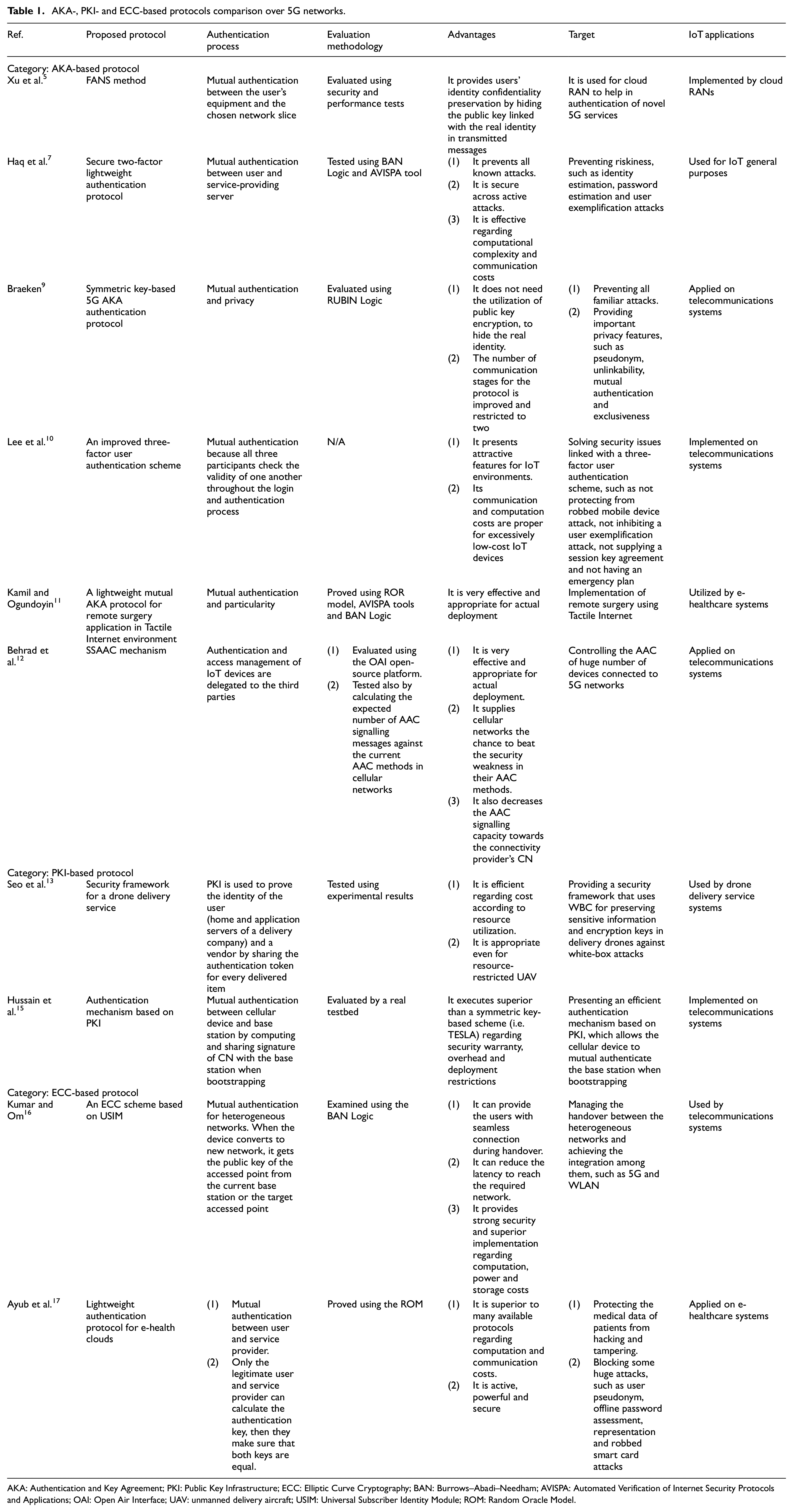
AKA: Authentication and Key Agreement; PKI: Public Key Infrastructure; ECC: Elliptic Curve Cryptography; BAN: Burrows–Abadi–Needham; AVISPA: Automated Verification of Internet Security Protocols and Applications; OAI: Open Air Interface; UAV: unmanned delivery aircraft; USIM: Universal Subscriber Identity Module; ROM: Random Oracle Model.
In general, AKA protocols have been searched for long time, and a lot of efforts have been done to make them lightweight in terms of costs, computation and communication. This leads to be used widely within IoT environment for general purposes. So, as we notice in Table 1, AKA protocols are the most used protocols among the other protocols, while PKI protocols are considered very strong in terms of security with relatively high computation and communication. As a result, this leads these protocols to be used within high-risk IoT systems, such as drone delivery service systems. ECC protocols are relatively small and fast in comparing with the other protocols according to its computation and communication. Therefore, they are suitable for IoT systems, which require speed in its performance, such as the telecommunications and e-healthcare systems.
Conclusion
Due to the growing number of new connected devices to 5G networks in IoT environment, large number of distinct cyber-attacks against these IoT devices appeared as a real security problem, which require to be solved. For this reason, we motivated in our research to introduce a survey of some protocols provided by researchers in distinct fields to solve this security challenge. We made a comparative study between them in terms of their category, authentication process, evaluation methodology, advantages, target, development year and applications within IoT field. The goal of this survey is to supply researchers with worthy information about these mutual authentication protocols and their uses within IoT domain, whether they can be used for cloud RANs, IoT general purposes, telecommunications systems, e-healthcare systems or drone delivery service systems. We recommend researchers to benefit from the valuable information, which introduced in this research because it will provide them with the opportunity to find the adequate protocol to protect their IoT system. In fact, AKA protocol was the most widely used one compared to other protocols for its low costs of computation and communication. In future works, we may shed the light on AKA-based protocols in real IoT environments for intensive evaluation, with more comparative features between them.
Footnotes

Handling Editor: Peio Lopez Iturri
Declaration of conflicting interests
The author(s) declared no potential conflicts of interest with respect to the research, authorship, and/or publication of this article.
Funding
The author(s) received no financial support for the research, authorship, and/or publication of this article.