




Abstract
The fault diagnosis of vibration exciter rolling bearing is of great significance to maintain the stability of vibration equipment. When the crack fault of the bearing occurs, the effective fault feature information cannot be extracted because the fault feature information of vibration signal is interfered by the noise around the vibrator. To solve this problem, a fault feature recognition method based on genetic algorithm–optimized Morlet wavelet filter and empirical mode decomposition is proposed. The Morlet wavelet filter optimized by genetic algorithm was used to filter the vibration signal, and then the empirical mode decomposition was applied to the filtered signal. In the envelope spectrum of the reconstructed signal, the characteristic frequency of the rolling bearing crack fault of the vibration exciter could be found accurately. Through simulation and experiment, it is proved that this method can provide theoretical and technical support for the crack fault diagnosis of vibration exciter rolling bearing.
Keywords
Introduction
Vibration exciter is a kind of equipment installed on the vibrating machinery to generate periodic vibration force. It is widely used in mining, metallurgy, construction, and other fields, with the characteristics of simple structure, convenient installation, and high work efficiency. 1 The exciter studied in this article is usually used in conjunction with the vibrating screen of the coal preparation plant. The working conditions of the vibrating screen exciter are relatively bad, and the health of the bearing directly affects the service life of the vibrating screen and the dynamic stability during operation. According to incomplete statistics, only about 30% of the failures of rotating machinery are caused by rolling bearings. 2 Equipment damage will lead to production line shutdown, serious cases will occur casualties, which requires to improve the dynamic stability and service life of the vibrating screen work. Various types of faulty bearings are shown in Figure 1.

Bearing failure conditions.
When the bearing rolling body hits the fault surface of the inner and outer rolling road, the continuous impact will produce a certain regular impact response. These vibration signals may be affected by the change of transmission path between the impact fault point and the vibration signal measurement point, so that the pulse response is modulated by amplitude. 3 The vibration signals collected by the sensor usually contain noise components and other interference information, and the effective fault feature information is submerged in the noise. Especially, signals collected from the vibrating machinery are mostly non-stationary and non-linear, so the demodulation and noise reduction are two major difficulties in the fault diagnosis. 4 To solve the modulation problem, some signal demodulation methods are proposed, among which the envelopment analysis is the most widely used. However, this method needs to determine the resonance band of the signal, so it cannot be used in a noisy environment. 5
Wavelet transform is often used in mechanical fault diagnosis because of its good time–frequency resolution and transient detection ability. Since Morlet wavelet and the bearing fault signal have similar impact characteristics, Morlet wavelet filter is selected for the signal demodulation and denoising. 6
Nikolaou et al. 7 used Morlet wavelet to demodulate the fault signal which was generated when the rolling body passes through the bearing defect. And the entropy of the wavelet coefficient was discussed and analyzed in order to accurately find out the most suitable envelope factor. However, the oscillation frequency of the wavelet is fixed, so it is also important to modify the shape of the wavelet from the perspective of signal matching. To optimize the parameters of the Morlet wavelet filter, Qiu et al. 8 improved the shape factor of the wavelets using the Minimum Shannon entropy criterion, and then selected the transform scale of wavelet using singular value decomposition (SVD). IS Bozchalooi and Liang 9 used an improved resonance prediction algorithm to find the appropriate scale of Morlet wavelet. Then, the shape factor of the wavelet was determined by the minimum smoothness index. However, the above methods have the disadvantages of low efficiency and high requirements for the technical level of workers, which are not suitable for the extraction of fault feature from the vibration exciter rolling bearing signals.
When choosing the optimization method, the equilibrium between the computational quantity and the result precision must be guaranteed. Genetic algorithm (GA) 10 not only has the global optimization ability and reliable performance but also has a small amount of calculation. Zhang and Randall 11 adopted GA to optimize band-pass filter and selected the optimal filter with the maximum kurtosis as the optimization index to filter the original signal. Pi et al. 12 used an improved GA to optimize the input weight matrix and hidden layer threshold of extreme learning machine. In view of the low computational efficiency of sparse decomposition when processing the high-dimensional complex signals, Li et al. 13 adopted GAs to optimize the optimization process based on the matching pursuit (MP) algorithm to improve the efficiency of signal reconstruction. GA can quickly search out all solutions in the solution space without falling into the trap of rapid descent of local optimal solutions. Using its inherent parallelism, it can easily perform distributed computing and speed up the solution. In order to highlight the characteristic frequency components of bearing faults, this article adopts the minimum Shannon entropy 14 as the criterion to optimize the center frequency and the bandwidth of Morlet wavelet filter using GA.
Although the optimized Morlet wavelet filter can improve the signal-to-noise ratio (SNR), the noise component within the determined bandwidth of the filter is not eliminated. Especially when the noise is large, the SNR of the filtered signal will not be significantly enhanced. IS Bozchalooi and Liang 9 removed in-band noise using spectral subtraction before the wavelet filtering. He et al. 15 used a soft threshold segmentation method called sparse coding shrinkage to further enhance pulse characteristics and suppress residual noise. But these two methods need to choose the appropriate threshold and have complicated calculation process. Tang et al. 16 proposed a diagnosis method based on the Empirical Mode Decomposition (EMD) and envelope spectrum analysis to solve the problem that the fault characteristic signal is weak, and the traditional envelope analysis needs to rely on experience to determine the analysis frequency band in the early fault diagnosis of hydraulic pump. Meng et al. 17 use an EMD algorithm to extract the characteristics of the rolling bearing vibration signals of wind turbines. F Liu et al. 18 use the Complementary Ensemble Empirical Mode Decomposition (CEEMD) and Linearly Decreasing Particle Swarm Optimization Probabilistic Neural Network (LDWPSO-PNN) methods to analyze and compare the vibration signals of rotating machinery. To further enhance the impact feature information of the signal and reduce the residual noise, the EMD method is further used to reprocess the signal filtered by the optimized Morlet wavelet filter.
Aiming at extracting the fault characteristic information of the rolling bearing of the vibration exciter, this article proposes a combined method based on the GA to optimize the Morlet wavelet filter and the EMD decomposition. And the method is applied to extract the characteristic frequency signals of the faults of the inner and outer rings of the rolling bearing.
Morlet wavelet filter optimization
Generally, the continuous wavelet transform has higher resolution than the binary wavelet transform and has more freedom in the selection of wavelet basis functions including non-orthogonal wavelet. Therefore, the continuous wavelet transform is more applicable for the fault diagnosis based on the vibration signals.19,20 Morlet wavelet has similar characteristics to the mechanical shock signals. So, the complex Morlet wavelet is used here, and its formula is as follows 7

where

According to the choice of

The wavelet presents the form of Gaussian window in the frequency domain,

The mode of the analytical result is the envelope C(t) of the band-pass filtered signal

The envelope spectrum analysis of the signal requires band-pass filtering. By optimizing the center frequency and bandwidth, it is convenient to find the best passband with the highest SNR and the most significant pulse characteristics. Criteria such as kurtosis, smoothing index, and Shannon entropy can be used for this purpose. The kurtosis is an indicator of the peak signal, a property of the pulse. The higher the kurtosis value, the higher the pulse content of the signal. However, the dependence of kurtosis on rotational speed lacks a meaningful reference, and it is too sensitive to some abnormal shocks. So, it is difficult to explain the meaning of the kurtosis value obtained by a certain test. To solve these problems, smoothing exponents are proposed. It is the ratio of the geometric mean and the arithmetic mean of the wavelet coefficients modulo. When the modulus of the wavelet coefficient is larger, the smoothing index is closer to zero, and only infinitesimal values can be obtained in numerical calculation. Shannon entropy can be used as a measure of sequence diversity. The entropy of wavelet coefficients can measure its looseness index. Here, the objective function is set as the minimum Shannon entropy of the filtered signal, as follows


where
To optimize the parameters of the Morlet wavelet filter, the following constraints need to be considered:
1. A basic wavelet must meet the allowable conditions, and it is equivalent to 21

Strictly speaking, the Morlet wavelet does not meet this zero-mean requirement. However, if

So, when
2. According to the sampling theorem, the upper limit of cutoff frequency must meet the following conditions

where
Meanwhile, the lower-limit cutoff frequency of the wavelet filter should be large enough in order to reduce the interference effect of the axial speed harmonic. So

where
3. In order to retain the impact features fully, the bandwidth of the Morlet wavelet filter is selected as

where
According to the above analysis, the optimal parameters of the Morlet wavelet filter are limited by the following conditions

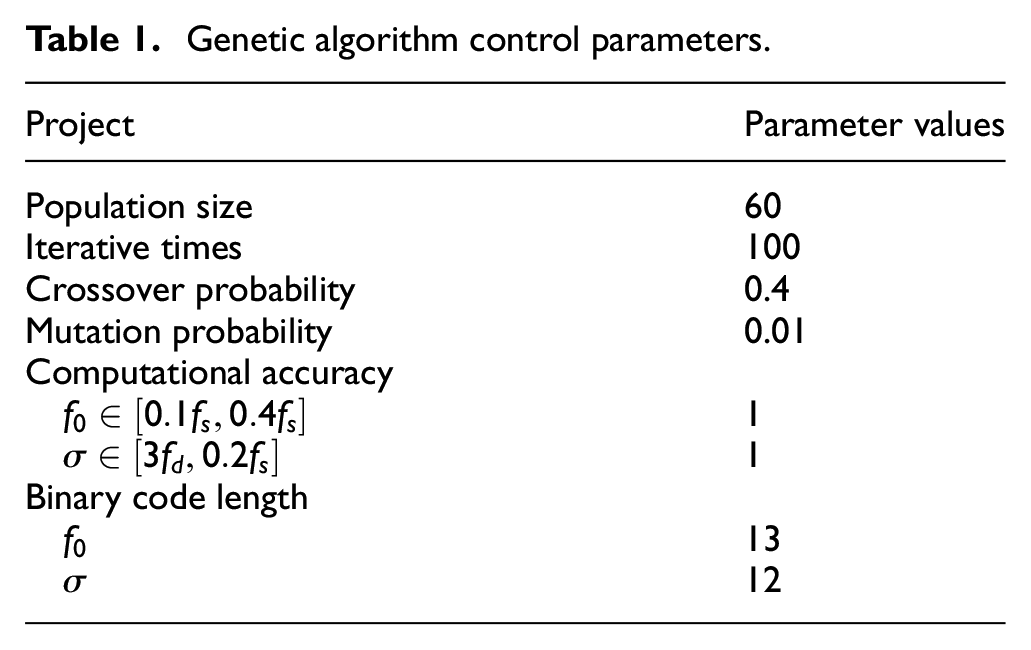
Here, the GA is used to optimize the calculation of the central frequency and the bandwidth parameters of the wavelet filter. In this algorithm, the potential solutions of the analysis problem are all in the form of chromosomes, the fitness function is an indispensable function in the GA, and its value is used to determine the potential solutions in the operation. In the entire optimization process of GA, a three-step optimization operator is used to gradually form a new generation of potential solutions, and each generation of individuals represents better and better adaptability to the living environment. Parallelism, global solution space search, and wide adaptability are among the main advantages of GA. Among them, the global solution space search effectively prevents the appearance of local optimum. In the process of GA operation, in the unit of population, all individuals in the independent variable are searched in parallel. GA can directly operate on structural objects, so it has a wide range of adaptability.
The central frequency

where
Genetic algorithm control parameters.

Flow of genetic algorithm optimization parameters.
EMD and reconstruction of filtered signal
Using GA to optimize the center frequency and bandwidth of Morlet filter can effectively eliminate some interference components. But the residual noise in the frequency band range determined by Morlet wavelet filter is not eliminated. Therefore, EMD is performed on the filtered signal to further suppress noise.
Principles of EMD
EMD decomposes a non-linear non-stationary signal into a set of intrinsic mode function (IMF) components and the sum of residual terms. For any signal
1. Determine all local extreme points of the signal.
2. The maximum and minimum points of the local extreme are connected by cubic spline curve to form the upper and lower envelope
3. Calculate the average of the upper and lower envelopes

4. Calculate the difference between the signal

5. Test whether

where

where
(6) Calculate the first residual signal

where

The screening process is stopped when the residual signal
The signal

where
Sensitive IMF reconstruction
After the decomposition of the vibration signal, a set of IMF was got. Some of them are sensitive components related closely to the fault, while some are other interference components that are unrelated to the fault. Therefore, it is necessary to screen out sensitive IMF before envelopment analysis of IMF to improve the accuracy of fault feature information extraction.
The kurtosis K reflects the numerical statistics of the distribution characteristics of the vibration signal. From a time-domain perspective, when the kurtosis values of some IMF are large, it indicates that these IMFs contain more impact components, which means the more fault impact components after the original signal decomposition is retained in these IMFs

where
In this article, we used the kurtosis criterion to screen the IMF, and the IMF component with K > 3 is used for the envelope spectrum analysis.
Through the envelopment analysis, if fault feature information and double frequency components can be seen obviously, that means there are more fault feature components in these regions. That is, in the case of more fault feature components, there are higher kurtosis values both in the time domain and in the envelopment spectrum. The envelopment formula is

where
Analysis of simulation signal
To construct the simulation signal of vibration exciter rolling bearing with crack fault. fn represents the inherent frequency, and fn =4500 Hz. y0 represents the displacement constant, and y0 = 3. g represents the damping coefficient, and g = 0.1. t represents the impact period, and t =0.02 s. fs represents the sampling frequency, and fs =25,600 Hz. N represents the sampling points, and N = 25,600. So, the expression is shown as

where
Figure 3(a) shows the time domain and the spectrum of the simulation signal of the faulty bearing. Figure 3(b) shows the envelopment spectrum of the simulation signal of the faulty bearing, which can be seen that it contains a lot of noise. Thus, the noise-containing signal is filtered through the optimal wavelet filter optimized by the GA, with the central frequency f0 =4570 Hz and the bandwidth σ =5040 Hz. Figure 3(c) shows the amplitude spectrum of the optimal Morlet wavelet filter. Figure 3(d) shows the filtered signal, and the periodic impact feature information can be vaguely seen, but the noise in this frequency band is still obvious. Figure 3(e) shows the corresponding envelopment spectrum, where the background noise is seen in this band. The filtered signals are decomposed by EMD to obtain six IMFs, and the kurtosis value of each IMF component is compared. The IMF components whose kurtosis value is greater than 3 are reconstructed, because they retain more shock feature information from the original signal. Envelope analysis is conducted on the reconstructed signal. From Figure 3(f), it can be clearly seen that the bearing fault characteristic frequency 50Hz and its frequency doubling appear, and most burrs unrelated to the bearing fault frequency are almost eliminated.
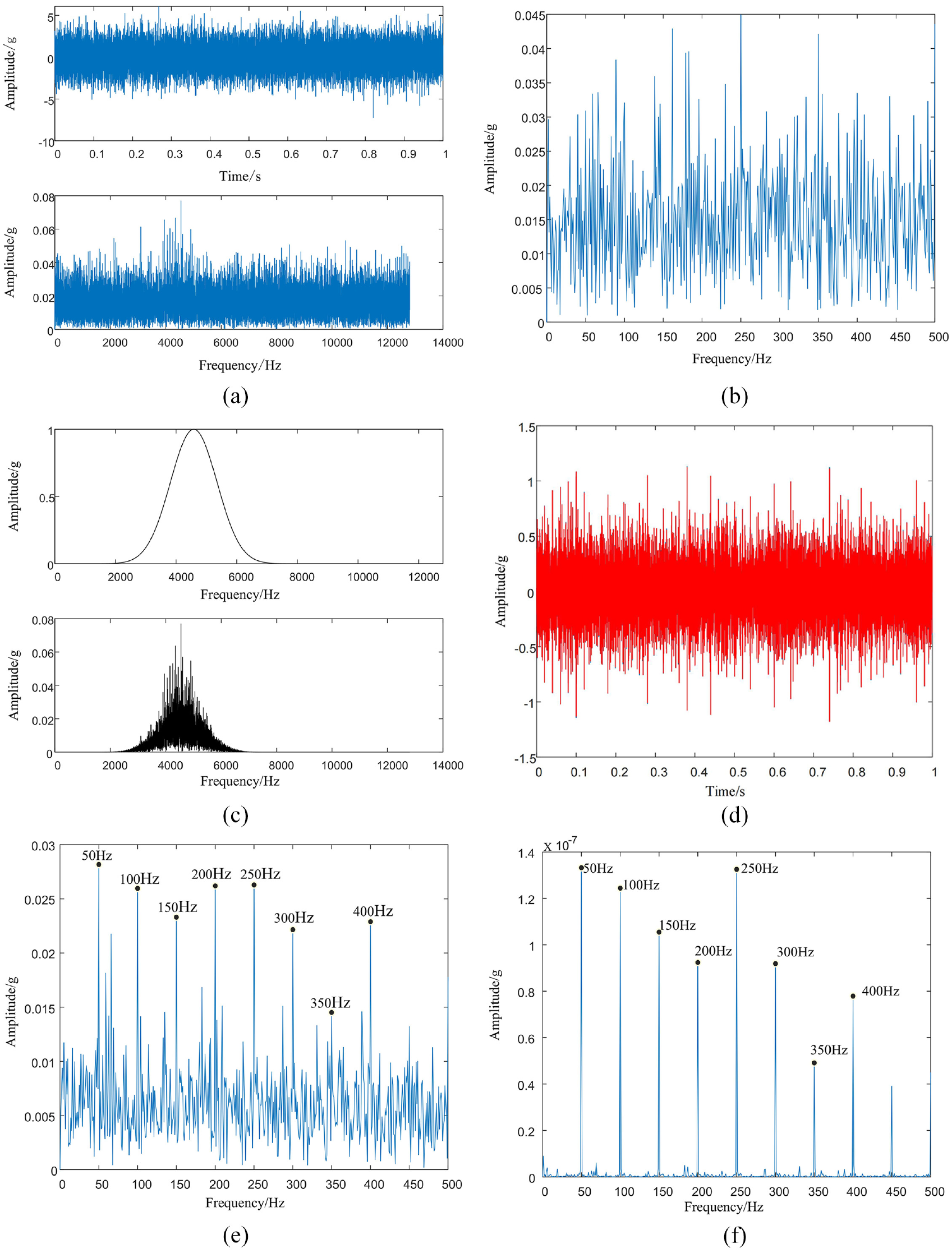
Processing result of bearing fault simulation signal. (a) Time and frequency spectrum of fault bearing simulation signal. (b) Envelope spectrum of signal in Figure 3(a). (c) Amplitude spectrum of Morlet wavelet filter. (d) Time-domain diagram of filtered signal. (e) Envelope spectrum of filtered signal. (f) Envelope spectrum of reconstructed signal.
Experimental analysis
In order to verify the fault diagnosis accuracy of above theoretical algorithm, the YKZ-1055 vibration exciter with two 1305 spherical roller bearings is selected as the object for experimental research. The experimental platform is shown in Figure 4. The shaft speed is 960 r/min. The theoretical value of the bearing fault feature frequency can be calculated according to the bearing parameters in Table 2. So, the feature frequency of outer ring fault and inner ring fault is 77.5 and 114.5 Hz, respectively.

Experimental platform of vibration exciter.
Bearing parameters.

Analysis of outer ring crack fault
The time-domain diagram and spectrum diagram of the signal when the bearing roller passes through the outer ring crack fault are shown in Figure 5(a). The envelope spectrum of the fault signal is shown in Figure 5(b). The impact feature of vibration signal is not obvious; it is difficult to find the outer ring fault frequency 77.5 Hz directly from the envelope spectrum. The center frequency of Morlet wavelet filter optimized by GA is f0 = 3701 Hz, and the bandwidth is σ = 3266 Hz. The amplitude spectrum of the band-pass filter is shown in Figure 5(c). The impact feature information can be seen from the time-domain plot of the filtered signal in Figure 5(d). The envelope spectrum of the filtered signal is shown in Figure 5(e). The outer ring fault frequency of 78 Hz and its frequency doubling can be found, but the amplitude of other frequencies is also large. In order to highlight the fault feature information more clearly, the EMD algorithm is applied to reconstruct the IMF components with the kurtosis values greater than 3, and the envelope spectrum of the reconstructed signal is shown in Figure 5(f). It can be found that the outer ring fault frequency of 78 Hz is more prominent, indicating that there is a fault in the outer ring of the bearing, and other components unrelated to the feature frequency of the bearing fault almost disappear.

Processing result of outer ring crack fault signal. (a) Time-domain diagram and frequency spectrum diagram of outer ring crack fault signal. (b) Envelope spectrum of outer ring crack fault signal. (c) Amplitude spectrum of Morlet wavelet filter. (d) Signal filtered of outer ring crack fault. (e) Envelope spectrum of filtered signal. (f) Envelope spectrum of reconstructed signal.
Analysis of inside track crack fault
The time-domain plot and spectral diagram of the signal are shown in Figure 6(a) when the bearing roller passes through the inside track crack fault. The envelope spectrum of the vibration signal is shown in Figure 6(b). It is difficult to directly identify the inside track fault frequency of 114.5 Hz from the envelopment spectrum. The center frequency of Morlet wavelet filter optimized by GA is f0 = 3767 Hz and the bandwidth is σ = 4033 Hz. The amplitude spectrum of the band-pass filter is shown in Figure 6(c). From the time-domain plot of the filtered signal in Figure 6(d), the impact feature becomes apparent and is improved compared with the original signal. The envelope spectrum of the filtered signal is shown in Figure 6(e), where the inside track fault frequency of 114 Hz and its frequency doubling can be found, but the amplitude of the other frequencies is also large. The EMD algorithm is applied to reconstruct the IMF components with the kurtosis values greater than 3, and the envelope spectrum of the reconstructed signal is shown in Figure 6(f). It can be found that the inside track fault frequency of 114 Hz is more obvious, indicating that the inner ring of the bearing is faulty, and other components unrelated to the bearing fault feature frequency almost disappeared.

Processing result of inside track crack fault signal. (a) Time-domain diagram and spectrum diagram of inside track crack fault signal. (b) Envelope spectrum of inside track crack fault. (c) Amplitude spectrum of Morlet wavelet filter. (d) Signal filtered of inside track crack fault. (e) Envelope spectrum of filtered signal. (f) Envelope spectrum of reconstructed signal.
Comparison with variational mode decomposition algorithm
As an adaptive signal processing method, the core of variational mode decomposition (VMD) is the variational problem, which minimizes the estimated bandwidth of each mode. Compared to the EMD decomposition method, the variable mode decomposition redefines the components and considers each component as a simple amplitude modulation (AM)–frequency modulation (FM) signal. 22
The variable mode decomposition method is to decompose the given signal
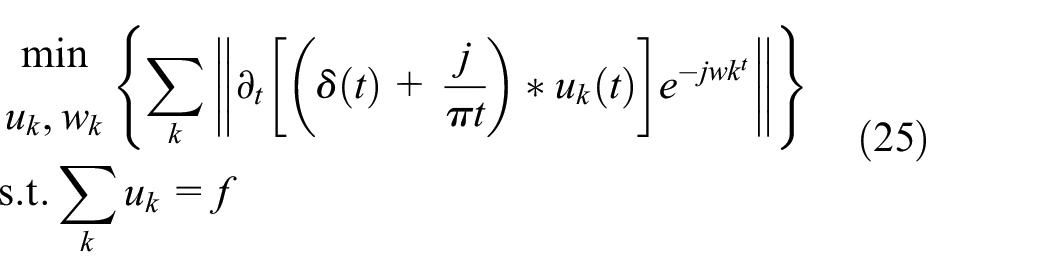
where
The Lagrange penalty operator brings in the equation to find the optimal solution of the model

where
The collected internal and external circle crack fault signals were processed by VMD to obtain five IMF components, as shown in Figure 7(a) and (c). The two IMF components with the largest kurtosis values were reconstructed. The envelope spectrum was obtained by the Hilbert transformation, as shown in Figure 7(b) and (d), respectively. It can be found that the fault feature frequency of the outer ring of the bearing is 77.34 Hz and that of the inner ring is 114.1 Hz, respectively. However, more noise components still exist compared to those of Figures 5(f) and 6(f).
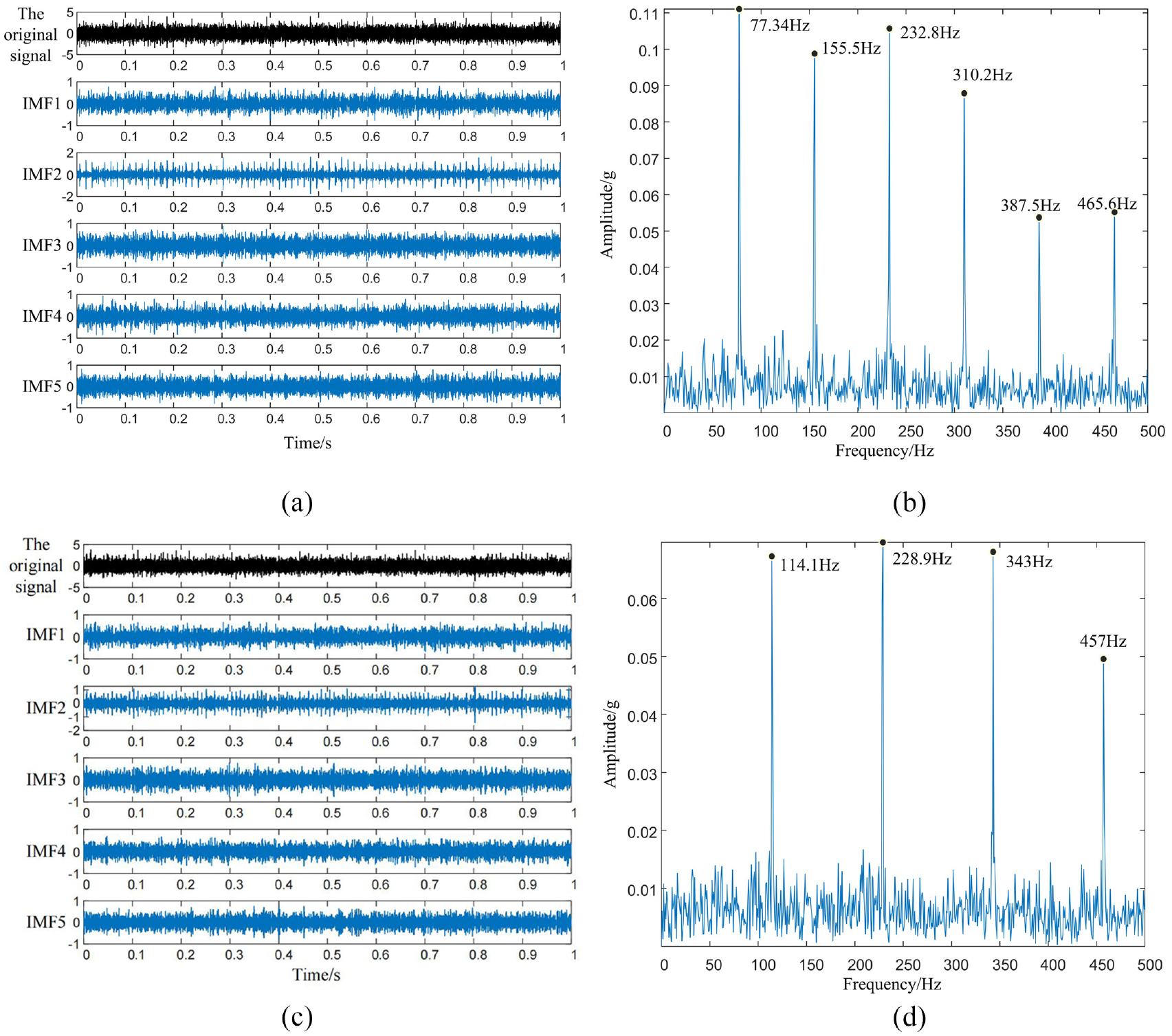
Processing effect of VMD algorithm. (a) VMD decomposition diagram of outer ring crack fault signal. (b) Envelope spectrum of reconstructed signal. (c) VMD decomposition diagram of inside track crack fault signal. (d) Envelope spectrum of reconstructed signal.
In order to quantitatively study the noise reduction performance of the two methods, this article uses the SNR and the mean square error as indicators to quantitatively evaluate the noise reduction performance which are shown in Tables 3 and 4. The comparison results show that the proposed algorithm has better effect on filtering and noise reduction.
Outer ring noise reduction results comparison.

VMD: variational mode decomposition; SNR: signal-to-noise ratio; GA: genetic algorithm; EMD: empirical mode decomposition.
Inner ring noise reduction results comparison.

VMD: variational mode decomposition; SNR: signal-to-noise ratio; GA: genetic algorithm; EMD: empirical mode decomposition.
Conclusion
To eliminate the noise interference around the vibration exciter, the fault feature recognition method of vibration signals based on GA-optimized Morlet wavelet filter and EMD is proposed. Through the analysis of simulation signals and actual fault signals of vibration exciter rolling bearing with the crack fault, the following conclusions can be drawn:
The optimized Morlet wavelet filter based on GA-optimized Morlet wavelet filter and EMD can eliminate most of the noise interference in the working environment of vibration exciter. So, the fault feature information of inner and outer ring of rolling bearing with the crack fault can be extracted effectively.
Compared with the common VMD method, the method proposed in this article has more effective extraction effect on the crack fault feature information of vibration exciter rolling bearing under strong noise background, and the noise reduction effect is better.
Footnotes
Handling Editor: Peio Lopez Iturri
Declaration of conflicting interests
The author(s) declared no potential conflicts of interest with respect to the research, authorship, and/or publication of this article.
Funding
The author(s) disclosed receipt of the following financial support for the research, authorship, and/or publication of this article: This work was supported by the Key Discipline of Mechanical Engineering in Henan Polytechnic University, the National Natural Science Foundation of China (grant no. 51805166) and the Key Research Projects of Colleges and Universities in Henan Province (grant no. 22A440013).
